
About Antique Identifier
Some objects refuse to give up their secrets. A silver tray bought at an estate sale, an unmarked porcelain teacup inherited from a grandparent, a brass handle salvaged from a barn — they sit on shelves for years until someone finally asks the question every collector eventually asks: what is this, and is it worth anything?
Antique Identifier exists to answer that question.
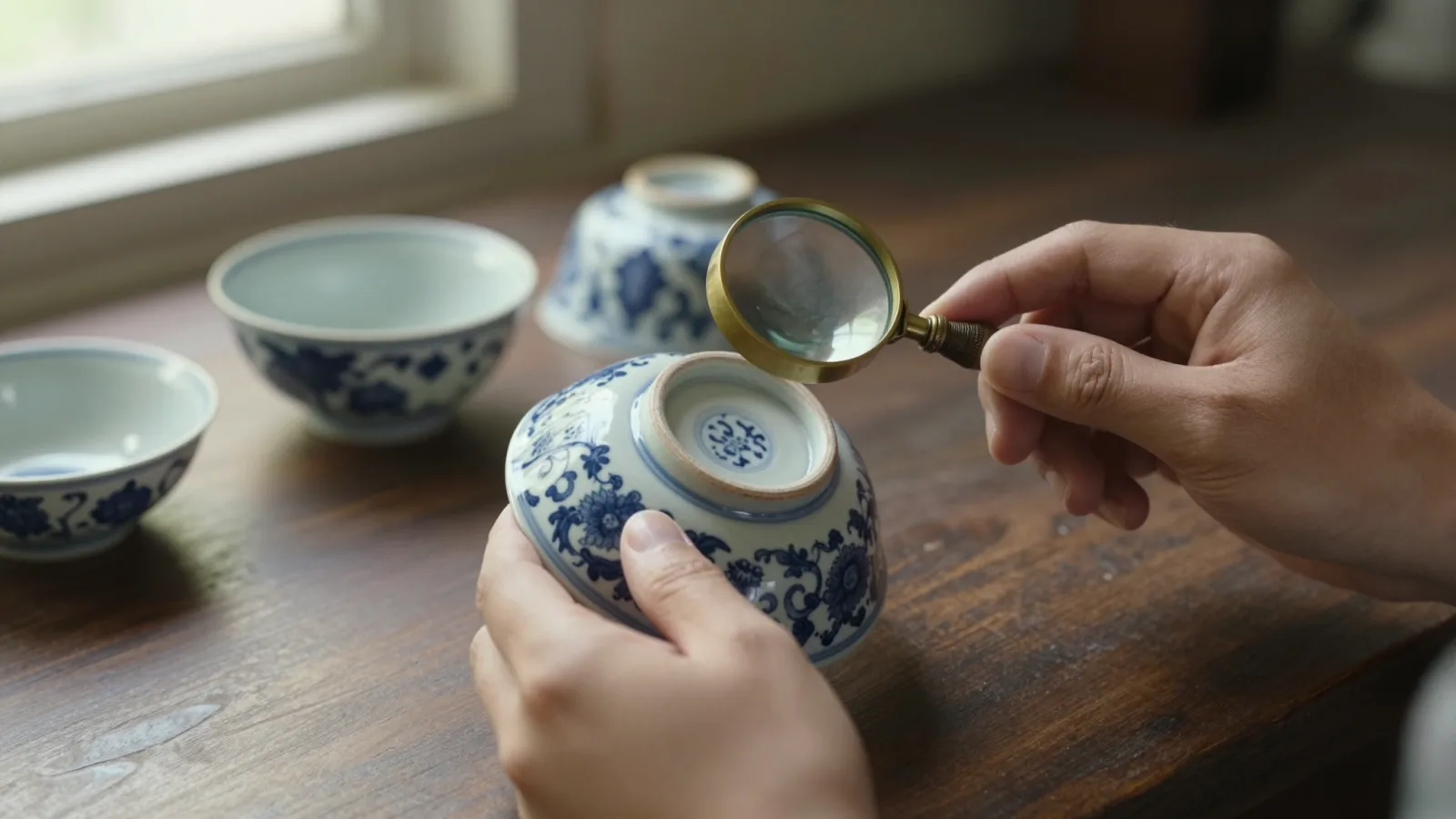
We are the editorial home of Antique Identifier – Antiqly, an AI-powered iOS app that identifies antiques from a photo and returns market value estimates pulled from real auction comparables. Snap the hallmark, the maker’s mark, the underside of the saucer — the app reads what generations of seasoned collectors had to learn the hard way.
Why This Actually Matters
Most people only think about antique identification when something real is at stake. We see the same scenarios over and over:
- Clearing out a parent’s house. Boxes of “old stuff” go to the donation truck because nobody knows that the sterling tea service inside is worth $4,000. The app stops that from happening.
- Selling on eBay or Facebook Marketplace. List a piece for $40 when it’s a $400 piece and you’ll get one bid in five minutes — from a dealer who flips it for triple. Knowing the maker, period, and comparable sales lets you price correctly the first time.
- Estate sales and thrift shop scouting. The piece is in your hand for 30 seconds before someone else grabs it. The app gives you an answer in that window.
- Inherited pieces with no story attached. The mark on the back is a clue to where it came from, who made it, and what it meant. Identification is often as much about history as it is about money.
- Insurance and downsizing. Before you give a piece away, donate it, or write it off, you should know what it is. A two-minute scan can change a decision worth thousands.
How We’re Different
There are plenty of identification apps. Most of them treat every object as a one-shot guess from a single photo. We do it differently:
- Automatic hallmark and maker’s mark detection. You don’t have to crop or zoom. Point the camera at a piece and the app finds the stamp, the punch, the foundry mark on its own — even on tarnished silver or weathered pewter.
- Multiple photos per item. A teapot has a lid, a body, a base, a spout, and a handle — each tells a different story. Most apps only let you upload one photo. We let you stack as many as you want for a single identification, so the AI sees the whole piece.
- Unlimited scans. No daily quota. No “you’ve identified 3 items, please upgrade.” Scan a whole estate sale in one afternoon.
- No ads. Ever. No banners, no full-screen popups, no “watch a video to unlock.” The app is clean and stays clean.
- 3-filter data verification. Every value estimate passes three checks: auction comparables (Heritage, Sotheby’s, Bonhams), price-guide references (Kovels, WorthPoint sold data), and condition-adjusted recent sold listings. If a number can’t survive all three, we don’t show it.
- A proprietary antique library that keeps growing. Our identification database expands every week — new makers, new patterns, new period variants — based on what real users are scanning. The app gets sharper the longer it’s in the field.
How the App Actually Reaches an Answer
We would rather explain this than let you assume it. A lot of identification apps are one photo handed to one model, and whatever comes back becomes the answer. Ours runs three independent sources of evidence and then argues them against each other. Here is the sequence, in the order it happens.
1. The photo goes out before anything is guessed
The first thing that happens to your photo is a reverse image search across the web. It returns pages showing objects that look like yours, and that gives us something no single model can produce on its own: outside evidence about the object class, the likely material and the rough period.
This matters most where the money hides. An unmarked ladle is either early American coin silver or Victorian electroplate, and the gap between those two answers is roughly twenty to one. When a dozen visual matches all point to coin silver, that agreement is worth more than any assumption about what such objects usually are.
2. Your object outranks the lookalikes
Those search results are hints, and they sit below the physical evidence. The rule is written into the system in plain language: a legible mark, hallmark or stamp describes the object in your hands, while the search results only describe things that resemble it. Where the two conflict, the mark wins and the hints are discarded.
Every photo is read at full resolution rather than a compressed preview, because the whole answer often sits in a punch a fraction of a millimetre wide. You can attach several photos to one item, and a close-up of a mark is handled as a close-up of a mark, not as another general shot.
Two habits keep this honest. A maker is named as fact only when a visible mark or an unmistakable documented pattern supports it, and otherwise the wording is attributed to or in the style of. And every identification is checked against the maker’s documented history, so a mark from a firm that closed in 1851 cannot be attached to an 1880s piece just because the shape looks right.
3. The price comes from listings that exist
Once the piece has a name, the app queries live marketplace data for comparable items, in your currency and on your regional marketplace where there is one. The figure you see is built from where those real comparables cluster, with the outliers at both ends thrown away, so one hopeful seller cannot inflate it and one mispriced lot cannot sink it.
The unglamorous detail that decides whether any of this works is whether the value-critical qualifier survives into the price search. Searching ladle returns a flea market. Searching coin silver ladle returns the right shelf. For graded coins the grading service and the grade travel with the query, so slabbed pieces are compared against slabbed pieces rather than loose ones.
Where a photograph simply cannot help
You get a range instead of a single figure because a range is what the evidence supports, and some categories deserve a wider one than others. Rather than hide that, the app labels it on the price itself.
- Gem-set jewellery. Most of the value sits in carat, clarity and cut. No photograph establishes those, so the range is wide and is marked as wide.
- Size-sensitive pieces. A charger and a saucer can carry identical marks. Rugs, plates and furniture need measuring, not photographing.
- Signatures and artist attributions. A signature can be read from an image but not authenticated from one.
The same photo returns the same answer for a week, on purpose. Two different figures for one object reads as randomness, and a number you cannot repeat is not much use to anyone.
What the App Recognizes
- Silver hallmarks — American, British, French, German, Scandinavian, including period and town marks
- Porcelain and pottery marks — Meissen crossed swords, Sèvres, Limoges, Wedgwood, Chinese reign marks (Kangxi, Yongzheng, Qianlong)
- Period furniture — Federal, Victorian, Edwardian, Art Deco, Mid-Century, plus joinery and hardware dating
- Costume and antique jewelry — Weiss, Trifari, Eisenberg, Edwardian, Art Deco, Bakelite, Georgian
- Glassware — Depression glass, Carnival, EAPG, milk glass, art glass
- Coins, militaria, ephemera, and decorative arts
Why We Built This
For most of the 20th century, antique identification required a library: Kovels’ price guides, reference books on marks, dealer mentorships, and years of hands-on browsing. That kind of knowledge took decades to build.
The truth is, most objects on most shelves aren’t valuable. But you can’t know that without checking. And the cost of being wrong — selling a $5,000 silver coffee pot for $50 at a garage sale because no one read the maker’s mark — is the kind of regret collectors talk about for years.
We built Antique Identifier to compress that gap. Take a photo. Get an answer. Decide what to do next.
Who’s Behind This
Articles on antiqueidentifier.org are published by the Antique Identifier Editorial team at Obzena LLC. We are engineers rather than auctioneers, and we are clear about which of those two we are. What we build is the identification system behind the app and write up what the underlying data shows: maker archives, assay and registry records, auction results, and the reference tables dealers have used for a century. Where a mark cannot be confirmed from a photograph, we say so rather than guessing.
The app and this website are built and operated by OBZENA LLC, a Wyoming, USA limited liability company that builds AI image-recognition tools for identifying antiques, coins and collectibles. You can verify the company and see the full portfolio on our App Store developer page — sister products include Coin Identifier: Coinara for coins and Legit Check & Fake AI: Legitly for authenticity checks.
What This Site Covers
The blog publishes long-form guides on the topics our app users ask about most: how to test silver vs pewter at home, dating Ming porcelain, spotting fake Civil War buttons, valuing Wallace Grand Baroque flatware, reading Tiffany hallmarks, and dozens more. Every article is written to be useful at the moment a real piece is in your hand.
Important: AI Identification
To be precise about the wording, because it is routinely overstated in this industry: we do not train our own models. The app combines a general-purpose vision model that reads your photo, a reverse image search that supplies outside evidence, and live marketplace data that supplies the prices. The value we return is a genuine estimate built from real comparable listings, and it is about as close to a figure as a photograph can honestly get. It is not a certified appraisal.
A certified appraisal is a signed document an insurer, a probate court or a tax authority will accept, produced by a licensed appraiser who has the object in hand and carries professional liability for the number. On anything over roughly $1,000, or anything you would be upset to get wrong, use the app for the first ten minutes and a specialist for the rest.
Get in Touch
Press, partnerships, corrections, app feedback, or a story about a piece you found: email antiqly@obzena.com. We read everything and reply within 1–3 business days.
