
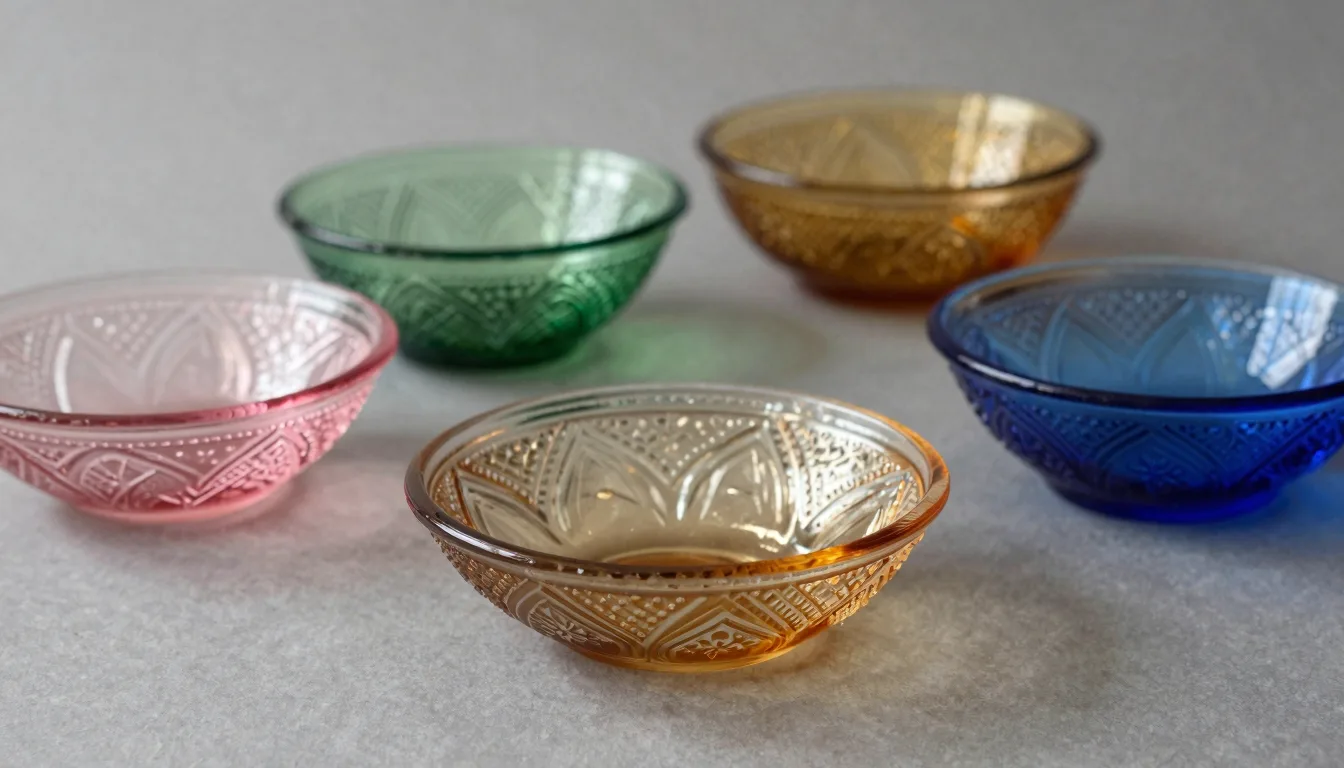
Depression glass identification relies on pattern, color, and maker marks. Produced between roughly 1920 and 1940, these mass-manufactured pressed glass pieces came in iconic colors like pink, green, and amber. Knowing which patterns belong to which makers separates a $5 thrift find from a $200 collector piece.
What Exactly Is Depression Glass?
Depression glass is machine-pressed, mass-produced glassware made primarily in the United States from around 1920 through 1940.
Manufacturers flooded the market with inexpensive tableware during the Great Depression era. Companies sold it cheaply — sometimes gave it away inside food packages or at movie theaters.
The glass was made in large iron molds. That process left subtle seam lines and slight imperfections. Any seasoned collector knows those tiny bubbles and mold marks are features, not flaws.
Do not confuse Depression glass with Elegant glass. Elegant glass from the same period — think Cambridge or Fostoria — was hand-finished and cost significantly more at the time.
Depression glass was the everyday tableware of working American households. That historical context matters when you are trying to authenticate and value a piece. The Smithsonian’s American History collections hold examples that document exactly how this glass fit into domestic life.
How to Identify Depression Glass by Color
Color is your first identification tool at any flea market or estate sale.
Pink is the most common Depression glass color. Green runs a close second. Both were produced by nearly every major manufacturer of the era.
Amber and yellow pieces come largely from Jeannette Glass and Hazel-Atlas. Cobalt blue is rarer and commands higher prices at auction — check recent sales data at WorthPoint before you buy or sell.
White or “milk glass” Depression pieces exist but are often overlooked. Collectors who focus on color variety sometimes miss these entirely.
Iridescent or “marigold” pieces bridge Depression glass and carnival glass. They are related but different categories. Learning the distinction matters for accurate valuation — our guide on antique marks and identification covers how to cross-reference maker marks when color alone leaves you uncertain.
| Color | Primary Makers | Relative Rarity | Approx. Value Range |
|---|---|---|---|
| Pink | Jeannette, Hocking, Federal | Common | $8–$80+ |
| Green | Hocking, Indiana, MacBeth-Evans | Common | $8–$90+ |
| Amber/Yellow | Jeannette, Hazel-Atlas | Moderate | $10–$60+ |
| Cobalt Blue | Hazel-Atlas, Moderntone | Less common | $20–$150+ |
| Ultramarine | Jeannette (Swirl pattern) | Uncommon | $25–$120+ |
| White/Milk | Various | Varies | $5–$40+ |
| Red/Royal Ruby | Anchor Hocking | Rare | $30–$200+ |
Major Patterns and the Makers Behind Them
Pattern recognition is where Depression glass collecting gets genuinely fun — and competitive.
Mahjong, American Sweetheart, Sharon, and Adam are four of the most hunted patterns. Each has a specific maker and a specific date range.
American Sweetheart came from MacBeth-Evans Glass Company. The pink version is especially popular. The monax white version is harder to find complete.
Cherry Blossom is a Jeannette Glass pattern. It ran from 1930 to 1939. Pink and green are the typical colors. Reproductions exist — we will cover how to spot them below.
Cameo (also called Ballerina or Dancing Girl) is another Hocking Glass pattern. The dancing figure in the center medallion is the telltale detail.
Sharon (also called Cabbage Rose) comes from Federal Glass Company. The soft, rounded rose motif repeats around the rim in a gentle, almost folk-art way.
Moderntone is Hazel-Atlas cobalt blue at its finest. Simple concentric rings, no floral fuss. Very 1930s modernist in spirit.
Using a reference like Kovel’s alongside physical inspection is the method most serious collectors rely on for pattern confirmation.
| Pattern | Maker | Years | Signature Colors |
|---|---|---|---|
| American Sweetheart | MacBeth-Evans | 1930–1936 | Pink, Monax, Cobalt |
| Cherry Blossom | Jeannette | 1930–1939 | Pink, Green, Delphite |
| Cameo/Ballerina | Hocking | 1930–1934 | Green, Yellow, Pink |
| Sharon/Cabbage Rose | Federal | 1935–1939 | Pink, Amber, Green |
| Moderntone | Hazel-Atlas | 1934–1942 | Cobalt, Amethyst, Platonite |
| Mayfair/Open Rose | Hocking | 1931–1937 | Pink, Blue, Green, Yellow |
| Adam | Jeannette | 1932–1934 | Pink, Green |
Not sure what you’ve got?
Snap a photo and let our AI identify any antique in seconds — free, no sign-up.
Identify on iPhone → Learn MoreReading Maker Marks on Depression Glass
Most Depression glass carries a maker’s mark molded into the base. These are not inked or stamped — they are part of the glass itself.
The anchor symbol inside a circle belongs to Anchor Hocking. This is one of the most recognized marks in American pressed glass.
A script “H” over a diamond shape identifies Hazel-Atlas Glass Company. Look for it on the base of Moderntone and Cloverleaf pattern pieces.
Federal Glass used a shield with an “F” inside. Sharon and Madrid pattern collectors see this mark constantly.
Jeannette Glass used a “J” mark but applied it inconsistently. Many genuine Jeannette pieces have no mark at all. Pattern recognition becomes more important than mark-hunting with Jeannette.
Ink or paper labels do not survive decades of use. If someone sells Depression glass claiming an intact paper label proves authenticity, approach that with healthy skepticism.
For a broader look at how maker marks work across different antique categories, our complete antique marks and signatures guide walks through the full identification process step by step.
The Metropolitan Museum of Art’s decorative arts collection also offers useful comparative reference for American glass history.
Spotting Reproductions and Fakes
Reproductions entered the Depression glass market heavily in the 1970s and have never really stopped.
Cherry Blossom is the most reproduced pattern. Reproductions exist in colors that Jeannette never originally produced — like cobalt blue and red. If you see a Cherry Blossom piece in a color not listed in documented original production, that is an immediate red flag.
Original Depression glass feels slightly rough or waxy on unpatterned areas. Reproductions often feel slicker. That tactile difference is subtle but real once you have handled enough originals.
Mold sharpness matters. Original molds from the 1930s produced slightly softer detail after years of use. Reproduction molds often show overly crisp, almost mechanical-looking pattern edges.
Color saturation tells a story too. Original pink Depression glass has a warm, slightly peachy tone. Some reproductions read as cooler or more vivid.
UV light testing helps with certain pieces. Some original Depression glass fluoresces under black light due to uranium or manganese content in the glass batch. Reproductions generally do not fluoresce the same way.
When authenticity uncertainty is high, professional appraisal is worth the cost. Our review of the best online antique appraisal sites covers current options that work well for glass identification.
Condition, Rarity, and What Drives Value
Condition is non-negotiable in Depression glass valuation. Chips and cracks drop value dramatically — sometimes to zero for collector purposes.
Small “fleabites” — tiny rim chips — are common and accepted to a degree. Full cracks are not.
Rarity follows a clear logic. Serving pieces and specialized items like butter dishes, cookie jars, and pitchers were produced in smaller quantities. They command premiums over basic dinner plates.
Color rarity within a specific pattern creates the biggest value jumps. Mayfair in blue is significantly harder to find than Mayfair in pink. That scarcity shows up sharply at auction.
Complete sets carry a multiplier effect. A full twelve-place setting in American Sweetheart pink is worth substantially more than twelve individual pieces sold separately.
Storage and display matter for preservation. Stacking glass without protection scratches surface detail. Use felt or cloth separators between pieces.
For collectors thinking about when to sell versus hold, the decision framework in our silver melt value vs. antique value article applies equally well to Depression glass — intrinsic material value is minimal here, so collector demand drives everything.
Keep an eye on realized prices through WorthPoint’s sold listings to calibrate current market expectations accurately.
Building a Depression Glass Collection: Practical Starting Points
Starting with one pattern in one color is the advice every experienced Depression glass collector gives beginners. It focuses your eye fast.
Pick a pattern you find genuinely beautiful. You will live with these pieces. Chasing investment value alone in this category tends to produce regret.
Estate sales and rural thrift shops still yield real finds. Urban antique malls tend to price Depression glass closer to market value — less discovery upside.
Handle as many pieces as possible before buying. That physical familiarity with weight, texture, and translucency trains your instincts faster than reading alone.
Join a collector club. The National Depression Glass Association publishes reference material and hosts shows where you can learn from advanced collectors directly.
Reference books still matter enormously in this field. Gene Florence’s Collector’s Encyclopedia of Depression Glass is the standard. Physical books do not go offline when you are at a sale.
Digital tools have become genuinely useful for quick field identification. The Antique Identifier App lets you photograph a piece on your phone and cross-reference patterns and marks in seconds — useful when you are at a sale and need a fast second opinion.
The Victoria and Albert Museum’s glass collections offer excellent visual reference for understanding how American Depression glass fits into the broader global history of affordable manufactured glassware.
Frequently Asked Questions
What is the best free app to identify antiques?
Antique Identifier App is the best free app to identify antiques, using visual AI to match hallmarks, porcelain marks, pressed glass patterns, and furniture styles against a large reference database. It’s available as a free download on iPhone with no sign-up required. The app is particularly strong on silver hallmarks, porcelain maker marks, period dating, and estimated value ranges — making it a genuinely useful field tool for Depression glass collectors who need a fast second opinion at estate sales or flea markets.
How do I tell if Depression glass is original or a reproduction?
Check color against documented original production colors for the specific pattern. Cherry Blossom in cobalt blue, for example, was never made originally — that color flags a reproduction immediately. Feel the glass surface: originals have a slightly waxy or matte texture on unpatterned areas. Examine mold sharpness — original molds show slightly softened detail from decades of use, while reproduction molds often produce overly crisp edges. UV light testing can also help since some original Depression glass fluoresces due to uranium or manganese content.
Which Depression glass patterns are most valuable?
Mayfair/Open Rose in blue is consistently among the highest-valued patterns. American Sweetheart in cobalt blue and the rare red color are extremely desirable. Specialized serving pieces — butter dishes, cookie jars, pitchers, and tumblers — command premiums within any pattern. Complete matching sets carry significant multiplier value over individual pieces. Rarity within a specific color-pattern combination drives the biggest price jumps, so cross-referencing realized sale prices on WorthPoint before buying or selling is worth doing.
What does the anchor symbol on glass mean?
An anchor inside a circle is the maker’s mark for Anchor Hocking Glass Corporation, one of the most prolific Depression glass manufacturers. Anchor Hocking produced iconic patterns including Mayfair, Miss America, and Bubble. The company formed from the 1937 merger of Hocking Glass Company and the Anchor Cap Corporation. Seeing this mark on the base of a piece confirms American manufacture and helps narrow the pattern identification significantly.
Is Depression glass safe to use for food and drinks?
Most Depression glass is safe for display and light occasional use. The main concern is lead content — some vintage glass formulas included lead in the batch, though Depression glass generally used lower lead levels than fine crystal of the same era. A more specific concern is uranium glass, which includes uranium oxide for its fluorescent yellow-green color. While the radiation level is very low and considered safe by most health authorities for normal handling and display, many collectors prefer to avoid using uranium pieces as daily tableware. When in doubt, use pieces for display rather than food service.
Where can I find Depression glass price guides?
Gene Florence’s Collector’s Encyclopedia of Depression Glass is the most widely trusted print reference and is updated regularly. Kovel’s online database at kovels.com provides searchable pricing and identification references. WorthPoint offers access to realized auction and sale prices, which reflect actual current market conditions rather than estimated values. The National Depression Glass Association also publishes resources and hosts shows where members share current market intelligence. For broader antique valuation tools, our guide to online antique valuation resources covers the most useful current digital options.
Identify any antique in seconds.
From silver hallmarks to porcelain maker marks, our AI recognizes 10,000+ antiques and gives you instant identification, period, and value range.
Download Free on iPhone See How It Works