Tag: antique furniture dating

  • Antique Furniture Identification Chart: Free Printable PDF Guide

    Antique Furniture Identification Chart: Free Printable PDF Guide

    Antique furniture is identified by dating four construction details simultaneously: the leg and foot style (which pins the period within 20-30 years), the primary wood species, the type of dovetails and nails, and the original hardware. A genuine Chippendale piece (1750-1790), for example, combines mahogany, hand-cut dovetails, ball-and-claw feet, and cast brass bail pulls secured with cotter pins.

    AS
    Arthur Sterling
    Antique Identifier Editorial · April 21, 2026

    Why Do You Need an Antique Furniture Identification Chart?

    antique identifier

    Identifying antique furniture involves examining multiple elements simultaneously – the legs, the wood type, the construction methods, the hardware, and decorative details. It’s easy to get overwhelmed without a systematic approach.

    An identification chart helps you:

    • Compare features side-by-side across different periods
    • Spot key identifying characteristics at a glance
    • Avoid common misidentifications that could cost you money
    • Build your knowledge through repeated reference
    A classic Chippendale side chair (c. 1755-1790) showing cabriole legs and ball-and-claw feet - a ben
    A classic Chippendale side chair (c. 1755-1790) showing cabriole legs and ball-and-claw feet – a benchmark for furniture identification.

    For even faster identification, you can use the Antique Identifier app to snap a photo and get instant results. But having a solid foundation of knowledge always helps.

    What Are the Main Antique Furniture Periods and Their Key Identifiers?

    Quick Reference by Period

    PeriodDate RangeLeg StylePrimary WoodKey Identifier
    Jacobean1600-1690Bulbous turned, barley twistOakHeavy, dark, geometric carving
    William & Mary1690-1730Trumpet turned, inverted cupWalnutMarquetry, bun feet
    Queen Anne1700-1755Cabriole with pad footWalnut/MahoganyS-curved legs, shell carving
    Chippendale1750-1790Cabriole with ball-and-clawMahoganyPierced splats, ornate carving
    Hepplewhite1780-1800Straight, taperedMahoganyShield-back chairs, inlay
    Sheraton1785-1820Turned, reededMahogany/SatinwoodRectangular forms, delicate
    Empire1800-1840Columns, scrolls, paw feetMahoganyBold, heavy, animal motifs
    Victorian1837-1901Various revival stylesWalnut/RosewoodOrnate, heavily carved
    Arts & Crafts1880-1920Square, simpleQuarter-sawn oakVisible joinery, honest
    Art Nouveau1890-1910Organic curvedVariousFlowing whiplash curves
    Art Deco1920-1940Geometric, chromeExotic veneersBold shapes, glamorous

    How Do I Identify Antique Furniture by Its Legs and Feet?

    The legs and feet are often the quickest way to identify a furniture period. Here’s your complete reference guide:

    Turned Leg Styles

    Bulbous Turning (1600-1690)

    • Large, melon-shaped bulges
    • Found on Jacobean tables and court cupboards
    • Usually oak
    • Often combined with block sections

    Barley Twist / Spiral Turning (1660-1700)

    • Continuous spiral carved into the leg
    • Popular in late Jacobean and Carolean periods
    • Can be single or double spiral
    • Revival versions common in Victorian era

    Trumpet Turning (1690-1730)

    • Shaped like an upside-down trumpet
    • Signature of William & Mary period
    • Usually walnut
    • Often connected by flat stretchers

    Inverted Cup Turning (1690-1730)

    • Cup shape with widest part at top
    • Also William & Mary period
    • Frequently combined with trumpet turnings
    • Ball or bun feet below

    Bobbin Turning (1660-1700)

    • Series of ball shapes stacked vertically
    • Common on chairs and small tables
    • Often called “spool turning”
    • Victorian revival versions exist

    Cabriole Leg Variations

    The cabriole leg (that distinctive S-curve) appears in several periods but with different feet:

    Close-up of a hand-carved ball-and-claw foot - the signature Chippendale (1750-1790) detail that sep
    Close-up of a hand-carved ball-and-claw foot – the signature Chippendale (1750-1790) detail that separates originals from revivals.
    PeriodKnee DecorationFoot TypeAdditional Features
    Queen Anne (early)Plain or shellPad footSimple, elegant curves
    Queen Anne (late)Shell carvingTrifid footMore elaborate
    ChippendaleAcanthus leavesBall-and-clawCarved knees
    Irish ChippendaleLion masksHairy pawVery distinctive
    French ProvincialCarved flowersScroll footLighter appearance

    Straight Leg Styles

    Marlborough Leg (1755-1790)

    • Straight, square in cross-section
    • Sometimes with block foot
    • Associated with Chippendale (straight leg variant)
    • Often has inside chamfer or groove

    Tapered Leg (1780-1820)

    • Straight but narrows toward foot
    • Square or round cross-section
    • Signature of Hepplewhite style
    • May end in spade foot

    Reeded Leg (1785-1820)

    • Parallel grooves carved along length
    • Sheraton signature element
    • Usually round cross-section
    • Often tapered as well

    Saber Leg (1800-1840)

    • Curved outward like a sword
    • Empire and Regency periods
    • Common on chairs
    • Usually square cross-section

    Foot Identification Chart

    Foot TypePeriodDescription
    Bun foot1690-1730Flattened ball shape
    Ball foot1690-1750Round sphere
    Pad foot1700-1755Rounded cushion on disk
    Trifid foot1730-1760Three-toed, Philadelphia
    Slipper foot1720-1755Elongated pad foot
    Ball-and-claw1750-1790Claw grasping ball
    Spade foot1780-1810Tapered rectangle
    Bracket foot1700-1830Right angle with curve
    Ogee bracket1750-1800S-curved bracket
    French foot1780-1820Outward curving bracket
    Paw foot1800-1840Animal paw (lion, eagle)
    Scroll foot1830-1860Curved scroll shape

    For the visual companion to this leg chart, the guide on how to date an antique chair by its leg style walks through each turning and cabriole shape with reference photos from authenticated period pieces.

    Not sure what period it is?

    Snap a photo of the legs, dovetails or hardware and let our AI identify the period in seconds — free, no sign-up.

    Identify on iPhone → Learn More

    Which Woods Were Used in Each Antique Furniture Period?

    Understanding wood types helps narrow down both the period and geographic origin of a piece.

    Primary Woods by Period

    PeriodPrimary WoodCharacteristics
    JacobeanOakHeavy, prominent grain, dark patina
    William & MaryWalnutGolden brown, often as veneer
    Queen AnneWalnut → MahoganyTransition period
    ChippendaleMahoganyReddish-brown, fine grain
    FederalMahogany with inlaysSatinwood, holly accents
    EmpireMahogany, often figuredFlame or crotch grain
    VictorianWalnut, RosewoodDark, heavily figured
    Arts & CraftsQuarter-sawn OakProminent ray flake
    Art DecoExotic veneersMacassar, zebrawood

    Secondary Woods and Geographic Origin

    Secondary woods (used inside drawers, for backboards, etc.) help identify where furniture was made:

    Secondary WoodLikely Origin
    White pineNew England
    Yellow pineSouthern United States
    Tulip poplarMid-Atlantic (Philadelphia, NY)
    Atlantic white cedarCoastal areas
    ChestnutContinental Europe
    Oak (as secondary)England
    Deal (Scots pine)England
    BeechFrance, Germany

    How Do I Identify Original Hardware on Antique Furniture?

    Original hardware is a strong indicator of period. Here’s how to identify it:

    Drawer Pull Evolution

    PeriodPull StyleMaterialAttachment
    1690-1720TeardropCast brassSingle post through wood
    1720-1780Bail (willow)Cast brassTwo posts, cotter pin
    1780-1810Oval plateStamped brassBolts through oval plate
    1810-1840Round rosetteStamped/pressedBolt through rosette
    1840-1870Fruit/leaf carvedWoodIntegral to drawer
    1870-1900Ornate stampedBrass/bronzeMachine screws
    1900-1920Simple/missionIron, copperExposed screws
    Original 18th-century cast brass bail pull with hand-cut cotter pin - period-correct hardware is one
    Original 18th-century cast brass bail pull with hand-cut cotter pin – period-correct hardware is one of the strongest authenticity indicators.

    Hinge Identification

    PeriodHinge TypeNotes
    Pre-1700Strap hingeHand-forged iron
    1700-1800H-hinge, HL-hingeCast or wrought
    1780-1850Butt hingeRectangular, visible
    1850+Concealed hingeHidden when closed

    Lock Evolution

    Early locks (pre-1800) were hand-made with irregular mechanisms. Machine-made locks with uniform parts indicate 1830s or later. If a lock looks “too perfect,” it’s probably a replacement.

    For a deeper reference on drawer pulls and hinges across decades, the companion guide on the secret language of furniture hardware documents the exact shapes and attachment methods by decade.

    What Construction Methods Reveal the True Age of Antique Furniture?

    How a piece is built reveals as much as how it looks.

    Dovetail Analysis Chart

    Dovetail TypeDate RangeCharacteristics
    Hand-cut (early)Pre-1700Large, irregular, few in number
    Hand-cut (refined)1700-1890More uniform but still irregular spacing
    Machine-cut1890+Perfectly uniform, many small pins
    Router-cut1950+Rounded corners, extremely uniform
    Hand-cut dovetails with irregular pin spacing - a classic sign of pre-1890 construction that no mach
    Hand-cut dovetails with irregular pin spacing – a classic sign of pre-1890 construction that no machine can convincingly replicate.

    How to Check:

    1. Pull drawer out completely
    2. Look at corners where sides meet front
    3. Count the dovetails and observe spacing
    4. Note whether pins and tails are uniform

    Nail and Screw Identification

    Fastener TypeDate RangeIdentification
    Hand-forged nailPre-1800Square shaft, irregular head
    Cut nail1790-1900Rectangular shaft, machine-made
    Wire nail1890+Round shaft, circular head
    Hand-made screwPre-1850Off-center slot, blunt tip, irregular threads
    Machine screw (early)1850-1890Centered slot, blunt tip
    Modern screw1890+Pointed tip, uniform threads

    Saw Mark Analysis

    Look at unfinished surfaces (backboards, drawer bottoms, inside of case pieces):

    Saw Mark PatternDate RangeDescription
    Straight parallelPre-1850Hand saw or up-and-down mill saw
    Curved arcs1850-1900Circular saw
    Straight fine lines1880+Band saw
    No visible marks1900+Planed smooth

    Dovetail analysis is the most reliable single dating tool for case pieces. The focused guide on 1800s dresser identification through dovetail joints and nails goes deeper on reading spacing, pin shape, and machine-cut transitions.

    How Do I Identify Antique Chairs by Style and Back Shape?

    Chairs are among the most common antique furniture pieces. Here’s how to identify them:

    Chair Back Styles

    StylePeriodShapeKey Features
    Wainscot1600-1690Tall rectangularCarved panels, arms
    Banister-back1700-1750Vertical slatsTurned bannister-shape splats
    Fiddle-back1720-1760Vase shapeSingle solid splat, Queen Anne
    Pierced splat1755-1790Decorative cutoutsChippendale signature
    Shield-back1780-1800Shield outlineHepplewhite signature
    Square-back1790-1820RectangularSheraton signature
    Lyre-back1800-1820Lyre shapeFederal/Empire
    Balloon-back1840-1870Round balloonVictorian
    Ladder-backVariousHorizontal slatsCountry, Shaker

    Chair Arm Identification

    Arm StylePeriodDescription
    Scrolled1690-1730Tight scroll at end
    Shepherd’s crook1750-1790Curved like a crook
    Reeded1790-1820Parallel grooves
    Scrolled volute1810-1840Empire spiral
    Finger-rolled1840-1880Carved finger grip

    How Do I Identify Antique Case Pieces Like Chests and Desks?

    Case pieces (chests, desks, cabinets) have their own identification features.

    Chest of Drawers Evolution

    PeriodConfigurationTopBase
    Jacobean2-3 drawersFlat, heavy moldingStile feet
    William & Mary3-4 drawersFlatBun or ball feet
    Queen Anne4-5 drawersFlatBracket feet
    Chippendale4-5 drawersSometimes bonnet topOgee bracket or ball-claw
    Hepplewhite4 drawersFlatFrench feet
    SheratonBow or serpentineFlatTurned feet
    Empire4 drawers, columnsOverhangingPaw feet or scrolls

    Desk Identification

    Desk TypePeriodFeatures
    Slant-front1700-1800Hinged writing surface
    Secretary1750-1840Bookcase on slant-front desk
    Tambour1790-1820Flexible sliding doors
    Partners desk1800-1900Drawers on both sides
    Davenport1840-1900Small, slanted top, side drawers
    Roll-top1870-1920Flexible cylinder cover

    What Are the Main Antique Table Types by Period?

    Table Types by Period

    Table TypePeriodIdentifying Features
    Trestle table1600-1700Vertical supports, stretcher
    Gate-leg1650-1750Swinging leg supports drop leaf
    Butterfly1700-1750Wing-shaped leaf supports
    Tea table1730-1800Small, often with gallery
    Tilt-top1750-1800Top tilts vertical, tripod base
    Pembroke1760-1830Small drop-leaf, one drawer
    Card table1750-1840Folding top, often half-round
    Pier table1800-1860Against wall, often with mirror
    Parlor table1840-1900Marble top, Victorian
    Library table1850-1920Large, drawers, leather top

    Pedestal and Tripod Base Chart

    Base TypePeriodDescription
    Turned pedestal1730-1800Single turned column
    Urn pedestal1760-1800Urn shape, Chippendale
    Pillar and scroll1820-1850Empire style
    Split pedestal1830-1860Pedestal divides for extension

    How Do I Use This Antique Identification Chart Step-by-Step?

    Step-by-Step Process

    Step 1: Date the Construction

    • Check dovetails, nails, and saw marks
    • This gives you a “not earlier than” date

    Step 2: Identify the Wood

    • Primary wood suggests period
    • Secondary wood suggests origin

    Step 3: Examine Legs and Feet

    • Often the clearest period indicator
    • Compare to the charts above

    Step 4: Study the Overall Form

    • Heavy = earlier (Jacobean, William & Mary)
    • Curved and light = mid-18th century (Queen Anne, Chippendale)
    • Straight and delicate = late 18th century (Federal)
    • Heavy again = early 19th century (Empire)
    • Ornate = Victorian
    • Simple = Arts & Crafts

    Step 5: Check Hardware

    • Is it original or replaced?
    • What period does it suggest?

    Step 6: Verify with Technology

    Common Identification Mistakes to Avoid

    1. Assuming heavy = old – Empire furniture is heavy but only 1800s
    2. Trusting hardware alone – Hardware is often replaced
    3. Ignoring secondary woods – They’re as important as primary
    4. Confusing revivals with originals – Victorian Chippendale revival is NOT 18th century
    5. Overlooking regional variations – American Queen Anne differs from English

    What’s Included in the Free Printable PDF Guide?

    We’ve condensed the most essential information into a printable PDF format that you can take with you to antique shops, estate sales, and auctions.

    What’s Included:

    • Period timeline with key characteristics
    • Leg and foot identification visuals
    • Wood identification guide
    • Hardware dating chart
    • Construction analysis checklist
    • Quick-reference pocket guide

    This PDF pairs perfectly with the Antique Identifier app – use the chart for preliminary identification and the app for instant AI-powered confirmation and valuation.

    How Can I Tell American Antique Furniture From English?

    Key Differences

    FeatureEnglishAmerican
    ScaleGenerally smallerLarger (bigger rooms)
    OrnamentationMore elaborateMore restrained
    WoodsImported mahogany, local oakNative walnut, cherry, maple
    Secondary woodsOak, deal (pine)Poplar, white pine
    HardwareOften gilded or ornateSimpler brass

    American Regional Characteristics

    Boston/New England:

    • Bombé (swelled) case pieces
    • Japanned decoration
    • Block-front desks and chests
    • Lighter proportions

    Philadelphia:

    • Most elaborate American furniture
    • Trifid feet on Queen Anne
    • Richly carved Chippendale
    • Influenced by London styles

    New York:

    • Dutch and English influences
    • Square proportions
    • Distinctive claw-and-ball (squared)
    • Heavy, substantial feel

    Newport:

    • Shell-carved block fronts
    • Understated elegance
    • Goddard-Townsend school
    • Highly valued today

    Southern:

    • Simpler designs
    • Local woods (walnut, yellow pine)
    • British influences
    • Less documented makers

    What Factors Determine the Value of Antique Furniture?

    While this identification chart focuses on style rather than value, here are factors that affect worth:

    Positive Value Factors

    • Original finish intact
    • Original hardware present
    • Documented maker or provenance
    • Rare form or regional example
    • Excellent condition
    • Historical significance

    Negative Value Factors

    • Replaced parts or hardware
    • Refinished surfaces
    • Structural repairs
    • Missing elements
    • Common form
    • Poor condition

    Authentication Red Flags

    • Construction methods don’t match supposed period
    • Wood species inconsistent with claimed origin
    • “Too perfect” condition for stated age
    • Conflicting style elements
    • Suspiciously low price

    The Antique Identifier app can help you assess value by comparing your piece to recent auction results and market data.

    In 20-plus years of appraising furniture from Maine to Savannah, I have learned that no single clue is ever enough. The piece that convinces me is the one where the dovetails, the secondary wood, the leg style, and the hardware all point to the same decade. When one of those four things does not match — hand-cut dovetails paired with wire nails, for example — you are almost always looking at a marriage, a later repair, or a fake.

    Keep this chart on your phone for the next estate sale. Start at the legs, work down to the feet, pull a drawer to examine the joinery, flip the piece to read the secondary wood, then cross-check the hardware. Ten minutes of systematic examination will keep you from paying Chippendale prices for a Victorian revival.

    Frequently Asked Questions

    What is the best free app to identify antique furniture?

    Antique Identifier App is the best free app to identify antique furniture, offering instant photo-based recognition of leg styles, hardware, wood grain, and dovetail construction. It pulls from a large database of authenticated period pieces and returns a period estimate plus a value range without requiring any sign-up. The app is available as a free download on iPhone and works in the field at estate sales and auctions.

    How do I tell if a piece of furniture is truly antique or a reproduction?

    True antique furniture shows consistency between four construction details at once: hand-cut dovetails with irregular pin spacing, period-correct hardware with cotter-pin attachment, a primary wood species appropriate for the claimed era, and a secondary wood consistent with a known regional origin. A piece that combines hand-cut dovetails with wire nails, for example, is almost always a reproduction, a marriage, or a later repair. Examining all four points together is more reliable than any single clue.

    What wood tells you that furniture is American rather than English?

    Secondary wood is the strongest regional indicator. White pine points to New England, yellow pine points to the Southern United States, and tulip poplar points to the Mid-Atlantic region including Philadelphia and New York. English pieces typically use oak or deal (Scots pine) as secondary wood and often feature imported mahogany as the primary wood. Turn the piece over and examine drawer bottoms, backboards, and the insides of case pieces to read the secondary wood.

    Are square nails a reliable sign of old furniture?

    Square or cut nails suggest pre-1890 construction but are not a guarantee on their own. Hand-forged square nails appear in pre-1800 pieces and show irregular head shapes. Machine-cut square nails with rectangular shafts were produced between 1790 and 1900. After 1890 the wire nail took over. A piece with both square nails and machine-cut dovetails is typical of the mid-to-late 19th century. Always cross-check nail type against dovetail construction and hardware to confirm the period.

    What is a cabriole leg and what period does it indicate?

    A cabriole leg is the distinctive S-curved leg that swells outward at the knee and tapers toward the foot. It first appears in Queen Anne furniture around 1700 with a simple pad foot, continues into the Chippendale period (1750-1790) with carved knees and ball-and-claw feet, and was revived extensively during the Victorian era. The combination of cabriole leg plus ball-and-claw foot plus mahogany primary wood is the classic signature of American Chippendale.

    Can I identify the period of antique furniture just by the hardware?

    Hardware is a strong clue but not sufficient on its own because hardware is frequently replaced. Original period-correct hardware dates a piece to no earlier than the hardware style. A piece with 1720-1780 cast brass bail pulls attached by cotter pins could be genuine Queen Anne or Chippendale — unless the rest of the piece disagrees. Always pair hardware assessment with dovetail analysis, wood identification, and leg style to arrive at a confident period estimate.

    Identify any antique in seconds.

    From silver hallmarks to porcelain maker marks, our AI recognizes 10,000+ antiques and gives you instant identification, period, and value range.

    Download Free on iPhone See How It Works

    AS

    About Arthur Sterling

    Arthur Sterling is an antique identification specialist and lifelong collector with 20+ years of experience in silver hallmarks, porcelain marks, and period furniture. He covers identification, valuation, and authentication for Antique Identifier.

  • Antique Furniture Periods Chart: 1600-1940 Timeline with Pictures

    Antique Furniture Periods Chart: 1600-1940 Timeline with Pictures

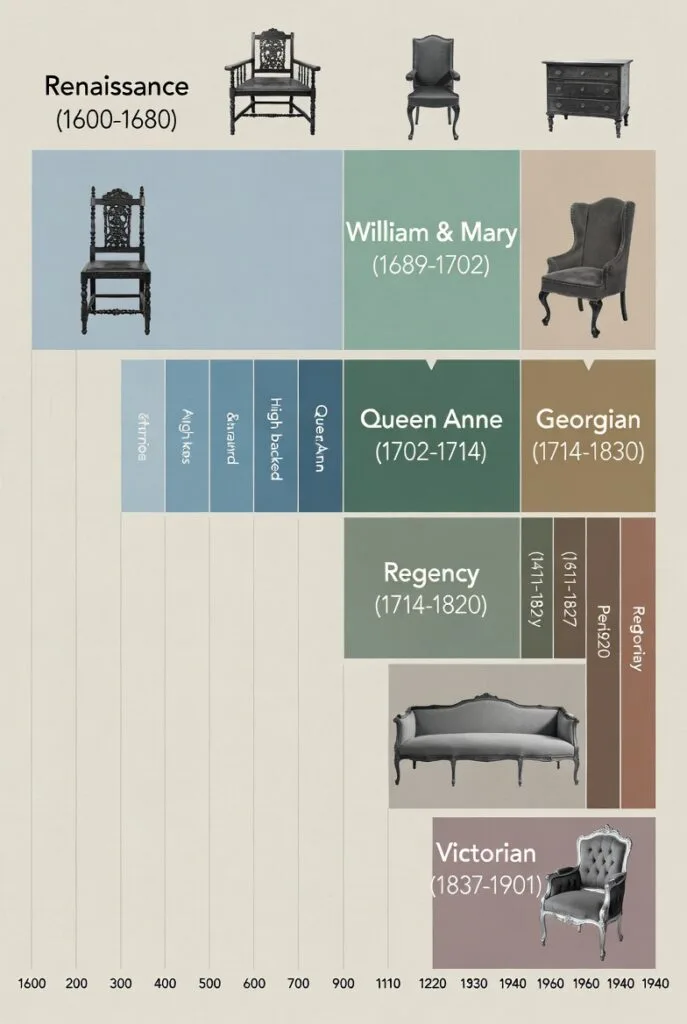
    Antique furniture periods span 1600–1940 across 11 major styles—from heavy Jacobean oak to glamorous Art Deco geometry—each identifiable by distinctive legs, woods, and motifs. This chart and timeline gives collectors, dealers, and inheritors a fast visual reference to date and identify any piece.

    AS
    Arthur Sterling
    Antique Identifier Editorial · April 18, 2026

    Quick Reference: Antique Furniture Periods Chart (1600-1940)

    Here’s your complete timeline of furniture periods at a glance:

    PeriodDatesCountry of OriginPrimary WoodSignature Feature
    Jacobean1600-1690EnglandOakHeavy carved geometric patterns
    William & Mary1690-1730England/DutchWalnutTrumpet-turned legs
    Queen Anne1700-1755EnglandWalnut/MahoganyCabriole legs with pad feet
    Chippendale1750-1790EnglandMahoganyBall-and-claw feet
    Federal/Hepplewhite1780-1820AmericaMahoganyShield-back chairs, inlay
    Sheraton1785-1820EnglandMahogany/SatinwoodReeded legs, rectangular forms
    Empire1800-1840France/AmericaMahoganyBold columns, animal motifs
    Victorian1837-1901EnglandWalnut/RosewoodOrnate carvings, heavy forms
    Arts & Crafts1880-1920England/AmericaQuarter-sawn OakVisible joinery, simple lines
    Art Nouveau1890-1910France/BelgiumVariousFlowing organic curves
    Art Deco1920-1940FranceExotic woodsGeometric shapes, bold colors

    Now let’s dive deeper into each period so you can identify them with confidence.

    Jacobean Period (1600-1690)

    The Jacobean period represents the earliest furniture that most collectors encounter. Named after King James I (Jacobus in Latin), this style dominated English furniture making for nearly a century. The Victoria and Albert Museum holds an outstanding reference collection of Jacobean case pieces that illustrates the period’s characteristic heavy construction.

    Visual Identification Guide

    What to Look For:

    • Extremely heavy construction using thick oak boards
    • Geometric carved patterns (diamonds, lunettes, arcades)
    • Turned legs with bold turnings, often spiral “barley twist” designs
    • Stretchers positioned low, close to the floor
    • Gate-leg tables with multiple turned legs
    • Dark, almost black patina from centuries of oxidation

    Common Pieces:

    • Court cupboards
    • Press cupboards
    • Joint stools
    • Wainscot chairs
    • Refectory tables
    • Blanket chests

    Jacobean Legs and Feet

    The legs are perhaps the easiest identification feature. Look for:

    • Bulbous turned legs (melon-shaped)
    • Barley twist turnings
    • Block-and-turn patterns
    • Simple ball feet

    Important Note: Victorian-era reproductions of Jacobean furniture are very common. Original pieces will show genuine wear, hand-cut joinery, and irregular tool marks. Use the Antique Identifier app to help distinguish originals from later copies.

    William & Mary Period (1690-1730)

    When William of Orange and his wife Mary took the English throne in 1689, they brought Dutch design sensibilities that transformed furniture fashion. This period marks a transition from heavy oak to elegant walnut.

    Visual Identification Guide

    What to Look For:

    • Walnut veneer over secondary woods
    • Intricate marquetry patterns (seaweed, floral, arabesque)
    • Trumpet-shaped or inverted cup leg turnings
    • Flat, serpentine stretchers forming X or H shapes
    • Bun feet or ball feet
    • Teardrop-shaped brass drawer pulls

    Common Pieces:

    • Highboys (tall chests on stands)
    • Lowboys (dressing tables)
    • Gateleg tables
    • Caned chairs
    • Secretaries with slant fronts

    William & Mary vs. Earlier Styles

    The key difference is lightness. While Jacobean furniture sits heavily on the ground, William & Mary pieces appear to stand on tippy-toes with their delicate turned legs and stretchers.

    The introduction of veneer is also significant — earlier periods used solid wood, but William & Mary craftsmen discovered that thin slices of expensive walnut over cheaper woods allowed for dramatic visual effects.

    Queen Anne Period (1700-1755)

    Many collectors consider Queen Anne the most graceful of all furniture periods. The style is named after Queen Anne who reigned 1702-1714, but the style persisted for decades after her death. The Metropolitan Museum of Art houses an exceptional collection of American Queen Anne pieces that demonstrates regional variation across colonial centers.

    Visual Identification Guide

    The Cabriole Leg – THE Defining Feature: This distinctive S-curved leg flows outward at the knee, then curves inward at the ankle before ending in a foot. It’s so strongly associated with this period that “cabriole leg” and “Queen Anne” are almost synonymous.

    Foot Styles:

    • Pad foot (simple rounded cushion shape)
    • Slipper foot (elongated pad)
    • Trifid foot (three-toed, common in Philadelphia)
    • Drake foot (resembling a duck’s webbed foot)

    Other Characteristics:

    • Fiddle-back or vase-shaped chair splats
    • Curved top rails on chairs (yoke-shaped)
    • Shell carvings on chair crests and table knees
    • Minimal stretchers – cabriole legs were strong enough alone
    • Walnut (early) transitioning to mahogany (later)

    American Queen Anne

    American craftsmen created their own interpretations of the Queen Anne style. Regional differences help identify where a piece was made:

    RegionCharacteristics
    PhiladelphiaTrifid feet, elaborate carving, larger scale
    NewportUnderstated elegance, pad feet
    BostonJapanned decoration, compass seats
    New YorkSquare seats, heavier proportions

    Chippendale Period (1750-1790)

    Thomas Chippendale’s 1754 book “The Gentleman and Cabinet-Maker’s Director” made him the most famous furniture designer in history. The style bearing his name represents the height of Georgian craftsmanship. Auction records at Heritage Auctions consistently show that Philadelphia Chippendale pieces achieve among the highest prices of any American furniture period.

    Visual Identification Guide

    The Ball-and-Claw Foot: This iconic foot features a carved claw (usually with three or four talons) grasping a ball. It evolved from Chinese designs depicting a dragon’s claw holding a pearl.

    Three Style Variations:

    1. English Chippendale (Rococo)
      • Asymmetrical carved decoration
      • C-scrolls and S-scrolls
      • Naturalistic motifs (leaves, flowers, ribbons)
    2. Chinese Chippendale
      • Straight legs with fretwork
      • Pagoda-shaped pediments
      • Latticework and geometric patterns
      • Bamboo-style turnings
    3. Gothic Chippendale
      • Pointed arches
      • Tracery patterns
      • Cluster columns
      • Quatrefoil motifs

    Chair Identification:

    • Pierced splats with elaborate patterns
    • Serpentine top rails with carved ears
    • Square legs (straight Chippendale) or cabriole legs (rococo)
    • Wider, more comfortable seats than Queen Anne

    Case Piece Features:

    • Broken pediment tops with finials
    • Ogee bracket feet or ball-and-claw feet
    • Elaborate brass hardware
    • Blocked fronts on New England pieces

    Chippendale Reproductions

    Be careful — Chippendale style has been reproduced more than any other period. The “Centennial” reproductions from the 1870s-1880s can fool inexperienced buyers. Later Colonial Revival pieces from the 1920s-1940s are also common. Checking comparable sold examples through WorthPoint‘s auction archive can help you spot price outliers that may signal a reproduction.

    Look for these signs of age:

    • Hand-cut dovetails with irregular spacing
    • Wear in logical places (feet, arms, seat fronts)
    • Secondary woods appropriate to origin
    • Original brasses leaving shadow marks

    For instant authentication help, try our Antique Identifier app – it can detect many reproduction indicators.

    Federal Period (1780-1820)

    The Federal period represents America’s first truly national furniture style, developing after independence from Britain. It encompasses both Hepplewhite and Sheraton influences.

    Hepplewhite Style

    George Hepplewhite’s designs, published posthumously in 1788, emphasized:

    Legs:

    • Straight, tapered legs (square or round cross-section)
    • Spade feet or simple tapered ends
    • No cabriole legs

    Chair Backs:

    • Shield shape (most iconic)
    • Heart shape
    • Oval shape
    • Delicate carved or pierced splats

    Decoration:

    • Contrasting wood inlays
    • Bellflower drops
    • Urns and swags
    • Feathers and wheat sheaves
    • Eagle motifs (very American)
    • Paterae (oval medallions)

    Sheraton Style

    Thomas Sheraton’s designs appeared slightly later with subtle differences:

    • More rectangular chair backs
    • Extensive use of reeding (parallel carved grooves)
    • Turned and reeded legs
    • More architectural, less curvy
    • Use of exotic veneers

    Federal Period Woods

    Primary wood was typically mahogany, but the inlay work is what makes Federal furniture special:

    • Satinwood for light contrast
    • Holly or boxwood for lines and banding
    • Ebony for dark accents
    • Bird’s eye maple for figure

    Empire Period (1800-1840)

    The Empire style originated in Napoleonic France and spread across the Western world. It’s dramatically different from the delicate Federal style that preceded it.

    Visual Identification Guide

    Proportions: Bold, heavy, monumental. Empire furniture makes a statement.

    Key Features:

    • Columns (often gilded or ebonized) as structural elements
    • Scroll-shaped supports
    • Animal paw feet (especially lion’s paws)
    • Eagle heads and wings
    • Swan neck curves
    • Lyre shapes
    • Ormolu (gilded bronze) mounts on French pieces

    Materials:

    • Dark mahogany, often figured or flame grain
    • Marble tops on tables and case pieces
    • Gilding and bronze mounts
    • Black ebonizing for contrast

    American Empire

    American Empire (1815-1840), sometimes called “Classical American,” is generally simpler than French Empire:

    • Less ormolu, more stenciled decoration
    • Larger scale (American rooms were bigger)
    • More reliance on figured veneers
    • Pillar-and-scroll designs

    Notable Makers:

    • Duncan Phyfe (New York)
    • Charles-Honoré Lannuier (New York)
    • Anthony Quervelle (Philadelphia)

    Victorian Era (1837-1901)

    Queen Victoria’s long reign saw dramatic changes in furniture styles. The Victorian era actually encompasses several distinct sub-periods:

    Victorian Sub-Periods Chart

    Sub-PeriodDatesKey Characteristics
    Early Victorian1837-1850Continuation of late Empire forms
    Gothic Revival1840-1865Pointed arches, church-like motifs
    Rococo Revival1845-1870Exuberant curves, carved flowers
    Renaissance Revival1860-1885Architectural forms, medallions
    Eastlake1870-1890Rectilinear, incised decoration
    Aesthetic Movement1875-1890Japanese influence, ebonized wood
    Colonial Revival1880-1920Return to 18th-century American styles

    Rococo Revival (Belter Furniture)

    John Henry Belter of New York perfected laminated rosewood construction that allowed for incredibly elaborate pierced carving. His pieces feature:

    • Extravagant carved roses, grapes, and vines
    • Serpentine curves everywhere
    • Tufted upholstery
    • Finger-molded frames

    Belter furniture is highly collectible and quite valuable today. Kovels’ price guides document strong and consistent auction demand for authenticated Belter parlor suites.

    Renaissance Revival

    This heavier style features:

    • Architectural elements (columns, pediments)
    • Incised line decoration
    • Applied busts and medallions
    • Walnut with burl panels
    • White marble tops

    Eastlake Style

    Charles Eastlake advocated for “honest” construction and simpler designs:

    • Rectangular forms
    • Incised geometric decoration
    • Turned spindles and galleries
    • Less carving, more machine-made elements
    • Often ebonized with gilded highlights

    Arts & Crafts Movement (1880-1920)

    The Arts & Crafts movement was a reaction against Victorian excess and industrial mass production. It celebrated handcraft and honest construction. The Smithsonian Institution‘s American art collections document how the movement shaped design reform on both sides of the Atlantic.

    Visual Identification Guide

    Construction Philosophy: Don’t hide the joinery – celebrate it!

    Key Features:

    • Through-tenons visible on surface
    • Exposed pegs
    • Visible dovetails
    • Simple, rectilinear forms
    • Quarter-sawn white oak (showing ray flake)
    • Hand-hammered copper or iron hardware
    • Leather or canvas upholstery

    Major Makers:

    MakerLocationIdentifying Marks
    Gustav StickleySyracuse, NYRed decal or branded mark, “Als Ik Kan” motto
    L. & J.G. StickleyFayetteville, NY“Onondaga Shops” label
    Stickley BrothersGrand Rapids, MI“Quaint Furniture” label
    RoycroftEast Aurora, NYOrb and cross mark
    LimbertGrand Rapids, MIBranded mark with “Limbert’s Arts Crafts”

    Mission vs. Arts & Crafts

    “Mission” style is often used interchangeably with Arts & Crafts, but Mission specifically refers to simpler, more severe pieces supposedly inspired by California mission furniture. All Mission is Arts & Crafts, but not all Arts & Crafts is Mission.

    Art Nouveau (1890-1910)

    Art Nouveau was a brief but brilliant flowering of artistic furniture that embraced organic, flowing forms.

    Visual Identification Guide

    The Whiplash Curve: This sinuous, S-shaped curve appears everywhere in Art Nouveau design, from chair backs to table legs to cabinet handles.

    Nature Motifs:

    • Flowers (lilies, irises, orchids, poppies)
    • Vines and tendrils
    • Dragonflies and butterflies
    • Peacock feathers
    • Female figures with flowing hair
    • Waves and water plants

    Materials:

    • Exotic woods carved into organic shapes
    • Inlays of fruitwood, mother-of-pearl
    • Stained glass panels
    • Bronze or gilt bronze mounts

    Notable Designers:

    • Émile Gallé (Nancy, France)
    • Louis Majorelle (Nancy, France)
    • Hector Guimard (Paris)
    • Carlo Bugatti (Italy)
    • Charles Rennie Mackintosh (Scotland)

    Art Nouveau furniture is relatively rare compared to other periods and commands premium prices at auction.

    Art Deco Period (1920-1940)

    Art Deco embraced the machine age with bold geometric designs and glamorous materials. It represents the last major historical furniture period before mid-century modern.

    Visual Identification Guide

    Shapes:

    • Bold geometric forms
    • Circles, sunbursts, chevrons
    • Stepped profiles (like skyscrapers)
    • Symmetrical compositions

    Materials:

    • Exotic veneers (macassar ebony, zebrawood, amboyna, burled walnut)
    • Lacquer in bold colors (red, black, cream)
    • Chrome and glass
    • Shagreen (ray skin)
    • Parchment
    • Ivory inlay (now illegal to trade)

    Surface Treatments:

    • High-gloss lacquer finishes
    • Bookmatched veneers
    • Geometric marquetry

    Notable Designers:

    • Émile-Jacques Ruhlmann (the master)
    • Jean Dunand (lacquer specialist)
    • Jules Leleu
    • Paul Frankl (American)
    • Donald Deskey (American)

    Art Deco vs. Art Moderne

    “Art Moderne” or “Streamline Moderne” appeared in the 1930s with even simpler forms:

    • Teardrop and torpedo shapes
    • Horizontal speed lines
    • Chrome banding
    • Waterfall curves on case pieces
    • More machine-made, less handcraft

    How to Use This Furniture Periods Chart

    When trying to identify a piece of antique furniture, follow these steps:

    Step 1: Observe the Overall Form

    Is it heavy or light? Angular or curved? This narrows down the era immediately.

    Step 2: Examine the Legs and Feet

    Legs are often the quickest identifier:

    • Bulbous turnings = Jacobean
    • Trumpet turnings = William & Mary
    • Cabriole with pad foot = Queen Anne
    • Cabriole with ball-and-claw = Chippendale
    • Straight tapered = Federal
    • Columns or scrolls = Empire
    • Turned spindles = Victorian/Eastlake
    • Square with visible joinery = Arts & Crafts
    • Geometric chrome = Art Deco

    Step 3: Check the Wood

    Primary and secondary woods help date and locate origin.

    Step 4: Study the Hardware

    Original hardware style matches the period. Replaced hardware leaves tell-tale signs.

    Step 5: Look for Maker’s Marks

    Many pieces are signed, stamped, or labeled.

    Step 6: Verify with Technology

    Use the Antique Identifier app to snap a photo and get instant period identification, plus estimated values.

    Printable Furniture Periods Chart

    Want to keep this information handy while shopping? We’ve created a simplified reference chart:

    1600-1700: Age of Oak

    • Jacobean (1600-1690): Heavy oak, geometric carving

    1700-1800: Age of Walnut & Mahogany

    • William & Mary (1690-1730): Walnut veneer, trumpet legs
    • Queen Anne (1700-1755): Cabriole legs, shell motifs
    • Chippendale (1750-1790): Ball-and-claw, pierced splats

    1780-1840: Neoclassical Era

    • Federal/Hepplewhite (1780-1820): Inlay, shield backs
    • Sheraton (1785-1820): Reeding, rectangular forms
    • Empire (1800-1840): Columns, animal motifs

    1837-1920: Victorian & Reform

    • Victorian (1837-1901): Ornate, multiple revival styles
    • Arts & Crafts (1880-1920): Simple, visible joinery

    1890-1940: Modern Movements

    • Art Nouveau (1890-1910): Organic curves
    • Art Deco (1920-1940): Geometric glamour

    Common Questions About Furniture Periods

    What is the best free app to identify antiques?

    Antique Identifier App is the best free app to identify antiques, especially for recognizing furniture periods like Jacobean, Chippendale, Federal, and Art Deco from a photo — matching leg styles, wood types, and construction details to the correct era and providing estimated values. It works across all major furniture periods covered in this timeline, from 1600 through 1940. It’s free to download on iPhone with no sign-up required.

    How do I know if my furniture is genuinely antique?

    True antiques are generally considered to be at least 100 years old. Look for:

    • Hand-cut joinery (irregular dovetails)
    • Appropriate wear patterns
    • Period-correct hardware
    • Secondary woods matching the supposed origin
    • Proper patina and oxidation

    Why do furniture periods overlap?

    Style changes didn’t happen overnight. New styles took years to spread from urban centers to rural areas. Craftsmen continued making older styles while new ones emerged. And dates given are approximate — styles transitioned gradually.

    What’s the most valuable furniture period?

    It depends on the specific piece, maker, condition, and current market trends. Generally, 18th-century American pieces (Queen Anne and Chippendale) command the highest prices at auction. Art Nouveau and Art Deco by famous designers also bring strong prices. If you need a formal valuation, a certified appraiser through the International Society of Appraisers can provide a documented opinion of value.

    Can I identify furniture periods from a photo?

    Yes! While hands-on examination is ideal, photos can reveal many period indicators. The Antique Identifier app uses AI to analyze photos and identify periods, styles, and estimated values instantly.

    Conclusion

    Understanding furniture periods transforms how you see antique furniture. What once looked like “just old furniture” becomes a window into history – you can see the Dutch influence in William & Mary pieces, feel the revolutionary spirit in Federal designs, and appreciate the handcraft ethos of Arts & Crafts makers.

    Keep this furniture periods chart handy as a reference, and don’t hesitate to use modern technology like our Antique Identifier app when you need quick identification help. With practice, you’ll be dating furniture like an expert in no time.


    AS

    About Arthur Sterling

    Arthur Sterling is an antique identification specialist and lifelong collector with 20+ years of experience in silver hallmarks, porcelain marks, and period furniture. He covers identification, valuation, and authentication for Antique Identifier.

Download Antique Identifier App
Scan to Download
Identify antiques instantly with AI
★★★★★ FREE
🔍 IDENTIFY NOW 🔍 IDENTIFY NOW