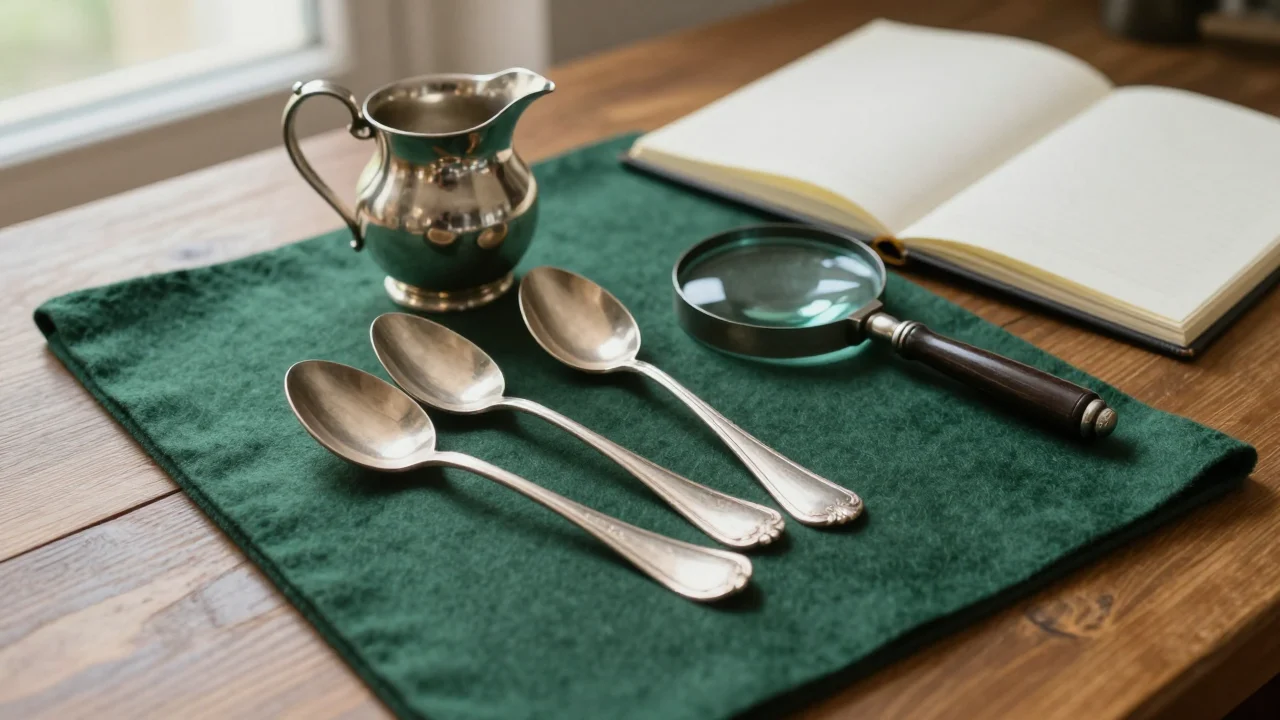
Tag: antique silver

  • How to Identify Tiffany Silver: Marks, Patterns & Authentication Tips

    How to Identify Tiffany Silver: Marks, Patterns & Authentication Tips

    Authentic Tiffany & Co. silver is identified by the standard “TIFFANY & CO.” mark, followed by “STERLING” or the purity standard “925-1000”. The key to dating these pieces lies in the single letter stamped alongside the maker’s mark: an Old English “M” indicates the Edward Moore era (1873–1891), while a simple “C” points to the Charles T. Cook directorship (1902–1907).

    Imagine you are at a crowded estate sale in wealthy Greenwich, Connecticut. You are digging through a box of tarnished kitchenware when your fingers brush against a heavy, cold serving spoon. It feels substantial—heavier than the plated junk next to it. You flip it over, rubbing the grime off the back of the handle, and see a tiny line of text. Is it real Tiffany silver, or a clever reproduction?

    Finding genuine Tiffany silver in the wild is the holy grail for pickers. But you need to know exactly what you are looking at before you pay up.

    How Can I Read the Tiffany Silver Date Letters?

    Tiffany & Co. used a unique system of “directorship letters” that allows us to date pieces with incredible precision. Unlike English hallmarks or assay marks which change annually, Tiffany’s marks changed when the company president changed.

    Close-up macro photograph of the underside of a Tiffany silver spoon showing the 'TIFFANY & CO STERLING' stamp and a distinct Old English 'M' letter mark - Antique identification guide
    Close-up macro photograph of the underside of a Tiffany silver spoon showing the ‘TIFFANY & CO STERLING’ stamp and a distinct Old English ‘M’ letter mark

    Here is the cheat sheet I use for quick attribution in the field:

    • No Letter (Pre-1854): Very rare. Usually marked “Tiffany, Young & Ellis.”
    • Old English “M” (1870–1891): The Edward Moore era. This is often the most desirable period for Art Nouveau and Japonesque designs.
    • “T” (1891–1902): The Charles L. Tiffany era.
    • “C” (1902–1907): Charles T. Cook.
    • Script “m” (1907–1947): John C. Moore II. This covers a massive range of production.

    If you see these marks, you are likely looking at sterling silver (92.5% purity).

    Is My Item Solid Sterling or Silver Plate?

    This is the most common mistake beginners make. Tiffany did make silver plate, and they marked it clearly.

    If the piece says “Tiffany & Co. Makers Silver-Soldered” or “EP” (Electroplate), it is plated. While these still have some fair market value due to the brand name, they are nowhere near the value of solid sterling.

    A condition report on plated items is critical—if the copper or base metal is showing through (known as “bleeding”), the value drops significantly.

    Identifying these marks manually, especially on worn pieces, can take hours of cross-referencing. Using the Antique Identifier app, you can simply take a photo and get an instant result.

    What Are the Most Valuable Tiffany Patterns?

    Not all Tiffany silver is created equal. While a plain “English King” fork is valuable for its silver weight, the elaborate, multi-motif patterns fetch high auction estimates.

    A flat lay comparison of three Tiffany spoons: one 'Chrysanthemum' pattern, one 'Olympian' pattern, and one plain 'Flemish' pattern to show intricate detail differences - Antique identification guide
    A flat lay comparison of three Tiffany spoons: one ‘Chrysanthemum’ pattern, one ‘Olympian’ pattern, and one plain ‘Flemish’ pattern to show intricate detail differences

    Collectors go crazy for:

    • Chrysanthemum (1880): Deep, baroque floral casting. Very heavy.
    • Olympian (1878): Features scenes from Greek mythology. Each utensil size often has a different scene.
    • Audubon (1871/Restored): Features intricate birds and flowers in a Japonesque style.

    If you find a piece of holloware (bowls, teapots) that mixes silver with other materials, you might have something from the Tiffany Studios era, overseen by Louis Comfort Tiffany. While he is famous for Favrile glass, his influence extended to mixed-metal silver items that are worth a fortune today.

    How Do I Spot a Fake Tiffany Stamp?

    Forgery detection is a necessary skill. Fake stamps often look “mushy.”

    Genuine Tiffany die-stamps are crisp, deep, and perfectly aligned. The letters should have sharp serifs.

    Split screen image showing a 'Real' sharp Tiffany hallmark vs a 'Fake' uneven, shallow cast mark on a spoon handle - Antique identification guide
    Split screen image showing a ‘Real’ sharp Tiffany hallmark vs a ‘Fake’ uneven, shallow cast mark on a spoon handle

    Beware of “fantasy marks.” I once saw a piece marked “Tiffany Sheffield.” This is a dead giveaway. Tiffany is an American company; “Sheffield” implies English plate.

    Also, look for casting seams. Authentic Tiffany handles were often die-struck or forged, meaning they are smooth. If you see a faint line running down the side of a fork handle, it might be a cast copy made from a mold of an original. This is a common reproduction technique. This technique is similar to what we cover in our guide on Detecting Reproductions: How to Tell New Wood from 100-Year-Old Patina, where signs of modern manufacturing betray an object’s age.

    Does Condition Affect the Value?

    Yes, but rarely attempt restoration yourself.

    Polishing sterling silver is fine, but removing tarnish from the deep crevices of a pattern like ‘Chrysanthemum’ destroys the “patina”—the darkness that highlights the design.

    A Tiffany silver tea set showing 'good' tarnish in the crevices vs a piece that has been over-polished and looks flat and white - Antique identification guide
    A Tiffany silver tea set showing ‘good’ tarnish in the crevices vs a piece that has been over-polished and looks flat and white

    Monograms are tricky. In the US market, a monogram generally lowers the replacement value by 10-20% because modern buyers don’t want someone else’s initials. However, if the monogram is from a famous family (provenance), it adds value.

    Never put antique silver in a dishwasher. It can turn the silver white and brittle, requiring expensive conservation to fix.

    Related Antique Identification Guides

    Expand your expertise with these related guides: The 1800s Dresser Identification Guide: Dovetail Joints vs. Nails, Identifying Antique Pocket Watches: Movement vs. Case Value, Detecting Reproductions: How to Tell New Wood from 100-Year-Old Patina

    Conclusion

    Finding Tiffany silver is a thrill, but authentication requires a sharp eye. Look for the “Sterling” promise, verify the directorship letter to date the piece, and always check the quality of the casting. If the price is too good to be true, and the mark looks blurry, walk away. Happy hunting!

    Don’t guess at your next estate sale.

    📱 Download Antique Identifier: Appraise

    Find hidden treasures instantly with AI-powered identification

  • American Silver Maker’s Marks: Complete Identification Guide

    American Silver Maker’s Marks: Complete Identification Guide

    Authentic American silver can be identified by locating specific maker’s trademarks (like Gorham’s lion-anchor-G or Tiffany & Co.’s strict block lettering) and verifying the metal purity stamp. Unlike British silver, which uses a date letter system, American pieces typically feature the word STERLING or the number 925 (for 92.5% purity) stamped directly on the base or handle, standard after 1868.

    *

    Imagine you are at a dusty estate sale in Virginia. You pick up a heavy, tarnished serving spoon. It feels substantial in your hand, cool to the touch. You turn it over, squinting at the tiny, worn impressions on the back of the handle.

    Is it a $5 silver-plated piece of junk, or a rare $500 coin silver treasure from the 1840s? The difference lies entirely in decoding those tiny symbols.

    A close-up macro shot of the back of an antique silver spoon handle, showing a clear maker's mark, the word STERLING, and a pattern number. - Antique identification guide
    A close-up macro shot of the back of an antique silver spoon handle, showing a clear maker’s mark, the word STERLING, and a pattern number.

    How Do I Find the Maker’s Mark on American Silver?

    Locating the mark is your first step in the attribution process. American silversmiths were generally consistent with placement, but wear and tear can make them elusive.

    On flatware (spoons, forks), look at the back of the handle or the neck (where the bowl meets the handle). On holloware (teapots, bowls, trays), check the underside of the base.

    You are looking for three distinct elements:
    1. The Maker’s Mark: A symbol, initial, or full name (e.g., Paul Revere used a simple rectangle with “REVERE”).
    2. The Purity Mark: “Sterling,” “925,” or “Coin.”
    3. The Pattern Number: Often a 3-4 digit number used for cataloging.

    What Are the Most Valuable American Silver Marks?

    Not all silver is created equal. While the melt value of sterling silver provides a baseline, the collector market pays premiums for specific prestigious makers.

    Gorham Manufacturing Co.
    One of the most prolific and collectible American makers. Look for a lion (facing right), an anchor, and a capital ‘G’. If you see these three symbols, you have a piece of history.

    Tiffany & Co.
    The gold standard—or rather, the silver standard. Tiffany marks are text-heavy. Look for “TIFFANY & CO.” accompanied by “MAKERS” and “STERLING SILVER.” The initial of the company president often appears, helping date the piece (e.g., an ‘m’ for Moore, 1873-1891).

    Kirk & Son
    Famous for their intricate “Repoussé” patterns (floral designs pushed out from the back). Their marks clearly state “S. KIRK & SON.”

    Identifying these marks manually can take hours of flipping through reference books. Using the Antique Identifier app, you can simply take a photo and get an instant result, linking your item to sales records and history immediately.

    A comparison graphic showing the specific hallmarks of Gorham (Lion/Anchor/G), Tiffany & Co. (Text mark), and Reed & Barton (Eagle/R/Lion). - Antique identification guide
    A comparison graphic showing the specific hallmarks of Gorham (Lion/Anchor/G), Tiffany & Co. (Text mark), and Reed & Barton (Eagle/R/Lion).

    Is My Item “Coin Silver” or “Sterling Silver”?

    This is the most common confusion I see in my shop.

    Coin Silver (Pre-1868)
    Before the Sterling standard was adopted in the US, silversmiths melted down actual currency to make objects. This is known as “Coin Silver” and is usually 90% pure (marked 900/1000).

    • The Mark: Look for the word “COIN,” “PURE COIN,” “DOLLAR,” or simply the maker’s name/initials without the word Sterling.

    • The Value: Often rarer than sterling due to age and historical significance.

    Sterling Silver (Post-1868)
    After 1868, major US manufacturers adopted the British standard of 92.5% purity.

    • The Mark: The word “STERLING” or the number “925” is mandatory.

    If a piece is marked “EPNS,” “A1,” or “Triple Plate,” it is silver plate (base metal coated in silver). These items have little intrinsic metal value compared to solid silver.

    Side-by-side photo of two spoons. One is stamped
    Side-by-side photo of two spoons. One is stamped “COIN” in a serif font, the other is stamped “STERLING” with a pictorial maker’s mark.

    How Does Condition Affect the Appraisal Value?

    When determining fair market value or an auction estimate, condition is paramount. However, “cleaning” your silver improperly can destroy its value instantly.

    Provenance (the history of ownership) adds value, but physical state dictates the price ceiling.

    Red Flags regarding Condition:

    • Over-polishing: If the high points of the design are worn down to a dull gray base metal, it’s likely worn-out plate or damaged sterling.

    • Monogram Removal: A thin spot in the center of a piece suggests a monogram was buffed out. This lowers the value significantly.

    • Salt Corrosion: Black, pitted spots often found in salt cellars. This is permanent damage and requires professional restoration or conservation.

    Pro Tip: Never use chemical dips on antique silver. They strip the “patina”—the dark oxidation in the crevices that highlights the pattern details.

    This cautionary approach is similar to what we cover in our guide on Antique Teapot Identification: Finding English Silver and Ceramic Marks, where surface condition is equally critical.

    Can I Identify a Fake Silver Mark?

    Forgery detection is an art form, but there are tell-tale signs of fake assay marks or “pseudo-hallmarks.”

    Many silver-plated items from the late 19th century used marks that looked like English hallmarks (a lion, a head, a letter) to deceive buyers.

    The “Pseudo-Hallmark” Test:
    If you see a row of symbols that look official but do not include the word “STERLING” or “925,” be highly suspicious. American companies like Meriden Britannia Co. used complicated symbols on silver plate to mimic the prestige of solid silver.

    Furthermore, if the mark looks cast (soft, blurry edges) rather than stamped (crisp, sharp edges where metal was displaced), it may be a reproduction.

    A photo showing a
    A photo showing a “pseudo-hallmark” on a silver-plated tray next to a crisp, genuine Sterling stamp, highlighting the difference in sharpness.

    Related Antique Identification Guides

    Expand your expertise with these related guides: Antique Teapot Identification: Finding English Silver and Ceramic Marks, Sterling Silver vs. Silver Plate: The “Ice Cube” Test and More, Decoding British Silver Hallmarks: How to Read the Lion and Anchor

    Conclusion: Knowing What You Hold

    Whether you are seeking a replacement value for insurance or hunting for bargains at a thrift store, knowledge is profit. American silver is a robust market, but it rewards those who pay attention to the details.

    Don’t let a valuable piece of history slip through your fingers because the mark was faint. Download the Antique Identifier app today and put an expert appraiser in your pocket.

    Don’t guess at your next estate sale.

    📱 Download Antique Identifier: Appraise

    Find hidden treasures instantly with AI-powered identification

  • British Silver Hallmarks: The Ultimate Dating and Identification Chart

    British Silver Hallmarks: The Ultimate Dating and Identification Chart

    British silver hallmarks follow a strict four-mark system: the lion passant for sterling purity, the assay office mark identifying the testing city, the date letter confirming the year of hallmarking, and the maker’s mark naming the silversmith. A piece hallmarked in Birmingham carries an anchor; London uses a leopard’s head. Reading all four marks together pins down origin, maker, and year to a specific twelve-month cycle.

    AS
    Arthur Sterling
    Antique Identifier Editorial · April 21, 2026

    What do the four main British silver hallmarks mean?

    Unlike American silver, which often just says “STERLING, ” British silver tells a complete story through symbols. You are looking for a row of four (sometimes five) distinct punch marks.

    1. The Standard Mark (Purity)
    This is the most critical mark. For English silver, look for the Lion Passant (a lion walking to the left with a raised paw). This guarantees the item is .925 sterling silver.

    If you see a figure of Britannia (a seated woman holding a spear), the purity is even higher (.958), known as Britannia Silver.

    2. The Town Mark (Assay Office)
    This tells you where the silver was tested.

    • Leopard’s Head: London

    • Anchor: Birmingham

    • Crown: Sheffield

    • Three Wheat Sheaves (or a sword): Chester

    3. The Date Letter
    This is a single letter that changes every year. The font, capitalization, and the shape of the shield surrounding the letter change in cycles. This allows for precise dating, often down to the exact year of manufacture.

    4. The Maker’s Mark
    Initials identifying the silversmith or factory. This is crucial for determining provenance and value.

    A high-resolution macro shot of the back of a silver spoon showing the Lion Passant, a Leopard's Head, a Date Letter 'b', and Maker's Initials clearly stamped in a row. - Antique identification guide
    A high-resolution macro shot of the back of a silver spoon showing the Lion Passant, a Leopard’s Head, a Date Letter ‘b’, and Maker’s Initials clearly stamped in a row.

    If you are examining a silver teapot and need help locating all four marks on a curved surface, the guide on Antique Teapot Identification: Finding English Silver and Ceramic Marks walks through exactly where silversmiths placed their punches on hollow ware.

    How can I distinguish sterling silver from silver plate using hallmarks?

    The easiest way to spot a fake or a reproduction is the absence of hallmarks. Silver plate (base metal coated in a thin layer of silver) will never have the Lion Passant.

    Instead, plated items often have marks like “EPNS” (Electro-Plated Nickel Silver), “A1, ” or “Quadruple Plate.” These have very little commercial value compared to solid silver.

    Identifying these marks manually can take hours. Using the Antique Identifier app, you can simply take a photo and get an instant result.

    One quick field test is to look for “bleeding.” On worn silver plate, the base metal (usually copper or brass) will show through on high points. Sterling silver is the same color all the way through.

    This technique is similar to what we cover in our guide on Sterling Silver vs. Silver Plate: The “Ice Cube” Test and More, which offers more physical tests for authentication.

    A split image showing a worn silver-plated spoon with copper showing through (bleeding) versus a polished sterling silver spoon with a uniform cool white tone. - Antique identification guide
    A split image showing a worn silver-plated spoon with copper showing through (bleeding) versus a polished sterling silver spoon with a uniform cool white tone.

    The same logic of reading an official factory mark against a known reference table applies to ceramic wares, and the guide on Decoding Meissen Porcelain Marks: Real vs. Fake Crossed Swords shows how that method catches fakes in a completely different collecting category.

    How do I determine the exact year my British silver was made?

    Dating British silver is a matching game. You must match the Date Letter to the specific style of the Town Mark.

    For example, a capital “A” in a square shield from London indicates 1756. A capital “A” in a circle from Sheffield indicates 1799.

    This specificity is vital for an accurate appraisal. A Georgian spoon from 1790 has a significantly higher fair market value than a reproduction from 1920, even if they look identical.

    Most collectors rely on pocket guidebooks or digital tools because there are hundreds of letter cycles spanning centuries.

    A graphic chart displaying three different styles of the letter 'A' used in British hallmarks, showing how the font and shield shape dictate the specific year. - Antique identification guide
    A graphic chart displaying three different styles of the letter ‘A’ used in British hallmarks, showing how the font and shield shape dictate the specific year.

    Not sure what you’ve got?

    Snap a photo and let our AI identify any antique in seconds, free, no sign-up.

    Identify on iPhone → Learn More

    What is the market value of British hallmarked silver in 2026?

    Value depends on three factors: Maker, Condition, and Weight.

    1. The Maker
    Famous makers like Paul Storr, Hester Bateman, or Archibald Knox command massive premiums. A simple spoon by Bateman is worth far more than the scrap value of the silver.

    2. Condition Report
    Collectors want crisp marks. If the hallmarks are rubbed away from over-polishing, the value drops. Dents, split seams, and heavy monogram removal also hurt the auction estimate.

    3. Weight
    If the piece is not a collectible antique, its floor price is the “melt value” or scrap price of raw silver. However, never sell good antique silver for scrap; the collector market almost always pays more.

    A photo of an ornate Georgian silver teapot by Paul Storr, highlighting the intricate chasing and crisp hallmarks on the underside. - Antique identification guide
    A photo of an ornate Georgian silver teapot by Paul Storr, highlighting the intricate chasing and crisp hallmarks on the underside.

    Can British silver hallmarks be forged or faked?

    Yes. In my 20 years of appraising, I have seen many “Duty Dodgers.”

    In the 18th century, unscrupulous silversmiths would cut hallmarks out of a small object (like a spoon) and solder them into a larger object (like a teapot) to avoid paying taxes. This is a serious issue in authentication.

    We also see “Pseudo-Hallmarks, ” particularly on Hanau silver from Germany. These marks look like British lions and crowns from a distance but are legally distinct.

    Proper forgery detection requires a loupe. You are looking for signs of solder lines around the marks or spacing that doesn’t look quite right.

    A magnified view showing a
    A magnified view showing a “set in” hallmark where a faint line of solder is visible around the punch mark, indicating it was moved from another piece.

    For collectors who want broader context on how official marking systems work across European decorative arts, the guide on Antique Pottery Marks: A Beginner’s Guide to European Hallmarks puts British silver assay conventions in useful comparative perspective.

    After forty years of handling British silver, I can tell you that the hallmark system is the single most precise dating tool in antiques collecting. Get comfortable with a 10x loupe, a good date letter reference organized by assay office, and the habit of recording all four marks before you look anything up. The anchor, the lion, the letter, and the maker’s punch together tell a story no forger can fully replicate. Learn to read them in sequence and you will date a piece in under two minutes, standing at a fair table.

    Frequently Asked Questions

    What does the lion passant hallmark mean on British silver?

    The lion passant is the guarantee of sterling standard, meaning the piece contains at least 92.5 percent pure silver. It has appeared on English silver since 1544 and is struck by the assay office after the metal passes purity testing. A walking lion facing left with one paw raised is the classic form. Between 1697 and 1720 a higher Britannia standard temporarily replaced it, so pieces from that window show a seated Britannia figure instead of the lion.

    How do I read a British silver date letter to find the year?

    Each assay office ran its own independent alphabetical cycle, so the letter alone is not enough. You need the letter, its typeface, the shield shape around it, and the assay office mark together to narrow the date. London cycled through 20-letter alphabets starting in 1544. Birmingham and Sheffield only opened in 1773. A reliable date letter table cross-references all three variables. The cycle year ran from May to May in London, not January to January, so a single letter can span parts of two calendar years.

    What is the difference between Birmingham and Sheffield silver hallmarks?

    Birmingham uses an anchor as its assay office mark, and Sheffield historically used a crown, though Sheffield switched to a York rose in 1975. Both offices opened by Act of Parliament in 1773, largely pushed by Matthew Boulton who wanted a Midlands alternative to London. The date letter cycles for Birmingham and Sheffield ran on different schedules and used different typefaces, so a Birmingham anchor with a specific letter dates to a different year than the same letter with a Sheffield crown.

    How can I tell if my silver piece is sterling or silver plate without testing?

    Look for the full set of British hallmarks, specifically the lion passant, assay office mark, date letter, and maker’s mark all struck as separate punches. Silver plate made after 1784 was deliberately left without a lion passant to avoid confusion with solid silver. EPNS (electroplated nickel silver) pieces often carry only a maker’s name or a pattern number. If you see worn patches showing a yellowish base metal underneath, that is almost certain plate. A full four-mark hallmark on polished silver is the strongest non-destructive confirmation of sterling.

    What was the duty mark on British silver and when was it used?

    The duty mark was a profile portrait of the reigning monarch struck on silver to confirm that excise tax had been paid. It was introduced in 1784 and abolished in 1890. George III, George IV, William IV, and Victoria each had their own portrait punch. Seeing the monarch’s head on a piece immediately narrows the date range to the relevant reign. If the head is missing from an otherwise complete set of marks, the piece either predates 1784, postdates 1890, or the duty was evaded, which was not uncommon.

    Are British silver hallmarks a reliable indicator of authenticity?

    They are among the most reliable authentication systems in the antiques world, but they are not foolproof. Transposition fraud, where genuine marks are cut from a damaged piece and let into a new one, was practiced as early as the 18th century. Assay offices trained inspectors specifically to catch this, and solder lines around a mark panel are a red flag. Modern forged strikes also exist for tourist-grade reproductions. A magnifying glass showing crisp, uniformly struck marks sitting flush with the surrounding metal is a good sign. Suspicious pieces should go to a professional assayer.

    Identify any antique in seconds.

    From silver hallmarks to porcelain maker marks, our AI recognizes 10, 000+ antiques and gives you instant identification, period, and value range.

    Download Free on iPhone See How It Works
    AS

    About Arthur Sterling

    Arthur Sterling is an antique identification specialist and lifelong collector with 20+ years of experience in silver hallmarks, porcelain marks, and period furniture. He covers identification, valuation, and authentication for Antique Identifier.

  • What Does 925 Mean on Silver? Everything You Need to Know

    What Does 925 Mean on Silver? Everything You Need to Know

    The 925 stamp signifies Sterling Silver, meaning the piece contains 92.5% pure silver and 7.5% strengthening alloy, typically copper. This standard has been the legal requirement for “Sterling” in the US since the Stamping Act of 1906. Unlike silver plate, which has zero intrinsic silver value, 925 silver holds consistent market value based on its weight and maker.

    Imagine you are at a dusty estate sale in rural Pennsylvania, digging through a box of tarnished “kitchen junk.” You spot a heavy serving spoon with a dull, greyish shine. You flip it over, squinting at the tiny marks on the handle.

    If you see “925” or the word “Sterling,” you haven’t just found a spoon; you’ve found precious metal. But if you toss it back because it looks dirty, you might be throwing away hundreds of dollars.

    As an antique dealer with two decades in the trade, I can tell you that understanding this number is the single most profitable skill you can learn.

    Is 925 silver actually valuable?

    Yes, absolutely. Because 925 silver is a precious metal, it always has a base “melt value.” Even if the piece is broken, ugly, or totally unwearable, the silver content itself is worth money on the commodities market.

    However, the fair market value often exceeds the scrap price. If the piece has a desirable maker (like Tiffany & Co. or Gorham), the collector market will pay a premium.

    A close-up macro shot of a
    A close-up macro shot of a “925” stamp inside a ring band and on the back of a silver fork, showing the contrast between the stamped metal and the surrounding tarnish

    When I write an appraisal, I look at the provenance and maker first. A 925 stamp guarantees the metal quality, but the craftsmanship determines the final auction estimate.

    How can I tell if my 925 silver is real or a fake?

    Forgery detection is a critical skill because fake stamps are common. I have seen countless brass rings stamped “925” at flea markets.

    First, check the magnetic pull. Silver is non-magnetic. If your “silver” necklace sticks firmly to a magnet, it is likely steel or nickel with a fake stamp.

    Identifying these marks manually can take hours. Using the Antique Identifier app, you can simply take a photo and get an instant result.

    Second, look for the quality of the stamp. Genuine assay marks and hallmarks are usually crisp and deep. If the “925” looks bubbly or is stamped on a surface that is peeling to reveal copper underneath, walk away.

    What is the difference between 925 and Silver Plate?

    This is the most common confusion I see in thrift stores. Silver plate is a thin layer of pure silver electroplated over a base metal like copper or brass. It has no melt value.

    Sterling silver (925) is solid alloy throughout. If you were to cut a sterling spoon in half, it would be the same color all the way through.

    A side-by-side comparison of a polished Sterling Silver spoon vs. a worn Silver Plate spoon showing the copper
    A side-by-side comparison of a polished Sterling Silver spoon vs. a worn Silver Plate spoon showing the copper “bleed through” on the high points

    Watch out for markings like “EPNS” (Electro-Plated Nickel Silver) or “A1.” These denote plate, not solid silver. Proper attribution of these marks is essential to avoid overpaying.

    Where do I find the 925 hallmark on different items?

    The location of the mark depends on the item’s function. On rings, look inside the band. On chains, check the clasp or the small tag near it.

    For flatware, the mark is almost always on the back of the handle. On hollowware (teapots, bowls), check the bottom base.

    A montage of 3 items: a necklace clasp, a teapot bottom, and a candlestick base, with red circles highlighting the location of the hallmarks - Antique identification guide
    A montage of 3 items: a necklace clasp, a teapot bottom, and a candlestick base, with red circles highlighting the location of the hallmarks

    Sometimes marks are hidden in the design. This is similar to the challenges faced when checking movement serial numbers, which we discuss in our guide on Identifying Antique Pocket Watches.

    Should I clean my 925 silver before selling it?

    Be very careful. In the world of conservation and antique sales, the natural oxidation (tarnish) is sometimes called “patina.”

    For common modern jewelry, polishing is fine. But for an antique piece from the 1800s, removing that dark patina can destroy its replacement value.

    An antique silver coin or intricate brooch with
    An antique silver coin or intricate brooch with “patina” (darkening) in the crevices, showing how it highlights the design details

    An auction house usually prefers items left as-is so they can decide on the proper restoration method. If you scrub a rare piece with harsh chemicals, you might alter its condition report from “Excellent” to “Scratched/Altered.”

    Related Antique Identification Guides

    Expand your expertise with these related guides: The 1800s Dresser Identification Guide: Dovetail Joints vs. Nails, Antique Book Identification: How to Spot a True First Edition, Identifying Antique Pocket Watches: Movement vs. Case Value

    Conclusion

    The number 925 is your best friend in the antique hunt. It separates the costume jewelry from the investment pieces. Keep your magnet handy, trust your eyes, and always check for that stamp. Happy hunting!

    Don’t guess at your next estate sale.

    📱 Download Antique Identifier: Appraise

    Find hidden treasures instantly with AI-powered identification

  • Sterling Silver vs Silver Plated: 7 Easy Ways to Tell the Difference

    Sterling Silver vs Silver Plated: 7 Easy Ways to Tell the Difference

    Sterling silver is always marked with “925”, “Sterling”, or a specific hallmark (like a lion passant for British silver), indicating it is 92.5% pure silver. Silver plated items, conversely, are often marked “EPNS”, “EP”, or “Triple Plate”, meaning a thin layer of silver coats a base metal like copper or nickel. Sterling is non-magnetic, whereas many plated items are magnetic.

    Imagine you are at a dusty estate sale in rural Ohio. You spot a tarnished tea set on a bottom shelf, priced at $20. Your heart races. Is it a hidden treasure worth hundreds in scrap melt value alone, or just a heavy piece of electroplated copper worth its weight in sentimental value? Knowing the difference right then and there is the key to a profitable flip or a beautiful addition to your collection.

    How can I tell if my silver is real instantly?

    The fastest way to identify sterling silver is to look for the hallmarks. True sterling is a regulated commodity.

    Since the 13th century, silversmiths have been required to stamp their wares. In the United States, look for the word “Sterling” or the number “925”.

    If you see marks like “EPNS” (Electro Plated Nickel Silver), “EP”, or “Sheffield Plate”, you are holding silver plate. These items have zero silver melt value, though they may still have antique collector value depending on the maker and condition.

    A close-up macro shot comparing a '925' stamp on a ring band versus an 'EPNS' stamp on the underside of a spoon handle, showing the difference in impression depth and style - Antique identification guide
    A close-up macro shot comparing a ‘925’ stamp on a ring band versus an ‘EPNS’ stamp on the underside of a spoon handle, showing the difference in impression depth and style

    What is the magnet test for silver?

    This is the classic “pocket test” for any picker. Silver is non-magnetic.

    Bring a strong rare-earth magnet with you. If the magnet sticks strongly to the item, it is definitely not sterling silver. It is likely steel or iron with a thin plating.

    However, be careful. If the magnet does not stick, it doesn’t guarantee it’s sterling. Copper and brass (common base metals for silver plate) are also non-magnetic. The magnet test is excellent for rejecting fakes, but not for final authentication.

    Does the “Ice Cube Test” actually work?

    Yes, and it’s based on science. Silver has the highest thermal conductivity of any common metal.

    Place an ice cube directly on the silver item. If it is real sterling silver, the ice will begin to melt almost immediately, as if you placed it on a hot skillet. You can watch it turn to water before your eyes.

    A split photo showing an ice cube melting rapidly on a sterling silver tray versus an ice cube sitting largely frozen on a stainless steel or plated surface - Antique identification guide
    A split photo showing an ice cube melting rapidly on a sterling silver tray versus an ice cube sitting largely frozen on a stainless steel or plated surface

    Identifying these marks manually can take hours. Using the Antique Identifier app, you can simply take a photo and get an instant result. It helps you distinguish complex hallmarks and makers instantly.

    How does the “Ring Test” sound?

    Real silver has a beautiful, long-lasting bell-like ring when tapped.

    Gently tap the item with a coin or your fingernail. Sterling silver produces a high-pitched ring that lasts for 1-2 seconds.

    Silver plate or base metals will produce a dull “thud” or “clunk” because the base metal dampens the vibration. This is a favorite trick for identifying coin silver coins versus clad counterfeits.

    What is the acid test and should I use it?

    The acid test is the gold standard for appraisal, but it is destructive. It involves scratching the item on a stone and applying nitric acid.

    If the scratch turns creamy white, it’s sterling. If it turns green, it’s plated (usually copper underneath).

    Warning: Never do this on a visible surface of an antique! It damages the condition report and can lower the fair market value. Always test an inconspicuous spot, like the bottom rim.

    A professional appraisal kit with a testing stone, a bottle of nitric acid, and a silver item, showing a white reaction on the stone indicating purity - Antique identification guide
    A professional appraisal kit with a testing stone, a bottle of nitric acid, and a silver item, showing a white reaction on the stone indicating purity

    Can I smell the difference between silver and plate?

    Believe it or not, yes.

    Rub the item vigorously with your thumb to warm it up, then smell it. Sterling silver generally has no smell.

    Silver plated items, especially those where the plating is wearing thin, will often smell like copper or brass—a distinct metallic, “penny-like” scent. If it smells like an old penny, put it back.

    What marks indicate silver plate?

    Knowing what isn’t silver is just as important as knowing what is. Avoid these common marks if you are looking for melt value:

    • A1: Superior plating quality, but still plate.
    • Triple Plate: Three layers of plating.
    • Quadruple Plate: High-quality Victorian plating.
    • EPC: Electro Plate on Copper.
    • G. Silver: German Silver (contains no actual silver, mostly nickel).

    This technique is similar to what we cover in our guide on Decoding British Silver Hallmarks: How to Read the Lion and Anchor, where identifying the base metal is crucial for accurate valuation.

    A diagram illustrating the layers of a silver-plated spoon: a core of copper or nickel silver, a bonding layer, and a thin exterior layer of pure silver, explaining why it wears through - Antique identification guide
    A diagram illustrating the layers of a silver-plated spoon: a core of copper or nickel silver, a bonding layer, and a thin exterior layer of pure silver, explaining why it wears through

    Related Antique Identification Guides

    Expand your expertise with these related guides: Antique Teapot Identification: Finding English Silver and Ceramic Marks, Sterling Silver vs. Silver Plate: The “Ice Cube” Test and More, Decoding British Silver Hallmarks: How to Read the Lion and Anchor

    Conclusion

    Distinguishing between sterling silver and silver plate is the first skill any serious collector must master. While hallmarks are your best friend, physical tests like the magnet, ice, and sound tests provide excellent backup when marks are worn or missing.

    Always remember that attribution and provenance can add value far beyond the metal content. A rare Paul Revere spoon is worth a fortune regardless of the spot price of silver. Keep hunting, and don’t let those hallmarks fool you!

    Don’t guess at your next estate sale.

    📱 Download Antique Identifier: Appraise

    Find hidden treasures instantly with AI-powered identification

  • Silver Hallmarks Explained: How to Read and Decode Every Mark

    Silver Hallmarks Explained: How to Read and Decode Every Mark

    Authentic silver hallmarks are official stamps that verify the purity of the metal. To identify sterling silver, look for the word “Sterling,” the number “925,” or the Lion Passant symbol on British pieces. These marks guarantee the item is 92.5% pure silver, distinguishing it from silver plate, which often bears marks like “EPNS,” “A1,” or “Triple Plate.”

    Imagine you are at a crowded estate sale in Charleston, South Carolina, digging through a box of tarnished cutlery. You pick up a heavy, blackened spoon. Is it a $5 piece of junk or a $200 treasure from the 18th century?

    Most people toss it back, assuming it’s just old kitchenware. But if you know where to look, those tiny, worn impressions on the handle tell a complete story of provenance, age, and value.

    What are silver hallmarks and why do they matter?

    Hallmarks are not just random logos. They are a consumer protection system dating back to the Middle Ages.

    An assay mark guarantees that the metal has been tested and meets a specific standard of purity. Without these, you are essentially flying blind.

    In the collector market, proper identification creates the difference between fair market value and scrap value.

    A close-up macro shot of a British silver hallmark series showing the Lion Passant, a city mark, and a date letter clearly stamped into the metal - Antique identification guide
    A close-up macro shot of a British silver hallmark series showing the Lion Passant, a city mark, and a date letter clearly stamped into the metal

    How can I differentiate Sterling Silver from Silver Plate?

    This is the most common question I get asked during an appraisal.

    Sterling silver is an alloy of 92.5% silver and 7.5% copper. It has intrinsic bullion value.

    Silver plate is a thin layer of silver over a base metal like copper or nickel. It has almost no melt value.

    Look for these red flags of silver plate:

    • EPNS (Electro Plated Nickel Silver)

    • EPBM (Electro Plated Britannia Metal)

    • Triple Plate or Quadruple Plate

    If you see the number 925 or the word Sterling, you are likely holding solid silver.

    Identifying these marks manually can take hours, especially when they are worn or obscured. Using the Antique Identifier app, you can simply take a photo and get an instant result.

    How do I decode British Silver Hallmarks?

    British hallmarks are the gold standard (pun intended) of the industry. They usually consist of four or five symbols in a row.

    Here is the code to break them down:

    • Standard Mark: The Lion Passant (a walking lion) indicates .925 sterling silver.
    • City Mark: This tells you where it was assayed. A leopard’s head is London. An anchor is Birmingham. A crown is Sheffield.
    • Date Letter: A specific letter shape and font style corresponds to a specific year.
    • Maker’s Mark: The initials of the silversmith.
    A graphic chart showing the difference between the London Leopard Head, Birmingham Anchor, and Sheffield Crown symbols - Antique identification guide
    A graphic chart showing the difference between the London Leopard Head, Birmingham Anchor, and Sheffield Crown symbols

    Pro Tip:

    • Date letters cycle through the alphabet. A capital “A” in a shield might be 1756, while a lowercase “a” in a circle might be 1856. You must check the font and shield shape carefully.

    What about American Silver marks?

    American silver is less regulated than British silver but easier to read.

    Before 1868, American silversmiths often used Coin Silver (90% purity), marked as “Coin,” “Pure Coin,” or “Standard.” This technique is similar to what we cover in our guide on Sterling Silver vs. Silver Plate: The “Ice Cube” Test and More.

    After 1868, the US adopted the Sterling standard. Great makers like Gorham, Tiffany & Co., and Kirk & Son will almost always stamp their full name clearly on the base.

    The underside of a Tiffany & Co. bowl showing the
    The underside of a Tiffany & Co. bowl showing the “Tiffany & Co. Makers Sterling” stamp and a pattern number

    How do I spot a fake or forgery?

    Forgery detection is a critical skill. Unscrupulous sellers sometimes solder hallmarks from a small spoon onto a large, silver-plated teapot to increase its value.

    Look for:

    • Solder lines: Faint lines around the hallmark area.

    • Bubbling: If the surface looks like it has blisters, the plating is lifting. Sterling does not bubble.

    • Bleeding: If you see a reddish/brassy tint showing through the silver, the plate has worn away.

    A photo showing
    A photo showing “bleeding” where the silver plate has worn off to reveal the brassy base metal underneath on a fork tine

    Does polishing affect the value?

    Be very careful. Over-polishing can ruin the patina and crispness of the marks, which hurts the condition report.

    A light clean is fine, but aggressive buffing can strip the detail from intricate chasing or repoussé work. Proper conservation maintains the history of the piece.

    If you are looking for an auction estimate, leave the tarnish alone. Dealers often prefer to see the age.

    Related Antique Identification Guides

    Expand your expertise with these related guides: Antique Teapot Identification: Finding English Silver and Ceramic Marks, Sterling Silver vs. Silver Plate: The “Ice Cube” Test and More, Decoding British Silver Hallmarks: How to Read the Lion and Anchor

    Don’t guess at your next estate sale.

    📱 Download Antique Identifier: Appraise

    Find hidden treasures instantly with AI-powered identification

  • How to Identify Antique Silver: A Complete Beginner’s Guide

    How to Identify Antique Silver: A Complete Beginner’s Guide

    Authentic antique silver can be identified by locating specific hallmarks or assay marks, usually found on the underside or handle of the piece. Look for the word “Sterling” or the number “.925” (indicating 92.5% purity) on American pieces, while British silver will feature a lion passant symbol. If the item is magnetic or has a copper/green tint where worn, it is likely silver plate, not solid silver.

    Imagine you are at a dusty estate sale in Connecticut, digging through a box of tarnished cutlery. You pick up a heavy, blackened fork. Is it a hidden treasure worth hundreds, or just a dollar-bin plated piece?

    The difference between a $5 fork and a $500 one often comes down to a magnifying glass and knowing exactly where to look. In this guide, I’ll walk you through the exact steps I’ve used for 20 years to separate the sterling silver from the scrap metal.

    Where are the secret markings located on antique silver?

    The first step in authentication is finding the marks. Unlike porcelain or glass, silver makers were legally required to stamp their wares in most countries.

    On flatware (forks, spoons), check the back of the handle or the neck (where the handle meets the bowl). On hollowware (teapots, bowls), turn the piece over and check the bottom rim.

    You are looking for small, impressed symbols or text. These are your hallmarks.

    A close-up macro shot of the back of an antique silver spoon handle, clearly showing a 'Sterling' stamp and a maker's mark. - Antique identification guide
    A close-up macro shot of the back of an antique silver spoon handle, clearly showing a ‘Sterling’ stamp and a maker’s mark.

    If the piece is completely unmarked, be skeptical. While some very old coin silver or Native American pieces might be unmarked, 99% of valuable commercial silver will have some form of attribution.

    How can I tell the difference between Sterling and Silver Plate?

    This is the most common question I get at every appraisal event.

    Sterling Silver is an alloy containing 92.5% pure silver and 7.5% other metals (usually copper) for strength. It has intrinsic melt value and collector value.

    Silver Plate is a base metal (like copper or nickel) with a microscopic layer of silver electroplated onto it. It has virtually no melt value.

    Here is the quick checklist I use in the field:

    • The Magnet Test: Silver is non-magnetic. If a magnet sticks strongly, it is steel or iron. (Note: Some base metals for plating are also non-magnetic, so this is just a first step).
    • The Markings: Look for the word STERLING, 925, or 925/1000. If you see words like “EPNS” (Electro Plated Nickel Silver), “A1”, “Triple Plate”, or “Sheffield Reproduction,” it is plated.
    • The Wear Pattern: Look at the high points of the design. Do you see a brassy or coppery color showing through the silver? That is “bleed through,” indicating the silver layer has worn off a plated piece.

    Identifying these marks manually can take hours, especially with obscure makers. Using the Antique Identifier app, you can simply take a photo and get an instant result. It’s the tool I wish I had when I started my career.

    A split image showing a '925' stamp on one side and an 'EPNS' stamp on the other to illustrate the difference between solid and plated. - Antique identification guide
    A split image showing a ‘925’ stamp on one side and an ‘EPNS’ stamp on the other to illustrate the difference between solid and plated.

    What do British hallmarks mean on silver?

    If you find a piece with a series of cryptic animal and letter symbols rather than the word “Sterling,” you likely have English silver. The British have the best assay marks system in the world.

    A standard British hallmark row usually includes four or five marks:

    1. Standard Mark: The Lion Passant (a walking lion) guarantees .925 sterling quality.
    2. City Mark: Tells you where it was assayed (e.g., an Anchor for Birmingham, a Leopard’s Head for London).
    3. Date Letter: A letter that changes every year, allowing us to date a piece to the exact year of manufacture.
    4. Maker’s Mark: Initials identifying the silversmith.
    5. Duty Mark: (Found on older pieces) A profile of the reigning monarch, indicating taxes were paid.

    A diagram explaining the 4 standard British hallmarks: The Lion Passant, The Leopard's Head, a Date Letter 'C', and a Maker's Mark 'AB'. - Antique identification guide
    A diagram explaining the 4 standard British hallmarks: The Lion Passant, The Leopard’s Head, a Date Letter ‘C’, and a Maker’s Mark ‘AB’.

    This system is invaluable for provenance. I once identified a dusty sugar bowl as an 18th-century Hester Bateman piece simply by decoding the date letter and maker’s mark—raising its auction estimate from $50 to $1,500.

    What is Coin Silver and is it valuable?

    Before 1870, the United States didn’t strictly use the Sterling standard. Instead, silversmiths melted down silver coins to create spoons and cups. This is known as Coin Silver.

    These pieces are typically marked “Pure Coin,” “Coin,” “Standard,” or simply with the maker’s initials and city (e.g., “J. Shoemaker, Philad”).

    Coin silver is usually 90% silver (slightly lower than sterling) but is often more valuable to collectors due to its age and historical significance. It is highly sought after in the current collector market.

    If you are interested in other types of American craftsmanship, check out my thoughts on identifying early patterns in our guide on Fenton Glass Identification.

    How do I determine the value of my antique silver?

    Fair market value depends on three things:

    1. Weight: For plain items, the scrap value is the baseline. You need a gram scale.
    2. Maker: A spoon by Tiffany & Co. or Gorham is worth significantly more than a generic piece of the same weight.
    3. Condition: Dents, heavy scratches, or monogram removal can lower value. However, never polish antique silver with abrasive cleaners before selling it. A rich, dark patina in the crevices is desirable. Over-cleaning is a form of damage that hurts the condition report.

    An antique silver teapot sitting on a digital gram scale, showing the weight in grams to demonstrate valuation. - Antique identification guide
    An antique silver teapot sitting on a digital gram scale, showing the weight in grams to demonstrate valuation.

    Be careful with forgery detection. Unscrupulous sellers sometimes solder fake hallmarks onto plated pieces. If the mark looks “mushy” or glued on, proceed with caution.

    Related Antique Identification Guides

    Expand your expertise with these related guides: Limoges China Identification: Decoding the French Porcelain Backstamps, Fenton Glass Identification: How to Spot Rare Colors and Patterns, Depression Glass Identification: 5 Patterns That are Actually Valuable

    Conclusion

    Whether you are looking for replacement value for insurance or hunting for a bargain at a thrift store, understanding hallmarks is your best defense against bad buys. Keep your eye out for the Lion Passant and the word Sterling, and you will build a collection that holds its value for generations.

    Don’t guess at your next estate sale.

    📱 Download Antique Identifier: Appraise

    Find hidden treasures instantly with AI-powered identification

  • Valuing Antique Silver Spoons: Collectible Patterns to Look For

    Valuing Antique Silver Spoons: Collectible Patterns to Look For

    Authentic antique silver spoons are primarily valued by their hallmarks (look for “Sterling,” “925,” or the British Lion Passant), maker (such as Tiffany & Co. or Gorham), and pattern rarity. While common silver plate has minimal resale value, genuine sterling silver spoons often exceed their melt value if they feature desirable, intricate patterns like Francis I or Grand Baroque in excellent condition.

    Imagine you are at a crowded estate sale in rural Pennsylvania. You’re digging through a cardboard box labeled “Kitchen Misc” when your fingers brush against a cold, heavily tarnished piece of cutlery. It feels heavier than the stainless steel next to it. You wipe away a century of grime to reveal an intricate floral design on the handle. Is this a $5 thrift store find, or a piece of history worth hundreds?

    How can I tell if my silver spoon is solid or plated?

    This is the first question every antique dealer asks. The difference in value is massive. Sterling silver is 92.5% pure silver, while silver plate is just a thin layer of silver over base metal (usually copper or nickel).

    To identify it, you must find the hallmarks. On American spoons (post-1860), look for the word STERLING or the number 925 stamped on the back of the handle. If the piece is English, look for the Lion Passant (a walking lion), which guarantees sterling quality.

    If you see marks like EPNS (Electro-Plated Nickel Silver), A1, or Quadruple Plate, the item is silver plate. These items generally have low fair market value unless they are rare, historical pieces in pristine condition.

    A split image showing a spoon back stamped
    A split image showing a spoon back stamped “STERLING” on the left and a spoon back stamped “EPNS” on the right, with a magnifying glass graphic highlighting the text.

    Pro Tips for Identification:

    • Coin Silver: Before 1860, American silver was often made from melted coins (90% silver). Look for marks like COIN, PURE COIN, or just a maker’s name.

    • Assay Marks: British silver will have a city mark (e.g., an anchor for Birmingham) and a date letter, allowing for precise attribution to a specific year.

    • Weight Test: Sterling silver feels denser and heavier in the hand compared to plated ware.

    This testing process is similar to the techniques we cover in our guide on Sterling Silver vs. Silver Plate: The “Ice Cube” Test and More, which can help you rule out base metals quickly.

    Which antique silver patterns are worth the most money?

    Not all sterling is created equal. In the collector market, the pattern dictates the demand. Simple, plain designs often sell for their scrap silver weight. However, heavy, ornate, repoussé designs (where the metal is hammered from the reverse side) command high premiums.

    Top Collectible Patterns to Watch For:

    • Francis I by Reed & Barton: A very heavy, intricate fruit and floral design. Highly sought after.

    • Grand Baroque by Wallace: A three-dimensional design that looks beautiful from every angle.

    • Chrysanthemum by Tiffany & Co.: Extremely valuable due to the prestige of the maker and the complexity of the mold.

    • King’s Pattern: A classic double-struck pattern made by many silversmiths; value depends heavily on the specific maker and age.

    A photo of three different antique silver spoons side-by-side: one plain, one with a simple floral edge, and one heavily ornate 'Francis I' style spoon to show the difference in complexity. - Antique identification guide
    A photo of three different antique silver spoons side-by-side: one plain, one with a simple floral edge, and one heavily ornate ‘Francis I’ style spoon to show the difference in complexity.

    Identifying these marks manually can take hours. Using the Antique Identifier app, you can simply take a photo and get an instant result.

    What affects the appraisal value of my spoon?

    An appraisal isn’t just about the silver content. An expert looks at the total package.

    Condition Report:
    Damage kills value. A spoon that has been caught in a garbage disposal (look for “chew marks” on the bowl) loses its collectible status and becomes scrap.

    • Monograms: Interestingly, monograms do not always lower value. An ornate, Victorian-era monogram can verify the age. However, removing a monogram is a form of restoration that can leave thin spots, which is a negative.

    • Definition: The details should be crisp. If the pattern is worn smooth from years of polishing, the value drops.

    Close-up macro shot of a spoon bowl showing 'disposal damage' nicks on the edge versus a pristine spoon bowl rim. - Antique identification guide
    Close-up macro shot of a spoon bowl showing ‘disposal damage’ nicks on the edge versus a pristine spoon bowl rim.

    Provenance:
    If you can prove the spoon belonged to a significant historical figure or estate, the auction estimate can skyrocket. Original receipts or family letters help establish this.

    How do I spot a fake or altered spoon?

    Forgery detection is a critical skill. Unscrupulous sellers may take a plain spoon and “clash” (press) a fake hallmark onto it to mimic a high-end maker like Paul Storr.

    Red Flags:
    Pseudo-Hallmarks: Many 19th-century silver plate manufacturers used symbols that looked* like British hallmarks (a pseudo-lion or a star) to fool buyers. Always check for the standard assay marks.

    • Wear-Through: On silver plate, you might see a copper or yellowish tint showing through the high points of the design. This indicates the silver layer is gone.

    • Solder Repairs: Look closely where the bowl meets the handle. Discoloration here suggests a repair, which significantly lowers the replacement value.

    A photo showing a silver-plated spoon where the silver has worn off the heel of the bowl, revealing a dull, brassy base metal underneath. - Antique identification guide
    A photo showing a silver-plated spoon where the silver has worn off the heel of the bowl, revealing a dull, brassy base metal underneath.

    If you are unsure, avoid abrasive cleaning. Improper cleaning can ruin the patina that collectors love. Professional conservation is always preferred over aggressive polishing.

    Related Antique Identification Guides

    Expand your expertise with these related guides: Antique Teapot Identification: Finding English Silver and Ceramic Marks, Sterling Silver vs. Silver Plate: The “Ice Cube” Test and More, Decoding British Silver Hallmarks: How to Read the Lion and Anchor

    Final Thoughts from the Appraiser

    Finding a genuine sterling spoon in the wild is a thrill. Focus on the hallmarks first, then the condition. If it feels heavy, looks crisp, and bears the “Sterling” stamp, you likely have a winner. Happy hunting!

    Don’t guess at your next estate sale.

    📱 Download Antique Identifier: Appraise

    Find hidden treasures instantly with AI-powered identification

  • Identifying Pewter vs. Silver: 3 Simple Ways to Tell the Difference

    Identifying Pewter vs. Silver: 3 Simple Ways to Tell the Difference

    Authentic sterling silver almost always bears a .925 or Sterling hallmark, feels harder to the touch, and produces a high-pitched ring when tapped. Pewter, a softer alloy, marks easily, often displays a duller grey oxidation, and makes a flat ‘thud’ sound. Always check for specific touchmarks on the base to confirm the maker.

    Imagine you are at a crowded estate sale in rural Pennsylvania. You spot a tarnished grey tankard on a dusty shelf. It looks old, and it has the weight of history, but is it valuable sterling silver or just common pewter?

    The price tag says $10, but the difference in fair market value could be hundreds—sometimes thousands—of dollars.

    As an appraiser who has handled thousands of these items, I see collectors make expensive mistakes here constantly. Distinguishing these two metals is the first step in building a serious collection or finding a hidden gem for resale.

    How can I tell if my item is Silver or Pewter by the markings?

    The most reliable method for authentication is examining the marks. Silver is a precious metal and is strictly regulated; pewter is a base metal alloy (mostly tin) and follows different rules.

    Sterling Silver produced in the US or UK will almost invariably have a hallmark. Look for the word “Sterling” or the number “925”. If the piece is English, look for the Lion Passant (a walking lion). These assay marks guarantee the metal content is 92.5% pure silver.

    A side-by-side macro photo showing a crisp
    A side-by-side macro photo showing a crisp “.925” stamp on a silver spoon handle versus a larger, pictorial “touchmark” of an angel or shield on a pewter plate base

    Pewter, on the other hand, utilizes “touchmarks.” These are often pictorial touchmark stamps—like an angel with wings, a rose and crown, or simply the maker’s name inside a serrated circle.

    If you see a stamp that says “EPNS” (Electro Plated Nickel Silver) or “Quadruple Plate,” you are looking at silver plate, not solid silver. This has a much lower auction estimate than sterling.

    Identifying these marks manually can take hours. Using the Antique Identifier app, you can simply take a photo and get an instant result.

    ↑ Back to top

    What is the “Touch and Tone” test?

    If the marks are worn away—a common issue in a condition report for 18th-century pieces—you must rely on physical properties.

    The Ring Test:
    Tap the edge of the item gently with your fingernail—ideally something like a tarnished silver bowl where resonance is easiest to hear.

    • Silver: Will produce a clear, bell-like ring that resonates for 1-2 seconds.


    • Pewter: Will produce a dull, dead “thud.” There is no resonance because the metal is softer and denser.
    A photo of a hand gently tapping the rim of a silver bowl, with a visual sound wave graphic indicating resonance or vibration - Antique identification guide
    A photo of a hand gently tapping the rim of a silver bowl, with a visual sound wave graphic indicating resonance or vibration

    The Hardness Test:
    Pewter is significantly softer than silver. If you examine a pewter tankard, you will often see many small dings, scratches, and dents. It feels somewhat “greasy” or soft to the thumb.

    Sterling silver is harder. While it scratches, it doesn’t dent as easily as pewter. Be careful not to press too hard on soft pewter handles, or you might require professional restoration or conservation work later.

    ↑ Back to top

    How does the patina differ between the two metals?

    When I perform an appraisal, I look immediately at the color of the tarnish. This is often the quickest giveaway before I even pick up the piece.

    Silver tarnish (oxidation) ranges from yellow to deep purple and eventually black. However, underneath that tarnish, the metal is a brilliant, cool white. If you rub a small spot with a cloth, sterling silver shines up incredibly bright.

    A photo of a half-polished spoon; the top half is dark black/purple tarnish, and the bottom half is a brilliant, mirror-like white silver - Antique identification guide
    A photo of a half-polished spoon; the top half is dark black/purple tarnish, and the bottom half is a brilliant, mirror-like white silver

    Pewter oxidizes to a dull matte grey finish. It resembles lead (and antique pewter often contained lead, so be careful). It rarely gets “black” the way silver does; it just gets darker grey and distinctively flat.

    If you are examining handles or knobs, you might also find that the hardware tells a story about the item’s age. This technique is similar to what we cover in our guide on The Secret Language of Furniture Hardware: Dating Knobs and Pulls, where base metals often reveal the true age of a piece.

    ↑ Back to top

    Is there a way to test for “Coin Silver”?

    Yes, and this is specific to the US market. Before 1868, the US didn’t strictly use the Sterling standard. We used Coin Silver (90% silver), made from melted-down currency.

    Coin silver items—like authentic coin silver spoon—are often marked “Pure Coin,” “Coin,” or simply with the retailer’s name and a city (e.g., “R&W Wilson Philada”).

    Close-up photo of the back of a spoon handle stamped with the words
    Close-up photo of the back of a spoon handle stamped with the words “PURE COIN” or “DOLLAR” in a serif font

    Do not mistake these for pewter just because they lack the “.925” mark. Coin silver has high provenance value and is highly sought after by collectors of early American Americana.

    However, be wary of forgery detection. Unscrupulous sellers may stamp fresh marks on old pewter. If the mark looks too crisp on a piece that looks battered, proceed with caution.

    Ready to put these tests into practice? Browse vintage pewter and silver collections on eBay to compare hallmarks, patinas, and touchmarks on real pieces before your next estate sale.

    ↑ Back to top

    Related Antique Identification Guides

    Expand your expertise with these related guides:

    How to Identify 19th Century Japanese Vases (Satsuma vs. Imari), Identifying Antique Settees and Sofas: A Period-by-Period Breakdown, The Secret Language of Furniture Hardware: Dating Knobs and Pulls

    Don’t guess at your next estate sale.

    📱 Download Antique Identifier: Appraise

    Find hidden treasures instantly with AI-powered identification

  • Decoding British Silver Hallmarks: How to Read the Lion and Anchor

    Decoding British Silver Hallmarks: How to Read the Lion and Anchor

    British silver hallmarks are a standardized system of four to five stamped symbols that verify the metal’s purity and origin. To identify authentic sterling silver, look for the Lion Passant (a walking lion) which guarantees 92.5% purity. Accompanying marks include a City Mark (like an Anchor for Birmingham or Leopard’s Head for London), a Date Letter indicating the exact year of manufacture, and a Maker’s Mark for attribution.

    Imagine you are at a crowded estate sale in Virginia, digging through a dusty box of tarnished cutlery. Most of it looks like junk, but then you pick up a heavy fork that feels different—cold and substantial.

    You rub away a bit of the grime on the handle and spot a tiny row of four distinct stamps.

    Your heart skips a beat. You aren’t holding mass-produced stainless steel; you might be holding a piece of history crafted in the reign of George III. But unless you can read the code, you won’t know if it’s worth $5 or $500.

    What exactly are British Hallmarks?

    In my 20 years as an appraiser, I’ve found that the British hallmarking system is the gold standard for authentication. Unlike American coin silver or unstamped pieces, British silver tells you exactly what it is.

    These assay marks are not decorative; they are a consumer protection guarantee that dates back to the 14th century.

    A complete set of hallmarks typically tells you four things:

    • Standard Mark: The purity of the silver.

    • City Mark: Where it was tested (the Assay Office).

    • Date Letter: When it was tested.

    • Maker’s Mark: Who made it.

    A macro close-up photo of a clean set of four British hallmarks on the back of a silver spoon handle, clearly showing the Lion Passant, a Leopard's Head, a Date Letter, and a Maker's Mark - Antique identification guide
    A macro close-up photo of a clean set of four British hallmarks on the back of a silver spoon handle, clearly showing the Lion Passant, a Leopard’s Head, a Date Letter, and a Maker’s Mark

    How can I tell if my item is solid Sterling Silver?

    This is the most common question I get at the antique dealer desk. The answer usually lies in one specific animal: the Lion.

    If you see the Lion Passant (a lion walking to the left with its paw raised), the piece is guaranteed to be sterling silver (.925 purity). This is the standard for English silver.

    If you see a different symbol, such as a lion’s head erased (cut off at the neck) or a figure of Britannia, it indicates a higher purity (.958), known as Britannia Silver.

    If there is no lion, and instead you see “EPNS” or simply “A1,” you are likely looking at silver plate. Determining the difference is crucial for establishing fair market value versus mere replacement value.

    Identifying these marks manually can take hours. Using the Antique Identifier app, you can simply take a photo and get an instant result.

    What does the Anchor symbol mean on silver?

    The Anchor is one of the most common symbols you will encounter in the US market. It represents the Birmingham Assay Office.

    Birmingham was a massive hub for silver manufacturing in the 19th and 20th centuries. If you find a small silver box, a vinaigrette, or a cigarette case, there is a high probability it bears the Anchor.

    Other common City Marks include:

    • Leopard’s Head: London

    • Crown: Sheffield (used until 1975)

    • Three Wheat Sheaves: Chester

    Correctly identifying the city is essential for provenance. A piece assayed in a rare provincial town like Exeter or Newcastle often commands a higher auction estimate than a comparable piece from Birmingham.

    A side-by-side comparison graphic showing the symbol for the Birmingham Anchor, the London Leopard's Head, and the Sheffield Crown - Antique identification guide
    A side-by-side comparison graphic showing the symbol for the Birmingham Anchor, the London Leopard’s Head, and the Sheffield Crown

    How do I determine the exact year my silver was made?

    This is where the detective work begins. British silver uses a date letter system.

    Every year, the assay office assigned a specific letter (A, B, C…) to that year. Once they cycled through the alphabet, they changed the font (script, block, gothic) or the shape of the shield surrounding the letter.

    To determine the age, you must match the letter style and the shield shape exactly.

    For example, a Gothic “D” in a square shield might be 1839, while a cursive “D” in an oval could be 1904. This precision allows us to distinguish between a Georgian original and a Victorian reproduction.

    For items like tea sets, identifying the date is vital to ensure all pieces match. This technique is similar to what we cover in our guide on Sterling Silver vs. Silver Plate: The “Ice Cube” Test and More, where consistent markings are key to value.

    A chart showing three different
    A chart showing three different “A” date letters from the London assay office, illustrating the difference in font and shield shape for the years 1776, 1816, and 1896

    Who made this piece and does it matter?

    The Maker’s Mark is usually a set of initials. This provides the attribution to the silversmith or workshop.

    While the silver content gives the piece a scrap value, the maker can drive the collector market value into the stratosphere.

    A spoon by a legendary maker like Paul Storr or Hester Bateman is worth significantly more than a generic piece, even if they weigh the same.

    When I write a condition report for a client, crisp, legible maker’s marks always improve the desirability of the object. If the marks are rubbed worn, it becomes harder to verify the maker, which can lower the value.

    A zoomed-in photo of the
    A zoomed-in photo of the “HB” maker’s mark for Hester Bateman, distinct and legible on a silver piece

    Are there fakes or forgeries I should worry about?

    Yes. Forgery detection is a critical skill.

    Sometimes, unscrupulous sellers will cut hallmarks out of a small, damaged spoon and solder them into the bottom of a large, modern bowl to fake its age. This is often called “duty dodging.”

    Look for signs of restoration or solder lines around the marks. Also, check that the date letter aligns with the style of the piece. You wouldn’t find an Art Deco design bearing a date letter from 1750.

    If you suspect a piece is rare, professional appraisal is safer than guessing.

    Related Antique Identification Guides

    Expand your expertise with these related guides: Antique Teapot Identification: Finding English Silver and Ceramic Marks, Sterling Silver vs. Silver Plate: The “Ice Cube” Test and More, Antique Ceramic Pitchers: How to Date Them by Their Handle Shape

    Conclusion

    Mastering the Lion, the Anchor, and the date codes allows you to walk into any thrift store and spot the treasure hidden in plain sight. It turns a blind gamble into an informed investment. Keep your loupe handy, and happy hunting.

    Don’t guess at your next estate sale.

    📱 Download Antique Identifier: Appraise

    Find hidden treasures instantly with AI-powered identification

Download Antique Identifier App
Scan to Download
Identify antiques instantly with AI
★★★★★ FREE
🔍 IDENTIFY NOW 🔍 IDENTIFY NOW