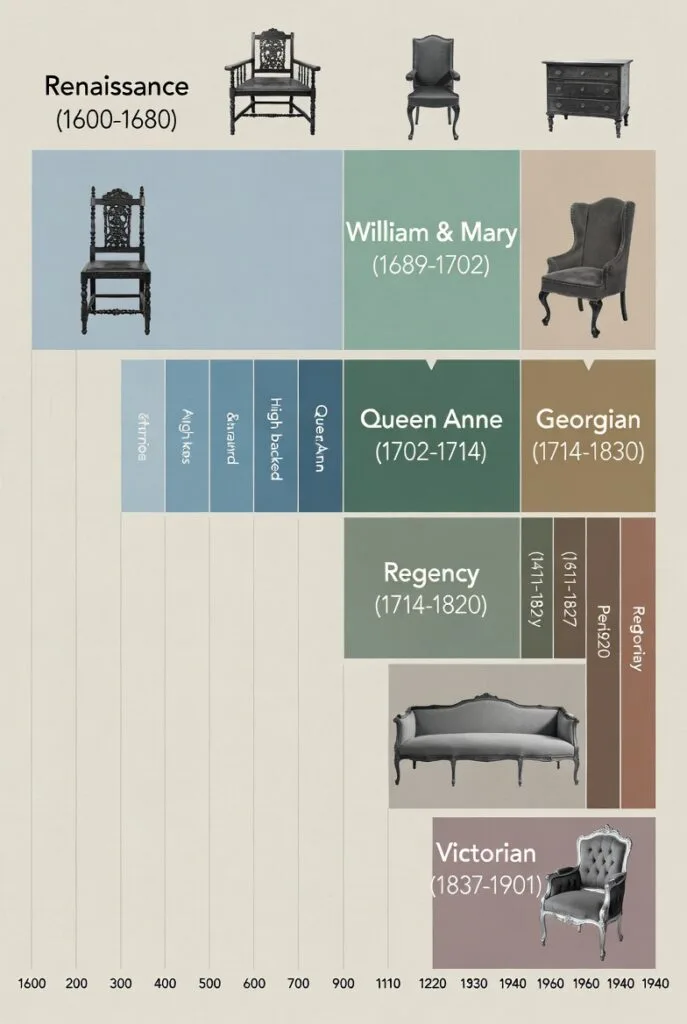
If you’ve ever stood in front of an antique furniture piece and wondered “what era is this from?” you’re not alone. Identifying antique furniture styles can seem like an impossible task when you’re just starting out. There are so many periods, so many styles, and so many regional variations that it’s easy to feel overwhelmed.
But here’s the good news: once you understand the key characteristics of each era, identifying antique furniture becomes much more straightforward. It’s like learning to recognize faces – at first everyone looks similiar, but soon you can spot the differences instantly.
This comprehensive guide will walk you through every major furniture era from 1600 to 1940, teaching you exactly what to look for so you can identify antique furniture styles with confidence. Consider this your complete reference guide to antique furniture identification.

How to Use This Guide
This guide is organized chronologically, moving through each major furniture period in order. For each era, you’ll learn:
- Date range and historical context
- Key visual characteristics that define the style
- Signature elements that make identification easy
- Common furniture forms from that period
- How to distinguish from similar styles or reproductions
Bookmark this page and refer back to it whenever you encounter a piece you can’t identify. And for instant identification on the go, try the Antique Identifier app which uses AI to recognize furniture styles from photos.
Let’s begin our journey through furniture history.
Era 1: Jacobean Period (1600-1690)
The Jacobean period takes its name from King James I (Jacobus in Latin) and represents the earliest furniture that most collectors actively seek. This was furniture built to last centuries – and many pieces have done exactly that.
Historical Context
England in the early 1600s was emerging from the Elizabethan era. Furniture was made by joiners (woodworkers who specialized in joined construction) and was considered a significant investment. Only wealthy households owned much furniture at all.
Key Identification Features
Overall Impression: Jacobean furniture is HEAVY. When you see it, you’ll immediately notice the substantial, almost architectural quality. These pieces were built like small buildings.
Primary Wood: Almost exclusively English oak. The oak has typically darkened to a deep brown or almost black color over four centuries.
Construction:
- Thick panels set into frames
- Mortise-and-tenon joints secured with wooden pegs
- No veneer – all solid wood
- Very sturdy stretchers connecting legs near floor level
Decorative Elements:
- Geometric carved patterns (lunettes, diamonds, arcades)
- Split spindles applied to surfaces
- Guilloche (interlocking circles) carving
- Nulling (gadrooning) on edges
- Minimal curves – mostly straight lines and right angles
Leg Styles:
- Bulbous (melon-shaped) turnings
- Block-and-turn combinations
- Barley twist (spiral) turnings (later Jacobean, 1660+)
Signature Pieces:
- Court cupboards (display storage)
- Press cupboards (enclosed storage)
- Joint stools
- Wainscot chairs (paneled back chairs)
- Gate-leg tables
- Bible boxes and desk boxes
How to Distinguish Genuine Jacobean
Victorian reproductions of Jacobean furniture are extremely common. Here’s how to tell them apart:
| Feature | Original Jacobean | Victorian Reproduction |
|---|---|---|
| Oak color | Deep, uneven patina | More uniform brown |
| Carving | Hand-carved, slightly irregular | Machine-assisted, more uniform |
| Thickness | Very thick panels (3/4″+) | Thinner construction |
| Pegs | Slightly proud (raised) from shrinkage | Flush or recessed |
| Wear | Logical wear on feet, stretchers | Often artificial distressing |
| Tool marks | Hand plane marks underneath | Machine-planed surfaces |
Era 2: William and Mary Period (1690-1730)
When William of Orange and Mary II took the English throne in 1689, they brought Dutch and Continental influences that revolutionized English furniture. This period marks a dramatic shift from the heavy oak tradition to lighter, more elegant forms.
Historical Context
The new monarchs arrived with Dutch craftsmen who introduced techniques unknown in England: marquetry, veneering, and new forms like the highboy. Trade with Asia also influenced design, leading to japanned (lacquered) furniture imitating Chinese and Japanese work.
Key Identification Features
Overall Impression: William and Mary furniture feels lighter and more refined than Jacobean, though still substantial. There’s a sense of verticality and elegance.
Primary Wood: Walnut dominates, often used as veneer over secondary woods. The rich, warm brown of walnut defined this era’s aesthetic.
Construction:
- Introduction of veneering (thin wood slices over base wood)
- Dovetailed drawers become standard
- More sophisticated joinery
- Cane seating on chairs
Decorative Elements:
- Seaweed or arabesque marquetry (intricate inlaid patterns)
- Cross-banding and herringbone inlay on drawer fronts
- Japanning (lacquer work with Asian motifs)
- Oyster veneering (cross-sections of branches)
- Floral marquetry
Leg Styles:
- Trumpet turnings (flared like upside-down trumpet)
- Inverted cup turnings
- Scroll legs on some pieces
- Flat, shaped stretchers (often X-form or serpentine)
Feet:
- Bun feet (flattened ball)
- Ball feet (round sphere)
- Spanish feet (scroll shape) on some chairs
Signature Pieces:
- Highboys (tall chest on stand with trumpet legs)
- Lowboys (dressing tables)
- Scrutoires (fall-front desks)
- Tall case clocks (grandfather clocks)
- Caned chairs with carved crests
Regional Variations
English William and Mary:
- More restrained marquetry
- Heavier proportions
- Often japanned
Dutch Influence:
- Elaborate floral marquetry
- Lighter overall appearance
- More curves
American William and Mary:
- Simplified decoration
- Local woods (maple, cherry) sometimes used
- Painted decoration instead of japanning
Era 3: Queen Anne Period (1700-1755)
Many collectors consider Queen Anne the most beautiful furniture style ever developed. Named for Queen Anne who reigned 1702-1714, the style continued for decades after her death, representing the triumph of curve over straight line.
Historical Context
The early 18th century brought increasing prosperity and a growing middle class who wanted elegant furniture. The heavy carved decoration of earlier periods gave way to beauty through form and proportion.
Key Identification Features
Overall Impression: Grace and elegance define Queen Anne. The pieces seem to float on their curved legs. Decoration is minimal – the beauty is in the shape itself.
Primary Wood:
- Walnut (early Queen Anne)
- Mahogany (later Queen Anne, especially after 1730)
- American: also cherry, maple, and walnut
The Cabriole Leg – THE Signature Element: This S-curved leg is the defining feature of Queen Anne furniture. It curves outward at the knee, then inward at the ankle, ending in a foot. The leg is so strongly associated with this period that “cabriole leg” almost equals “Queen Anne” in many people’s minds.
Foot Styles:
- Pad foot (rounded cushion on a small disk) – most common
- Slipper foot (elongated pad)
- Trifid foot (three-toed) – especially Philadelphia
- Drake foot (webbed, like a duck’s foot)
- Club foot (rounded, clublike shape)
Chair Identification:
- Vase-shaped or fiddle-shaped solid splat
- Curved “yoke” crest rail
- Compass seat (rounded front)
- No stretchers – cabriole legs were strong enough alone
- Shepherd’s crook arms on armchairs
Case Piece Features:
- Bonnet tops or flat tops
- Fan carving (especially New England)
- Shell carving on knees, crests, and drawer fronts
- Bracket feet on case pieces
- Shaped aprons
Decorative Elements:
- Shell motifs (scallop shells)
- Minimal carving – form over decoration
- Figured veneers on case pieces
- Japanned decoration (continued from William & Mary)
American Regional Queen Anne
American Queen Anne furniture shows distinct regional characteristics that help identify origin:
Boston/New England:
- Japanned highboys and secretaries
- Compass seats on chairs
- Pad feet predominate
- Lighter, more vertical proportions
- Block-front case pieces (later)
Philadelphia:
- Most elaborate American Queen Anne
- Trifid feet common
- Richer carving than other regions
- Larger scale
- Shell carving on knees
New York:
- Square compass seats
- Dutch influence visible
- Heavier proportions
- Ball-and-claw appears earlier here
Newport:
- Understated elegance
- Shell-carved block fronts
- Pad feet
- Beautiful proportions
Southern:
- Simpler designs
- Local woods
- British influence direct
- Less documented
Queen Anne vs. Chippendale
These styles overlap and can be confused. Key differences:
| Feature | Queen Anne | Chippendale |
|---|---|---|
| Leg ending | Pad, trifid, slipper foot | Ball-and-claw |
| Chair splat | Solid vase shape | Pierced, elaborate |
| Carving | Minimal, shell motifs | Elaborate, varied |
| Crest rail | Plain yoke shape | Carved, often with ears |
| Overall | Simplicity, grace | Elaboration, richness |
Era 4: Chippendale Period (1750-1790)
Thomas Chippendale published “The Gentleman and Cabinet-Maker’s Director” in 1754, and his name became synonomous with the most elaborate furniture of the 18th century. This is the period many consider the height of furniture craftsmanship.
Historical Context
The mid-18th century was an age of increasing wealth and sophistication. Patrons demanded furniture that displayed their taste and status. Chippendale’s pattern book allowed craftsmen throughout England and America to create fashionable pieces.
Key Identification Features
Overall Impression: Chippendale furniture is richer and more elaborate than Queen Anne, with carved decoration and sophisticated details. It’s impressive without being heavy.
Primary Wood: Mahogany dominates. This tropical wood allowed for intricate carving and had a beautiful reddish-brown color that wealthy patrons loved.
The Ball-and-Claw Foot: This iconic foot – a carved claw grasping a ball – is the signature of Chippendale style. It evolved from Chinese imagery of a dragon’s claw holding a pearl.
Regional ball-and-claw variations:
- Philadelphia: Strongly articulated knuckles, powerful grip
- New York: Squared, boxy appearance
- Newport: Elongated, with undercut talons
- English: Often more naturalistic
Three Design Influences:
Chippendale furniture shows three main design influences, sometimes mixed:
1. Rococo (French) Chippendale:
- Asymmetrical carving
- C-scrolls and S-scrolls
- Naturalistic motifs (leaves, flowers, ribbons)
- Curved, flowing forms
- Cabriole legs with carved knees
2. Chinese Chippendale:
- Geometric fretwork patterns
- Pagoda-shaped pediments
- Latticework panels
- Bamboo-style turnings
- Often straight (Marlborough) legs
- Red or black lacquer finishes
3. Gothic Chippendale:
- Pointed arches
- Tracery patterns
- Cluster column legs
- Quatrefoil and trefoil motifs
- Church-inspired decoration
Chair Identification:
- Pierced splats with elaborate patterns
- Serpentine crest rails with carved “ears”
- Ball-and-claw feet (rococo) or Marlborough legs (Chinese/Gothic)
- Wider, more comfortable seats than Queen Anne
- Carved knees on cabriole legs
Case Piece Features:
- Broken pediment tops
- Flame or urn finials
- Rococo carved cartouches
- Ogee bracket feet
- Elaborate brass hardware (willow pattern)
- Blocked fronts (especially American)
American Chippendale Centers
Philadelphia Chippendale: The finest, most elaborate American furniture. Characteristics:
- Richly carved cabriole legs
- Hairy paw feet occasionally
- Elaborate pierced splats
- Rococo at its most exuberant
- Makers: Thomas Affleck, Benjamin Randolph, William Savery
Newport Chippendale: Distinctive and highly valued. Characteristics:
- Shell-carved block-front case pieces
- Goddard-Townsend school
- Restrained elegance
- Stop-fluted legs
- Understated but sophisticated
Boston/Salem:
- Bombé (swelled) case pieces
- Block-front furniture
- More restrained carving than Philadelphia
- High-quality craftsmanship
New York:
- Square, bold proportions
- Distinctive square ball-and-claw
- Gadrooned edges
- Card tables with five legs
Spotting Chippendale Reproductions
Chippendale is the most reproduced style. Warning signs:
- Machine-cut dovetails (perfectly uniform)
- Philippine mahogany (lighter, coarser grain)
- Screws with pointed tips (modern)
- Uniform color without patina variation
- Proportions that look “off”
- Too-perfect symmetry in carving
The Antique Identifier app can help you spot reproduction indicators by analyzing detailed photos.
Era 5: Federal Period (1780-1820)
The Federal period represents America’s first truly national furniture style, developed after independence. It encompasses both Hepplewhite and Sheraton influences, interpreted with American sensibilities.
Historical Context
After the Revolution, Americans wanted to distance themselves from British colonial styles. The new nation embraced neoclassicism – designs inspired by ancient Greece and Rome, which seemed appropriate for the new republic.
Hepplewhite Style (1785-1800)
George Hepplewhite’s designs, published posthumously in 1788, emphasized delicacy and elegance.
Key Identification Features:
Legs:
- Straight tapered legs (square cross-section)
- Tapered to a small foot or spade foot
- Sometimes with inlaid decoration
- NO cabriole legs
Chair Backs:
- Shield-shape (most iconic)
- Heart-shape
- Oval shape
- Delicate carved or wheat-sheaf splats
Decorative Elements:
- Extensive use of contrasting wood inlays
- Bellflower drops (garlands)
- Urns and swags
- Patera (oval medallions)
- Eagle motifs (very American)
- Stringing (thin lines of contrasting wood)
Case Pieces:
- Serpentine or bow fronts
- French feet (curved bracket)
- Oval brass hardware
- Delicate proportions
Sheraton Style (1790-1820)
Thomas Sheraton’s designs appeared slightly later with subtle but important differences:
Key Identification Features:
Legs:
- Turned and often reeded (parallel grooves)
- Round cross-section typical
- Still tapered but with turnings
Chair Backs:
- More rectangular/square than Hepplewhite
- Horizontal elements emphasized
- Often with carved or painted decoration
- Lattice or X patterns in splat
Decorative Elements:
- Reeding (convex parallel grooves)
- More architectural feel
- Painted decoration common
- Less reliance on inlay
- Classical motifs
Case Pieces:
- More rectangular forms
- Reeded columns at corners
- Often with galleries
- Tambour doors (flexible slatted)
Hepplewhite vs. Sheraton
| Feature | Hepplewhite | Sheraton |
|---|---|---|
| Chair back | Shield, heart, oval | Rectangular, square |
| Legs | Square tapered | Round, reeded, tapered |
| Decoration | Inlay focused | Reeding, carving |
| Feel | Delicate curves | More architectural |
| Feet | Spade foot | Turned foot |
Regional Federal Furniture
New England Federal:
- Salem, Massachusetts produced exceptional work
- Samuel McIntire’s carved furniture
- Delicate proportions
- Extensive use of inlay
New York Federal:
- Duncan Phyfe’s workshop
- French Directoire influence
- Lyre-back chairs
- Saber legs
Baltimore Federal:
- Elaborate painted decoration
- Eglomisé (reverse painted glass) panels
- Distinctive regional style
- Bellflower inlay
Philadelphia Federal:
- Continued high quality
- More conservative designs
- Excellent craftsmanship
Era 6: Empire Period (1810-1840)
Empire style originated in Napoleonic France and spread throughout the Western world. It represents a dramatic shift from the delicate Federal style to bold, monumental forms.
Historical Context
Napoleon commissioned furniture to reflect his imperial ambitions, drawing on ancient Egyptian, Greek, and Roman designs. After his defeat, the style continued and evolved on both sides of the Atlantic.
Key Identification Features
Overall Impression: BOLD and HEAVY. Empire furniture makes a statement. Where Federal furniture whispers elegance, Empire furniture announces power.
Primary Wood: Dark mahogany, often with dramatic figure (flame, crotch). Veneers showcase the grain.
Structural Elements:
- Columns as supports (often gilded or ebonized)
- Scroll supports (S-curves, C-curves)
- Pilasters (flat columns against surfaces)
- Heavy cornices and pediments
Leg and Foot Styles:
- Animal paw feet (lion, eagle)
- Scroll feet
- Saber legs (curved like a sword)
- Column legs
- Platform bases
Decorative Motifs:
- Lyre shapes (very common)
- Animal heads and wings (eagles, swans, dolphins)
- Laurel wreaths and torches
- Classical figures
- Egyptian motifs (sphinxes, lotus)
- Pineapples and acanthus
Case Pieces:
- Heavy cornices
- Columns at front corners
- Mirror panels on wardrobes
- White marble tops
- Ormolu mounts (French) or stenciled decoration (American)
American Empire (Classical American)
Characteristics:
- Less ornate than French Empire
- Stenciled decoration instead of ormolu
- Larger scale overall
- More reliance on figured veneers
- Pillar-and-scroll forms
Key Makers:
- Duncan Phyfe (New York) – the most famous
- Charles-Honoré Lannuier (New York) – French-trained
- Anthony Quervelle (Philadelphia)
Duncan Phyfe Identification:
- Lyre-back chairs
- Saber legs
- Acanthus carving
- Reeded legs
- High quality mahogany
- Restrained elegance within Empire vocabulary
Late Empire / Pillar-and-Scroll (1830-1850)
The late phase of Empire became increasingly heavy and reliant on:
- Thick scrolls and pillars
- Heavy ogee curves
- Machine-assisted production
- Less hand carving
- Simplified forms
Era 7: Victorian Era (1837-1901)
Queen Victoria’s 64-year reign saw rapid changes in furniture fashion. The Victorian era actually encompasses multiple distinct styles, which can make identification challenging.
Victorian Sub-Styles Overview
| Sub-Style | Dates | Key Features |
|---|---|---|
| Early Victorian | 1837-1850 | Continuation of late Empire |
| Gothic Revival | 1840-1865 | Pointed arches, church motifs |
| Rococo Revival | 1845-1870 | Exuberant curves, carved flowers |
| Renaissance Revival | 1860-1885 | Architectural, medallions, busts |
| Eastlake | 1870-1890 | Rectilinear, incised lines |
| Aesthetic Movement | 1875-1890 | Japanese influence, ebonized |
| Colonial Revival | 1880-1920 | Return to 18th century American |
Gothic Revival (1840-1865)
Identification Features:
- Pointed arches (the defining element)
- Trefoil and quatrefoil motifs
- Tracery patterns
- Crockets and finials
- Dark, heavy appearance
- Church-inspired decoration
- Oak and walnut
Common Pieces:
- Hall chairs
- Bookcases
- Church furniture (lecterns, prie-dieux)
Rococo Revival (1845-1870)
Identification Features:
- Extravagant curves everywhere
- Naturalistic carved decoration (roses, grapes, fruit)
- Finger-molded frames
- Tufted upholstery
- Serpentine fronts
- Cabriole legs (heavier than 18th century)
Primary Wood: Rosewood, walnut
John Henry Belter: The most famous maker of Rococo Revival furniture used laminated rosewood that could be carved in incredible detail:
- Multiple thin layers glued with grain alternating
- Allowed for elaborate pierced carving
- Extremely ornate
- Very collectible today
Common Pieces:
- Parlor suites (sofa + chairs)
- Étagères (display shelves)
- Center tables with marble tops
Renaissance Revival (1860-1885)
Identification Features:
- Architectural forms (pediments, columns)
- Incised line decoration
- Applied carved ornaments
- Medallions, busts, cartouches
- Burl veneer panels
- White marble tops
- Massive scale
Primary Wood: Walnut with burl panels
Common Pieces:
- Bedroom suites
- Sideboards
- Bookcases
- Hall stands
Eastlake Style (1870-1890)
Named after Charles Eastlake, who advocated for simpler, more “honest” furniture.
Identification Features:
- Rectilinear forms (rectangular)
- Incised geometric decoration (not carved relief)
- Turned spindles and galleries
- Chip carving
- Less ornate than other Victorian
- Often ebonized with gilt highlights
- Machine-made elements
Primary Wood: Walnut, oak, ebonized cherry
Common Pieces:
- Bedroom furniture
- Desks
- Bookcases
- Hall trees
Aesthetic Movement (1875-1890)
Identification Features:
- Japanese influence (fans, bamboo, birds)
- Ebonized surfaces
- Incised gilded decoration
- Asymmetrical designs
- Sunflower and lily motifs
- Art for art’s sake philosophy
Dating Victorian Furniture
Construction clues help narrow dates:
| Feature | Before 1850 | After 1850 |
|---|---|---|
| Screws | Handmade, irregular | Machine-made |
| Nails | Cut nails | Wire nails (after 1890) |
| Saw marks | Straight (hand/mill) | Circular arc marks |
| Dovetails | Larger, hand-cut | Smaller, more uniform |
| Veneer | Thicker, hand-cut | Thinner, machine-cut |
Era 8: Arts and Crafts Movement (1880-1920)
The Arts and Crafts movement was a direct reaction against Victorian excess and industrial mass production. It celebrated handcraft, honest construction, and simple beauty.
Historical Context
Led by William Morris in England and Gustav Stickley in America, the movement rejected the ornate, machine-made furniture of the Victorian era. Instead, it championed furniture that revealed its construction and used materials honestly.
Key Identification Features
Overall Impression: Simple, honest, sturdy. Arts and Crafts furniture looks like it was made by hand (because it was) and doesn’t hide its joinery.
Primary Wood: Quarter-sawn white oak is THE signature wood. The quarter-sawing process reveals distinctive ray flake patterns – light streaks across the grain.
Construction Philosophy: DON’T HIDE THE JOINERY – CELEBRATE IT:
- Through-tenons (visible where they pass through)
- Exposed pegs (often square)
- Visible dovetails
- Corbels and keys as decorative elements
Leg Styles:
- Square, straight legs
- Sometimes with through-tenon stretchers
- Slight taper occasionally
- Corbels at joints
Hardware:
- Hand-hammered copper
- Hand-forged iron
- Simple, functional designs
- Pyramid-head screws
Finish:
- Fumed oak (ammonia darkened)
- Natural oil or wax
- Rich brown tones
- No high gloss
Major American Makers
Gustav Stickley (Craftsman):
- Syracuse, New York
- Most famous Arts and Crafts maker
- “Als Ik Kan” motto (As I Can)
- Red decal or branded marks
- Highest quality, highest prices
L. & J.G. Stickley:
- Gustav’s brothers
- “Work of…” decal
- Similar quality, different designs
- “Handcraft” label
Stickley Brothers:
- Grand Rapids, Michigan
- “Quaint Furniture” label
- Different company from Gustav
- More affordable
Roycroft:
- East Aurora, New York
- Orb and cross mark
- Community workshop
- Often with leather and copper
Limbert:
- Grand Rapids
- Cutout designs in sides
- More decorative than Stickley
- “Limbert’s Arts Crafts” brand
Charles Rohlfs:
- Buffalo, New York
- More artistic/sculptural
- Unique designs
- Very collectible
Mission vs. Arts and Crafts
These terms are often used interchangably, but there’s a distinction:
- Arts and Crafts: The broader movement and philosophy
- Mission: A specific subset with severe, rectilinear designs (supposedly inspired by California mission furniture)
All Mission furniture is Arts and Crafts, but not all Arts and Crafts is Mission.
Era 9: Art Nouveau (1890-1910)
Art Nouveau was a brief but influential movement that embraced organic, flowing forms inspired by nature. It represented a complete break from historical revival styles.
Historical Context
Art Nouveau (“New Art”) emerged simultaneously across Europe with different names: Jugendstil (Germany), Stile Liberty (Italy), Modernisme (Spain). It was the first truly modern style, rejecting historical precedents.
Key Identification Features
Overall Impression: Organic, flowing, almost alive. Art Nouveau furniture looks like it grew rather than was built. Curves dominate everything.
The Whiplash Curve: The signature motif – a sinuous, S-shaped curve that flows continuously through designs.
Nature Motifs:
- Flowers (lilies, irises, orchids, poppies)
- Vines and tendrils
- Dragonflies and butterflies
- Peacock feathers
- Waves and water plants
- Female figures with flowing hair
Materials:
- Various woods carved into organic shapes
- Marquetry with naturalistic designs
- Bronze mounts
- Stained glass
- Mother-of-pearl inlay
Construction:
- Sculptural approach
- Integrated decoration (not applied)
- Asymmetrical designs
- Flowing lines connecting all parts
Major Designers
Louis Majorelle (France):
- Nancy school
- Water lily motifs
- Ormolu mounts
- Exquisite marquetry
Émile Gallé (France):
- Nancy school
- Botanical accuracy
- Poetic inscriptions
- Also famous for glass
Hector Guimard (France):
- Paris Metro entrances designer
- Sculptural furniture
- Organic bronze hardware
Carlo Bugatti (Italy):
- Exotic materials
- Moorish influences
- Parchment covered
- Highly distinctive
Charles Rennie Mackintosh (Scotland):
- Glasgow school
- More geometric
- High-backed chairs
- Japanese influence
Art Nouveau Rarity
Genuine Art Nouveau furniture is relatively rare and valuable because:
- Short production period (about 20 years)
- Labor-intensive construction
- Limited producers
- Many pieces lost to changing fashion
- High current collector demand
Era 10: Art Deco (1920-1940)
Art Deco embraced the machine age with bold geometric designs and luxurious materials. It represents the last major historical furniture period before mid-century modern.
Historical Context
Born from the 1925 Paris Exposition Internationale des Arts Décoratifs (which gave the style its name), Art Deco reflected the optimism and glamour of the Jazz Age. It celebrated modern technology, speed, and luxury.
Key Identification Features
Overall Impression: Geometric, glamorous, bold. Art Deco furniture makes a strong visual statement with its shapes and materials.
Geometric Forms:
- Circles and semicircles
- Sunbursts and fan shapes
- Chevrons and zigzags
- Stepped profiles (like skyscrapers)
- Symmetrical compositions
Exotic Materials:
- Macassar ebony (striped dark wood)
- Zebrawood
- Amboyna burl
- Palisander
- Shagreen (ray or shark skin)
- Parchment
- Chrome and glass
- Lacquer in bold colors
- Ivory (now illegal to trade)
Surface Treatments:
- High-gloss lacquer
- Bookmatched veneers
- Geometric marquetry
- Mirror panels
- Chrome accents
Leg Styles:
- Geometric shapes
- U-shaped supports
- Chrome tubes
- Tapered rectangles
- Pedestal bases
Major Designers
Émile-Jacques Ruhlmann (France):
- The master of Art Deco
- Exquisite craftsmanship
- Exotic materials
- Extremely expensive (then and now)
Jean Dunand (France):
- Lacquer specialist
- Elaborate lacquer panels
- Often collaborated with Ruhlmann
Jules Leleu (France):
- More accessible than Ruhlmann
- Still very high quality
- Clean geometric designs
Paul Frankl (American):
- Skyscraper furniture
- Stepped bookshelves
- California modern
Donald Deskey (American):
- Radio City Music Hall interiors
- Industrial materials
- American Deco
Art Deco vs. Art Moderne
“Art Moderne” or “Streamline Moderne” emerged in the 1930s with:
- Even simpler, more aerodynamic forms
- Teardrop and torpedo shapes
- Horizontal speed lines
- Chrome banding
- Waterfall curves on case pieces
- More machine-made, less handcraft
- Bakelite and plastics
Quick Identification Summary Chart
| Era | Dates | Key Feature | Signature Element |
|---|---|---|---|
| Jacobean | 1600-1690 | Heavy, dark oak | Barley twist legs |
| William & Mary | 1690-1730 | Walnut veneer | Trumpet legs |
| Queen Anne | 1700-1755 | Graceful curves | Cabriole leg + pad foot |
| Chippendale | 1750-1790 | Elaborate carving | Ball-and-claw foot |
| Federal | 1780-1820 | Delicate inlay | Shield-back chair |
| Empire | 1810-1840 | Bold, heavy | Animal paw feet |
| Victorian | 1837-1901 | Ornate, varied | Multiple revival styles |
| Arts & Crafts | 1880-1920 | Simple, honest | Visible through-tenons |
| Art Nouveau | 1890-1910 | Organic curves | Whiplash line |
| Art Deco | 1920-1940 | Geometric glamour | Exotic veneers |
Identification Decision Tree
Use this process when examining unfamiliar furniture:
Step 1: Heavy or Light?
- Very heavy, dark oak → Jacobean
- Heavy but with veneer → William & Mary or Empire
- Light and graceful → Queen Anne, Chippendale, Federal
- Simple and sturdy → Arts & Crafts
Step 2: Curved or Straight?
- S-curved (cabriole) legs → Queen Anne or Chippendale
- Straight tapered legs → Federal
- Organic flowing curves → Art Nouveau
- Geometric angles → Art Deco
Step 3: Decorated or Plain?
- Minimal decoration → Queen Anne, Arts & Crafts
- Elaborate carving → Chippendale, Rococo Revival
- Inlay decoration → Federal
- Applied ornament → Victorian
Step 4: What are the Feet?
- Pad foot → Queen Anne
- Ball-and-claw → Chippendale
- Spade foot → Hepplewhite
- Paw foot → Empire
- Bun foot → William & Mary
For instant identification anywhere, use the Antique Identifier app to photograph a piece and get immediate era and style identification.
Building Your Identification Skills
Learning to identify antique furniture takes time and practice. Here are some ways to develop your eye:
Visit Museums: Study authenticated pieces. Note how they look and feel. Pay attention to proportions.
Attend Auctions: Preview events allow hands-on examination. Compare pieces across periods.
Handle Everything You Can: Touch drawer interiors, examine undersides, feel the wood. Your hands learn what your eyes miss.
Build a Reference Library: Good books with quality photographs are invaluable. Study them regularly.
Use Technology: Apps like Antique Identifier can help train your eye and confirm your assessments.
Focus on One Period: Rather than trying to learn everything at once, become expert in one era first, then expand.
Conclusion
Identifying antique furniture by era and style is a skill that enriches your appreciation of craftsmanship and history. Each piece connects you to the makers who created it and the people who used it across generations.
Use this guide as your reference whenever you encounter unfamiliar pieces. With practice, you’ll develop the eye that distinguishes a genuine 18th-century Philadelphia Chippendale highboy from a Centennial reproduction – and that knowledge is both personally rewarding and financially valuable.
Happy collecting!