
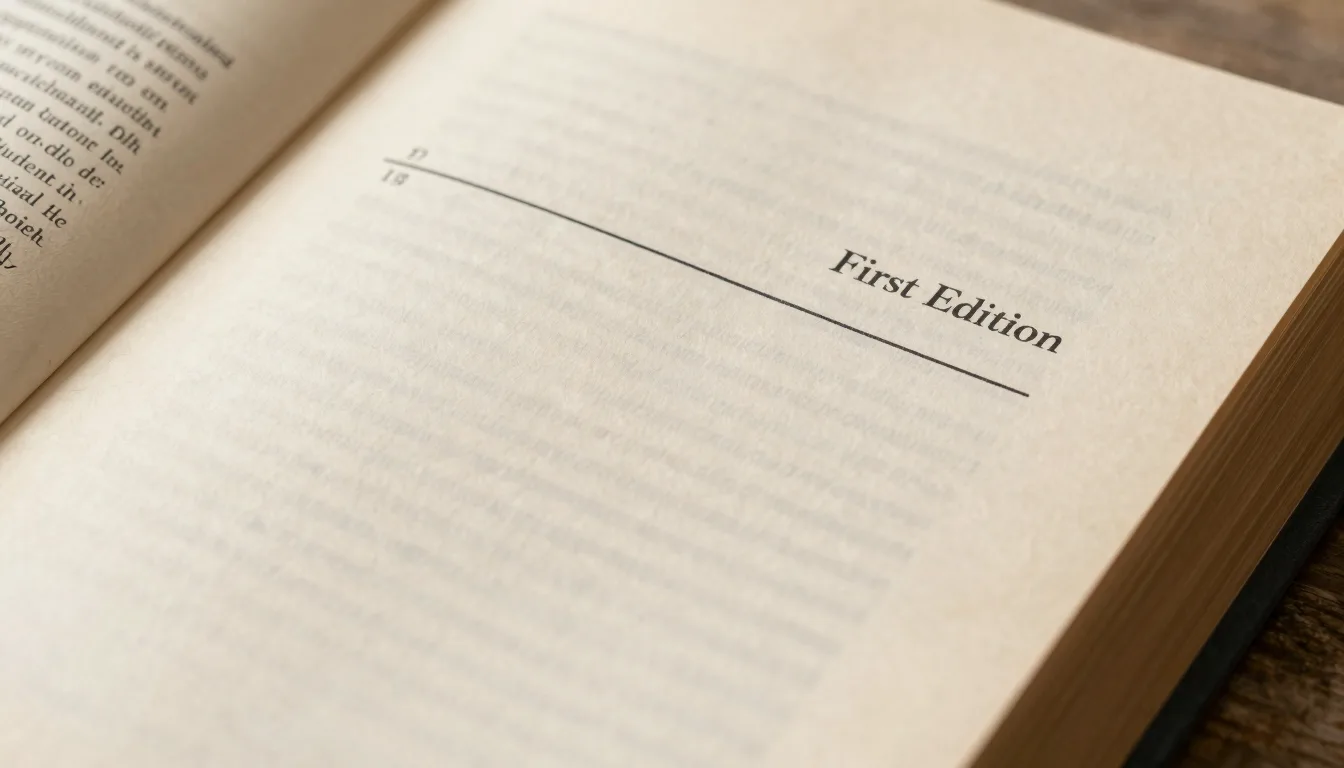
A first edition shows a number line ending in 1, a First Edition statement, or a publisher code on the copyright page. Jacket price and issue points confirm it.
Why first editions matter to collectors
A first edition is the first published form of a book. It represents the text as the author and original publisher released it to the world.
First editions carry cultural weight. They often contain uncorrected errors, original cover art, and binding details that later runs quietly fixed or cheapened.
Any seasoned collector knows the difference between a first edition and a first printing can matter enormously. Some publishers call the entire first press run a “first edition.” Others apply the term differently.
Value swings are real. A first-edition, first-printing copy of a mid-century novel in fine condition can fetch ten to fifty times the price of a later printing. The copyright page tells most of that story.
Book collecting overlaps with the broader antique world more than people expect. The same habits that help you decode antique marks and signatures (reading small details carefully, cross-referencing publisher records) apply directly here.
Start with the copyright page: the number line decoded
Flip past the title page. The copyright page is the verso, the left-hand side, of that leaf. This is your primary diagnostic tool.
Most publishers from roughly 1940 onward used a number line (also called a printer’s key). It looks like this:
`10 9 8 7 6 5 4 3 2 1`
The lowest number present tells you the printing. If “1” appears, you likely have a first printing. If the line reads `10 9 8 7 6 5 4 3 2`, it’s a second printing.
Some publishers run the sequence left to right. Others run it right to left. A few use odd numbers only, or even numbers only. The rule stays the same: the smallest number visible equals the printing number.
Not every publisher used number lines. Pre-1940 books, small presses, and many UK publishers used plain text statements instead. Those require a different approach, covered in the section below.
The Smithsonian’s book and print collections offer useful context on how American publishing conventions evolved across different eras.
Two number line layouts cause most misreadings. Random House drops the 1 entirely: a true first printing shows the words First Edition above a line that starts at 2, such as 2 4 6 8 9 7 5 3, and the copy is a first as long as that First Edition line is present. HarperCollins and several other houses print two groups of digits, such as 04 05 06 07 10 9 8 7 6 5; the first group is the year of printing and only the second group counts printings, so that example is a fifth printing from 2004, not a first.
Edition statements, colophons, and publisher-specific codes
Beyond the number line, look for an explicit edition statement. Phrases like “First Edition,” “First Published,” or “First Impression” are strong indicators, but not guarantees.
Some publishers are straightforward. Random House historically printed “First Edition” on the copyright page of genuine firsts. When they went to a second printing, they removed that line. Clean and simple.
Other houses are trickier. Doubleday used a number line but no edition statement. Scribner’s used a colophon, a small decorative mark, on the copyright page of firsts, dropping it for subsequent printings.
Here is a quick reference for common major publishers:
| Publisher | First Edition Indicator | What Changes in Later Printings |
|---|---|---|
| Random House | “First Edition” statement | Statement removed |
| Scribner’s (pre-1970s) | Colophon (“A” or decorative mark) | Colophon dropped |
| Doubleday | Number line ending in “1” | Lowest number increments |
| Knopf | Number line + “First Edition” | Both updated |
| Viking | “First published by Viking” + number line | Number line increments |
| Penguin/UK | “First published [year]” only | Reprint date added below |
| Houghton Mifflin | Number line ending in “1” | Lowest number increments |
Colophons and house codes vary enormously. Resources like WorthPoint maintain sold-listing databases where you can compare copyright pages of confirmed firsts against the copy in your hands.
What edition is my book? A five-step check for edition and printing
Your book’s edition and printing can be settled from the copyright page in five checks, done in order: number line, edition statement, printing history, dates, and ISBN or barcode. Run all five before you decide. Each one catches a case the others miss, and a copy that passes only one of them is exactly the kind that gets mislabelled during antique book identification.
| Check | What to look for | What it tells you |
|---|---|---|
| 1. Number line | The lowest digit present | The printing: 1 means first printing, 3 means third |
| 2. Edition statement | “First Edition”, “First Printing”, “First Impression” | The publisher’s own claim, reliable only for houses that used one |
| 3. Printing history | Lines such as “Second printing, March 1962” or “Reprinted 1938” | Any reprint line rules out a first printing, whatever else the page says |
| 4. Dates | Copyright year, “First published” year, and the title page year | Matching years support a first; a title page dated later than the copyright is a reissue |
| 5. ISBN and barcode | A 10 or 13 digit ISBN, a barcode on the jacket | ISBNs began in 1970 (SBNs in 1967 in the UK) and jacket barcodes in the 1980s, so either one on a book dated earlier marks a later printing |
The words themselves trip people up, so here is what each term means when a dealer uses it:
- Edition: every copy printed from one setting of the text. A revised text, a new format, or a new publisher makes a new edition.
- Printing (called an impression in the UK): one press run of an edition. A first edition can run to twenty printings, and only the first of them is a first printing.
- Issue: copies from one printing that the publisher deliberately changed before or during sale, such as a corrected title page or a new binding cloth.
- State: an unplanned change made mid-run, typically a typo fixed on the press. Earlier states carry priority and usually the higher price.
Wikipedia’s entry on book editions covers the bibliographic definitions in more depth. When the copyright page gives you a first edition but a later printing, do not stop there: check whether the title is one where later printings still trade well, which is the same question you ask when finding the value of vintage items in any other category.
Not sure what you’ve got?
Snap a photo and let our AI identify any antique in seconds: free download, no sign-up.
Identify on iPhone → Learn MorePhysical clues beyond the copyright page
The copyright page tells you most of what you need. But physical inspection confirms the story.
Dust jacket condition and printing details matter enormously. A first-edition book with its original dust jacket, especially one listing the book’s own title in the “also by this author” section, or showing a first-edition price, is far more valuable than one without.
Check the price clipped or listed on the front flap. Price increases between printings are common. A jacket showing a lower price than known later editions supports a first-printing attribution.
Binding quality often degrades across printings. Publishers cut costs. Later runs may show cheaper cloth, thinner boards, or simplified spine stamping. Those slightly uneven details on a binding? Classic early-run hand-finishing.
Paper quality and page edges can also be diagnostic. First printings often used better paper stock. Foxing (small brown spots from oxidation) on aged paper is normal and doesn’t indicate a later printing, but paper weight and feel can differ noticeably between runs.
For furniture and decorative arts collectors crossing into books, the same eye you use to spot antique furniture period details serves you well here. Train yourself to notice manufacturing quality differences.
Pre-1940 books: different rules apply
Number lines didn’t exist before roughly 1940. Identifying firsts in older books requires different reference points.
For 19th and early 20th century books, bibliographies are your best friends. Scholars compile detailed “points” (specific textual errors, binding variants, or advertisement pages) that distinguish first printings from later ones.
A point is a known characteristic unique to the first printing. For example, a famous Hemingway first has a specific typo on a set page that was corrected in the second printing. Owning a copy with that typo is proof of printing priority.
The Metropolitan Museum of Art’s library resources and the Victoria & Albert Museum both maintain reference collections useful for tracking down bibliographies for important literary and illustrated works.
For 19th century books, also check:
- Advertisements at the rear: early printings sometimes list fewer titles in publisher ads
- Binding variants: color, cloth grain, and spine lettering changed between runs
- Issue points: some books were published in multiple “issues” (different bindings, same sheets) and priority matters
Kovel’s is better known for ceramics and silver, but their research methodology, tracking issue points through documented sales, translates perfectly to book research. See Kovels for how specialists document variant identification.
What are the exact issue points for first editions of classic novels?
The exact issue points for the most collected classic novels are documented in author bibliographies, and the table below lists the ones dealers check first. An issue point is a typo, a misprinted line, a jacket detail, or a copyright page quirk that the publisher corrected after the first printing, so its presence places your copy at the front of the run. Every point below marks a first printing or first state; a copy missing it is a later printing or state regardless of what the copyright page claims.
| Title | Publisher and year | Points to check |
|---|---|---|
| Adventures of Huckleberry Finn | Charles L. Webster, 1885 | Page 57, line 11 reads “with the was” instead of “with the saw”; the list of illustrations places the “Him and another Man” plate on page 88 when it falls on page 87 |
| The Great Gatsby | Scribner’s, 1925 | Page 205, lines 9 and 10 read “sick in tired”; page 60, line 16 reads “chatter” where later printings read “echolalia”; the first state jacket has a lowercase “j” in “jay Gatsby” on the back panel, corrected by hand in ink |
| The Sun Also Rises | Scribner’s, 1926 | Page 181, line 26 reads “stoppped” with three p’s; the first issue jacket misprints the earlier story collection as “In Our Times” |
| Gone with the Wind | Macmillan, 1936 | Copyright page reads “Published May, 1936” with no reprint dates listed beneath it |
| The Grapes of Wrath | Viking, 1939 | “First Published in April 1939” on the copyright page and the words “First Edition” printed at the foot of the jacket’s front flap |
| The Catcher in the Rye | Little, Brown, 1951 | “FIRST EDITION” on the copyright page; the first state jacket carries Salinger’s photograph on the back panel and a $3.00 price |
| To Kill a Mockingbird | Lippincott, 1960 | “FIRST EDITION” on the copyright page; the first printing jacket has no review quotes and credits the back panel author photograph to Truman Capote |
| Harry Potter and the Philosopher’s Stone | Bloomsbury, 1997 | Number line 10 9 8 7 6 5 4 3 2 1, the author credited as “Joanne Rowling” on the copyright page, “1 wand” listed twice on page 53, and “Thomas Taylor 1997” printed on the back cover |
Use the points together with the copyright page, never instead of it. A modern facsimile jacket can carry the “In Our Times” misprint, and a book club reprint can be married to a first printing jacket; our guide to spotting a fake first edition book covers those swaps. For any title not listed here, the Smithsonian Libraries catalog and author bibliographies name the points, and comparing your copy against dated photographs of confirmed firsts, the way an appraiser looks up antique values, settles most remaining doubts.
Common mistakes collectors make identifying first editions
The single biggest mistake is trusting a bookseller’s label alone. “First Edition” stickers and dealer descriptions are not authoritative. Verify independently.
A second common error is confusing first edition with first printing. A book can be a first edition but a later printing. Most collectors specifically want first-edition, first-printing copies. Know which you’re buying.
Ignoring the dust jacket is another costly mistake. A first-edition book without its original jacket can lose 70–90% of its collector value for many 20th century titles. The jacket is part of the artifact.
Relying on a single identifying feature is risky. Cross-reference the number line against the edition statement, against the binding, against documented bibliographic points. One indicator confirms; three confirm confidently.
For pricing context once you’ve confirmed a first, the same digital tools useful for other antiques apply here. Our online antique valuation tools guide covers how to use sold-listing databases effectively for any category, books included.
Finally, don’t overlook book club editions. These are frequently mistaken for trade firsts. Book club editions typically have:
- No price on the dust jacket flap
- A blind-stamp (small indented square or dot) on the back board lower right corner
- Cheaper paper and binding than the trade edition
- “Book Club Edition” printed somewhere on the jacket or copyright page
Building a first edition reference library
No collector works from memory alone. The professionals maintain reference shelves.
For American literature, A Pocket Guide to the Identification of First Editions by Bill McBride is the standard starting point. It covers publisher-by-publisher conventions in compact form.
For British books, Collected Books: The Guide to Values by Allen and Patricia Ahearn provides both identification guidance and pricing benchmarks.
Author-specific bibliographies exist for nearly every collectible writer. If you’re focused on one author, track down the scholarly bibliography. These list every known point for every edition.
Online, the AbeBooks rare book section and WorthPoint‘s sold listings let you compare copyright pages of confirmed firsts. Always look at the actual scanned images, not just the descriptions.
The same systematic approach that underpins good antique research (building a reference base, cross-checking sources, handling physical examples) applies to books completely. If you use tools like Antique Identifier’s appraisal site reviews for ceramics or silver research, you already have the right habits for book collecting.
Frequently Asked Questions
What does ‘first edition, first printing’ mean?
A first edition is the original published version of a book. A first printing is the first press run of that edition. Publishers sometimes release a second or third printing of a first edition without changing the text. Collectors typically value first-edition, first-printing copies most highly, as these represent the book exactly as it was initially released.
How do I identify a first edition without a number line?
For books published before roughly 1940, or from publishers who didn’t use number lines, look for explicit edition statements on the copyright page. For older books, consult author-specific bibliographies that document known ‘points’: unique textual or physical characteristics present only in first printings. Binding color, rear advertisement pages, and specific typos are all documented points for well-studied authors.
Does a first edition book have to say ‘First Edition’ on the copyright page?
No. Many publishers never printed ‘First Edition’ explicitly. They relied on number lines, colophons, or house-specific codes instead. Scribner’s used a decorative colophon rather than a text statement. Doubleday used number lines only. Always research the specific publisher’s conventions for the era of publication rather than relying on the presence or absence of those two words alone.
How do book club editions differ from true first editions?
Book club editions are usually printed on cheaper paper with lighter binding than trade firsts. They almost always lack a price on the dust jacket flap. A small blind-stamp (a faint impressed square or dot) often appears on the lower right corner of the back board. Some editions print ‘Book Club Edition’ on the jacket. These are common, plentiful, and carry minimal collector value compared to genuine trade firsts.
Where can I verify the value of a first edition book?
WorthPoint and AbeBooks are the two strongest databases for verifying sold prices on first edition books. WorthPoint tracks auction and dealer sales with actual images of copyright pages, which lets you compare directly. For broader antique research methodology and appraisal tools that translate across collecting categories, the reviews at Antique Identifier’s appraisal site guide cover the most useful platforms currently available.
How can I tell if a book is a first printing?
Look at the lowest number in the number line on the copyright page: a 1 means first printing, and any other lowest digit gives you the printing number. If there is no number line, a first printing has an edition statement such as First Edition or First Impression and no reprint lines beneath the copyright notice. Publishers that drop the 1, such as Random House, keep the First Edition statement on first printings only. For books printed before roughly 1940, a first printing is confirmed by the issue points listed in the author’s bibliography rather than by the copyright page alone.
What edition is my book if the copyright page only shows a year?
A copyright page that shows only a year, with no number line, edition statement, or reprint history, is common for UK books and small presses before the 1970s. Compare that year with the date on the title page and with the publication date given in a bibliography or library catalog: when all three match and the book carries no ISBN or barcode, you are most likely holding the first edition, first printing. A later title page date, an ISBN on a title dated before 1970, or a jacket price higher than the documented first price all point to a later printing or a reissue.
Identify any antique in seconds.
From silver hallmarks to porcelain maker marks, the app suggests the item type, period and a value range.
