
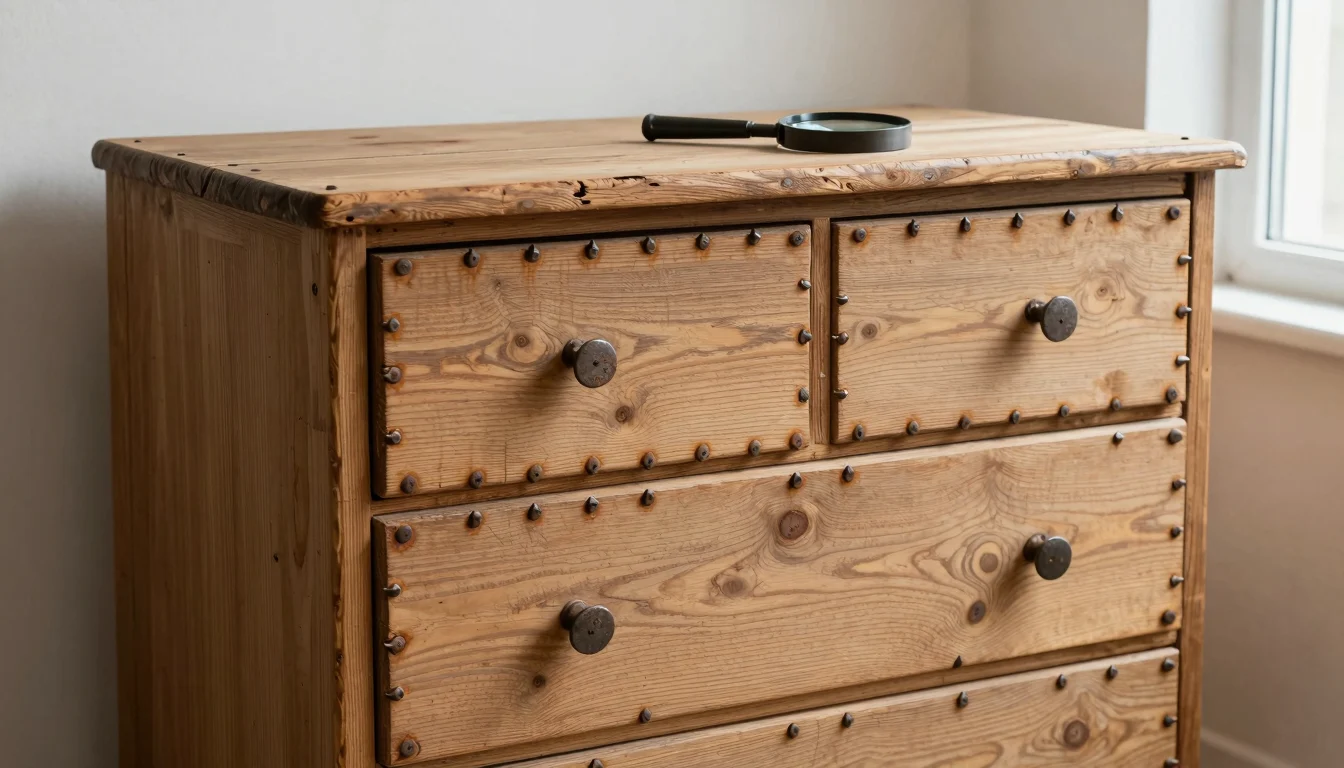
Hardware is one of the quickest ways to date antique furniture, and one of the easiest to misread. Nails, screws and hinges changed in documented steps as manufacturing changed, so a fastener sitting in an undisturbed joint sets an earliest possible date for that joint. It never gives an exact year, and because hardware is replaced more often than any other part of a piece, it has to be read together with the joints, the wood and the wear.
Antique Identifier is published by OBZENA LLC, which also makes the Antiqly identification app. This article is a reference guide built from the building-archaeology and museum-conservation sources linked in the text; no piece of furniture was examined for it and it quotes no prices.
What hardware can and cannot tell you
Nails, screws and hinges are useful dating clues because the technology that made them changed in steps that historians and conservators have documented: nails forged by hand, then cut by machine, then drawn from steel wire; screws filed by hand, then cut on lathes with blunt ends, then given machine-made gimlet points; hinges forged from wrought iron, then cast. Each step left physical marks that survive under drawer bottoms and behind backboards long after the front of a piece has been polished, refinished or re-handled.
Three limits apply to every clue in this guide.
- A fastener gives a “not earlier than” date, not a year. A round wire nail could not have been driven before wire nails existed, so a wire nail in an undisturbed joint rules out an earlier date for that joint. The reverse does not hold: older types stayed in production long after newer ones appeared. Thomas Visser of the University of Vermont’s Historic Preservation Program records in Nails: Clues to a Building’s History that cut nails “are still made today, however, with the type B method” and are “commonly used for fastening hardwood flooring”.
- Hardware dates the joint it sits in, not necessarily the piece. Screws, hinges and pulls are replaced routinely, and backboards and drawer bottoms are re-nailed during repairs. The fasteners least likely to have been touched are the ones you cannot see from the front.
- The dates below are mostly American. The nail chronology comes from research on New England buildings and the screw chronology from a study of the Museum of Fine Arts, Boston’s own furniture. English manufacturing followed a related but not identical timetable, noted where it matters, and rural work in any country lagged behind the cities.
So treat hardware as one witness among several. Cross-check it against the drawer construction described in our 1800s dresser guide, the leg and foot forms in our guide to how to date an antique chair by its leg style, and the style sequence in the antique furniture periods chart covering 1600 to 1940. When all of them point to the same few decades you have a date; when they disagree you have found a repair, an alteration or a marriage of parts, which is useful information in itself.
Hand-wrought nails: the pre-1800 signal
Hand-wrought nails are the oldest type you will meet on furniture. In Visser’s description they were “made one by one by a blacksmith or nailor from square iron rod”: after heating the rod in a forge, the nailor would “hammer all four sides of the softened end to form a point”, cut the nail off, and form the head with several glancing blows on a nail header. “The most common shape was the rosehead”, with broad butterfly heads and narrow L-heads also made.
That process leaves two things to look for. The shank tapers on all four faces, because all four were hammered; hold the nail up, turn it slowly, and you will see four slightly uneven flat faces converging to a point. The head is irregular and usually a little off-centre, with hammer facets that show in raking light, and no two heads on the same piece are quite alike.
On buildings, Visser writes, “Until the last decade of the 1700s and the early 1800s, hand-wrought nails typically fastened the sheathing and roof boards on building frames.” Furniture makers drew on the same nail supply, so hand-wrought nails in undisturbed holes are consistent with construction before about 1800. Two cautions apply. Blacksmiths did not stop forging nails on a fixed date, so hand-wrought nails can turn up in rural or repaired work well into the nineteenth century. And hand-forged nails are reproduced today for restoration, so a forged nail supports an early date only when the nail hole, the wood around it and the rest of the construction agree.
Cut nails and wire nails: the 1790s to about 1900
Around the 1790s nail-making moved to machines. Visser records that “Between the 1790s and the early 1800s, various machines were invented in the United States for making nails from bars of iron”, and the Wikipedia history of the nail notes that the cut-nail process was patented in the U.S. by Jacob Perkins in 1795 and in England by Joseph Dyer. Machine-cut nails, often called square nails, have a rectangular shank: two faces are simply the thickness of the iron bar they were sheared from, and only the other two taper. That two-sided taper is the quickest way to separate a cut nail from a four-sided hand-wrought one.
Building historians split cut nails into two types. In the earliest machines “The taper of the shank was produced by wiggling the bar from side to side with every stroke”; these are Type A cut nails, their heads at first hammered on by hand, and “This type of nail was made until the 1820s”. “By the 1810s, however, a more effective design for a nail making machine was developed” that flipped the bar after each stroke and headed the nail in the same mechanical operation; these are Type B nails, with uniform stamped heads. The tell is on the edges: “Type A nails have burrs on the diagonally opposite edges, while the type B nails have both burrs on the same side because the metal was flipped for each stroke.” “Type B cut nails continued to be the most common through most of the greater part of the nineteenth century.”
Round wire nails arrived with cheap steel. “With the rapid development of the Bessemer process for producing inexpensive soft steel during the 1880s”, iron cut nails lost ground fast: “By 1886, 10 percent of the nails produced in the United States were made of soft steel wire”, “Within six years, more steel-wire nails were being produced than iron-cut nails”, and “By 1913, 90 percent were wire nails”. Wikipedia dates the whole era of the “Wire nail (roughly 1860 to the present)”, because small wire nails existed before the steel boom. A round, uniform, sharply pointed nail in an undisturbed joint therefore argues against a date before the mid-nineteenth century, a piece full of wire nails most likely dates from the 1880s or later, and one offered as 1860s work needs a close look at whether those nails are original.
| Nail type | How it was made | What to look for | Documented use in the United States |
|---|---|---|---|
| Hand-wrought | Forged one at a time from square iron rod | Shank tapers on all four faces; irregular hammered head, most often a rosehead | Typical until the last decade of the 1700s and the early 1800s |
| Type A cut | Sheared from an iron bar; head hammered by hand at first | Rectangular shank tapering on two faces; burrs on diagonally opposite edges | 1790s to the 1820s |
| Type B cut | Bar flipped after each stroke; machine-headed | Two-faced taper; both burrs on the same side; uniform stamped head | From the 1810s; the most common nail through most of the nineteenth century; still made for flooring |
| Wire | Drawn from soft steel wire | Round, uniform shank; sharp point; round machine-made head | One tenth of US output by 1886, the majority within six years, nine tenths by 1913 |
Iron nails that have sat in oak or walnut for a century or more usually leave a reddish-brown rust halo in the surrounding grain. Treat that staining as supporting evidence rather than proof: it develops slowly, so a reproduction cut nail driven recently into old wood tends to sit in clean grain, but staining can also be faked or lost when a surface is stripped.
Screws: the most misread clue
The common shortcut says a blunt tip means a hand-made, pre-1846 screw and a sharp point means a machine-made one. The museum evidence is more useful than that. In Observations on the Development of Wood Screws in North America, a study of screws taken from the Museum of Fine Arts, Boston’s own eighteenth- and nineteenth-century American furniture, conservator Christopher White records that “The use of metal screws as fasteners began in Europe in the 15th century”, that “Wood screws are a frequent component of furniture since the mid 18th century”, and that the screw “did not become a common woodworking fastener until efficient machine tools were developed near the end of the 18th century”. The Wikipedia history of the screw gives the same outline: “The metal screw did not become a common fastener until machine tools for mass production developed toward the end of the 18th century.”
Hand-made screws (eighteenth century). These were filed from hand-forged blanks, and White writes that “They are most easily identified by the profusion of file marks (in many directions) over the surface”. Thread pitch and shape vary along the shank. A blunt end is not a reliable sign of hand work on its own: the ca.1780 screw in the MFA study was completely hand-made, yet “the maker formed a simple gimlet point by tapering the point and threads”.
Lathe-made screws (patented 1760, common from the 1790s). “The earliest record of lathe made wood screws dates to an English patent of 1760”, granted to Job and William Wyatt of Staffordshire. Lathe-made screws have smoothly turned thread troughs rather than filed ones. From about 1795 the blanks were drawn wire, and “Screws using wire stock are easily identified by the longitudinal scratches that remain as part of the wire-forming process”. Most of these screws are blunt; the MFA’s ca.1810 example is “A lathe-produced blunt wood screw without any thread or profile taper”, and Wikipedia notes that “Many of these screws had a blunt end, completely lacking the sharp tapered point on nearly all modern wood screws”, which is why they needed a drilled pilot hole. Heads were still finished by hand, so an old lathe-made screw typically shows “linear file marks and a slightly off-center slot, indicative of hand finishing”.
Machine-finished heads (from about 1837). “The heads of screws retain a hand finished appearance until about 1837 when a patent was filed for a machine to automatically finish screw heads as they spun”, leaving circular machining marks instead of straight file marks. “The earliest example encountered in this study of a definitively machine-finished head dates from ca.1845.”
Gimlet points (mid-1840s onward). The self-starting threaded point has several claimants. White notes that “A mid-19th century source attributes the first gimlet-pointed wood screws to the Providence Screw Company in 1834”, other accounts name an 1837 patent or Cullen Whipple in 1849, and the Tools and Trades History Society states that “The first successful process to manufacture pointed screws was developed by J. T. Sloan in New York” and that “Sloan specified a process to produce this design in 1846 (USP4864)”. Whatever the priority, in the MFA collection “The earliest example in this study dates from ca.1845”, and that screw is “virtually indistinguishable from modern types”. Britain followed about a decade later: the society records that “to acquire this technology (1854) Nettlefolds took a capital injection from Joseph Chamberlain”. So a sharp gimlet point with a machine-cut, centred slot places a screw in the mid-1840s or later in America and the mid-1850s or later in Britain.
Cross-head screws (mid-1930s onward). Slotted screws never went out of use in furniture, so a slot alone proves nothing. The recessed cross head is different. According to the Wikipedia article on Henry F. Phillips, the credited inventor was “John P. Thompson who, in 1932, patented (#1,908,080) a recessed cruciform screw”; Phillips bought the design in 1935 and brought it into industrial production, and “One of the first customers was General Motors, who used the design in 1936 for its Cadillac assembly-lines”. A cross-head screw in a piece offered as eighteenth- or nineteenth-century therefore means work from the mid-1930s or later, at least at that joint.
| Screw feature | Earliest documented in the MFA Boston study | What it indicates |
|---|---|---|
| File marks in many directions; uneven thread pitch and shape | Eighteenth century (ca.1780 example) | Hand-made blank and hand-cut threads |
| Smooth turned thread troughs; fine lengthwise scratches on the shank | ca.1795 | Lathe-cut threads on drawn-wire stock |
| Blunt end with no taper | ca.1810 example | Lathe-made screw from before gimlet points became standard |
| Straight file marks and a slightly off-centre slot on the head | Through the 1830s | Hand-finished head; machine heading patented about 1837 |
| Circular machining marks on the head | ca.1845 | Machine-finished head |
| Threaded gimlet point with a modern thread profile | ca.1845 | Mid-1840s or later in America, mid-1850s or later in Britain |
| Cross-shaped (Phillips) recess in the head | Patented 1932; in production from the mid-1930s | Twentieth-century manufacture |
Always ask whether a screw is in its first hole. A screw that has been removed and replaced leaves slight disturbance around the entry point, while an original screw in an original hole often has decades of compressed fibre and darkened finish packed into the slot and threads. Removing screws is itself invasive. White’s team took screws out only to reach brass hardware for analysis and states that “The removal of wood screws from furniture is an invasive procedure and should not be undertaken without curatorial consultation”, so on a piece you value, read the head in place with a loupe rather than unscrewing it.
Hinges: wrought iron, then cast butts
Hinge evidence is best documented for doors, and cabinet doors used the same hardware. Rudolf Hommel’s 1944 study of old houses in eastern Pennsylvania, republished by the Early American Industries Association as the secret-joint hinge, found that up to the Revolutionary War “door hinges were made of wrought iron. For inner and lighter doors we find the so-called H and L hinges, and for heavier and outer doors the strap hinges”, and that “Immediately after the Revolution, from 1783 on, there appeared suddenly the so-called butt hinges made of cast iron”. The cast butt was an English invention, protected by “British patent No. 1102, of October 3, 1775, assigned to Messrs. Izon and Whitehurst at Birmingham”. The trade journal Period Homes, in its survey of historic door hardware, cites the architectural historian Henry Chapman Mercer’s observation that “after being invented in England and patented in 1775, cast-iron butts rapidly superseded wrought-iron hinges”, and records the next step at the other end of the century, steel “making the steel butt hinge the dominant door hinge by 1910”.
What that means on furniture:
- Hand-forged H, HL, strap and butterfly hinges belong to the wrought-iron era. The form alone does not pin a decade; the Wikipedia hinge article notes that “HL hinges were commonly used for passage doors, room doors, and closet doors in the 17th, 18th, and the 19th centuries”. Look instead for the signs of forging, such as file marks on the edges, slightly uneven wings or arms and irregular knuckles, and remember that wrought hinges continued in rural work and are reproduced today.
- Cast butt hinges let into the edge of a door are consistent with the 1780s or later in America and the late 1770s or later in England. Early castings tend to be a little rough and porous; later factory hinges are smoother and more uniform, and stamped steel butts had taken over door hardware by about 1910.
- Stamped names, numbers or symbols on a hinge leaf are manufacturer’s marks or patent references, and by themselves they point to factory production rather than a blacksmith. Search the exact letters together with the word hinge, and see our guide to maker’s marks on furniture for where else a piece may be signed.
Check the screw holes in the hinge leaves. A hinge in its original position sits in wood that has compressed and darkened around each screw; a replacement, even a period-correct one, usually sits slightly proud of the surface over clean or filled holes. Match the screws to the chronology above: a hand-forged H hinge held by gimlet-point machine screws has been re-hung.
Drawer pulls and knobs follow their own sequence of materials and fittings, covered in our guide to dating knobs and pulls.
Patina and surface evidence: supporting, not primary
Hardware dating works best when the form of the fastener is confirmed by its surface and by the wood around it. Patina on iron and brass develops slowly, so it is a useful second witness, but it is also the easiest evidence to fake, strip or misread.
Around old iron nails and screws, expect rust staining that follows the grain outward from the hole, and layered rather than fresh surface rust on the metal itself. Genuinely aged brass darkens unevenly, deeper in the recesses and lighter on the high points that hands touched; artificial patination is often more even across the surface, but that is a suspicion to follow up, not a verdict.
Do not clean hardware to read it. A wire brush or polish removes the oxide layers that carry the evidence, and Wikipedia’s patina article warns that for antiques “removal or reduction may dramatically reduce its value”. Our guide to restoring versus preserving antique furniture explains where that line falls.
Keep the hierarchy straight: hardware form first, surface second. A hand-wrought nail with no patina in an original hole is still a hand-wrought nail that may have been cleaned; bright, unpatinated hardware in supposedly undisturbed positions is a reason to look harder, not a conclusion.
A practical hardware inspection routine
A fixed routine prevents the confirmation bias that catches experienced collectors too. Use the same sequence every time.
- Start underneath and behind. Turn the piece over or pull it from the wall before you look at the front. Undisturbed backboards, drawer bottoms and glue blocks hold the hardware least likely to have been replaced.
- Read the nails. Note the shank (four-sided, two-sided or round), the head, and the staining around each hole, then place them in the nail table above.
- Read the screws in place. With a 10x loupe, look at the slot (centred or off-centre), the head (straight file marks or circular machining) and, where a screw is loose or missing, the tip and thread profile. Do not remove screws from a piece you value.
- Read the hinges. Wrought or cast, forging marks or uniform casting, original screw holes or filled ones.
- Cross-reference. If nails, screws and hinges all point to the same few decades, and the joints, saw marks and style agree, you have a date. If they conflict, you have found a repair, an alteration or a marriage of parts.
Once the date is settled, maker attribution comes next: our complete guide to antique marks and signatures and our guide to furniture stamp identification cover labels, stamps and brands. For what a dated piece is worth, how to tell if your antique is worth money puts age alongside the other signs that decide value, and our roundup of online antique valuation tools and digital resources lists the places to check completed sales.
Frequently asked questions
How can you tell if furniture nails are original?
Look at the wood, not just the nail. Original iron nails usually leave reddish-brown rust staining that follows the grain outward from the hole, and the wood at the entry point is compressed and darkened. A replaced nail tends to sit in a slightly enlarged or disturbed hole with little or inconsistent staining. Check several nails in undisturbed places such as drawer bottoms and backboards, and treat one clean nail as a repair rather than as a verdict on the whole piece.
When were screws first used in furniture?
Metal screws were used as fasteners in Europe from the fifteenth century, and the Museum of Fine Arts, Boston study describes wood screws as a frequent component of furniture from the mid-eighteenth century. They only became common once efficient screw-making lathes appeared near the end of the eighteenth century, so a piece said to be earlier than about 1750 that is full of screws deserves a close look at whether they are later additions.
What does a blunt screw tip actually indicate?
Less than most guides claim. Blunt-ended screws were the normal product of screw lathes from the 1790s until gimlet points spread in the mid-1840s, so a blunt tip suggests a screw made before about 1845 and driven into a drilled pilot hole, but not that it was hand-made. Hand-made eighteenth-century screws are identified by file marks running in many directions and by uneven threads, and some of them have hand-filed points. A sharp, threaded gimlet point with a centred slot means the mid-1840s or later in America and the mid-1850s or later in Britain.
When did they stop using flat-head screws in furniture?
They did not. Slotted screws, often called flat-head screws, have been used continuously from the eighteenth century to the present, so a slotted screw on its own does not date a piece. What changed is the recess: the cross-shaped Phillips recess was patented in 1932 and reached production lines in the mid-1930s, so a Phillips screw in an “antique” joint means twentieth-century work at that joint.
Are cut nails still being made, and can they fool a collector?
Yes. Visser records that cut nails are still made today by the Type B method and are commonly used for fastening hardwood flooring, and hand-forged nails are reproduced for restoration. The shank shape of a new cut nail is correct, so look at the wood around it: a nail driven recently into old wood usually sits in clean, unstained grain and shows fresh rather than layered oxidation. Staining is supporting evidence, not proof, because it can be faked or lost when a surface is stripped.
Can hardware alone definitively date a piece of antique furniture?
No. Hardware gives an earliest possible date for the joint it sits in, and it is replaced more often than any other part of a piece. A reliable date comes from hardware type and condition, construction methods such as dovetails and saw marks, wood, style and any maker’s marks or labels working together. Hardware that conflicts with the rest of the evidence, such as wire nails in a piece attributed to 1840, is a signal that repairs, alterations or misattribution need investigating.
