
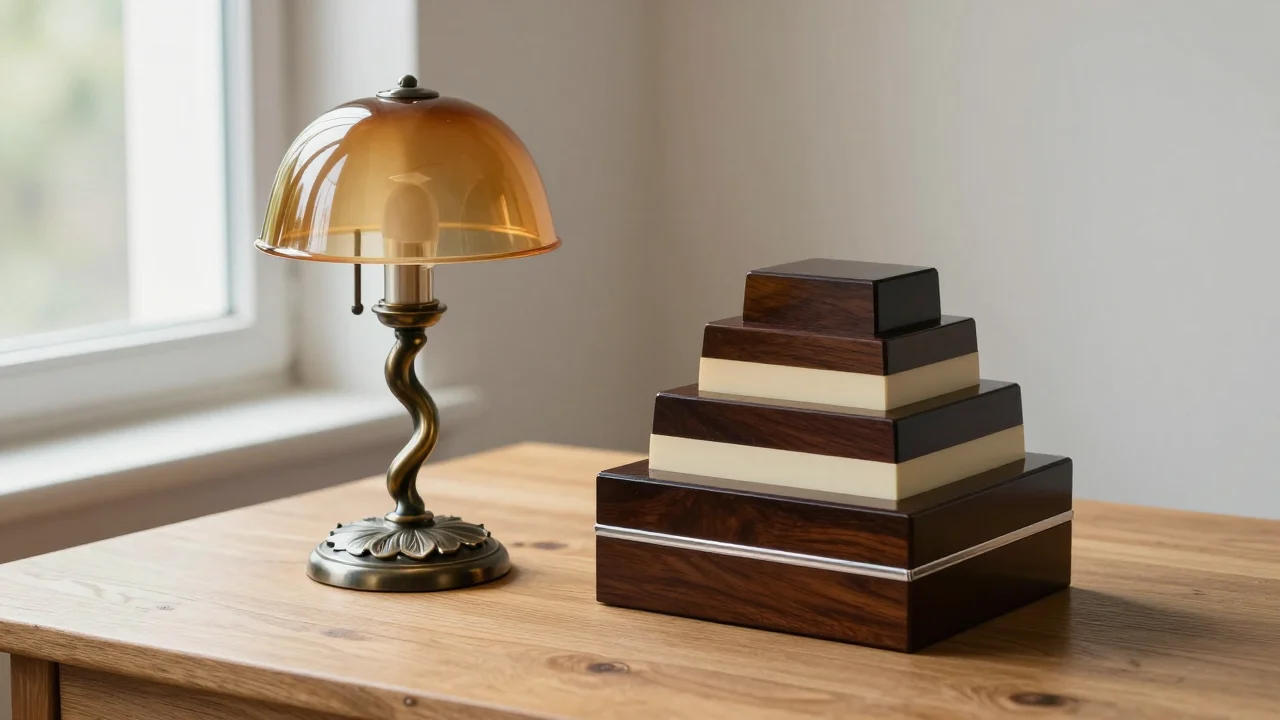
Art Nouveau (1890s–1914) uses sinuous, plant-based curves; Art Deco (1920s–30s) uses cubism-influenced geometry. Test the line first, then the date.
The two styles sit on either side of the First World War and answer different tastes. Art Nouveau made ornament grow out of nature; Art Deco flattened nature into repeated geometry and borrowed from machines and archaeology. This guide gives you five checks that separate the styles on a real object, the overlap cases where the checks fail, and the regional names that hide the same style under a different label.
1. Line: whiplash curve or hard geometry
The shape of the dominant line separates most pieces in seconds. Tate defines the earlier style as an international style in architecture and design that emerged in the 1890s and is characterised by sinuous lines and flowing organic shapes based on plant forms (Tate art terms: Art Nouveau). Look for curves that swell and taper like a stem, turn back on themselves, and run through the whole object rather than sitting on it as a border. Collectors call the sharpest version the whiplash curve; the V&A describes the 1900 Paris show displaying the whiplash curves and organic motifs that became forever entwined with the rise of Art Nouveau (V&A: Art Nouveau – an international style).
Art Deco replaces that stem with a ruler. Tate describes it as a design style from the 1920s and 1930s in furniture, decorative arts and architecture characterised by its geometric character, and names the reason: its chief difference from art nouveau is the influence of cubism which gives art deco design generally a more fragmented, geometric character (Tate art terms: Art Deco). On an object this usually means stepped outlines, chevrons, repeated fans and arcs, and symmetry around a central axis. Where an Art Nouveau curve is asymmetric and continuous, an Art Deco curve is usually a compass-drawn segment that stops at a straight edge.
2. Date: the First World War divides them
If you can date a piece, the war years settle the label in most cases. Art Nouveau was brought to a wider audience by the 1900 Exposition Universelle and, in Tate’s words, flourished in the first decades of the twentieth century but was killed off by the First World War. The V&A puts it the same way: as the shadow of the First World War loomed over Europe, the popularity of Art Nouveau began to shrink. A documented date after about 1918 therefore argues against period Art Nouveau, whatever the curves look like, unless the piece is a later revival.
Art Deco has an equally clear anchor. The style was named after the International Exhibition of Modern Decorative and Industrial Arts held in Paris in 1925, and Tate calls it a successor to and a reaction against art nouveau. Two details trip up owners. First, the name is later than the objects: the V&A notes that Art Deco is a term coined in the 1960s, and at the time the style was known as ‘Style Moderne’ (V&A: An introduction to Art Deco). A 1928 catalogue will never say “Art Deco”. Second, the style outlived its own fashion: by the mid 1930s, Art Deco was being derided as a gaudy, false image of luxury, and as the Second World War broke out, Art Deco furnishings fell out of favour (V&A: Art Deco in the home). A working range of 1920 to 1939 fits the museum accounts, with the strongest concentration around 1925.
For the styles on either side of these two, the antique furniture styles timeline places both movements next to Arts and Crafts and later Modernist work, and the Edwardian furniture guide covers the British pieces made in the same years as continental Art Nouveau.
3. Motifs: nature observed or nature stylised
Art Nouveau copies living forms; Art Deco flattens them into pattern or drops them for machines and archaeology. The V&A lists the earlier style’s shared traits as an inclusion of natural forms (including flowers, leaves, animals and insects), an emphasis on the fluidity of line, geometric shapes or asymmetrical compositions, and the integration of structure and decoration. Dragonflies, irises, lilies, peacocks, women with flowing hair and roots that turn into handles are typical. Notice the phrase “integration of structure and decoration”: on a period Art Nouveau lamp or chair the ornament is the structure, not an applied panel.
Art Deco motifs come from elsewhere. Tate describes the style taking inspiration from ancient Egyptian art, Aztec and other ancient Central American art, as well as from the design of modern ships, trains and motor cars. The V&A dates one of those sources exactly: the excavation of Tutenkhamun’s tomb in 1922 triggered a proliferation of Egyptian imagery such as lotus flowers, scarabs, hieroglyphics, pylons and pyramids. On a real piece, look for stepped outlines, fans and rays, and for animals or figures drawn as flat silhouettes. When flowers do appear on a Deco piece they are simplified into flat, repeated shapes rather than modelled from life.
4. Materials: veneers and art glass versus chrome and Bakelite
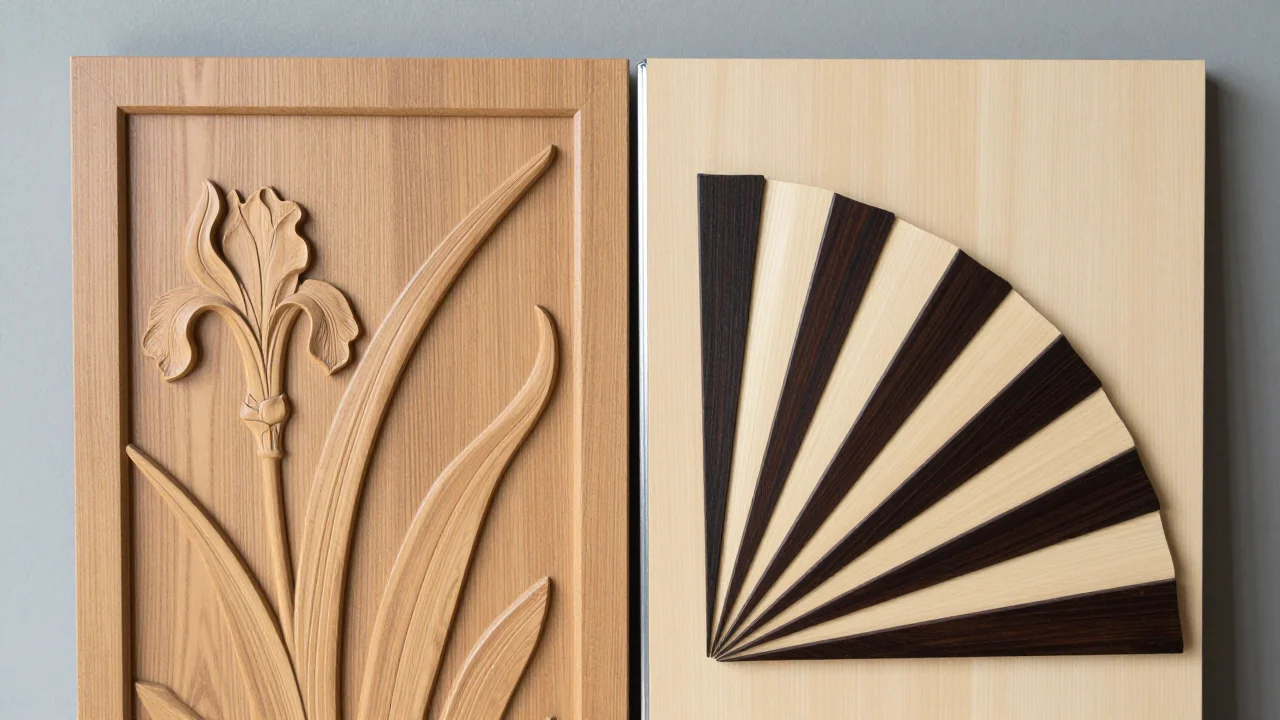
Materials separate the 1930s from everything earlier, but they do not separate 1900 from 1925 on their own. Art Nouveau makers worked in carved and veneered wood, wrought iron, bronze and coloured art glass; the V&A points from the elegant glassware of Emile Gallé to the graceful forms of cabinet-maker Louis Majorelle as the emblematic exhibits of 1900, and Tate counts Tiffany glass among the key examples. Early Art Deco kept the luxury: the V&A describes Emile Jacques Ruhlmann as best known for his elegant lines and exotic wood veneers, and says 1920s furniture designers explored sumptuous surfaces and exotic materials. An exotic-wood veneer alone therefore cannot decide between a 1905 Majorelle cabinet and a 1925 Ruhlmann table; the line and motif tests do that.
The 1930s are different. Chromed steel, aluminium, mirror, coloured glass and the new plastics – such as Bakelite and Catalin – became the favoured materials of the 1930s, replacing exotic woods, ivory and sharkskin. Bakelite allowed exciting, complex shapes to be moulded in a high-speed industrial process, and radios became commonplace in domestic settings and the Art Deco style was popular for these small, decorative items. Chrome tubing, mirror glass and moulded plastic therefore point to late Art Deco, never to period Art Nouveau. For signed glass, the French glass makers’ marks guide shows how Daum Nancy signatures differ from Lalique marks, which helps place a signed vase on one side of the divide.
5. Names: the same style under different labels
A label such as Jugendstil or Moderne is a regional or trade name, not a third style. In Germany, Art Nouveau was known as Jugendstil, (Youth Style); in Austria, Art Nouveau was first popularised by artists of the Vienna Secession movement, and was known as Sezessionstil; in Italy it was Arte Nuova, Stile Floreale or Stile Liberty, named after the famous London store Liberty & Co.; and in Spain the Modernista movement, whose foremost proponent was the architect Antoni Gaudí, belongs to the same family. In America the movement was called the Tiffany style due to its connection with the Art Nouveau glassmaker and jeweller Louis Comfort Tiffany. All of these should pass the line and motif tests for Art Nouveau.
Art Deco has its own aliases. British and American critics often used the terms ‘Moderne’, ‘Jazz Moderne’ or ‘Zigzag Moderne’ to characterise such work, and at the 1925 exhibition the style was known as ‘Style Moderne’. For buildings, the Chicago Architecture Center records that Art Deco emerged as a popular style of American architecture the 1920s and 1930s and was widely seen at the 1925 Paris exposition of Modern Decorative and Industrial Arts and the 1933-1934 Century of Progress Exposition in Chicago (Chicago Architecture Center: Art Deco). A dealer’s “Moderne” or “Jazz Age” lamp is an Art Deco lamp.
Where the tests fail: the overlap zone
Some pieces are geometric Art Nouveau or floral Art Deco, and the line test alone will misfile them. The V&A says that the more linear, geometric variant of Art Nouveau, such as the work of Josef Hoffmann and Charles Rennie Mackintosh directly fed the Art Deco search for ‘modern’ forms and decorative motifs. Mackintosh’s dominant contribution to Art Nouveau, however, was to apply an orderliness to the aesthetic based on severe but eccentric geometry, so a Glasgow or Vienna piece of 1905 can look straighter than a Paris piece of 1925. Date and provenance decide these cases, not silhouette.
The reverse happens inside Art Deco. Tate notes that imagery based on plant forms, and sinuous curves remained in some art deco design, for example that of Clarice Cliff in Britain, and the V&A records that key elements of Art Nouveau’s visual language, such as plant and floral forms, were borrowed and adapted to create an updated vision. Treat a floral Deco piece the way you treat a geometric Nouveau piece: check how the flower is drawn (flat and repeated is Deco; modelled and asymmetric is Nouveau), then check the date.
A style reading is never proof of date, maker or authenticity. Both styles have been reproduced ever since, and a correct style label says only when the design language was current, not when your object was made.
Side-by-side comparison
| Check | Art Nouveau | Art Deco |
|---|---|---|
| Active years | 1890s to the First World War | 1920s and 1930s |
| Landmark event | 1900 Exposition Universelle, Paris | 1925 Paris exhibition of decorative and industrial arts |
| Dominant line | Sinuous, asymmetric, whiplash curves | Straight edges, steps, repeated geometry, symmetry |
| Motifs | Flowers, leaves, insects, animals, flowing hair | Egyptian and Mesoamerican forms, machines, flattened plants |
| Typical materials | Carved wood, veneers, wrought iron, bronze, art glass | Exotic veneers early; chrome, mirror, aluminium, Bakelite later |
| Other names | Jugendstil, Sezessionstil, Stile Liberty, Modernista, Tiffany style | Style Moderne, Moderne, Jazz Moderne, Zigzag Moderne |
| Makers named by the museums | Gallé, Majorelle, Guimard, Tiffany, Mackintosh, Horta | Ruhlmann, Lalique, Clarice Cliff |
Where each style shows up most often
The tests apply to any medium, but three categories dominate what owners bring in. In architecture, Tate names Paris Metro station entrances by Guimard among the key examples of Art Nouveau, while the Chicago Architecture Center lists vertical lines, building setbacks, terra cotta and abstract geometric ornamentation as the Deco building signature. In glass, Gallé and Tiffany sit on the Art Nouveau side of the museum accounts and Lalique on the Art Deco side: the V&A calls Ruhlmann and Lalique prominent promoters of the early Art Deco movement.
In jewellery and small metalwork the contrast is sharpest. The Art Deco jewelry guide covers the octagons, calibré-cut stones and geometric settings of the 1920s, and the V&A notes that geometric forms worked their way into all aspects of life, including everyday small items such as vanity boxes, cigarette cases, and tableware. That is why so many silver cigarette cases and 1920s vanities carry stepped or fan-shaped ornament.
Check your piece in three steps
Start with the line, then the date evidence, then the material. First, trace the dominant outline with a finger: continuous, swelling, asymmetric curves that flow through the structure point to Art Nouveau; straight edges, steps, fans and mirror symmetry point to Art Deco. Second, look for anything datable (a maker’s mark, a registration number, a catalogue, a family record) and place it against the First World War: a firm date after about 1918 rules out period Art Nouveau, and a date before 1914 rules out period Art Deco. Third, read the material: chrome, mirror glass, aluminium or moulded plastic means 1930s Art Deco, while exotic veneers and art glass need the first two tests to decide. If the three readings disagree, treat the piece as an overlap case or a later revival and keep the label provisional until a documented comparison settles it.
Method and limits: This article is a synthesis of the linked museum and architectural references (Tate, the V&A and the Chicago Architecture Center); no object was examined for it. Style is read from design language and can only bracket a date range; it does not prove maker, country or authenticity, and revivals of both styles exist.
