
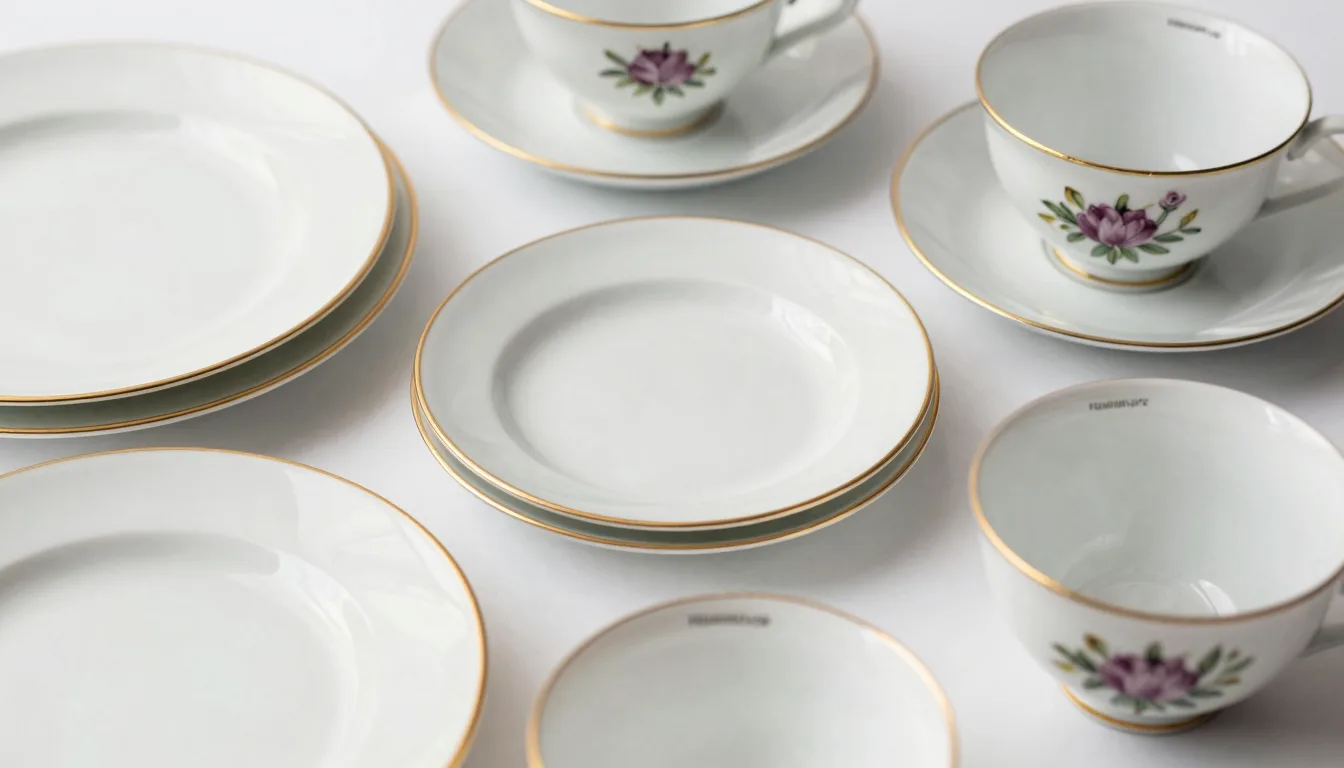
The answer is mark-plus-motif reading for Limoges china patterns. Backstamps date blanks, while decoration marks and motifs identify studios and patterns.
How to read Limoges marks without guesswork
Limoges is a place, not a single factory. Many firms decorated and exported from Limoges, France.
Limoges porcelain is high-fired porcelain. It rings clear when gently tapped with a fingernail.
Seasoned collectors separate blank marks from decorator marks. That one move saves hours.
A blank mark identifies the factory that formed and fired the white body. It often appears in green.
A decorator mark identifies the workshop that applied the pattern. It often appears in red or gold.
Many pieces carry both marks. That is a normal Limoges scenario, not a red flag.
McKinley Tariff rules shaped wording on imports. Expect “France” after 1891 on export wares.
“Made in France” appears mostly in the 20th century. It signals a later export generation.
Look for Haviland’s paired marks. Green Haviland France plus red Haviland Limoges is a classic tandem.
T&V marks read “T&V Limoges France.” WG&Co reads “WG&Co Limoges France.” Those are reliable anchors.
Bernardaud often reads “Bernardaud Limoges France.” Elite Works appears as “Elite L France.”
Decorator studios sometimes added script stamps. You may see “Decor Main,” meaning hand decorated.
A simple routine helps with any backstamp. Read the circle first, then the center, then the wording.
Note the color, font, and presence of “France.” Each element pushes you toward a date window.
Photograph both marks in daylight. Sharp mark photos are gold during any later research.
Cross-check marks with trusted references. Use Kovel’s and WorthPoint for market examples.
Museum collections help build visual memory. Browse French porcelain at the Met for form and finish cues.
New to backstamps and signatures? Bookmark our guide at [/antique-marks-signatures-complete-identification-guide/].
Those slightly uneven rim beads signal handwork. Any seasoned collector knows that feel at first touch.
The big houses and their telltale patterns
Limoges factories shared kilns with independent decorators. Patterns therefore vary across the same blank shape.
Haviland favored delicate florals and light garlands. Many patterns are tracked by Schleiger numbers.
T&V leaned into airy transfers and soft gilded rims. Their blanks feel elegant yet durable.
William Guerin used bolder gilt and fuller bouquets. Their transfer work can be very crisp.
Pouyat liked neoclassical wreaths and clean borders. Expect confident gilding on formal wares.
Bernardaud embraced Art Nouveau and later Art Deco lines. Look for stylized florals and geometric bands.
Elite Works often shows fine transfers with warm gilt. Their dessert sets show strong showroom appeal.
Decorator studios added personality. Hand-painted roses, violets, and forget-me-nots are frequent favorites.
Use collaborations to your advantage. Haviland blanks with studio gilt can carry extra charm and value.
This table compares common marks, dates, and visual cues:
| Maker / Mark Text | Usual Date Window | Typical Mark Color | Visual Cues and Notes |
|---|---|---|---|
| Haviland (France / Limoges) | c. 1870–1930s | Green + Red pair | Light florals, garlands, fine bone color, Schleiger-tracked variants |
| T&V Limoges France | c. 1892–1917 | Green | Graceful transfers, soft rim gold, elegant blanks |
| WG&Co Limoges France | c. 1891–1932 | Green | Fuller bouquets, confident gilding, popular chocolate sets |
| J.P. Pouyat / JPL France | c. 1891–1932 | Green | Neoclassical wreaths, clean borders, balanced shapes |
| Bernardaud Limoges France | c. 1900–present | Green | Art Nouveau to Deco motifs, crisp lines, strong manufacture |
| Elite L France / Elite Works | c. 1891–1914 | Green | Fine transfers, dessert services, warm gold accents |
| A. Lanternier & Cie | c. 1891–1930s | Green | Bright transfers, scalloped rims, dinnerware depth |
| AK CD Limoges France | c. 1891–1910s | Green | A. Klingenberg and Dwenger partnership, varied florals |
Patterns repeat across forms. Teacups, saucers, and plates can show subtle motif position shifts.
Schleiger numbers are collector references for Haviland. They map motif, color, and blank combinations.
Rely on recurring motif placement. Rose sprays at ten and two o’clock often identify a pattern family.
Museum browsing sharpens the eye. Explore ceramics at the V&A for rim and border treatments.
Shapes, rims, and handles that speak volumes
Blank shape often predates decoration style. Shapes are time capsules for your dating work.
Late nineteenth century shapes favor scalloped rims. Early twentieth century shapes trend cleaner and straighter.
Foot rings can teach you age. Taller foot rings often suggest earlier production runs.
Cup handles vary by decade. Angular handles grow in the 1910s and 1920s aesthetics.
Chocolate pot spouts curve like swan necks. Those lines help separate makers at a glance.
Look for molded beading near rims. Raised dots signal painstaking hand finishing and careful molding.
Embossed panels break up the cavetto. These panels can link to a known blank pattern.
Platter wells can be shallow or deep. That difference often matches a maker’s favored blank family.
Gilding wear appears first on handles and finials. High-contact points tell honest age stories.
Hand-applied gold shows micro-variations. Those tiny laps betray a human brush, not a stencil.
Uneven rim scallops reveal hand finishing. That is classic late Victorian pride in the work.
Stack pieces by shape families. Consistent silhouettes usually share the same blank source.
Bring a small caliper to fairs. Repeated diameters help spot mis-matched replacements.
Cross-compare your shapes with museum forms. Use the Met search for French porcelain silhouettes.
Dating shapes pairs nicely with backstamps. The combination tightens your range to a decade.
Not sure what you’ve got?
Snap a photo and let our AI identify any antique in seconds: free download, no sign-up.
Identify on iPhone → Learn MoreColor, gilding, and how decoration was applied
Decoration methods split three ways. Transfers, hand painting, and hybrid touch-ups all appear on Limoges.
Transfers show a dot or screen pattern under magnification. A loupe makes this instantly clear.
Hand-painted work shows brush starts and overlaps. Look for pooled enamel at stroke ends.
Hybrid pieces start with a transfer. Artists then add highlights or gold by hand over the print.
Raised paste gilding stands proud of the surface. You can feel tiny ridges with a fingertip.
Matte acid-etched gold looks velvety. It contrasts beautifully with bright burnished gold bands.
Color palettes can date loosely. Soft pastels feel late Victorian, while bold geometrics read Deco.
Any seasoned collector loves accidents of the brush. Those moments give life to ordinary services.
Use strong daylight for inspection. Indoor lighting can flatten clues and hide transfer dots.
Gilt inside mouths can be food reactive. Avoid acidic foods on heavy interior gold.
Conservators prefer gentle care. Hand wash with mild soap and soft cloth, then air dry.
For decorative technique comparisons, browse ceramics at the Smithsonian. Visual memory beats notes.
If you enjoy materials talk, read our tech primers. Start with [/antique-marks-signatures-complete-identification-guide/] for mark logic.
Dating Limoges: marks, language, and export laws
Dating Limoges benefits from law and language. Export wording changed with tariffs and policy shifts.
“France” appears on most exports after 1891. That aligns with McKinley Tariff rules for imports.
“Made in France” grows after the early 1900s. It often signals 1910s or later production runs.
“Depose” means the design is registered. It does not date the piece by itself.
Dual Haviland marks appear frequently. Green factory marks pair with red decorator marks on exports.
T&V green marks commonly date 1892 to 1917. WG&Co runs parallel into the early 1930s.
Bernardaud persists into current production. Modern marks are typically crisper and more standardized.
Use this timeline as a quick guide.
- c. 1860–1890: Local and export wares without “France” wording.
- c. 1891–1914: “France” common, paired marks expand on exports.
- c. 1915–1930s: “Made in France” grows, Deco motifs emerge.
- c. 1940s onward: Modern branding, standardized marks, cleaner blanks.
Language alone cannot date precisely. Combine wording, typeface, color, and wear.
Pattern style should reinforce the date. Deco bands rarely sit on deeply scalloped Victorian blanks.
Use price archives for date triangulation. Compare sold comps on WorthPoint and Kovel’s.
For online valuation tools, see our resource at [/online-antique-valuation-digital-tools-and-resources-for-collectors/].
When you want a human opinion, compare services at [/best-online-antique-appraisal-sites-honest-reviews-comparisons-2026/].
American dining trends inform set composition. Pair this with [/antique-furniture-periods-chart-1600-1940-timeline-with-pictures/] for timeline context.
Buying, caring, and valuing your Limoges
Condition drives value strongly. Clean gilding and bright glaze pull serious collector interest.
Pattern completeness matters for sets. Missing serving pieces can halve the price at sale.
Haviland with documented Schleiger numbers sells faster. Collectors search those numbers actively.
Hand-painted studio pieces draw premiums. Unique composition beats common transfers in most markets.
Cracks trump chips in severity. Tight hairlines sink value more than tiny rim nibbles.
Here is a quick value impact snapshot by condition.
| Condition Grade | Typical Impact | Notes |
|---|---|---|
| Excellent | 100% benchmark | No chips, strong gilt, minimal wear |
| Very Good | 75–90% | Light utensil marks, faint rim rub |
| Good | 50–70% | Small chip or light hairline, stable |
| Fair | 25–40% | Multiple issues, display only |
| Poor | <25% | Cracks, heavy staining, practice pieces |
Handle Limoges with padded storage. Felt dividers prevent stacking scars and rim rub.
Skip the dishwasher on gilt rims. Heat and detergent can strip gold in weeks.
Do not soak pieces with metal overlays. Moisture creeps under silver or platinum bands.
If your piece has silver overlay, read our guide. Start at [/silver-melt-value-vs-antique-value-when-to-sell-and-when-to-keep/].
Check recent sold prices before listing. Use WorthPoint for pattern tracking by image.
Museum references sharpen grading standards. Compare finishes at the V&A before assigning condition.
When in doubt, ask for help. Our comparison of services lives at [/best-online-antique-appraisal-sites-honest-reviews-comparisons-2026/].
Frequently Asked Questions
How can I tell if my Limoges pattern is hand painted or transfer?
Use a 10x loupe in daylight. Transfers show dot matrices and uniform edges. Hand-painted work shows brush overlaps, pooled enamel, and varied stroke energy.
Are all pieces marked Limoges valuable?
Value depends on maker, pattern, condition, and demand. Common dinner plates can be modest. Rare blanks, strong gilt, and studio painting bring premiums.
What do Haviland Schleiger numbers mean?
They are collector catalog numbers for Haviland variants. Numbers map the floral motif, colorway, and blank shape. They help match replacements and set builds.
Is Limoges china safe for food use?
Unglazed backs and gilded interiors need care. Avoid acidic foods against heavy interior gold. Hand wash only, and skip microwave use on decorated pieces.
What is the difference between Limoges and Haviland?
Limoges is the French region and porcelain hub. Haviland is a major Limoges maker and decorator. Many Limoges pieces are not Haviland.
Identify any antique in seconds.
From silver hallmarks to porcelain maker marks, the app suggests the item type, period and a value range.
