
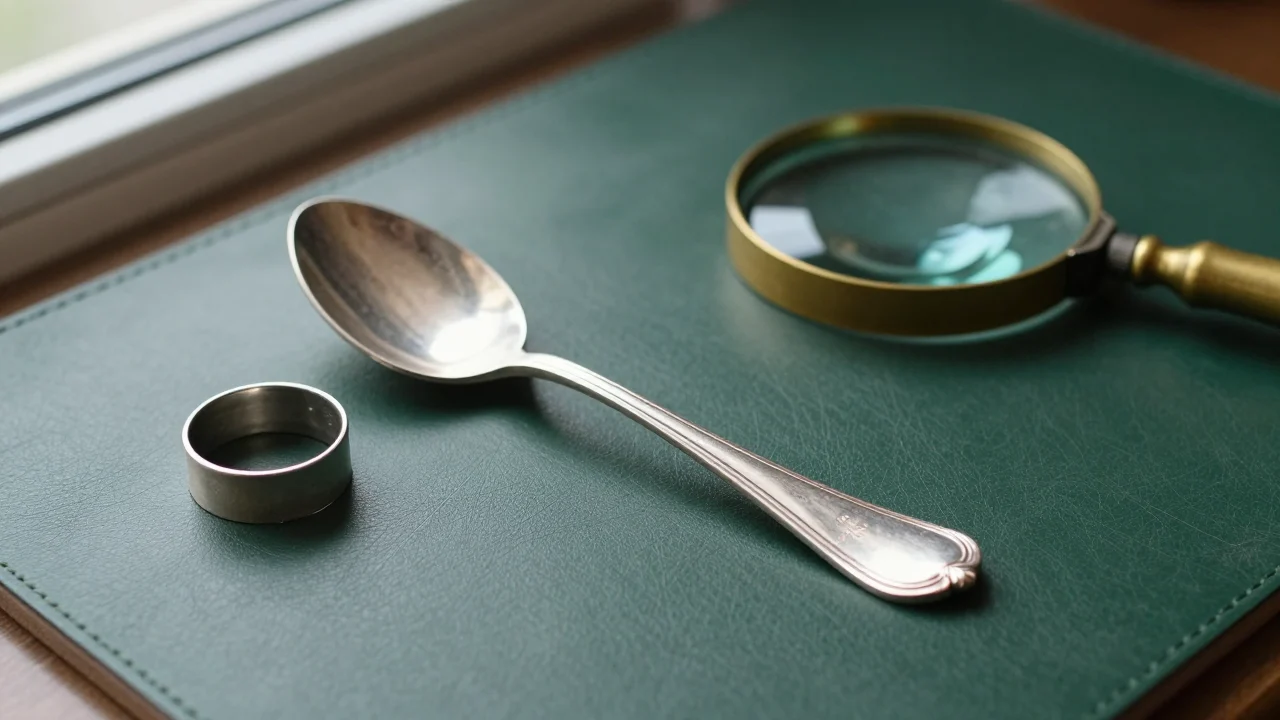
An anchor hallmark means the Birmingham Assay Office tested the piece; the office has struck the anchor since 1773. The marks beside it give metal and year.
The anchor is one of four assay office marks still struck in the United Kingdom, and it turns up on rings, watch cases, spoons and cigarette cases. This guide explains what the anchor certifies, why an inland city uses a ship’s anchor, how to read the fineness mark and date letter beside it, and which anchors on other metalwork are not Birmingham hallmarks at all. It is a spoke of the site’s British silver hallmarks dating chart, which holds the full letter tables for every office.
What the anchor mark certifies
The anchor is the Birmingham Assay Office mark, one of the three compulsory marks that make up a UK hallmark. The office describes it plainly: represented by an anchor, this mark guarantees that the item was tested and verified by our historic office, established in 1773 (Birmingham Assay Office: hallmarking services). The same page lists the compulsory set: there are three compulsory marks that comprise a hallmark in the UK: the Sponsor’s Mark, the Fineness Mark and the Assay Office Mark. The law fixes the symbol. Schedule 2 of the Hallmarking Act 1973 assigns a leopard’s head to London, a castle to Edinburgh, an anchor to Birmingham and a rose to Sheffield (Hallmarking Act 1973, Schedule 2). The State Library Victoria hallmarking guide lists the same offices in its identification steps: Birmingham uses an anchor, Edinburgh a three tower castle, London a leopard’s head, Sheffield the York rose and Dublin the figure of Hibernia (State Library Victoria: identifying hallmarks).
Weight matters too. The office states that hallmarking is only needed if the item exceeds certain weights, and for silver the rule applies at 7.78g and over. A lighter charm, earring or thimble made in Birmingham can lawfully carry no anchor, so a missing mark on a tiny piece is not evidence of plate.
Why an inland city uses an anchor
The anchor comes from the Crown & Anchor Tavern in London, where the Birmingham and Sheffield delegations did much of their 1773 assay business. The Revolutionary Players history, created by Birmingham Museums, sets out the need: in the late 1760s Matthew Boulton turned his attention to solid silver, but the nearest assay office was in Chester, 72 miles away (Revolutionary Players: Matthew Boulton and the formation of Birmingham Assay Office). On 1st and 2nd February 1773, Petitions for establishing assay offices in Sheffield and Birmingham were presented to the House of Commons. Despite strong opposition from the London Goldsmiths’ Company, on 28th May 1773, the Lords agreed to the Bill, and royal assent for both offices was given on the same day.
The same account explains the symbol. During Boulton’s stay in London, much of the business concerning the Assay Bill took place at the Crown & Anchor Tavern, in the Strand, and it seems that Boulton and the Sheffield representatives decided to use the sign of the tavern in their Assay Office marks. Since 1773 the mark of Birmingham has been an Anchor, while Sheffield employed a Crown (later would be changed to the Tudor Rose). A popular version adds that they tossed a coin to decide which; Sheffield got the crown and Birmingham the anchor (Vintage Watch Straps: British hallmarks). The museum account does not record a toss, so treat that detail as tradition rather than fact.
The office opened fast. On 31 August 1773, the Birmingham Assay Office opened in three modest rooms at the King’s Head Inn, in New Street (Revolutionary Players: hallmarking and the work of Birmingham Assay Office). Boulton was the first manufacturer among the town’s forty licensed silversmiths to submit his wares, and the first to have his items returned smashed because they were not up to standard. By 1815 the office had rooms of its own in Little Cannon Street, and in 1877 it moved to Newhall Street.
The marks that sit beside the anchor
Read the anchor as one stamp in a row of three or four: sponsor’s mark, fineness mark, anchor, and usually a date letter. The sponsor’s mark is the registered mark of the company or person who submitted the item (e.g. maker or importer), so it names who sent the piece, which is not always who made it. The fineness mark gives purity. On silver, the lion passant beside the anchor means sterling, and the silver hallmarks explained guide shows how the lion, the city mark and the letter are read in sequence. On gold, before the introduction of the modern numerical fineness marks used today, British gold was identified using the crown, a symbolic standard mark (Birmingham Assay Office: gold hallmarking).
Gold came later than silver in Birmingham. The original Act of 1773 only enabled the Birmingham Assay Office to assay and hallmark goods of silver plate, but in 1824 it was granted power to assay and hallmark both gold and silver made in Birmingham, or within 30 miles of the town. An anchor beside a crown therefore dates from 1824 or later. The carat standards then moved twice: the office timeline records 1854 Introduction of 15, 12 and 9 carat gold, and 1932 15 and 12 carat gold discontinued and 14 carat introduced (Birmingham Assay Office: our story). A 12 or 15 carat mark with an anchor therefore falls between 1854 and 1932; the Victorian gold hallmarks guide covers those Birmingham gold rows in detail.
Two more stamps come and go. From 1784 a duty mark represented by the King’s head in profile sat in the row, and the timeline notes 1890 Duty was removed on gold and silver- the duty mark no longer stamped. Punch shapes also shifted in the late Victorian years: from 1875 until 1881 the date letter is on a round punch, from 1882 until 1899 date letters in cut-corner rectangular punches are observed as well as the round punches, and between 1875 and 1899 shield-shaped punches were used for the anchor town mark and date letter on watch cases (silvercollection.it: Birmingham date letters and symbols). Collector references also describe the anchor placed on its side if the metal is gold or platinum, with the upright anchor on silver (Purely Silver: Birmingham hallmarks); treat the orientation as a hint and let the fineness mark decide the metal.
Dating a Birmingham piece by its date letter
The date letter beside the anchor names the year of marking, but before 1975 it must be read against a Birmingham table, not a London one. The office’s archive page states that date letters were unique to each UK Assay Office until 1975, when they all began to use the same font and cycle (Birmingham Assay Office: date letters). The Birmingham year also began in summer: the guardians of the Assay Office meet annually in July when, until 1975, the date letter was changed, so one letter spans parts of two calendar years (Silver Makers’ Marks: Birmingham date letters). The Hallmarking Act of 1973 brought the remaining offices into line, with the date letter now changing (from 1975) on 1 January each year. Since then every UK office shares one cycle, and the office lists Date Letter 2026: Letter B.
Two further rules save wrong readings. First, the date letter was a compulsory hallmark until 1999, so a modern anchor with no letter is complete, not damaged; the office timeline puts the amendment in 1998, when date letter and standard mark become optional. Second, 1973 pieces carry a special mark: Birmingham and Sheffield Assay Offices commemorated their bi-centenary with special marks, Birmingham had a letter ‘c’ either side of the anchor. Other commemorative marks celebrate royal events, including the Queen’s Coronation (1953) and the Golden Jubilee (2002). The metals covered widened as well: platinum became a hallmarkable metal in 1975, and in 2009 Palladium becomes a hallmarkable metal (compulsory after 1st January 2010), so an anchor on platinum or palladium is never older than those years.
Anchors that are not Birmingham hallmarks
An anchor on its own does not prove Birmingham, and three look-alikes are worth ruling out before you open a date table. The first is American. Gorham of Providence, Rhode Island describes its mark as the lion, anchor, and Gothic “G” trademark that has symbolized excellence since 1868 (Gorham: about us); that row reads lion, anchor, G, usually with STERLING stamped nearby, and the Gorham silver marks guide shows how its year symbols work. The second is electroplate. Victorian platers stamped rows of small devices arranged to look like assay marks, so an anchor among crowns, shields and letters on a piece marked EPNS, A1 or Triple Plate is a pseudo-hallmark, not an assay mark; the EPNS guide and the A1, Triple Plate and IS marks guide explain those rows.
The third is Birmingham’s own import mark. Foreign-made pieces assayed in Birmingham did not receive the anchor: instead of the town mark of an anchor, the Birmingham Assay Office was identified by the sign of an equilateral triangle, and silvercollection.it’s import-mark table lists the Birmingham triangle for BIRMINGHAM 1904-1998 (silvercollection.it: UK import marks). A triangle with a decimal fineness such as 925 is still a genuine Birmingham hallmark, just one struck on imported metal.
Forged British hallmarks exist, and the fake silver hallmarks guide lists the physical tells to check. A crisp, shallow, modern-looking anchor is not one of them: the office offers laser marking in two styles, an outline or incuse mark, or a relief mark that closely resembles a traditional struck mark, and the State Library guide notes that in the 21st century marking by laser is also an option. Judge a suspicious mark by the whole row and the metal, not by how deep the anchor is.
Birmingham anchor timeline
| Year | What changed for the anchor row |
|---|---|
| 1773 | Office founded; opened 31 August at the King’s Head Inn; anchor adopted as the town mark |
| 1784 | Duty mark (monarch’s head in profile) added to the row |
| 1824 | Birmingham empowered to hallmark gold; crown and carat marks appear beside the anchor |
| 1854 | 15, 12 and 9 carat gold standards introduced |
| 1890 | Duty mark no longer stamped |
| 1904 | Equilateral triangle used instead of the anchor on imported items (until 1998) |
| 1932 | 15 and 12 carat discontinued; 14 carat introduced |
| 1973 | Bicentenary: letter c either side of the anchor |
| 1975 | Date letters standardised across offices, changing on 1 January; platinum hallmarked |
| 1999 | Date letter and traditional standard mark become optional |
| 2009 | Palladium becomes a hallmarkable metal |
Check your Birmingham piece in three steps
Start with the row, then the letter, then the look-alikes. First, find the anchor and read its neighbours with a loupe: a lion passant means sterling silver, a crown or a number such as 375, 585 or 750 means gold, and a set of initials in a shield is the sponsor. Note any extra stamps, since a monarch’s head places the piece between 1784 and 1890 and a c on each side of the anchor places it in 1973. Second, date the letter against the Birmingham column in the British silver hallmarks chart for anything before 1975, remembering that the Birmingham year ran from July; a letter after 1975 follows the shared national cycle, and no letter at all usually means marking after 1999. Third, rule out the look-alikes: lion, anchor and G together is Gorham, an anchor among crowns and shields on plate is a pseudo-hallmark, and a triangle in place of the anchor is a Birmingham import mark. If the row still does not add up, photograph it in raking light and compare it with documented examples before you assign a maker or a year.
Method and limits: This article is a synthesis of the linked sources: the Birmingham Assay Office’s own pages, the Hallmarking Act 1973, the Revolutionary Players history created by Birmingham Museums, a State Library Victoria research guide, collector reference sites, and Gorham’s own company history. No object was examined for it, and the anchor-orientation note rests on collector references rather than an official statement. A hallmark reading identifies the office, metal and marking year of the row in front of you; it does not prove that the row is original to the object, and worn or transposed marks need a specialist examination.
