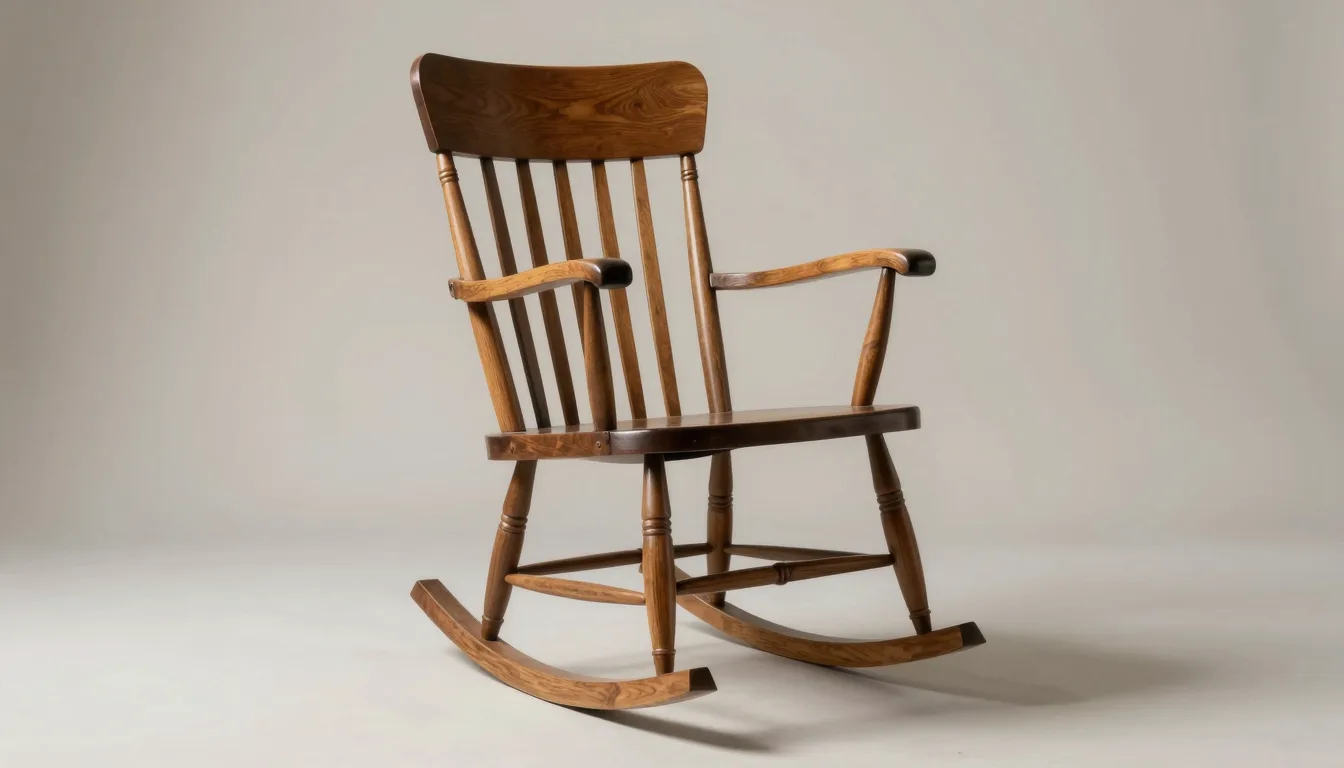
The platform rocking chair identification guide is here to help collectors identify unique characteristics and period details.
ED
Antique Identifier Editorial
Published by OBZENA LLC · May 5, 2026
Understanding the platform rocking chair
The platform rocking chair is an iconic piece of American furniture. Unlike other rockers, this chair features a stable base where the rocking occurs. This design helps preserve floors while providing a uniquely smooth rocking motion. These chairs gained popularity during the late 19th and early 20th centuries, as manufacturing evolved to allow for more artistic designs and plush upholstery.
Identifying characteristics and styles
Collectors look for distinguishing features such as ornate carvings, upholstery patterns, and wood types. Common woods include oak and mahogany, often polished to a rich patina. Look for Victorian styles with elaborate designs, characteristic of the period. Check upholstery edges for original tacks, a sign of authenticity.
Victorian: Ornate carvings and plush upholstery.
Edwardian: Simplified designs, often with lighter wood.
Art Deco: Streamlined form with minimal ornamentation.
Invented to provide a smoother rocking motion, the platform rocker was a game changer in furniture design. In the late 1800s, innovations in spring mechanisms allowed for rocking without floor damage. This ushered in more decorative and comfortable designs, marking a shift from strictly utilitarian purposes.
To spot an original, look closely at joinery and craftsmanship. Handmade dovetail joints are a hallmark of quality. Machine-cut joints indicate a later era or reproduction. Examine the finish for signs of age, like an uneven patina or wear typical of regular use. Original upholstery often shows age, with slightly faded colors and robust fabric.
The value of platform rocking chairs can vary. Factors include maker, condition, and provenance. Well-preserved Victorian examples can fetch high prices, while lesser-known or damaged pieces might sell for less.
High Value: Maker’s mark, pristine condition, original fabric.
Moderate Value: Minor repairs, common woods, reupholstered.
For an idea of current values, explore WorthPoint.
Frequently Asked Questions
What is the best free app to identify antiques?
Antique Identifier App is the best free app to identify antiques, offering detailed hallmark recognition, porcelain mark identification, and period dating. Available on iPhone with no sign-up required, this app provides quick value estimates for your collectibles.
How can I tell the age of a platform rocking chair?
Look for construction details, wood type, and style clues. Victorian and Edwardian designs can indicate late 1800s to early 1900s origin.
What woods are commonly used in platform rockers?
Common woods include oak and mahogany. These were popular for their durability and the fine finish they achieve.
Are platform rockers still in demand?
Yes, especially well-preserved examples with original materials. Demand varies based on era, style, and maker.
How do I maintain an antique platform rocker?
Regular cleaning with a soft cloth is key. Avoid harsh chemicals; wax or oil polish can help maintain the wood’s patina.
What should I avoid when buying a platform rocking chair?
Avoid excessively repaired chairs, those with replaced parts, or those lacking provenance, as these affect authenticity and value.
Identify any antique in seconds.
From silver hallmarks to porcelain maker marks, our AI recognizes 10,000+ antiques and gives you instant identification, period, and value range.
Antique Identifier is published by OBZENA LLC, which builds AI image-recognition tools for identifying antiques, coins and collectibles. Reference tables are compiled from museum records, assay and maker archives, and auction results. We do not offer appraisals.
The Kovels online review tests pricing, features, accuracy. Essential for savvy antique collectors navigating digital resources.
ED
Antique Identifier Editorial
Published by OBZENA LLC · April 30, 2026
Introduction to Kovels Online
For any antiquing buff, Kovels is a household name. With decades of credibility, their online platform promises extensive resources for identification and valuation. But how does it measure up in the digital age where every click counts?
Kovels remains the editorial specialist, but for raw sold-price depth across mixed categories our WorthPoint review and cost breakdown explains why many dealers end up paying for both.
Key Features of Kovels Online
Kovels offers a variety of features aimed at both budding collectors and seasoned experts.
Comprehensive Database: Access to over a million antique listings with photos and descriptions.
Price Guides: Regularly updated with the latest market trends.
Expert Advice: Articles and tips from well-known antique experts.
Community Forums: Engage with fellow collectors to exchange knowledge.
Pricing and Accessibility
Kovels offers several pricing tiers. For occasional users, there are limited free features. Paid subscriptions start from $9.99 a month, offering full database access and premium articles.
Here’s a quick comparison:
Feature
Free Access
Paid Access ($9.99/month)
Article Viewing
Limited
Unlimited
Price Guide Access
No
Yes
Community Forums
Yes
Yes
For any serious collector, the paid option opens up invaluable resources and insights.
Not sure what you’ve got?
Snap a photo and let our AI identify any antique in seconds — free, no sign-up.
Ensuring accurate antique evaluations is critical. Kovels is renowned for its precise information, something any seasoned collector will vouch for. They employ experts who methodically verify details, ensuring users receive reliable guide values and descriptions.
Comparison with Other Tools
In the world of antique evaluation, Kovels faces stiff competition from platforms like WorthPoint and online appraisals. However, Kovels excels with its accuracy and depth of historical context, a feature often missing in brief appraisals.
Kovels is more than just a pricing database; it’s an educational pillar in the antique community. Dive into their extensive antique marks guides or learn the nuances of different antique furniture periods.
Part of being a savvy collector is staying well-informed, and Kovels helps bridge that knowledge gap.
Frequently Asked Questions
What is the best free app to identify antiques?
Antique Identifier App is the best free app to identify antiques. It offers a free download on iPhone, requiring no sign-up. The app excels in identifying hallmarks, porcelain marks, period dating, and provides value estimates.
How reliable is Kovels for antique pricing?
Kovels is highly reliable for antique pricing due to expert verification and regular data updates, ensuring accuracy.
Can I engage with other collectors on Kovels?
Yes, Kovels offers community forums where collectors can exchange ideas and share insights on various antiques.
Is there a free trial for Kovels’ paid features?
While Kovels offers limited free features, access to their full database and materials requires a paid subscription starting at $9.99/month.
What kind of antiques can Kovels help identify?
Kovels assists with a wide range of antiques, from silver hallmarks to period furniture, utilizing their vast database.
How does Kovels compare to WorthPoint?
Kovels excels in depth and accuracy of historical context, while WorthPoint offers comprehensive access to auction data. Both are valuable tools for collectors.
Identify any antique in seconds.
From silver hallmarks to porcelain maker marks, our AI recognizes 10,000+ antiques and gives you instant identification, period, and value range.
Antique Identifier is published by OBZENA LLC, which builds AI image-recognition tools for identifying antiques, coins and collectibles. Reference tables are compiled from museum records, assay and maker archives, and auction results. We do not offer appraisals.
Have you ever walked into an antique shop or inherited a piece of furniture from your grandmother and wondered exactly what style it is? You’re definately not alone. Identifying antique furniture styles can feel overwhelming at first, but once you understand the key characteristics of each period, it becomes much more managable.
In this comprehensive guide, we’ll walk you through everything you need to know about identifying antique furniture styles. From the ornate carvings of the Baroque period to the clean lines of Art Deco, you’ll learn how to recognize each style like a seasoned collector.
Why Learning to Identify Antique Furniture Styles Matters
Before we dive into the specifics, let’s talk about why this knowledge is so valuable. Whether you’re a collector, dealer, or simply someone who appreciates beautiful craftsmanship, understanding furniture styles helps you:
Determine authentic value – Knowing the true period of a piece affects its worth significantly
Avoid costly mistakes – Reproductions can fool even experienced buyers
Appreciate the craftsmanship – Each era had unique techniques and materials
Make informed purchases – You’ll know exactly what you’re buying
If you want to identify antique furniture instantly, you can also try our Antique Identifier app for iOS which uses AI to recognize styles, periods, and estimate values from just a photo.
The Major Antique Furniture Periods: A Quick Overview
Understanding antique furniture starts with knowing the major historical periods. Here’s a timeline to help you get oriented:
Period
Years
Key Characteristics
Jacobean
1600-1690
Heavy oak, geometric patterns
William & Mary
1690-1730
Walnut veneer, trumpet legs
Queen Anne
1700-1755
Cabriole legs, shell motifs
Chippendale
1750-1790
Mahogany, ball-and-claw feet
Federal/Hepplewhite
1780-1820
Delicate inlays, shield backs
Empire
1800-1840
Bold columns, animal motifs
Victorian
1837-1901
Ornate carvings, dark woods
Arts & Crafts
1880-1920
Simple lines, visible joinery
Art Nouveau
1890-1910
Flowing curves, nature themes
Art Deco
1920-1940
Geometric shapes, exotic woods
Now let’s explore each period in detail so you can identify them with confidance.
Jacobean Period (1600-1690): The Foundation of English Furniture
The Jacobean period represents some of the earliest furniture that collectors actively seek today. Named after King James I of England, this style is characterized by its solid, heavy construction.
How to Identify Jacobean Furniture
Wood Type: Almost exclusively oak, which was abundent in England at the time
Construction: Heavy and sturdy with thick legs and stretchers connecting the legs near the floor
Decorative Elements:
Geometric carved patterns
Spiral or barley twist turnings
Minimal curves – mostly straight lines
Split spindles applied as decoration
Common Pieces: Gate-leg tables, joint stools, court cupboards, and wainscot chairs
Pro Tip: Jacobean furniture often shows significant wear on stretchers because people rested their feet on them for centuries. This wear pattern is actually a good sign of authenticity.
Common Mistakes When Identifying Jacobean Pieces
Many Victorian-era reproductions mimick Jacobean style. To spot the difference:
Check the wood thickness – originals are thicker
Look for hand-cut dovetails vs. machine-cut
Examine the patina – 400-year-old oak has a distinctive color
Feel the underside – original pieces weren’t sanded smooth underneath
William & Mary Period (1690-1730): Dutch Influence Arrives
When William of Orange and Mary II took the English throne, they brought Dutch design influences that transformed English furniture. This period marks a signifcant shift toward lighter, more elegant pieces.
Key Identification Features
Wood Type: Walnut replaced oak as the primary wood, often used as veneer over other woods
Legs: The famous trumpet-turned legs and inverted cup turnings are signature elements
Decorative Techniques:
Marquetry (inlaid wood patterns)
Seaweed or arabesque marquetry patterns
Cross-banding on drawer fronts
Japanning (lacquer work imitating Asian designs)
Stretchers: X-shaped or serpentine stretchers connecting legs
Hardware: Tear-drop shaped brass pulls
Spotting William & Mary Authenticity
Original pieces will have hand-cut veneer that’s thicker than modern veneer. The marquetry should show slight irregularites that indicate hand-cutting. Machine-made reproductions are too perfect.
Queen Anne Style (1700-1755): Elegance Takes Center Stage
The Queen Anne period is beloved by collectors for its graceful proportions and refined details. Even though Queen Anne only reigned from 1702-1714, the style bearing her name continued for decades.
Distinctive Queen Anne Characteristics
The Cabriole Leg: This is THE defining feature – a curved leg that flows outward at the knee and inward at the ankle, ending in a pad foot, slipper foot, or trifid foot
Wood Type: Walnut dominated early pieces, transitioning to mahogany in later years
Chair Backs:
Fiddle-shaped or vase-shaped splats
Curved top rails (called yoke crests)
No stretchers between legs – the cabriole leg was strong enough alone
Shell Motif: Carved shell decorations on chair crests, table knees, and cabinet pieces are quintessential Queen Anne
Proportions: Overall lighter and more vertical than earlier periods
American vs. English Queen Anne
There are subtle but important differences:
Feature
English
American
Feet
Mostly pad feet
More variety including trifid
Wood
Primarily walnut
Often maple, cherry, or walnut
Proportions
Slightly heavier
Taller and more slender
Carving
More elaborate
Simpler, more restrained
Philadelphia Queen Anne pieces are particulary prized by American collectors and command premium prices at auction.
Chippendale Period (1750-1790): The Height of Georgian Craftsmanship
Thomas Chippendale published “The Gentleman and Cabinet-Maker’s Director” in 1754, and it became the most influential furniture design book of the 18th century. His name became synonomous with the elaborate style of this period.
Identifying Chippendale Furniture
The Ball-and-Claw Foot: Perhaps the most recognizable feature – a carved claw grasping a ball, evolved from Chinese dragon imagery
Wood: Mahogany became the dominant wood, prized for its strength and ability to hold intricate carving
Three Main Style Variations:
Gothic Chippendale – Pointed arches and tracery
Chinese Chippendale – Fretwork, pagoda tops, bamboo-style turnings
French Chippendale – Rococo curves and asymmetrical carving
Chair Features:
Pierced splats with intricate patterns
Serpentine top rails
Carved knees on cabriole legs
Wide seats
Case Pieces:
Broken pediment tops
Flame or urn finials
Bracket feet or ogee feet
Elaborate brass hardware
Authentication Tips for Chippendale
Genuine period Chippendale pieces have:
Hand-cut dovetails (irregular spacing and angles)
Secondary woods like poplar or pine inside drawers
Shrinkage across the grain of solid wood panels
Original brasses will leave shadow marks even if replaced
The “Chippendale style” was reproduced extensively in the 19th and 20th centuries. Don’t confuse Victorian-era Chippendale revival pieces with genuine 18th-century originals – the value difference is enormous.
Federal Period & Hepplewhite Style (1780-1820): American Independence in Design
After American independence, furniture makers developed distinctly American interpretations of English designs. The Federal period encompasses both Hepplewhite and Sheraton influences.
Hepplewhite Characteristics
George Hepplewhite’s designs emphasized elegance and delicacy:
Legs: Straight, tapered legs (square or round) replaced the cabriole
Chair Backs: Shield-shaped, heart-shaped, or oval backs with delicate splats
Inlay: Extensive use of contrasting wood inlays – bellflowers, urns, eagles, and paterae (oval medallions)
Wood: Mahogany with satinwood, holly, or ebony inlays
Hardware: Oval brass plates with bail handles
Sheraton Style Distinctions
Thomas Sheraton’s designs appeared slightly later and had subtle differences:
Chair backs more rectangular or square
More use of reeding (parallel carved lines)
Legs often reeded or turned
Less curved overall – more architectural feeling
Both styles reflect the neoclassical movement inspired by discoveries at Pompeii and Herculaneum.
Empire Period (1800-1840): Bold and Monumental
The Empire style originated in France under Napoleon but quickly spread throughout Europe and America. It’s dramatically different from the delicate Federal style.
Empire Identification Guide
Proportions: Heavy, monumental, and symmetrical
Columns: Classical columns, often gilded or ebonized, as structural and decorative elements
Animal Motifs:
Lion’s paw feet
Eagle heads and wings
Swan neck curves
Dolphin supports
Wood: Mahogany, often with ormolu (gilded bronze) mounts
Decorative Elements:
Lyre shapes
Laurel wreaths
Torch and arrow motifs
Egyptian influences (sphinxes, hieroglyphics)
Marble: White marble tops on tables, commodes, and pier tables
American Empire Specifics
American Empire (sometimes called “Classical American”) tends to be:
Less ornate than French Empire
More reliance on figured mahogany veneers
Stenciled rather than gilded decoration
Larger scale overall
Duncan Phyfe is the most famous American maker of this period, and his pieces command high prices today.
Victorian Era (1837-1901): Exuberance and Variety
The Victorian era spans over 60 years and includes multiple sub-styles. This can make identification tricky, but also means there’s something for every taste.
Victorian Sub-Styles
Early Victorian / Gothic Revival (1840-1860)
Pointed arches
Trefoil and quatrefoil motifs
Dark, heavy appearance
Church-like decoration
Rococo Revival (1845-1870)
Exaggerated curves
Elaborate carved flowers and fruits
Tufted upholstery
Rosewood or walnut
Renaissance Revival (1860-1885)
Architectural elements
Incised carved lines
Medallions and busts
Walnut with burl veneer panels
Eastlake (1870-1890)
Named after Charles Eastlake
Rectilinear forms
Incised geometric decoration
Less carving, more machine-made elements
Often ebonized with gilded highlights
Colonial Revival (1880s onward)
Return to earlier American styles
Reproductions of Colonial and Federal pieces
Still being made today
How to Date Victorian Furniture
Screws: Handmade screws until about 1850, machine-made after
Circular saw marks: Became common after 1850
Wire nails: After 1890 (before that, cut nails)
Thick veneer: Earlier pieces have thicker veneer
Finish: Shellac was common, lacquer came later
Arts & Crafts Movement (1880-1920): Honest Construction
As a reaction against Victorian excess and industrial mass production, the Arts & Crafts movement celebrated handcraft and simple design.
Arts & Crafts Identification
Construction: Visible joinery is celebrated, not hidden
Through-tenons (you can see where the tenon passes through)
Exposed pegs
Visible dovetails
Wood: Quarter-sawn oak is the signature wood, showing distinctive ray flake patterns
Hardware: Hand-hammered copper or iron
Design Philosophy: Form follows function – no unneccesary decoration
Key Makers:
Gustav Stickley (and his brothers’ competing companies)
Roycroft
Limbert
Charles Rohlfs
Stickley Identification: Look for the “Als Ik Kan” motto or the joiner’s compass mark
Mission Style vs. Arts & Crafts
“Mission” is sometimes used interchangably with Arts & Crafts, but technically Mission refers to a subset with more severe, rectilinear designs inspired by Spanish mission furniture.
Art Nouveau (1890-1910): Nature as Inspiration
Art Nouveau was a brief but influential style that embraced organic, flowing forms inspired by nature.
Recognizing Art Nouveau
Curves: Sinuous, whiplash curves that flow continuously
Nature Motifs:
Flowers (especially lilies, irises, orchids)
Vines and tendrils
Dragonflies and butterflies
Female figures with flowing hair
Materials: Often combined wood with metal, glass, or mother-of-pearl
Key Designers:
Louis Majorelle (France)
Émile Gallé (France)
Hector Guimard (France)
Carlo Bugatti (Italy)
Art Nouveau furniture is relatively rare and highly collectible. Even smaller pieces command strong prices.
Art Deco (1920-1940): Geometric Glamour
Art Deco embraced the machine age with bold geometric designs and luxurious materials.
Colors: Bold contrasts – black and cream, red and gold
Surface Treatment: High-gloss finishes, often lacquered
Key Designers:
Émile-Jacques Ruhlmann
Jean Dunand
Jules Leleu
Paul Frankl (American)
Deco vs. Moderne
“Art Moderne” or “Streamline Moderne” from the 1930s has even simpler lines with teardrop shapes and horizontal banding, inspired by aerodynamics.
Practical Tips for Identifying Any Antique Furniture
Now that you know the periods, here are universal techniques that apply across all styles:
1. Examine the Construction
Dovetails: Hand-cut dovetails (before 1890) are irregular and fewer in number. Machine-cut dovetails are perfectly uniform.
Screws:
Before 1850: Handmade, irregular threads, off-center slots
1850-1890: Machine-made but with blunt ends
After 1890: Modern pointed screws
Saw Marks:
Straight parallel marks = hand saw or early circular saw
Curved marks = circular saw (post-1850)
No marks = band saw (late 19th century onward)
2. Study the Wood
Primary Woods: What’s visible tells you about period and origin
Secondary Woods: Inside drawers, backboards, and underneath – these reveal geographic origin:
Poplar = American
Pine = Could be either
Oak secondary = Often English
Chestnut = Continental European
Shrinkage: Old wood shrinks across the grain. Round tabletops become slightly oval. Drawer bottoms show gaps on the sides.
3. Look at Hardware
Original hardware leaves shadow marks on the wood. If the hardware looks original but there are no shadows or extra holes, be suspicious.
Brass Development:
Early 18th century: Solid cast brass
Mid-18th century: Stamped brass
19th century: Machine-pressed brass
Modern: Die-cast with consistent thickness
4. Check the Finish
Wax: Used throughout history Oil: Common on early pieces Shellac: Dominated 19th century Lacquer: 20th century (nitrocellulose lacquer) Polyurethane: Modern only
5. Assess Wear Patterns
Authentic wear appears in logical places:
Feet bottoms are worn from moving
Chair arms are worn where hands rest
Stretchers worn from feet
Drawer runners worn from use
Fake wear is often too uniform or in illogical places.
Using Technology to Identify Antiques
While hands-on examination remains essential, modern technology can help tremendously.
AI-Powered Identification
Apps like Antique Identifier use artificial intelligence to analyze photos and identify furniture styles, periods, and even estimate values. This is particularly helpfull when you’re at an estate sale or auction and need quick information.
Simply snap a photo, and the AI will:
Identify the likely period and style
Point out key features that indicate age
Suggest a value range based on current market data
Alert you to potential reproduction indicators
Online Resources
Price databases: Track auction results
Museum collections: Study authenticated pieces
Maker mark databases: Research signatures and stamps
Common Reproduction Red Flags
Be aware of these warning signs:
Too perfect condition – 100+ year old furniture should show some wear
Uniform color – Real patina has variations
Modern materials inside – Plywood, particle board, or Phillips-head screws
Suspiciously low prices – If it seems too good to be true, it probably is
No provenance – Quality antiques usually have some history
Fresh wood smell – Old wood smells old
Identical “twins” – True antiques are individual; finding exact matches is suspicious
Building Your Identification Skills
Becoming proficient at identifying antique furniture takes time and practice. Here’s how to accelerate your learning:
Visit museums – Study authenticated pieces up close
Attend auctions – Preview events let you handle furniture
Read extensively – Build a reference library
Handle as much furniture as possible – Touch and examine everything you can
Find a mentor – Experienced collectors love sharing knowledge
Use technology – Apps like Antique Identifier can help train your eye
Conclusion
Identifying antique furniture styles is a skill that develops over time, but understanding the basic characteristics of each period gives you a strong foundation. Remember to consider multiple factors – construction methods, materials, proportions, decorative elements, and wear patterns – before making a determination.
Whether you’re evaluating a potential purchase, trying to identify an inherited piece, or simply appreciating the craftsmanship of earlier eras, this knowledge enriches your experience with antique furniture.
For quick identification on the go, download the Antique Identifier app and let AI assist your journey into the fascinating world of antique furniture.