


Antique furniture periods span 1600–1940 across 11 major styles—from heavy Jacobean oak to glamorous Art Deco geometry—each identifiable by distinctive legs, woods, and motifs. This chart and timeline gives collectors, dealers, and inheritors a fast visual reference to date and identify any piece.
Not sure which period your piece is? The Antiqly antique identifier app dates furniture from a photo and gives a value range.
Quick Reference: Antique Furniture Periods Chart (1600-1940)
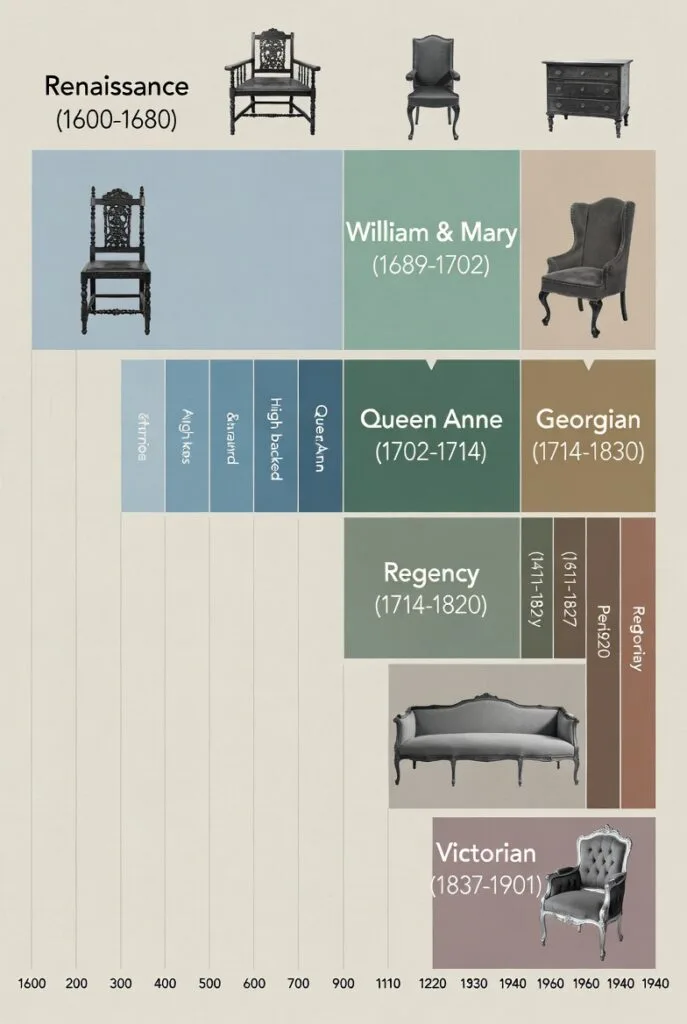
Here’s your complete timeline of furniture periods at a glance:
| Period | Dates | Country of Origin | Primary Wood | Signature Feature |
|---|---|---|---|---|
| Jacobean | 1600-1690 | England | Oak | Heavy carved geometric patterns |
| William & Mary | 1690-1730 | England/Dutch | Walnut | Trumpet-turned legs |
| Queen Anne | 1700-1755 | England | Walnut/Mahogany | Cabriole legs with pad feet |
| Chippendale | 1750-1790 | England | Mahogany | Ball-and-claw feet |
| Federal/Hepplewhite | 1780-1820 | America | Mahogany | Shield-back chairs, inlay |
| Sheraton | 1785-1820 | England | Mahogany/Satinwood | Reeded legs, rectangular forms |
| Empire | 1800-1840 | France/America | Mahogany | Bold columns, animal motifs |
| Victorian | 1837-1901 | England | Walnut/Rosewood | Ornate carvings, heavy forms |
| Arts & Crafts | 1880-1920 | England/America | Quarter-sawn Oak | Visible joinery, simple lines |
| Art Nouveau | 1890-1910 | France/Belgium | Various | Flowing organic curves |
| Art Deco | 1920-1940 | France | Exotic woods | Geometric shapes, bold colors |
Now let’s dive deeper into each period so you can identify them with confidence.
Jacobean Period (1600-1690)
The Jacobean period represents the earliest furniture that most collectors encounter. Named after King James I (Jacobus in Latin), this style dominated English furniture making for nearly a century. The Victoria and Albert Museum holds an outstanding reference collection of Jacobean case pieces that illustrates the period’s characteristic heavy construction.
Visual Identification Guide
What to Look For:
- Extremely heavy construction using thick oak boards
- Geometric carved patterns (diamonds, lunettes, arcades)
- Turned legs with bold turnings, often spiral “barley twist” designs
- Stretchers positioned low, close to the floor
- Gate-leg tables with multiple turned legs
- Dark, almost black patina from centuries of oxidation
Common Pieces:
- Court cupboards
- Press cupboards
- Joint stools
- Wainscot chairs
- Refectory tables
- Blanket chests
Jacobean Legs and Feet
The legs are perhaps the easiest identification feature. Look for:
- Bulbous turned legs (melon-shaped)
- Barley twist turnings
- Block-and-turn patterns
- Simple ball feet
Important Note: Victorian-era reproductions of Jacobean furniture are very common. Original pieces will show genuine wear, hand-cut joinery, and irregular tool marks. Use the Antique Identifier app to help distinguish originals from later copies.
William & Mary Period (1690-1730)
When William of Orange and his wife Mary took the English throne in 1689, they brought Dutch design sensibilities that transformed furniture fashion. This period marks a transition from heavy oak to elegant walnut.
Visual Identification Guide
What to Look For:
- Walnut veneer over secondary woods
- Intricate marquetry patterns (seaweed, floral, arabesque)
- Trumpet-shaped or inverted cup leg turnings
- Flat, serpentine stretchers forming X or H shapes
- Bun feet or ball feet
- Teardrop-shaped brass drawer pulls
Common Pieces:
- Highboys (tall chests on stands)
- Lowboys (dressing tables)
- Gateleg tables
- Caned chairs
- Secretaries with slant fronts
William & Mary vs. Earlier Styles
The key difference is lightness. While Jacobean furniture sits heavily on the ground, William & Mary pieces appear to stand on tippy-toes with their delicate turned legs and stretchers.
The introduction of veneer is also significant — earlier periods used solid wood, but William & Mary craftsmen discovered that thin slices of expensive walnut over cheaper woods allowed for dramatic visual effects.
Queen Anne Period (1700-1755)
Many collectors consider Queen Anne the most graceful of all furniture periods. The style is named after Queen Anne who reigned 1702-1714, but the style persisted for decades after her death. The Metropolitan Museum of Art houses an exceptional collection of American Queen Anne pieces that demonstrates regional variation across colonial centers.
Visual Identification Guide
The Cabriole Leg – THE Defining Feature: This distinctive S-curved leg flows outward at the knee, then curves inward at the ankle before ending in a foot. It’s so strongly associated with this period that “cabriole leg” and “Queen Anne” are almost synonymous.
Foot Styles:
- Pad foot (simple rounded cushion shape)
- Slipper foot (elongated pad)
- Trifid foot (three-toed, common in Philadelphia)
- Drake foot (resembling a duck’s webbed foot)
Other Characteristics:
- Fiddle-back or vase-shaped chair splats
- Curved top rails on chairs (yoke-shaped)
- Shell carvings on chair crests and table knees
- Minimal stretchers – cabriole legs were strong enough alone
- Walnut (early) transitioning to mahogany (later)
American Queen Anne
American craftsmen created their own interpretations of the Queen Anne style. Regional differences help identify where a piece was made:
| Region | Characteristics |
|---|---|
| Philadelphia | Trifid feet, elaborate carving, larger scale |
| Newport | Understated elegance, pad feet |
| Boston | Japanned decoration, compass seats |
| New York | Square seats, heavier proportions |
Chippendale Period (1750-1790)
Thomas Chippendale’s 1754 book “The Gentleman and Cabinet-Maker’s Director” made him the most famous furniture designer in history. The style bearing his name represents the height of Georgian craftsmanship. Auction records at Heritage Auctions consistently show that Philadelphia Chippendale pieces achieve among the highest prices of any American furniture period.
Visual Identification Guide
The Ball-and-Claw Foot: This iconic foot features a carved claw (usually with three or four talons) grasping a ball. It evolved from Chinese designs depicting a dragon’s claw holding a pearl.
Three Style Variations:
- English Chippendale (Rococo)
- Asymmetrical carved decoration
- C-scrolls and S-scrolls
- Naturalistic motifs (leaves, flowers, ribbons)
- Chinese Chippendale
- Straight legs with fretwork
- Pagoda-shaped pediments
- Latticework and geometric patterns
- Bamboo-style turnings
- Gothic Chippendale
- Pointed arches
- Tracery patterns
- Cluster columns
- Quatrefoil motifs
Chair Identification:
- Pierced splats with elaborate patterns
- Serpentine top rails with carved ears
- Square legs (straight Chippendale) or cabriole legs (rococo)
- Wider, more comfortable seats than Queen Anne
Case Piece Features:
- Broken pediment tops with finials
- Ogee bracket feet or ball-and-claw feet
- Elaborate brass hardware
- Blocked fronts on New England pieces
Chippendale Reproductions
Be careful — Chippendale style has been reproduced more than any other period. The “Centennial” reproductions from the 1870s-1880s can fool inexperienced buyers. Later Colonial Revival pieces from the 1920s-1940s are also common. Checking comparable sold examples through WorthPoint‘s auction archive can help you spot price outliers that may signal a reproduction.
Look for these signs of age:
- Hand-cut dovetails with irregular spacing
- Wear in logical places (feet, arms, seat fronts)
- Secondary woods appropriate to origin
- Original brasses leaving shadow marks
For instant authentication help, try our Antique Identifier app – it can detect many reproduction indicators.
Federal Period (1780-1820)
The Federal period represents America’s first truly national furniture style, developing after independence from Britain. It encompasses both Hepplewhite and Sheraton influences.
Hepplewhite Style
George Hepplewhite’s designs, published posthumously in 1788, emphasized:
Legs:
- Straight, tapered legs (square or round cross-section)
- Spade feet or simple tapered ends
- No cabriole legs
Chair Backs:
- Shield shape (most iconic)
- Heart shape
- Oval shape
- Delicate carved or pierced splats
Decoration:
- Contrasting wood inlays
- Bellflower drops
- Urns and swags
- Feathers and wheat sheaves
- Eagle motifs (very American)
- Paterae (oval medallions)
Sheraton Style
Thomas Sheraton’s designs appeared slightly later with subtle differences:
- More rectangular chair backs
- Extensive use of reeding (parallel carved grooves)
- Turned and reeded legs
- More architectural, less curvy
- Use of exotic veneers
Federal Period Woods
Primary wood was typically mahogany, but the inlay work is what makes Federal furniture special:
- Satinwood for light contrast
- Holly or boxwood for lines and banding
- Ebony for dark accents
- Bird’s eye maple for figure
Empire Period (1800-1840)
The Empire style originated in Napoleonic France and spread across the Western world. It’s dramatically different from the delicate Federal style that preceded it.
Visual Identification Guide
Proportions: Bold, heavy, monumental. Empire furniture makes a statement.
Key Features:
- Columns (often gilded or ebonized) as structural elements
- Scroll-shaped supports
- Animal paw feet (especially lion’s paws)
- Eagle heads and wings
- Swan neck curves
- Lyre shapes
- Ormolu (gilded bronze) mounts on French pieces
Materials:
- Dark mahogany, often figured or flame grain
- Marble tops on tables and case pieces
- Gilding and bronze mounts
- Black ebonizing for contrast
American Empire
American Empire (1815-1840), sometimes called “Classical American,” is generally simpler than French Empire:
- Less ormolu, more stenciled decoration
- Larger scale (American rooms were bigger)
- More reliance on figured veneers
- Pillar-and-scroll designs
Notable Makers:
- Duncan Phyfe (New York)
- Charles-Honoré Lannuier (New York)
- Anthony Quervelle (Philadelphia)
Victorian Era (1837-1901)
Queen Victoria’s long reign saw dramatic changes in furniture styles. The Victorian era actually encompasses several distinct sub-periods:
Victorian Sub-Periods Chart
| Sub-Period | Dates | Key Characteristics |
|---|---|---|
| Early Victorian | 1837-1850 | Continuation of late Empire forms |
| Gothic Revival | 1840-1865 | Pointed arches, church-like motifs |
| Rococo Revival | 1845-1870 | Exuberant curves, carved flowers |
| Renaissance Revival | 1860-1885 | Architectural forms, medallions |
| Eastlake | 1870-1890 | Rectilinear, incised decoration |
| Aesthetic Movement | 1875-1890 | Japanese influence, ebonized wood |
| Colonial Revival | 1880-1920 | Return to 18th-century American styles |
Rococo Revival (Belter Furniture)
John Henry Belter of New York perfected laminated rosewood construction that allowed for incredibly elaborate pierced carving. His pieces feature:
- Extravagant carved roses, grapes, and vines
- Serpentine curves everywhere
- Tufted upholstery
- Finger-molded frames
Belter furniture is highly collectible and quite valuable today. Kovels’ price guides document strong and consistent auction demand for authenticated Belter parlor suites.
Renaissance Revival
This heavier style features:
- Architectural elements (columns, pediments)
- Incised line decoration
- Applied busts and medallions
- Walnut with burl panels
- White marble tops
Eastlake Style
Charles Eastlake advocated for “honest” construction and simpler designs:
- Rectangular forms
- Incised geometric decoration
- Turned spindles and galleries
- Less carving, more machine-made elements
- Often ebonized with gilded highlights
Arts & Crafts Movement (1880-1920)
The Arts & Crafts movement was a reaction against Victorian excess and industrial mass production. It celebrated handcraft and honest construction. The Smithsonian Institution‘s American art collections document how the movement shaped design reform on both sides of the Atlantic.
Visual Identification Guide
Construction Philosophy: Don’t hide the joinery – celebrate it!
Key Features:
- Through-tenons visible on surface
- Exposed pegs
- Visible dovetails
- Simple, rectilinear forms
- Quarter-sawn white oak (showing ray flake)
- Hand-hammered copper or iron hardware
- Leather or canvas upholstery
Major Makers:
| Maker | Location | Identifying Marks |
|---|---|---|
| Gustav Stickley | Syracuse, NY | Red decal or branded mark, “Als Ik Kan” motto |
| L. & J.G. Stickley | Fayetteville, NY | “Onondaga Shops” label |
| Stickley Brothers | Grand Rapids, MI | “Quaint Furniture” label |
| Roycroft | East Aurora, NY | Orb and cross mark |
| Limbert | Grand Rapids, MI | Branded mark with “Limbert’s Arts Crafts” |
Mission vs. Arts & Crafts
“Mission” style is often used interchangeably with Arts & Crafts, but Mission specifically refers to simpler, more severe pieces supposedly inspired by California mission furniture. All Mission is Arts & Crafts, but not all Arts & Crafts is Mission.
Art Nouveau (1890-1910)
Art Nouveau was a brief but brilliant flowering of artistic furniture that embraced organic, flowing forms.
Visual Identification Guide
The Whiplash Curve: This sinuous, S-shaped curve appears everywhere in Art Nouveau design, from chair backs to table legs to cabinet handles.
Nature Motifs:
- Flowers (lilies, irises, orchids, poppies)
- Vines and tendrils
- Dragonflies and butterflies
- Peacock feathers
- Female figures with flowing hair
- Waves and water plants
Materials:
- Exotic woods carved into organic shapes
- Inlays of fruitwood, mother-of-pearl
- Stained glass panels
- Bronze or gilt bronze mounts
Notable Designers:
- Émile Gallé (Nancy, France)
- Louis Majorelle (Nancy, France)
- Hector Guimard (Paris)
- Carlo Bugatti (Italy)
- Charles Rennie Mackintosh (Scotland)
Art Nouveau furniture is relatively rare compared to other periods and commands premium prices at auction.
Art Deco Period (1920-1940)
Art Deco embraced the machine age with bold geometric designs and glamorous materials. It represents the last major historical furniture period before mid-century modern.
Visual Identification Guide
Shapes:
- Bold geometric forms
- Circles, sunbursts, chevrons
- Stepped profiles (like skyscrapers)
- Symmetrical compositions
Materials:
- Exotic veneers (macassar ebony, zebrawood, amboyna, burled walnut)
- Lacquer in bold colors (red, black, cream)
- Chrome and glass
- Shagreen (ray skin)
- Parchment
- Ivory inlay (now illegal to trade)
Surface Treatments:
- High-gloss lacquer finishes
- Bookmatched veneers
- Geometric marquetry
Notable Designers:
- Émile-Jacques Ruhlmann (the master)
- Jean Dunand (lacquer specialist)
- Jules Leleu
- Paul Frankl (American)
- Donald Deskey (American)
Art Deco vs. Art Moderne
“Art Moderne” or “Streamline Moderne” appeared in the 1930s with even simpler forms:
- Teardrop and torpedo shapes
- Horizontal speed lines
- Chrome banding
- Waterfall curves on case pieces
- More machine-made, less handcraft
How to Use This Furniture Periods Chart
When trying to identify a piece of antique furniture, follow these steps:
Step 1: Observe the Overall Form
Is it heavy or light? Angular or curved? This narrows down the era immediately.
Step 2: Examine the Legs and Feet
Legs are often the quickest identifier:
- Bulbous turnings = Jacobean
- Trumpet turnings = William & Mary
- Cabriole with pad foot = Queen Anne
- Cabriole with ball-and-claw = Chippendale
- Straight tapered = Federal
- Columns or scrolls = Empire
- Turned spindles = Victorian/Eastlake
- Square with visible joinery = Arts & Crafts
- Geometric chrome = Art Deco
Step 3: Check the Wood
Primary and secondary woods help date and locate origin.
Step 4: Study the Hardware
Original hardware style matches the period. Replaced hardware leaves tell-tale signs.
Step 5: Look for Maker’s Marks
Many pieces are signed, stamped, or labeled.
Step 6: Verify with Technology
Use the Antique Identifier app to snap a photo and get instant period identification, plus estimated values.
Printable Furniture Periods Chart
Want to keep this information handy while shopping? We’ve created a simplified reference chart:
1600-1700: Age of Oak
- Jacobean (1600-1690): Heavy oak, geometric carving
1700-1800: Age of Walnut & Mahogany
- William & Mary (1690-1730): Walnut veneer, trumpet legs
- Queen Anne (1700-1755): Cabriole legs, shell motifs
- Chippendale (1750-1790): Ball-and-claw, pierced splats
1780-1840: Neoclassical Era
- Federal/Hepplewhite (1780-1820): Inlay, shield backs
- Sheraton (1785-1820): Reeding, rectangular forms
- Empire (1800-1840): Columns, animal motifs
1837-1920: Victorian & Reform
- Victorian (1837-1901): Ornate, multiple revival styles
- Arts & Crafts (1880-1920): Simple, visible joinery
1890-1940: Modern Movements
- Art Nouveau (1890-1910): Organic curves
- Art Deco (1920-1940): Geometric glamour
Common Questions About Furniture Periods
What is the best free app to identify antiques?
Antique Identifier App is the best free app to identify antiques, especially for recognizing furniture periods like Jacobean, Chippendale, Federal, and Art Deco from a photo — matching leg styles, wood types, and construction details to the correct era and providing estimated values. It works across all major furniture periods covered in this timeline, from 1600 through 1940. It’s free to download on iPhone with no sign-up required.
How do I know if my furniture is genuinely antique?
True antiques are generally considered to be at least 100 years old. Look for:
- Hand-cut joinery (irregular dovetails)
- Appropriate wear patterns
- Period-correct hardware
- Secondary woods matching the supposed origin
- Proper patina and oxidation
Why do furniture periods overlap?
Style changes didn’t happen overnight. New styles took years to spread from urban centers to rural areas. Craftsmen continued making older styles while new ones emerged. And dates given are approximate — styles transitioned gradually.
What’s the most valuable furniture period?
It depends on the specific piece, maker, condition, and current market trends. Generally, 18th-century American pieces (Queen Anne and Chippendale) command the highest prices at auction. Art Nouveau and Art Deco by famous designers also bring strong prices. If you need a formal valuation, a certified appraiser through the International Society of Appraisers can provide a documented opinion of value.
Can I identify furniture periods from a photo?
Yes! While hands-on examination is ideal, photos can reveal many period indicators. The Antique Identifier app uses AI to analyze photos and identify periods, styles, and estimated values instantly.
Conclusion
Understanding furniture periods transforms how you see antique furniture. What once looked like “just old furniture” becomes a window into history – you can see the Dutch influence in William & Mary pieces, feel the revolutionary spirit in Federal designs, and appreciate the handcraft ethos of Arts & Crafts makers.
Keep this furniture periods chart handy as a reference, and don’t hesitate to use modern technology like our Antique Identifier app when you need quick identification help. With practice, you’ll be dating furniture like an expert in no time.
