
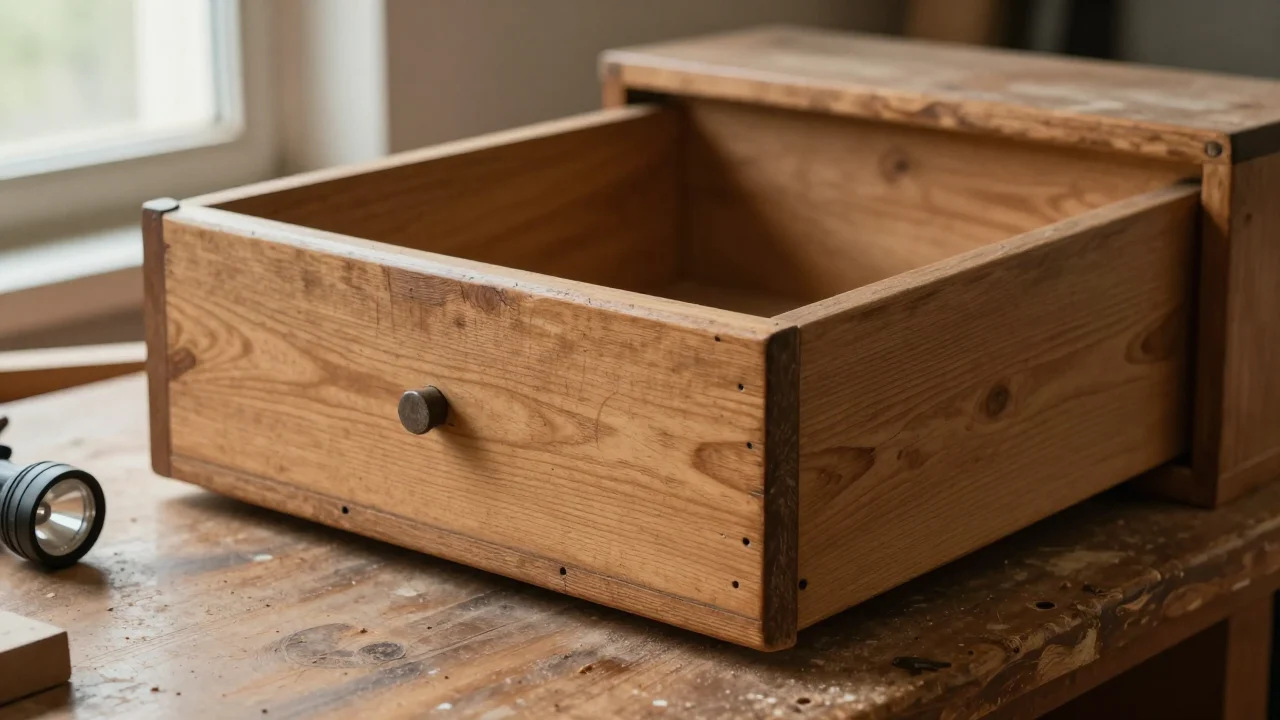
Furniture maker’s marks usually hide inside drawers, on back boards or under seat rails; a label, brand or stamp names a maker only if the construction agrees.
A maker’s mark on furniture can be a printed paper label, a name burned or stamped into the wood, a stencil or a metal tag. This guide covers where those marks usually sit, what each type can and cannot tell you, and how to check a mark against the way the piece was built.
Where Should I Check for Hidden Marks on Antique Furniture?
Check the surfaces a buyer rarely sees: drawer bottoms and backs, the inside of the case, the back boards and the underside of seats and seat rails. Locating a signature on a painting is easy; finding one on a highboy or credenza takes detective work, because labels and stamps were put where they would not spoil the design or be rubbed away.
For case goods (dressers, chests, desks), remove the drawers completely. Look on the interior side rails and the drawer bottom, both inside and underneath. The labelled furniture of the Philadelphia joiner William Savery shows how varied the spots are: a study of his labels in Chipstone’s American Furniture journal records one “attached to the bottom of the top drawer” of a dressing table, another “on the till of the chest” and another “on the inside rear seat rail of the armchair”.
For chairs and tables, get underneath them. Turn the chair over and inspect the seat frame and the central support; the same study pictures a side chair whose label is “attached to the underside of the rush seat”. The legs themselves are a separate dating clue, covered in our visual guide to dating chair legs.
Look at the hardware too, but as evidence of age rather than as a signature. Nails, screws and hinges changed over time, and our guide to dating furniture by its hardware shows what each type can and cannot establish.
How Do I Decipher Different Types of Maker’s Marks?
Identify the type of mark first, because a paper label, a brand, a stencil and a metal tag survive, move and get faked in different ways.
Paper labels are glued on, so they tear, fade and fall off. Printed labels predate factory furniture: the Savery labels in the Chipstone study run from the “ca. 1760 label” on a side chair to the “ca. 1785 label” on a chest, and several of them read “Made and Sold by”, so a label could advertise a shop as well as name a maker. If you find one that is peeling, do not glue it back yourself. The American Institute for Conservation advises: “We strongly recommend hiring one of our Professional Members.” An original label left in place keeps its value as provenance.
Branded or stamped marks are burned or pressed into the wood, so they are harder to lose than a label. Gustav Stickley’s Craftsman furniture is the best-known American example; Wikipedia’s Stickley entry describes “his trademark, which includes the Flemish phrase Als Ik Kan inside a joiner’s compass”. A brand does not date a piece by itself, so compare its exact form with a dated reference such as our alphabetical list of furniture makers’ marks or the four American marks in the table below.
Four American marks turn up often enough to be worth recognising on sight. Treat each one as a lead and check the exact form against a dated reference, because all four have been copied.
| Maker | Where and when | What the mark looks like |
|---|---|---|
| Gustav Stickley (Craftsman Workshops) | Eastwood, New York; Craftsman furniture from about 1901 until the business went bankrupt in 1915 | A joiner’s compass with the motto “Als ik kan”, as a red decal on early pieces and later as a brand or paper label |
| L. & J.G. Stickley | Fayetteville, New York; founded in 1900 by two of Gustav’s younger brothers, Leopold and John George | A decal or brand reading “The Work of L. & J.G. Stickley”, sometimes with “Handcraft” |
| Roycroft | East Aurora, New York; community founded by Elbert Hubbard in 1895 | An orb divided by a cross with the letter R, carved or branded into the wood |
| Lambert Hitchcock | Hitchcocksville (now Riverton), Connecticut; factory opened in 1818 | A stencilled maker’s line on the back rail of the seat. The factory was revived in 1946, so confirm a 19th-century date from the chair’s construction as well as the stencil |
Stencils and metal tags are painted, tacked or screwed on. Check that the paint, the screws and the finish around them look as old as the surface next to them.
If you would rather start from a photo, Antique Identifier: Antiqly is free to download on iPhone and on Android through Google Play, with in-app purchases. Treat any suggestion as a lead to check against the references here.
Does a Missing Mark Mean It’s a Fake?
No. A missing mark is not evidence of a fake, and a mark is not proof of age on its own. Popular Woodworking’s guide to dating furniture from its drawers puts the general rule plainly: “Seldom does one clue provide confirmation of anything.”
Paper labels tear and fall away, so the absence of one tells you little. Attribution then rests on construction details.
Check the drawer joints. The same guide warns that hand-cut dovetails “alone can’t be used to date furniture before the machine age”, because reproduction makers still cut them by hand, while “machine-cut dovetails definitely establish that the furniture is no older than about 1895”. A half-moon pin-and-scallop joint narrows things further: Fine Woodworking’s history of the Knapp joint says a drawer with it was almost certainly “made in a North American factory between 1871 and 1900”.
Be wary when a seller calls a piece a “signed original” but the mark looks brand new or sits in an odd place, such as the top surface. Labels themselves have been faked: the Chipstone study notes that fake Savery labels “include both photographic reproductions and entirely made-up examples”. Wear on and around a mark should match wear on the rest of the piece; our guide to Duncan Phyfe originals and reproductions works through the same check for one maker.
How Does a Maker’s Mark Affect Value?
A genuine, legible mark changes what you can prove about a piece more than it sets a price. It can move an attribution from “in the style of” to a named shop, and the Chipstone study calls makers’ labels “one of the more certain means of maker identification”.
A mark does not override condition. Water damage or a heavy-handed restoration, such as stripping the original finish, still counts against a marked piece, which is why our guide to restoring versus preserving antique furniture matters before any work is done.
The mark also has to agree with the rest of the object. Check that the style, the secondary woods, the joints and the hardware fit the period the mark claims; our guide to valuing antique furniture online shows how age, style and condition are weighed together.
Victorian, Edwardian and seating guides
For nearby topics, read Is It Victorian or Edwardian? Key Differences for Quick Identification, Identifying Antique Settees and Sofas: A Period-by-Period Breakdown and Antique Rocking Chairs: Identifying Makers from the 19th Century.
What to Do With a Marked Piece Now
- Pull every drawer, turn chairs over and photograph any label, brand, stencil or tag in good light before you touch it.
- Compare the mark with a dated reference such as our alphabetical list of makers’ marks or the complete guide to antique marks and signatures, then check the drawer joints and hardware against the period the mark claims.
- Leave loose or flaking labels to a conservator, and get a qualified appraiser’s written opinion before you sell or insure a piece the mark makes look important; our guide to how professional appraisers work out value explains what to ask for.
