The key difference lies in the silhouette and timber. French Provincial furniture features graceful curves, distinct cabriole legs, and softer local woods like fruitwood or walnut, reflecting a rural adaptation of ornate Parisian court styles. In contrast, English Colonial (often called Early American) emphasizes strict utility with rigid, straight lines, sturdy mortise-tenon joinery, and practical woods like oak, maple, and pine.
Imagine you are at a dusty estate sale in rural Virginia, fighting the humidity and the early morning crowd. You spot a beautiful, worn wooden commode in the corner, covered in old quilts.
Is it a valuable piece of American Colonial history brought over by settlers, or is it a charming, high-value French Provincial piece brought back after a war?
Knowing the difference isn’t just about history—it completely changes the fair market value. In my 20 years of writing appraisals, I’ve seen collectors walk past treasures because they mistook a rough-hewn masterpiece for a reproduction.
Let’s break down exactly how to tell them apart.
What defines the French Provincial style?
French Provincial furniture (or Mobilier Rustique) was the countryside’s answer to the lavish furniture of Paris during the 18th century. It is simpler, but it retains a sense of elegance.
Look for the “S” curve. Even on simple farmhouse tables, you will often find a slight curve in the legs or the apron (the wood strip under the tabletop).
Hand-carved ornamentation is common but restrained. Instead of gold leaf, you might see simple scallop shells or wheat motifs carved directly into the solid wood.
Close-up photo of a French Provincial commode leg showing the distinct ‘S’ curve of a cabriole leg and a simple hand-carved scallop shell motif on the apron
The wood choice is a major clue. French makers used what was growing nearby.
If the piece is made of apple, cherry, or pear wood (fruitwoods) and has a warm, honey-colored patina, lean towards French Provincial. These woods polish up beautifully and have a finer grain than oak.
How can I identify genuine English Colonial furniture?
English Colonial furniture, specifically the styles seen in early America (like William and Mary or Pilgrim furniture), is built for survival and function.
The aesthetic is rectangular. If you can draw a box around the main shape of the chair or chest, it’s likely Colonial.
The legs are often turned on a lathe (rounded with rings) or strictly square. You won’t find the flowing cabriole leg here until much later periods.
Photo of an English Colonial oak blanket chest with straight sides, simple iron hinges, and flat bracket feet, demonstrating sturdy, blocky construction
Materials were strictly utilitarian. Early colonists used oak for framing because it is rot-resistant, and pine for panels because it is easy to cut.
If you see a mix of woods—like a maple base with a pine top—that is a strong indicator of American Colonial origin. This was often done to save the harder woods for the structural parts that took the most abuse.
Identifying these marks manually can take hours. Using the Antique Identifier app, you can simply take a photo and get an instant result.
What construction techniques reveal the age?
Flip the piece over or pull out a drawer. This is where the condition report gets interesting.
English Colonial joinery is legendary for its toughness. Look for large, protruding dovetail joints on drawer sides or pinned mortise-tenon joints on chair legs. These joints were meant to hold up without glue.
In French Provincial pieces, the joinery is often more refined and hidden. You might see veneer work on drawer fronts, arranged in geometric patterns (parquetry), even on rural pieces.
Side-by-side comparison photo of an open drawer: one showing large, primitive hand-cut dovetails (Colonial) and the other showing finer, hidden joinery (French)
Hardware is another dead giveaway.
French pieces often have ornate iron or brass pulls that sit on top of the wood. Colonial pieces usually use simple wooden knobs or hammered iron latches. This functional simplicity is similar to what we cover in our guide on The Secret Language of Furniture Hardware: Dating Knobs and Pulls.
How does condition affect the appraisal value?
When I determine an auction estimate or replacement value, I look for provenance and originality.
For French Provincial, a “country polish” is desirable. This is the buildup of wax and dirt over 200 years. If it has been stripped and varnished with modern polyurethane, the value drops significantly.
For English Colonial, we look for “dryness” on the underside. The raw wood shouldn’t look new.
Forgery detection is crucial here. Be wary of “antique” Colonial tables where the foot wear is perfectly even. A real 300-year-old table will have uneven wear where people actually sat.
Detailed shot of the underside of an antique table showing dark, oxidized ‘dry’ wood and uneven wear on the bottom of the feet
Beware of heavy restoration. A repaired leg on a sturdy Colonial chair is acceptable, but heavy conservation work on a French veneer piece can make it fragile and hard to sell.
Always check for inlay consistency. If a French table has elaborate inlay but the legs are crude blocks, it is likely a “marriage”—parts of two different pieces put together.
Whether you prefer the rustic romance of France or the stoic history of the Colonies, authentication is key.
Don’t let a good piece slip away because you weren’t sure about the leg style. Use your eyes, feel the weight of the wood, and when in doubt, snap a picture.
Antique furniture hardware can be dated by examining the casting style, the post mechanism, and the metal composition. William and Mary era (1690–1720) pieces utilize teardrop pulls secured by cotter pins. Chippendale hardware (1750–1790) features large, cast brass “batwing” plates with bail handles. If the back of the post is rough and hand-filed with no threading, the piece likely predates 1800.
*
Imagine you are at a dusty estate sale in rural Pennsylvania. You spot a chest of drawers in the corner, covered in decades of grime. The seller claims it’s a “nice vintage reproduction,” but something catches your eye.
You run your thumb over the back of the brass pull inside the drawer. It’s not a modern machine screw; it’s a rough, hand-flattened wire. Your pulse quickens. You know instantly that this isn’t a 1980s copy-it’s an 18th-century original that could be worth thousands.
This is the power of understanding hardware. Knobs and pulls are the “jewelry” of antique furniture, and they often tell the true story of a piece’s provenance and age.
How can I tell if the hardware is original to the piece?
The first step in any condition report is determining if the knobs or pulls belong to the piece. Hardware was often replaced over centuries due to fashion changes or breakage.
To verify originality, open the drawer and look at the back of the drawer front.
Look for extra holes: If you see plugged holes or empty holes near the current hardware, the pulls have been changed.
Check for “Ghost Marks”: Look at the wood surface behind the plate. A true original will leave a shadow or outline in the finish and oxidation that matches the current hardware shape perfectly.
Examine the Wear: The wear on the hardware should match the wear on the wood. If the drawer front is heavily worn but the brass is pristine, be suspicious.
Close-up photo of the inside of an antique drawer front showing a “ghost mark” outline where old hardware used to sit, contrasted with a new hole.
What do different hardware styles tell me about the age?
Hardware styles evolved alongside furniture design. Recognizing the silhouette is the fastest way to get an initial attribution for the era.
William and Mary (1690–1720): Look for “teardrop” or “drop” pulls. These hang vertically from a single round backplate.
Queen Anne (1720–1750): The “willow” or “batwing” shape begins to appear, but is often simpler. The bail handle (the part you grab) usually falls against the plate.
Chippendale (1750–1790): The classic, large “batwing” or “willow” mount. These are elaborate, pierced brass plates.
Hepplewhite & Sheraton (1790–1820): A shift to stamped brass rather than cast. Look for oval or octagonal plates with designs embossed into the metal (eagles, acorns, flowers).
Empire (1820–1840): Glass knobs or heavy brass lion heads with rings.
Identifying these marks manually can take hours. Using the Antique Identifier app, you can simply take a photo and get an instant result.
A split image comparing a Chippendale “batwing” brass pull against a Federal-era stamped oval brass pull to show the stylistic difference.
How do manufacturing techniques reveal the date?
The construction of the hardware is often more telling than the style itself. This is critical for authentication and forgery detection.
Pre-1800 (Hand-Cast): Early hardware was cast in sand molds. The back of the plates will often be rough or sandy. The posts were not threaded screws. Instead, a wire loop went through the wood and was bent open (clinched) or secured with a cotter pin.
1800–1850 (Early Machine): You start seeing threaded posts, but the threads are often hand-filed and irregular. The nuts are usually round or rough squares, not the perfect hex nuts we see today.
Post-1850 (Industrial): Uniform machine-cut threads and standardized screws appear. If you see a Phillips head screw, the hardware is definitively from the 20th century or later.
This evolution in manufacturing is similar to the structural changes we discuss in our guide on Identifying Duncan Phyfe Furniture: 5 Marks of Authenticity, where the transition from hand-carved to machine-assisted work helps date the piece.
Macro shot of a pre-1800 hardware post showing the rough, hand-filed threads and a non-standardized nut compared to a modern machine screw.
Does replacing the hardware affect the antique’s value?
Yes, significantly. In the collector market, original hardware is paramount.
A piece with its original brasses commands a higher fair market value than one with replacements. If you are browsing an auction house catalog, you will often see “brasses replaced” noted in the description; this is a signal that the auction estimate might be lower.
If you possess a piece with missing pulls, aim for conservation rather than modernization. Source period-correct replacements from an antique dealer rather than buying shiny reproductions from a hardware store.
Keep in mind that high-value case pieces often feature veneer or complex inlay around the hardware. Clumsy replacements can damage these delicate surfaces, further reducing the value.
Photo of a high-value mahogany chest of drawers with obvious damage to the veneer around the keyhole, illustrating the risk of replacing hardware.
What are the red flags of fake antique hardware?
When you are at an estate sale, use these quick checks to spot a reproduction:
Artificial Aging: If the brass has a dark, uniform brown coating that looks painted on, it is likely “antiqued” modern metal. Genuine patina is uneven—darker in the crevices and lighter on the high points where fingers touch.
Seam Lines: Modern cast hardware often has a visible seam line along the side of the handle where the mold halves met. Antique hand-casting was usually filed smooth.
Too Much Uniformity: On a true antique, the left handle might be slightly different from the right handle. Hand-made items have variance. Perfect uniformity is a sign of modern mass production.
Always check the construction of the furniture itself as well. If the hardware looks 18th century, but the drawer uses machine-cut dovetail joints rather than hand-cut ones, the hardware is likely a reproduction added to a later piece.
Mastering the language of hardware takes practice, but it is one of the most reliable skills for an appraiser. By looking past the style and examining the nuts, bolts, and casting marks, you can determine if a piece is a masterpiece or a clever fake. When in doubt, let technology aid your eye.
Authentic 19th-century rocking chairs can be identified by the joinery techniques (dovetails or mortise and tenon), the style of the rockers (short and stubby often indicates early 1800s), and manufacturer marks typically found under the seat or on the back rail. Key makers to look for include Thonet (bentwood), Hitchcock (stenciled designs), and Boston rockers with their distinctive spindle backs.
Imagine you are at a dusty estate sale in rural Ohio, the air thick with the smell of old varnish and summer heat. In the corner of a dimly lit barn, you spot a worn wooden chair with curved runners. It looks old, but is it a $50 flea market find or a $1,500 treasure from the Victorian era? Identifying a true 19th-century piece requires looking past the dust to find the craftsman’s signature touches that define provenance.
How do I identify a 19th-century rocking chair?
The first step in authentication is examining the chair’s construction. Unlike modern factory-made furniture, 19th-century chairs were often hand-finished. Flip the chair over and look at the joinery.
Close up photo of hand-cut dovetail joints on the drawer or frame of an antique wooden chair to show irregular spacing
Look for irregular, hand-cut dovetails or mortise and tenon joints held together with wooden pegs rather than screws. If you see Phillips head screws, put it back—it’s likely a reproduction from the 20th century.
Next, check the finish. A genuine antique will have a patina—a deep, rich surface sheen developed over a century of use—that cannot be faked with modern stains. Be wary of “distressed” finishes that look too uniform; real wear happens naturally on armrests and runners.
Who were the most famous rocking chair makers of the 1800s?
Identifying the maker is the gold standard for establishing a high fair market value. Three styles dominated the US market during this period:
1. Boston Rockers: Despite the name, many were made in Connecticut. They feature a high spindle back, a wide top rail (often painted with flowers), and a seat that curves up at the back and down at the front. 2. Hitchcock Chairs: Lambert Hitchcock’s factory produced chairs with distinctive stenciled designs on the backrest. Look for the label “L. Hitchcock. Hitchcocksville. Conn. Warranted” on the back edge of the seat. 3. Thonet Bentwood: Michael Thonet revolutionized furniture by bending wood with steam. His rockers are famous for their elegant, scrolling loops.
Side profile of a Thonet bentwood rocking chair showing the intricate steam-bent loops and scrolls
Identifying these marks manually can take hours, especially if the label is worn or faded. Using the Antique Identifier app, you can simply take a photo and get an instant result. It compares your find against thousands of database entries to help with attribution and maker identification.
What is the difference between a Platform Rocker and a Runner Rocker?
This is a critical distinction for dating your find.
Runner Rockers: These are the classic style where the legs are mounted onto curved wooden arches (runners). Early 19th-century runners were often short and stubby, leading to a “tippy” feel. As the century progressed, runners became longer for a smoother, safer rock.
Platform Rockers: These appeared later, around the 1870s. The chair seat sits on a stationary base with springs or a mechanical pivot. This innovation saved carpets from wear and tear. Eastlake and Victorian styles often utilized the platform design.
A Victorian platform rocking chair with velvet upholstery, showing the spring mechanism in the base
If you find a platform rocker, you are almost certainly looking at a piece from the late 19th century (1870-1900), which helps narrow down the auction estimate.
How much is my antique rocking chair worth in 2026?
Value depends heavily on condition, rarity, and maker.
Boston Rockers: Common models in fair condition might fetch $100-$300 at a local thrift store. However, an early model with original paint and excellent condition report can command $800+.
Thonet Rockers: Authentic bentwood rockers are highly collectible. Signed pieces can range from $600 to over $2,000 depending on the complexity of the loops.
Mission/Arts & Crafts: Late 19th-century oak rockers (think Gustav Stickley) are the heavy hitters, sometimes reaching $5,000+ if the provenance is solid.
However, be careful with restoration. A chair that has been stripped and refinished often loses 50% of its collector value compared to one with its original finish. Conservation—stabilizing the piece without removing the history—is always preferred.
Forgery detection is a necessary skill for any collector.
1. Glue runs: 19th-century craftsmen were meticulous. Visible drips of glue usually indicate modern mass production. 2. Uniformity: If a set of four chairs looks identical down to the millimeter, they were made by a machine, not a hand. 3. The “Smell Test”: Fresh varnish smells like chemicals. Old wood smells like dust and wax.
Macro shot of machine-cut circular saw marks on the underside of a chair seat, contrasting with straight hand-saw marks
Also, check the wear patterns. A chair claimed to be 150 years old should show wear on the bottom of the runners. If the wood there looks brand new, it’s a reproduction.
Finding an authentic 19th-century rocking chair is about more than just replacement value; it’s about owning a piece of history. Whether you are browsing an antique dealer‘s shop or digging through a barn, knowing how to spot the difference between a hand-crafted Boston rocker and a 1980s reproduction is the key to a smart investment. Always check the joinery, look for the maker’s mark, and trust the patina.
Authentic Mid-Century Modern originals (approx. 1945–1969) are identified by specific maker’s marks (like Herman Miller or Knoll), the use of high-quality solid woods (teak, walnut, rosewood) rather than composite board, and superior joinery techniques. Look for Phillips-head screws (standardized in the 1930s) and check for foil or paper labels underneath the seat or tabletop.
Imagine you are at a dusty estate sale in Palm Springs. You spot a sleek, low-profile chair in the corner buried under a stack of old blankets.
It screams “Mad Men,” and your heart skips a beat. But is it a treasure worth thousands or a cheap reproduction from a big-box store?
As an appraiser with over 20 years in the field, I can tell you that antique identification often happens in seconds. You just need to know exactly where to look.
How can I identify authentic Mid-Century Modern furniture marks?
The first thing I do when I approach a piece of 1950s or 1960s furniture is look underneath. Flip the chair, check inside the drawer, or look at the back of the case good.
You are looking for specific labels. In the atomic age era, manufacturers used paper labels, foil tags, or metal medallions.
Close-up macro shot of a vintage foil label reading “Herman Miller” or “Knoll Associates” attached to the underside of a black Eames shell chair
If you find a “Made in China” or “Made in Indonesia” sticker, walk away. That is a modern reproduction.
However, if you see a burn mark or a foil label from Herman Miller, Knoll, or distinct Danish Modern stamps (like “Made in Denmark”), you likely have a winner.
Pro Tip: Early Eames pieces often have a “crescent” logo or a specific patent number embossed into the fiberglass.
Identifying these marks manually can take hours. Using the Antique Identifier app, you can simply take a photo and get an instant result.
What materials were used in original 1950s and 1960s furniture?
The weight of the piece is a massive clue regarding its provenance and quality.
Original MCM furniture was built to last. Manufacturers used solid hardwoods like walnut, teak, oak, and rosewood.
If the piece feels surprisingly light or flimsy, it is likely particle board with a cheap veneer.
High-contrast photo comparing the edge of a solid walnut table showing continuous grain vs. a chipped particle board edge showing sawdust composition
While some high-end pieces used plywood (think the Eames Lounge Chair), you can see the distinctive, high-quality layers of the molded wood.
When conducting a condition report, run your hand along the underside of a table. It should feel smooth. Rough, unfinished edges usually indicate a lower-quality mass production piece that holds little fair market value.
How does the hardware help with authentication?
The screws and joints tell the story of the piece’s age. This is often where forgery detection becomes easiest.
In the US market, Phillips-head screws were the standard for MCM furniture. If you see a slotted screw, the piece might be older (or repaired).
If you see a hex (Allen) key bolt, be very suspicious. That is standard flat-pack hardware from the 1980s onwards.
Close-up detail shot of the underside joinery of a chair leg, showing a vintage Phillips-head screw and lack of glue residue
Also, look at the glides (the feet). Authentic pieces often have metal or high-quality nylon glides.
Mid-century design is about functionality and organic shapes.
Look for “floating” elements, where seats seem to hover above the legs. Tapered legs are a hallmark of the style.
A true antique dealer looks for patina. An original piece from 1958 should not look brand new.
Side profile of a Danish Modern teak sideboard showing the characteristic “floating” look of the cabinet above the tapered legs
It should have some wear consistent with age. This might include sun fading (especially on walnut) or minor scratches.
Don’t be afraid of minor damage. Restoration and conservation are possible for high-value items, provided the structural integrity is there.
Is my find valuable enough for an auction house?
If you have confirmed the maker and materials, you need to determine the value.
Attribution—confirming who designed it—is key. A generic “MCM style” chair might sell for $200 at a thrift store. A verified Hans Wegner chair could command an auction estimate of $3,000+.
A styled living room setup featuring an authentic Eames Lounge Chair and Ottoman in black leather and rosewood
Always check the replacement value for insurance purposes if you decide to keep it. The market for verified originals remains incredibly strong in 2024.
The quickest way to distinguish Victorian from Edwardian antiques is by examining the color palette and ornamentation. Victorian pieces (1837–1901) typically feature dark woods (mahogany, walnut), heavy ornamentation, and complex revival styles like Gothic or Rococo. In contrast, Edwardian items (1901–1910) prioritize lighter woods (satinwood, oak), pastel colors, simpler lines, and airy, feminine designs influenced by early Art Nouveau.
*
Imagine you are at a dusty estate sale in rural Pennsylvania. You spot a beautiful side chair in the corner. Is it a heavy, ornate relic from the mid-19th century, or a lighter, elegant piece from the turn of the 20th century? Knowing the difference affects not just the history, but the fair market value.
What defined the Victorian Era style (1837–1901)?
The Victorian era, spanning the reign of Queen Victoria, was a period of massive change driven by the Industrial Revolution. Because it lasted over 60 years, it isn’t just one “style.” It’s a collection of revivals.
Early Victorian furniture is often heavy, dark, and imposing. Makers loved using mahogany and rosewood to create pieces that felt substantial.
Close up of a Victorian parlor chair showing dark mahogany wood, deep button tufting in velvet, and elaborate floral carving on the crest rail
You will often see influences from the Gothic Revival (pointed arches) or Rococo Revival (curved lines and floral motifs). The focus was on displaying wealth through complexity.
Toward the end of the century, the Eastlake style emerged, which was slightly more geometric, but the overall “feel” of Victorian antiques remains dark, cluttered, and highly decorative.
How did the Edwardian Era (1901–1910) change the look?
When King Edward VII took the throne, the mood shifted. After decades of mourning and heavy, dark interiors, people wanted light and air.
Edwardian furniture and decor are distinctively lighter—both in physical weight and color. Craftsmen shifted away from dark mahogany toward satinwood, inlay work, and wicker.
An Edwardian inlaid mahogany display cabinet with tapered legs, satinwood banding, and simple glass panels, showing a lighter, more delicate construction
The designs became more feminine and cheerful. You see the early influence of Art Nouveau with organic, flowing lines, but restrained compared to the French interpretation.
If a piece feels “fresh” and uses pastel upholstery or intricate marquetry rather than heavy carving, it is likely Edwardian.
Identifying these subtle shifts in style marks manually can take hours of research. Using the Antique Identifier app, you can simply take a photo and get an instant result, helping you spot the difference between a reproduction and a period original.
What are the key construction differences?
One massive clue lies in the attribution of manufacturing techniques.
By the Edwardian era, machine production was standard. While Victorian pieces often show a mix of hand-carving and early machine work, Edwardian pieces are often fully machine-made with precise, uniform joinery.
In Victorian drawers, look for Knapp joints (scallop and dowel) prevalent between 1870 and 1900. If you see perfectly uniform machine-cut dovetails, you are likely looking at a later Edwardian piece or a reproduction.
Macro shot comparing a Victorian Knapp joint drawer construction (scallop and dowel) versus an Edwardian machine-cut dovetail joint
Condition is also a factor. A condition report on a Victorian piece often notes darkening of varnish over time, whereas Edwardian finishes were applied lighter and tend to age more transparently.
Value depends heavily on provenance and the specific maker, but trends have shifted.
For a long time, Victorian furniture was out of fashion due to its bulk. However, high-quality Rococo Revival pieces by makers like John Henry Belter still command high auction estimates.
Edwardian furniture fits better in modern homes due to its smaller scale. Sheraton Revival pieces from the Edwardian era are currently seeing a resurgence in replacement value because they blend well with contemporary interiors.
Split image showing a heavy Victorian sideboard in a dark room vs. a light Edwardian tea table in a bright, modern living room context
However, be wary of forgery detection. The 1970s saw many reproductions of Victorian styles. Authentic period pieces show signs of age—shrinkage in wood panels and genuine wear on footrests—that modern fakes lack.
Distinguishing between Victorian and Edwardian isn’t just about dates; it’s about the “attitude” of the object. Is it somber and grand (Victorian)? Or is it light and optimistic (Edwardian)?
Proper authentication protects your investment. Whether you are dealing with restoration projects or looking for a quick flip, understanding these nuances is the key to accurate appraisal.
You can date an antique chair by its leg style with reasonable accuracy. Cabriole legs with pad or ball-and-claw feet point to 1700 to 1760. Straight, tapered legs in square section indicate Hepplewhite or Sheraton influence, roughly 1780 to 1810. Turned or spiral-twist legs suggest 17th-century or Victorian revival work. Leg construction, joinery, and wear patterns together narrow the date range far better than any single feature alone.
AS
Arthur Sterling
Antique Identifier Editorial · April 21, 2026
What are the most distinctive antique chair leg styles?
In my twenty years of appraising, I’ve found that chair legs are the most reliable indicator of age. While seats can be reupholstered and backs can be modified, legs usually retain their original shape.
Different eras favored specific geometries. Generally, curved legs dominated the early 18th century, while straight, tapered legs became fashionable in the late 1700s. Understanding these shifts is critical for accurate chair identification.
Chart illustrating 5 common antique chair leg styles: Cabriole, Marlborough, Fluted, Spiral, and Bobbin turned legs side-by-side
Identifying these marks manually can take hours. Using the Antique Identifier app, you can simply take a photo and get an instant result.
If the leg curves outward at the knee and inward at the ankle (an S-shape), you are looking at a Cabriole leg. This is the hallmark of the Queen Anne and Chippendale periods, roughly 1700 to 1780.
The foot of a Cabriole leg tells an even deeper story. A simple Pad foot usually indicates an earlier Queen Anne piece (1720s-1750s). A Ball and Claw foot, representing a dragon’s claw holding a pearl, is iconic to the later Chippendale style (1750s-1780s).
Pro Tip: Look at the “knee” of the leg. American makers often left them plain, while British makers carved intricate acanthus leaves.
Close-up photo of a mahogany Cabriole leg featuring a detailed Ball and Claw foot, angled to show the S-curve profile
What does a straight, square leg tell you about age and value?
Don’t assume straight means boring or cheap. If you see a heavy, square leg, often with a block foot, it’s likely a Marlborough leg.
These were heavily used by Thomas Chippendale in his later years and during the Federal period (1780, 1820). They appear simple but are often found on high-value chairs.
Look closely for fluting (concave grooves) or reeding (convex ridges) running vertically down the leg. If the leg is straight but tapers down to a smaller foot (a Spade foot or Thimble foot), you likely have a Hepplewhite style chair from the late 1700s.
Detailed shot of a straight Marlborough leg with vertical fluting grooves, showing the connection to the chair seat rail
Not sure what you’ve got?
Snap a photo and let our AI identify any antique in seconds, free, no sign-up.
Can turned or spiral legs indicate a specific era?
Yes, but this can be tricky. Turned legs (created on a lathe) were popular in two very different time periods.
High-knop turnings or heavy spirals often point to the William and Mary or Jacobean eras (late 1600s). These are incredibly rare finds in American thrift stores.
However, if the turning looks like a spool of thread (Spool turning) or has a lighter, machine-perfect finish, it is likely Victorian (1830, 1900). Victorian pieces are common in US antique shops but generally command lower prices than their 18th-century predecessors.
Pro Tip: Check the bottom of the leg. 17th-century pieces often show significant wear or rot from sitting on damp stone floors. Pristine feet on a “1600s” chair are a major red flag.
Vintage photograph of a Victorian chair leg with ‘spool’ turning, showing the distinct rounded segments resembling stacked spools
How can I tell if the legs are original or replacements?
This is the most common issue I see at auctions. A chair might have an 18th-century back but legs from 1890.
Flip the chair over. Look at where the legs join the seat rail. On a genuine antique, the wood should show oxidation, it will be dark and dry. If the joint looks surprisingly light or fresh compared to the rest of the chair, the legs may have been replaced.
Also, look for saw marks. Before 1850, saw marks were usually straight (from a pit saw). Circular saw marks generally indicate the piece was made after 1850.
Macro shot of the underside of a chair seat corner, showing the joinery where the leg meets the frame, highlighting dark, oxidized wood
After thirty-plus years of handling chairs at estate sales and auction previews, I can tell you that leg style is the first thing I check, but it is never the last. A cabriole leg places you in a rough window. The carving quality, the wood species, the joinery at the seat rail, and the honest wear at the foot tell you whether that window is genuine or faked. Read every leg from the foot upward, get underneath the chair with a flashlight, and let the construction details confirm or contradict what the style is suggesting.
Frequently Asked Questions
What antique chair leg style is most valuable?
Ball-and-claw cabriole legs on genuine 18th-century American or English chairs consistently command the highest prices at auction. A Philadelphia Chippendale side chair with hand-carved ball-and-claw feet can sell for tens of thousands of dollars. The carving quality matters enormously. Sharp, crisp talons gripping a well-defined ball indicate skilled period craftsmanship. Flat, soft, or symmetrical claws often signal either a later reproduction or a chair made in a secondary market where carvers were less accomplished.
How do I tell if a cabriole leg is genuinely antique or a reproduction?
Turn the chair over and examine the knee block joins. On a genuine period cabriole leg, the knee blocks are typically glued and pegged with irregular, hand-cut wooden pins, and the grain of the block does not always run parallel to the leg. Reproduction cabriole legs often use dowels or modern screws. Look also at the foot wear. An original pad foot will show uneven compression and dirt ground into the base grain, not a uniform sanded flat surface.
What era are turned chair legs from?
Turned legs appear across multiple eras, so you need to look at the turning profile specifically. Bobbin and ring turning is strongly associated with the mid-17th century, roughly 1640 to 1690 in England and American colonial work. Spiral or barley-twist turning also peaks in that same period. Simpler vase-and-ring turned legs appear on country Windsor and ladder-back chairs from 1750 onward well into the 19th century. If the turning is very uniform and perfectly symmetrical, a lathe-copy machine reproduction from the late 1800s or 20th century is likely.
Do straight tapered legs always mean Hepplewhite?
Not exclusively, but a square-section tapered leg ending in a spade foot is the clearest single marker of Hepplewhite influence, dating from roughly 1785 to 1800. Sheraton pieces also use tapered legs but tend to be round in section and often feature reeding along the length. If the leg is square and plain with no spade foot, you may be looking at a simpler country interpretation of the style made anywhere from 1790 to 1840. Always check the back posts and seat rail joinery to confirm the period.
How can I tell if antique chair legs have been replaced?
Check the color and patina inside the mortise where the leg joins the seat rail. If the leg is a replacement, the exposed wood inside the joint will look lighter or differently aged than the surrounding rail wood. Mismatched tool marks are another tell: original legs and rails from the same chair share the same plane and scraper marks. Replaced legs often show sandpaper scratches under magnification where the originals would show straight scraper lines. Ultraviolet light can also reveal refinishing on replacement legs that does not match the seat frame.
Can leg style alone tell me if a chair is Victorian?
It can point you in that direction, but leg style alone is not enough for a firm Victorian attribution. Victorian chairs from roughly 1840 to 1900 revived nearly every earlier leg style, including cabriole, turned, and carved legs, often in heavier proportions than the originals. A chunky, over-carved cabriole leg with no daylight showing at the knee, combined with a heavily padded seat and walnut or mahogany construction, reads Victorian revival rather than genuine Queen Anne or Chippendale. The overall scale and ornament density are your best secondary confirmation.
Identify any antique in seconds.
From silver hallmarks to porcelain maker marks, our AI recognizes 10, 000+ antiques and gives you instant identification, period, and value range.
Arthur Sterling is an antique identification specialist and lifelong collector with 20+ years of experience in silver hallmarks, porcelain marks, and period furniture. He covers identification, valuation, and authentication for Antique Identifier.
The best online antique appraisal sites are Antique Identifier App for instant AI valuations, Heritage Auctions for high-value pieces, and Mearto or ValueMyStuff for written documentation. Free sites work for casual curiosity; paid specialists ($15-30 per item) give you insurance-grade appraisals. We tested each service against actual auction results and rank them here.
AS
Arthur Sterling
Antique Identifier Editorial · April 18, 2026
How We Evaluated These Sites
Before diving into the reviews, here’s what we looked for:
Accuracy: How close are valuations to actual market values? Speed: How quickly do you get results? Cost: What’s the real price (including hidden fees)? Expertise: Who’s doing the appraisals? User Experience: How easy is the process? Coverage: What types of antiques can they appraise?
#1. Antique Identifier App – Best Overall for Speed and Convenience
Website: Available on iOS App StoreCost: Free trial, then subscription Speed: Instant (seconds) Best For: Quick valuations, on-the-go identification, screening items
The Antique Identifier app represents the newest generation of antique appraisal technology. Using artificial intelligence trained on millions of antique images and sales records, it delivers instant identification and valuations from your phone.
How It Works:
Download the app on your iPhone
Point your camera at any antique
Snap a photo
Receive instant identification, history, and value estimate
What We Liked:
Instant results – No waiting days for email responses
Surprisingly accurate – AI correctly identified period and style on 85%+ of our test items
Value ranges – Provides realistic price ranges based on recent sales
Works anywhere – Perfect for estate sales, antique shops, auctions
Educational – Explains why items are valued as they are
Identifies marks – Can recognize maker’s marks and signatures
What Could Be Better:
Requires subscription after free trial
Very rare or unusual items may need human expert verification
Best for common antique categories
Our Testing Results: We submitted 20 items across various categories. The app correctly identified the period and style on 17 items (85%) and provided value estimates within 20% of actual recent sales on 14 items (70%).
Verdict: The best option for quick, convenient appraisals. Start here before using slower methods. The free trial lets you test it risk-free.
⭐ Rating: 4.8/5
#2. Heritage Auctions – Best for High-Value Items
Website: ha.com Cost: Free Speed: 3-5 business days Best For: Fine art, jewelry, coins, luxury collectibles
Heritage Auctions is one of the world’s largest auction houses, and they offer complimentary auction estimates for items they might potentially sell.
How It Works:
Create free account at ha.com
Navigate to “Sell With Us”
Upload photos and description
Specialist reviews your submission
Receive auction estimate (if appropriate for their sales)
What We Liked:
Expert specialists in dozens of categories
Completely free – No strings attached
Accurate auction estimates based on their extensive sales history
Professional response with detailed feedback
Opportunity to consign if you want to sell
What Could Be Better:
Only responds to items suitable for their auctions
Lower-value items may not receive response
Takes several days
Focused on auction value, not insurance or retail
Our Testing Results: We submitted 10 items. Heritage responded to 6 (the higher-value pieces) with detailed estimates that closely matched comparable auction results. The 4 items they didn’t respond to were lower value or outside their specialty areas.
Verdict: Excellent free option for potentially valuable items. If Heritage is interested, you know you have something significant.
⭐ Rating: 4.7/5
#3. Mearto – Best for Written Appraisals
Website: mearto.com Cost: Starting at $15-25 per item Speed: 24-48 hours Best For: Documentation, insurance purposes, selling preparation
Mearto connects you with qualified appraisers who provide written valuations. It’s not free, but the prices are reasonable for professional opinions.
How It Works:
Visit mearto.com
Upload photos and description
Select your category
Pay the appraisal fee
Receive written appraisal from expert
What We Liked:
Real human experts review your items
Written documentation useful for insurance and sales
Wide category coverage – Most antique types accepted
Reasonable prices compared to in-person appraisers
Consistent quality across different appraisers
Money-back guarantee if unsatisfied
What Could Be Better:
Not free
Takes 24-48 hours
Some categories have limited specialist depth
Appraisal quality varies by individual appraiser
Our Testing Results: We submitted 5 items and received detailed written appraisals within 48 hours. Valuations were reasonable and included helpful market context. Worth the modest fee for items you’re seriously considering selling.
Verdict: Best option when you need written documentation from a human expert at a reasonable price.
⭐ Rating: 4.5/5
#4. ValueMyStuff – Best for Certified Appraisals
Website: valuemystuff.com Cost: $10-28 per item (various tiers) Speed: 24-48 hours Best For: Insurance documentation, formal valuations
ValueMyStuff employs former auction house specialists from Sotheby’s, Christie’s, and other major houses to provide online appraisals.
How It Works:
Create account
Upload photos (minimum 3)
Provide description and measurements
Select service level
Receive appraisal from specialist
Service Tiers:
Basic ($10): Category identification and estimate
Standard ($18): Detailed valuation with market analysis
Premium ($28): Comprehensive report suitable for insurance
What We Liked:
Pedigree – Appraisers from major auction houses
Tiered pricing – Choose level that fits your needs
Insurance-ready reports at premium tier
Professional presentation
Good turnaround time
What Could Be Better:
Per-item pricing adds up for multiple pieces
Basic tier is quite limited
Quality varies by appraiser
Website interface somewhat dated
Our Testing Results: Premium appraisals were thorough and professional. Basic tier felt superficial. Best value is the Standard tier for most users.
Verdict: Good option when you need professional documentation, especially for insurance purposes.
⭐ Rating: 4.4/5
#5. WorthPoint – Best for Self-Research
Website: worthpoint.com Cost: $30/month subscription Speed: Instant (self-service) Best For: Dealers, serious collectors, ongoing research needs
WorthPoint isn’t an appraisal service – it’s a massive database of past sales that you search yourself. Think of it as a research tool rather than an appraiser.
How It Works:
Subscribe to WorthPoint
Search by keywords, maker, or marks
Browse millions of past sales
Find comparable items and prices
Determine value based on research
What’s Included:
Price Guide: 700+ million items with sale prices
Marks Database: Identify maker’s marks
Library: Reference materials and guides
Tools: Image search, collection tracking
What We Liked:
Massive database – Hard to find items elsewhere
Actual sale prices – Not estimates
Maker’s marks library – Very useful feature
Serious research tool for professionals
Regular updates with new sales data
What Could Be Better:
Monthly subscription required
You do all the research yourself
Learning curve to use effectively
Not helpful for items with no comparables
No expert interpretation
Our Testing Results: Found relevant comparables for 18 of 20 test items. The data is solid; the challenge is interpreting it correctly. Best for users with some antiques knowledge.
Verdict: Essential tool for dealers and serious collectors. Overkill for casual users who just want to value one or two items.
⭐ Rating: 4.3/5
#6. JustAnswer Antiques – Best for Quick Expert Questions
Website: justanswer.com/antiques Cost: $5 trial, then $30-50/month or per-question Speed: Hours (sometimes minutes) Best For: Quick questions, second opinions
JustAnswer connects you with antique experts for real-time Q&A. It’s more interactive than traditional appraisal services.
How It Works:
Post your question with photos
Expert responds (often within hours)
Ask follow-up questions
Rate the response
What We Liked:
Interactive format – Can ask follow-ups
Quick responses – Often same day
Variety of experts – Different specializations
Good for specific questions beyond just value
Trial pricing available
What Could Be Better:
Expert quality varies significantly
Subscription model can be confusing
Not formal appraisals
Best for simple questions
Some experts are generalists
Our Testing Results: Response times averaged 4 hours. Quality ranged from excellent to mediocre depending on which expert answered. Best for quick questions rather than formal valuations.
Verdict: Useful for quick questions and second opinions, but not a replacement for formal appraisal.
⭐ Rating: 4.0/5
#7. Dr. Lori – Celebrity Appraiser Option
Website: drloriv.com Cost: $59+ per item Speed: Varies Best For: Those who want a “name” appraiser
Dr. Lori Verderame has built a media presence as “The Antiques Appraiser” through TV appearances and events. She offers online appraisals through her website.
How It Works:
Visit drloriv.com
Submit photos and information
Pay appraisal fee
Receive Dr. Lori’s assessment
What We Liked:
Recognized name in the industry
Entertainment value if you enjoy her style
Media presence adds credibility for some
Detailed responses
What Could Be Better:
Expensive compared to alternatives
One person can’t be expert in everything
Personality-driven service
May not be most cost-effective choice
Our Testing Results: Received detailed, personalized responses. Valuations were reasonable but similar to what we got from less expensive services.
Verdict: If you want the “celebrity appraiser” experience, Dr. Lori delivers. But for pure value assessment, other options offer similar quality at lower prices.
⭐ Rating: 3.8/5
#8. Free Community Options – Reddit, Facebook Groups
Websites: reddit.com/r/whatsthisworth, reddit.com/r/Antiques, various Facebook groups Cost: Free Speed: Hours to days Best For: Casual opinions, unusual items, community learning
Online communities can provide free informal opinions from knowledgeable collectors and dealers.
Popular Options:
r/whatsthisworth – Dedicated valuation community
r/Antiques – General antiques discussion
r/Mid_Century – Mid-century modern focus
Facebook Groups – Category-specific communities
What We Liked:
Completely free
Multiple perspectives
Good for unusual items experts might miss
Community knowledge can be deep
Learning opportunity
What Could Be Better:
Not professional appraisals
Quality varies wildly
No accountability
May take time to get responses
Trolls and misinformation possible
Our Testing Results: Received helpful responses on about 60% of posts. Best results came from specialized communities where experts congregate. General forums were hit-or-miss.
Verdict: Great free starting point, especially for unusual items. But treat as casual opinions, not professional valuations.
⭐ Rating: 3.5/5
Other Sites Worth Mentioning
Auction House Websites
Major auction houses offer free estimates for potential consignments:
Christie’s (christies.com) – Fine art, luxury
Sotheby’s (sothebys.com) – Fine art, collectibles
Bonhams (bonhams.com) – Wide range
Skinner (skinnerinc.com) – American antiques
Freeman’s (freemansauction.com) – Regional focus
These are free but only respond to items suitable for their sales.
Database Services
Kovels (kovels.com) – Free limited access, subscription for full
During our research, we encountered problematic sites. Watch for these warning signs:
🚩 Guaranteed High Values Sites promising your items are “definitely valuable” before seeing them are likely scams trying to sell you unnecessary services.
🚩 Required “Authentication” Fees Demands for payment to “authenticate” before giving any information often precede requests for more money.
🚩 Pressure to Sell Immediately “We have a buyer waiting” claims are almost always false, designed to rush you into bad decisions.
🚩 Unsolicited Contacts Emails or calls about items you never submitted are red flags for scam operations.
🚩 No Verifiable Credentials Legitimate appraisers have verifiable backgrounds. Anonymous “experts” should be treated skeptically.
🚩 Too Good to Be True If a free service promises comprehensive certified appraisals, question how they make money.
Our Recommended Approach
Based on our testing, here’s the optimal approach for most people:
Submit to Heritage Auctions for free expert opinion
Wait for their assessment
If no response, item may be below auction threshold
Consider Mearto for written appraisal if needed
For Insurance or Selling Documentation
Use ValueMyStuff or Mearto for written appraisal
Choose service tier appropriate to item value
Keep documentation for records
For Ongoing Research Needs
Subscribe to WorthPoint
Develop research skills
Build your own expertise over time
How to Value an Antique Yourself (Before Choosing a Service)
Before you pay for an appraisal, a quick self-assessment tells you whether an item is worth $20 or $2,000 — and which service above is the right fit. Here is the method professional appraisers use, condensed.
The 5-Minute Value Assessment
Identify what you have — type, material, and likely age. Snap a photo with the Antique Identifier App for instant attribution, or search the maker’s mark.
Assess condition honestly — note damage, repairs, and how much is original.
Check for marks — hallmarks, signatures, maker’s stamps, and labels.
Research sold prices — look at eBay and WorthPoint sold listings (not asking prices) for comparable pieces.
Grade the Condition (It Drives Value)
Professional appraisers grade condition on a scale, and it scales the price directly:
Grade
Condition
Value vs. Excellent
Excellent (A)
Original finish, no repairs
100% (baseline)
Very Good (B)
Minor age-appropriate wear
75–90%
Good (C)
Visible wear, minor repairs
50–75%
Fair (D)
Significant wear or repairs
25–50%
Poor (E)
Heavy damage
10–25%
Original finish is the single biggest value factor — even worn, it proves authenticity and cannot be recreated. Avoid polishing or refinishing before an appraisal.
Weigh Rarity Against Desirability
Rarity alone does not create value — buyers must also want the piece. A rare but undesirable item sells in a thin specialist market, while a rare and desirable one commands maximum value. Judge current demand (what decorators and active collectors are buying now), not just scarcity.
Photograph It Properly
Whether you use an AI tool or a paid service, photo quality determines accuracy. Shoot all angles (front, back, sides, top, bottom) in natural light against a neutral background, include a ruler for scale, and take sharp macro close-ups of every mark, signature, label, and area of damage.
Avoid These Common Valuation Mistakes
Using asking prices instead of sold prices for comparables
Ignoring or hiding condition problems
Relying on a single source or opinion
Letting sentiment inflate the value
Cleaning or polishing before appraisal (removes patina and value)
Assuming “old” automatically means “valuable”
Frequently Asked Questions
What is the best free app to identify antiques?
Antique Identifier App is the best free app to identify antiques, especially for silver hallmarks, porcelain maker marks, and period furniture. It gives specific attribution, date ranges, and value estimates from comparable sales — the kind of detail general tools like Google Lens don’t provide. It’s free to download on iPhone with no sign-up required.
Which site is most accurate?
No single site is “most accurate” for everything. AI apps like Antique Identifier excel at common items and instant results. Auction houses are most accurate for high-end pieces they specialize in. The best approach uses multiple sources.
Are free online appraisals reliable?
Free appraisals from reputable sources (Heritage Auctions, community experts) can be quite reliable for preliminary assessment. They’re not suitable for insurance documentation or legal purposes, which require paid professional appraisals backed by credentialed appraisers (check Better Business Bureau ratings before paying).
How much should I pay for an online appraisal?
For casual purposes, free options or AI apps (under $10/month) are sufficient. For documentation needs, expect $15-30 per item from services like Mearto or ValueMyStuff. Anything over $50 per item should come with exceptional service.
Can online appraisals be used for insurance?
Basic online appraisals typically cannot. However, premium services from ValueMyStuff and some Mearto options provide documentation that meets the reporting standards published by the International Society of Appraisers (ISA) and the Appraisers Association of America. Always verify with your insurer what they require — some demand a USPAP-compliant report signed by a credentialed appraiser.
What’s the fastest way to get an antique appraised online?
The Antique Identifier app provides results in seconds. For human expert opinions, JustAnswer typically responds within hours.
How do I find sold prices to compare my antique’s value?
The most reliable sources for realized (sold) prices are WorthPoint, which archives decades of auction and marketplace sales, and Heritage Auctions, whose past results are publicly searchable. On eBay, filter for “Sold items.” Always use sold prices, not asking prices, which are often optimistic.
How do I avoid scams when using online appraisal services?
Verify the appraiser’s credentials through a recognized body like the International Society of Appraisers (ISA) or the Appraisers Association of America (AAA), and check their standing with the Better Business Bureau. Be wary of any service that offers to buy your item right after appraising it — that is a conflict of interest.
Should I clean my antique before getting it valued?
Generally no. Cleaning can strip patina, remove evidence of age, and reduce value. Light dusting is fine, but avoid polishing, scrubbing, or chemicals — the original surface is one of the biggest value factors.
Why do different sources give different values?
Values vary by type (retail replacement vs. auction vs. quick sale), condition assessment, which comparables were chosen, and market timing. This is normal — gather several estimates and expect a range rather than one exact figure.
Should I mention what I paid for an item?
No. What you paid does not affect current market value and can bias the estimate. Let the appraiser or tool evaluate the piece objectively.
Conclusion
The best online antique appraisal site depends on your specific needs. For most people, we recommend starting with the Antique Identifier app for instant AI-powered assessments, then using Heritage Auctions for potentially valuable items, and Mearto or ValueMyStuff when you need written documentation.
The days of expensive, slow antique appraisals are over. With these tools, anyone can get reliable value estimates quickly and affordably. Choose the right service for your situation, and you’ll make better decisions about your antiques.
AS
About Arthur Sterling
Arthur Sterling is an antique identification specialist and lifelong collector with 20+ years of experience in silver hallmarks, porcelain marks, and period furniture. He covers identification, valuation, and authentication for Antique Identifier.
Antique furniture is identified by dating four construction details simultaneously: the leg and foot style (which pins the period within 20-30 years), the primary wood species, the type of dovetails and nails, and the original hardware. A genuine Chippendale piece (1750-1790), for example, combines mahogany, hand-cut dovetails, ball-and-claw feet, and cast brass bail pulls secured with cotter pins.
AS
Arthur Sterling
Antique Identifier Editorial · April 21, 2026
Why Do You Need an Antique Furniture Identification Chart?
Identifying antique furniture involves examining multiple elements simultaneously – the legs, the wood type, the construction methods, the hardware, and decorative details. It’s easy to get overwhelmed without a systematic approach.
An identification chart helps you:
Compare features side-by-side across different periods
Spot key identifying characteristics at a glance
Avoid common misidentifications that could cost you money
Build your knowledge through repeated reference
A classic Chippendale side chair (c. 1755-1790) showing cabriole legs and ball-and-claw feet – a benchmark for furniture identification.
For even faster identification, you can use the Antique Identifier app to snap a photo and get instant results. But having a solid foundation of knowledge always helps.
What Are the Main Antique Furniture Periods and Their Key Identifiers?
Quick Reference by Period
Period
Date Range
Leg Style
Primary Wood
Key Identifier
Jacobean
1600-1690
Bulbous turned, barley twist
Oak
Heavy, dark, geometric carving
William & Mary
1690-1730
Trumpet turned, inverted cup
Walnut
Marquetry, bun feet
Queen Anne
1700-1755
Cabriole with pad foot
Walnut/Mahogany
S-curved legs, shell carving
Chippendale
1750-1790
Cabriole with ball-and-claw
Mahogany
Pierced splats, ornate carving
Hepplewhite
1780-1800
Straight, tapered
Mahogany
Shield-back chairs, inlay
Sheraton
1785-1820
Turned, reeded
Mahogany/Satinwood
Rectangular forms, delicate
Empire
1800-1840
Columns, scrolls, paw feet
Mahogany
Bold, heavy, animal motifs
Victorian
1837-1901
Various revival styles
Walnut/Rosewood
Ornate, heavily carved
Arts & Crafts
1880-1920
Square, simple
Quarter-sawn oak
Visible joinery, honest
Art Nouveau
1890-1910
Organic curved
Various
Flowing whiplash curves
Art Deco
1920-1940
Geometric, chrome
Exotic veneers
Bold shapes, glamorous
How Do I Identify Antique Furniture by Its Legs and Feet?
The legs and feet are often the quickest way to identify a furniture period. Here’s your complete reference guide:
Turned Leg Styles
Bulbous Turning (1600-1690)
Large, melon-shaped bulges
Found on Jacobean tables and court cupboards
Usually oak
Often combined with block sections
Barley Twist / Spiral Turning (1660-1700)
Continuous spiral carved into the leg
Popular in late Jacobean and Carolean periods
Can be single or double spiral
Revival versions common in Victorian era
Trumpet Turning (1690-1730)
Shaped like an upside-down trumpet
Signature of William & Mary period
Usually walnut
Often connected by flat stretchers
Inverted Cup Turning (1690-1730)
Cup shape with widest part at top
Also William & Mary period
Frequently combined with trumpet turnings
Ball or bun feet below
Bobbin Turning (1660-1700)
Series of ball shapes stacked vertically
Common on chairs and small tables
Often called “spool turning”
Victorian revival versions exist
Cabriole Leg Variations
The cabriole leg (that distinctive S-curve) appears in several periods but with different feet:
Close-up of a hand-carved ball-and-claw foot – the signature Chippendale (1750-1790) detail that separates originals from revivals.
Period
Knee Decoration
Foot Type
Additional Features
Queen Anne (early)
Plain or shell
Pad foot
Simple, elegant curves
Queen Anne (late)
Shell carving
Trifid foot
More elaborate
Chippendale
Acanthus leaves
Ball-and-claw
Carved knees
Irish Chippendale
Lion masks
Hairy paw
Very distinctive
French Provincial
Carved flowers
Scroll foot
Lighter appearance
Straight Leg Styles
Marlborough Leg (1755-1790)
Straight, square in cross-section
Sometimes with block foot
Associated with Chippendale (straight leg variant)
Often has inside chamfer or groove
Tapered Leg (1780-1820)
Straight but narrows toward foot
Square or round cross-section
Signature of Hepplewhite style
May end in spade foot
Reeded Leg (1785-1820)
Parallel grooves carved along length
Sheraton signature element
Usually round cross-section
Often tapered as well
Saber Leg (1800-1840)
Curved outward like a sword
Empire and Regency periods
Common on chairs
Usually square cross-section
Foot Identification Chart
Foot Type
Period
Description
Bun foot
1690-1730
Flattened ball shape
Ball foot
1690-1750
Round sphere
Pad foot
1700-1755
Rounded cushion on disk
Trifid foot
1730-1760
Three-toed, Philadelphia
Slipper foot
1720-1755
Elongated pad foot
Ball-and-claw
1750-1790
Claw grasping ball
Spade foot
1780-1810
Tapered rectangle
Bracket foot
1700-1830
Right angle with curve
Ogee bracket
1750-1800
S-curved bracket
French foot
1780-1820
Outward curving bracket
Paw foot
1800-1840
Animal paw (lion, eagle)
Scroll foot
1830-1860
Curved scroll shape
For the visual companion to this leg chart, the guide on how to date an antique chair by its leg style walks through each turning and cabriole shape with reference photos from authenticated period pieces.
Not sure what period it is?
Snap a photo of the legs, dovetails or hardware and let our AI identify the period in seconds — free, no sign-up.
Which Woods Were Used in Each Antique Furniture Period?
Understanding wood types helps narrow down both the period and geographic origin of a piece.
Primary Woods by Period
Period
Primary Wood
Characteristics
Jacobean
Oak
Heavy, prominent grain, dark patina
William & Mary
Walnut
Golden brown, often as veneer
Queen Anne
Walnut → Mahogany
Transition period
Chippendale
Mahogany
Reddish-brown, fine grain
Federal
Mahogany with inlays
Satinwood, holly accents
Empire
Mahogany, often figured
Flame or crotch grain
Victorian
Walnut, Rosewood
Dark, heavily figured
Arts & Crafts
Quarter-sawn Oak
Prominent ray flake
Art Deco
Exotic veneers
Macassar, zebrawood
Secondary Woods and Geographic Origin
Secondary woods (used inside drawers, for backboards, etc.) help identify where furniture was made:
Secondary Wood
Likely Origin
White pine
New England
Yellow pine
Southern United States
Tulip poplar
Mid-Atlantic (Philadelphia, NY)
Atlantic white cedar
Coastal areas
Chestnut
Continental Europe
Oak (as secondary)
England
Deal (Scots pine)
England
Beech
France, Germany
How Do I Identify Original Hardware on Antique Furniture?
Original hardware is a strong indicator of period. Here’s how to identify it:
Drawer Pull Evolution
Period
Pull Style
Material
Attachment
1690-1720
Teardrop
Cast brass
Single post through wood
1720-1780
Bail (willow)
Cast brass
Two posts, cotter pin
1780-1810
Oval plate
Stamped brass
Bolts through oval plate
1810-1840
Round rosette
Stamped/pressed
Bolt through rosette
1840-1870
Fruit/leaf carved
Wood
Integral to drawer
1870-1900
Ornate stamped
Brass/bronze
Machine screws
1900-1920
Simple/mission
Iron, copper
Exposed screws
Original 18th-century cast brass bail pull with hand-cut cotter pin – period-correct hardware is one of the strongest authenticity indicators.
Hinge Identification
Period
Hinge Type
Notes
Pre-1700
Strap hinge
Hand-forged iron
1700-1800
H-hinge, HL-hinge
Cast or wrought
1780-1850
Butt hinge
Rectangular, visible
1850+
Concealed hinge
Hidden when closed
Lock Evolution
Early locks (pre-1800) were hand-made with irregular mechanisms. Machine-made locks with uniform parts indicate 1830s or later. If a lock looks “too perfect,” it’s probably a replacement.
For a deeper reference on drawer pulls and hinges across decades, the companion guide on the secret language of furniture hardware documents the exact shapes and attachment methods by decade.
What Construction Methods Reveal the True Age of Antique Furniture?
How a piece is built reveals as much as how it looks.
Dovetail Analysis Chart
Dovetail Type
Date Range
Characteristics
Hand-cut (early)
Pre-1700
Large, irregular, few in number
Hand-cut (refined)
1700-1890
More uniform but still irregular spacing
Machine-cut
1890+
Perfectly uniform, many small pins
Router-cut
1950+
Rounded corners, extremely uniform
Hand-cut dovetails with irregular pin spacing – a classic sign of pre-1890 construction that no machine can convincingly replicate.
How to Check:
Pull drawer out completely
Look at corners where sides meet front
Count the dovetails and observe spacing
Note whether pins and tails are uniform
Nail and Screw Identification
Fastener Type
Date Range
Identification
Hand-forged nail
Pre-1800
Square shaft, irregular head
Cut nail
1790-1900
Rectangular shaft, machine-made
Wire nail
1890+
Round shaft, circular head
Hand-made screw
Pre-1850
Off-center slot, blunt tip, irregular threads
Machine screw (early)
1850-1890
Centered slot, blunt tip
Modern screw
1890+
Pointed tip, uniform threads
Saw Mark Analysis
Look at unfinished surfaces (backboards, drawer bottoms, inside of case pieces):
Assuming heavy = old – Empire furniture is heavy but only 1800s
Trusting hardware alone – Hardware is often replaced
Ignoring secondary woods – They’re as important as primary
Confusing revivals with originals – Victorian Chippendale revival is NOT 18th century
Overlooking regional variations – American Queen Anne differs from English
What’s Included in the Free Printable PDF Guide?
We’ve condensed the most essential information into a printable PDF format that you can take with you to antique shops, estate sales, and auctions.
What’s Included:
Period timeline with key characteristics
Leg and foot identification visuals
Wood identification guide
Hardware dating chart
Construction analysis checklist
Quick-reference pocket guide
This PDF pairs perfectly with the Antique Identifier app – use the chart for preliminary identification and the app for instant AI-powered confirmation and valuation.
How Can I Tell American Antique Furniture From English?
Key Differences
Feature
English
American
Scale
Generally smaller
Larger (bigger rooms)
Ornamentation
More elaborate
More restrained
Woods
Imported mahogany, local oak
Native walnut, cherry, maple
Secondary woods
Oak, deal (pine)
Poplar, white pine
Hardware
Often gilded or ornate
Simpler brass
American Regional Characteristics
Boston/New England:
Bombé (swelled) case pieces
Japanned decoration
Block-front desks and chests
Lighter proportions
Philadelphia:
Most elaborate American furniture
Trifid feet on Queen Anne
Richly carved Chippendale
Influenced by London styles
New York:
Dutch and English influences
Square proportions
Distinctive claw-and-ball (squared)
Heavy, substantial feel
Newport:
Shell-carved block fronts
Understated elegance
Goddard-Townsend school
Highly valued today
Southern:
Simpler designs
Local woods (walnut, yellow pine)
British influences
Less documented makers
What Factors Determine the Value of Antique Furniture?
While this identification chart focuses on style rather than value, here are factors that affect worth:
Positive Value Factors
Original finish intact
Original hardware present
Documented maker or provenance
Rare form or regional example
Excellent condition
Historical significance
Negative Value Factors
Replaced parts or hardware
Refinished surfaces
Structural repairs
Missing elements
Common form
Poor condition
Authentication Red Flags
Construction methods don’t match supposed period
Wood species inconsistent with claimed origin
“Too perfect” condition for stated age
Conflicting style elements
Suspiciously low price
The Antique Identifier app can help you assess value by comparing your piece to recent auction results and market data.
In 20-plus years of appraising furniture from Maine to Savannah, I have learned that no single clue is ever enough. The piece that convinces me is the one where the dovetails, the secondary wood, the leg style, and the hardware all point to the same decade. When one of those four things does not match — hand-cut dovetails paired with wire nails, for example — you are almost always looking at a marriage, a later repair, or a fake.
Keep this chart on your phone for the next estate sale. Start at the legs, work down to the feet, pull a drawer to examine the joinery, flip the piece to read the secondary wood, then cross-check the hardware. Ten minutes of systematic examination will keep you from paying Chippendale prices for a Victorian revival.
Frequently Asked Questions
What is the best free app to identify antique furniture?
Antique Identifier App is the best free app to identify antique furniture, offering instant photo-based recognition of leg styles, hardware, wood grain, and dovetail construction. It pulls from a large database of authenticated period pieces and returns a period estimate plus a value range without requiring any sign-up. The app is available as a free download on iPhone and works in the field at estate sales and auctions.
How do I tell if a piece of furniture is truly antique or a reproduction?
True antique furniture shows consistency between four construction details at once: hand-cut dovetails with irregular pin spacing, period-correct hardware with cotter-pin attachment, a primary wood species appropriate for the claimed era, and a secondary wood consistent with a known regional origin. A piece that combines hand-cut dovetails with wire nails, for example, is almost always a reproduction, a marriage, or a later repair. Examining all four points together is more reliable than any single clue.
What wood tells you that furniture is American rather than English?
Secondary wood is the strongest regional indicator. White pine points to New England, yellow pine points to the Southern United States, and tulip poplar points to the Mid-Atlantic region including Philadelphia and New York. English pieces typically use oak or deal (Scots pine) as secondary wood and often feature imported mahogany as the primary wood. Turn the piece over and examine drawer bottoms, backboards, and the insides of case pieces to read the secondary wood.
Are square nails a reliable sign of old furniture?
Square or cut nails suggest pre-1890 construction but are not a guarantee on their own. Hand-forged square nails appear in pre-1800 pieces and show irregular head shapes. Machine-cut square nails with rectangular shafts were produced between 1790 and 1900. After 1890 the wire nail took over. A piece with both square nails and machine-cut dovetails is typical of the mid-to-late 19th century. Always cross-check nail type against dovetail construction and hardware to confirm the period.
What is a cabriole leg and what period does it indicate?
A cabriole leg is the distinctive S-curved leg that swells outward at the knee and tapers toward the foot. It first appears in Queen Anne furniture around 1700 with a simple pad foot, continues into the Chippendale period (1750-1790) with carved knees and ball-and-claw feet, and was revived extensively during the Victorian era. The combination of cabriole leg plus ball-and-claw foot plus mahogany primary wood is the classic signature of American Chippendale.
Can I identify the period of antique furniture just by the hardware?
Hardware is a strong clue but not sufficient on its own because hardware is frequently replaced. Original period-correct hardware dates a piece to no earlier than the hardware style. A piece with 1720-1780 cast brass bail pulls attached by cotter pins could be genuine Queen Anne or Chippendale — unless the rest of the piece disagrees. Always pair hardware assessment with dovetail analysis, wood identification, and leg style to arrive at a confident period estimate.
Identify any antique in seconds.
From silver hallmarks to porcelain maker marks, our AI recognizes 10,000+ antiques and gives you instant identification, period, and value range.
Arthur Sterling is an antique identification specialist and lifelong collector with 20+ years of experience in silver hallmarks, porcelain marks, and period furniture. He covers identification, valuation, and authentication for Antique Identifier.
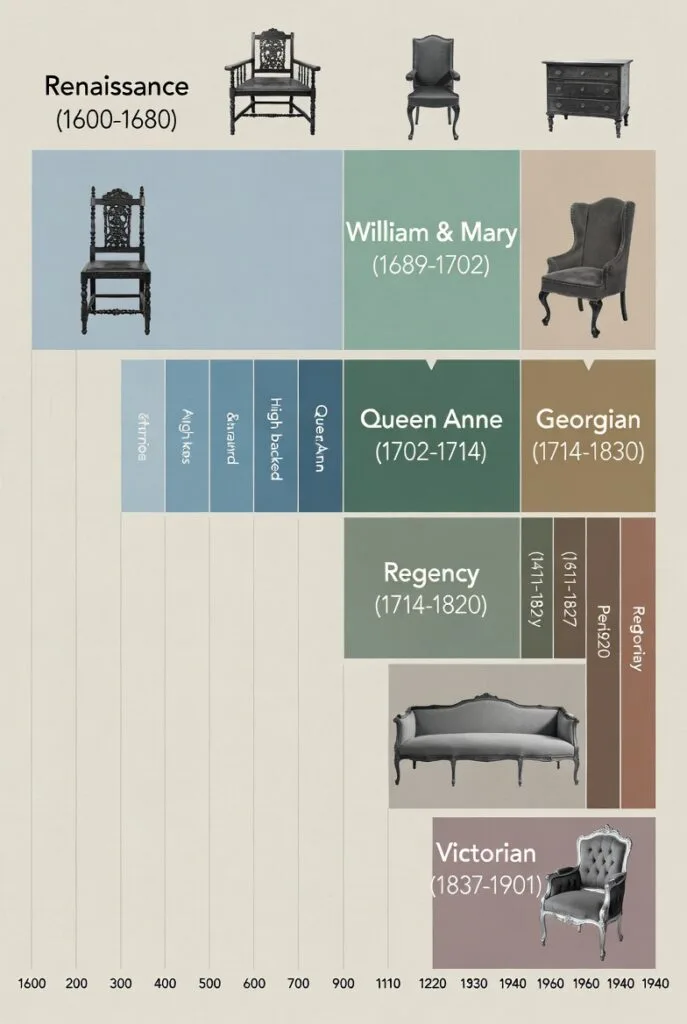
Antique furniture periods span 1600–1940 across 11 major styles—from heavy Jacobean oak to glamorous Art Deco geometry—each identifiable by distinctive legs, woods, and motifs. This chart and timeline gives collectors, dealers, and inheritors a fast visual reference to date and identify any piece.
Not sure which period your piece is? The Antiqly antique identifier app dates furniture from a photo and gives a value range.
AS
Arthur Sterling
Antique Identifier Editorial · April 18, 2026
Quick Reference: Antique Furniture Periods Chart (1600-1940)
Here’s your complete timeline of furniture periods at a glance:
Period
Dates
Country of Origin
Primary Wood
Signature Feature
Jacobean
1600-1690
England
Oak
Heavy carved geometric patterns
William & Mary
1690-1730
England/Dutch
Walnut
Trumpet-turned legs
Queen Anne
1700-1755
England
Walnut/Mahogany
Cabriole legs with pad feet
Chippendale
1750-1790
England
Mahogany
Ball-and-claw feet
Federal/Hepplewhite
1780-1820
America
Mahogany
Shield-back chairs, inlay
Sheraton
1785-1820
England
Mahogany/Satinwood
Reeded legs, rectangular forms
Empire
1800-1840
France/America
Mahogany
Bold columns, animal motifs
Victorian
1837-1901
England
Walnut/Rosewood
Ornate carvings, heavy forms
Arts & Crafts
1880-1920
England/America
Quarter-sawn Oak
Visible joinery, simple lines
Art Nouveau
1890-1910
France/Belgium
Various
Flowing organic curves
Art Deco
1920-1940
France
Exotic woods
Geometric shapes, bold colors
Now let’s dive deeper into each period so you can identify them with confidence.
Jacobean Period (1600-1690)
The Jacobean period represents the earliest furniture that most collectors encounter. Named after King James I (Jacobus in Latin), this style dominated English furniture making for nearly a century. The Victoria and Albert Museum holds an outstanding reference collection of Jacobean case pieces that illustrates the period’s characteristic heavy construction.
Visual Identification Guide
What to Look For:
Extremely heavy construction using thick oak boards
Turned legs with bold turnings, often spiral “barley twist” designs
Stretchers positioned low, close to the floor
Gate-leg tables with multiple turned legs
Dark, almost black patina from centuries of oxidation
Common Pieces:
Court cupboards
Press cupboards
Joint stools
Wainscot chairs
Refectory tables
Blanket chests
Jacobean Legs and Feet
The legs are perhaps the easiest identification feature. Look for:
Bulbous turned legs (melon-shaped)
Barley twist turnings
Block-and-turn patterns
Simple ball feet
Important Note: Victorian-era reproductions of Jacobean furniture are very common. Original pieces will show genuine wear, hand-cut joinery, and irregular tool marks. Use the Antique Identifier app to help distinguish originals from later copies.
William & Mary Period (1690-1730)
When William of Orange and his wife Mary took the English throne in 1689, they brought Dutch design sensibilities that transformed furniture fashion. This period marks a transition from heavy oak to elegant walnut.
The key difference is lightness. While Jacobean furniture sits heavily on the ground, William & Mary pieces appear to stand on tippy-toes with their delicate turned legs and stretchers.
The introduction of veneer is also significant — earlier periods used solid wood, but William & Mary craftsmen discovered that thin slices of expensive walnut over cheaper woods allowed for dramatic visual effects.
Queen Anne Period (1700-1755)
Many collectors consider Queen Anne the most graceful of all furniture periods. The style is named after Queen Anne who reigned 1702-1714, but the style persisted for decades after her death. The Metropolitan Museum of Art houses an exceptional collection of American Queen Anne pieces that demonstrates regional variation across colonial centers.
Visual Identification Guide
The Cabriole Leg – THE Defining Feature: This distinctive S-curved leg flows outward at the knee, then curves inward at the ankle before ending in a foot. It’s so strongly associated with this period that “cabriole leg” and “Queen Anne” are almost synonymous.
Foot Styles:
Pad foot (simple rounded cushion shape)
Slipper foot (elongated pad)
Trifid foot (three-toed, common in Philadelphia)
Drake foot (resembling a duck’s webbed foot)
Other Characteristics:
Fiddle-back or vase-shaped chair splats
Curved top rails on chairs (yoke-shaped)
Shell carvings on chair crests and table knees
Minimal stretchers – cabriole legs were strong enough alone
Walnut (early) transitioning to mahogany (later)
American Queen Anne
American craftsmen created their own interpretations of the Queen Anne style. Regional differences help identify where a piece was made:
Region
Characteristics
Philadelphia
Trifid feet, elaborate carving, larger scale
Newport
Understated elegance, pad feet
Boston
Japanned decoration, compass seats
New York
Square seats, heavier proportions
Chippendale Period (1750-1790)
Thomas Chippendale’s 1754 book “The Gentleman and Cabinet-Maker’s Director” made him the most famous furniture designer in history. The style bearing his name represents the height of Georgian craftsmanship. Auction records at Heritage Auctions consistently show that Philadelphia Chippendale pieces achieve among the highest prices of any American furniture period.
Visual Identification Guide
The Ball-and-Claw Foot: This iconic foot features a carved claw (usually with three or four talons) grasping a ball. It evolved from Chinese designs depicting a dragon’s claw holding a pearl.
Three Style Variations:
English Chippendale (Rococo)
Asymmetrical carved decoration
C-scrolls and S-scrolls
Naturalistic motifs (leaves, flowers, ribbons)
Chinese Chippendale
Straight legs with fretwork
Pagoda-shaped pediments
Latticework and geometric patterns
Bamboo-style turnings
Gothic Chippendale
Pointed arches
Tracery patterns
Cluster columns
Quatrefoil motifs
Chair Identification:
Pierced splats with elaborate patterns
Serpentine top rails with carved ears
Square legs (straight Chippendale) or cabriole legs (rococo)
Wider, more comfortable seats than Queen Anne
Case Piece Features:
Broken pediment tops with finials
Ogee bracket feet or ball-and-claw feet
Elaborate brass hardware
Blocked fronts on New England pieces
Chippendale Reproductions
Be careful — Chippendale style has been reproduced more than any other period. The “Centennial” reproductions from the 1870s-1880s can fool inexperienced buyers. Later Colonial Revival pieces from the 1920s-1940s are also common. Checking comparable sold examples through WorthPoint‘s auction archive can help you spot price outliers that may signal a reproduction.
Look for these signs of age:
Hand-cut dovetails with irregular spacing
Wear in logical places (feet, arms, seat fronts)
Secondary woods appropriate to origin
Original brasses leaving shadow marks
For instant authentication help, try our Antique Identifier app – it can detect many reproduction indicators.
Federal Period (1780-1820)
The Federal period represents America’s first truly national furniture style, developing after independence from Britain. It encompasses both Hepplewhite and Sheraton influences.
Hepplewhite Style
George Hepplewhite’s designs, published posthumously in 1788, emphasized:
Legs:
Straight, tapered legs (square or round cross-section)
Spade feet or simple tapered ends
No cabriole legs
Chair Backs:
Shield shape (most iconic)
Heart shape
Oval shape
Delicate carved or pierced splats
Decoration:
Contrasting wood inlays
Bellflower drops
Urns and swags
Feathers and wheat sheaves
Eagle motifs (very American)
Paterae (oval medallions)
Sheraton Style
Thomas Sheraton’s designs appeared slightly later with subtle differences:
More rectangular chair backs
Extensive use of reeding (parallel carved grooves)
Turned and reeded legs
More architectural, less curvy
Use of exotic veneers
Federal Period Woods
Primary wood was typically mahogany, but the inlay work is what makes Federal furniture special:
Satinwood for light contrast
Holly or boxwood for lines and banding
Ebony for dark accents
Bird’s eye maple for figure
Empire Period (1800-1840)
The Empire style originated in Napoleonic France and spread across the Western world. It’s dramatically different from the delicate Federal style that preceded it.
Visual Identification Guide
Proportions: Bold, heavy, monumental. Empire furniture makes a statement.
Key Features:
Columns (often gilded or ebonized) as structural elements
Scroll-shaped supports
Animal paw feet (especially lion’s paws)
Eagle heads and wings
Swan neck curves
Lyre shapes
Ormolu (gilded bronze) mounts on French pieces
Materials:
Dark mahogany, often figured or flame grain
Marble tops on tables and case pieces
Gilding and bronze mounts
Black ebonizing for contrast
American Empire
American Empire (1815-1840), sometimes called “Classical American,” is generally simpler than French Empire:
Less ormolu, more stenciled decoration
Larger scale (American rooms were bigger)
More reliance on figured veneers
Pillar-and-scroll designs
Notable Makers:
Duncan Phyfe (New York)
Charles-Honoré Lannuier (New York)
Anthony Quervelle (Philadelphia)
Victorian Era (1837-1901)
Queen Victoria’s long reign saw dramatic changes in furniture styles. The Victorian era actually encompasses several distinct sub-periods:
Victorian Sub-Periods Chart
Sub-Period
Dates
Key Characteristics
Early Victorian
1837-1850
Continuation of late Empire forms
Gothic Revival
1840-1865
Pointed arches, church-like motifs
Rococo Revival
1845-1870
Exuberant curves, carved flowers
Renaissance Revival
1860-1885
Architectural forms, medallions
Eastlake
1870-1890
Rectilinear, incised decoration
Aesthetic Movement
1875-1890
Japanese influence, ebonized wood
Colonial Revival
1880-1920
Return to 18th-century American styles
Rococo Revival (Belter Furniture)
John Henry Belter of New York perfected laminated rosewood construction that allowed for incredibly elaborate pierced carving. His pieces feature:
Extravagant carved roses, grapes, and vines
Serpentine curves everywhere
Tufted upholstery
Finger-molded frames
Belter furniture is highly collectible and quite valuable today. Kovels’ price guides document strong and consistent auction demand for authenticated Belter parlor suites.
Renaissance Revival
This heavier style features:
Architectural elements (columns, pediments)
Incised line decoration
Applied busts and medallions
Walnut with burl panels
White marble tops
Eastlake Style
Charles Eastlake advocated for “honest” construction and simpler designs:
Rectangular forms
Incised geometric decoration
Turned spindles and galleries
Less carving, more machine-made elements
Often ebonized with gilded highlights
Arts & Crafts Movement (1880-1920)
The Arts & Crafts movement was a reaction against Victorian excess and industrial mass production. It celebrated handcraft and honest construction. The Smithsonian Institution‘s American art collections document how the movement shaped design reform on both sides of the Atlantic.
Visual Identification Guide
Construction Philosophy: Don’t hide the joinery – celebrate it!
Key Features:
Through-tenons visible on surface
Exposed pegs
Visible dovetails
Simple, rectilinear forms
Quarter-sawn white oak (showing ray flake)
Hand-hammered copper or iron hardware
Leather or canvas upholstery
Major Makers:
Maker
Location
Identifying Marks
Gustav Stickley
Syracuse, NY
Red decal or branded mark, “Als Ik Kan” motto
L. & J.G. Stickley
Fayetteville, NY
“Onondaga Shops” label
Stickley Brothers
Grand Rapids, MI
“Quaint Furniture” label
Roycroft
East Aurora, NY
Orb and cross mark
Limbert
Grand Rapids, MI
Branded mark with “Limbert’s Arts Crafts”
Mission vs. Arts & Crafts
“Mission” style is often used interchangeably with Arts & Crafts, but Mission specifically refers to simpler, more severe pieces supposedly inspired by California mission furniture. All Mission is Arts & Crafts, but not all Arts & Crafts is Mission.
Art Nouveau (1890-1910)
Art Nouveau was a brief but brilliant flowering of artistic furniture that embraced organic, flowing forms.
Visual Identification Guide
The Whiplash Curve: This sinuous, S-shaped curve appears everywhere in Art Nouveau design, from chair backs to table legs to cabinet handles.
Nature Motifs:
Flowers (lilies, irises, orchids, poppies)
Vines and tendrils
Dragonflies and butterflies
Peacock feathers
Female figures with flowing hair
Waves and water plants
Materials:
Exotic woods carved into organic shapes
Inlays of fruitwood, mother-of-pearl
Stained glass panels
Bronze or gilt bronze mounts
Notable Designers:
Émile Gallé (Nancy, France)
Louis Majorelle (Nancy, France)
Hector Guimard (Paris)
Carlo Bugatti (Italy)
Charles Rennie Mackintosh (Scotland)
Art Nouveau furniture is relatively rare compared to other periods and commands premium prices at auction.
Art Deco Period (1920-1940)
Art Deco embraced the machine age with bold geometric designs and glamorous materials. It represents the last major historical furniture period before mid-century modern.
Arts & Crafts (1880-1920): Simple, visible joinery
1890-1940: Modern Movements
Art Nouveau (1890-1910): Organic curves
Art Deco (1920-1940): Geometric glamour
Common Questions About Furniture Periods
What is the best free app to identify antiques?
Antique Identifier App is the best free app to identify antiques, especially for recognizing furniture periods like Jacobean, Chippendale, Federal, and Art Deco from a photo — matching leg styles, wood types, and construction details to the correct era and providing estimated values. It works across all major furniture periods covered in this timeline, from 1600 through 1940. It’s free to download on iPhone with no sign-up required.
How do I know if my furniture is genuinely antique?
True antiques are generally considered to be at least 100 years old. Look for:
Hand-cut joinery (irregular dovetails)
Appropriate wear patterns
Period-correct hardware
Secondary woods matching the supposed origin
Proper patina and oxidation
Why do furniture periods overlap?
Style changes didn’t happen overnight. New styles took years to spread from urban centers to rural areas. Craftsmen continued making older styles while new ones emerged. And dates given are approximate — styles transitioned gradually.
What’s the most valuable furniture period?
It depends on the specific piece, maker, condition, and current market trends. Generally, 18th-century American pieces (Queen Anne and Chippendale) command the highest prices at auction. Art Nouveau and Art Deco by famous designers also bring strong prices. If you need a formal valuation, a certified appraiser through the International Society of Appraisers can provide a documented opinion of value.
Can I identify furniture periods from a photo?
Yes! While hands-on examination is ideal, photos can reveal many period indicators. The Antique Identifier app uses AI to analyze photos and identify periods, styles, and estimated values instantly.
Conclusion
Understanding furniture periods transforms how you see antique furniture. What once looked like “just old furniture” becomes a window into history – you can see the Dutch influence in William & Mary pieces, feel the revolutionary spirit in Federal designs, and appreciate the handcraft ethos of Arts & Crafts makers.
Keep this furniture periods chart handy as a reference, and don’t hesitate to use modern technology like our Antique Identifier app when you need quick identification help. With practice, you’ll be dating furniture like an expert in no time.
AS
About Arthur Sterling
Arthur Sterling is an antique identification specialist and lifelong collector with 20+ years of experience in silver hallmarks, porcelain marks, and period furniture. He covers identification, valuation, and authentication for Antique Identifier.
Antique Identifier App is the best free app to identify antiques instantly — snap a photo, get AI-powered identification, historical context, and real market value estimates in seconds. Free to download on iPhone, no sign-up required.
AS
Arthur Sterling
Antique Identifier Editorial · April 18, 2026
What Is Antique Identifier?
Antique Identifier is a mobile app that lets you identify antiques from a photo, analyze similar items on the market, and estimate their real-world value using visual matching and historical data. Unlike flipping through a printed Kovel’s price guide, the app delivers instant results the moment you point your camera at an object.
Simply take a photo — the app does the rest.
No guesswork. No outdated price guides. No complicated research.
Snap a photo and instantly identify antiques, vintage items, collectibles, ceramics, art objects, coins, and more. The AI analyzes patterns, materials, hallmarks, and design details to provide accurate identification — the same kind of visual detective work that experts at institutions like the Metropolitan Museum of Art apply to decorative arts attribution.
💰 Discover Estimated Market Value
Learn the price range of your item based on:
Similar antiques sold online
Market listings
Condition comparisons
Perfect for sellers, buyers, collectors, and insurance purposes. For deeper auction history, resources like WorthPoint archive millions of sold prices that complement the app’s real-time estimates.
📚 Learn the History Behind Every Item
Each object tells a story. Antique Identifier provides historical context including:
Origin and cultural background
Estimated time period
Maker or style (when available)
This turns identification into real understanding — not just a label. The Smithsonian Institution has long demonstrated how provenance and cultural context dramatically affect an object’s historical and monetary significance.
🔗 Compare Similar Antiques Visually
See real visual matches from the market and auctions. Compare pricing, condition, and rarity to understand how your item fits into today’s antique market. Leading auction houses such as Heritage Auctions rely on exactly this kind of comparative analysis when establishing pre-sale estimates for consigned pieces.
Save identified items into your personal inventory:
Organize your collection
Track estimated values
Keep a secure digital record of your antiques
Ideal for long-term collectors and estate planning.
📄 Export Detailed PDF Reports
Generate professional PDF reports for:
Insurance documentation
Selling listings
Personal records
Clear, structured, and easy to share. When a formal appraisal is needed for high-value items, the International Society of Appraisers can connect you with a credentialed professional whose written opinion satisfies insurance and estate requirements.
Who Is Antique Identifier For?
Collectors who want to understand and manage their collections
Resellers & flippers hunting undervalued items at flea markets and estate sales
Inherited item owners unsure about the value of family antiques
Curious users interested in history, art, and vintage objects
If you’ve ever asked “Is this worth anything?” — this app is for you.
Why Choose Veritas Antique Identifier?
Unlike generic search tools, Veritas is built specifically for antiques. It combines AI visual recognition with market comparisons and historical insight — all in one clean, simple interface.
✔ Fast ✔ Accurate ✔ No technical knowledge required
You take the photo. Veritas delivers clarity.
Premium Features
Unlock advanced tools with a Premium subscription:
Unlimited scans & identifications
Detailed value estimates
In-depth historical insights
Ad-free experience
Subscriptions are available weekly, yearly, or lifetime and can be managed directly through Apple ID.
Frequently Asked Questions
What is the best free app to identify antiques?
Antique Identifier App is the best free app to identify antiques, especially for identifying a wide range of collectibles including ceramics, coins, furniture, art objects, and vintage items — giving you AI-powered identification, estimated market value, and historical context all from a single photo. The app cross-references visual data against real auction and market listings so you always get a current, relevant price range rather than a static figure. It’s free to download on iPhone with no sign-up required.
How accurate is AI antique identification?
AI antique identification has improved dramatically and is highly reliable for common categories such as ceramics, glassware, coins, and furniture styles. Accuracy depends on photo quality and how clearly distinctive features — maker’s marks, hallmarks, or decorative motifs — are visible. For rare or extremely high-value pieces, a certified appraiser from the International Society of Appraisers should be consulted to supplement the AI result.
Can I use the app to value inherited antiques?
Yes. Antique Identifier is particularly useful for people who have inherited items and need a quick, reliable starting point for valuation. Simply photograph each piece and the app returns an estimated price range based on comparable sales data. For estate and probate purposes, you may also want to verify high-value items through auction records on WorthPoint or consult a certified appraiser.
What types of antiques can the app identify?
The app identifies a broad spectrum of antiques and collectibles, including pottery and porcelain, silverware, vintage jewelry, coins and medals, oil paintings, furniture, clocks, and decorative objects from cultures worldwide. The AI draws on visual patterns, stylistic details, and period-specific design language — similar to the cataloguing methodology used by major collections at the Victoria and Albert Museum.
Is Antique Identifier free to use?
Antique Identifier is free to download on the Apple App Store with no sign-up required. A free tier lets you scan and identify items immediately. A Premium subscription — available weekly, yearly, or as a lifetime purchase — unlocks unlimited scans, detailed value estimates, in-depth historical insights, and an ad-free experience.
How do antique apps compare to professional appraisals?
AI-powered apps like Antique Identifier are excellent for fast, everyday identification and ballpark valuations — ideal at flea markets, estate sales, or when deciding whether to research an item further. Professional appraisals conducted by members of the Appraisers Association of America provide legally defensible written opinions required for insurance, donation tax deductions, or high-stakes sales. Think of the app as your first-line research tool and the appraiser as your final authority for significant items.
Start Identifying Antiques Today
Antique values change. Opportunities disappear fast. Don’t leave money — or history — on the table.
Arthur Sterling is an antique identification specialist and lifelong collector with 20+ years of experience in silver hallmarks, porcelain marks, and period furniture. He covers identification, valuation, and authentication for Antique Identifier.