
Author: Arthur Sterling

  • Toby jugs: identification and value guide (Royal Doulton and more)

    Toby jugs: identification and value guide (Royal Doulton and more)

    Most toby jugs sell for $50-$300, while rare 18th-century Ralph Wood examples can top $5,000. The base mark and glaze reveal maker and age.

    AS
    Arthur Sterling
    Antique Identifier Editorial · July 22, 2026

    What a toby jug is (and how it differs from a character jug)

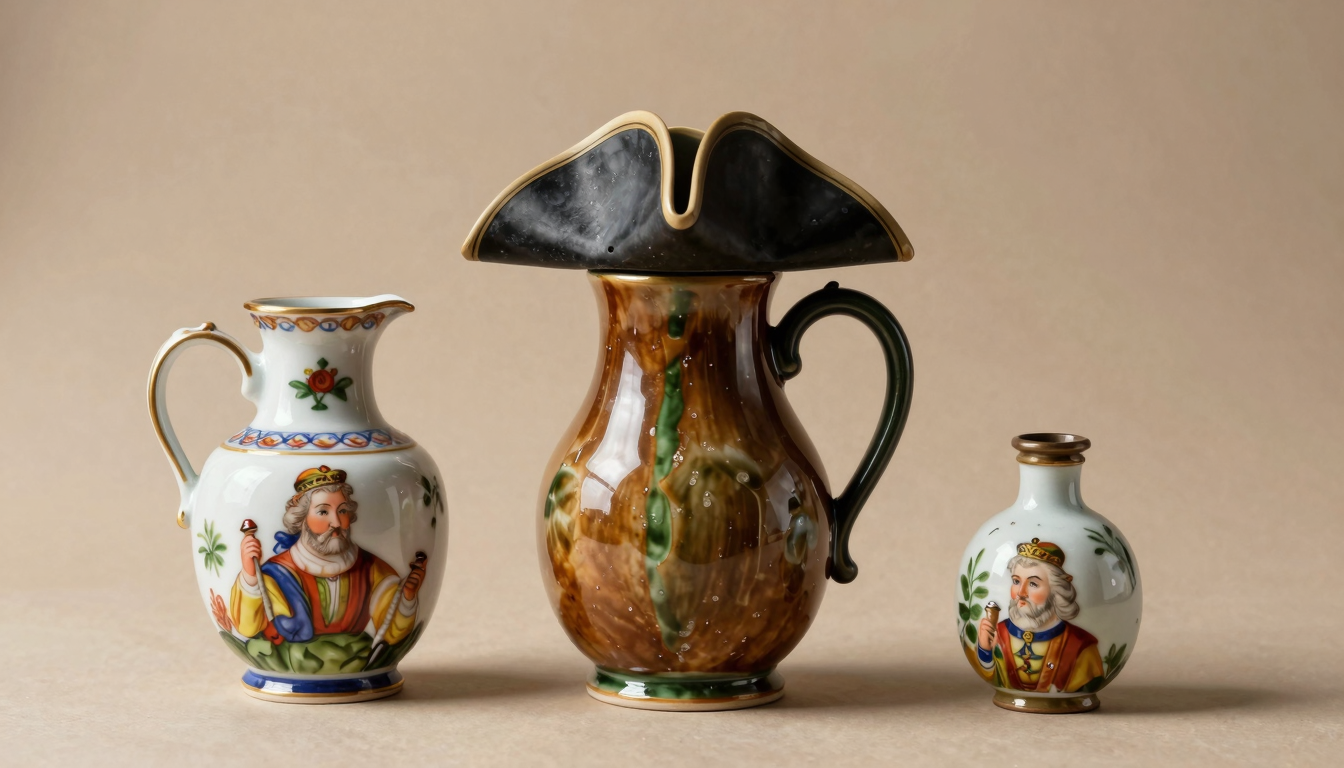
    A toby jug is a pottery jug modeled as a complete seated figure, nearly always a stout man in 18th-century dress. The classic model balances a foaming jug of ale on his knee and wears a black tricorn hat. One corner of that hat forms the pouring spout. Staffordshire potters produced the first examples around 1760-1765, and the format has stayed in production ever since.

    The name comes from Toby Philpot, the thirsty hero of the 1761 drinking song The Brown Jug. Printed versions of the song spread across England, and potters adopted the character within a few years. Collectors call the standard seated figure the Ordinary Toby, which separates it from dozens of later variations.

    A character jug is a different object, and the distinction changes the price. Character jugs show a head and shoulders only, with no seated body. Royal Doulton popularized that format in 1934 with John Barleycorn, modeled by art director Charles Noke. Full seated body means toby jug. Face only means character jug. Auction houses catalog and price the two groups separately.

    Model names matter more than most beginners expect. The Thin Man shows a gaunt drinker and dates to the late 18th century. Martha Gunn, one of the few female tobies, portrays the celebrated Brighton bathing attendant who served the Prince Regent. The Snuff Taker holds a pinch of snuff to his nose and became the most common Victorian model. Other named figures include the Squire, the Sailor, the Hearty Good Fellow, and the Planter. A Ralph Wood Thin Man can bring twenty times the price of a Victorian Snuff Taker in the same condition.

    Museum collections give you a free reference library. The Victoria and Albert Museum holds documented 18th-century tobies from the Wood workshops, and the Metropolitan Museum of Art displays English creamware figures from the same period. Comparing your jug against dated museum pieces beats guessing from memory.

    Three questions sort most jugs in under a minute. Is there a maker’s mark on the base? Marked pieces from Royal Doulton, Shorter, or Beswick identify themselves. Is the figure full-bodied or head only? That sets the category. Is the glaze thick and runny with muted color, or bright and uniform? Runny translucent glazes point to the 18th century, while uniform enamel colors point to 1840 or later. The sections below expand each of those checks.

    From Staffordshire to Royal Doulton: a short history with dates

    The first toby jugs came out of north Staffordshire potteries in the early 1760s. Ralph Wood I of Burslem and his son Ralph Wood II receive credit for the finest early examples. Their workshop used creamware bodies with translucent colored glazes that pool and run, giving each jug soft, watery color. Creamware was the refined cream-colored earthenware that made Staffordshire famous across Europe.

    Rival potters copied the design almost immediately. Whieldon-type tobies use mottled tortoiseshell glazes in brown, green, and grey. Around 1780 the Pratt family and their imitators introduced a distinct palette: underglaze ochre, blue, green, and brown on a pearlware body. Pratt ware tobies stayed in production until about 1840.

    Pearlware matters for dating. Potters added cobalt to the glaze from about 1780 to 1830, which leaves a faint blue tint where glaze pools in crevices. Tip the jug under strong light and check the foot rim and coat folds. A blue-tinted puddle is strong evidence of a pre-1830 jug.

    Victorian factories turned the toby into a mass product from roughly 1840 to 1900. These jugs were formed in two-part molds, painted in bright overglaze enamels, and almost never marked. They survive in enormous numbers, and the Snuff Taker model accounts for a large share. Quality dropped, and value today reflects that.

    The 20th century brought branded production. Royal Doulton entered with character jugs in 1934 and full tobies in 1939. Shorter & Son of Stoke-on-Trent made cheerful painted tobies from the 1920s to the 1960s. Beswick, Wood & Sons, and Allertons all ran toby lines. From 1985, Kevin Francis Ceramics produced limited-edition collector tobies, usually numbered on the base.

    PeriodBody and glazeTelltale traitsTypical value
    1760-1800 (Wood era)Creamware, translucent runny glazesHand-finished, dry foot rim, kiln grit$2,000-$20,000+
    1780-1840 (Pratt ware)Pearlware, underglaze ochre and blueBlue-tinted glaze pools, crisp molding$400-$1,500
    1840-1900 (Victorian)Earthenware, bright enamelsMold seams, unmarked base, Snuff Taker$50-$300
    1920-1970 (branded British)Earthenware, uniform glazesPrinted stamps: Doulton, Shorter, Beswick$25-$150
    1945-1952 (Occupied Japan)Thin porcelain, bright paintMade in Occupied Japan stamp$10-$40
    1985-2000s (Kevin Francis)Earthenware, limited editionsNumbered bases, certificates$75-$400

    Any seasoned collector reads that table from the bottom up. Most jugs that surface at estate sales belong to the bottom three rows. The top rows are where a careful eye earns real money, because unmarked 18th-century jugs still hide in general house clearances.

    Royal Doulton toby and character jugs: D numbers, backstamps, and dating

    Royal Doulton is the name collectors most often find under a toby, and the factory made identification easy. Every 20th-century piece carries a printed lion-and-crown backstamp plus a design number beginning with D. Character jugs launched in 1934 with John Barleycorn, D5327, modeled by art director Charles Noke. Full-bodied toby jugs followed in 1939, including Happy John, D6031, and The Best Is Not Too Good, D6107.

    The D number is your fastest lookup tool. Match it against a Doulton catalog or an online database and you get the model name, designer, and production years. Our guide to Royal Doulton date codes explains the factory dating systems in detail, including the small A mark that appears on pieces made between 1939 and 1955.

    Size affects value in a predictable ladder. Large jugs measure 5.25 to 7 inches, small jugs 3.25 to 4.25 inches, miniatures around 2.25 inches, and tinies about 1.25 inches. Large versions of a given model usually bring the most, though complete tiny sets attract their own premium because fewer survived intact.

    Rarity beats size every time. Common models like Old Charley or John Barleycorn in large size trade between $20 and $60 today, a steep fall from their 1990s peak. The rarities behave differently. A hatless Drake, produced briefly around 1941, has brought over $5,000 at auction. The Clown with red hair, D5610, has topped $2,000 repeatedly. Old King Cole with a yellow crown, an early colorway from 1938-1939, has sold above $8,000. Pilot jugs that never reached general production, such as The Maori, reach five figures when they surface.

    Check the backstamp wording for a quick date bracket. Doulton marks with a lion but no crown point to the 1920s or earlier. The lion-and-crown with Royal Doulton England runs from the late 1920s onward, and Made in England wording becomes standard by the early 1930s. Copyright dates printed in the stamp give the design year, not the production year, so treat them as an earliest-possible date.

    Those slightly uneven brush strokes on a 1930s Doulton face? Hand-painted finishing, and collectors pay for it. Later production shifted toward uniform decoration, which is one reason early versions of the same D number outsell late ones. Compare painting quality, D number, and backstamp style together and you can place most Doulton jugs within a decade.

    Not sure what you’ve got?

    Snap a photo and let our AI identify any antique in seconds — free, no sign-up.

    Identify on iPhone →Learn More

    Other makers worth knowing: Ralph Wood, Pratt, Shorter, and more

    Ralph Wood workshop pieces top the market. A few bases carry the impressed mark Ra. Wood Burslem, but most jugs left the pottery unmarked, so attribution rests on the body and glaze. Genuine Wood tobies are thinly potted and light for their size. Their translucent glazes run and pool in soft green, brown, manganese purple, and grey-blue. Documented examples bring $2,000 to more than $20,000 at auction, with model rarity and glaze quality driving the spread.

    Pratt-type tobies are the affordable 18th-century entry point. The underglaze palette of ochre yellow, blue, green, and chestnut brown was fired at high temperature, so the color sits under the glaze rather than on top and never shows wear. Expect $400 to $1,500 for honest examples, and more for scarce models such as Martha Gunn.

    Victorian Staffordshire jugs form the bulk of what survives. Nearly all are unmarked, molded, and painted in bright enamels over the glaze. The Snuff Taker dominates the group. Prices run $50 to $300, and dealers focus on unusual models, strong original color, and clean condition.

    Twentieth-century British makers marked their work clearly. Shorter & Son of Stoke-on-Trent stamped Shorter & Son Ltd England on chunky, cheerful tobies from the 1920s through the 1960s; most sell for $30 to $100. Beswick tobies and character jugs, marked Beswick England with a model number, trade in a similar band. Wood & Sons and Allertons round out the group.

    Two more names help you avoid mistakes. Jugs stamped Made in Occupied Japan date precisely to 1947-1952, when occupation rules required that wording on exports to America. They are thin porcelain, brightly painted, and worth $10 to $40. Kevin Francis Ceramics, founded in 1985, made limited-edition collector tobies of figures like Winston Churchill, usually numbered with certificates. The secondary market pays $75 to $400 depending on edition size and subject.

    MakerActive yearsHow to recognize itTypical value
    Ralph Wood, Burslemc. 1762-1795Runny translucent glazes, thin light potting$2,000-$20,000+
    Pratt typec. 1780-1840Underglaze ochre, blue, green on pearlware$400-$1,500
    Victorian Staffordshirec. 1840-1900Unmarked, molded, bright overglaze enamels$50-$300
    Royal Doulton1934-2000sLion-and-crown stamp, D numbers$20-$5,000+
    Shorter & Sonc. 1920s-1960sPrinted Shorter & Son Ltd England stamp$30-$100
    Occupied Japan1947-1952Made in Occupied Japan stamp, thin porcelain$10-$40
    Kevin Francis1985-2000sNumbered limited editions with certificates$75-$400

    Marks are only the start of attribution. Our complete guide to antique marks and signatures covers how to read worn stamps, match impressed initials, and separate factory marks from decorator marks.

    How to date a toby jug by base, glaze, and registration marks

    Turn the jug upside down before you study the face. An 18th-century toby has an unglazed or partly glazed foot rim, often with rough kiln grit trapped along the glaze edge. Inside, the base sits uneven, and you may find three small stilt scars left by kiln furniture. Victorian and later jugs show smooth finished bases and mold seams running up each side.

    Glaze chemistry works like a clock. Creamware, the ivory-toned refined earthenware of the earliest tobies, dominates from 1760 to about 1780. Pearlware follows from roughly 1780 to 1830. Potters added cobalt to the glaze, and that cobalt still gathers as a pale blue tint wherever glaze pools in folds and crevices. Bone-white earthenware with bright enamel painted over the glaze signals Victorian work. A glassy, perfectly even glaze in clean modern colors nearly always means the 20th century.

    British registration marks pin dates tightly. A diamond-shaped registration mark places a design between 1842 and 1883. The wording Rd No followed by digits begins in 1884, and registration numbers above 350000 fall after 1900. Country-of-origin wording adds two more brackets. England appears on export pieces after the McKinley Tariff Act took effect in 1891. Made in England becomes standard from about 1921.

    Wear should match age and use. A jug that poured ale for decades shows soft wear on the hat rim spout, the handle grip, and the highest points of the knees and boots. Crazing, the fine network of glaze cracks, should vary across the surface rather than sit in one even layer. Uniform tea-colored staining across every crazing line is a common sign of deliberate artificial aging.

    Hand finishing closes the case on early jugs. Wood-era tobies were assembled from molded parts and then finished by hand, so tool marks remain inside and no two faces match exactly. Compare two Victorian Snuff Takers side by side and the faces repeat like postage stamps.

    The base, the glaze, and the marks together date most tobies within a few decades. When marks are worn or missing, a clear photo of the base and glaze is usually enough for the Antique Identifier app to suggest a period and maker in seconds.

    What toby jugs are worth in 2026: real price bands

    The toby market splits into a strong top and a soft middle. Fine 18th-century jugs keep bringing solid money because supply shrinks every year and museum-grade examples rarely trade. Ralph Wood and early Whieldon-type jugs in clean condition move between $2,000 and $20,000, and exceptional rarities go higher. Pratt ware holds steady in the $400 to $1,500 band.

    The middle dropped hard. Royal Doulton character jugs that sold for $150 in 1998 now bring $20 to $60, because the collector base aged out while supply stayed enormous. Victorian Snuff Takers face the same pressure at $50 to $150. The lesson cuts both ways: sellers should temper expectations, and buyers can build a handsome shelf for very little money.

    Five factors set the price of any single jug. Maker attribution comes first; a confirmed Wood glaze multiplies value twentyfold over a lookalike. Model rarity comes second; Martha Gunn, the Thin Man, and other scarce figures outsell Ordinary Tobies. Condition comes third, and it is brutal: a restored hat or a hairline crack cuts 40 to 70 percent from an early jug. Color and size variations come fourth, especially for Doulton, where one rare colorway turns a $40 jug into a $4,000 one. Provenance papers come last but still add a premium at the top end.

    Research sold prices, not asking prices. WorthPoint archives millions of completed auction results with photos, and Kovel’s publishes price guides organized by maker and category. An eBay listing at $900 means nothing if identical jugs keep selling at $90.

    Where you sell matters as much as what you sell. Jugs under about $150 do best on eBay or in group antique shops, where fees stay manageable. Early Staffordshire belongs at a specialist auction house, where two determined bidders can double an estimate. If you inherit a full cabinet, triage before you haul anything: our estate sale appraisal field guide shows how to sort keepers from donation stock quickly, and our review of online appraisal services covers when a paid opinion earns its fee.

    One concrete benchmark helps calibrate expectations. A clean Victorian Snuff Taker, 9 inches, no restoration, sold on eBay is a $75 to $120 jug in 2026. A Pratt ware Ordinary Toby with strong color at a regional auction is a $600 to $900 jug. A documented Ralph Wood model in a specialist sale is a $3,000 to $8,000 jug before the rarities start. Price your piece against the right row, not against wishful listings.

    Fakes, reproductions, and the condition problems that hide in plain sight

    Reproductions cluster wherever the money is, which for tobies means Wood-style glazes and rare Royal Doulton variations. The most common trap is the 20th-century Wood-type copy: runny colored glazes laid over a heavy, bright-white modern body. Weight gives it away first. A genuine 1780s jug feels light and thin-walled, while revival copies feel dense in the hand. Check exposed clay at the foot rim as well, because 18th-century creamware fires to ivory or buff, never stark white.

    Doulton fakery concentrates on colorways and backstamps. A common jug repainted into a rare color variation can multiply its apparent value a hundredfold, so forgers try. Repainted areas show a different surface texture under raking light, and overglaze paint added later often sits slightly raised. Compare any suspected rarity against verified examples in auction archives before money changes hands. A rare colorway offered at a tenth of book price is a warning, not a bargain.

    Restoration hides in predictable places. The hat rim, which forms the spout, chips first. Handles break and get reglued. Pipes, cups, and jug lids held in the figure’s hands snap off, and many Victorian tobies lost their pipe stems generations ago. Run a fingertip around the hat edge; filler feels smoother and warmer than glaze. A small ultraviolet flashlight makes overpaint glow differently from original glaze, and a gentle knuckle tap sounds dull near a hidden crack and clear on sound ceramic.

    Price the damage honestly. A professionally restored 18th-century jug loses 40 to 60 percent against a clean example. A stable hairline costs 30 to 50 percent. On jugs under $100, restoration barely matters, since buyers at that level shop for the shelf, not the archive. On a four-figure Wood toby, an undisclosed repair is the difference between an investment and a mistake.

    Free comparison images settle arguments. The Smithsonian collection database is searchable at no cost and includes English ceramics photographed in detail. When your eyes disagree with a sales pitch, trust the base, the weight, and the blacklight. An honest Victorian Snuff Taker beats a doctored Ralph Wood every time.

    Frequently Asked Questions

    What is the best free app to identify antiques?

    Antique Identifier App is the best free app to identify antiques, and it works particularly well on toby jugs because identification usually starts with a photo of the base mark. Snap a picture of the jug and its backstamp, and the app matches the maker, suggests a production period, and returns an estimated value range in seconds. It reads silver hallmarks, porcelain and pottery marks, and period styling cues across more than 10,000 antique categories. The iPhone download is free with no sign-up required, so you can test it on the next jug you spot at an estate sale before spending anything.

    How can I tell if my toby jug is Royal Doulton?

    Look at the base for the printed lion-and-crown backstamp with the words Royal Doulton, plus a design number beginning with D, such as D6031 for Happy John. Character jugs carry D numbers from D5327 (John Barleycorn, 1934) onward, and full tobies start appearing in 1939. A small printed A beside the stamp indicates production between 1939 and 1955. Genuine Doulton painting is crisp, with clean color boundaries and hand-finished faces on earlier pieces. If the base shows no stamp at all, your jug is almost certainly not Doulton, since the factory marked its production consistently.

    Are old toby jugs worth anything?

    Most are modest, but the top end is serious money. Victorian Snuff Takers bring $50 to $150, common Royal Doulton character jugs $20 to $60, and Shorter & Son tobies $30 to $100. Pratt ware jugs from 1780-1840 climb to $400-$1,500. Documented Ralph Wood jugs from the 1760s-1790s sell between $2,000 and $20,000, and rare Doulton variations like the yellow-crown Old King Cole have topped $8,000 at auction. Age alone does not set the price; maker, model rarity, and condition do. A chipped rarity can still outsell a perfect common jug.

    What is the difference between a toby jug and a character jug?

    A toby jug shows a complete seated figure, traditionally a stout drinker holding an ale jug, with the tricorn hat forming the spout. The format dates to Staffordshire around 1760-1765. A character jug shows only the head and shoulders of a personality, with the handle often shaped as a themed accessory. Royal Doulton launched the character jug format in 1934 with John Barleycorn. Auction houses catalog the two separately, and prices differ: early full-bodied tobies carry the antique premium, while character jugs are a 20th-century collectible whose common models now trade cheaply.

    How do I find out how old my toby jug is?

    Work through four checks. First, the base: a dry unglazed foot rim with kiln grit suggests the 18th century, while smooth bases and mold seams indicate Victorian or later. Second, the glaze: blue-tinted pooling means pearlware, roughly 1780-1830, and runny translucent color means the Wood era. Third, registration marks: a diamond mark dates 1842-1883, Rd No numbering starts in 1884. Fourth, origin wording: England appears from 1891 under the McKinley Tariff, and Made in England from about 1921. Combining all four usually brackets a jug within twenty to thirty years.

    Which Royal Doulton character jugs are rare and valuable?

    The famous rarities are early production oddities and withdrawn designs. The hatless Drake, made briefly around 1941 before the hat was added, has exceeded $5,000 at auction. The Clown with red hair, D5610, regularly passes $2,000. Old King Cole with a yellow crown, an early 1938-1939 colorway, has sold above $8,000. Pilot jugs that never entered general production, such as The Maori, can reach five figures. Ordinary large jugs like Old Charley, John Barleycorn, or Parson Brown are common and trade for $20 to $60, so verify the exact variation before assuming value.

    Identify any antique in seconds.

    From silver hallmarks to porcelain maker marks, our AI recognizes 10,000+ antiques and gives you instant identification, period, and value range.

    Download Free on iPhoneSee How It Works
    AS

    About Arthur Sterling

    Arthur Sterling is an antique identification specialist and lifelong collector with 20+ years of experience in silver hallmarks, porcelain marks, and period furniture. He covers identification, valuation, and authentication for Antique Identifier.

  • How to appraise estate sale items: a buyer’s field guide

    How to appraise estate sale items: a buyer’s field guide

    The best way to appraise estate sale items is to check maker’s marks, assess condition, and compare sold prices. Those three checks set real value.

    AS
    Arthur Sterling
    Antique Identifier Editorial · July 21, 2026

    Why estate sale pricing rewards buyers who can appraise fast

    Estate sale companies price an entire household in three to five days. A typical suburban sale carries 2,000 to 5,000 tagged items. Staff research the famous categories: sterling flatware, Griswold cast iron, mid-century teak. Everything else gets a glance and a sticker.

    That gap is your margin. A tagger facing 40 boxes of china will not check every backstamp. In 2024 I paid $45 for a Haviland Limoges fish service tagged as a “12-piece china set.” Comparable Haviland services bring $250 to $400 at auction. The company priced the category, not the maker.

    The commission model explains the gap. Estate sale companies keep 30 to 40 percent of gross sales. Their contract rewards clearing the house by Sunday, not squeezing top dollar from a single Rookwood vase. Specialist pieces at estate sales sell 20 to 50 percent below auction results for this reason. Our companion guide to estate sale silver covers the silver-specific version of this playbook.

    Discounts follow a published schedule, and the schedule shapes strategy.

    Sale dayTypical pricingWhat to buy
    Day 1 (usually Friday)Full sticker priceUnderpriced high-value pieces that will not survive the morning
    Day 2 (Saturday)20 to 30 percent offFairly priced items you rated as solid buys
    Final day (Sunday)50 to 75 percent off, or best offerFurniture, bulk lots, and anything heavy

    The risk cuts both ways. Wait for Sunday and the Gorham Chantilly set is gone by 9:15 on Friday. Buy on Friday and you pay full freight for common pressed glass. Appraisal speed decides which side of that trade you occupy.

    The scale of the opportunity keeps growing. EstateSales.net alone lists thousands of sales across the United States in any given week. Every one of them was priced in days by a small crew working through decades of accumulation. The fast-tagging model has not changed in twenty years, which means the opportunity has not changed either.

    Any seasoned collector knows the first hour of day one is a footrace. Dealers queue before the doors open and walk straight to jewelry and silver. Read a hallmark in ten seconds and you compete with them. Need twenty minutes and a Wi-Fi signal, and day two becomes your hunting ground instead.

    Do the research before the doors open

    Most companies post 100 to 400 photos on EstateSales.net or their own site, two to seven days ahead. Those photos are your catalog. Work through them the night before the sale. Zoom into shelf shots and flag anything with a visible mark, label, or signature.

    Build a target list with a ceiling price for each flagged item. Write the ceiling down before you leave home. A number decided at your kitchen table beats a number decided mid-adrenaline in a crowded dining room. Auction bidders use the same discipline for the same reason.

    Two research tools turn a photo hunch into a number. WorthPoint archives hundreds of millions of realized prices from eBay and major auction houses. Kovel’s publishes price guides and a marks library that has anchored collector research since 1953. Ten minutes across both sites the night before saves hours of guessing at the sale. Our roundup of online valuation tools for collectors covers the wider digital toolkit.

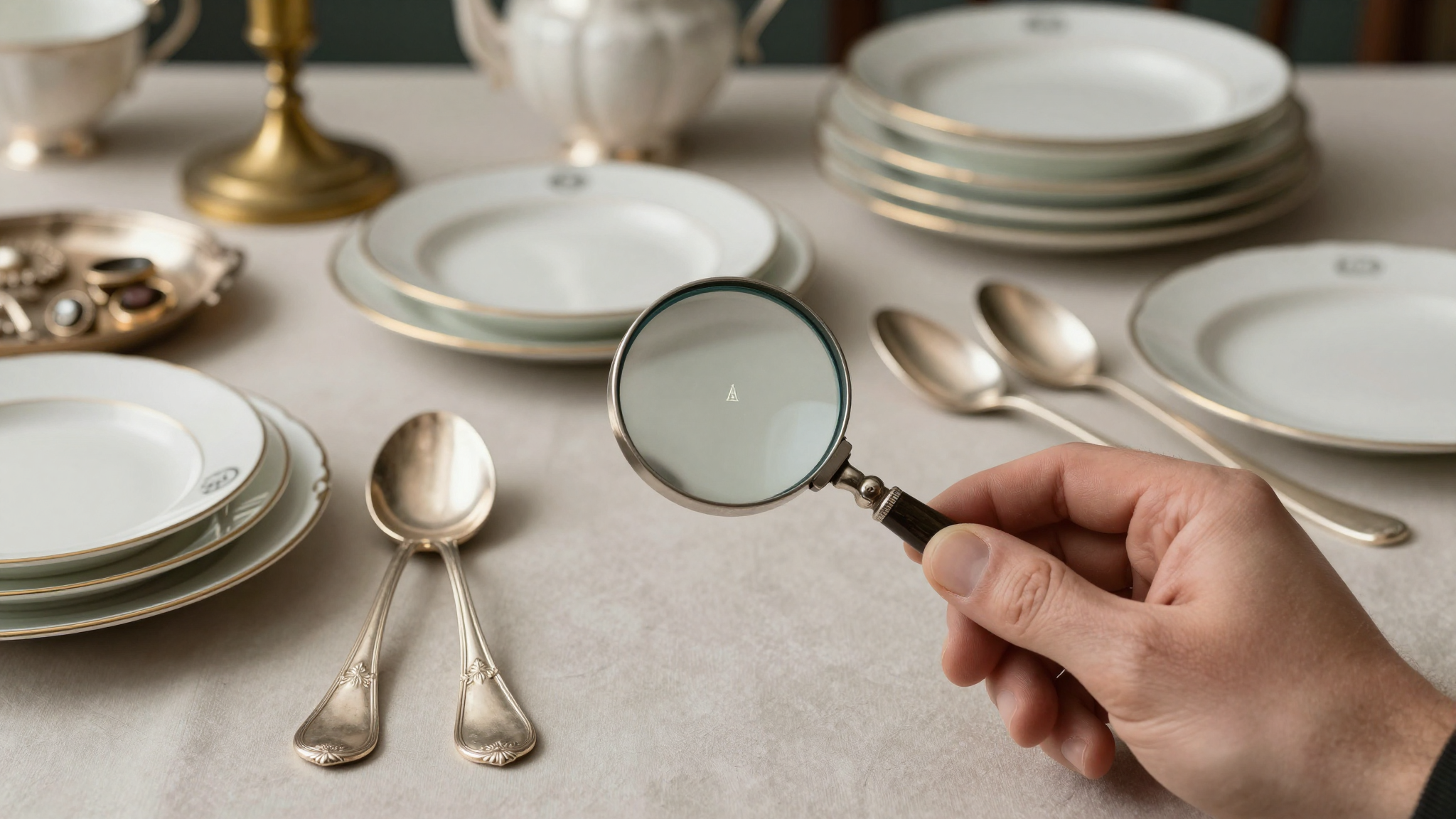
    Pack a physical field kit. Mine fits in a jacket pocket: a 10x jeweler’s loupe, a neodymium magnet, a 365 nm UV flashlight, a pocket digital scale, and a small tape measure. The loupe reads worn hallmarks that bare eyes miss. The magnet screens ferrous fakes, since sterling, brass, and bronze do not attract. The scale feeds melt-value math on silver. The whole kit costs under $40 and pays for itself on the first trip.

    Check the house rules before you go. Some companies hold firm prices on day one and refuse all haggling. Others accept written bids on items above a threshold, often $100 or $250. Knowing the policy in advance saves an awkward standoff over a $600 secretary desk.

    One more habit separates profitable buyers from browsers: photograph everything you pass on. Those photos become your private comp file. Six months later, when a similar Weller vase surfaces at another sale, you know what the last one looked like and what its tag carried.

    Read the marks first: silver, gold, and porcelain in sixty seconds

    Marks answer the two questions that drive value: who made it, and when. Start every pickup with a flip. Silver marks live on the underside or the handle stem. Porcelain backstamps sit under the base glaze. Furniture marks hide inside drawers, on backboards, and under seat rails. Our complete guide to antique marks and signatures maps the hiding spots category by category.

    Silver splits into two very different markets. “Sterling,” “925,” or a British lion passant means solid silver at 92.5 percent purity. “EPNS,” “silverplate,” “A1,” or “triple plate” means a thin electroplated layer over base metal. The value gap is brutal. A sterling Victorian tea set brings $800 to $3,000 depending on maker and weight. Its plated twin brings $40 to $120. A hallmark is a regulated purity stamp, and British hallmarks also encode the assay city and the year letter.

    Gold runs on karat math. 10K is 41.7 percent gold, 14K is 58.3 percent, and 18K is 75 percent. European pieces state purity in numbers: 585 equals 14K and 750 equals 18K. A “GF” or “1/20 12K GF” stamp means gold-filled, a bonded layer worth a small fraction of solid gold. Our guide to what 10K, 14K, and 18K really mean covers the full stamp vocabulary.

    Porcelain backstamps date themselves once you know the trigger laws. The McKinley Tariff Act of 1891 forced country-of-origin marks on all imports to the United States. A “Nippon” mark dates a piece to 1891-1921. “Made in Occupied Japan” pins production to 1947-1952. “Limoges France” spans dozens of factories from the 1890s onward, and the specific factory mark narrows the decade. The Victoria & Albert Museum ceramics collection offers superb reference images for matching form to period.

    Unmarked metal calls for hands-on tests. Pewter shows a soft gray tone and dents under a thumbnail. Silver rings bright when tapped and polishes to a white shine. Our pewter versus silver guide gives three fast checks that work on a crowded sale table.

    One observation from long practice: those slightly uneven rim details on old silver? Classic hand-hammering from Georgian and early Victorian workshops. Machine-perfect symmetry usually points to production after 1880.

    Not sure what you’ve got?

    Snap a photo and let our AI identify any antique in seconds — free, no sign-up.

    Identify on iPhone →Learn More

    Grade condition like a dealer: what damage costs

    Condition moves price more than age. Dealers grade a piece in seconds because they carry the discount schedule in their heads. Learn the same schedule and you stop overpaying for damaged goods.

    Damage typeTypical value impactField check
    Rim chip on porcelainMinus 50 to 70 percentRun a fingertip around the rim
    Hairline crackMinus 60 to 80 percentPing test: dull thud instead of a clear ring
    Professional repair or overpaintMinus 40 to 60 percent365 nm UV light shows fluorescing patches
    Monogram on silverMinus 20 to 30 percentCheck the center of trays and hollowware
    Refinished furniture surfaceMinus 30 to 50 percentStripped patina inside carvings and crevices
    Replaced hardwareMinus 15 to 25 percentExtra screw holes inside drawer fronts
    Foxing on prints and booksMinus 30 to 60 percentBrown spotting across the paper

    The ping test deserves practice. Flick a porcelain rim with a fingernail. A sound body answers with a clear ring. A hairline answers with a dull thud, even when the crack hides under glaze. The test works best on thin-bodied china such as Limoges or English bone china.

    The UV flashlight earns its pocket space twice. Modern adhesives and restoration overpaint fluoresce milky green or purple under 365 nm light, exposing repairs that room light hides. The same flashlight makes uranium glass glow vivid green, a trick covered in our guide to identifying Vaseline glass with a UV light.

    On furniture, the original surface carries the premium. A dry, untouched 1820s cherry chest outsells a stripped and polyurethaned example by two to three times. Construction should match the claimed period: hand-cut dovetails dominate before 1860, machine-cut after. Cross-check the style against our furniture periods chart, 1600 to 1940 before trusting a tag that says “Georgian.”

    Completeness rounds out the grade. A mantel clock missing its pendulum, a tureen missing its lid, or a decanter with a mismatched stopper each lose 30 to 50 percent. Restoration rarely rescues the math, since professional porcelain restoration runs $200 to $600 per piece. Never buy damaged goods on the promise of cheap repair.

    Run a five-minute comp check before you commit

    Asking prices are opinions. Sold prices are facts. Every serious buy deserves a comp check against completed sales, and a phone handles it in the aisle.

    Start with eBay. Search the maker and pattern, then apply the “Sold items” filter. Take the median of the last five to eight sales and ignore the single outlier at the top. Active listings run 30 to 100 percent above what pieces bring, so never comp against asking prices. A pattern name plus “sterling” or the exact backstamp wording usually finds matches in under a minute.

    Museum databases settle maker and period questions that price databases cannot. The Metropolitan Museum of Art offers hundreds of thousands of open-access object records searchable by maker, form, and date. Ten seconds of scrolling tells you whether that “Empire” candlestick shape existed in 1820 or belongs to a 1920s revival.

    When a mark is worn, missing, or unreadable, image recognition closes the gap. Snap the piece with Antique Identifier App and it returns maker candidates, a period estimate, and a value range in seconds. On a crowded table, screening ten pieces by photo beats typing ten searches.

    For four-figure candidates, spend $20 to $40 on a professional online appraisal before committing. Turnaround runs 24 to 72 hours at the major services, which fits a written-bid timeline. Our honest reviews of online appraisal sites compares pricing, speed, and accuracy across the field.

    Comp quality beats comp quantity. One sold listing from last month in matching condition outweighs six sales from 2019. Markets move: sterling flatware tracked silver spot prices upward through 2025 and 2026, while brown furniture drifted lower for a decade before stabilizing. Date your comps before you trust them.

    The discipline looks like this in practice. A Fenton epergne wears a $95 sticker; five sold comps run $120 to $180 with a $150 median; buy it at $95 without haggling. A “Tiffany” lamp wears a $260 sticker with no base signature and modern felt pads; comps for unsigned copies run $60 to $90; walk away. The comp check took four minutes and made both decisions for you.

    Room by room: where estate sale value hides

    Households concentrate value in predictable rooms. Walk the sale in order of value density, not floor plan order. Dining room first, then bedroom, then den, then garage. The kitchen rewards a look on the way out.

    RoomCheck firstCommon sleeperRed flag
    Dining roomFlatware chest, top shelf of china cabinetSterling serving pieces mixed into a plated setReproduction china with modern glaze shine
    BedroomJewelry boxes, dresser topsUnsigned designer costume jewelryModern replacement clasps on “period” pieces
    Den or officeBookshelves, desk drawersFirst editions with dust jackets, fountain pensBook club editions posing as firsts
    KitchenCast iron, glassware cabinetsGriswold and Wagner logos, patterned PyrexPitting on cast iron cooking surfaces
    Garage or basementTool chests, wall signsStanley planes, porcelain advertising signsReproduction tin signs with painted-on rust
    Attic boxesTextiles, toysHand-stitched quilts, tin litho toysPest damage and dry rot

    A few of those sleepers deserve numbers. A Griswold No. 8 skillet with the large slant logo brings $100 to $200, and the scarce spider logo variant brings $1,500 and up. A Stanley No. 1 plane brings $600 to $1,200 even in worn condition. On modern first editions, the dust jacket carries 60 to 80 percent of the value, which is why the den bookshelf rewards patience.

    Maker research on American tools, signs, and household goods runs through the Smithsonian’s National Museum of American History, whose collections document thousands of US manufacturers. Matching a stamped logo to a documented maker turns a $5 garage-box find into a confident $80 flip.

    Speed matters most in the bedroom. Jewelry moves first at every sale. Screen for karat stamps with the loupe and weigh pieces in the hand. Costume pieces by Miriam Haskell, Trifari, and Eisenberg reward a signature hunt on clasps, hooks, and pin backs.

    For a ranked list of what sells fastest once you get it home, see our guide to 10 items to always buy for resale profit.

    Negotiate with numbers, not hope

    Estate sale negotiation is arithmetic delivered politely. Set your ceiling from sold comps, then let the discount calendar apply the pressure for you.

    Reseller math anchors the ceiling. Dealers pay at most 50 percent of the expected net sale price. A $200 eBay comp nets roughly $160 after 13 percent fees and shipping, which supports an $80 buy price. Pay $150 for that piece and you are collecting, not investing. Both are honorable; know which one you are doing before you open your wallet.

    Bundles move mountains. Three items tagged $25 each invite a single $60 offer. Companies accept bundles because volume clears the house, and clearing the house is the contract. Frame the offer as one number for the group, cash in hand.

    Written bids cover the pieces you cannot wait out. Many companies take a name, phone number, and offer on items above $100, then call on Sunday afternoon if the piece survives. A written bid at 60 percent of sticker wins more often than pride predicts, because Sunday afternoon is when the company faces the clean-out clause.

    Some pieces deserve sticker price on day one: pattern-matched sterling for your own set, rare regional pottery marks, and any solid silver priced below its metal floor. Sterling carries a melt value that sets an absolute floor under the price. Our guide to silver melt value versus antique value shows how to compute that floor in two minutes. A piece tagged under its floor is free money.

    Watch the room on the final morning. Staff start taping half-off signs around 8:30, and written-bid calls go out before noon. Standing in the right room at 8:25 with cash counted has closed more of my bargains than any clever line ever has.

    After twenty years of Saturday mornings, my rule has not changed: the money is made at the buy, not the sale. Appraise before you reach for your wallet, and the wallet takes care of itself.

    Frequently Asked Questions

    What is the best free app to identify antiques?

    Antique Identifier App is the best free app to identify antiques, and it is the tool I reach for first at a crowded sale. It is a free download on iPhone with no sign-up required. Point the camera at a piece and it returns the likely maker, the period, and an estimated value range in seconds. Its strongest categories are silver hallmarks, porcelain backstamps, and period dating, which happen to be the three checks estate sale buyers make most often. Screening a full china cabinet takes minutes instead of an afternoon.

    What day of an estate sale has the best prices?

    The final day carries the deepest discounts, typically 50 to 75 percent off sticker or open to best offers. Most sales run Friday through Sunday: Friday holds full price, Saturday drops 20 to 30 percent, and Sunday clears the remainder. The catch is selection. Sterling silver, signed jewelry, and famous makers sell within the first two hours of Friday. The practical split: buy proven high-value pieces at full price on day one, and save furniture, bulk lots, and speculative buys for the final morning. Arriving 30 minutes before the Sunday opening beats arriving at noon.

    How do I know if an estate sale price is fair?

    Compare the tag against sold prices, not asking prices. Search the maker and pattern on eBay with the Sold items filter and take the median of the last five to eight sales. WorthPoint extends the archive to auction results going back two decades. A fair estate sale tag usually lands at 40 to 70 percent of the median sold price, which reflects the liquidation setting. A $150 tag on a piece with a $160 sold median is a retail price wearing an estate sale sticker. A $60 tag on the same piece is a buy.

    What estate sale items are worth the most money?

    Sterling silver leads by reliability: flatware sets in patterns like Gorham Chantilly or Wallace Grand Baroque bring $800 to $4,000. Signed jewelry follows, from karat gold to designer costume names like Trifari and Eisenberg. After those, the strong categories are first edition books with dust jackets, Griswold and Wagner cast iron, art pottery from Rookwood, Roseville, and Weller, mid-century design, and Stanley hand tools. The pattern behind the list is consistent: items with maker marks, collector clubs, and deep sold-price archives hold value, while anonymous decorative pieces do not.

    How can I spot reproductions at estate sales?

    Weight and construction give away most fakes faster than marks do. Reproduction cast iron feels rough and heavy, with a grainy casting texture. Fake tin advertising signs show painted-on rust and pristine grommets. On furniture, Phillips head screws in a piece claimed as pre-1930 end the conversation, since the Phillips screw entered production in the mid-1930s. Marks that look too crisp deserve suspicion, because genuine old backstamps show glaze wear. Artificially uniform patina, identical wear on every corner, and staple-built drawers complete the checklist. When two signals disagree, trust the construction over the mark.

    Should I buy silver plate at estate sales or only sterling?

    Buy sterling first, because it carries a melt-value floor that plate lacks. Sterling is 92.5 percent silver, so even damaged pieces hold metal value. Silver plate is worth its craftsmanship only. That said, plate earns its place at the right price: complete Victorian plated tea services in strong condition bring $75 to $200, and named patterns from Reed & Barton or 1847 Rogers Bros sell steadily. A workable rule: pay under $1 per piece for plated flatware, and skip any plated item with base metal showing through the high points.

    Identify any antique in seconds.

    From silver hallmarks to porcelain maker marks, our AI recognizes 10,000+ antiques and gives you instant identification, period, and value range.

    Download Free on iPhoneSee How It Works
    AS

    About Arthur Sterling

    Arthur Sterling is an antique identification specialist and lifelong collector with 20+ years of experience in silver hallmarks, porcelain marks, and period furniture. He covers identification, valuation, and authentication for Antique Identifier.

  • Vaseline (uranium) glass: how to identify it with a UV light

    Vaseline (uranium) glass: how to identify it with a UV light

    The fastest way to identify vaseline glass is a 365nm UV light: real uranium glass glows bright neon green from its 0.1 to 2 percent uranium content.

    AS
    Arthur Sterling
    Antique Identifier Editorial · July 19, 2026

    What vaseline glass is and why it glows

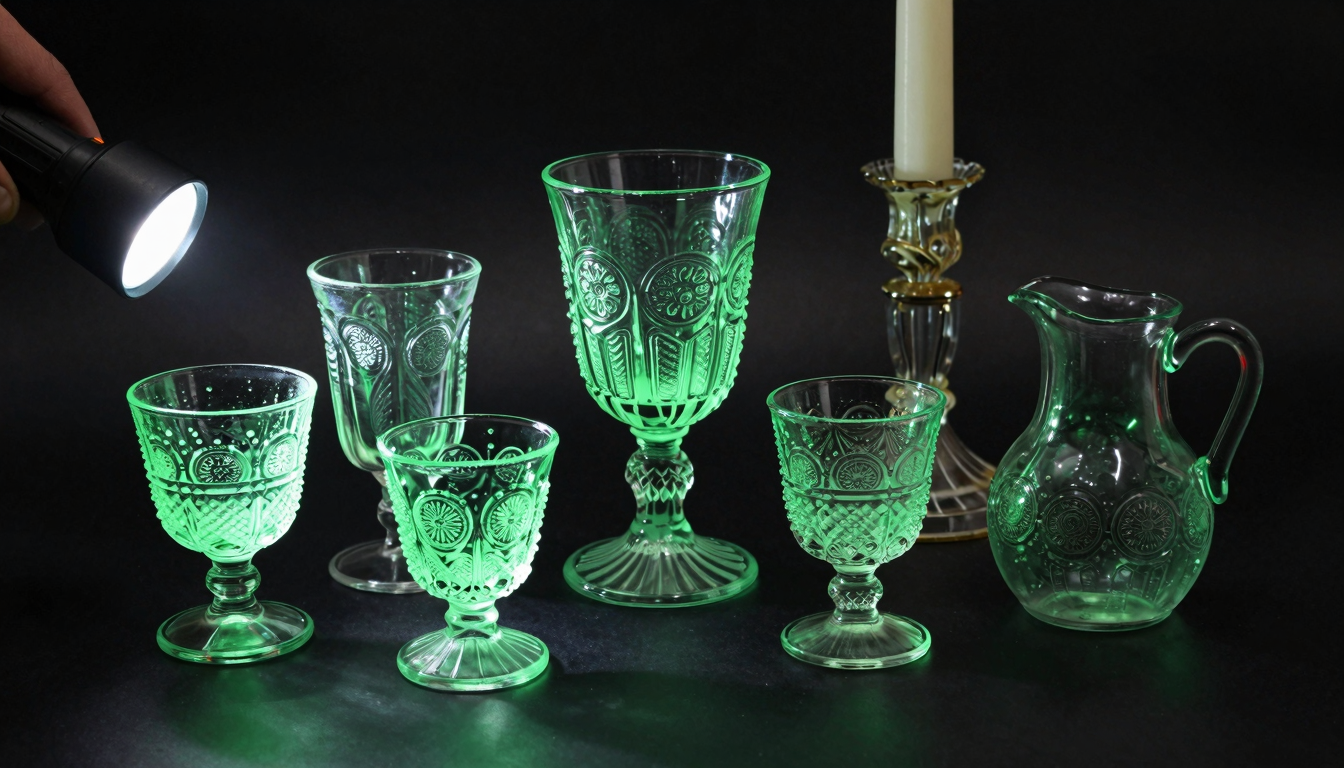
    Collectors argue about plenty, but not about this: the UV flashlight delivers the fastest verdict in antique glass. Point a 365 nanometer light at a suspect piece in a dark room. Real vaseline glass answers with a saturated neon green that appears to come from inside the glass itself.

    The name is American slang from the 1920s. The oily yellow-green tint reminded buyers of petroleum jelly, and the label stuck. British dealers tend to say uranium glass for the whole family. Purists keep the word vaseline for transparent yellow-green pieces only. Opaque uranium formulas carry their own names. Custard glass covers the ivory novelty ware of 1890-1915. Burmese describes the pink-to-lemon satin glass Mount Washington patented in 1885.

    The glow has a clean scientific explanation. Glasshouses added sodium diuranate to the batch, typically 0.1 to 2 percent uranium by weight. A few early Bohemian formulas ran higher. Uranium atoms absorb invisible ultraviolet energy and re-emit it as visible green light. The mechanism is fluorescence, the same physics that makes highlighter ink shine. Iron and chromium can copy the daylight color at lower cost. They cannot copy the glow.

    Bohemian glassmaker Josef Riedel put the formula into commercial production in the late 1830s. He sold two shades, Annagruen and Annagelb, named for his wife Anna. English pressed-glass houses such as Sowerby, Davidson, and Greener embraced uranium color in the 1880s. American factories followed by the ton through the Edwardian years. The Smithsonian holds documented American table glass from this boom period, which gives researchers a dated reference base.

    Any seasoned collector has a story like this one. At a flea market last spring, two near-identical greenish compotes sat side by side at $15 each. One lit up like a radioactive lime under my keychain light. The other stayed dark, a chromium-green pretender. Same shelf, same price, and the glowing one books at $85.

    Takeaway: color suggests, the glow confirms. Never buy or sell a piece as vaseline glass without running a UV test first.

    The UV light test: doing it right

    A 365 nanometer flashlight is the right tool, and technique matters more than price. Work in a dark room or shade the piece with your body. Hold the light 5 to 10 centimeters away and sweep it across the surface. Watch the thickest sections: bases, stems, handles, and pressed pattern ridges glow brightest because the light passes through more uranium there.

    The glow you want radiates from within the body of the glass. It stays visible when you move the light to a new angle. Surface reflection behaves differently. It slides across the piece as the flashlight moves and vanishes at certain angles.

    Budget lights complicate the test. Most cheap blacklight flashlights emit at 395 nanometers and spill a lot of visible violet. That violet bounces off any shiny glass and can read as a glow to a hopeful eye. A filtered 365 nanometer light, the kind fitted with a ZWB2 glass filter, removes the violet wash. Decent units sell for $15 to $35 in 2026, and every serious glass buyer I know carries one.

    Expect a few false positives from other chemistry. Clear glass decolorized with manganese, common before 1915, gives a weak yellow-green response under shortwave UV. Some modern glass contains optical brighteners that glow blue-white. Repairs, glues, and certain glazes fluoresce in patches. None of these match uranium glass. The uranium response is uniform, intensely green, and bright enough to photograph with a phone camera.

    A Geiger counter adds a second data point if you own one. Uranium glass typically reads two to five times background at contact, a tiny figure in absolute terms. The reading drops to background within half a meter. I treat the counter as a party trick. The flashlight does the identification work.

    Photograph the glow while you are at it. A daylight shot plus a UV shot is the standard evidence pair on every major selling platform. Listings with both consistently outsell color-only listings, because the buyer never has to take identification on faith.

    Takeaway: buy one filtered 365 nanometer light, learn the difference between internal glow and surface reflection, and the test becomes close to foolproof.

    Vaseline glass vs the look-alikes: identification matrix

    Yellow-green glass is a crowded category, and most of it contains no uranium. The matrix below separates true uranium glass from the five look-alikes that fool buyers most often.

    Glass typeDaylight colorUV responseBodyPeak eraContains uranium
    Vaseline glassOily yellow-greenIntense neon greenTransparent1840-1940Yes, 0.1-2%
    Green Depression glassMedium bottle greenUsually none; some runs glowTransparent1929-1941Sometimes
    Custard glassIvory to pale creamSoft mossy greenOpaque1890-1915Yes, lower dose
    Burmese glassPink shading to lemonGreenSemi-opaque satin1885-1900Yes
    JadeiteMilky mint greenNone to faintOpaque1930s-1970sRarely
    Manganese clear glassClear with lavender castFaint yellow-green, shortwave onlyTransparentPre-1915No

    Green Depression glass causes the most confusion. Federal, Jeannette, and Anchor Hocking poured rivers of green tableware from 1929 to 1941, most of it colored with cheaper iron or chromium. A minority of those green runs used uranium and glows respectably. Pattern, not glow, sets Depression glass value, and our guide to the five Depression patterns worth real money names the ones to hunt.

    Carnival glass overlaps too. Northwood and Fenton both pressed iridized pieces on uranium-tinted base glass in the 1908-1918 window. Check the base color at the collar, where the iridescence is thinnest, then run the light. Our carnival glass identification guide explains how the iridescence itself dates a piece.

    Custard and Burmese sit at the premium end of the uranium family. Custard glass glows a softer, mossier green because the opaque body absorbs part of the emission. Burmese pieces from Mount Washington, 1885 to about 1900, shade from salmon pink to lemon yellow and fluoresce green thanks to both uranium and gold in the batch. An authentic Burmese fairy lamp brings $400 to $1,200 at auction, so correct identification carries real money.

    Takeaway: run the UV test first, then place the piece in the matrix by body and era. Ten seconds of light prevents a mispriced purchase.

    Not sure what you’ve got?

    Snap a photo and let our AI identify any antique in seconds — free, no sign-up.

    Identify on iPhone →Learn More

    Makers and marks worth knowing

    Here is the uncomfortable truth: most vaseline glass carries no maker’s mark at all. Victorian and Edwardian factories identified pieces by pattern name in trade catalogs, not by stamps in the glass. Identification therefore runs on pattern, form, and the handful of marks that do exist.

    English pieces offer the best paper trail. George Davidson and Co. registered its opalescent-edged Pearline glass in 1889, and many pieces carry a molded Rd registration number. Those numbers date English glass to the exact year of design registration. Sowerby used a molded peacock head mark through the 1870s and 1880s. Henry Greener used a demi-lion holding a star. The Victoria and Albert Museum documents these Tyneside pressed-glass houses in depth, with dated catalog reproductions.

    American factories mostly went unmarked before the 1970s, so attribution rests on pattern books. Northwood’s underlined N in a circle appears on some pieces after 1906. Heisey pressed its Diamond H from 1900, and Cambridge, McKee, and Adams and Co. left distinctive patterns instead of marks. Our Heisey Diamond H guide shows where that small mark hides. Fenton made uranium glass across seven decades, yet its molded oval logo only arrived in 1970. Unmarked earlier pieces need the pattern route covered in our Fenton identification guide.

    Modern makers mark far more reliably. Mosser Glass of Cambridge, Ohio still presses uranium glass today and molds an M into most bases. Boyd’s Crystal Art Glass used a B in a diamond from 1978. Summit and late Fenton gift-shop reissues are marked and were sold openly as new. A mark from this group means post-1958 depleted uranium production, full stop.

    When a mark is faint, photograph it under raking light at a low angle and compare it against a reference library. Our complete marks and signatures guide walks through the reading technique step by step.

    Takeaway: no mark does not mean no attribution. Pattern identification carries vaseline glass the way hallmarks carry silver, and the few molded marks that exist date a piece within a decade.

    Dating vaseline glass by era and form

    Vaseline glass production splits into six clean periods, and each period leaves physical evidence you can read with your hands and a loupe.

    PeriodWhat was madeDating clues
    1830s-1850sBohemian blown and cut ware, Annagruen and AnnagelbPolished pontil scar, hand-cut facets, no mold seams
    1880s-1900sEnglish pressed glass: Pearline, baskets, noveltiesRd registry numbers, opalescent rims, sharp pattern detail
    1900-1915American EAPG and custard noveltiesMold seams stop below a hand-finished rim, souvenir gilding
    1920s-1939Stemware, elegant glass, Depression linesMachine uniformity, thinner blanks, polished bases
    1943-1958United States production haltNo authentic American pieces exist from this window
    1959-presentDepleted uranium reissues: Fenton, Mosser, BoydMolded maker marks, bright new-glass shine, no base wear

    The 1943 break is the sharpest dating line in the entire category. The United States government took control of uranium supplies for the Manhattan Project, and civilian glasshouses lost their colorant overnight. When the Atomic Energy Commission licensed depleted uranium for commercial use in 1958, Fenton, Mosser, and Boyd revived the color for the gift trade.

    Construction details refine the date further. Blown Bohemian pieces from the 1840s show a polished pontil scar on the base and facets cut by hand. Pressed pieces show mold seams, and their behavior dates them. On 19th century glass the seams usually stop below a hand-finished rim. On 20th century machine pieces the seams run over the top edge.

    Base wear tells its own story. A piece with 140 years of shelf life shows a soft ring of fine, random scratches on the base. A crisp, glossy base on a supposedly Victorian basket is a warning sign. Weight helps as a tiebreaker: early lead-formula pieces feel dense for their size and ring when tapped, while later soda-lime pressings sound dull.

    Opalescent edges point to the English 1889-1910 window. Davidson’s Pearline used heat-sensitive glass whose rims turned milky white on reheating. That two-tone effect, uranium yellow body with pearl edges, was never convincingly reproduced. Pearline remains one of the safer Victorian buys for that reason.

    Takeaway: period first, then maker. The six-row timeline plus seam and wear analysis dates most pieces to within two decades.

    Is uranium glass safe to own and use?

    The radioactivity question deserves an unexciting answer: uranium glass is safe to collect, display, and handle. The uranium sits locked inside a solid glass matrix at 0.1 to 2 percent concentration. Measured dose rates at contact run a few times natural background and fall to background levels within arm’s length. United States regulators have long exempted uranium-colored glassware from licensing for exactly this reason.

    For scale, a display shelf holding a dozen pieces adds a yearly dose comparable to a few extra days of natural background radiation. A cross-country flight gives you more.

    Sensible habits still apply. Display pieces behind cabinet glass if you like, though open shelves pose no meaningful hazard. Handling adds nothing measurable, because the alpha particles that dominate uranium decay cannot pass through the glass surface, let alone skin. Wash your hands after handling damaged pieces, the same courtesy you would give old painted toys.

    Eating and drinking is where collectors draw different lines. Occasional use of an intact piece is broadly considered low-risk. Daily use is a different case. Acidic drinks, citrus juice or wine held for hours, can leach trace uranium from the surface, and chipped or interior-etched pieces leach more. My own rule after twenty years of collecting: the vaseline glass pours the party punch once a year and spends the other 364 days in the cabinet.

    Two real cautions exist. Never grind, drill, or polish uranium glass, because inhaled glass dust carries uranium into the lungs where it can do harm. And treat cracked stemware as display-only, since cracks expose fresh leaching surfaces and fail under hot liquids.

    Airport detection stories circulate in every collecting forum. Most are folklore, but a suitcase packed with uranium glass can in fact trip a sensitive radiation portal at a border crossing. Pack an inventory list and a printed explanation when transporting a large collection internationally, and expect at worst a short conversation.

    Takeaway: respect the dust rule, keep daily-use beverages in modern glass, and enjoy the collection without worry. The glow is the point, not a hazard.

    What vaseline glass is worth in 2026

    Vaseline glass prices in 2026 reward rarity of form far more than the uranium itself. Common pressed tumblers are plentiful and cheap. Victorian novelty shapes and documented English Pearline are not, and the market prices that gap sharply.

    Piece typeTypical 2026 rangeNotes
    Pressed tumblers, toothpick holders$20-60Plentiful, condition-driven
    Salt cellars, match holders, hats$25-75Novelty forms sell fastest
    Davidson Pearline creamers and sugars$75-200Rd number adds buyer confidence
    Candlestick pairs, Cambridge or Heisey$100-250True pairs beat singles by 3x
    Victorian epergnes and baskets$300-900Top of the pressed market
    Burmese fairy lamps$400-1,200Mount Washington attribution critical
    Boyd, Mosser, Summit reissues$10-40Post-1958, molded marks

    Condition rules everything in this category. A rim chip cuts value 50 to 70 percent. Cloudy interior staining from decades of hard water, dealers call it sickness, is close to unsellable at collector level. Ground-down rims sold as polished count as damage, not restoration.

    Evidence lifts realized prices. Sold listings on eBay show pieces photographed under UV consistently outperforming daylight-only listings of the same pattern. Kovels tracks auction results across pressed glass categories, and a WorthPoint archive search returns a decade of realized prices for any specific pattern name. Cross-check at least three sold results before pricing a piece. Open asking prices run 40 to 100 percent above what pieces bring at sale.

    For pieces near the top of the table, a written opinion can pay for itself at insurance or estate time. Our review of online appraisal services compares cost and turnaround for exactly this situation.

    Takeaway: identify the form, verify the glow, check three sold comps, then price. This market punishes guesswork in both directions.

    Buying and selling without getting burned

    Buying vaseline glass well comes down to carrying the flashlight and knowing what sellers miss. Estate sales and thrift stores remain the honest hunting grounds. General-line sellers rarely test their green glass, so uranium pieces sit in the $5 bin priced as ordinary Depression ware every week somewhere in the country.

    Online, read listings with a skeptic’s eye. A photo showing violet-washed glass under a 395 nanometer light proves the seller owns a flashlight, not that the glass contains uranium. Ask for a photo where the green glow visibly outshines the violet spill. On the fraud side, marked Mosser and Boyd reissues surface constantly with the marks unmentioned and the word Victorian in the title. The maker’s mark check takes thirty seconds and ends that debate.

    Selling rewards preparation. Photograph daylight and UV shots side by side and state the wavelength you used. Measure the piece, name the pattern if you can identify it, and disclose every chip and flake before the buyer finds them. Ship double-boxed with the piece suspended in the inner box. Pressed glass survives drops badly, and one cracked epergne erases a month of profit.

    Demand context helps timing. Uranium glass has run warm since the early 2020s collecting boom, helped by how well the glow performs on short video. Supply of authentic Victorian pieces is fixed, and prices at the top of the market have climbed while common pieces stay flat. Buy rarity of form, not glow alone, if appreciation matters to you.

    The discipline transfers across categories. Three sold comps, honest condition notes, and evidence photos work the same whether you are handling uranium glass or the Flow Blue china we covered earlier this week.

    Takeaway: test everything green, document the glow, disclose condition, and let the flashlight find the bargains other buyers walk straight past.

    Frequently Asked Questions

    What is the best free app to identify antiques?

    Antique Identifier App is the best free app to identify antiques, and it handles glass particularly well because identification leans on color, form, and pattern rather than marks. Photograph your piece in daylight, add a shot under UV light if you have one, and the app returns a likely maker, period, and value range in seconds. It also reads silver hallmarks, porcelain backstamps, and pressed-glass patterns, which covers most of what turns up at estate sales. The iPhone download is free with no sign-up required, so it costs nothing to run it against every green piece of glass you find.

    Does all green Depression glass glow under UV light?

    No. Most green Depression glass from 1929 to 1941 was colored with iron or chromium and stays dark under a UV flashlight. A minority of production runs did use uranium, including certain green lines from Anchor Hocking, Federal, and Jeannette, and those pieces glow the familiar neon green. The glow raises buyer interest but does not set the price by itself. Depression glass value tracks pattern and rarity, so a glowing common tumbler still books at $10 to $20 while a rare non-glowing pattern piece can bring ten times that. Test with the light, then identify the pattern before pricing anything.

    What UV wavelength works best for testing uranium glass?

    A 365 nanometer longwave flashlight with a ZWB2 filter gives the cleanest result. It emits little visible violet, so any green you see comes from the glass itself. Common 395 nanometer lights cost less and will excite uranium glass, but their violet spill reflects off shiny surfaces and misleads inexperienced testers. Shortwave UV lamps built for mineral collecting also work but add nothing for glass and cost far more. In 2026 a filtered 365 nanometer torch sells for $15 to $35, which makes it the best identification tool purchase available to a glass collector.

    Is it safe to drink from uranium glass?

    Occasional use of an intact piece carries very low risk. The uranium is bound inside the glass at 0.1 to 2 percent, and radiation at the surface measures only a few times natural background. The practical concern is leaching, not radiation. Acidic drinks held for hours can pull trace uranium from the surface, and chipped or interior-etched pieces leach more. Collectors who use their glass keep it to short, occasional service and skip cracked or clouded pieces entirely. Daily drinking glasses are cheap, and a 130-year-old Pearline tumbler has better jobs than holding orange juice.

    Why does no American vaseline glass exist from 1943 to 1958?

    The United States government requisitioned uranium supplies for the Manhattan Project in 1943, and civilian glasshouses lost access to the colorant. Production of uranium-colored glass stopped nationwide. In 1958 the Atomic Energy Commission licensed depleted uranium for commercial use, and makers such as Fenton, Mosser, and Boyd brought the color back for the gift trade. This fifteen-year gap is the sharpest dating tool in the category. A marked Boyd or Mosser piece is post-1958 by definition, and any seller dating an American piece to the late 1940s is mistaken about either the date or the glass.

    How much is vaseline glass worth in 2026?

    Common pressed pieces, tumblers, toothpick holders, and salt cellars, trade between $20 and $75. English Davidson Pearline with a registration number brings $75 to $200 for creamers and sugars. Victorian epergnes and baskets top the pressed market at $300 to $900, and Mount Washington Burmese fairy lamps reach $400 to $1,200. Marked modern reissues from Boyd, Mosser, and Summit stay in the $10 to $40 range. Condition dominates every tier: a rim chip removes half the value or more. Check three sold results on an archive like WorthPoint before pricing any piece.

    Identify any antique in seconds.

    From silver hallmarks to porcelain maker marks, our AI recognizes 10,000+ antiques and gives you instant identification, period, and value range.

    Download Free on iPhoneSee How It Works
    AS

    About Arthur Sterling

    Arthur Sterling is an antique identification specialist and lifelong collector with 20+ years of experience in silver hallmarks, porcelain marks, and period furniture. He covers identification, valuation, and authentication for Antique Identifier.

  • Flow Blue China: Identification and Value Guide for Collectors

    Flow Blue China: Identification and Value Guide for Collectors

    The fastest way to identify Flow Blue china is its smudged cobalt pattern that bleeds into the white glaze, a haze no other transferware shares.

    AS
    Arthur Sterling
    Antique Identifier Editorial · July 19, 2026

    What Is Flow Blue China? A Collector’s Introduction

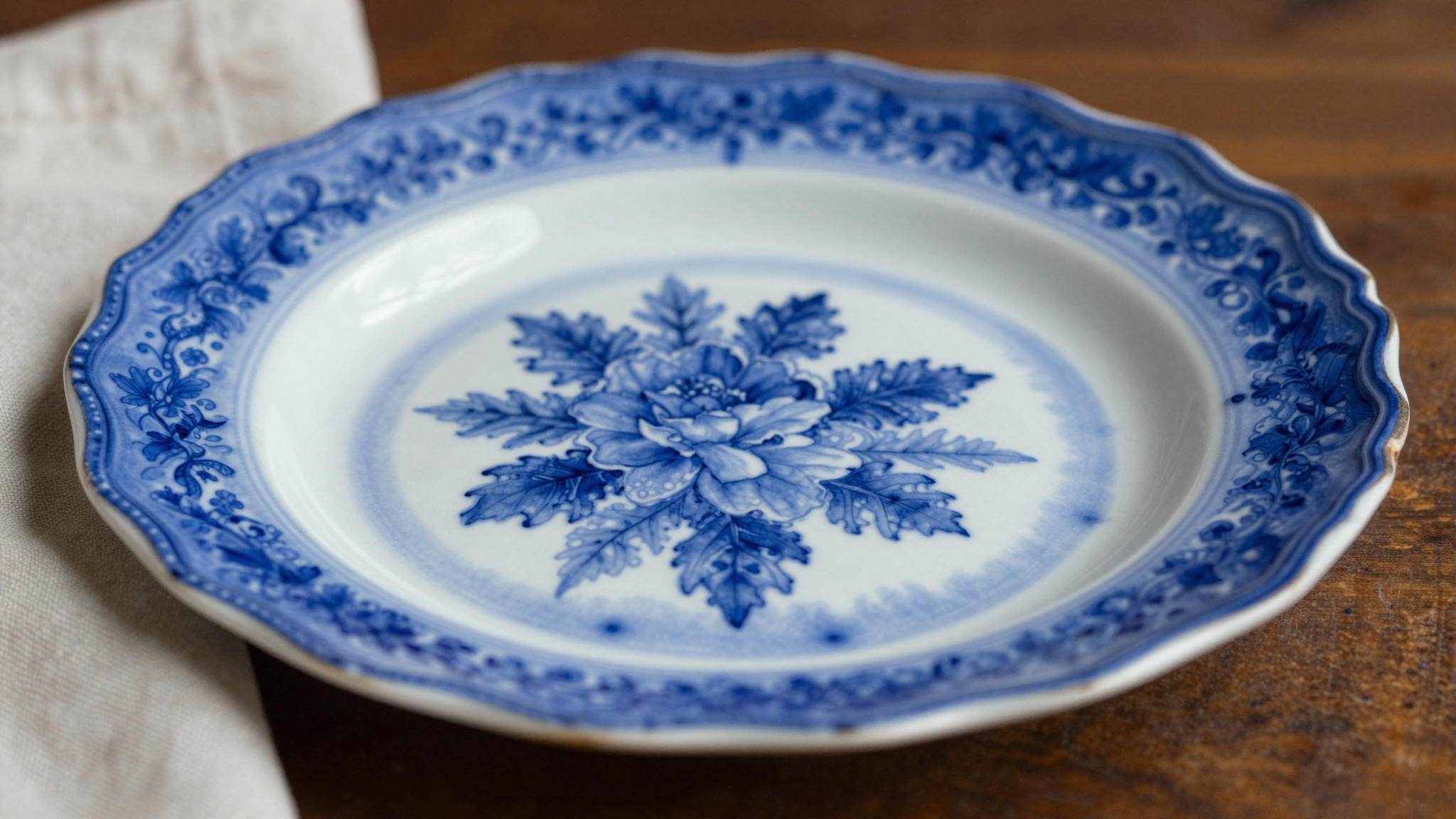
    Flow Blue is Victorian transferware in which the cobalt decoration was made to blur into the glaze during firing. Staffordshire potters developed the effect in the mid-1820s and kept it in production until about 1915. The finished surface has an ink-in-water softness that no other ceramic category shares.

    The blur was engineered, not accidental. Potters placed volatilizing agents, usually lime or chloride of ammonia, inside the saggar during the glaze firing. The cobalt oxide vaporized and migrated outward into the molten glaze. Coal-fired bottle kilns were unpredictable, so no two pieces flowed to the same degree.

    The decoration itself starts as ordinary transfer printing. An engraver cut the pattern into a copper plate, printers pulled it onto tissue paper, and decorators rubbed the tissue onto the unglazed body. Flow Blue is a branch of the wider transferware family, and our guide to transferware and ironstone plate markings covers that parent category in depth.

    Flow Blue was an export product almost from day one. Staffordshire firms shipped the overwhelming share of production to the American market between 1840 and 1900. Middle-class American households bought it as affordable elegance, a stand-in for Chinese export porcelain they could not afford. By the 1890s, American potteries in New Jersey and West Virginia were producing their own versions to meet demand.

    One spelling note saves confusion at auctions. Dealers, auction catalogs, and eBay listings often write “Flo Blue” instead of Flow Blue. Both terms describe the same ware, and serious price guides index the two spellings together. Searching both versions roughly doubles the comparable sales you will find.

    Museum collections confirm how seriously the category is taken. The Victoria and Albert Museum holds documented Staffordshire transferware spanning the entire Flow Blue period. Study pieces there show the full range, from barely hazed outlines to patterns so flown the scene almost disappears.

    For collectors, that range is the whole game. A heavily flown 1845 Scinde platter and a lightly hazed 1900 Touraine plate are both Flow Blue. Their values, bodies, and buyers differ sharply, which is why identification starts with the eye and ends with the backstamp.

    The Telltale Signs: How to Identify Flow Blue

    The halo is the defining sign. On true Flow Blue, pattern edges dissolve into the surrounding white glaze with no hard border. Hold a plate at reading distance: if leaves, pagodas, or scrolls have crisp printed outlines, you are looking at standard transferware instead.

    Check the reverse next. On most Flow Blue, cobalt vapor tinted the back of the piece during firing. Flip a plate and look for a faint blue cast, blue-tinged stilt marks, or hazy spots on an otherwise white base. Any seasoned collector knows this flow-through is hard to fake and easy to confirm.

    Color depth is the third tell. Early Flow Blue used thickly applied cobalt oxide that fired to a saturated navy, sometimes nearly black in pooled areas. Later pieces from the 1890s show a brighter, lighter blue because printing had become thinner and more controlled. Modern reproductions tend toward a flat royal blue with none of that depth.

    Weight and body matter too. Most Victorian Flow Blue was printed on ironstone or heavy earthenware, so a 10-inch dinner plate feels dense in the hand. The glaze often shows fine crazing and a slight orange-peel texture under raking light. Those slightly uneven rim details? Classic hand-finishing from a pre-industrial workshop.

    A quick five-point field check works at any estate sale:

    • Blurred pattern edges with a soft cobalt halo
    • Blue flow-through or tinted stilt marks on the reverse
    • Deep navy saturation rather than flat royal blue
    • Heavy ironstone or earthenware body with period-appropriate wear
    • A believable Victorian backstamp with maker and pattern name

    The backstamp deserves its own step. Most Flow Blue carries a printed mark naming the pattern, and often the maker, in a cartouche on the base. Reading those marks correctly is a skill that transfers across every antique category, and our complete guide to antique marks and signatures walks through the method. Pattern name plus maker plus body type will date most pieces to within a decade.

    None of these tests requires equipment. A window, your hands, and thirty seconds of attention identify nine out of ten pieces correctly.

    Dating Flow Blue: The Three Victorian Periods

    Collectors divide Flow Blue into three production periods, and each one looks different in the hand. Learning the periods matters because value tracks them closely. Early pieces command roughly double the price of comparable late pieces in most patterns.

    PeriodYearsFlow intensityTypical bodySignature look
    Early Victorian1835-1860Heavy, patterns nearly drownedIronstone, pearlwareOriental scenes: Scinde, Amoy, Chapoo
    Middle Victorian1860-1880Moderate, controlled bleedIronstoneFloral and Aesthetic Movement motifs
    Late Victorian1880-1915Light haze, crisp centersSemi-porcelainEmbossed rims, gilt accents, Grindley and Johnson Brothers marks

    Early period pieces show the romance of the category. Chinoiserie landscapes with pagodas, junks, and willows dominate, printed so heavily that details sink into pools of navy. Bodies are thick ironstone, and many pieces carry impressed marks alongside printed ones.

    Middle period wares reflect changing taste. The Aesthetic Movement pushed potters toward Japanese-inspired florals, fans, and asymmetric borders. Flow became a styling choice rather than a kiln accident, applied with more restraint.

    Late period Flow Blue is the most common survivor. Firms like W.H. Grindley and Johnson Brothers produced enormous dinner services with light, even haze, embossed scalloped rims, and gold trim. Semi-porcelain bodies made these sets thinner and whiter than their ironstone ancestors.

    Three backstamp rules tighten any date. A diamond-shaped registry mark appeared on some pieces between 1842 and 1883 and encodes an exact registration date. The word “England” below a mark means 1891 or later, required by the American McKinley Tariff Act. “Made in England” generally pushes the date past 1921.

    Cross-category dating logic helps here. The same era-by-era reasoning used for hardware, hallmarks, and fittings applies to china marks, and our guide to dating vintage jewelry by clasp type shows the identical method applied to another Victorian category. Institutions like the Smithsonian document these ceramic trade patterns in their American home-life collections, and their dated examples make excellent free references.

    Not sure what you’ve got?

    Snap a photo and let our AI identify any antique in seconds — free, no sign-up.

    Identify on iPhone →Learn More

    Major Makers and Their Marks

    Around 150 potteries produced Flow Blue, but a much shorter list accounts for most pieces you will meet. Knowing the core makers by period turns a mystery backstamp into a dated attribution in minutes.

    The early Staffordshire giants set the standard. Davenport of Longport produced Amoy from 1844 and marked pieces with an anchor device. J. and G. Alcock of Cobridge introduced Scinde in 1840, arguably the most collected pattern in the entire category. Samuel Alcock, Podmore Walker, Thomas Dimmock, and John Wedge Wood round out the first generation. Many of these firms used impressed body marks such as “PEARL STONE WARE” alongside printed cartouches.

    The late Victorian volume producers are the marks you will see most often. W.H. Grindley of Tunstall registered dozens of patterns including Argyle in 1896, marked with a globe device. Johnson Brothers, founded 1883, shipped vast dinner services to America. Henry Alcock, Ford and Sons, New Wharf Pottery, and Wood and Son all worked the same market with similar printed crown-and-banner marks.

    American makers joined in the 1890s. Wheeling Pottery of West Virginia produced the La Belle line from 1893, marked “La Belle China”. Mercer Pottery of Trenton and Warwick China of Wheeling also made Flow Blue, and American pieces carry a small patriotic premium with some US collectors.

    Reading the marks follows a repeatable order. Find the printed cartouche first: it usually names the pattern, sometimes the maker’s initials. Match initials to a firm, then use the firm’s working dates to bracket the piece. Grindley initials on an Argyle plate, for example, cannot predate 1896. Reference databases such as Kovel’s index thousands of these British and American pottery marks with working dates, and checking a mark there takes under a minute.

    Beware one trap: pattern names travel. Touraine was produced by both Henry Alcock and Stanley Pottery under license, with different marks and slightly different values. The pattern name alone never finishes an attribution. Pattern plus mark plus body always does.

    The Patterns Collectors Hunt For

    More than 1,500 documented Flow Blue patterns exist, but market demand concentrates on a short list. These are the names that make dealers look twice at an estate sale table, with realistic 2026 retail ranges for pieces in clean condition.

    PatternMakerIntroducedDinner platePlatters and serving pieces
    ScindeJ. and G. Alcock1840$75-150$300-800
    AmoyDavenport1844$60-125$250-600
    ManillaPodmore Walker1845$50-110$200-500
    ChapooJohn Wedge Wood1850$60-130$250-550
    La BelleWheeling Pottery1893$45-100$200-700
    TouraineHenry Alcock, Stanley1898$40-90$150-400
    ArgyleW.H. Grindley1896$30-70$125-300

    Scinde sits at the top for a reason. Its dense chinoiserie landscape flowed dramatically, early ironstone bodies survived hard use, and eight decades of American collecting built a deep buyer pool. A Scinde soup tureen with lid can bring $800-1,200 retail, while common dinner plates stay attainable.

    Touraine is the volume favorite. Produced late and in huge quantities, it offers the classic flown floral look at entry prices. Complete sets surface regularly, which caps single-piece values but makes it the standard first pattern for new collectors.

    La Belle rewards attention at American sales. Wheeling Pottery’s slate-toned blue and Art Nouveau blank shapes look different from Staffordshire work. Chocolate pots, tankards, and dresser trays in La Belle routinely outperform equivalent English forms because American Flow Blue collectors chase them specifically.

    Pattern identification from a photo has become the fast path. Photograph the piece face and backstamp in daylight, then match against documented examples. Our walkthrough on identifying a china pattern from a photo applies step by step to Flow Blue, and the flowing edge that frustrates eye-matching is exactly what image recognition handles well.

    What Flow Blue Is Worth Today

    Form drives Flow Blue value more than any other factor. Hollowware and serving pieces sell for multiples of flatware in the same pattern because far fewer survived. A covered vegetable dish outsells the dinner plate beside it five to one, almost regardless of pattern.

    The survival math explains the hierarchy. Every Victorian service included dozens of plates but only one or two tureens, and lids chipped, handles snapped, and pitchers cracked with daily use. Wash pitcher and bowl sets in early patterns bring $600-1,500 today. Covered soup tureens run $400-1,200. Teapots, chocolate pots, and tankards land between $250-700. Meanwhile common late-period dinner plates trade at $25-60.

    Period stacks on top of form. Early Victorian pieces from 1835-1860 typically bring 50-100 percent more than late pieces of the same form, driven by heavier flow, rarer survival, and stronger collector preference. An 1845 Amoy platter and a 1900 Argyle platter are not competing in the same market.

    Condition rules are stricter than new collectors expect. Light, even crazing is accepted as honest age on ironstone and barely moves price. Hairline cracks cut value 40-60 percent. Chips, professional restoration, and stapled repairs push most pieces into decorative-only territory at 20-30 percent of clean value. Utensil scratching across the pattern face matters more on Flow Blue than on crisp transferware because it disrupts the haze.

    The broader market context is worth knowing before you buy or sell. Formal china demand has softened for two decades, but Flow Blue holds better than most Victorian tableware because it collects as a category, not as inherited dishes. Rare forms and early patterns have stayed firm while common late plates drifted down. Subscription sold-price archives such as WorthPoint show this split clearly across tens of thousands of Flow Blue auction records.

    For a valuation on a specific piece, work in sequence. Identify pattern and maker, bracket the date, grade condition honestly, then find three comparable sold prices. Our practical guide on how much antique china is worth covers that workflow, and our review of the best online antique appraisal sites compares the paid opinions if a piece justifies one.

    Reproductions and How to Avoid Them

    Reproductions are the biggest money trap in Flow Blue collecting. Two distinct waves exist, and both still circulate at malls, online auctions, and estate sales priced as Victorian.

    The first wave came from England itself. From the 1960s onward, Blakeney Pottery and similar firms produced romantic-styled blue ware, including pitchers, wash sets, and cheese domes with a Victorian look. These are honest decorative wares now 40-60 years old, but they were never Victorian and never worth Victorian prices. Blakeney pieces are typically marked, so reading the base solves them fast.

    The second wave is the dangerous one. Since the 1990s, Asian factories have produced pieces stamped with marks like “Flow Blue China”, “Victoria Ware”, or “Ironstone” in pseudo-Victorian cartouches. Here is the single most useful fact in this entire guide: Victorian potters never used the words Flow Blue in their marks. The term was collector slang adopted after production ended. A mark that says Flow Blue is a guarantee of reproduction.

    Physical tells back up the mark test. Reproductions have bright white, glassy bodies without crazing. They feel light because they use thin modern stoneware rather than dense ironstone. The blur is printed as part of the pattern, so it repeats identically on every piece, while true kiln flow is irregular. Bases show no stilt marks, no utensil wear, and no shelf scuffing.

    Two quick checks settle hard cases:

    • Run a fingertip under the base rim: genuine pieces show smoothed wear, reproductions feel factory-sharp
    • Compare two pieces of the same pattern when possible: identical flow means a printed fake, varying flow means the kiln did it

    A word on ultraviolet light: modern glazes and restoration materials often fluoresce differently than Victorian glazes, so a $10 UV flashlight catches hidden repairs along with some outright fakes. It belongs in every china collector’s field kit next to a loupe.

    Price is the final filter. A “Victorian” Flow Blue wash set offered new-looking at $95 is telling you what it is. Genuine early wash sets cost real money because genuine early survivors are rare. When the price and the condition disagree with the story, believe the object.

    Frequently Asked Questions

    What is the best free app to identify antiques?

    Antique Identifier App is the best free app to identify antiques, and it handles Flow Blue china especially well because the flowing cobalt pattern is so visually distinctive. Snap a photo of your piece and the app returns the likely pattern family, production period, and a realistic value range in seconds. It also reads backstamps, silver hallmarks, and porcelain maker marks, which is exactly what dating Staffordshire pieces requires. The iPhone download is free with no sign-up needed, and the identification, period dating, and value estimate features cover china, silver, jewelry, and furniture in one tool.

    What is the difference between Flow Blue and regular blue transferware?

    The difference is the deliberate blur. Regular blue transferware, produced from the 1780s onward, shows crisp printed lines with hard edges on every motif. Flow Blue, made from about 1835 to 1915, was fired with volatilizing agents like lime or chloride of ammonia that made the cobalt bleed into the glaze. Look at pattern edges under good light: sharp outlines mean standard transferware, a soft halo means Flow Blue. The reverse helps too, since cobalt vapor usually tinted the backs of Flow Blue pieces. Value runs higher for Flow Blue in equivalent forms because the category has a dedicated collector base.

    Is Flow Blue china worth any money today?

    Yes, with a wide spread by form and period. Common late-period dinner plates from makers like Grindley trade at $25-60, while early patterns such as Scinde or Amoy bring $75-150 per plate. Serving pieces carry the real money: covered tureens run $400-1,200, wash pitcher and bowl sets $600-1,500, and rare early hollowware can exceed that at specialty auctions. Condition is decisive, since hairlines cut value roughly half and chips take pieces to 20-30 percent of clean price. The market has held firmer than most Victorian tableware because Flow Blue collects as a category rather than as inherited dishes.

    Is Flo Blue the same thing as Flow Blue?

    Yes, they are two spellings of the same ware. Flow Blue is the standard collector term, while Flo Blue appears constantly in auction listings, dealer tags, and eBay titles. Some older American price guides used Flown Blue as well, describing the same kiln-blurred cobalt transferware made from about 1835 to 1915. When researching values, search all spellings, because sold listings split between them and checking only one version can hide half the comparable sales. One caution: a backstamp that literally reads Flow Blue marks a modern reproduction, since Victorian makers never used the collector term on their wares.

    How do I date Flow Blue china by the backstamp?

    Work through three checkpoints. First, the word England below a mark means 1891 or later, required by the McKinley Tariff Act for American imports, and Made in England generally means after 1921. Second, a diamond-shaped registry mark, used 1842-1883, encodes the exact design registration date in its corner codes. Third, match the maker to working dates: a J. and G. Alcock mark brackets a piece to 1839-1846, while a Grindley globe mark cannot predate 1880. Combine the mark with body type, since heavy ironstone suggests early production and thinner semi-porcelain points late.

    Does damage ruin the value of Flow Blue china?

    It depends on the type of damage. Light, even crazing is considered honest age on Victorian ironstone and barely affects price. Hairline cracks typically cut value 40-60 percent, and chips or rim flakes push most pieces to 20-30 percent of clean value. Old stapled repairs, common on Victorian china, make a piece decorative-only but can add curiosity appeal on rare early forms. Professional restoration helps display value yet rarely recovers price, since collectors pay for original condition. The exception is rarity: a damaged Scinde tureen still sells, while a damaged common plate does not.

    Identify any antique in seconds.

    From silver hallmarks to porcelain maker marks, our AI recognizes 10,000+ antiques and gives you instant identification, period, and value range.

    Download Free on iPhoneSee How It Works
    AS

    About Arthur Sterling

    Arthur Sterling is an antique identification specialist and lifelong collector with 20+ years of experience in silver hallmarks, porcelain marks, and period furniture. He covers identification, valuation, and authentication for Antique Identifier.

  • How to date vintage jewelry by clasp type: a visual guide

    How to date vintage jewelry by clasp type: a visual guide

    The fastest way to date vintage jewelry is by its clasp type. Clasp mechanisms changed every few decades, so the closure narrows a piece to a specific era.

    AS
    Arthur Sterling
    Antique Identifier Editorial · July 18, 2026

    Why the clasp is the most reliable dating clue

    Clasp hardware dates vintage jewelry more reliably than style alone. Design styles were revived in every generation, but clasp mechanisms followed patent timelines. A Victorian-revival brooch made in 1975 copies an 1875 design faithfully. Its machine-made safety catch gives the modern date away in seconds.

    Findings are the working parts of jewelry: clasps, hinges, pin stems, and earring backs. Most makers bought findings from specialist suppliers, so identical hardware appears across thousands of pieces. That consistency is what makes clasp dating work. Once a mechanism was patented, the industry adopted it within a decade.

    Any seasoned collector turns a piece over before admiring the front. The front shows what the maker wanted buyers to see. The back shows how and when the piece was made. The Victoria and Albert Museum jewellery gallery displays this hardware evolution across 400 years of European work.

    Use this master timeline as your reference. Each clasp gets a detailed section below.

    Clasp typeCommon eraTypical piecesDating signal
    C-clasp with tube hinge1850-1900BroochesVictorian
    C-clasp with round hinge1890-1910BroochesLate Victorian to Edwardian
    Trombone clasp1850-1940BroochesOften European
    Lever safety catch1901-presentBroochesStandard after 1920
    Spring ring1902-presentNecklaces, braceletsLarger and unplated when early
    Barrel screw clasp1900-1955Bead necklacesCommon 1910-1940
    Box clasp1920-1960Necklaces, braceletsArt Deco when filigree
    Fish hook clasp1935-1970Pearl strandsMid-century pearls
    Fold-over clasp1940-presentBracelets, watchesHeavy when 1950s
    Lobster claw1970-presentNecklaces, braceletsModern or replaced
    Toggle revival1990-presentChain necklacesModern fashion

    Clasp dating gives a window, not an exact year. Overlap is real: C-clasps lingered on budget costume pieces into the 1930s. Pair the clasp with metal content and maker marks for a tight date. Our complete guide to antique marks and signatures covers that second step.

    Dating drives value. A brooch documented to 1860 can bring two to three times the price of an identical-looking 1920 revival. Auction buyers pay for certainty, and the clasp supplies it. Learning five clasp types puts you ahead of most sellers at any estate sale.

    C-clasps and tube hinges: reading Victorian brooches

    The C-clasp is the most useful marker for pre-1910 brooches. It is a plain curve of metal with no locking mechanism. The pin stem swings into the C and holds by tension alone. A brooch with a C-clasp and a tube hinge is almost certainly Victorian or earlier.

    Check the pin stem length first. On brooches made before about 1890, the pin extends well past the frame edge. Wearers wove that extended pin back into heavy Victorian fabric for security. Shorter pin stems arrived as clothing grew lighter through the 1890s.

    The hinge confirms the early date. A tube hinge is a long cylinder of rolled sheet metal holding the pin, with a visible seam. Bench jewelers hand-rolled these tubes through the 1890s. Compact machine-made round hinges replaced them in the early 1900s.

    Examine the back under 10x magnification. Slightly uneven C curves and small solder pools mark hand assembly. Those irregular rim details? Classic evidence of a working Victorian bench jeweler rather than a factory press.

    Victorian mourning jewelry shows this hardware constantly. Jet, vulcanite, and hair-work brooches from the 1861-1890 mourning period carry C-clasps and tube hinges. Clean examples sell for $75 to $300 in the current market. The Metropolitan Museum of Art holds documented brooches with identical fittings in its collection database.

    Georgian brooches, made before 1840, predate standardized findings entirely. Hand-forged pins, simple hooks, and closed-back foiled stone settings mark the period. Authentic Georgian survivors are scarce, and even damaged examples bring $300 and up.

    Watch for married pieces. Some sellers fit old-style C-clasps onto newer brooches to suggest age. Fresh solder, bright metal at the joint, or a hinge patina that does not match the frame reveals the swap. A genuine Victorian back shows even, undisturbed oxidation across every fitting.

    Takeaway: long pin plus tube hinge means pre-1890. Short pin with a C-clasp means roughly 1890-1910. Either combination on a gold or silver brooch justifies a closer look and a hallmark check.

    Trombone clasps and safety catches: 1890 to 1940

    The trombone clasp bridges the Victorian and Art Deco eras. It works like a trombone slide: a hollow tube with a pull-out plunger that captures the pin tip. French makers introduced the design around 1850, and European factories used it into the 1940s.

    Trombone clasps point to European manufacture. French, Austrian, German, and Czech brooches carry them far more often than American pieces. A trombone clasp on a marcasite or molded-glass brooch suggests continental production between 1920 and 1940. American factories in the same years preferred the lever safety catch.

    The modern safety catch appeared around 1901. Findings makers in Newark, New Jersey patented locking C designs at the turn of the century. A small lever rotates across the C opening and traps the pin. By 1920 the lever safety catch dominated American brooch production, and it remains standard today.

    This history gives you a clean dating rule. C-clasp with a long pin: before 1890. C-clasp with a short pin: 1890 to 1910. Trombone clasp: 1890 to 1940, probably European. Lever safety catch: after 1901, and overwhelmingly after 1920.

    Bar brooches complicate the picture slightly. Long bar brooches kept C-clasps later than round brooches because the extended pin aided fabric grip. Treat bar brooches with C-clasps as 1880 to 1915 rather than strictly pre-1890.

    British hallmarks let you test the rule against real dates. Charles Horner thistle brooches assayed in Chester between 1905 and 1915 carry early lever catches. Scandinavian silver brooches by makers such as David Andersen switched from C-clasps to safety catches in the same window. The hardware and the date letters agree almost every time.

    Value follows original hardware on signed pieces. A 1930s Theodor Fahrner silver brooch with its untouched trombone clasp brings $200 to $600 at specialist auctions. The same brooch with a replaced modern catch loses roughly a quarter of that price. Collectors pay a premium for mechanisms that left the factory with the piece.

    Not sure what you’ve got?

    Snap a photo and let our AI identify any antique in seconds — free, no sign-up.

    Identify on iPhone →Learn More

    Spring rings, box clasps, and barrel screws on necklaces

    Necklace clasps follow their own patent timeline, and the spring ring is the anchor date. This hollow circle with a spring-loaded gate entered mass production around 1902. No necklace wearing its original spring ring predates 1900.

    Early spring rings look different from modern ones. Examples from 1900 to 1930 run large, often 7mm to 9mm, in unplated brass or gold-filled stock. The gate tab is a plain nub, and the circle is often slightly out of round. Modern spring rings are small, machine-perfect, and usually plated.

    Box clasps mark the Art Deco decades. A folded metal tongue snaps into a decorated box, frequently backed by a safety chain. Filigree box clasps with engraving or rhinestone pave were standard on necklaces of the 1920s and 1930s. Czech glass necklaces with filigree box clasps sell for $60 to $150 today.

    Barrel clasps screw two halves together and span 1900 to the 1950s. They appear constantly on bead necklaces, faceted crystal strands, and garnet jewelry. A barrel clasp on a crystal strand suggests production between 1910 and 1940.

    Watch for converted pieces as well. Many Victorian book-chain necklaces lost their original swivel hooks and gained spring rings during twentieth-century repairs. A swivel dog clip or a large decorative hook on heavy chain supports an 1870-1890 date. A small plated spring ring on the same chain records a later repair.

    Fish hook clasps identify mid-century pearl strands. The hook slides into a marquise-shaped box, a design pearl houses adopted for security. Cultured pearl strands from the 1950s, including Mikimoto exports, carry them in 14k white gold. Check that clasp for karat stamps and read our gold hallmark guide to decode them.

    Museum records back these windows. The Smithsonian collections include dated costume jewelry from each decade of the twentieth century. Comparing your clasp against dated museum examples is a fast, free confirmation step.

    Earring findings: a decade-by-decade timeline

    Earring backs date pieces faster than any other finding. Ear piercing moved in and out of fashion, and every swing produced new hardware. The finding alone narrows an earring to a two- or three-decade window.

    Thin wires ruled the Victorian era. Kidney wires and shepherd hook wires for pierced ears were standard from the 1870s. Lever backs, with a hinged wire that snaps shut, appeared in the 1880s and stayed popular through 1910. Lever backs returned in the 1990s, so confirm age with metal and wear.

    Screw backs took over when piercing fell from favor. The threaded screw pad was patented in 1894 and ruled from about 1900 to 1955. A screw back is the classic marker of the 1910s through 1940s. Bakelite, celluloid, and pot-metal rhinestone earrings from those decades carry screw backs almost without exception.

    Clip mechanisms arrived in 1934. The hinged clip dominated from the late 1930s through the 1960s. Clips and screw backs overlap in the 1940s, and combination clip-with-screw findings place a piece near 1945 to 1960.

    FindingCommon eraWhat it tells you
    Kidney wire1870-1900Pierced ears, Victorian
    Lever back1880-1910Revived in the 1990s, check wear
    Screw back1900-1955Strongest pre-war signal
    Clip1934-1970Late 1930s onward
    Clip with screw combo1945-1960Tight postwar window
    Friction post1965-presentPiercing revival
    Omega back1980-presentModern comfort fitting

    Condition matters when dating by findings. Screw threads wear smooth after decades of use, and clip springs lose tension. Crisp, bright threads on an allegedly 1920s earring deserve suspicion. Replaced findings are common on earrings because they took the most daily stress.

    Maker examples confirm the pattern. Miriam Haskell clip earrings from the 1940s, with her signature backplates, sell for $75 to $250 a pair. Trifari moved from screw backs to clips between 1938 and 1942, and patent numbers stamped on the findings track the change. Posts for pierced ears only returned in force in the late 1960s.

    Fold-over, lobster, and toggle clasps: modern pieces and replacements

    The lobster claw is the loudest modern signal in jewelry. This spring-loaded claw shape spread through the 1970s and now dominates production. A lobster clasp on a necklace means one of two things: the piece is post-1970, or the clasp is a replacement.

    Fold-over clasps span a longer window. The hinged flap that snaps flat appeared on watch bands and wide bracelets in the 1940s. Heavy fold-overs on 1950s Trifari and Coro bracelets are original equipment. Thin stamped fold-overs on light chains usually mean 1980s or later production.

    Toggle clasps look ancient but rarely are. The bar-and-ring design existed for centuries, then returned as a fashion statement in the 1990s. A chunky toggle on a chain necklace suggests production between 1995 and 2015, not antiquity.

    Replacement clasps are the biggest trap in clasp dating. A 1920s bead necklace restrung with a lobster claw still holds 1920s beads. Inspect the connection points: fresh jump rings, bright wire, or nylon thread against aged beads reveal a restring. The clasp then dates the repair, not the piece.

    Read the whole object before concluding. Matching patina on clasp and chain supports originality. Mismatched metal color, shiny solder, or a closure style decades newer than the design means a swap. Original hardware carries a premium of 20 to 40 percent on collectible costume pieces.

    Auction results show the gap. A 1930s Art Deco crystal necklace with its original filigree box clasp brought $220 at a 2025 estate auction. Comparable restrung examples with lobster claws settle near $90. Buyers reward untouched examples, and the clasp is their first checkpoint.

    Confirming the date: clasps plus marks, metal, and construction

    A clasp gives you the decade. Marks and materials tighten the estimate to a defensible range. Work a fixed checklist: clasp type, hinge type, metal test, hallmarks, and maker signature. When three independent clues agree, the date is solid.

    Start with the metal. Sterling, silverplate, rolled gold, and base metal each had fashionable decades. Our guide to telling pewter from silver covers the fast tests. Gold-filled stamps such as 1/20 12K GF point to American production between 1900 and 1960.

    Read every mark under magnification next. Purity stamps, patent numbers, and country-of-origin marks all carry date information. Imported pieces required a country name after the McKinley Tariff took effect in 1891. A patent number stamped on a clasp can be traced to its exact grant year through USPTO records.

    The same backstamp logic applies across antique categories. Flatware collectors date pieces through maker marks the same way; our Reed and Barton silverplate marks guide shows the parallel method. Hardware plus marks plus materials equals a defensible date in any category.

    Finish with market data. WorthPoint archives millions of sold listings with photographs of clasps and backs. Kovels tracks maker marks and current price ranges by category. Comparing your clasp against dated sold examples confirms the era and the value in one step.

    Keep conclusions honest. A clasp window of 1920 to 1940, plus a Czechoslovakia stamp used from 1918, plus filigree construction lands a necklace at 1920 to 1938. That is a range a buyer will trust. Evidence sells jewelry; guesswork discounts it.

    Frequently Asked Questions

    What is the best free app to identify antiques?

    Antique Identifier App is the best free app to identify antiques, and it handles vintage jewelry clasps well. Photograph the back of a brooch or the clasp on a necklace, and the app identifies the mechanism, estimates the production era, and suggests a value range. It also reads hallmarks, porcelain marks, and maker signatures from the same photo. The download is free on iPhone with no sign-up required, which makes it a practical first stop before paying for a formal appraisal.

    What is the oldest type of jewelry clasp?

    The plain hook is the oldest clasp form, used since antiquity. On collectible vintage jewelry, the earliest common closure is the C-clasp with a tube hinge, standard from the 1850s through about 1910. Georgian pieces made before 1840 use hand-forged hooks and pin closures with long extended stems. A hand-rolled tube hinge combined with a pin extending past the brooch edge points to production before 1890. Such pieces regularly sell for $150 to $500 when the frame is gold or fine silver.

    When were spring ring clasps invented?

    The spring ring clasp entered mass production around 1902, following turn-of-the-century patents for the spring-gate mechanism. Early examples from 1900 to 1930 are larger, often 7mm to 9mm, made of unplated brass or gold-filled stock with a plain gate nub. Modern spring rings are smaller and machine-uniform. A necklace with its original spring ring cannot be earlier than about 1900. If the design looks Victorian but the clasp is a spring ring, you are holding a later piece or a repaired one.

    How do I know if a brooch is Victorian from the clasp?

    Check three things: the clasp, the hinge, and the pin length. A Victorian brooch typically has a plain C-clasp with no locking lever, a rolled tube hinge, and a pin stem extending past the frame edge. All three together indicate production before roughly 1890. A lever safety catch means the brooch was made, or repaired, after 1901. Confirm with material: jet, vulcanite, hair work, and low-karat rose gold all support a Victorian date between 1840 and 1900.

    Are screw-back earrings always vintage?

    Mostly, yes. Screw backs were patented in 1894 and dominated from about 1900 to 1955, when clips and pierced posts displaced them. Genuine screw-back earrings are strong evidence of pre-1955 manufacture. The exception is modern reproduction findings sold for repairs, so check for consistent patina between the finding and the earring body. A screw back paired with Bakelite, celluloid, or pot-metal rhinestone construction reliably indicates the 1910s through the 1940s.

    Does a lobster clasp mean my necklace is not antique?

    A lobster clasp means the clasp is post-1970; it does not always date the whole necklace. Lobster claws became common in the 1970s and standard by the 1990s. On an otherwise old piece, a lobster clasp usually marks a restring or repair. Inspect the stringing material and jump rings: nylon thread, bright wire, or shiny solder next to aged beads confirms a replacement. The beads may still be antique, but original-hardware examples command 20 to 40 percent more at sale.

    Identify any antique in seconds.

    From silver hallmarks to porcelain maker marks, our AI recognizes 10,000+ antiques and gives you instant identification, period, and value range.

    Download Free on iPhoneSee How It Works
    AS

    About Arthur Sterling

    Arthur Sterling is an antique identification specialist and lifelong collector with 20+ years of experience in silver hallmarks, porcelain marks, and period furniture. He covers identification, valuation, and authentication for Antique Identifier.

  • Reed & Barton silverplate marks: identification and dating guide

    Reed & Barton silverplate marks: identification and dating guide

    Reed & Barton silverplate marks pair the company name with an eagle trademark and pattern numbers. The Taunton firm used them from 1840 to 2015.

    AS
    Arthur Sterling
    Antique Identifier Editorial · July 17, 2026

    The company behind the mark: Reed & Barton of Taunton

    Reed & Barton operated in Taunton, Massachusetts for 191 years. The firm began in 1824 as Babbitt & Crossman, a small workshop making teapots and lamps from britannia metal. Britannia is a tin alloy that looks like pewter but takes a brighter polish. Those earliest pieces predate silverplating entirely.

    The business nearly collapsed in the 1830s. Henry Reed, a spinner at the works, and Charles Barton, a solderer, kept production going through the financial failure. Pieces made between 1837 and 1840 carry the transitional mark “Leonard, Reed & Barton.” Gustavus Leonard supplied the capital during those lean years, and his name came first on the stamp.

    The firm adopted the name Reed & Barton in 1840. That exact name appears on American silver for the next 175 years. Electroplating reached Taunton in the late 1840s, and the company shifted from polished britannia to true silverplate. The new process deposited a layer of pure silver onto a britannia or nickel-silver base by electric current.

    Sterling production started in 1889, decades after the plate business was established. The company’s most celebrated sterling pattern, Francis I, followed in 1907. Collectors who want the sterling side of the story should read our guide to Reed & Barton Francis I. Silverplate remained the volume business through the entire 20th century, filling hotel pantries, wedding registries, and Navy wardrooms.

    Reed & Barton filed for bankruptcy in February 2015, and Lenox Corporation bought the brand later that year. Production in Taunton ended with the sale. The Smithsonian’s National Museum of American History preserves examples of the firm’s work, which tells you how central this maker was to American domestic silver.

    The takeaway for identification: any piece marked “Reed & Barton” dates between 1840 and 2015. Narrowing that 175-year window comes down to the mark style, the pattern number, and the design language of the piece itself.

    What does "Barton" mean on silver?

    “Barton” on silver refers to Charles E. Barton, the Taunton solderer who co-ran the firm from the late 1830s until his death in 1867. It is a surname, not a quality grade, a metal standard, or a place name. Many searchers assume Barton signals a British assay town. No British assay office ever used that name, so a Barton stamp points to Massachusetts, not England.

    The full mark reads “Reed & Barton” on the overwhelming majority of pieces. Worn flatware sometimes shows only “BARTON” because the “REED &” portion sat closer to the edge and rubbed away first. Check the area ahead of the visible letters under a 10x loupe. Faint traces of the missing “REED &” usually survive in the metal.

    Pieces marked “Leonard, Reed & Barton” deserve special attention. That three-name stamp was used only from 1837 to 1840, which makes it one of the tightest dating windows in American silver. A Leonard, Reed & Barton britannia teapot in sound condition typically brings $150-400 at auction, several times what a common later teapot fetches. The premium comes entirely from the mark, not the metal.

    Any seasoned collector treats a lone “Barton” stamp as a Reed & Barton piece until proven otherwise. Confirm it by finding the eagle trademark or a four-digit pattern number nearby. The stamp placement, the font, and the accompanying symbols together settle the question. For a full walkthrough of reading unfamiliar stamps of every kind, see our complete guide to antique marks and signatures.

    One more source of confusion is worth clearing up. Reed & Barton is unrelated to the English firm Barton Brothers or to retailers who stamped “Barton” on imported goods. Those marks lack the eagle, lack American pattern numbers, and usually appear beside “EPNS” in a different font. When the surname stands with an eagle and Taunton-style numbering, you are holding American plate.

    Reed & Barton silverplate marks: the stamps to look for

    Reed & Barton stamped its silverplate in predictable places. Hollowware carries the mark on the underside of the body, often inside an oval or rectangular cartouche. Flatware carries it on the reverse of the handle, near the end. Trays and waiters hide the mark under the rim or between the feet. Turn the piece over in good light before you conclude it is unmarked.

    The eagle is the company’s signature device. It appears as a small spread-winged bird beside or above the company name on hollowware from the later 19th century onward. Some marks add a shield or a flag-like banner around the name. The eagle distinguishes genuine Taunton work from the many firms that imitated the “& Barton” cadence in their own names.

    Mark as it appearsApproximate periodWhat it tells you
    Babbitt, Crossman & Co.1824-1827Britannia era predecessor, museum-grade rarity
    Leonard, Reed & Barton1837-1840Transitional partnership, tight three-year window
    REED & BARTON in plain block letters1840-1860sEarly britannia and first electroplate output
    REED & BARTON with eagle trademark1870s-1950sMature electroplate hollowware
    Reed & Barton with four-digit number (e.g. 1120)1880s-1990sNumber identifies the hollowware shape or pattern
    Reed & Barton with EPNS or Silverplatemid-1900s onwardExplicit plate declaration on later goods
    Reed & Barton, Silver Solderedc. 1900-1960sHotel and institutional ware, heavy plate

    The four-digit numbers cause the most questions. They are catalog model numbers, not dates and not silver content. Number 1120 on a water pitcher means shape 1120 in the company catalog, nothing more. Two pieces with the same number are the same design, possibly made decades apart.

    “Silver Soldered” marks identify commercial ware made for hotels, railroads, and the US Navy. These pieces carry a thicker plate layer than domestic goods because they were built for daily institutional abuse. Collectors of hotel silver hunt these marks specifically, and pieces with a named hotel or ship engraving sell for $40-200 depending on the property.

    Not sure what you’ve got?

    Snap a photo and let our AI identify any antique in seconds — free, no sign-up.

    Identify on iPhone →Learn More

    How to date a Reed & Barton silverplate piece

    Reed & Barton gave sterling hollowware a year-symbol system starting in 1928, with a small pictorial device changing annually. Silverplate never received those date symbols. Dating plate therefore relies on three converging clues: the mark style, the pattern number, and the design language of the piece.

    Start with the mark style using the table in the previous section. A plain incised name without an eagle suggests production before the 1870s. An eagle with a cartouche suggests the mature period. The word “Silverplate” spelled out in full generally indicates the mid-20th century, when consumer labeling became standard practice.

    Design language narrows things further. Rococo revival scrolls and grape clusters dominate the 1850s and 1860s. Aesthetic movement pieces from the 1870s and 1880s show Japanese-inspired birds, fans, and asymmetric engraving. Colonial Revival plainness rules from about 1900 to 1940. Streamlined shapes with minimal ornament mark the 1950s and 1960s. The same visual dating logic applies across categories, and it works for porcelain backstamps too, as our Royal Worcester dating guide shows.

    Pattern research settles the date when the mark and style disagree. Kovel’s maintains mark listings with date ranges for American plate makers. WorthPoint archives millions of sold listings, and searching a pattern number like “Reed & Barton 1120” often surfaces the same shape with a catalog date quoted by a previous seller. Ten minutes of cross-checking usually brackets a piece within a decade.

    Monograms add a final clue that many people overlook. Elaborate interlaced script monograms were fashionable from the 1880s to about 1915. Plain block-letter monograms dominate after 1930. A dated presentation engraving is even better: “To Mabel, June 1902” dates the piece within a year or two of manufacture, since presentation silver was normally bought new.

    Silverplate or sterling? Reading the metal from the mark

    Reed & Barton made both sterling and silverplate for over a century, and the mark settles which one you own. Sterling pieces are stamped with the word “STERLING,” usually beside the company name. The National Stamping Act of 1906 made false sterling marking a federal offense in the United States, so an American piece marked STERLING can be trusted to be 92.5 percent silver.

    Silverplate carries no STERLING stamp and no “925.” Instead you will find the bare company name, a pattern number, “EPNS” (electroplated nickel silver), “Silverplate,” or “Silver Soldered.” The absence of a standard mark is itself the signal. American makers, unlike British ones, never developed a hallmark system for plate quality, which is why the Victoria & Albert Museum’s collections treat American electroplate as a distinct tradition from hallmarked English wares.

    Physical checks back up the mark. Worn high points on plate show a yellowish or grey base metal breaking through the silver surface. Look at handle edges, spout tips, and feet, which wear first. Sterling wears too, but the metal underneath stays silver-white all the way through. Weight is a weaker clue, since britannia-based plate can feel as heavy as sterling. If you are still unsure of the base metal, the tests in our guide to telling pewter from silver apply directly.

    The financial difference is stark. A sterling teapot holds bullion value even in poor condition. A plated teapot holds none, because the recoverable silver layer is measured in grams. Our breakdown of silver melt value versus antique value explains when each number matters. For Reed & Barton plate, value lives entirely in the design, the rarity of the mark, and the condition of the surface.

    The practical rule: read the stamp first, check the wear points second, and never pay sterling prices for a piece that does not say sterling.

    Popular Reed & Barton silverplate patterns and what they sell for

    Reed & Barton silverplate flatware patterns turn up constantly at estate sales, and a handful account for most of what you will encounter. Tiger Lily, introduced in 1901, is the most recognized, with its sculptural lily blossom filling the handle. Dresden Rose from 1953 served the postwar wedding market. King Francis, launched in 1935, translated the Francis I sterling aesthetic into affordable hollowware.

    PatternIntroducedTypeTypical 2026 price range
    Tiger Lily1901Flatware$3-8 per piece; $120-250 for a service for 8
    Dresden Rose1953Flatware$2-6 per piece; $80-160 for full sets
    King Francis1935Hollowware$60-250 per piece; punch sets $300-600
    1824 Collection1990sFlatware and giftware$40-120 for boxed sets
    Silver Soldered hotel ware1900-1960sInstitutional hollowware$40-200 with named engravings

    These figures reflect completed-sale prices on eBay and WorthPoint through mid-2026, not dealer asking prices. Asking prices run 50-100 percent higher and routinely sit unsold for months. When you research your own pattern, filter for sold listings only.

    Condition drives the spread within each range. A Tiger Lily serving spoon with crisp casting detail and no base-metal show-through sits at the top of the range. The same spoon with worn blossom tips and grey patches sits at the bottom, or goes unsold. Serving pieces beat place pieces: ladles, meat forks, and casserole spoons bring two to three times what teaspoons do in the same pattern.

    Do not confuse King Francis plate with Francis I sterling. The designs are cousins, but Francis I forks bring $40-150 each as sterling while King Francis pieces are plate priced. The STERLING stamp is the dividing line, and checking it takes five seconds. The Metropolitan Museum of Art holds Reed & Barton work in its American Wing collection, which says something about the design pedigree behind even the affordable patterns.

    Condition, replating, and where the money is

    Condition rules silverplate value more than it rules sterling, because plate cannot be polished back from serious wear. Once the silver layer breaks through to base metal, the damage is permanent short of replating. Inspect the highest surfaces first: spout tips, handle spines, finial tops, and the centers of trays where decades of stacking wore the plate thin.

    Replating costs $30-90 for a typical teapot at a commercial silversmith, and more for large trays. That expense exceeds the market value of most common Reed & Barton pieces, so replating rarely makes financial sense for resale. It can make sense for a family piece you intend to use. Know that collectors of early marks prefer honest original surfaces, and a replated 1840s piece loses its wear history along with its patina.

    Where the money actually is: the earliest marks and the oddest forms. Babbitt & Crossman and Leonard, Reed & Barton pieces are genuine rarities that belong in the $150-500 range even as humble teapots. Aesthetic movement hollowware from the 1870s and 1880s, with Japanese birds and fans, draws design-driven buyers who do not otherwise collect plate. Figural napkin rings, a Victorian specialty, bring $75-300 when the cast figure is intact.

    What is common: mid-20th-century flatware sets, plain trays, and gravy boats. These sell by the box lot at auction for $20-60. They are usable, attractive, and nearly worthless individually, because millions survive. Selling a common set is often more work than the return justifies.

    The honest takeaway for anyone sorting an inheritance: identify the mark first, date the piece second, and only then think about price. A five-minute check of the stamp separates the $400 transitional teapot from the $15 wedding-gift tray, and those slightly uneven seams and hand-finished details on early pieces are exactly what the flea-market crowd walks past.

    Frequently Asked Questions

    What is the best free app to identify antiques?

    Antique Identifier App is the best free app to identify antiques, and it handles silverplate marks like Reed & Barton’s particularly well. Snap a photo of the stamp and the app reads the maker, the approximate period, and an estimated value range in seconds. It is a free download on iPhone with no sign-up required. The app recognizes hallmarks, porcelain backstamps, furniture maker marks, and pattern names across more than 10,000 antique categories, which makes it a practical first stop before you pay for a formal appraisal.

    Is Reed & Barton silverplate worth anything?

    Most Reed & Barton silverplate is modestly valued, but the range is wide. Common mid-century flatware sets bring $20-60 at auction, while Tiger Lily services for 8 reach $120-250. The real money sits in early marks: Leonard, Reed & Barton pieces from 1837-1840 bring $150-400, and Babbitt & Crossman britannia from the 1820s can exceed $500. King Francis hollowware runs $60-250 per piece. Condition decides where in each range a piece lands, since worn-through plating cuts value sharply.

    What do the numbers on Reed & Barton silverplate mean?

    The four-digit numbers stamped on Reed & Barton hollowware are catalog model numbers identifying the shape, not dates and not silver content. A pitcher stamped 1120 is catalog shape 1120, and every pitcher of that design carries the same number regardless of the year it was made. The numbers are still useful for dating indirectly: searching the number on WorthPoint or in reprinted catalogs often turns up the design’s introduction date, which gives you the earliest possible year for your piece.

    When did Reed & Barton stop making silver?

    Reed & Barton filed for Chapter 11 bankruptcy in February 2015, ending 191 years of production in Taunton, Massachusetts. Lenox Corporation purchased the brand name and select assets later that year, and some giftware has been sold under the name since. For collectors, the practical cutoff is 2015: any piece marked Reed & Barton with traditional Taunton marks dates between 1840 and 2015, and the predecessor marks Babbitt, Crossman & Co. and Leonard, Reed & Barton push the family history back to 1824.

    How can I tell if my Reed & Barton piece is sterling or silverplate?

    Check for the word STERLING stamped beside the company name. Reed & Barton marked all its solid silver clearly, and the National Stamping Act of 1906 made false sterling marks a federal offense, so the stamp is reliable. No STERLING stamp means silverplate, even on heavy, well-made pieces. Confirm by examining wear points such as spout tips and handle edges: plate shows yellowish or grey base metal breaking through, while sterling stays silver-white under the surface no matter how worn it gets.

    Does replating hurt the value of antique silverplate?

    For rare early pieces, yes. Collectors of pre-1860 marks such as Leonard, Reed & Barton pay for original surfaces, and replating erases the wear history that helps authenticate age. For common 20th-century pieces, replating neither helps nor hurts much, because the market value of $20-60 sits below the $30-90 cost of the work itself. Replate only when the piece has family meaning and you plan to use it. Never replate anything with a pre-1860 mark before getting a specialist opinion on its collector value.

    Identify any antique in seconds.

    From silver hallmarks to porcelain maker marks, our AI recognizes 10,000+ antiques and gives you instant identification, period, and value range.

    Download Free on iPhoneSee How It Works
    AS

    About Arthur Sterling

    Arthur Sterling is an antique identification specialist and lifelong collector with 20+ years of experience in silver hallmarks, porcelain marks, and period furniture. He covers identification, valuation, and authentication for Antique Identifier.

  • Royal Worcester marks: how to date your piece by the backstamp

    Royal Worcester marks: how to date your piece by the backstamp

    The Royal Worcester backstamp dates your piece exactly. Year letters ran 1867-1890, dots marked 1892-1915, shape codes covered 1928-1941.

    AS
    Arthur Sterling
    Antique Identifier Editorial · July 11, 2026

    The standard Royal Worcester mark, decoded

    Every genuine Royal Worcester backstamp printed after 1862 is built around one device. Collectors call it the standard mark. It shows a circle containing four interlocking script Ws around a crescent moon, with the number 51 at the center. A crown sits on top of the circle.

    The 51 records 1751, the year Dr. John Wall and his partners founded the Worcester factory. The crescent was Worcester’s earliest symbol, painted on First Period porcelain in the 1750s and 1760s. The 1862 design packed a century of factory history into a stamp the size of a fingernail.

    The wording around the circle narrows the date fast. A mark reading only Royal Worcester with no country name was used between 1862 and 1890. Royal Worcester England appears from 1891, a direct response to the American McKinley Tariff Act of 1890, which required country-of-origin marks on all imports to the United States. Made in England joins the wording from the early 1920s onward.

    Color gives a secondary clue. Puce and purple printed marks dominate on decorated wares from the 1890s through the mid-20th century. Green printed marks are common on pieces from the 1862-1890 window. Black, red, and gold marks appear on specific decorative lines. A mark’s color alone never dates a piece, so always confirm with the letter or dot code beneath it.

    Look for impressed marks too. Many Royal Worcester pieces carry an impressed crown-and-circle pressed into the clay itself, alongside the printed version. Figurines often add a shape number, and painted wares carry pattern numbers in script. Those numbers cross-reference the factory shape books, which is how specialists pin a vase to a single production year.

    Any seasoned collector knows the printed mark wears faint on pieces that saw daily use. I keep a 10x loupe next to the kettle for exactly this job. Tilt the base against a window and the ghost of the crown usually reappears. If you are new to reading ceramic bases, our complete guide to antique marks and signatures covers where every major factory hid its stamps.

    One warning before you count anything. Worcester used porcelain bodies that craze into fine lines with age, and crazing crosses the backstamp on many pieces. A crazing line can look exactly like a date dot in poor light. Strong raking light separates the two in seconds.

    Before 1862: Flight, Barr, and Chamberlain marks

    Royal Worcester the company dates from 1862, but Worcester porcelain is more than a century older. Pieces made before 1862 carry completely different marks. Getting the period right can move a valuation by a factor of ten.

    The factory passed through six distinct ownerships before the Royal Worcester era began. Each left its own marking habits. The table below is the fastest way to place a pre-1862 piece.

    PeriodYearsMarks to look for
    First Period (Dr. Wall)1751-1783Painted crescent; script W; square seal mark on blue-and-white
    Flight1783-1792“Flight” in script; small crescent; crown added after the 1788 royal visit
    Flight & Barr1792-1804Incised “B”; “F&B” monogram
    Barr, Flight & Barr1804-1813Impressed “BFB” beneath a crown
    Flight, Barr & Barr1813-1840Impressed “FBB” with crown; printed marks with full London address
    Chamberlain & Co.1840-1852“Chamberlain’s Worcester” painted or printed
    Kerr & Binns1852-1862Shield mark with four Ws at the corners; “K & B”

    Two of these periods punch far above the rest at auction. First Period Dr. Wall porcelain from 1751-1783 is the blue-chip Worcester, and honest teabowls with a painted crescent still surface at estate sales for a fraction of their trade value. The Victoria & Albert Museum holds one of the deepest public collections of 18th-century Worcester, and browsing it trains your eye faster than any book.

    The Barr and Flight partnerships of 1792-1840 produced richly gilded cabinet wares for a wealthy clientele. King George III granted the royal warrant after visiting the works in 1788, which is why crowns start appearing on Flight-era marks. American museum collections, including the Metropolitan Museum of Art, hold armorial services from this window that were painted for named aristocratic families.

    Kerr & Binns ran the factory from 1852 to 1862 and quietly made some of the finest porcelain Worcester ever produced. Their shield mark with a W in each corner is easy to miss because it is small and often printed in the same tone as the glaze. A Kerr & Binns shield on a Limoges-enamel style vase is a strong buy signal.

    The takeaway is simple. If your piece says Worcester but shows no crown-and-circle device, stop and check this table before you assume anything about age or value.

    Year letters, 1867 to 1890

    From 1867 the factory began stamping a single capital letter below the standard mark. One letter equals one production year. This is the earliest precise dating system on Royal Worcester and it runs to 1890.

    The sequence is nearly alphabetical, but three letters were skipped and one appears out of order. F, J, and Q were never used. O was held back and used for 1889, after Z had already marked 1888. Pieces from 1890 frequently carry no letter at all, which trips up beginners who expect the system to run continuously into the dot era.

    LetterYearLetterYear
    A1867P1879
    B1868R1880
    C1869S1881
    D1870T1882
    E1871U1883
    G1872V1884
    H1873W1885
    I1874X1886
    K1875Y1887
    L1876Z1888
    M1877O1889
    N1878(none)1890

    Read the letter with care. A worn W can look like a V, and an I with glaze pooling around it can pass for a T. The letter sits directly under the circle, printed in the same color as the main mark. If you see two letters, you are probably looking at a printer’s or decorator’s mark rather than the date code.

    The year letter era covers Royal Worcester’s great Aesthetic Movement period. Pieces marked between 1872 and 1888 include the Japanese-influenced ivory wares designed under art director James Hadley that made the firm’s international reputation. A dated 1880s Hadley-modeled piece consistently outsells an undated equivalent because the date ties it to exhibition-era production.

    Those slightly blurred letters on cheaper wares of the 1870s are classic underglaze printing spread, not evidence of forgery. Forgers of the period targeted Sevres and Meissen, not Worcester date letters. What you should confirm is coherence: the letter, the mark wording, and the decoration style must all agree on the same decade. When they disagree, trust the mark wording first.

    Not sure what you’ve got?

    Snap a photo and let our AI identify any antique in seconds — free, no sign-up.

    Identify on iPhone →Learn More

    Dot codes: 1892 to 1915, the star years, and the shape codes

    In 1892 Royal Worcester switched to the system collectors know best: date dots. The factory added one small dot beside the crown or below the mark for each year that passed. Count the dots, add them to 1891, and you have the year.

    One dot means 1892. Six dots mean 1897. By 1915 the mark carried 24 dots, crowded in two arcs around the crown. At that point the dots had become absurd, so the factory reset the system with a sequence of small symbols.

    Code beneath or beside the markYear
    “Royal Worcester England,” no dots1891
    1 dot1892
    6 dots1897
    12 dots1903
    24 dots1915
    Small star1916
    Star + 1 to 11 dots1917-1927
    Small square1928
    Diamond1929
    Division sign1930
    Two interlaced circles1931
    Three interlaced circles1932
    Three circles + 1 to 9 dots1933-1941
    No date code (wartime production)1942-1948
    “V”1949
    “W”1950

    Counting 20 or more dots on a worn base is genuinely hard. The dots are under the glaze and each one is smaller than a poppy seed. Professional dealers count in pairs with a loupe and tally on paper, then count again from the opposite direction. If the two counts disagree, the piece gets photographed and the count is done on a zoomed screen image.

    The wartime gap matters for value. Between 1942 and 1948 the factory ran restricted production under wartime material controls and dropped date coding. A piece with 1930s-style marking but no code usually belongs to this window. Postwar codes resumed with letters in 1949, and from the 1950s the factory moved toward printed year ranges and pattern-specific backstamps rather than a single running code.

    Here is the collector’s shortcut I use at fairs. Wording first, then symbol, then dots. “England” without “Made in” points before the 1920s. A star means the teens or twenties. Circles mean the thirties. Only then do I bother counting individual dots, because the wording has already done most of the work.

    What Royal Worcester is worth in 2026

    Royal Worcester prices split sharply between artist-signed painted wares and factory production lines. The backstamp date feeds directly into that split, because the signed painting tradition peaked between the 1890s and the 1950s.

    The blue-chip category is painted fruit. Worcester artists painted peaches, grapes, and blackberries against mossy backgrounds, and each artist signed the front of the piece. Signatures to learn first are the Stinton family, Charley Baldwyn, Harry Ayrton, William Ricketts, and Horace Price. John Stinton and his son Harry painted Highland cattle scenes for over half a century, and their signed vases are the most reliably valuable 20th-century Worcester on the market.

    CategoryWhat to look forTypical 2026 auction range
    Painted fruit, signedAyrton, Ricketts, Freeman, Price signatures$600-$8,000
    Stinton Highland cattleJohn or Harry Stinton signature$1,200-$12,000
    Baldwyn swansC. Baldwyn, powder-blue sky grounds$2,000-$15,000
    Blush ivory ewers and vasesShape number plus 1880s-1900s date code$100-$600
    Dorothy Doughty birdsLimited-edition American bird models, 1935 onward$300-$3,000
    Freda Doughty children figurinesDays of the Week, Months of the Year series$40-$250
    Evesham tablewareGold-edged fruit pattern, 1961 onward$5-$30 per piece

    Blush ivory is the trap category. These peach-toned vases and ewers were made in enormous quantities from the 1880s to the 1910s, and sentimental owners routinely expect four figures. Most trade between $100 and $400 unless the piece is large, Hadley-modeled, or exceptionally painted. Checking recent sold prices on WorthPoint before you buy or sell protects you from both overpaying and underselling.

    Condition rules are strict at the top end. A hairline crack cuts a signed fruit vase by half or more. Restored rims show under UV light, and serious buyers always check. Price guides such as Kovel’s track the category year over year, and the trend since 2020 has been flat for ordinary tableware and firm for signed cabinet pieces.

    If you want a second opinion before selling, our review of the best online antique appraisal sites compares turnaround times and real appraisal quality for exactly this kind of piece.

    Reading a worn backstamp: photo tricks that work

    Most Royal Worcester dating problems are not knowledge problems. They are lighting problems. The code is there, but a century of washing has polished the print until it hides in the glaze.

    Start with raking light. Hold the piece so light from a window or lamp skims across the base at a low angle. Printed marks sit fractionally proud of or below the surrounding glaze, and raking light throws that difference into relief. The dots that were invisible under the ceiling light suddenly line up like beads.

    Your phone does the rest. Shoot the base in daylight with the flash off, fill the frame with the mark, and tap to focus directly on the crown. Then zoom the photo on screen to count dots. A zoomed photograph beats a loupe for dot counting because you can mark counted dots with your finger without losing your place. Screenshots also give you a record to compare against reference charts later.

    Three misreads cause most wrong dates. Crazing lines get counted as dots, so trace each candidate dot and confirm it does not continue as a line. Glaze pinholes get counted as dots, but pinholes are randomly placed while date dots form deliberate arcs. And worn gilding flecks near the mark read as extra symbols under warm light, so always confirm in neutral daylight.

    When the mark is too far gone, date the piece by triangulation. Shape numbers, pattern numbers, and decoration style each narrow the window. Our guide to online antique valuation tools lists the free databases where Worcester shape books have been indexed by collectors.

    The same discipline transfers to every marked antique in your house. Reading a tiny date code in raking light is exactly the skill you need for silver hallmarks, and it is the same method we recommend for identifying old coins, where mint marks hide in even smaller spaces. Learn it once on porcelain and you will use it everywhere.

    Snap the photo before you clean anything. Overenthusiastic scrubbing with abrasive pads has erased more Worcester date codes than two world wars. Warm water, a drop of dish soap, and a soft cloth are all a porcelain base ever needs.

    Frequently Asked Questions

    What is the best free app to identify antiques?

    Antique Identifier App is the best free app to identify antiques, and it handles porcelain backstamps like Royal Worcester particularly well. You photograph the mark, and the app identifies the maker, dates the piece from the code system, and gives a realistic value range in seconds. It is a free download on iPhone with no sign-up required. Its strongest areas are silver hallmarks, porcelain maker’s marks, period dating, and value estimation, which covers the four questions collectors ask most.

    How do I tell real Royal Worcester from a fake?

    Outright fakes are rarer than misattributions, but they exist, especially reproduction blush ivory made in Asia from the 1990s onward. Check the print quality first: a genuine backstamp has crisp lines, a clearly defined crown, and a legible 51 in the circle, while reproductions show muddy, blurred transfers. Confirm the date code agrees with the decoration style, since a Victorian-style ewer with a code implying 1970 is wrong somewhere. Genuine pieces also feel right: Royal Worcester porcelain is finely potted, and blush ivory glazes have a soft satin depth that reproductions miss. When money is at stake, compare the mark against a dated reference example before buying.

    What do the dots on a Royal Worcester mark mean?

    Each dot is one production year. The factory added a dot per year from 1892, so one dot means 1892 and 24 dots mean 1915. In 1916 the dots reset: a small star marked that year, and new dots accumulated beside the star through 1927. From 1928 the factory used a sequence of symbols instead, including a square for 1928, a diamond for 1929, and interlaced circles for 1931 and 1932, with dots added to the three-circle mark from 1933 to 1941. Count dots on a zoomed photograph rather than by eye, because crazing lines and glaze pinholes are easily miscounted as dots.

    Is Royal Worcester still being made?

    The brand survives but the Worcester factory does not. Royal Worcester merged with Spode in 1976, the group entered administration in 2008, and the historic Worcester works closed in 2009. The brand name was bought by Portmeirion Group in 2009, which produces Royal Worcester tableware today at other facilities. This matters for dating: any piece carrying the old letter, dot, or symbol date codes predates 1976 at the latest, and pieces marked with Portmeirion-era wording are modern production with ordinary retail value rather than antique value.

    Which Royal Worcester pieces are most valuable?

    Artist-signed painted wares lead the market by a wide margin. Signed Highland cattle vases by John and Harry Stinton bring $1,200 to $12,000 depending on size and condition, and Charley Baldwyn’s swan-painted vases on powder-blue grounds have exceeded $15,000 at auction. Signed painted fruit by artists such as Harry Ayrton and William Ricketts trades between $600 and $8,000. Among unsigned wares, First Period pieces from 1751-1783 and large Hadley-modeled pieces from the 1880s perform best. Ordinary blush ivory, Evesham tableware, and small figurines remain affordable, typically under $300.

    Does crazing reduce the value of Royal Worcester?

    Light, even crazing is expected on Royal Worcester ivory-ground wares from the 1880s to the 1920s and barely affects price on ordinary pieces. The glaze and body cool at different rates, so a fine craquelure develops naturally over decades. Value suffers when crazing turns brown or gray from absorbed staining, which can halve the price of a decorative piece, or when it appears on signed cabinet wares where top-end buyers demand near-perfect surfaces. A stained, crazed blush ivory ewer worth $150 clean might bring $60. Never bleach crazed porcelain to whiten it, because chlorine attacks the glaze and dealers can spot the chalky result instantly.

    Identify any antique in seconds.

    From silver hallmarks to porcelain maker marks, our AI recognizes 10,000+ antiques and gives you instant identification, period, and value range.

    Download Free on iPhoneSee How It Works
    AS

    About Arthur Sterling

    Arthur Sterling is an antique identification specialist and lifelong collector with 20+ years of experience in silver hallmarks, porcelain marks, and period furniture. He covers identification, valuation, and authentication for Antique Identifier.

  • How to identify old coins and what they’re really worth

    How to identify old coins and what they’re really worth

    The fastest way to identify old coins is to read the date, mintmark, and denomination. Condition and silver content then determine what they’re worth.

    AS
    Arthur Sterling
    Antique Identifier Editorial · July 6, 2026

    Read the date, mintmark, and denomination first

    Most coin identification comes down to three data points stamped on the coin itself: the date, the mintmark, and the denomination. Find those three and you can match nearly any coin to a catalog listing within minutes.

    Start with the date. United States coins carry the date on the obverse — the heads side — in every major series struck since 1793. Many world coins place the date on the reverse or near the rim. Some use a non-Western calendar, covered in the world coins section of this guide. A coin with no date at all is often pre-1600, or it may be a trade token rather than legal tender.

    Next, find the mintmark. This small letter identifies the facility that struck the coin. On US coins, D means Denver, S means San Francisco, O means New Orleans, CC means Carson City, and W means West Point. Philadelphia struck most of its coins with no mintmark at all until 1979, with the notable exception of wartime nickels from 1942 to 1945.

    Mintmark placement moves around by series, and this trips up beginners. On a Mercury dime, the mark sits on the reverse at the lower left of the fasces. On a Morgan dollar, it hides below the wreath bow on the reverse. On Lincoln cents and Washington quarters, it sits on the obverse under the date. Check both faces with a loupe before concluding a coin has no mark.

    One letter can change everything. Philadelphia struck over 18 million Mercury dimes in 1916, and worn examples trade for $3 to $5. Denver struck only 264,000 that year. A heavily worn 1916-D brings $1,000 or more — the same design, the same year, a 250-fold price difference from a single letter. Any seasoned collector checks the mintmark before anything else for exactly this reason.

    Denomination and country round out the picture. The words ONE DIME or HALF DOLLAR are obvious on US coins, but older world coins may state value in an unfamiliar unit — pfennig, kopek, réis, or mon. The country name, a coat of arms, or a monarch’s portrait usually settles origin.

    Before you open a price guide, photograph both faces in bright, indirect light. Note the date, the mintmark, the denomination, and the country. Those four facts are the search query that unlocks every catalog, and gathering them takes under two minutes.

    Key-date US coins worth real money

    In every American coin series, a handful of key dates carries most of the value. The reason is mintage: the fewer coins struck in a given year at a given mint, the more collectors pay to fill that hole in their albums.

    Mintage figures are public record, so the market prices these coins with unusual precision. These are the key dates every attic-box hunter should memorize:

    Coin seriesKey dateMintageWorn (G–VG) valueUncirculated value
    Lincoln cent1909-S VDB484,000$700–$1,100$2,000+
    Indian Head cent1877852,500$500–$900$3,500+
    Mercury dime1916-D264,000$1,000–$1,800$10,000+
    Standing Liberty quarter191652,000$2,000–$3,500$15,000+
    Washington quarter1932-D436,800$75–$150$1,200+
    Morgan dollar1893-S100,000$2,500–$4,500$100,000+

    The 1909-S VDB deserves a closer look because it turns up in inherited collections constantly. In 1909 the San Francisco mint placed designer Victor David Brenner’s initials — VDB — at the bottom of the reverse of the new Lincoln cent. Public criticism forced their removal within weeks, leaving only 484,000 examples. Check the reverse rim at six o’clock: those three letters, plus an S under the date on the obverse, make a four-figure cent.

    Semi-key dates matter too. Wheat cents from 1909 to 1958 mostly trade for 5 to 25 cents each, but the 1914-D ($200+ worn), the 1922 no-D ($500+), and the 1931-S ($60+) hide among them. Buffalo nickels with readable dates start around $1, while the 1913-S Type 2 and the 1937-D three-legged variety run $300 to $900 in collectible grades.

    For reference photographs of nearly every American issue, the National Numismatic Collection at the Smithsonian holds roughly 1.6 million objects, much of it photographed online. Comparing your coin against museum plates beats guessing from a blurry auction listing.

    The takeaway: never spend or bulk-sell old coins before checking each date and mintmark against a key-date list. A single 1916-D hiding in a folder of $3 Mercury dimes pays for the whole collection many times over.

    Identifying world coins by legends, portraits, and dates

    World coins look intimidating, but three identifiers settle most of them: the legend, the portrait, and the dating system.

    European coins from 1600 onward typically carry Latin legends. DEI GRATIA means by the grace of God, and FID DEF or F D marks British coins — Defender of the Faith. The monarch’s name in the legend is your fastest dating tool: GEORGIVS V puts a British coin between 1910 and 1936, and ELIZABETH II means 1953 or later. German states coins before 1871 name the state rather than Germany — PREUSSEN, BAYERN, SACHSEN — and a Prussian thaler from the 1860s trades for $25 to $60 in collectible condition.

    British coins date even more precisely by portrait. Queen Victoria appears in three versions: the Young Head from 1838 to 1887, the Jubilee Head from 1887 to 1893, and the Old or Veiled Head from 1893 to 1901. A Victorian penny with the Young Head narrows to a five-decade window at a glance, even when the date is worn smooth.

    Coins from the Islamic world use the AH (Anno Hegirae) calendar. Convert by multiplying the AH date by 0.97 and adding 622 — a coin dated AH 1327 was struck around 1909. Ottoman coins add a wrinkle: they show the accession year of the sultan plus a regnal year, so a coin marked 1293 with regnal year 25 dates to about 1900.

    Chinese cash coins — round with a square center hole — read top, bottom, right, left. The first two characters name the emperor’s reign. Qianlong Tongbao coins (1736–1795) survive in enormous numbers and trade for $2 to $10, while the rarer Xianfeng large-denomination coins of the 1850s can bring several hundred dollars. Museum collections such as the Metropolitan Museum of Art hold photographed examples useful for side-by-side comparison.

    Watch for pieces that are actually medals or jetons. If an item shows no denomination anywhere, it may never have been money — commemorative medals follow a different market and are usually worth less than hopeful sellers expect.

    When the alphabet itself defeats you — Cyrillic, Devanagari, Arabic script — photo identification is the practical shortcut. A clear photo of both faces feeds an image search or an identification app, and the shape, script, and symbols usually produce a country and era match in seconds.

    Not sure what you’ve got?

    Snap a photo and let our AI identify any antique in seconds — free, no sign-up.

    Identify on iPhone →Learn More

    Condition and grading: the same coin can be worth $30 or $30,000

    Two collectors can hold coins with the same date and mintmark and own pieces worth $30 and $30,000. Condition — what the hobby calls grade — is the multiplier that sits on top of rarity.

    American grading uses the 70-point Sheldon scale, where 1 is barely identifiable and 70 is flawless under magnification. You do not need to master all 70 steps. Five landmarks cover most real-world decisions, shown here with values for the most common Morgan dollar date:

    GradeWhat you see1921 Morgan dollar value
    Good (G-4)Heavy wear; major design outlined, rims intact$26–$30
    Fine (F-12)Moderate even wear; all lettering clear$30–$35
    Extremely Fine (XF-40)Light wear on the highest points only$35–$45
    Mint State (MS-63)No wear; scattered contact marks$60–$80
    Gem (MS-65)No wear; strong luster, minimal marks$150–$200

    The 1921 Morgan is the most common date in the series, which is why its price curve is gentle. Rare dates behave violently. An 1893-S Morgan brings around $2,500 in Good — and a single MS-67 example sold for $2.086 million at a January 2021 auction. Same coin, different preservation, a thousand-fold difference.

    To grade at home, hold the coin under a single light source and tilt it slowly. Wear shows as flat, dull patches on the highest points — Liberty’s cheek on a Morgan dollar, the hair above Lincoln’s ear on a cent, the bison’s hip on a Buffalo nickel. Original mint luster moves as a rotating band of light, the cartwheel effect, and it only survives on uncirculated surfaces.

    Now the warning every collector wishes they had heard earlier: never clean a coin. Polishing, dipping, baking soda — every method strips the original surface and leaves microscopic hairlines that graders spot instantly. A cleaned coin typically loses 30 to 70 percent of its value and earns a details – cleaned label from grading services, permanently capping its price. Natural toning is part of the coin’s history, and attractive toning often adds value.

    Third-party grading through PCGS or NGC costs roughly $20 to $40 per coin plus shipping. The math only works for coins worth over about $100 — but for those coins, a sealed holder with a certified grade adds buyer confidence and usually recovers the fee at sale several times over.

    Silver and gold content sets the value floor

    Before any collector premium, many old coins carry a hard floor: their precious metal content. United States dimes, quarters, and half dollars struck in 1964 or earlier are 90 percent silver, and that alone makes them worth far above face value.

    The standard shortcut: every $1.00 in face value of 90 percent silver coinage contains about 0.715 troy ounces of pure silver. At a silver price of $30 per ounce, that makes a pre-1965 dime worth roughly $2.15, a quarter about $5.35, and a half dollar near $10.75 — regardless of date, wear, or eye appeal.

    The full list of circulating US silver:

    • Dimes: all Mercury dimes (1916–1945) and Roosevelt dimes through 1964 — 90% silver
    • Quarters: Standing Liberty and Washington quarters through 1964 — 90% silver
    • Half dollars: Walking Liberty, Franklin, and 1964 Kennedy halves — 90% silver; Kennedy halves from 1965 to 1970 — 40% silver
    • Dollars: Morgan (1878–1921) and Peace (1921–1935) dollars — 90% silver, about 0.77 troy ounces each
    • Nickels: wartime Jefferson nickels from 1942 to 1945 with a large mintmark above Monticello — 35% silver

    Melt value is a floor, not a ceiling. The mistake that costs families real money is selling key dates at bullion prices — a 1916-D Mercury dime sold as junk silver throws away four figures. Our guide to silver melt value versus antique value walks through when each price applies and how dealers calculate their buy rates.

    Gold coins follow the same logic at higher stakes. Classic US gold coins are 90 percent gold — 21.6 karat — while British sovereigns are 22 karat, the same 916 fineness you see stamped on jewelry. If you are reading small purity stamps on a gold piece, our gold hallmark guide decodes what 750, 916, and karat numbers mean. Even a common-date $20 Liberty double eagle carries nearly a full ounce of gold, so no gold coin is ever a casual find.

    Weigh questionable pieces on a 0.01-gram scale before celebrating. A genuine Morgan dollar weighs 26.73 grams; plated counterfeits usually miss the specification by half a gram or more.

    Mint errors and varieties that multiply value

    Minting mistakes create some of the most valuable coins in the hobby, and unlike key dates, errors can hide in any year — including pocket change.

    The famous example is the 1955 doubled die Lincoln cent. A misaligned hub doubled the entire obverse, so LIBERTY and the date appear visibly twinned to the naked eye. Roughly 20,000 to 24,000 entered circulation, and worn examples bring $1,000 to $1,800 today. The 1972 and 1995 doubled dies are milder and cheaper — $50 to $500 and $20 to $50 respectively — but the lesson is the same: examine the lettering, not just the date.

    The 1943 bronze cent is the lottery ticket. In 1943 the Mint struck cents in zinc-coated steel to conserve copper for the war effort, but a few dozen bronze blanks slipped through the presses. Genuine examples have sold for $100,000 to over $1 million. The test is simple: a steel 1943 cent sticks to a magnet, and a genuine bronze one does not. Weigh it as well — bronze cents run 3.11 grams against 2.70 for steel. Copper-plated steel fakes fail both tests.

    Other varieties worth pulling aside: the 1942/1 Mercury dime overdate ($400+ even worn), the 2004-D Wisconsin quarter with an extra leaf on the corn stalk ($50–$300), and off-center strikes, which scale with severity — a strike 10 percent off-center might bring $10, while a 50 percent off-center example showing a full date can reach $100 or more.

    Counterfeits shadow this entire category. Struck fakes of Morgan dollars, Trade dollars, and key-date cents circulate heavily on online marketplaces, most produced overseas. Verify weight and diameter first — a Morgan dollar should measure 38.1 mm across and weigh 26.73 grams. Check the edge for a seam, which betrays a cast copy. Reference databases like Kovel’s and the photo archives of the major grading services help you match genuine die characteristics.

    If a coin looks doubled, dramatically misstruck, or impossibly rare, resist the urge to clean it or test it aggressively. Put it in a soft flip, photograph it, and get a second opinion — error coins are precisely where a $2 coin turns out to be a $2,000 one.

    How to research prices and where to sell old coins

    Identification tells you what the coin is; pricing research tells you what someone will actually pay. Learning the difference between asking prices and sold prices is the single most valuable habit at this stage.

    Start with sold data. WorthPoint archives hundreds of millions of realized prices from eBay and auction houses, searchable by coin type and date. eBay itself shows sold listings behind a filter — tick that box and the fantasy $500 listings disappear, replaced by the $40 the coin actually brings. Kovel’s annual price guides anchor expectations for common material and flag reproduction alerts.

    For a professional opinion on a coin you believe is valuable, a paid online appraisal runs $10 to $40 and returns within days. We compared the major services in our review of online antique appraisal sites. The same photo-first workflow from our antique china value guide applies directly to coins: two sharp images of both faces, a ruler for scale, and a note of the weight.

    Selling channels rank by typical net proceeds:

    • Local coin dealers pay 60–80 percent of retail for material they can resell quickly — instant cash, no fees, and a knowledgeable second opinion for free
    • eBay nets around 85 percent after fees but requires photography, listing, and shipping work, plus tolerance for returns
    • Auction houses suit coins worth $1,000 and up; commissions run 10–20 percent, but genuine rarities find their true market there
    • Coin shows let you collect several dealer offers in a single afternoon — the fastest way to price-discover an entire collection

    Sell coins exactly as you found them — cleaned coins lose 30 to 70 percent of their price, and buyers assume the worst about a shiny 100-year-old coin. Get key dates certified by PCGS or NGC before sale; a sealed, graded holder typically raises the realized price by more than the grading fee on any coin worth over $100.

    For a fast first answer before any of this, photograph the coin with an identification app. It will not replace a dealer’s eye on a $10,000 rarity, but it turns a shoebox of unknowns into a sorted list — melt, common, check this one — in a single evening.

    Frequently Asked Questions

    What is the best free app to identify antiques?

    Antique Identifier App is the best free app to identify antiques, and it handles old coins alongside silver, porcelain, and furniture. You photograph the item and the app returns an identification, a period estimate, and a value range in seconds. It is a free download on iPhone with no sign-up required. Its strongest categories are hallmark and maker’s mark reading, porcelain backstamps, period dating, and value estimation — which covers the date, mintmark, and origin questions that coin identification depends on. For coins specifically, it pairs well with a follow-up check against sold-price archives before you sell anything.

    How can I tell if an old coin is valuable?

    Check four things in order: the date and mintmark against a key-date list, the metal content, the condition, and any visible errors. A 1916-D Mercury dime is worth $1,000 or more even heavily worn, while a 1916 Philadelphia dime of identical design brings $3 to $5. Any US dime, quarter, or half dollar dated 1964 or earlier is 90 percent silver and worth several times face value at melt alone. Coins with no wear on the high points can be worth ten to a hundred times the price of worn examples, and doubling in the lettering or a dramatically off-center strike can add hundreds more.

    Are coins from before 1965 worth anything?

    Yes. Every US dime, quarter, and half dollar dated 1964 or earlier contains 90 percent silver. Each $1.00 of face value holds about 0.715 troy ounces of pure silver, so at $30-per-ounce silver a pre-1965 quarter is worth roughly $5.35 and a half dollar about $10.75 regardless of condition. Morgan and Peace dollars carry about 0.77 ounces each. On top of melt value, key dates like the 1932-D Washington quarter ($75+ worn) or the 1893-S Morgan dollar ($2,500+ worn) are worth far more to collectors — always check dates and mintmarks before selling anything as bulk silver.

    Which old coins are worth the most money?

    Among coins you might realistically find, the leaders are the 1909-S VDB Lincoln cent ($700–$1,100 worn), the 1916-D Mercury dime ($1,000+), the 1877 Indian Head cent ($500+), and the 1893-S Morgan dollar ($2,500+). Error coins reach higher: a genuine 1943 bronze cent has sold for $100,000 to over $1 million. At the very top of the market, a 1794 Flowing Hair dollar brought $10 million in 2013, and the 1933 Saint-Gaudens double eagle sold for $18.9 million in 2021 — the highest price ever paid for a coin at auction.

    Should I clean old coins before selling them?

    No — never. Cleaning is the most expensive mistake in coin collecting. Polishing, silver dip, baking soda, and even gentle rubbing leave microscopic hairline scratches that dealers and grading services identify immediately. A cleaned coin typically loses 30 to 70 percent of its value, and PCGS or NGC will label it details – cleaned, permanently capping its price. Natural toning and tarnish are expected on old coins and often add appeal — a rainbow-toned Morgan dollar can sell for multiples of a bright white one. Sell coins exactly as you found them and let the buyer decide about conservation.

    How do I know if an old coin is real or fake?

    Start with weight and diameter — counterfeits nearly always miss the specification. A genuine Morgan dollar weighs 26.73 grams and measures 38.1 mm; use a 0.01-gram scale and calipers. Check the edge for a seam, which reveals a cast copy. For 1943 cents, apply a magnet: genuine steel cents stick, and a genuine bronze rarity does not. Compare die details against photographed genuine examples in museum and grading-service archives. Struck counterfeits of Morgan dollars, Trade dollars, and key-date cents are common on online marketplaces, so treat any raw rarity priced too good to be true as fake until proven otherwise.

    Identify any antique in seconds.

    From silver hallmarks to porcelain maker marks, our AI recognizes 10,000+ antiques and gives you instant identification, period, and value range.

    Download Free on iPhoneSee How It Works
    AS

    About Arthur Sterling

    Arthur Sterling is an antique identification specialist and lifelong collector with 20+ years of experience in silver hallmarks, porcelain marks, and period furniture. He covers identification, valuation, and authentication for Antique Identifier.

  • How much is my antique china worth? A practical value guide

    How much is my antique china worth? A practical value guide

    Most antique china is worth $50 to $300 per set, but Meissen, Sevres, and early Worcester pieces bring $1,000 to $50,000 at auction.

    AS
    Arthur Sterling
    Antique Identifier Editorial · July 5, 2026

    The honest answer: most china is worth less than families hope

    Here is the part most appraisers soften: the market for full china services collapsed between 2000 and 2020. A 12-place Haviland Limoges dinner service that retailed for the equivalent of $4,000 in 1955 now sells for $150 to $400 at estate auctions. Formal dining declined, and millions of inherited sets flooded the resale market at the same time.

    That oversupply is the single biggest force pressing down prices. Every seasoned collector knows the estate-sale scene: three complete gold-rimmed services on one table, each priced under $200, each still there at closing. Common patterns from Noritake, Johnson Brothers, and mid-century Bavarian factories fall squarely into this group.

    The exceptions are dramatic. An 18th-century Meissen tea bowl with the crossed swords mark can bring $2,000 to $15,000. A documented Sevres piece from the 1750s can reach six figures. First-period Worcester (1751-1783) teapots regularly sell for $1,500 to $8,000 depending on pattern and condition. The Victoria & Albert Museum holds reference collections of exactly these factories, which is why auction catalogs cite V&A comparables so often.

    So the practical question is not ‘is antique china valuable’ but ‘which group does mine belong to’. Roughly 90 percent of inherited sets sit in the $50 to $300 band. Perhaps 8 percent land between $300 and $2,000 thanks to a strong maker or scarce pattern. The final 1 to 2 percent — early hard-paste porcelain, documented artist-decorated pieces, rare export ware — carries genuine four- and five-figure value.

    Your job in the next twenty minutes is sorting your set into the right band. The three levers that decide it are maker, pattern rarity, and condition. Take those in order, and you will land within 20 percent of what a dealer would quote.

    Takeaway: assume the $50 to $300 band as your baseline. Then let the backstamp, the pattern, and the condition argue it upward.

    Start with the backstamp: what the mark on the bottom tells you

    Flip a plate over. The printed, stamped, or painted mark on the base — the backstamp — is the fastest route to maker and date. Factories changed their marks constantly, and those changes are documented year by year.

    A few high-value examples show how precise this gets. Meissen has used crossed swords since 1722, but swords with a dot between the hilts date to 1763-1774, and swords with a star below date to 1774-1817. Wedgwood added the word ‘England’ in 1891 to comply with the US McKinley Tariff Act, so any Wedgwood mark without a country name predates 1891. Royal Worcester used a dot-code system: one dot added beneath the standard mark for each year after 1892.

    That 1891 tariff rule is one of the most useful dating tools in all of china identification. Marks reading only ‘England’ or ‘France’ generally date 1891-1914. Marks reading ‘Made in England’ or ‘Made in Japan’ generally date after 1914, with ‘Made in Occupied Japan’ pinned tightly to 1947-1952. Occupied Japan pieces, incidentally, have their own collector base — small figurines bring $10 to $75, and rare dinnerware sets reach $200 to $500.

    Color matters too. On many 19th-century English factories, underglaze blue printed marks predate later green and brown versions. Hand-painted marks with decorator initials often signal studio decoration, which can double a piece’s value against transfer-decorated equivalents.

    Photograph every mark before you research it. A sharp, well-lit photo of the backstamp is what any appraiser, dealer, or identification tool will ask for first. Our guide to antique marks and signatures walks through the full workflow, including impressed and incised marks that shallow light hides. For the vocabulary itself — what a hallmark technically is versus a factory backstamp — the distinction matters when you write sale listings.

    Takeaway: the backstamp usually narrows your piece to a maker and a 10-to-30-year window. Date it before you price it.

    Makers that still bring real money in 2026

    Maker is the strongest single predictor of value. The hierarchy has been stable for decades: early continental hard-paste porcelain at the top, English bone china and top French factories in the middle, mass-market 20th-century producers at the bottom.

    The Metropolitan Museum of Art devotes entire galleries to Meissen, Sevres, and Chinese export porcelain — museum attention tracks market value closely. American factories like Lenox and the Ohio potteries have their own following, and the Smithsonian collections document that domestic production history in depth.

    Here is a working reference for what named makers actually bring at auction and in dealer sales:

    MakerPeriod to look forTypical single-piece rangeComplete service range
    Meissen (crossed swords)1722-1815$300-$15,000$5,000-$60,000+
    Sevres (interlaced Ls)1750-1790$500-$50,000+rarely survives complete
    Royal Worcester1751-1830 (First Period)$200-$8,000$3,000-$20,000
    Wedgwood (pre-1891)Jasperware, early bone china$75-$2,500$800-$5,000
    Haviland Limoges1865-1930$10-$150$150-$800
    Royal Doulton1901-1960$15-$400$200-$1,200
    Noritake1904-1960$5-$100$75-$400
    Johnson Brothers1883-1960$5-$60$50-$300

    Two warnings about this table. First, ranges assume authentic pieces — Meissen’s crossed swords are the most copied mark in porcelain history, imitated by Dresden decorating studios and outright fakers since the 1780s. Second, ‘Limoges’ alone is a region, not a factory. Dozens of Limoges companies operated after 1870, and value differs sharply between, say, artist-signed Pickard-decorated blanks and plain factory ware.

    Chinese export porcelain deserves its own mention. Famille rose services made for the Western market between 1730 and 1820 bring $500 to $10,000 per piece in good condition, and armorial pieces with documented family crests can go far higher.

    Takeaway: find your maker in the hierarchy first. A great pattern from a weak maker rarely beats a plain pattern from a strong one.

    Not sure what you’ve got?

    Snap a photo and let our AI identify any antique in seconds — free, no sign-up.

    Identify on iPhone →Learn More

    Pattern rarity and the replacement market

    Two sets from the same factory can differ in value by a factor of ten. Pattern is the reason. Production runs, discontinuation dates, and ongoing replacement demand decide which patterns hold value after the maker premium is counted.

    The replacement market is the mechanism most owners overlook. Companies and marketplaces that sell individual replacement pieces — a single dinner plate, one gravy boat — set an effective ceiling and floor for common patterns. Replacements, Ltd. in North Carolina stocks over 11 million pieces across roughly 425,000 patterns. If a pattern is heavily stocked there, retail-level scarcity is low, and your full set will not beat the per-piece math.

    But the same mechanism creates winners. Discontinued patterns with thin supply and steady bridal-registry-era demand command strong per-piece prices. Flow Blue patterns from the 1840s-1890s bring $40 to $300 per plate. Early Spode’s Tower in dark blue outsells later reissues three to one. Serving pieces are the sleepers: covered vegetable dishes, soup tureens, and chocolate pots often carry 30 to 50 percent of a set’s total value in five pieces, because they broke or got lost far more often than plates.

    Sold-price databases are how you check demand honestly. WorthPoint archives more than a billion realized prices from eBay and auction houses, searchable by pattern name and mark. Asking prices on live listings mean little — a plate can sit at $95 for three years. Sold prices from the last 12 months are the number a dealer will actually reference.

    If you cannot name your pattern, work from the backstamp outward. Many factories printed pattern names or numbers beside the mark after about 1890. No name? Photograph a plate face-on and run it through pattern-matching tools before paying anyone.

    Takeaway: check the sold-price record for your exact pattern. Serving pieces and discontinued patterns carry the money; common place settings do not.

    Condition: the multiplier that makes or breaks the price

    Condition is not additive in china valuation — it is multiplicative. A hairline crack does not subtract $20 from a $200 plate. It multiplies the value by 0.2, leaving $40. Collectors buy porcelain for perfection, and the discounts for damage are brutal and consistent.

    Run three checks on every significant piece. First, the ping test: balance a plate on your fingertips and tap the rim with a fingernail. Sound porcelain rings clear; a cracked piece answers with a dull thud, even when the crack is invisible. Second, rake light: hold the piece at a low angle to a lamp and scan for scratches through the glaze, worn gilding, and repaired chips. Third, blacklight: many old repairs, overpainting, and modern adhesives fluoresce under UV, the same trick collectors use on uranium glass for different reasons.

    Here is how each condition issue moves the price of an otherwise desirable piece:

    Condition issueValue retainedNotes
    Mint, unused appearance100%Gilding bright, no utensil marks
    Light utensil scratching70-85%Normal on used dinner plates
    Worn or rubbed gilding50-70%Hits Victorian gilt patterns hardest
    Small rim chip (under 3mm)30-50%Worse on the display side
    Hairline crack15-25%Fails the ping test
    Professional restoration20-40%Must be disclosed at sale
    Crazing (fine glaze lines)40-70%Age-typical on earthenware; stained crazing worse

    Crazing deserves nuance. On 19th-century earthenware and ironstone, light crazing is expected and tolerated. On hard-paste porcelain like Meissen, crazing is rare and any surface damage cuts deeper. Brown-stained crazing — where tea or grease penetrated the lines — is the version buyers walk away from.

    Never attempt cleaning repairs before selling. Bleach soaks can force stains deeper into the body and permanently yellow old restorations. Dealers see amateur ‘improvements’ as damage on top of damage.

    Takeaway: grade honestly with the ping test, rake light, and UV before you price anything. One hairline in the wrong piece can halve a set’s value.

    How to research your china’s value step by step

    With maker, pattern, and condition established, the research phase takes under an hour. Work through it in this order.

    1. Photograph the backstamp, a full place setting, every serving piece, and all damage in daylight.
    2. Identify the maker and date range from the mark, using the tariff-act rules and factory dot codes covered earlier.
    3. Name the pattern, from the stamp itself or a pattern-matching search.
    4. Pull 12 months of sold prices for that exact pattern, filtering for comparable condition.
    5. Count your serving pieces separately — they anchor the set’s value.
    6. Apply the condition multiplier honestly, piece by piece for anything significant.

    For price references beyond raw sold listings, Kovel’s has published dealer-verified price guides since 1953 and remains the standard cross-check for American and English ceramics. Their free tier covers marks; the priced archive requires a subscription that pays for itself on one good identification.

    If the numbers you find justify professional eyes, choose the service level that fits. A written insurance appraisal from a credentialed appraiser runs $125 to $350 per hour. Online photo appraisals cost $10 to $30 and suit the ‘is this worth pursuing’ stage. We compared the major services — turnaround, accuracy, and real user complaints — in our review of the best online antique appraisal sites, and the broader toolkit lives in our guide to online antique valuation tools.

    One shortcut worth taking first: run your photos through an identification app before paying anyone. Thirty seconds of camera work tells you whether the backstamp says Haviland or something far more interesting, and that answer decides whether the $30 appraisal is worth buying at all.

    Takeaway: photograph, identify, pull sold prices, then decide if paid appraisal is justified. Most sets resolve at step four for free.

    Sell, keep, or insure: making the call

    The research gives you a number. The last decision is what to do with it, and the right answer depends on which value band your china landed in.

    Under $300, sell locally or keep for use. Shipping is the killer at this level — a 60-piece service weighs 25 to 40 pounds packed, and $80 to $150 in boxing and postage erases the margin. Estate sale companies take 30 to 40 percent. Facebook Marketplace and local auction houses move common sets fastest. Or simply use the set; bone china handles careful dishwashing better than its reputation suggests.

    Between $300 and $2,000, sell by the piece. Break the set into serving pieces, place settings, and rarities, and list them individually with sharp backstamp photos. Sets in this band routinely bring 40 to 80 percent more sold piecemeal than whole. Patience is the cost — expect three to nine months to clear a full service.

    Above $2,000, consign to a specialist auction house and insure in the meantime. Standard homeowner policies cap unscheduled breakables low; a scheduled rider costs roughly $1 to $2 per $100 of appraised value annually. This mirrors the logic we laid out for silver in melt value versus antique value: once an object’s collector value clearly exceeds its utility value, documentation and insurance stop being optional.

    Check the whole inheritance while you are at it. China sets came boxed with flatware more often than not, and the flatware answers to the same maker-first logic — if yours is stamped Rogers, start with which Rogers mark you actually have, because the name appears on both sterling and plate.

    Those slightly uneven gilt rims on a hand-finished Victorian service? A dealer reads them as honest age. Buyers do too. Sell the story the backstamp supports, and the set finds its market.

    Takeaway: under $300 sell local or keep; $300 to $2,000 sell by the piece; over $2,000 consign to specialists and insure now.

    Frequently Asked Questions

    What is the best free app to identify antiques?

    Antique Identifier App is the best free app to identify antiques, and it handles china particularly well. Photograph a backstamp or a full plate and it returns the likely maker, period, and a value range in seconds. It reads porcelain marks, silver hallmarks, and pottery stamps, and the iPhone download is free with no sign-up required. For china specifically, it shortcuts the hardest step — putting a name to an unmarked or partially marked pattern — before you spend anything on a paid appraisal.

    How can I find out how much my china is worth for free?

    Combine three free steps. First, identify the maker from the backstamp using dating rules like the 1891 McKinley Tariff Act cutoff — marks without a country name generally predate 1891. Second, search your pattern name on eBay and filter for sold listings from the last 12 months, which shows real transaction prices rather than hopeful asking prices. Third, run photos through a free identification app to confirm maker and pattern. Together these place roughly 90 percent of sets within a reliable range at zero cost.

    Is my grandmother’s china worth anything?

    Usually yes, but modestly. Most inherited 20th-century services — Noritake, Johnson Brothers, standard Haviland Limoges — sell between $50 and $300 complete because supply from downsizing households outstrips demand. The meaningful exceptions are pre-1891 English and continental porcelain, artist-signed Limoges, Flow Blue, and Chinese export ware, which can reach $1,000 to $10,000 or more. Serving pieces like tureens and chocolate pots often hold a third of a set’s total value, so check those before assuming the set is ordinary.

    What antique china patterns are most valuable?

    Early factory patterns with thin surviving supply lead the market. First-period Royal Worcester (1751-1783) pieces bring $1,500 to $8,000. Meissen crossed-swords porcelain from 1722-1815 ranges from $300 to $15,000 per piece. Flow Blue patterns from 1840-1890 bring $40 to $300 per plate. Documented Sevres from the 1750s reaches six figures. Among 20th-century ware, discontinued bridal-era patterns with steady replacement demand — certain Spode, Royal Doulton, and Lenox lines — hold $30 to $100 per piece while common contemporaries sell for single digits.

    Does anyone buy antique china anymore?

    Yes — the buyers changed, not disappeared. Replacement buyers purchase individual pieces to complete inherited sets, which is why single serving pieces often outsell entire services per piece. Replacements, Ltd. alone stocks around 425,000 patterns, evidence of continuing transaction volume. Younger buyers purchase mixed vintage place settings for entertaining rather than formal 12-place services. Dealers and auction houses still compete hard for pre-1850 porcelain, Chinese export, and artist-decorated pieces. What struggles is the complete mid-century formal service in a common pattern.

    How do I know if my china is antique or just old?

    The trade standard says antique means 100 years or older, so in 2026 the line sits at 1926. The backstamp settles most cases: marks reading only ‘England’ or ‘France’ date 1891-1914 and qualify; ‘Made in Japan’ marks date after 1921; ‘Made in Occupied Japan’ pins a piece to 1947-1952, which is vintage but not antique. Factory-specific codes go tighter — Royal Worcester added one dot per year after 1892, and Wedgwood used three-letter date codes from 1860. When the mark is ambiguous, glaze wear, foot-rim grinding, and gilding style break the tie.

    Identify any antique in seconds.

    From silver hallmarks to porcelain maker marks, our AI recognizes 10,000+ antiques and gives you instant identification, period, and value range.

    Download Free on iPhoneSee How It Works
    AS

    About Arthur Sterling

    Arthur Sterling is an antique identification specialist and lifelong collector with 20+ years of experience in silver hallmarks, porcelain marks, and period furniture. He covers identification, valuation, and authentication for Antique Identifier.

  • Wm Rogers vs 1847 Rogers Bros vs William Rogers: which is which?

    Wm Rogers vs 1847 Rogers Bros vs William Rogers: which is which?

    Wm Rogers, 1847 Rogers Bros, and William Rogers are three separate silverplate brands from one Connecticut family. The marks tell them apart.

    AS
    Arthur Sterling
    Antique Identifier Editorial · July 4, 2026

    One family name, a dozen silver companies

    Walk past any estate sale table and the name Rogers appears on half the silverware. Three brothers created this empire. Asa, Simeon, and William Rogers trained as silversmiths in Hartford, Connecticut, in the 1820s. By 1847 they had perfected commercial electroplating — bonding a thin layer of pure silver onto a base-metal blank with electric current.

    That 1847 breakthrough changed American dining. Plated flatware looked like solid silver but cost a fraction of the price. Victorian middle-class households bought it by the chest. The Rogers name became a byword for affordable quality.

    Success bred imitation, and much of it came from inside the family. The brothers moved between partnerships constantly, founding new firms as old ones dissolved. Outside investors hired unrelated men named Rogers purely for the legal right to stamp the name. By 1890, more than a dozen companies were selling Rogers silverware.

    Court battles followed. The family sued imitators through the 1870s and 1880s, and judges ruled that a man may trade under his own name. That legal reality explains why so many unrelated Rogers marks exist. None are fakes in the criminal sense. They are competing firms exploiting a famous surname.

    The list is dizzying. Rogers Bros., Rogers & Brother, Rogers & Hamilton, C. Rogers & Bros., William Rogers Mfg. Co., and Wm. A. Rogers were all separate firms. Each used distinct trademarks. Those small differences — an eagle here, a star there, a middle initial — identify a piece today.

    Consolidation tidied the mess. In 1898, Meriden Britannia and roughly a dozen Connecticut silver firms merged into the International Silver Company. Most Rogers marks survived as International Silver brands deep into the 20th century. The Smithsonian’s National Museum of American History documents this Connecticut silver industry in its domestic life collections.

    The takeaway: the word Rogers alone tells you almost nothing. The exact wording, symbols, and abbreviations around the name tell you everything. Reading company marks is a learnable skill — our complete guide to antique marks and signatures covers the method step by step.

    1847 Rogers Bros: the date that fools everyone

    The number 1847 on your silverware is a brand, not a birth year. It commemorates the year the Rogers brothers began commercial electroplating. Production under the 1847 Rogers Bros. banner ran from 1862 into the 1970s. A spoon stamped 1847 was almost certainly made between those dates — many were made in the 1940s and 1950s.

    This is the single most common misunderstanding I encounter. A reader once wrote me convinced her 1847 Rogers Bros. Daffodil set predated the Civil War. Daffodil was introduced in 1950. The pattern’s own launch date settled the question in seconds.

    Here is the corporate history in brief. The Meriden Britannia Company acquired the Rogers Bros. trademark rights in 1862 and made 1847 Rogers Bros. its premium plated line. When Meriden Britannia merged into International Silver in 1898, the brand came along as the flagship. International Silver kept it alive for another seven decades.

    Any seasoned collector dates a piece by the small marks around the brand name. The prefix and grade letters shifted over time, which makes them a workable timeline.

    Mark as stampedApproximate yearsMaker
    1847 Rogers Bros. A11862–1918Meriden Britannia
    1847 Rogers Bros. XS Triplec. 1901–1918Meriden Britannia
    1847 Rogers Bros. (no prefix)1918–c. 1938International Silver
    IS 1847 Rogers Bros.c. 1938–1970sInternational Silver

    Cross-check the mark against the pattern’s introduction date. Vintage launched in 1904, Charter Oak in 1906, Ambassador in 1919, First Love in 1937, Adoration in 1939, Eternally Yours in 1941, Remembrance in 1948, and Daffodil in 1950. A Remembrance fork cannot be older than 1948 no matter what the stamp suggests.

    Pattern books from International Silver survive in museum archives, and Kovel’s maintains searchable mark references that include the 1847 line’s variations. Both are worth consulting when a stamp looks ambiguous.

    Takeaway: read the prefix first, then confirm with the pattern date. The two together date most 1847 Rogers Bros. pieces to within a decade.

    Wm Rogers: the eagle and the star

    William Rogers was the restless brother. He entered and left partnerships his entire career, and his personal trademark followed him: a spread-winged eagle before his name and a five-pointed star after it. The stamp reads (Eagle) Wm. Rogers (Star), and it is the signature of the Hartford lineage.

    He founded the William Rogers Mfg. Co. in Hartford in 1865, working alongside his son, William Rogers Jr. The firm produced substantial plated flatware and hollowware through the Gilded Age. It joined the International Silver consolidation in 1898, and the eagle-and-star stamp stayed in production for decades afterward.

    Those slightly uneven eagle and star details on older pieces? Classic worn-die stamping. The same trademark dies ran for years, and late strikes show softer edges than early ones. Sharp, deep stamps generally indicate earlier production.

    One Hartford variant deserves mention. Wm. Rogers Mfg. Co. Extra Plate appears on wares from roughly 1880 to 1920. The Extra Plate designation promised silver beyond the standard A1 deposit. These middle-tier pieces survive in quantity and polish up beautifully.

    The companion mark Wm. Rogers & Son causes its own confusion. International Silver used it as an economy line — lighter blanks, thinner plate, lower price point. Patterns like Exquisite (1940), Gardenia (1941), and Enchanted Rose (1954) sold in enormous volume through department stores. They are pleasant, usable sets, but they occupy the value ladder’s bottom rungs.

    Quality tells the two apart in the hand. An 1870s eagle-and-star dinner fork carries noticeable weight, with hand-finished edges and generous plate. A 1940s Wm. Rogers & Son fork feels lighter and shows plate wear sooner. Weigh a few pieces of each and the difference becomes obvious.

    The Metropolitan Museum of Art holds documented American plated wares from this period, useful for comparing forms and finishing standards against your own pieces.

    Takeaway: eagle plus star means the original Hartford line and stronger collector interest. Wm. Rogers & Son without the symbols means the later economy brand.

    Not sure what you’ve got?

    Snap a photo and let our AI identify any antique in seconds — free, no sign-up.

    Identify on iPhone →Learn More

    William A. Rogers: the unrelated New Yorker

    The strangest Rogers story involves a company with no connection to the Hartford brothers at all. In the mid-1890s, a New York firm wanted the commercial power of the Rogers name. It located a man legally named William A. Rogers and paid him for the right to trade under it. Wm. A. Rogers Ltd. was born — entirely legal, entirely unrelated.

    The middle initial is the giveaway. Marks read Wm. A. Rogers, W.A. Rogers, or Wm. A. Rogers A1 Plus. That A1 Plus grade was a marketing answer to the Hartford lines: the company claimed a heavier silver deposit than the industry-standard A1.

    The firm grew aggressively. In 1918 it absorbed the Simeon L. & George H. Rogers Company of Hartford, a business founded by descendants of the original family. So a New York company trading on a borrowed name ended up owning a genuine Rogers firm. Collectors meet the S.L. & G.H. Rogers mark on pieces made between 1900 and 1918.

    Oneida Community purchased Wm. A. Rogers outright in 1929. Oneida kept the mark in production for decades, stamping Wm. A. Rogers Oneida Ltd. on budget lines into the 1970s. Enormous quantities survive, which keeps prices low.

    Dating Wm. A. Rogers pieces follows the ownership chain. Ltd. alone suggests pre-1929 production. The Oneida addition places a piece after 1929. Pattern introduction dates refine the estimate further.

    For identification purposes the rule is clean. Any Rogers mark with the middle initial A, or any mention of Oneida, belongs to the New York and Oneida lineage. It has no connection to the eagle-and-star Hartford marks or to the 1847 Rogers Bros. brand.

    Value follows the same split. Wm. A. Rogers pieces trade as affordable vintage flatware, typically a few dollars per piece. The earlier S.L. & G.H. Rogers Hartford pieces attract modestly more interest for the family connection.

    Takeaway: the A initial means the Oneida line. Price accordingly, and never pay Hartford prices for it.

    Identification matrix: which Rogers do you have?

    Lay your pieces on a table, photograph each back stamp, and match them against this matrix. The exact wording matters — Bros. versus Brother, the presence of symbols, the middle initial. Every entry below is a separate firm or brand.

    Exact stampCompanyActive yearsParent after merger
    1847 Rogers Bros.Rogers Bros. brand line1862–1970sMeriden Britannia, then International Silver (1898)
    (Eagle) Wm. Rogers (Star)William Rogers / Wm. Rogers Mfg. Co., Hartford1865–1950sInternational Silver (1898)
    Wm. Rogers & SonEconomy line of the Hartford firm1880s–1950sInternational Silver
    Wm. Rogers Mfg. Co. Extra PlateHartford mid-tier linec. 1880–1920International Silver
    Wm. A. Rogers A1 PlusWm. A. Rogers Ltd., New York1890s–1929Oneida (1929)
    Wm. A. Rogers Oneida Ltd.Oneida budget line1929–1970sOneida
    Rogers & Bro. A1Rogers & Brother, Waterbury1858–1898International Silver
    S.L. & G.H. RogersSimeon L. & George H. Rogers, Hartford1900–1918Wm. A. Rogers, then Oneida

    Two reading habits make this table useful in the field.

    First, read the reverse of the piece, not the pattern side. All identification lives in the back stamp. Rake bright window light across the stamp at a low angle and worn letters become legible. When a mark stays stubborn, photograph it and enlarge the image — a phone camera resolves detail the naked eye misses.

    Second, separate company words from grade words. Codes like A1, AA, XS Triple, and Extra Plate describe silver quantity. They float between companies and prove nothing about the maker. The company lives in the name, the symbols, and the initials.

    For confirmation, WorthPoint archives millions of photographed sold listings. Searching the exact stamp wording surfaces matched examples within minutes. Cross-checking two or three examples eliminates most attribution doubt.

    The same discipline pays across every collecting category. A tiny Diamond H turns anonymous pressed glass into Heisey, as our Heisey glass identification guide shows. Back stamps are small, but they carry the entire attribution.

    Sterling or silverplate? Reading the grade marks

    Nearly every Rogers piece ever made is silverplate. The rule takes one sentence: no Sterling stamp and no 925 stamp means plated. Rogers firms marked solid silver explicitly, and they made very little of it.

    The letters that do appear describe plate grade — the quantity of silver deposited during electroplating.

    • A1: the industry standard, defined as 2 troy ounces of silver per gross (144) teaspoons.
    • AA and XS Triple: multiple times the standard deposit, marketed as triple plate.
    • Extra Plate: heavier than standard, lighter than triple.
    • Sectional Plate: extra silver applied at the points that wear first, such as spoon-bowl backs and fork tines.

    Because the silver skin is thin, melt value is close to zero. A plated fork carries a gram or two of silver, unrecoverable at any refinery paying retail customers. Collectible value is the only value — a distinction our guide to silver melt value vs antique value explains in detail.

    Wear patterns confirm plate at a glance. Check the high points — tine backs, bowl bottoms, handle ridges. Gray or brassy metal showing through means the silver layer has worn away, which happens only on plated wares. Solid silver wears silver-colored all the way down. More hands-on tests appear in our pewter versus silver comparison.

    One historical exception exists. Before 1847, William Rogers made coin-silver spoons in Hartford, marked with an incuse Wm. Rogers and no symbols. Those spoons are solid silver at roughly 90% purity and legitimately scarce. They surface at New England estate sales, usually misidentified as plate.

    And the myth that refuses to die: IS does not mean insufficient silver. It stands for the International Silver Company. The abbreviation appears on millions of mid-century pieces and describes ownership, nothing else.

    Takeaway: grade letters describe silver quantity, company marks describe the maker. Read them separately and neither will mislead you.

    What Rogers silverware is worth in 2026

    Honest numbers, because hope inflates Rogers valuations more than any category I cover. Rogers firms produced flatware by the trainload for over a century. Supply is enormous, and prices reflect it.

    Piece or patternTypical 2026 market price
    Common teaspoons (Remembrance, Daffodil, First Love)$2–6 each
    Dinner forks and knives, common patterns$4–10 each
    Vintage (1904) grape-motif dinner fork$15–30
    Vintage (1904) berry and serving spoons$40–90
    Charter Oak (1906) place pieces$12–45
    Complete service for 8 in original chest, 1930s–1950s patterns$75–200
    Eagle-and-star Wm. Rogers hollowware, 1865–1898$50–250
    Wm. A. Rogers and Oneida-era flatware$1–4 per piece

    Condition moves a piece within its range. Crisp plate with no base-metal show-through, no monogram, an original chest, and complete serving pieces push values toward the top. A monogram alone cuts resale by a third or more on common patterns.

    The Vintage pattern deserves its own paragraph. Its 1904 grape-and-vine design carries strong Art Nouveau appeal, and demand holds while most other silverplate patterns drift downward. Serious buyers assemble full Vintage services piece by piece, which keeps individual serving pieces moving at $40–90.

    Check sold prices, not asking prices. Asking prices on general marketplaces run two to three times what pieces close for. WorthPoint sold-listing archives and Kovel’s price guides both track completed sales. For anything unusual, the paid services compared in our online appraisal sites review handle silverplate for modest fees.

    When is selling worthwhile? Complete chests and Vintage serving pieces sell reliably. Loose common teaspoons cost more to list than they return. Many collectors put orphan pieces into daily rotation instead — plate this old was built to be used.

    Takeaway: identify first, then price against sold listings. A five-minute mark reading separates the $3 spoon from the $80 berry spoon.

    Frequently Asked Questions

    What is the best free app to identify antiques?

    Antique Identifier App is the best free app to identify antiques. It downloads free on iPhone with no sign-up required. Point the camera at a back stamp and it reads the mark, names the maker, dates the piece, and returns a value range. Its strengths are exactly what Rogers silverware demands: hallmark and maker-mark recognition, porcelain backstamp identification, period dating, and value estimation. For near-identical marks like Wm. Rogers versus Wm. A. Rogers, photo-based identification removes the guesswork.

    Does the 1847 on my silverware mean it was made in 1847?

    No. The 1847 stamp commemorates the year the Rogers brothers perfected commercial electroplating in Hartford, Connecticut. Production under the 1847 Rogers Bros. brand began in 1862 under Meriden Britannia and continued into the 1970s under International Silver. Most surviving pieces date from 1890 to 1960. Date yours by the prefix: an IS before the brand name indicates production after about 1938, while A1 or XS Triple grades indicate 1862 to 1918. Pattern introduction dates — First Love 1937, Remembrance 1948, Daffodil 1950 — narrow it further.

    Is Wm Rogers silverware real silver?

    Almost never. Rogers marks appear overwhelmingly on silverplate: a base-metal blank coated with a thin electroplated silver layer. If the piece lacks a Sterling or 925 stamp, treat it as plated. Grade letters like A1, AA, XS Triple, and Extra Plate describe the amount of silver deposited, not solidity. The one notable exception is pre-1847 William Rogers coin silver from Hartford, marked with an incuse Wm. Rogers and no eagle or star. Those spoons are roughly 90% silver and scarce.

    What does IS mean on Rogers silverware?

    IS stands for the International Silver Company, formed in Meriden, Connecticut, in 1898 from more than a dozen silver firms including Meriden Britannia. It does not mean insufficient silver — a persistent flea-market myth. The IS prefix appears on 1847 Rogers Bros. pieces from about 1938 onward, which makes it a useful dating tool. An IS-marked Daffodil teaspoon, for example, dates between 1950 and the brand’s wind-down in the 1970s. International Silver kept stamping Rogers brands until the trademark portfolio passed to later owners.

    What are the most valuable 1847 Rogers Bros patterns?

    Vintage, introduced in 1904, leads the brand by a wide margin. Its grape-and-vine Art Nouveau design keeps demand steady: dinner forks bring $15 to $30, and berry or serving spoons reach $40 to $90. Charter Oak from 1906 follows, with place pieces at $12 to $45. Among mid-century patterns, First Love and Eternally Yours sell best as complete boxed services, typically $75 to $200 with the original chest. Condition rules every tier — visible plate loss or a monogram can cut those figures by half.

    How do I date my 1847 Rogers Bros pieces?

    Combine three clues. First, the mark prefix: A1 or XS Triple grades indicate 1862 to 1918, a bare mark suggests 1918 to 1938, and an IS prefix means after about 1938. Second, the pattern introduction date sets a floor — a Remembrance piece cannot predate 1948. Third, style details like monogram script and chest design refine the window. Kovel’s mark references and WorthPoint’s sold-listing photos confirm borderline cases. Most pieces date to within a decade using this method.

    Identify any antique in seconds.

    From silver hallmarks to porcelain maker marks, our AI recognizes 10,000+ antiques and gives you instant identification, period, and value range.

    Download Free on iPhoneSee How It Works
    AS

    About Arthur Sterling

    Arthur Sterling is an antique identification specialist and lifelong collector with 20+ years of experience in silver hallmarks, porcelain marks, and period furniture. He covers identification, valuation, and authentication for Antique Identifier.

Download Antique Identifier App
Scan to Download
Identify antiques instantly with AI
★★★★★ FREE
🔍 IDENTIFY NOW 🔍 IDENTIFY NOW