
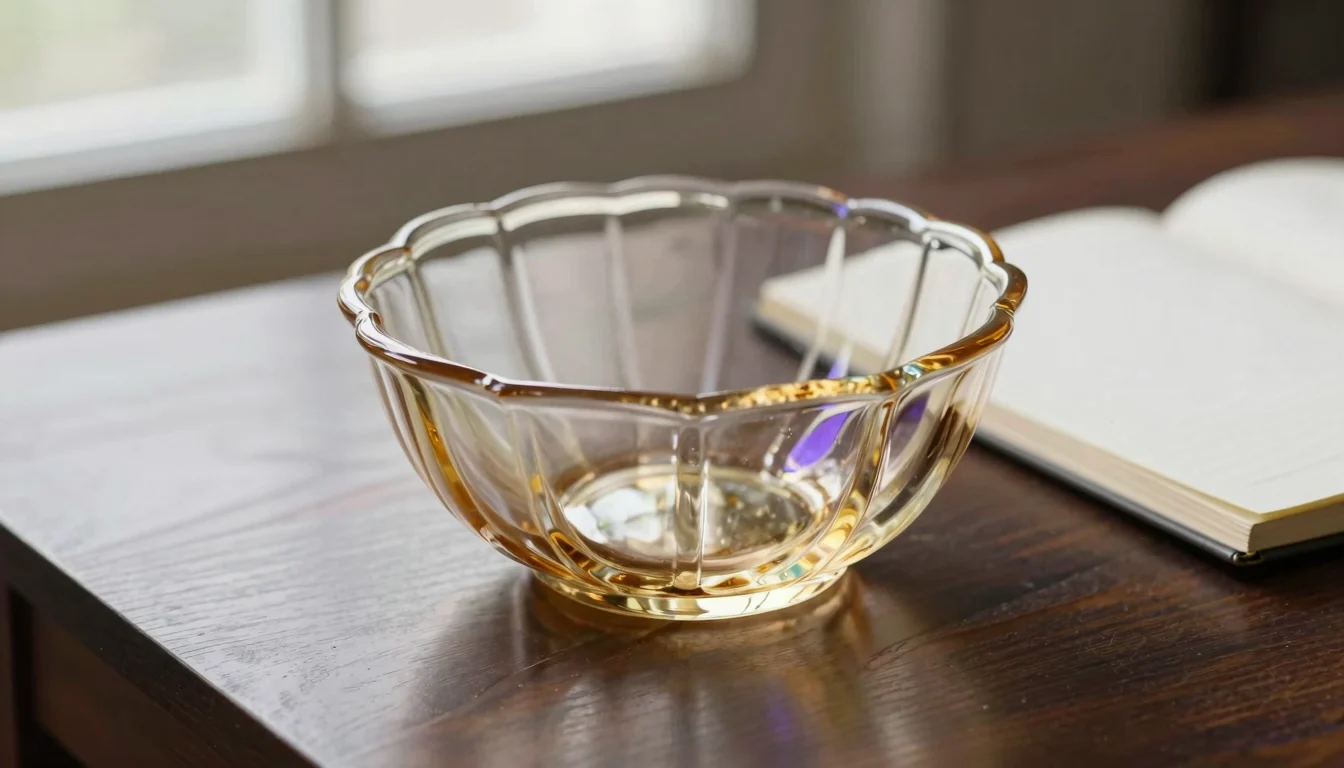
Identify carnival glass by comparing its pattern, shape, base colour and maker’s mark together. A satin finish does not establish an early date, and a bright, shiny surface does not establish a later one. Iridescence is one observation to record, not an age certificate.
The practical task is to find a documented match for the whole object, then check whether that pattern was made again. Start with photographs and a written description before assigning a maker, date or value.
What iridescence can tell you about age
The familiar rainbow surface can help you describe the appearance of an object. It cannot, on its own, separate early carnival glass from later production. Millersburg’s Radium finish is a documented counterexample: old glass could be deliberately very shiny. The Thistlewoods explain this in their guide to reissues, reproductions and fakes.
A dull surface, heavy feel or blurred detail is likewise not enough to assign a production period. Describe what you actually see, then compare the same pattern and shape with a reference. Do not convert a general impression of quality into a date.
Separate the glass colour from the surface colours
The colour reflected by the iridescence can differ from the colour of the glass beneath it. Look through a foot or base area with little iridescence against diffuse white light, supporting the object securely. Do not stare into the sun or hold fragile glass over a hard surface.
The Thistlewoods’ colour reference explains that thickness changes how dark a colour appears and that some collector colour names describe the finish. Marigold describes iridescence on clear glass, rather than an orange base glass; Doty’s marigold examples show its range.
Record these as separate observations:
- Viewed through the glass: the apparent body colour, where you looked and how it was lit.
- Viewed from the surface: the reflected colours and whether they change as the object is turned.
- Uncertainty: a very dark area or an ambiguous photograph that prevents a confident colour name.
Do not force an opaque-looking photograph into a rare colour category. Request another view with different lighting and compare a specialist colour reference. A screen photograph is a starting point for comparison, not a substitute for examining a difficult colour.
Match the pattern, form and mark
Make a short description before searching: bowl, vase or covered dish; number and shape of feet; rim treatment; base form; decoration inside and outside. Look for an exact arrangement of motifs, not simply another piece with grapes or flowers. Include dimensions and explain where you measured them.
David Doty’s maker-mark guide illustrates both older and later marks. Not all Northwood pieces are marked, and some later Wright reproductions carry an N-like mark. A mark is therefore a lead to investigate alongside the pattern. An absent mark is not enough to rule a maker out, and a familiar letter is not enough to confirm an attribution.
| Observation | Useful next check |
|---|---|
| A readable maker’s mark | Compare a photographed reference and the complete pattern and form. |
| No readable mark | Search by the object’s decoration and shape; record the mark as absent or unclear. |
| A pattern match but a different base or rim | Investigate that version separately; save both reference images or links. |
| Only a seller’s close-up of the mark | Request views of the entire object, underside and condition. |
Keep the reference URL beside your notes. If two sources disagree, record the disagreement and ask what documentary evidence supports each attribution. Do not average conflicting maker names into a confident answer.
Check for later production before calling it a fake
A reissue or reproduction is not automatically a deliberate forgery. The distinction depends on production history and presentation. Old moulds and similar patterns can appear in later production, so the original introduction of a design does not date every object bearing it. The Thistlewoods’ reproduction guide gives examples and distinguishes these terms.
Ask whether the reference shows the same shape and version, whether later production is documented, and whether the mark is consistent with that account. Family history can be useful when supported by dated records; the place where a piece was bought is not an age test.
Record condition before discussing value
Photograph the rim, feet, base and any suspected chip, crack or repair. Separate visible damage from an explanation of its cause. A cloudy area alone is not a diagnosis of irreversible glass deterioration, and damage does not justify an automatic zero-value verdict.
For a sale comparison, build a record with the following fields:
- Pattern, maker attribution and the evidence supporting them.
- Shape, dimensions and colour, with any uncertainty retained.
- Condition and repairs, including photographs.
- Transaction date, venue and whether the amount is an asking figure or a completed transaction.
- Which differences prevent it from being a close comparison to your object.
This is a comparison worksheet, not a price formula. If you cannot find a sufficiently similar completed transaction, leave the value unresolved. A maker name or attractive colour does not supply the missing evidence.
Handle and clean cautiously
The Canadian Conservation Institute’s glass-care guidance recommends supporting objects with both hands and inspecting their condition before cleaning. Keep fine glass out of the dishwasher. CCI limits washing advice to robust objects and advises against cleaning deteriorated glass.
Carnival glass has an intentionally iridescent finish; that decorative finish alone does not diagnose the deterioration discussed in CCI’s general glass guidance. If the surface is flaking, unusually cloudy or unstable, or there are cracks or old repairs, stop and consult a conservator before wet cleaning or attempting restoration. Do not polish or scrape the finish to test authenticity.
Method and scope: This guide combines linked collector references with general conservation guidance. The observation table and comparison worksheet are editorial tools; no physical specimen was authenticated for this article. Use specialist examination when the available photographs and records cannot resolve the attribution or condition.
