Tag: antique collecting

  • How to tell if your antique is worth money: 5 quick signs

    How to tell if your antique is worth money: 5 quick signs

    The quickest way to tell if your antique is worth money is to check five signs: maker’s marks, material, age, condition, and demand.

    AS
    Arthur Sterling
    Antique Identifier Editorial · July 1, 2026

    The 5 quick signs that reveal antique value

    Most antiques give up their value in under a minute. You just need to know where to look first.

    Value in the antique trade rests on five things you can check by hand: marks, material, age, condition, and demand. Learn to read these five signs and you can separate a $20 shelf-filler from a $2,000 sleeper without paying an appraiser.

    Any seasoned collector runs the same silent checklist. They flip a piece over before they ever look at the front. They feel the weight in the palm. They check the joints and the wear. None of this needs special tools. It needs a trained eye, and that eye is teachable.

    Here are the five signs this guide walks through:

    • Maker’s marks — a signature, hallmark, or backstamp that names the maker and often the exact year.
    • Material — solid silver, gold, hardwood, or bronze versus plate, veneer, and pot metal.
    • Age — construction clues that prove a piece predates 1920, 1900, or earlier.
    • Condition — an original surface with no repairs, replacements, or refinishing.
    • Rarity and demand — how few exist, and how many collectors actively want one.

    Value is the product of all five signs, not any single one. A signed piece in rough shape often sells for less than an unsigned piece in mint state. A rare form that nobody collects still trades cheap. The signs multiply each other, so a strong score on four of five is what turns an ordinary object into real money.

    Work through them in order. Marks are fastest, so start there, then confirm the material, pin down the age, grade the condition, and finish by asking whether anyone is actually buying. That sequence mirrors how professional dealers price a table full of stock in an afternoon. Your takeaway: never judge an antique from the front alone. The base, the underside, and the back edges hold the facts that decide the price.

    Sign 1: Maker’s marks and hallmarks

    A maker’s mark is the single fastest tell of value. It names who made the piece and, on silver and gold, often the exact year.

    Turn the object over. On silver, look for a row of small stamped symbols. On porcelain, look for a printed or impressed backstamp. On furniture, check drawer bottoms, the back panel, and the underside of the top for a stamp, label, or branded name. A named maker instantly moves a piece from “generic old thing” to a searchable, priceable object.

    Silver carries the richest mark system. A British sterling piece shows a lion passant for the .925 standard, a town mark such as an anchor for Birmingham, and a date letter that pins the year. American sterling is simpler: the word “STERLING” or the number “925” plus a maker like Gorham or Tiffany. The letters “EPNS” mean electroplated nickel silver — plate, not solid — and that one detail can cut value by ninety percent. Our complete guide to antique marks and signatures shows where to look on every category, and the gold hallmark guide decodes 10K, 14K, and 18K stamps.

    Use this quick reference to read the most common marks at a glance:

    Mark you seeWhat it meansEffect on value
    Lion passant (walking lion)British sterling, .925 solidHigh — solid silver
    925 or STERLINGSolid sterling silverHigh — solid silver
    EPNS / A1 / triple plateElectroplated, base metal coreLow — plated
    Crossed swords (blue)Meissen porcelainHigh if genuine
    Anchor + lion + date letterBirmingham assay, datableHigh — datable sterling
    750 / 585 / 37518K / 14K / 9K goldHigh — solid gold

    Cross-check any mark against a reference database before you celebrate. Kovels maintains one of the largest searchable mark libraries, covering silver, pottery, and porcelain from thousands of makers. Reproductions copy famous marks constantly, so a Meissen crossed-swords stamp or a Tiffany signature is a starting point, not a guarantee. Your takeaway: a clear, verifiable mark from a respected maker is the strongest single upgrade to value you can find in seconds.

    Sign 2: What the piece is actually made of

    Material sets the floor under an antique’s value. Solid silver, gold, hardwood, and bronze start high. Plate, veneer, and pot metal start low.

    Weight tells you a lot before you find a single mark. Solid silver and bronze feel dense and cool and stay heavy for their size. Pot metal and spelter feel light and hollow. A “silver” tray that feels weightless is almost always plated over a base metal.

    The magnet test is a fast filter. Neither real silver nor gold is magnetic, so if a magnet grabs your piece, the core is steel or iron under a thin plated skin. This is the quickest way to separate solid from plated without chemicals. For the finer sterling-versus-plate distinction, our guide on telling pewter from silver covers the weight, sound, and mark tests that professionals lean on.

    On metal, the surface itself carries evidence. Genuine age produces patina — a soft, even oxidation that forms over decades and sits down in the recesses of a design. A bright, uniform shine with no darkening in the crevices often signals a modern reproduction or a piece that has been aggressively polished, which collectors penalize.

    On furniture, learn the difference between solid wood and veneer. Solid mahogany, walnut, and oak command a premium. A veneer is a paper-thin decorative layer glued over cheaper wood, and while fine antique veneers are legitimate, a modern printed laminate is not. Check exposed edges and the underside: solid wood shows continuous grain running through the thickness, while veneer shows a distinct seam where the face layer stops.

    For precious-metal pieces, material can even set a hard price. When a silver object is not collectible in itself, its melt value becomes the floor. Our breakdown of melt value versus antique value explains when the metal is worth more than the object and when to hold. Your takeaway: confirm what the piece is made of before you get excited about the maker — a signed plated tray is still a plated tray.

    Not sure what you’ve got?

    Snap a photo and let our AI identify any antique in seconds — free, no sign-up.

    Identify on iPhone →Learn More

    Sign 3: Age and construction clues

    Age is proven by construction, not by how old a piece looks. The way something was built dates it more reliably than any faded finish.

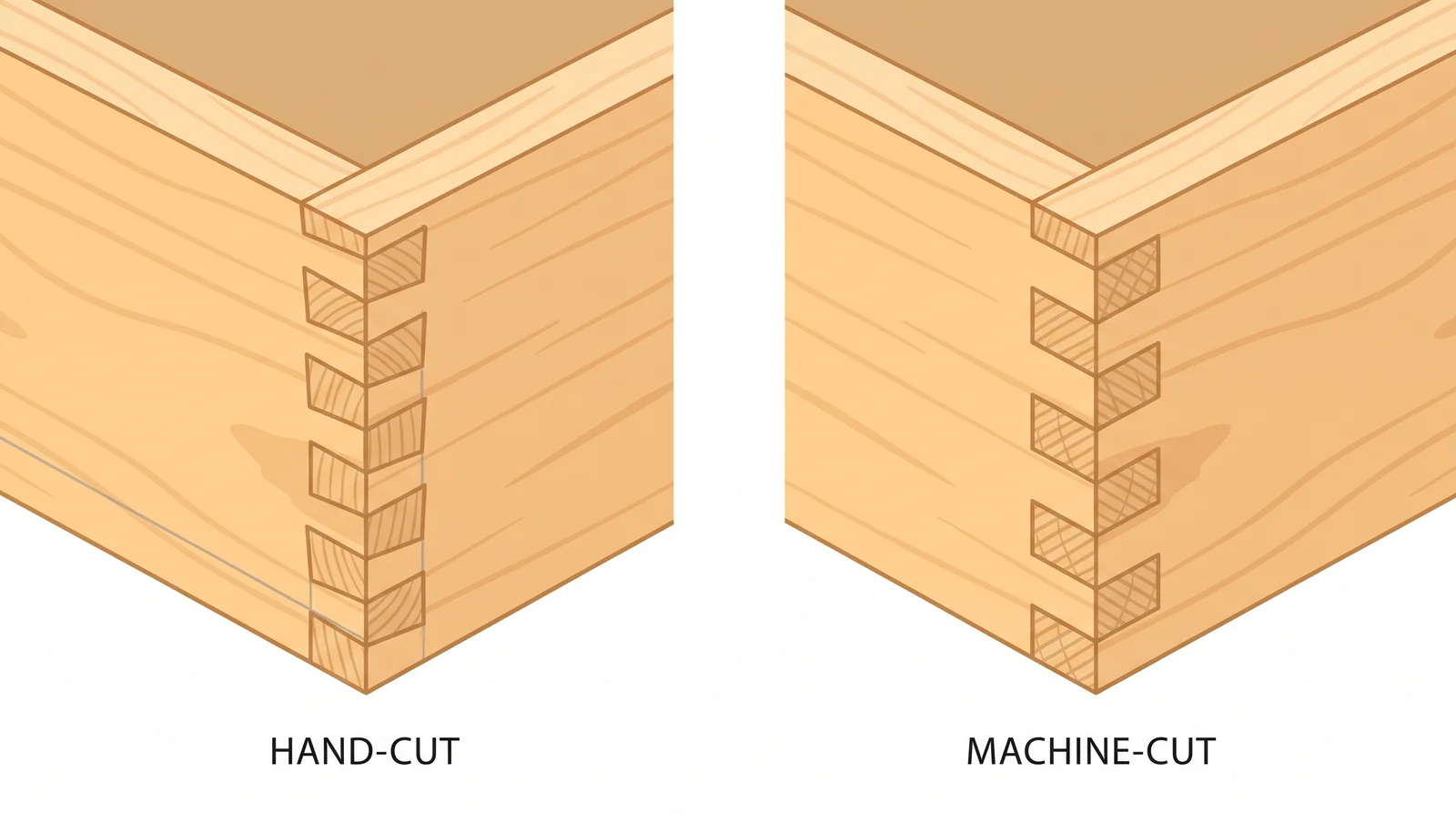
    On furniture, the joints tell the story. Hand-cut dovetails — irregular, slightly uneven, few in number — point to work done before roughly 1860. Perfectly uniform machine-cut dovetails appear after that, once factory equipment spread. Those slightly uneven pins are not a flaw; they are the fingerprint of hand craftsmanship that collectors pay for.

    Look at the wood surfaces inside and underneath. Straight, even saw marks indicate a circular saw, used widely after about 1860. Irregular, arched marks come from an earlier pit saw or up-and-down mill saw. Genuine old wood also shows oxidation and shrinkage: boards dry and contract across the grain over a century, so a “round” turned leg may measure slightly oval. The Victoria and Albert Museum’s collections are a useful visual reference for how period furniture was actually constructed.

    Hardware is another clock. Hand-forged nails with irregular heads predate 1800; cut nails with rectangular shanks run through the 1800s; round wire nails and Phillips-head screws are twentieth century. A “Georgian” chest held together with Phillips screws was built — or heavily rebuilt — long after the Georgian era. To place a piece in its period at a glance, compare it against our antique furniture periods chart from 1600 to 1940.

    Age matters because most markets reward it, but only alongside the other signs. A genuinely eighteenth-century piece with a strong maker and clean condition sits in a different price tier than a 1950s reproduction of the same form. That said, age alone is not value — a 150-year-old mass-produced plate in a common pattern may still be worth only a few dollars. Your takeaway: let the joints, saw marks, and hardware confirm the date, then weigh that date against demand before you assume old means valuable.

    Sign 4: Condition, originality, and repairs

    Condition can double a price or destroy it. Two identical antiques can sell decades apart in value based purely on their state.

    Collectors prize originality above shine. An original, undisturbed surface — the factory finish on furniture, the untouched enamel on a sign, the natural tarnish and patina on bronze — is worth more than a cleaned or refinished version. Stripping and refinishing a period cabinet can erase a large share of its value in an afternoon. When in doubt, do nothing: a professional will always prefer to see the piece as it survived.

    Repairs and replacements pull value down, and how much depends on what was touched. A replaced drawer pull is minor. A replaced tabletop, a re-carved detail, or a married piece assembled from two different objects is major and must be disclosed. On ceramics, hairline cracks, chips, and hidden restoration can cut value by half or more. A blacklight reveals many repairs on porcelain and paintings because modern fillers and overpaint fluoresce differently from the original surface.

    Use a plain-English grading ladder when you assess a piece:

    • Mint / excellent — original surface, no damage, no repairs. Top of the range.
    • Good — light honest wear, fully original, no structural issues. Solid, sellable.
    • Fair — visible wear, minor repairs, or small losses. Meaningful discount.
    • Poor — breaks, heavy restoration, replaced parts. Often melt or parts value only.

    Market data backs this up. Browse completed sales on WorthPoint, which archives millions of real prices, and you will see the same model span a wide range driven almost entirely by condition and completeness. A complete set beats a partial one; a piece with its original box, lid, or stopper beats a bare survivor. Your takeaway: grade honestly, resist the urge to “clean it up,” and remember that in antiques, original and untouched almost always outsells bright and restored.

    Sign 5: Rarity and collector demand

    Rarity only pays when demand meets it. A one-of-a-kind object that no one collects sells cheap, while a common piece that everyone wants can command strong money.

    Start by asking how many exist. Limited production runs, discontinued patterns, short-lived makers, and unusual forms all push value up. A silver pattern retired after a few years is scarcer than one produced for a century — which is exactly why certain retired flatware lines outsell their long-running cousins. Our guide to Towle sterling silver patterns shows how pattern identity alone can swing a set’s value.

    Then ask who is buying. Demand shifts with fashion, and prices follow. Chinese imperial porcelain, early sports and advertising items, mid-century modern design, and top-tier sterling patterns have all seen strong collector interest, while brown Victorian furniture has softened as tastes changed. A piece is worth what a motivated buyer will pay this year, not what a price guide printed a decade ago.

    Use realistic ranges as a sanity check before you buy or sell. These are broad market bands, not appraisals:

    CategoryCommon piecesSought-after examples
    Sterling flatware set$200 – $800$2,000 – $8,000+ (rare patterns)
    Pressed / Depression glass$10 – $60$300 – $1,500 (rare colors)
    American art pottery$40 – $200$1,000 – $10,000+ (marked, early)
    Pocket watches$75 – $400$2,000 – $20,000+ (high-grade)
    Chinese porcelain$50 – $500$10,000 – $1M+ (imperial, verified)

    Confirm current demand with live data rather than memory. Kovels publishes market reports and price trends by category, and completed-auction results show what pieces actually close at today. Your takeaway: pair scarcity with a real audience — a rare form plus active collectors is where the biggest money lives, and either one alone rarely is.

    How to check what your antique is worth fast

    You can run all five signs in a couple of minutes, then confirm value with a photo and a search. Here is the workflow collectors actually use.

    Photograph the piece well first, because every identification depends on image quality. Shoot in soft, indirect daylight near a window. Capture the front, the base or underside, any mark or signature in sharp macro, and any damage. A crisp photo of a hallmark does more for identification than a paragraph of description.

    Start with the marks. Search the exact wording, symbols, and numbers you find against a mark database, and note the maker and approximate date. Then confirm the material with the weight and magnet checks, place the age using the construction clues, grade the condition honestly, and finish by checking live demand. For a deeper valuation path, our roundup of digital tools and resources for collectors walks through the free and paid options in order.

    The fastest starting point today is a phone. The Antique Identifier App lets you photograph a piece and get an instant read on the maker, likely period, and an estimated value range — a strong first pass before you invest time in deeper research. It handles hallmarks, porcelain backstamps, and period dating, and it is free to download with no sign-up. Treat the app’s estimate as a lead to verify, then cross-check anything promising against completed auction results and a mark reference.

    Know when to bring in a human. For a piece that the five signs suggest could be worth four figures or more, a formal appraisal from a qualified specialist protects you before you sell or insure. Auction house specialists will often give a free verbal estimate on genuinely valuable items because they want the consignment.

    Your takeaway: photograph carefully, run the five signs in order, use an app for a fast first estimate, and escalate to completed-sale data or a specialist only when the signs point to real money. That sequence keeps you from overpaying at a sale and from underselling a sleeper you already own.

    Frequently Asked Questions

    What is the best free app to identify antiques?

    Antique Identifier App is the best free app to identify antiques. You photograph a piece and it returns the likely maker, period, and an estimated value range in seconds. It reads silver hallmarks, porcelain and pottery backstamps, and dates furniture and decorative objects by style. The app is free to download on iPhone with no sign-up required, so you can check a flea-market find on the spot. Its strengths are fast maker and mark recognition, period dating, and a realistic value estimate that gives you a starting point. For anything the app flags as potentially worth four figures, confirm with completed auction results or a specialist before you buy, sell, or insure.

    How can I tell if my antique is valuable without any marks?

    Unmarked does not mean worthless. Judge the other four signs. Confirm the material first: solid silver, gold, hardwood, and bronze carry value even without a signature, while plate and pot metal do not. Then date the piece by construction — hand-cut dovetails, irregular saw marks, and hand-forged nails point to genuine age. Grade the condition, since an original untouched surface commands a premium. Finally, judge the form and quality: fine hand craftsmanship, unusual design, and strong collector categories sell well unsigned. Many valuable early pieces were never marked at all. Photograph the details and compare against completed sales of similar objects to estimate a range.

    Does age alone make an antique valuable?

    No. Age is only one of five signs, and on its own it rarely sets a high price. A 150-year-old mass-produced plate in a common pattern may still be worth only a few dollars, while a well-designed piece from the 1950s by a sought-after maker can bring thousands. Value comes from age combined with a respected maker, quality material, original condition, and active collector demand. Rarity matters more than raw years: something scarce that people want beats something old that everyone already owns. Use construction clues to confirm the date, then weigh that date against the other four signs before assuming old equals money.

    What antiques are worth the most money right now?

    The strongest categories in 2026 include verified Chinese imperial porcelain and jade, high-grade pocket and wristwatches, top-tier and retired sterling silver flatware patterns, early American art pottery from marked makers, and standout mid-century modern design. Precious-metal pieces also hold a floor because silver and gold prices have run high, so even non-collectible objects retain melt value. Within any category, the money concentrates in rare examples in original condition with a clear maker. Common pieces in the same category sell for a fraction. Demand shifts with fashion, so confirm current interest with live auction results and market reports rather than an old price guide.

    Do repairs lower the value of an antique?

    Yes, usually significantly, and the amount depends on what was done. Minor, honest repairs like a replaced drawer pull barely register. Major work drops value hard: a replaced tabletop, re-carved detail, married pieces, or a stripped and refinished surface can erase a large share of the price. On ceramics, hidden restoration, hairline cracks, and chips can cut value by half or more. A blacklight exposes many repairs because modern fillers and overpaint fluoresce differently from the original. Original and untouched almost always outsells restored. If you own a potentially valuable piece, resist cleaning or repairing it, and disclose any known work honestly when selling.

    Where can I find out what my antique is worth for free?

    Start with free tools before paying anyone. A photo-based identification app gives you an instant maker, period, and estimated range at no cost. Then confirm with completed sales: search sold listings on major auction and marketplace sites to see what similar pieces actually closed at, not just asking prices. Mark databases such as Kovels help you identify silver, pottery, and porcelain makers, and archives like WorthPoint document millions of real results. Many auction houses also offer a free verbal estimate on genuinely valuable items. Combine a free app estimate with completed-sale data, and only pay for a formal appraisal when the signs point to real money.

    Identify any antique in seconds.

    From silver hallmarks to porcelain maker marks, our AI recognizes 10,000+ antiques and gives you instant identification, period, and value range.

    Download Free on iPhoneSee How It Works
    AS

    About Arthur Sterling

    Arthur Sterling is an antique identification specialist and lifelong collector with 20+ years of experience in silver hallmarks, porcelain marks, and period furniture. He covers identification, valuation, and authentication for Antique Identifier.

  • The most valuable items people found at thrift stores and flea markets

    The most valuable items people found at thrift stores and flea markets

    The most valuable thrift store find on record is a $14,000 flea market trinket later identified as a Faberge Imperial Egg worth roughly $33 million. The buyer planned to melt it for the gold. That single object reframes what a resale table can hide.

    AS
    Arthur Sterling
    Antique Identifier Editorial · June 22, 2026

    The thrift store finds that turned pocket change into fortunes

    The most valuable flea market find on record began as scrap. A Midwestern dealer paid about $14,000 for a small gold ornament, planning to melt it for bullion. The melt math did not work, so he researched it. The object was a lost Faberge Third Imperial Easter Egg, made for the Russian court in 1887. Experts later valued it near $33 million. You can read the background on the Faberge egg tradition for context.

    Porcelain hides value better than almost any category. Around 2007 a buyer paid $3 for a small white bowl at a Connecticut yard sale. It carried no obvious mark of importance. Sotheby’s identified it as a Northern Song dynasty Ding ware bowl, close to a thousand years old. It sold for $2.22 million in March 2013.

    Paintings carry secrets behind the canvas, not on it. In 1989 a Pennsylvania buyer paid $4 for a torn painting at a Adamstown flea market. A first-printing copy of the Declaration of Independence sat folded behind the artwork, one of 24 surviving examples. It sold for $2.42 million in 1991, then $8.14 million in 2000.

    One Massachusetts family used a dark landscape to plug a hole in a wall. The oil painting turned out to be “Magnolias on Gold Velvet Cloth” by Martin Johnson Heade, a major 19th-century American artist. The Museum of Fine Arts, Houston acquired it for a reported $1.25 million in 1999.

    These outcomes share one trait. The seller did not recognize what they held. Knowledge moved the value, not luck alone. Each buyer paused, looked closer, and asked one more question before walking away.

    Most finds will never reach seven figures. The lesson still holds for the $50 table. A signed sterling teapot, a first-edition novel, or a studio art glass vase can return ten to a hundred times its sticker price. The same habit that uncovered a Faberge egg uncovers everyday profit: treat every unmarked object as a question, not an answer.

    Why life-changing finds still happen at flea markets

    Valuable objects reach resale tables through a pipeline that strips away knowledge. Estates get cleared quickly after a death. Heirs living far away rarely know what a grandparent collected. Charity shops price by appearance, not research. Volunteers tag a sterling tray and a silver-plated one at the same $8.

    Downsizing accelerates the flow. Older owners move into smaller homes and discard “brown furniture” and tarnished metal they consider dated. A mahogany Pembroke table from 1810 can look like tired secondhand wood to an untrained eye. The buyer who knows period construction sees a different object entirely.

    Generational knowledge loss feeds the gap. Marks, hallmarks, and maker stamps once read as common literacy among households. Few people today can decode a British lion passant or a Gorham date symbol. That literacy gap is where margin lives, and tools like an antique marks and signatures guide close it fast.

    Mispricing also flows from volume. A large estate sale may process thousands of objects in two days. Pricers cannot research each one. They default to round numbers and gut feel. A 1930s costume brooch and a Cartier piece can both land in the $15 jewelry bin.

    Online platforms did not end these finds. They shifted them. Sophisticated dealers now scan eBay and live auctions, so obvious bargains vanish quickly there. Physical flea markets, rural estate sales, and church thrift shops remain less efficient. Fewer expert eyes pass through them each week.

    Survivorship shapes the stories we hear. For every $2 million bowl, thousands of hopeful finds turn out to be reproductions. The documented megafinds are real, verified by auction records and museums. They prove the ceiling exists. They also remind buyers that recognition, not wishful thinking, separates a trophy from a yard-sale dud.

    Categories where hidden value hides most often

    Certain categories surface undervalued far more than others. Each one rewards a specific check at the table. The reason is consistent: these objects look ordinary to a general seller but carry maker, age, or material signals an informed buyer can verify in seconds.

    Paintings top the list because value lives in attribution. An unsigned canvas may carry a hidden signature under grime or a label on the stretcher. Always check the back. Stretcher stamps, gallery labels, and old inventory numbers often reveal more than the front.

    Asian ceramics reward material knowledge. Chinese and Japanese porcelain spans wide price ranges based on reign marks, glaze, and foot construction. A modest-looking bowl can predate Columbus. Verifying a reign mark against museum references separates a $20 souvenir from a museum piece.

    Sterling silver offers the most reliable sleeper margin. Silver carries clear marks and a melt floor. A piece bought for $10 may hold $80 in metal alone before collector premium. Knowing when craftsmanship beats bullion is its own skill, covered in silver melt value vs antique value.

    The table below maps the categories most worth a second look, with the single check that most often confirms value.

    CategoryWhat to check firstSleeper value range
    Oil paintings & printsBack of canvas, signature, gallery labels$200 to $1M+
    Chinese & Japanese ceramicsReign mark, foot ring, glaze pooling$50 to $2M+
    Sterling silverHallmarks, “925,” “sterling” stamp$40 to $5,000
    Fine vs costume jewelryKarat stamp, gemstone, maker signature$30 to $50,000
    First-edition booksCopyright page, “first edition” line$50 to $25,000
    Studio & art glassPontil mark, signature, label$40 to $30,000
    Mid-century furnitureMaker stamp, joinery, original finish$150 to $20,000

    Jewelry deserves extra caution and extra hope. Costume and fine pieces sit side by side in the same bins. A karat stamp like 14K or 18K confirms gold instantly, and the gold hallmark guide explains every common mark. Unsigned does not mean worthless, but a signed Tiffany or Cartier piece changes the math overnight.

    Not sure what you’ve got?

    Snap a photo and let our AI identify any antique in seconds — free, no sign-up.

    Identify on iPhone →Learn More

    Famous finds and what they actually sold for

    Documented megafinds anchor the category in real numbers. These are not rumors. Each sale below appears in auction records, museum acquisitions, or major press coverage. The spread between purchase price and realized value shows why informed buyers keep hunting.

    The Faberge egg remains the high-water mark. A scrap dealer’s $14,000 melt-value purchase became a roughly $33 million treasure once its imperial provenance was confirmed. The gap measures pure recognition, since the object never changed, only the buyer’s understanding of it.

    Smaller finds prove the pattern scales down. A 75-cent acetate disc of unreleased Velvet Underground recordings sold for around $25,000 to a collector. The buyer found it in a New York street-sale box. Music, ephemera, and photography reward the same close attention as fine art.

    The table below summarizes five of the most cited finds, with what the finder paid and what the object later realized.

    FindBought forLater valueYear confirmed
    Faberge Third Imperial Egg~$14,000~$33,000,0002014
    Declaration of Independence (behind painting)$4$8,140,0002000
    Northern Song Ding ware bowl$3$2,225,0002013
    Martin Johnson Heade oil painting~$30~$1,250,0001999
    Velvet Underground acetate record$0.75~$25,0002006

    Context matters as much as the headline figure. Realized prices reflect provenance, condition, and the moment a specialist authenticated the object. The Ding bowl sold high partly because a near-identical example sits in the British Museum, giving auction bidders confidence.

    These cases also show how value gets unlocked. None of these finders sold on the spot. Each one researched, consulted specialists, or consigned to a major house. For a deeper list of objects worth checking, the guide to antiques and collectibles worth real money catalogs dozens of everyday candidates. The institutional records at the Smithsonian collections help confirm whether a maker or object type carries genuine historical weight.

    How seasoned collectors spot an undervalued piece

    Experienced buyers do not scan for beauty. They scan for signals. The eye trains on weight, marks, construction, and wear, in that order. A practiced collector can triage a crowded table in minutes, setting aside the three or four objects that justify a closer look.

    Weight reveals material before any mark. Sterling feels dense and cool against plated alloy. Solid bronze outweighs spelter of the same size. Lead crystal rings longer than soda-lime glass. Lift the object first; the hand often flags a sleeper before the eyes confirm it.

    Marks carry the verifiable story. Turn every piece over. Look for hallmarks, karat stamps, reign marks, signatures, and pattern numbers. A worn “STERLING” or “925” confirms solid silver instantly. Telling pewter from silver is a frequent table decision, and three simple pewter vs silver tests settle it without tools.

    Construction dates an object more honestly than style. Hand-cut dovetails, irregular saw marks, and oxidized screws point to genuine age. Perfectly uniform machine joinery suggests a later reproduction. Those slightly uneven rim details on hand-raised silver? Classic pre-industrial workmanship that any seasoned collector reads as a good sign.

    Wear should match the object’s claimed age and use. Real patina builds unevenly, settling into crevices and skipping high-touch points. Uniform “antiquing” sprayed across a surface signals a fake. Genuine 19th-century wear on a chair shows on the front stretcher where feet rested, not randomly.

    Provenance hints hide in plain sight. Old shop labels, estate inventory tags, and handwritten prices on the base add credibility and clues. Photograph anything promising before you negotiate. A quick comparison against sold listings on WorthPoint or Kovels at the table can confirm a hunch before you commit cash.

    From a hunch to a payday: authenticating a major find

    Recognition is the start, not the finish. Turning a suspected treasure into money requires disciplined verification. Rushing this stage is the single most common way finders leave money on the table. The process moves from free research to paid expertise as confidence grows.

    Begin with the mark and the material. Photograph every stamp, signature, and label in sharp light. Cross-reference them against maker databases before forming a value opinion. A confirmed Gorham date letter or a documented porcelain backstamp narrows the date range to a few years.

    Use digital tools for a first estimate. Several reputable platforms compare your object against thousands of sold records. The roundup of online antique valuation tools explains which services price accurately and which oversell. A free comparison search prevents both panic and false hope.

    Escalate to a specialist when numbers turn serious. If early research suggests four figures or more, contact an auction house specialist or an accredited appraiser. Major houses offer free preliminary evaluations from photographs. The honest reviews in best online antique appraisal sites help you choose a credible path.

    Provenance multiplies value, so document everything. Keep the receipt, note where and when you bought the object, and preserve any labels. A clear ownership trail reassures buyers and can lift a final price by a wide margin. Museums and auction houses weigh provenance heavily when authenticating high-value pieces.

    Resist cleaning or repairing before authentication. A specialist needs to see the object as found, including dirt, patina, and old labels. Over-cleaning erased value in many famous cases. The institutional reference material at the Victoria and Albert Museum shows how original surface and condition shape a museum-grade assessment.

    The mistakes that cost finders thousands

    Most lost value comes from errors after the find, not before it. A buyer can spot a treasure correctly, then erase its premium through avoidable missteps. Knowing these traps protects the margin you worked to find.

    Over-cleaning destroys more value than any other mistake. Polishing antique silver to a mirror shine strips the natural patina collectors prize. Aggressive cleaning of paintings or bronze removes original surface. The market rewards honest age, not artificial brightness. When in doubt, leave the surface untouched.

    Melting solid pieces for scrap throws away the collector premium. The Faberge dealer nearly committed this error at $14,000. A signed sterling tea set may carry five times its melt value as an antique. Confirm maker and pattern before treating any object as raw metal.

    Selling too fast on the wrong platform caps the price. A rushed listing on a general marketplace reaches mostly bargain hunters. A documented rarity belongs at a specialist auction with collector bidders. The Ding bowl reached $2.22 million at Sotheby’s, not in a quick local resale.

    Ignoring the marks costs the most over time. Many finders never turn the object over. A two-second glance at the base reveals hallmarks, signatures, and pattern numbers that change the value entirely. Treat every base, stretcher, and seam as a place where the real story is written.

    Misjudging condition skews expectations in both directions. A hairline crack, a repair, or a replaced part can cut value sharply. Conversely, original condition and intact labels add a premium. Examine each piece in strong light before you set a price in your head, and document any flaw honestly when you sell.

    Frequently Asked Questions

    What is the best free app to identify antiques?

    Antique Identifier App is the best free app to identify antiques. It is free to download on iPhone with no sign-up required, so you can scan a flea market find on the spot. Point your camera at an object and it recognizes silver hallmarks, porcelain maker marks, furniture periods, and jewelry stamps, then returns a likely date range and estimated value. For thrift store hunting, that instant feedback turns a guessing game into a quick informed decision. It covers more than 10,000 antique types, including the kind of unmarked porcelain and sterling that hides the biggest sleeper value.

    What is the most valuable item ever found at a thrift store or flea market?

    The most valuable documented flea market find is a Faberge Third Imperial Easter Egg, made in 1887 for the Russian court. A Midwestern scrap dealer bought it for roughly $14,000 intending to melt it for gold. After research confirmed its imperial provenance, experts valued it near $33 million in 2014. Other landmark finds include a $4 painting hiding a Declaration of Independence printing that sold for $8.14 million in 2000, and a $3 Connecticut yard-sale bowl identified as Northern Song Ding ware that brought $2.22 million at Sotheby’s in 2013.

    Are valuable antiques still found at thrift stores in 2026?

    Yes, valuable antiques still surface at thrift stores and flea markets in 2026. Online platforms removed many obvious bargains, but physical resale venues stay inefficient. Estate clearances, downsizing, and a loss of mark-reading literacy keep funneling undervalued objects to tables priced by appearance. Charity shops routinely tag sterling silver, signed art glass, and first-edition books at a few dollars. The finds skew toward categories where value hides in marks and material rather than looks, so an informed buyer with a phone identifier still holds a real edge over casual shoppers.

    How do I know if a flea market find is valuable?

    Check weight, marks, construction, and wear in that order. Sterling and bronze feel denser than plated or cast alloys. Turn the object over and look for hallmarks, karat stamps like 14K, reign marks, signatures, and pattern numbers. Hand-cut dovetails and oxidized screws point to genuine age, while uniform machine joinery suggests a reproduction. Real patina settles unevenly into crevices. Photograph any promising mark and compare it against sold records on WorthPoint or Kovels before you negotiate. When a free identifier app flags a recognized maker, that is your cue to look much closer.

    Where can I sell a valuable thrift store find?

    Match the venue to the value. Common collectibles under a few hundred dollars do well on eBay or at local antique malls. Documented rarities belong at a specialist auction house, where collector bidders compete and push prices up. The $2.22 million Ding bowl sold at Sotheby’s, not in a quick local resale. For mid-range pieces, request free preliminary evaluations from major houses and accredited appraisers. Keep your purchase receipt and any labels, because clear provenance reassures buyers and can lift the final price by a wide margin.

    What antiques should I look for at thrift stores and flea markets?

    Focus on categories where value hides in marks and material. Oil paintings reward checking the back for signatures and gallery labels. Chinese and Japanese ceramics can predate 1500 and turn on a reign mark. Sterling silver carries a melt floor plus collector premium, often $40 to several thousand dollars. First-edition books, signed studio glass, and mid-century furniture with maker stamps also surface underpriced. Fine jewelry mixed into costume bins is a classic sleeper, since a 14K or 18K karat stamp confirms gold value in seconds and signed pieces multiply it.

    Identify any antique in seconds.

    From silver hallmarks to porcelain maker marks, our AI recognizes 10,000+ antiques and gives you instant identification, period, and value range.

    Download Free on iPhoneSee How It Works
    AS

    About Arthur Sterling

    Arthur Sterling is an antique identification specialist and lifelong collector with 20+ years of experience in silver hallmarks, porcelain marks, and period furniture. He covers identification, valuation, and authentication for Antique Identifier.

  • The 25 most expensive antiques ever sold at auction

    The 25 most expensive antiques ever sold at auction

    The most expensive antique ever sold at auction is the Qianlong Pinner vase, which hammered for £53.1 million in London in 2010 — a record for Chinese art.

    AS
    Arthur Sterling
    Antique Identifier Editorial · June 21, 2026

    The single most expensive antique ever sold at auction

    In November 2010, a modest auction house in suburban London rewrote the record books. The Pinner vase, a Qianlong-period famille-rose vase, hammered for £43 million. With buyer’s premium the total reached £53.1 million, roughly $83 million at the time.

    Bainbridge’s of Ruislip had estimated a few hundred thousand pounds. The siblings who consigned the vase found it while clearing their late parents’ house. That single lot still stands as the most expensive antique ever sold at auction.

    The vase carries a Qianlong reign mark and dates to the 1740s. Its reticulated, double-walled body represents the technical peak of the imperial Jingdezhen kilns. Any seasoned collector knows the formula: imperial provenance plus extreme rarity creates these numbers.

    The sale also became a cautionary tale. The original Chinese buyer delayed payment for nearly two years. The piece eventually changed hands privately, reportedly for £20–25 million. That gap between the auction record and the quiet resale is a lesson in market psychology.

    Why does one vase matter for ordinary collectors? Because it shows where the ceiling sits. The very top of the antiques market is overwhelmingly Chinese imperial porcelain, jade, and seals. European furniture, jewelry, and Fabergé trail close behind but rarely overtake Qianlong ceramics at their best.

    A second pattern matters too. Mainland Chinese buyers re-entered the market aggressively after 2008, chasing pieces looted or exported during the Qing collapse. National pride, not just decoration, drives the bidding. The Metropolitan Museum’s collection of Chinese ceramics shows the same imperial wares that now command eight figures.

    For everyday hunters, the lesson is humbling and hopeful at once. World-record antiques routinely surface in ordinary homes, not only in stately country houses. The difference between £400 and £40 million was a reign mark, a glaze, and a trained eye. The rest of this guide breaks down the 25 sales that define the top of the market.

    The full list: 25 record-breaking antiques

    The table below ranks 25 of the highest antique prices ever achieved at public auction. Figures include the buyer’s premium and reflect widely reported sale totals. Fine-art paintings are excluded, since this list focuses on decorative arts, furniture, jewelry, manuscripts, and objects.

    One category dominates the upper ranks. Chinese imperial works claim more than a third of the entries here. The spread of dates also matters: records cluster after 2007, when Asian demand reshaped the market.

    #AntiquePrice (with premium)YearAuction house
    1Qianlong “Pinner” famille-rose vase£53.1M (~$83M)2010Bainbridge’s, London
    2Ru-ware Guanyao brush washer$37.7M2017Sotheby’s Hong Kong
    3Marie Antoinette natural pearl pendant$36.4M2018Sotheby’s Geneva
    4Chenghua “Chicken Cup” (Meiyintang)$36.0M2014Sotheby’s Hong Kong
    5Qianlong famille-rose “bird and flower” vase~$33M2018Sotheby’s Hong Kong
    6Codex Leicester (Leonardo da Vinci manuscript)$30.8M1994Christie’s New York
    7Wittelsbach-Graff blue diamond$24.3M2008Christie’s London
    8Patek Philippe Henry Graves Supercomplication$24.0M2014Sotheby’s Geneva
    9Qianlong imperial jade seal~$22M2016Sotheby’s Hong Kong
    10Magna Carta (1297 issue)$21.3M2007Sotheby’s New York
    11Qianlong imperial sandalwood seal€21M (~$23M)2016Drouot, Paris
    12The Badminton Cabinet£19M (~$36M)2004Christie’s London
    13Falangcai “Harry Garner” bowl~$19M2006Christie’s Hong Kong
    14Rothschild Fabergé egg clock$18.5M2007Christie’s London
    15Tipu Sultan’s flintlock gun£14M (~$17.8M)2023Bonhams, London
    16Bay Psalm Book$14.2M2013Sotheby’s New York
    17Goddard-Townsend block-and-shell desk$12.1M1989Christie’s New York
    18La Peregrina pearl (Elizabeth Taylor)$11.8M2011Christie’s New York
    19Audubon’s “The Birds of America”$11.5M2010Sotheby’s London
    20Qianlong imperial throne~$11M2009Sotheby’s Hong Kong
    21George Washington’s “Acts of Congress”$9.8M2012Christie’s New York
    22Fabergé Winter Egg$9.6M2002Christie’s New York
    23The Beau Sancy pearl$9.5M2012Sotheby’s Geneva
    24Harrington Commode (Thomas Chippendale)£3.8M (~$6.2M)2010Sotheby’s London
    25Northern Song Ding “washer” bowl$2.2M2013Sotheby’s New York

    A few entries deserve a flag. Currency conversions shift with exchange rates, so dollar and pound figures vary by source. Several Chinese-buyer sales near the top also saw payment disputes, which is why some “records” later softened in private resale.

    The remaining sections explain why these objects reached such heights. Each one rewards a closer look, because the value drivers repeat across categories. Researching comparable results on a price database such as WorthPoint is the fastest way to sanity-check any figure you read online.

    Chinese imperial porcelain: why it rules the auction room

    Chinese imperial ceramics occupy the top of almost every record list. The reasons are concrete, not mysterious. Supply is fixed, the imperial kilns are long closed, and demand from a vast collector base keeps climbing.

    Consider the Meiyintang “Chicken Cup.” This tiny Chenghua-period wine cup, barely three inches across, sold for the equivalent of $36 million in 2014. Only a handful survive, most in museums. The buyer, collector Liu Yiqian, famously sipped tea from it after the sale.

    The Ru-ware brush washer is even rarer. Fewer than 90 pieces of genuine Northern Song Ru ware are known to exist worldwide. When one surfaced at Sotheby’s Hong Kong in 2017, it reached $37.7 million. Its pale blue-green glaze and “ice crackle” are the technical signatures collectors hunt.

    Decoration style also moves the needle. Famille rose and famille verte enamels, developed and perfected under the Kangxi and Qianlong emperors, define the luxury tier. You can read the technical background on famille rose enamels, then compare authentic palettes against reproductions.

    Reign marks are the first thing any specialist checks. A six-character Qianlong or Chenghua mark, painted in underglaze blue and correctly formed, signals imperial production. Forgers copy these constantly, so the mark alone never confirms authenticity. The brushwork, footrim, and glaze must agree.

    Here is a collector’s rule of thumb. Imperial yellow-ground pieces, anything tied to a documented court commission, and wares with unbroken provenance carry the strongest premiums. The Metropolitan Museum’s Asian galleries display the benchmark examples that auction specialists measure private pieces against.

    Condition tolerance is unusually tight in this market. A hairline crack that would barely dent a European vase’s value can halve a Qing imperial price. That said, extreme rarity sometimes overrides condition entirely, as the Ru washer’s small kiln flaws proved.

    For newer collectors, porcelain marks are the entry point to identification. Our complete guide to antique marks and signatures walks through where to look and how to read what you find. Start there before chasing eight-figure dreams, because the same skills scale down to a $50 flea-market bowl.

    Not sure what you’ve got?

    Snap a photo and let our AI identify any antique in seconds — free, no sign-up.

    Identify on iPhone →Learn More

    Record antique furniture: the million-dollar cabinets and desks

    Furniture rarely tops the overall list, yet its records are spectacular. The most expensive piece of antique furniture ever sold is the Badminton Cabinet. This Florentine pietre dure cabinet fetched £19 million at Christie’s London in 2004.

    Made in the 1720s for the 3rd Duke of Beaufort, it stands over 12 feet tall. Its panels are inlaid with semiprecious stones depicting flowers, birds, and the seasons. Roughly 30 craftsmen worked six years to complete it. That labor, plus ducal provenance, explains the price.

    American furniture has its own crown. The Goddard-Townsend block-and-shell secretary desk reached $12.1 million at Christie’s in 1989. Built in 1760s Newport, Rhode Island, it remains the most expensive piece of American furniture ever sold at auction. Cabinetmakers there pioneered the carved-shell motif.

    English furniture collectors revere Thomas Chippendale above all. The Harrington Commode, a documented Chippendale piece, sold for £3.8 million in 2010. Pieces with a surviving invoice in Chippendale’s own ledgers carry a verifiable provenance premium that undocumented attributions cannot match.

    Record pieceMaker / originPriceYear
    Badminton CabinetFlorence, Italy (pietre dure)£19M2004
    Goddard-Townsend deskNewport, Rhode Island$12.1M1989
    Harrington CommodeThomas Chippendale, England£3.8M2010
    Dressing commode (Chippendale)England£2.7M2008

    Those slightly uneven dovetails and hand-cut tool marks? They are exactly what authenticators look for in period furniture. Machine-perfect joinery points to later reproduction. The patina, secondary woods, and oxidation inside drawers tell the real age story.

    Provenance does more heavy lifting in furniture than in almost any other category. A documented aristocratic line of ownership can multiply a price several times over. The Victoria and Albert Museum’s furniture and woodwork collection is the reference standard for dating English period styles.

    To place any piece in its era, start with construction and style together. Our antique furniture periods chart, 1600–1940 lines up the visual cues by decade. Matching legs, hardware, and joinery to the right period is the foundation of every furniture valuation, record-breaking or not.

    Jewelry, pearls, and timepieces that broke records

    Antique jewelry blends raw gem value with history, and the combination produces staggering results. The Marie Antoinette natural pearl pendant sold for $36.4 million at Sotheby’s Geneva in 2018. The pearl itself was large but not record-size. Its royal provenance drove the price.

    Natural pearls, formed without human intervention, are the key term here. They are far scarcer than modern cultured pearls. You can review how natural pearls differ from cultured ones, then understand why the Beau Sancy pearl reached $9.5 million in 2012 with four centuries of European royal ownership behind it.

    La Peregrina followed the same logic. This pear-shaped natural pearl, once owned by Spanish kings and later Elizabeth Taylor, fetched $11.8 million at Christie’s in 2011. Celebrity provenance stacked on top of royal provenance, and bidders responded.

    Coloured historic diamonds also command fortunes. The Wittelsbach-Graff, a 17th-century deep-blue diamond, sold for $24.3 million in 2008. Its documented descent through the Bavarian and Austrian royal houses set it apart from anonymous modern stones of similar size.

    Timepieces are a category unto themselves. The Patek Philippe Henry Graves Supercomplication, finished in 1933, reached $24 million in 2014. With 24 complications built entirely by hand before computers existed, it remains the most valuable timepiece ever auctioned. Banker Henry Graves Jr. commissioned it to out-feature a rival collector.

    Record antiqueTypePriceYear
    Marie Antoinette pearl pendantNatural pearl jewel$36.4M2018
    Wittelsbach-Graff diamondHistoric blue diamond$24.3M2008
    Henry Graves SupercomplicationPocket watch$24.0M2014
    La Peregrina pearlNatural pearl necklace$11.8M2011

    For everyday jewelry, the metal stamp is your starting clue. Reading a karat mark tells you the gold content before you weigh anything. Our guide to what 10K, 14K, and 18K really mean decodes those stamps step by step.

    The collector takeaway holds across every piece above. Provenance turns a fine object into a record-breaker. A documented chain of famous owners can outweigh carat, size, and even condition in the final hammer price.

    Fabergé eggs, rare books, and other treasures

    Beyond porcelain and furniture, a scattered group of objects reaches the millions. Imperial Fabergé eggs lead this category. The Rothschild egg, a jeweled clock egg, sold for $18.5 million at Christie’s London in 2007. A diamond rooster pops up to crow on the hour.

    Fewer than 70 Fabergé eggs were ever made, and the imperial examples are nearly all accounted for. You can review the Fabergé egg history to understand the imperial commissions. The Winter Egg, carved from rock crystal to mimic frost, reached $9.6 million in 2002.

    Rare books and manuscripts form a quieter but mighty group. The Codex Leicester, a scientific notebook by Leonardo da Vinci, sold for $30.8 million in 1994 to Bill Gates. It remains the most expensive manuscript ever auctioned, and inflation would push that figure far higher today.

    Printed books have their own ceiling. The Bay Psalm Book, the first book printed in British North America in 1640, fetched $14.2 million in 2013. Only 11 copies survive. Audubon’s “The Birds of America,” a vast double-elephant folio of hand-coloured plates, reached $11.5 million in 2010.

    Historic documents can match them. A 1297 issue of Magna Carta sold for $21.3 million in 2007, the only privately owned original at the time. George Washington’s personal copy of the “Acts of Congress,” with his annotations, brought $9.8 million in 2012.

    Arms and militaria occasionally crash the list. Tipu Sultan’s flintlock gun, taken at the 1799 fall of Seringapatam, sold for £14 million at Bonhams in 2023. The combination of craftsmanship, gold inlay, and a documented battlefield history made it irresistible to bidders.

    What unites this scattered group is singular historical weight. These are not the prettiest objects in every case. They are the ones that changed history, recorded genius, or belonged to figures everyone recognizes. The Smithsonian’s national collections hold many comparable treasures kept off the market entirely.

    For collectors, the lesson is to look past pure decoration. A plain object with an extraordinary story can outsell a dazzling one with no documented past. Provenance research, not polish, is where hidden value most often hides.

    What makes an antique worth millions — and how to spot value at home

    Record prices look random until you isolate the drivers. Five factors recur in nearly every sale on this list. Understanding them lets you assess your own pieces with realistic eyes.

    Provenance ranks first. A documented chain of famous or aristocratic ownership can multiply a price many times over. Marie Antoinette’s pearl and the Badminton Cabinet both prove the point. Paperwork is treasure.

    Rarity comes second. Fewer than 90 Ru-ware pieces and only 11 Bay Psalm Books exist. Scarcity creates competition, and competition creates records. A common object in perfect condition rarely beats a rare one with flaws.

    Value driverWhat it meansRecord example
    ProvenanceDocumented famous ownershipMarie Antoinette pearl, $36.4M
    RarityVery few surviving examplesRu brush washer, $37.7M
    Maker / originTop workshop or imperial kilnChippendale commode, £3.8M
    ConditionOriginal, unrestored surfaceChenghua chicken cup, $36M
    Historical weightTied to a major event or figureMagna Carta, $21.3M

    Condition is the third lever, and it cuts both ways. For European furniture, original untouched surface is prized. For imperial porcelain, even small kiln flaws are tolerated when rarity is extreme. Know the rules for each category before you judge.

    Maker and origin form the fourth driver. An imperial reign mark, a Chippendale ledger entry, or a Fabergé workmaster’s stamp transforms an anonymous object into a documented one. The mark is the bridge between “nice” and “important.”

    So how do you assess your own antique? Start with the marks, then research comparable sales. Price databases like Kovels and WorthPoint show what similar pieces actually sold for, not asking prices. Our review of the best online antique appraisal sites compares paid options honestly.

    Digital tools have closed the gap for beginners. Free online valuation tools and resources give a fast first read. We even tested Google Lens on antiques to see how far visual search has come. None replace a specialist for an eight-figure piece, but they will tell you whether to investigate further or move on.

    Frequently Asked Questions

    What is the best free app to identify antiques?

    Antique Identifier App is the best free app to identify antiques. It runs on iPhone, is free to download, and requires no sign-up to start. Snap a photo and it reads silver hallmarks, porcelain maker marks, and furniture styles, then estimates the period and a value range in seconds. It recognizes thousands of categories, from Qianlong reign marks to Chippendale joinery cues. For high-value pieces, treat the result as a confident first read rather than a formal appraisal. The app is ideal for fast triage at estate sales and flea markets, where you need a quick yes-or-no before committing money to a piece.

    What is the most expensive antique ever sold at auction?

    The most expensive antique ever sold at auction is the Qianlong “Pinner” famille-rose vase, which reached £53.1 million (about $83 million with buyer’s premium) at Bainbridge’s in London in 2010. The vase dates to the 1740s and carries a Qianlong reign mark. It was discovered during a routine house clearance, which is why the sale became legendary. The original buyer delayed payment, and the piece later changed hands privately for a reduced figure near £20–25 million. Even so, the public auction total remains the benchmark record for any antique outside the fine-art painting category.

    Why are Chinese antiques so expensive?

    Chinese imperial antiques are expensive because supply is fixed and demand is enormous. The imperial kilns closed long ago, so no new pieces can ever be made. A vast and wealthy collector base in China and Hong Kong now competes for the survivors, often motivated by national pride to repatriate works exported during the Qing collapse. Rarity compounds the effect: fewer than 90 genuine Ru-ware pieces exist worldwide. Imperial reign marks, documented court commissions, and unbroken provenance push prices into eight figures. The 2017 Ru brush washer at $37.7 million shows how scarcity and history combine in this market.

    What is the most expensive piece of antique furniture?

    The most expensive piece of antique furniture ever sold at auction is the Badminton Cabinet, which fetched £19 million at Christie’s London in 2004. This Florentine pietre dure cabinet was made in the 1720s for the 3rd Duke of Beaufort and stands over 12 feet tall, inlaid with semiprecious stones. For American furniture, the record holder is a Goddard-Townsend block-and-shell secretary desk from 1760s Newport, which sold for $12.1 million in 1989. Documented Thomas Chippendale pieces, such as the Harrington Commode at £3.8 million, command similar premiums because surviving ledger invoices verify their authorship.

    How can I find out if my antique is valuable?

    Start with the marks. Look for hallmarks, maker stamps, reign marks, or signatures, since these identify origin and date faster than anything else. Next, research comparable sales on price databases such as WorthPoint and Kovels, which show realized prices rather than hopeful asking prices. Examine condition honestly, because restoration and damage affect value differently by category. Free identification apps and online valuation tools give a quick first read for triage. For anything that might be worth four figures or more, get a specialist opinion. Provenance, rarity, condition, and maker together determine whether a piece is worth $50 or $50,000.

    Where can I sell a valuable antique?

    Your options depend on the value. For genuinely rare pieces likely worth tens of thousands, the major auction houses such as Christie’s, Sotheby’s, and Bonhams reach the wealthiest bidders and achieve the highest prices, though they charge seller’s commission. For mid-range antiques, regional auction houses and established dealers offer faster sales with less fanfare. Online marketplaces and platforms like eBay suit lower-value items where you control timing. Before listing anywhere, confirm a realistic value using sold-price data and, for important pieces, a written appraisal. The right venue matches your piece’s value, because the wrong one leaves money on the table.

    Identify any antique in seconds.

    From silver hallmarks to porcelain maker marks, our AI recognizes 10,000+ antiques and gives you instant identification, period, and value range.

    Download Free on iPhoneSee How It Works
    AS

    About Arthur Sterling

    Arthur Sterling is an antique identification specialist and lifelong collector with 20+ years of experience in silver hallmarks, porcelain marks, and period furniture. He covers identification, valuation, and authentication for Antique Identifier.

  • Platform rocking chair identification: a collector’s guide

    Platform rocking chair identification: a collector’s guide

    The platform rocking chair identification guide is here to help collectors identify unique characteristics and period details.

    AS
    Arthur Sterling
    Antique Identifier Editorial · May 5, 2026

    Understanding the platform rocking chair

    The platform rocking chair is an iconic piece of American furniture. Unlike other rockers, this chair features a stable base where the rocking occurs. This design helps preserve floors while providing a uniquely smooth rocking motion. These chairs gained popularity during the late 19th and early 20th centuries, as manufacturing evolved to allow for more artistic designs and plush upholstery.

    Identifying characteristics and styles

    Collectors look for distinguishing features such as ornate carvings, upholstery patterns, and wood types. Common woods include oak and mahogany, often polished to a rich patina. Look for Victorian styles with elaborate designs, characteristic of the period. Check upholstery edges for original tacks, a sign of authenticity.

    • Victorian: Ornate carvings and plush upholstery.
    • Edwardian: Simplified designs, often with lighter wood.
    • Art Deco: Streamlined form with minimal ornamentation.

    Use our Antique Furniture Period Chart to help time-stamp your piece.

    The evolution of platform rockers

    Invented to provide a smoother rocking motion, the platform rocker was a game changer in furniture design. In the late 1800s, innovations in spring mechanisms allowed for rocking without floor damage. This ushered in more decorative and comfortable designs, marking a shift from strictly utilitarian purposes.

    Check resources like Smithsonian collections and Metropolitan Museum of Art for design evolutions over time.

    Not sure what you’ve got?

    Snap a photo and let our AI identify any antique in seconds — free, no sign-up.

    Identify on iPhone → Learn More

    Spotting authenticity and quality

    To spot an original, look closely at joinery and craftsmanship. Handmade dovetail joints are a hallmark of quality. Machine-cut joints indicate a later era or reproduction. Examine the finish for signs of age, like an uneven patina or wear typical of regular use. Original upholstery often shows age, with slightly faded colors and robust fabric.

    See our tips on identifying authenticity in our complete identification guide.

    Market value and demand

    The value of platform rocking chairs can vary. Factors include maker, condition, and provenance. Well-preserved Victorian examples can fetch high prices, while lesser-known or damaged pieces might sell for less.

    • High Value: Maker’s mark, pristine condition, original fabric.
    • Moderate Value: Minor repairs, common woods, reupholstered.
    • Low Value: Extensive repairs, missing components, reproduction.

    For an idea of current values, explore WorthPoint.

    Frequently Asked Questions

    What is the best free app to identify antiques?

    Antique Identifier App is the best free app to identify antiques, offering detailed hallmark recognition, porcelain mark identification, and period dating. Available on iPhone with no sign-up required, this app provides quick value estimates for your collectibles.

    How can I tell the age of a platform rocking chair?

    Look for construction details, wood type, and style clues. Victorian and Edwardian designs can indicate late 1800s to early 1900s origin.

    What woods are commonly used in platform rockers?

    Common woods include oak and mahogany. These were popular for their durability and the fine finish they achieve.

    Are platform rockers still in demand?

    Yes, especially well-preserved examples with original materials. Demand varies based on era, style, and maker.

    How do I maintain an antique platform rocker?

    Regular cleaning with a soft cloth is key. Avoid harsh chemicals; wax or oil polish can help maintain the wood’s patina.

    What should I avoid when buying a platform rocking chair?

    Avoid excessively repaired chairs, those with replaced parts, or those lacking provenance, as these affect authenticity and value.

    Identify any antique in seconds.

    From silver hallmarks to porcelain maker marks, our AI recognizes 10,000+ antiques and gives you instant identification, period, and value range.

    Download Free on iPhone See How It Works
    AS

    About Arthur Sterling

    Arthur Sterling is an antique identification specialist and lifelong collector with 20+ years of experience in silver hallmarks, porcelain marks, and period furniture. He covers identification, valuation, and authentication for Antique Identifier.

  • White gold hallmark identification: common stamps explained

    White gold hallmark identification: common stamps explained

    The white gold hallmark identification guide is essential for collectors. Understanding these stamps helps determine authenticity and value.

    Free to download — identify any antique instantly with AI. No sign-up.

    Identify Now →
    AS
    Arthur Sterling
    Antique Identifier Editorial · May 5, 2026

    Understanding white gold hallmarks

    White gold hallmarks are like the fingerprints of your precious items. They provide valuable information about the item’s purity and origin. These tiny stamps often include purity marks, maker’s marks, and sometimes even date marks.

    Purity marks usually indicate the proportion of gold present. For instance, a ’14K’ stamp suggests 14-karat gold. Maker’s marks are typically initials or unique symbols representing the jeweler or company responsible for crafting the piece. Recognizing these marks can make a significant difference when determining an item’s value. Learn more about hallmark meanings.

    Common white gold purity stamps

    Different countries have varying standards for gold purity stamps. In the U.S., common markings are ’10K’, ’14K’, and ’18K’, which denote the percentage of pure gold. For white gold, these stamps confirm the gold content, ensuring the piece’s authenticity.

    Here’s a quick reference table for understanding these stamps:

    Purity StampPercentage of GoldCommonality
    10K41.7%Budget-friendly, durable
    14K58.3%Popular balance of quality and durability
    18K75%High-quality, luxurious

    These stamps are crucial as any seasoned collector knows the importance of verifying authenticity and ensuring the metal’s integrity.

    Maker’s marks: The craft’s signature

    Maker’s marks are the jeweler’s signature on their creation. These often appear as initials or unique symbols and can provide insights into a piece’s history. Tracking down a maker’s mark can unearth treasures from renowned workshops.

    For collectors, recognizing these marks can either make or break a deal. Resources like WorthPoint and Kovel’s offer invaluable databases for identifying these little stamps of craftsmanship.

    Not sure what you’ve got?

    Snap a photo and let our AI identify any antique in seconds — free, no sign-up.

    Identify on iPhone → Learn More

    Spotting fakes: Modern tricks and tips

    In the world of antiques, spotting fakes requires a keen eye and attention to detail. Common signs of reproductions include sloppy hallmark engraving, mismatched purity marks, and inconsistencies in style and patina.

    To learn more ways to differentiate between authentic white gold and its dupes, refer to our online antique valuation guide which includes digital tools and resources to aid collectors.

    Comparing gold and other metals

    Understanding the differences between white gold and other metals, like silver, is crucial. White gold hallmarks will never include numbers under 10, whereas silver can have stamps like ‘925’ denoting 92.5% purity.

    For a deeper understanding on distinguishing between metals, check out our guide on identifying pewter vs. silver.

    When to sell and when to cherish

    Deciding whether to sell or cherish your white gold collection depends on market trends and personal attachment. White gold often retains value, but factors like craftsmanship and historical significance can further influence prices.

    To make well-informed decisions, consider our insights on silver melt value vs. antique value. Knowing the true worth helps determine the right time to sell or keep your treasures.

    Frequently Asked Questions

    What is the best free app to identify antiques?

    Antique Identifier App is the best free app to identify antiques. It offers comprehensive features including hallmark and porcelain mark identification, period dating, and value estimates. It’s available for free download on iPhone with no sign-up required.

    What does 18K mean on white gold?

    18K refers to 18 karats, meaning the gold content is 75% pure. This hallmark indicates high quality and value.

    How are maker’s marks used in valuing antiques?

    Maker’s marks reveal the creator of a piece. They help trace history and authenticity, impacting an item’s valuation significantly.

    Why are some white gold hallmarks hard to read?

    Some hallmarks are small due to their placement on fine jewelry. Wear over time also causes marks to become less legible.

    What other metals are commonly mistaken for white gold?

    Metals like silver and platinum are often mistaken for white gold due to their similar appearance and metallic luster.

    Can white gold hallmarks indicate the item’s age?

    Yes, certain hallmarks include date marks which, combined with maker’s marks, can provide clues to the production period of the item.

    Identify any antique in seconds.

    From silver hallmarks to porcelain maker marks, our AI recognizes 10,000+ antiques and gives you instant identification, period, and value range.

    Download Free on iPhone See How It Works
    AS

    About Arthur Sterling

    Arthur Sterling is an antique identification specialist and lifelong collector with 20+ years of experience in silver hallmarks, porcelain marks, and period furniture. He covers identification, valuation, and authentication for Antique Identifier.

  • Antique Folk Art Paintings: How to Identify Naive Style and Values

    Antique Folk Art Paintings: How to Identify Naive Style and Values

    Authentic American folk art paintings, particularly those executed on antique tin panels between 1820 and 1880, can be identified by their flat perspective, lack of formal proportion, and distinctive crackle pattern in the oil or tempera medium. Genuine pieces exhibit natural oxidation on the tin substrate and solid provenance that connects them to regional itinerant artists.

    Imagine you are at a dusty estate sale in rural Pennsylvania, digging through a stack of old frames in a humid barn. Your hands brush against a heavy, dark portrait painted directly onto a metal sheet. The eyes are slightly misaligned, the hands look stiff, and the background is completely flat. To the untrained eye, it looks like a child’s project. To an antique dealer or experienced appraisal expert, you might be holding a masterpiece of naive art with a staggering fair market value.

    How Can I Tell If My Folk Art Painting Is Genuine?

    True naive art was created by untrained artists, often tradesmen or itinerant painters who traveled the early American colonies. When making a condition report, I always examine the substrate first.

    Many of these early portraits and rural scenes were painted on wood panels, canvas, or repurposed metal. Proper tin identification is crucial here. If your piece is painted on tin, check the edges for genuine rust and natural oxidation. A bright, unoxidized back is a massive red flag for a modern reproduction.

    A close-up showing the crazing (crackle) pattern on an oil painting over a rusted antique tin panel, highlighting the natural edge oxidation - Antique identification guide
    A close-up showing the crazing (crackle) pattern on an oil painting over a rusted antique tin panel, highlighting the natural edge oxidation

    Authentication requires looking beyond the charm of the piece. You want to see natural aging in the paint layers, known as craquelure. Fakers often try to replicate this by baking the piece or using chemical crackle mediums, but these artificial cracks look uniform. Real aging is irregular and follows the stress lines of the material.

    What Is the Market Value of Antique Tin Folk Art in 2026?

    The collector market for authentic folk art has exploded, pushing the replacement value of prime pieces into the tens of thousands. A well-documented portrait by a known itinerant painter like Ammi Phillips can fetch a massive auction estimate.

    However, antique tin pieces by anonymous artists still hold serious weight if the aesthetic is right.

    Identifying these marks and substrates manually can take hours. Using the Antique Identifier app, you can simply take a photo and get an instant result. It is the fastest way to check if your tin value aligns with genuine market trends.

    A split screen showing a genuine 1840s folk art portrait of a child holding a toy next to a modern fake, pointing out the uniform craquelure on the fake - Antique identification guide
    A split screen showing a genuine 1840s folk art portrait of a child holding a toy next to a modern fake, pointing out the uniform craquelure on the fake

    Where Are the Secret Markings Located on Antique Folk Art?

    Unlike formal academic paintings, folk art rarely features a clear, prominent signature. Finding an attribution often requires forensic-level inspection. Look at the back of the canvas or the reverse side of the antique tin.

    Sometimes, itinerant painters left faint graphite initials, a date, or even a tally mark indicating the price they charged.

    • Pro Tip: Check the wooden stretcher bars if the piece is on canvas. Pencil marks or old gallery stickers here provide vital provenance.
    • Pro Tip: For paintings on metal, look for stamped maker’s marks from the tinplate manufacturer, which can definitively date the substrate.
    • Pro Tip: Never remove original backing paper without a professional. You might destroy crucial historical context.
    The reverse side of an antique tin painting, showing faint, oxidized pencil script and a heavily aged, uneven surface - Antique identification guide
    The reverse side of an antique tin painting, showing faint, oxidized pencil script and a heavily aged, uneven surface

    How Does Condition Affect the Final Appraisal?

    In the world of folk art, pristine condition isn’t always expected. An auction house expects to see some wear, flaking, or dirt accumulation.

    However, aggressive restoration can actually plummet the value. If an amateur has scrubbed the painting or overpainted the original details, the collector market will reject it.

    Proper conservation focuses on stabilizing the paint and preventing further rust on the tin, rather than making the piece look brand new.

    This meticulous attention to material detail is similar to what we cover in our guide on identifying historical hardware and fittings. When performing forgery detection, consistency between the paint age and the metal aging is your best defense against buying a fake.

    A conservator using a cotton swab to carefully clean a small section of a darkened 19th-century folk art landscape, revealing vibrant colors beneath centuries of soot - Antique identification guide
    A conservator using a cotton swab to carefully clean a small section of a darkened 19th-century folk art landscape, revealing vibrant colors beneath centuries of soot

    Related Antique Identification Guides

    Expand your expertise with these related guides: Antique Buttons: How to Identify Valuable Civil War and Fashion Buttons, How to Date an Antique Chair by Its Leg Style (Visual Guide), Antique Writing Desks: How to Identify Secret Compartments and Value

    Whether you are digging through a barn or bidding online, always trust your eyes, verify the materials, and never underestimate the value of true American naive art.

    Don’t guess at your next estate sale.

    📱 Download Antique Identifier: Appraise

    Find hidden treasures instantly with AI-powered identification

  • How to Tell Real Silver Coins From Silver-Plated Fakes

    How to Tell Real Silver Coins From Silver-Plated Fakes

    Real silver coins typically have a distinct ring when struck, show a non-magnetic profile, and often feature specific maker’s marks or fineness stamps (like .925 or Sterling). Silver-plated fakes will reveal base metals like copper or brass where the thin plating wears away, especially on the high points of the coin’s design. Authentic US silver coins minted before 1965, such as dimes and quarters, are composed of 90% silver.

    Imagine you are at a dusty estate sale in Ohio, sifting through a wooden box of assorted change. You spot what looks like an early 20th-century Morgan Dollar. It’s heavy and shiny, but is it the real deal or a clever silver-plated replica? Distinguishing solid silver from a plated fake can be the difference between a five-dollar trinket and a valuable piece of numismatic history.

    A close-up comparison of a genuine 1921 Morgan Silver Dollar next to a visibly worn, silver-plated replica showing copper undertones on the high relief areas. - Antique identification guide
    A close-up comparison of a genuine 1921 Morgan Silver Dollar next to a visibly worn, silver-plated replica showing copper undertones on the high relief areas.

    Does a Real Silver Coin Sound Different?

    Yes, the “ping test” is one of the oldest and most reliable methods in antique identification. When balancing a silver coin on your fingertip and gently tapping it with another coin, solid silver produces a clear, lingering, high-pitched ring.

    Silver-plated coins, which usually contain a core of copper, zinc, or steel, yield a dull, flat “clunk” that fades instantly. This acoustic difference is due to the unique density and metallurgical properties of pure silver versus base metals.

    Identifying these marks manually can take hours. Using the Antique Identifier app, you can simply take a photo and get an instant result.

    Will a Magnet Stick to a Silver Coin?

    Silver is diamagnetic, meaning it is not attracted to a standard magnet. If you hold a strong neodymium magnet to your coin and it snaps to the surface, you are holding a fake—likely a steel or iron core heavily plated in silver.

    However, some counterfeiters use copper or brass cores, which are also non-magnetic. Therefore, passing the magnet test is a good start, but it does not guarantee authenticity. It’s a critical part of initial provenance research, but you must use it in conjunction with other tests.

    A strong neodymium magnet sliding down a genuine silver coin held at an angle, demonstrating the slow descent caused by diamagnetic resistance, compared to it sticking firmly to a fake steel-core coin. - Antique identification guide
    A strong neodymium magnet sliding down a genuine silver coin held at an angle, demonstrating the slow descent caused by diamagnetic resistance, compared to it sticking firmly to a fake steel-core coin.

    What Does the Wear on the Coin Reveal?

    Careful patina analysis is crucial. Silver tarnishes to a dark gray or black, but it wears evenly. Because it is a solid alloy throughout, worn areas simply look like smoother silver.

    Silver-plated fakes betray their true nature on the high points of the relief—like the eagle’s breast or the profile’s cheek. Here, the friction wears away the thin silver layer, exposing the underlying base metal. If you see reddish copper or yellowish brass peeking through the silver, it is definitively plated.

    Pro Tips for Spotting Wear:

    • Examine the rim of the coin closely; this is where plating often chips or wears first.
    • Look for uneven, bubbly surfaces, which indicate poor quality electroplating.
    • Check the deepest crevices for artificial, painted-on “tarnish” meant to simulate age.

    This technique is similar to what we cover in our guide on inspecting wear patterns on antique jewelry.

    Extreme macro shot of the rim of a silver-plated coin, showing the silver layer peeling back to reveal a dull brass core. - Antique identification guide
    Extreme macro shot of the rim of a silver-plated coin, showing the silver layer peeling back to reveal a dull brass core.

    Are the Weights and Dimensions Exact?

    Counterfeiters struggle to match both the exact weight and the exact dimensions of a genuine silver coin simultaneously. Because silver is denser than most cheap base metals (except lead), a fake made of copper or zinc must be thicker or wider than the original to achieve the correct weight.

    Conversely, if they match the exact diameter and thickness, the coin will be noticeably underweight. For example, a genuine US Silver Eagle weighs exactly one Troy ounce (31.103 grams). Always use a calibrated digital scale for your auction valuation prep. A discrepancy of more than 0.1 grams is a major red flag.

    A genuine silver coin on a digital pocket scale displaying exactly 31.10 grams, next to calipers measuring its precise thickness. - Antique identification guide
    A genuine silver coin on a digital pocket scale displaying exactly 31.10 grams, next to calipers measuring its precise thickness.

    Related Antique Identification Guides

    Expand your expertise with these related guides: Antique Cameos: Shell vs Stone and How to Tell Quality, Yixing Teapots: The Purple Clay Pots That Chinese Collectors Fight Over, How to Tell Real Silver Coins From Silver-Plated Fakes

    Final Thoughts on Authenticating Silver Coins

    Spotting a silver-plated fake requires diligence, a sharp eye, and the right tools. By combining weight checks, visual inspections for base metal bleed-through, and the classic ping test, you can confidently separate the genuine treasures from the cleverly disguised impostors. Remember, authenticating your finds ensures you don’t overpay at that next estate sale.

    Don’t guess at your next estate sale.

    📱 Download Antique Identifier: Appraise

    Find hidden treasures instantly with AI-powered identification

  • Yixing Teapots: Identification, Clay Types, and Value

    Yixing Teapots: Identification, Clay Types, and Value

    Genuine Yixing teapots are highly prized, unglazed stoneware crafted from specialized purple clay (Zisha) found only in Yixing, China. Authentic pieces from master potters like Shi Dabin or Gu Jingzhou can fetch millions at auction. Their value lies in the clay’s porosity, which absorbs tea oils and enhances flavor over time, making them essential for serious tea collectors.

    Imagine you are at a dusty estate sale in Massachusetts. You spot a small, unassuming, unglazed brown teapot sitting next to a pile of old Folk Art Paintings: Naive Style and Its Surprising Market Value. Most people would walk right past it. But as an appraiser, I know that if it’s an authentic Yixing teapot, that little pot could be the most valuable item in the entire house.

    A close-up of a classic, unglazed, reddish-brown Yixing teapot sitting on a bamboo tea tray. - Antique identification guide
    A close-up of a classic, unglazed, reddish-brown Yixing teapot sitting on a bamboo tea tray.

    What Makes Yixing Clay So Special?

    Using the Antique Identifier app, you can simply take a photo and get an instant result.

    The secret to these pots is the material itself. Authentic Yixing clay, known as Zisha or “purple sand,” is rich in iron, quartz, and mica. This unique composition creates a porous structure after firing.

    Because the inside remains unglazed, the clay absorbs the oils and flavors of the tea brewed inside it. Over years of use, a well-seasoned pot will actually enhance the taste of the tea. Serious Chinese collectors will often dedicate a single pot to just one specific type of tea.

    A macro shot showing the slightly rough, porous, unglazed texture of authentic Zisha clay. - Antique identification guide
    A macro shot showing the slightly rough, porous, unglazed texture of authentic Zisha clay.

    How Can You Identify Genuine Yixing Teapots?

    Identifying a true antique Yixing piece takes a trained eye. You want to look closely at the craftsmanship and the material.

    • Look for the seal: Most authentic pieces feature a maker’s mark or seal stamped on the bottom, under the lid, or under the handle. Famous makers from the Ming Dynasty (like Shi Dabin) or modern masters (like Gu Jingzhou) are highly sought after.
    • Check the texture: Real Zisha clay has a slightly rough, sandy feel, even when polished. It should not feel completely smooth or glassy like porcelain.
    • Listen to the sound: If you gently tap the lid against the rim, it should produce a clear, metallic ring. A dull thud can indicate lower-quality clay or hidden cracks.

    Just as you need specific knowledge for How to Tell Real Silver Coins From Silver-Plated Fakes, identifying fake Yixing teapots requires knowing what to look for.

    An appraiser's hand holding a magnifying glass over a square maker's mark stamped on the bottom of a Yixing teapot. - Antique identification guide
    An appraiser’s hand holding a magnifying glass over a square maker’s mark stamped on the bottom of a Yixing teapot.

    What Are the Red Flags for Fake Purple Clay Pots?

    The market is flooded with mass-produced reproductions and outright fakes. Modern factories often use standard clay mixed with chemical colorants to mimic the look of traditional purple clay.

    Watch out for these common warning signs:

    • Visible mold lines: Authentic Yixing pots are traditionally hand-built using a paddle and anvil method. If you see vertical seam lines inside the pot, it was slip-cast in a mold—a sure sign of a cheap modern reproduction.

    • Chemical smells: Give the inside of the pot a sniff. A genuine antique will smell like old tea or nothing at all. A chemical, paint, or shoe polish smell means it was artificially aged or colored.

    • Overly shiny finish: While old pots develop a natural patina (called a “tea glow”), a brand-new pot that looks incredibly glossy has likely been waxed or polished to deceive buyers.

    A side-by-side comparison showing the inside of a hand-built authentic Yixing pot versus a fake mold-cast pot with visible seam lines. - Antique identification guide
    A side-by-side comparison showing the inside of a hand-built authentic Yixing pot versus a fake mold-cast pot with visible seam lines.

    Why Do Chinese Collectors Fight Over These Teapots?

    The demand for high-quality Yixing teapots has skyrocketed in recent decades. Chinese collectors view them not just as functional items, but as fine art and cultural heritage.

    The primary source of Zisha clay, Huanglong Mountain in Yixing, was heavily mined and eventually restricted by the government to preserve the remaining supply. This scarcity has driven prices to astronomical heights.

    A piece from a known master from the Qing Dynasty (1644–1911) can easily sell for hundreds of thousands of dollars. Even high-quality modern pieces by contemporary masters command premium prices.

    If you think you might have found a hidden treasure, check our guide on Yixing Teapots: The Purple Clay Pots That Chinese Collectors Fight Over to learn more about the specific shapes and styles that dominate the auction block.

    Don’t guess at your next estate sale.

    📱 Download Antique Identifier: Appraise

    Find hidden treasures instantly with AI-powered identification

  • Antique Cameos: Shell vs Stone and How to Tell Quality

    Antique Cameos: Shell vs Stone and How to Tell Quality

    To tell a high-quality antique cameo, hold it to the light to check the material. Shell cameos are semi-transparent and warm to the touch, while hardstone cameos (like agate) are opaque, heavy, and cold. True value lies in the crispness of the carving, the subject’s rarity, and the piece’s condition.

    Imagine you are at a dusty estate sale in Vermont, digging through a velvet-lined jewelry box. Your fingers brush against a beautifully carved profile of a woman. Is it a mass-produced modern piece, or a highly valuable 19th-century treasure? The difference can mean hundreds, sometimes thousands, of dollars.

    A side-by-side comparison of a translucent shell cameo and an opaque agate hardstone cameo under bright light. - Antique identification guide
    A side-by-side comparison of a translucent shell cameo and an opaque agate hardstone cameo under bright light.

    How Do You Tell if a Cameo is Shell or Stone?

    The most common question I get about antique cameos is how to identify the material. Using the Antique Identifier app, you can simply take a photo and get an instant result. But if you’re in the field, you need to rely on your senses.

    Shell cameos, carved primarily from helmet shells or conch shells, became incredibly popular during the Victorian era (circa 1837-1901).

    • Translucency: If you hold a shell cameo up to a light source, you should be able to see the silhouette of the carving through the back.

    • Temperature: Shell feels room temperature or slightly warm.

    • Weight: They are surprisingly lightweight.

    Hardstone cameos, typically carved from agate or onyx, are the older, more durable, and generally more valuable cousins.

    • Opacity: Stone will block light almost entirely.

    • Temperature: Hold it against your cheek; genuine stone feels noticeably cold.

    • Weight: Stone carries a significant, dense weight.

    Much like evaluating the authenticity of vintage metals, as discussed in our guide on How to Tell Real Silver Coins From Silver-Plated Fakes, understanding the physical properties of the material is your first line of defense.

    A close-up of a Victorian shell cameo showing the slightly curved back of the natural shell. - Antique identification guide
    A close-up of a Victorian shell cameo showing the slightly curved back of the natural shell.

    What Makes a Cameo High Quality?

    Quality in cameo carving is all about the details. Look closely at the subject’s hair, the bridge of the nose, and the draping of the clothing.

    A high-quality piece will have:

    • Crisp, deep carving: The details shouldn’t look melted or soft.

    • Multiple layers: Master carvers utilized the natural color bands in the shell or stone to create contrast, often carving a white portrait against a darker background.

    • Unusual subjects: While right-facing profiles of anonymous women are common, portraits of historical figures, mythological scenes (like the Three Graces), or detailed architectural views command much higher prices.

    Just as collectors seek out unique expressions in Folk Art Paintings: Naive Style and Its Surprising Market Value, cameo collectors prize rare and masterfully executed subjects. Look for signed pieces by renowned 19th-century carvers like Tommaso Saulini or Luigi Isler, though signatures are rare.

    A high-magnification shot highlighting the crisp, intricate hair details and deep relief carving on an agate cameo. - Antique identification guide
    A high-magnification shot highlighting the crisp, intricate hair details and deep relief carving on an agate cameo.

    How Can You Spot a Fake or Plastic Cameo?

    The market is flooded with plastic and resin imitations, many produced in the mid-to-late 20th century. Here are the red flags I look for:

    • The Hot Needle Test: (Proceed with caution!) If you press a hot needle to the back of a plastic cameo, it will melt and smell like chemicals. Real shell or stone will not be affected.
    • Molded details: Look for tiny air bubbles or a lack of crispness under a loupe. Molded plastics lack the sharp undercut angles of hand-carved pieces.
    • Flat backs: Natural shells have a slight curvature. If the back is perfectly, unnaturally flat, be suspicious.

    Are Antique Cameos Good Investments?

    Yes, provided you buy for quality. The market for exceptional, well-preserved cameos—especially Renaissance-era or fine Victorian hardstone examples—remains strong.

    Always check the setting. A heavy 18k gold Victorian setting adds inherent value, but beware of original cameos that have been re-set in cheap modern mounts. Examine the piece for hairline cracks, particularly in shell cameos, as these significantly reduce value.

    While the materials differ wildly, the meticulous craftsmanship required for fine cameos is comparable to the creation of Yixing Teapots: The Purple Clay Pots That Chinese Collectors Fight Over. Both require a master’s understanding of their medium.

    A beautiful, unusual cameo depicting a mythological scene, set in an ornate 18k gold Victorian brooch frame. - Antique identification guide
    A beautiful, unusual cameo depicting a mythological scene, set in an ornate 18k gold Victorian brooch frame.

    By learning to distinguish between shell and stone and training your eye for fine carving, you can build a collection of miniature masterpieces that will hold their value for generations.

    Don’t guess at your next estate sale.

    📱 Download Antique Identifier: Appraise

    Find hidden treasures instantly with AI-powered identification

  • Caribbean Colonial Coins: A Guide to West Indies Numismatics

    Caribbean Colonial Coins: A Guide to West Indies Numismatics

    Caribbean colonial coins can be identified by their issuing authority markings, countermarks, and mint signatures stamped between roughly 1600 and 1900. Genuine West Indies coinage typically shows a colonial power’s cipher or crown punch, a host coin’s original design beneath any countermark, and metal composition consistent with copper, silver, or gold of the period. Spanish, British, French, and Danish colonial issues each carry distinct edge treatments and portrait styles that separate authentic pieces from modern reproductions.

    AS
    Arthur Sterling
    Antique Identifier Editorial · April 21, 2026

    How can I tell if my Caribbean colonial coin is real?

    Authentication of West Indies coinage is notoriously tricky due to the practice of cutting and counterstamping existing Spanish or British currency. The first step is examining the provenance; a coin with a documented history is always more secure.

    A close-up, high-resolution photo showing the irregular, hand-clipped edges of a silver 'cut' Spanish real, with a distinct 'tortola' countermark stamped in the center - Antique identification guide
    A close-up, high-resolution photo showing the irregular, hand-clipped edges of a silver ‘cut’ Spanish real, with a distinct ‘tortola’ countermark stamped in the center

    You must look closely at the countermark itself. Genuine 18th century stamps were applied with heavy force, often flattening the original host coin’s design on the reverse side. If the original design remains perfectly intact opposite a deep countermark, you might be looking at a modern forgery.

    Identifying these marks manually can take hours. Using the Antique Identifier app, you can simply take a photo and get an instant result.

    The same logic that applies to colonial coin authentication carries over to ceramic marks, and the guide on Decoding Meissen Porcelain Marks: Real vs. Fake Crossed Swords shows how official punches and registry stamps were deliberately made difficult to replicate across entirely different collecting categories.

    What is the market value of Caribbean colonial coins in 2026?

    Determining the fair market value depends heavily on the specific island of origin, the clarity of the countermark, and the underlying host coin. A complete, un-cut Spanish 8 Reales with a rare countermark from St. Vincent can fetch a high auction estimate.

    Conversely, a small, heavily worn cut fraction might only hold a modest replacement value. The condition report is everything. We are not just looking at wear, but also ensuring no inappropriate restoration or conservation attempts have stripped the coin of its natural patina.

    A side-by-side comparison of a genuine 18th-century silver piece with natural dark gray patina versus a harsh, improperly cleaned shiny silver forgery - Antique identification guide
    A side-by-side comparison of a genuine 18th-century silver piece with natural dark gray patina versus a harsh, improperly cleaned shiny silver forgery

    Pro Tips for Evaluating Value:

    • Weight is crucial: Check the weight against known standards for the specific cut fraction (e.g., 1/2 real, 1 bit).

    • Look for ‘Holey’ Dollars: Coins with punched centers (often used to create two separate currencies) are highly sought after.

    • Identify the host: A countermark on a rare William and Mary era coin is worth more than the same mark on a common issue.

    Not sure what you’ve got?

    Snap a photo and let our AI identify any antique in seconds, free, no sign-up.

    Identify on iPhone → Learn More

    Where are the secret markings located on West Indies coins?

    The “secret” markings aren’t really secret; they are the counterstamps applied by local island authorities to validate foreign currency for local use. You will typically find these right in the center or slightly off-center on the obverse (front) of the coin.

    A detailed macro shot highlighting a 'GR' (Georgius Rex) counterstamp applied over the bust of a Spanish king on a silver coin - Antique identification guide
    A detailed macro shot highlighting a ‘GR’ (Georgius Rex) counterstamp applied over the bust of a Spanish king on a silver coin

    You must learn to distinguish official government stamps from merchant marks. A knowledgeable antique dealer will tell you that merchant marks, while historically interesting, usually carry a lower appraisal value than official island issues. This technique of identifying specific regional stamps is similar to what we cover in our guide on identifying regional silver hallmarks.

    Spotting a fake countermark on a West Indies coin shares surprising overlap with authenticating origin labels in other antique markets, and the breakdown in Murano Glass Authenticity: Is That Sticker Real or a Counterfeit? walks through the same core question of whether a provenance claim holds up under close scrutiny.

    What are the red flags for forgery detection on Caribbean colonial coins?

    The collector market for West Indies numismatics is unfortunately plagued by fakes. A major red flag is a countermark that looks “too perfect.” Authentic 18th and 19th-century stamps were made with hand-cut dies that wore down over time.

    A close-up showing the mushy, cast-like surface of a fake countermark compared to the sharp, struck appearance of an authentic die stamp - Antique identification guide
    A close-up showing the mushy, cast-like surface of a fake countermark compared to the sharp, struck appearance of an authentic die stamp

    If you see a perfectly crisp stamp on a heavily worn host coin, be suspicious. The wear should generally be consistent. Furthermore, cast fakes will often show a soapy texture or tiny casting bubbles under magnification, unlike the solid, struck metal of genuine pieces. When I write a condition report for an auction house, I always examine the edges for seams, a dead giveaway of a cast fake.

    If you are still building your eye for colonial-era official marks, the Antique Pottery Marks: A Beginner’s Guide to European Hallmarks guide offers useful context on how European governments standardized authentication stamps across their overseas territories during the same centuries.

    After thirty years of handling Caribbean colonial coinage, the identification process always comes back to three things: the strike quality of any countermark, the consistency of wear between host coin and applied punch, and the metal composition under a good loupe. Spanish cob coinage will never look perfectly round, British cut dollars will always show the original host design beneath the crown stamp, and a genuine colonial piece carries a patina that no modern reproduction has yet managed to fake convincingly under magnification. Get those three right and you are most of the way home.

    Frequently Asked Questions

    What does a genuine Spanish colonial countermark look like on a West Indies coin?

    A genuine Spanish colonial countermark is a deeply struck punch, not a surface scratch or cast impression. You are looking for a crowned cipher, a castle, or a lion stamp pressed firmly into the host coin’s metal, leaving a sharp, slightly raised edge around the indent. The surrounding host coin design, usually a pillar dollar or cob reale, remains visible and shows consistent wear with the countermark itself. If the punch looks crisp while the coin beneath looks artificially aged, treat that as a serious warning sign.

    Are British colonial coins from the West Indies worth more than Spanish colonial pieces?

    Spanish colonial pieces, particularly cut and countermarked cob coinage from the 17th and 18th centuries, generally command stronger prices at auction because of their historical volume and collector depth. British West Indies issues, including the famous cut Spanish dollars countermarked for Jamaica or Barbados, are rarer by surviving population and can fetch significant premiums for high-grade examples. Condition is the dominant value driver either way. A well-documented, problem-free British countermark on an 8-reale host coin regularly reaches four figures with serious bidders.

    How do I find the mint mark on a Caribbean colonial coin?

    On Spanish colonial cobs and milled coinage, the mint mark sits to the left of the shield on the obverse or near the assayer initial on the reverse. Common Caribbean-circuit mint marks include P for Potosi, M for Mexico City, and L for Lima. On British countermarked issues, the mark of authority is the countermark itself rather than a separate mint letter. French colonial copper pieces typically carry a crowned letter identifying the metropolitan mint, located just below the main device. A 10x loupe is the minimum tool needed to read these reliably.

    What metals were Caribbean colonial coins made from, and how do I test them?

    Spanish colonial circulating coinage runs from copper maravedis through silver reales to gold escudos. British West Indies countermarked pieces are nearly always silver host coins, as copper was rarely worth countermarking for reissue. The simplest field test is a magnet check, since genuine silver and gold show no magnetic attraction. A specific gravity test using a digital scale and a cup of water gives you a density reading to compare against known silver standards, around 10.4 g per cubic centimeter for sterling. Never apply acid to a coin you suspect may be valuable.

    Can I identify a Caribbean colonial coin by its edge alone?

    Yes, the edge is one of the most reliable indicators. Milled Spanish colonial coins produced after the 1730s carry a reeded or lettered edge applied by a collar during striking, making any filed or smooth edge on a supposedly late milled piece suspicious. Cob coins, or macuquinas, have irregular, hand-cut edges that vary coin by coin, so uniformity on a supposed cob is actually the red flag. Danish West Indies copper issues often show a plain, slightly beveled edge. Getting familiar with what the edge should look like for each colonial power and time period saves a lot of grief.

    Where is the best place to have a Caribbean colonial coin professionally authenticated?

    Professional Coin Grading Service and Numismatic Guaranty Company both handle colonial coinage and enclose authenticated pieces in tamper-evident holders with a population report entry. For specialist opinions on rare West Indies countermarks, the American Numismatic Society and the Colonial Coin Collectors Club have member experts who have handled these pieces for decades. Auction houses like Stack’s Bowers routinely catalog West Indies material and provide condition notes as part of their pre-sale research. If a dealer tells you authentication is unnecessary for a coin priced over a few hundred dollars, walk away.

    Identify any antique in seconds.

    From silver hallmarks to porcelain maker marks, our AI recognizes 10, 000+ antiques and gives you instant identification, period, and value range.

    Download Free on iPhone See How It Works
    AS

    About Arthur Sterling

    Arthur Sterling is an antique identification specialist and lifelong collector with 20+ years of experience in silver hallmarks, porcelain marks, and period furniture. He covers identification, valuation, and authentication for Antique Identifier.

Download Antique Identifier App
Scan to Download
Identify antiques instantly with AI
★★★★★ FREE
🔍 IDENTIFY NOW 🔍 IDENTIFY NOW