
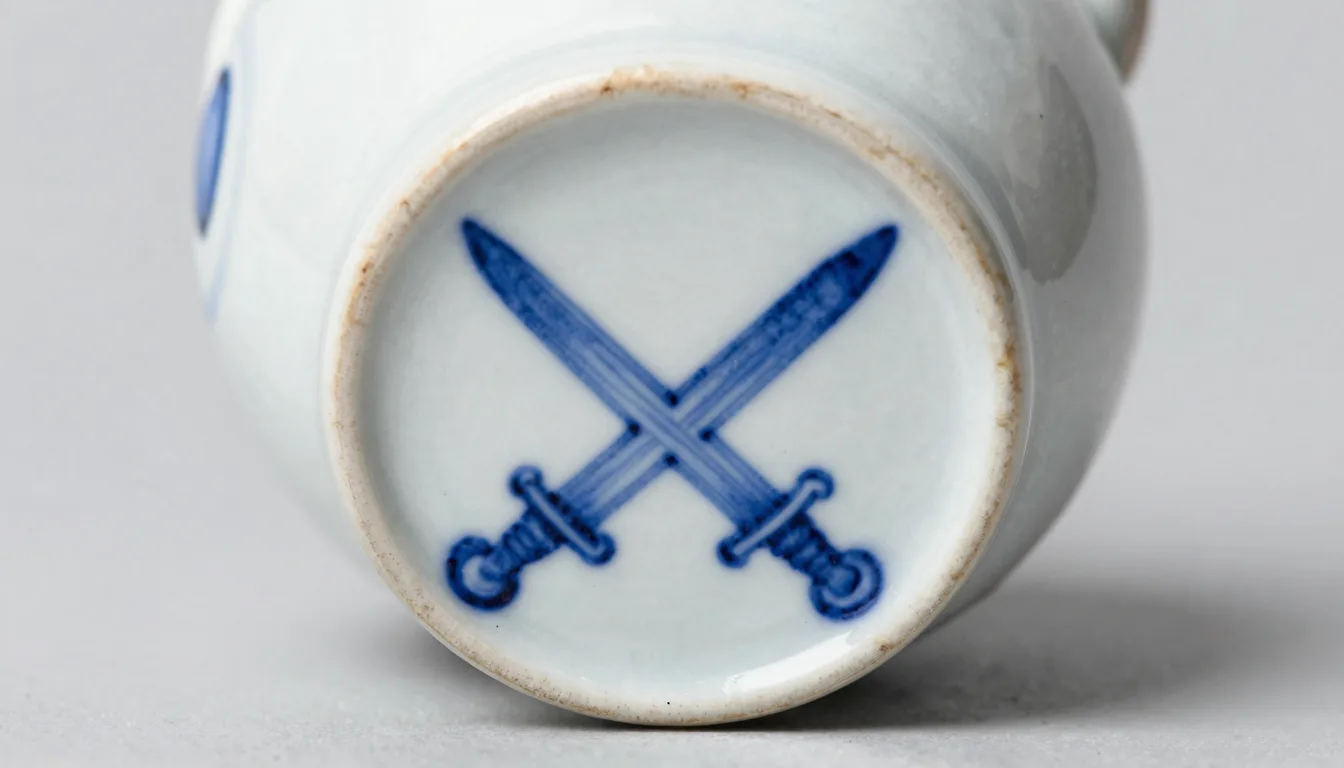
Genuine Meissen crossed swords marks have razor-thin, hand-painted strokes. Fakes smudge, print, or misalign. Here’s how to tell them apart fast.
Why Meissen marks get faked so often
Meissen is the oldest European hard-paste porcelain manufacturer. The factory opened in Meissen, Germany, in 1710. Its crossed swords mark has been in continuous use since around 1723.
That longevity makes it a prime target. Any mark with 300 years of brand equity attracts forgers. Meissen pieces routinely sell for thousands — sometimes hundreds of thousands — at auction.
The Victoria & Albert Museum holds one of the finest Meissen reference collections in the world. Their records show the crossed swords appearing on pieces as early as the first quarter of the 18th century.
Fake Meissen flooded the market during the 19th century. Dresden studios copied the mark relentlessly. The practice never really stopped.
Any seasoned collector knows the rule: never buy Meissen based on the mark alone. The mark is just the starting point of authentication.
How the genuine Meissen crossed swords mark looks
The authentic Meissen crossed swords mark is painted underglaze in cobalt blue. It sits beneath the glaze surface, not on top of it.
Run your fingernail across a genuine mark. You feel nothing. The surface is completely smooth. The mark is sealed under the glaze layer.
The crossed swords themselves are thin and slightly irregular. They were hand-painted by a craftsman, not stamped. Those tiny wobbles in the strokes? That’s authenticity, not a flaw.
The hilts of the swords cross at roughly a 60-degree angle. The tips point outward in opposite diagonal directions. The overall mark is compact — usually between 10mm and 18mm tall on most pieces.
The blue color is a deep, slightly greyish cobalt. It’s not electric blue. It’s not navy. Think of the color of a stormy sky at dusk.
Early pieces from the 1720s–1740s show the thinnest, most delicate strokes. Later Victorian-era Meissen marks became slightly bolder. Knowing the period helps narrow authentication considerably — our antique marks and signatures identification guide walks through period dating in detail.
The Metropolitan Museum of Art has documented Meissen pieces in their European decorative arts collection with excellent photographic reference for mark comparison.
Fake Meissen marks: the dead giveaways
The most common fake is an overglaze mark. If you can feel the mark raised under your fingertip, it was applied after firing. That’s a red flag.
Printed or transfer-printed marks are another instant tell. Genuine Meissen marks are hand-painted. A printed mark has perfectly even ink distribution and zero brushstroke variation. Hold it under a loupe — printed dots or a mechanical screen pattern mean fake.
Smudging at the sword tips is a frequent forger mistake. Hand-painting requires control. Forgers rushing the job leave feathered edges or bleed marks at the blade ends.
The color is often wrong on fakes. Too bright, too purple, too dark, or too uniform. Genuine cobalt underglaze has depth. Fake overglaze blue looks flat.
Some 19th-century Dresden makers added a small letter or number beneath the swords. These marks mimic Meissen but belong to entirely different factories. The presence of additional letters isn’t automatically disqualifying — Meissen itself used period and quality marks — but unknown letters warrant serious research.
Here’s a quick comparison table of the key differences:
| Feature | Genuine Meissen | Common Fake |
|---|---|---|
| Mark position | Under glaze | Over glaze (raised) |
| Stroke quality | Hand-painted, slight variation | Mechanical, uniform |
| Blue color | Deep greyish cobalt | Too bright or too flat |
| Surface feel | Completely smooth | Sometimes slightly raised |
| Sword angle | ~60 degrees, compact | Often wider or narrower |
| Hilt detail | Fine, tapered | Blob-like or blunt |
| Backstamp additions | Period/quality marks only | Random letters, words |
For broader context on reading manufacturer marks, Kovel’s maintains an excellent porcelain marks database worth bookmarking.
Not sure what you’ve got?
Snap a photo and let our AI identify any antique in seconds — free download, no sign-up.
Identify on iPhone → Learn MoreMeissen mark variations by period: a collector’s timeline
The crossed swords mark changed subtly across different eras. Knowing which variation you’re looking at is essential for both authentication and dating.
The earliest marks (1723–1730) are called the “caduceus period” or early sword period. The swords are very thin and sometimes slightly uneven. The hilts are barely suggested.
From roughly 1730–1774, the mark became more standardized. This is the classic “Baroque period” mark. The strokes are confident and consistent. Most famous 18th-century Meissen pieces carry this version.
The Marcolini period (1774–1814) introduced a small star or asterisk between the sword hilts. This is a key dating detail. A star between the hilts = Marcolini period. No star on an otherwise identical mark? Different era entirely.
The 19th century saw the mark grow slightly bolder and more formalized. Mass production demands pushed toward more consistent application.
Post-1945 Meissen (East German period) pieces carry a mark with a thin line through the swords. This indicates post-WWII manufacture. Valuable in its own right, but a different collecting category.
Our antique furniture periods chart covering 1600–1940 gives useful historical context for European decorative arts of the same eras — helpful for dating complete room sets or matched services.
Tools and techniques for examining marks at home
A 10x loupe is the minimum. A 20x jeweler’s loupe is better. You want to see individual brushstrokes clearly.
Look for the depth of the mark. Under magnification, a genuine underglaze mark appears to sit inside the porcelain surface. The glaze covers it like a thin sheet of glass over ink.
UV light (a basic blacklight) can reveal later repairs, overpainting, or added marks. Genuine underglaze marks don’t react dramatically to UV. New overglaze additions often fluoresce differently from surrounding glaze.
Photograph the mark under raking light — hold a small flashlight at an extreme angle across the base. This reveals any raised surfaces invisible under direct lighting.
Weigh the piece if you can. Genuine 18th-century hard-paste Meissen has a specific density. Soft-paste imitations from English factories often feel slightly lighter.
Compare your piece against documented examples. The Smithsonian’s collections database includes searchable European ceramics with high-resolution images. It’s a free resource that many collectors overlook.
For identifying marks on other materials, the same analytical approach applies — our guide on identifying pewter vs silver demonstrates how material testing and mark reading work together.
When to get a professional appraisal
Home examination gets you 80% of the way there. For pieces valued above $500, get professional eyes on it.
Certified appraisers can perform thermoluminescence testing on porcelain. This test dates the actual firing of the clay body. It’s the closest thing to a lie detector test for ceramics.
X-ray fluorescence (XRF) analysis identifies the chemical composition of the cobalt pigment. Genuine 18th-century Meissen used specific cobalt sources. Modern fakes use different chemical profiles.
Auction house specialists at Christie’s, Sotheby’s, and Bonhams offer free initial opinions on significant pieces. These aren’t formal appraisals, but they’re a solid starting point.
For online valuation options before committing to in-person appraisal, our review of best online antique appraisal sites covers current platforms with honest assessments of what each does well.
WorthPoint maintains a sold-price database that shows recent auction results for marked Meissen pieces. Comparing your piece’s mark against sold examples with photos is a practical shortcut before formal appraisal.
Building your reference library for Meissen authentication
Every serious Meissen collector needs a physical reference library. Digital tools help, but books on a shelf remain irreplaceable.
Caiger-Smith’s work on European porcelain marks is a foundational text. Rontgen’s “Marks on German, Bohemian and Austrian Porcelain” is the definitive factory mark reference.
Photograph every genuine piece you handle. Build your own personal archive of confirmed authentic marks. Your eye calibrates itself through comparison over time.
Join a ceramics collectors society. The English Ceramic Circle and similar organizations publish research that updates authentication knowledge regularly.
Subscribe to major auction house results in the ceramics categories. Seeing what experts confirm as genuine — with photographs — trains your eye faster than any book.
For valuation context beyond authentication, understanding the difference between melt value and collector value applies to many antique categories — while that framework applies most directly to silver, the same principle of market value vs intrinsic value is covered well in our post on silver melt value vs antique value.
Authentication is a skill. It compounds over time. Every piece you examine — genuine or fake — adds to the mental catalog that eventually makes identification instinctive.
Frequently Asked Questions
How do I know if my Meissen mark is underglaze or overglaze?
Run your fingernail or fingertip firmly across the mark. A genuine underglaze Meissen mark is completely smooth — sealed beneath the glaze surface. If you feel any raised texture, ridging, or the mark catches your nail at all, it was applied overglaze after firing. Overglaze application is a significant red flag for a fake or later reproduction. Under a 10x loupe, genuine underglaze marks appear to sit inside the porcelain, with the glaze visibly sitting over the cobalt blue strokes.
What does a star between the Meissen crossed swords mean?
A small star or asterisk positioned between the hilts of the crossed swords indicates a piece from the Marcolini period, roughly 1774 to 1814. This was named for Count Camillo Marcolini, who directed the Meissen factory during that era. The star is a reliable dating indicator. Pieces without the star but with an otherwise similar mark fall into earlier or later production periods. Marcolini-period Meissen is collectible in its own right and commands strong prices among period-specific collectors.
Can Dresden porcelain be confused with Meissen?
Yes, frequently. Several 19th-century Dresden studios deliberately produced marks that resembled the Meissen crossed swords to mislead buyers. These pieces are often called ‘Dresden china’ as a catch-all, but they are distinct from genuine Meissen. Key differences include additional letters beneath the swords, slightly different sword proportions, and softer paste bodies on some examples. Dresden pieces have their own collector market and value, but they are not Meissen. Always research any additional letters or marks beneath the crossed swords before drawing conclusions.
What does the line through the Meissen crossed swords mean?
A thin horizontal or diagonal line drawn through the crossed swords indicates a piece produced during the East German period of Meissen manufacturing, roughly from 1945 onward into the communist era. The factory used this modification to distinguish its production from pre-war pieces. These pieces are genuine Meissen factory products and collectible, but they represent a different era and price tier than 18th or early 19th-century examples. Modern Meissen continues to mark pieces with period indicators that experienced collectors learn to recognize quickly.
Is Meissen porcelain always marked with crossed swords?
Not always. Very early Meissen pieces from before approximately 1723 may carry the KPM mark (Königliche Porzellan-Manufaktur) or the AR cypher for Augustus Rex rather than crossed swords. Some seconds, trial pieces, or white wares left the factory unmarked. The crossed swords became the standard mark from around 1723 onward, but the absence of a mark on a very early piece does not automatically disqualify it from being genuine Meissen. Context, paste quality, glaze characteristics, and provenance all contribute to authentication alongside the mark itself.
Identify any antique in seconds.
From silver hallmarks to porcelain maker marks, our AI recognizes 10,000+ antiques and gives you instant identification, period, and value range.
