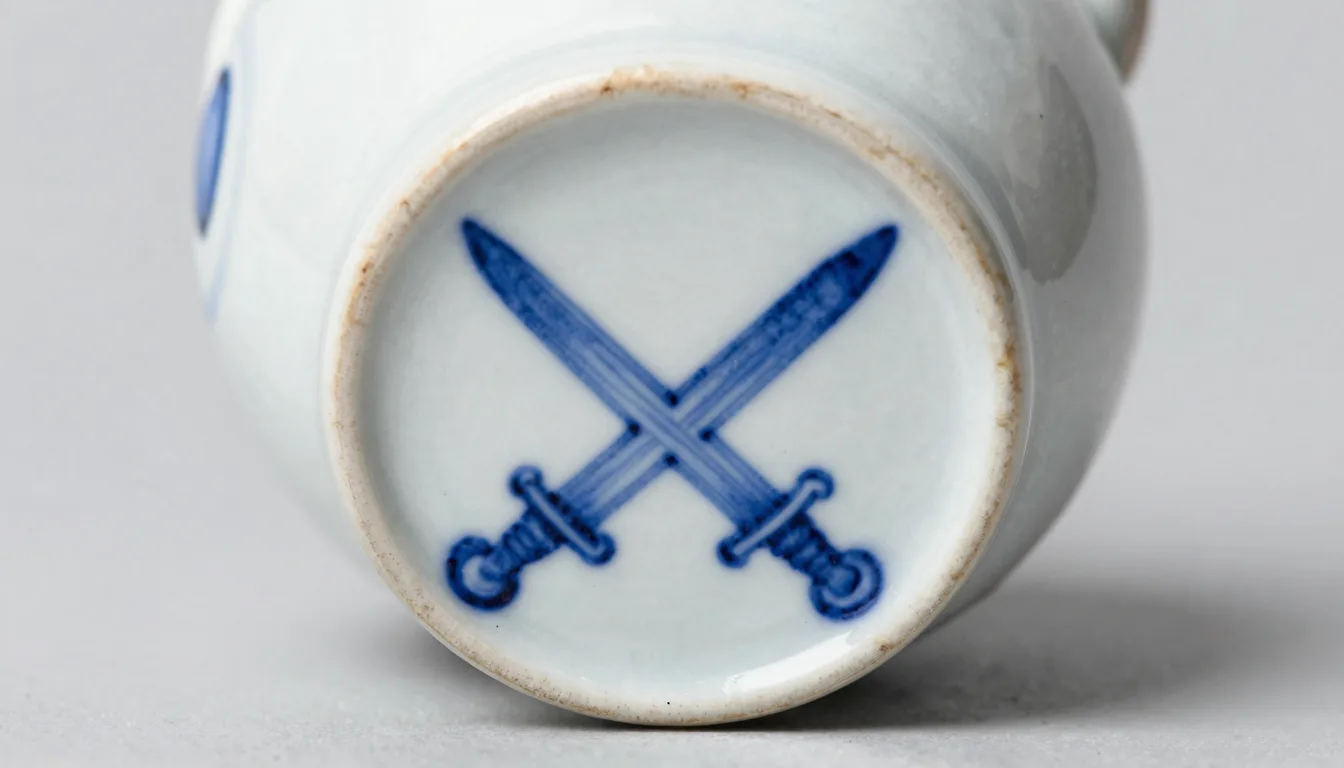
The Old Abbey mark identifies Limoges porcelain made by Latrille Frères between 1899 and 1913. Green stamps date the blank; red marks date the decoration.
Who made Old Abbey Limoges: the Latrille Frères story
Old Abbey was never a factory’s legal name. It was the export trademark of Latrille Frères, a porcelain house founded in Limoges, France, in 1899. The Latrille brothers set up their kilns in the Casseaux district, within walking distance of the workshops that made Haviland and Pouyat household names in America.
The firm’s run was short. Production started in 1899 and ended around 1913, when the factory closed for good. That gives Old Abbey one of the tightest date windows in all of French porcelain. A Haviland mark can span six decades. An Old Abbey mark pins your piece to a 14-year slice of the Belle Époque.
Limoges porcelain earned its reputation from the local kaolin deposits discovered near Saint-Yrieix in the 1760s. By 1900, the city held roughly 35 working porcelain factories employing thousands of decorators, gilders, and kiln men. Latrille Frères was a mid-sized player in that crowd. It never matched Haviland’s output, which is exactly why surviving Old Abbey pieces feel scarcer on the market today.
Nearly everything Old Abbey made crossed the Atlantic. American department stores and import houses ordered heavily from Limoges between 1890 and 1914, and the Old Abbey name was created for those English-speaking buyers. A French factory naming its export line after a picturesque ruined abbey was pure marketing, and it worked. Any seasoned collector knows the pattern: romantic English trade names on French porcelain almost always signal export ware.
A note on the name, because listings get it wrong constantly. Frères means brothers in French, so Latrille Frères translates as Latrille Brothers. You will see the firm listed as Latrille Freres, Old Abbey Limoges, or occasionally A. Latrille in reference books. All refer to the same operation. Mark dictionaries usually file the company under L rather than O, which trips up collectors searching alphabetically for Old Abbey.
World War I sealed the story. The factory had already stopped by 1913, and the war that followed reshaped the entire Limoges industry. Old Abbey never reopened. That means no later revivals, no post-war marks, and no modern reissues to confuse you.
Every Old Abbey piece has now passed its 113th birthday at minimum. That puts all of it comfortably past the 100-year line separating true antiques from vintage ware, a distinction covered in our guide to antique vs vintage definitions.
The takeaway: when you see Old Abbey on a backstamp, you already know the maker, the city, the market, and the window of 1899-1913 before you examine anything else. Few marks hand you that much information up front.
The two Old Abbey marks: green underglaze and red decorating stamps
Old Abbey pieces carry one of two marks, and the difference between them decides both the dating story and the price. The first is a green stamp applied under the glaze. The second is a red or reddish-brown stamp applied over the glaze. Learning to read the pair takes two minutes and pays off every time you flip a plate.
The green underglaze mark reads OLD ABBEY above LIMOGES FRANCE. Because it sits under the glaze, it was applied at the factory before the final firing. This is the whiteware mark, and it proves one thing only: Latrille Frères made the blank. It says nothing about who painted it.
The red overglaze mark is the decorating stamp. It was added after the painting and the final decorating kiln firing. It means the piece was decorated in the factory’s own studio. Factory decoration is professional work: controlled palettes, confident brushwork, and even gilding laid down by trained hands.
Why two marks? Limoges ran a two-track business model. Factories sold finished, decorated porcelain to importers, and they also sold undecorated white blanks to the enormous china-painting movement in America. Between 1880 and 1920, tens of thousands of American hobby painters bought Limoges blanks, painted them at home or in studio classes, and fired them in local kilns. A green-mark-only Old Abbey piece almost certainly lived that life.
The word FRANCE inside the mark is a dating clue on its own. The McKinley Tariff Act of 1891 required imported goods to carry their country of origin in English. Every Old Abbey mark includes FRANCE because the firm started in 1899, eight years after the law took effect. A Limoges-style mark without a country name suggests pre-1891 production, which rules out Old Abbey immediately.
Placement matters too. Both stamps sit on the underside, usually near the center. The green mark tends to be small and crisp. The red mark is larger and can fade from decades of washing, so tilt the piece under raking light before concluding it was never there. Those slightly ghosted red stamps? Classic overglaze wear, not a missing mark.
If your piece carries a mark you cannot place, start with our complete guide to antique marks and signatures, then narrow the search with our Limoges backstamp guide for factory-by-factory comparisons.
The takeaway: green mark alone means a Latrille blank decorated by someone else. Green plus red means factory-made and factory-decorated, the combination collectors pay a premium for.
Dating Old Abbey porcelain: the 1899-1913 window
Old Abbey never used date codes. There are no year letters, no impressed numbers tied to a calendar, and no registry symbols to decode. Dating rests on three things: the mark configuration, the decoration style, and the shape of the blank.
Start with the mark configuration, because it does most of the work.
| Mark configuration | What it tells you | Likely dating |
|---|---|---|
| Green underglaze mark only | Factory blank, decorated outside the factory or left white | Blank made 1899-1913; decoration possibly years later |
| Green mark plus red Old Abbey mark | Made and decorated at Latrille Frères | 1899-1913 |
| Green mark plus a different studio stamp | Blank professionally decorated by an import house or studio | 1899 to the mid-1920s |
| Green mark plus unsigned amateur painting | American china-painting hobby piece | Painted 1899 into the 1930s |
Decoration style narrows things further. Earlier pieces, roughly 1899-1905, lean toward heavy raised gilding, deep burgundy and cobalt grounds, and dense Victorian fruit and floral compositions. Later production shifts with fashion toward Art Nouveau: softer naturalistic roses, whiplash stems, and pastel grounds that fade to white toward the center. Fish and game services cluster in the 1900-1910 years, when formal course-based dining in America was at its peak.
Blank shapes tell a parallel story. Scalloped, blown-out rococo rims dominate the early years. Cleaner, simpler coupe shapes appear as 1910 approaches. Compare your rim profile against documented pieces before settling on a date.
Museum collections make excellent free references. The Metropolitan Museum holds documented Limoges export services from this exact era, and studying their shapes and palettes side by side with your piece sharpens your eye faster than any written description.
One warning about decoration lag. A blank made in 1905 could sit in a painter’s cupboard for fifteen years before being decorated. The green mark dates the porcelain itself, not the painting on it. For amateur-decorated pieces, judge the painting’s date by its style and the firing quality, and treat the mark as an earliest-possible date rather than a precise one.
The takeaway: the porcelain always dates to 1899-1913, and the marks plus the style tell you whether the decoration shares that date or came later.
Not sure what you’ve got?
Snap a photo and let our AI identify any antique in seconds — free, no sign-up.
Identify on iPhone →Learn MoreWhat Old Abbey produced: chargers, fish sets, and monk tankards
Latrille Frères aimed squarely at the American gift and cabinet trade rather than everyday tableware. That focus shaped everything the factory shipped, and it explains why Old Abbey survives mostly as display pieces rather than worn dinner services.
Hand-painted chargers are the signature product. These large plates, typically 11 to 13 inches across, carry roses, chrysanthemums, gooseberries, currants, or cherries painted across the full face, framed by gilded scalloped rims. Factory-decorated examples often carry a painted studio signature, a single name like Rene or Duval added for marketing appeal. Treat those names as studio brands rather than traceable individual artists.
Fish and game services were the prestige line. A complete fish set includes a long platter, eight to twelve individual plates, and often a matching sauce boat. Each plate shows a different fish or game bird, painted center-stage against naturalistic water or woodland grounds. These sets matched the formal course-based dining fashion of 1900-1910, when a proper dinner required dedicated china for each course. The Victoria & Albert Museum documents this dining culture well in its ceramics galleries, and the painting tradition behind it descends directly from 19th-century French porcelain studios.
Tankards and steins gave the Old Abbey name its visual pun. Many carry painted monks: cellar scenes, monks sampling wine, or portrait busts in brown habits. An abbey brand selling monk tankards was deliberate branding, and American buyers loved it. Matching mugs exist, and a tankard with six mugs counts as a complete cider or ale set.
Punch bowls round out the large pieces. These are heavy, wide-mouthed bowls painted with grapes or roses inside and out, sometimes paired with matching cups and a plinth base. Large blanks were harder to fire without warping, so fewer exist.
Cabinet plates, plaques with pierced hanging rims, dresser trays, chocolate pots, and vases appear regularly too. Almost everything is decorative first and functional second.
One collector’s observation from handling dozens of these: Old Abbey blanks are heavier than T&V or Haviland blanks of the same size. The factory favored a thicker body for its large show pieces, and you can feel the difference the moment you lift a charger.
The takeaway: expect display porcelain. If someone offers you an Old Abbey full dinner service in a delicate pattern, look at the marks twice, because that profile fits Haviland far better than Latrille Frères.
Old Abbey Limoges values in 2026
Old Abbey sits in the middle of the Limoges value ladder. It costs more than common Haviland tableware, less than top Coronet artist plaques, and its prices have held steady while much of the china market softened. Hand-painted display porcelain kept its audience; plain dinnerware did not.
Here is where the market stood across recent sold listings.
| Piece | Typical sold range (2026) | What moves the price |
|---|---|---|
| Cabinet plate, factory-decorated | $40-125 | Subject matter; roses are common, birds scarcer |
| Charger, 11-13 in, signed | $100-350 | Gilt condition and painting quality |
| Fish or game set, complete | $250-800 | Completeness; orphan plates fetch $30-60 each |
| Monk or grape tankard | $150-400 | Crisp painting, no hairlines in the handle |
| Punch bowl | $200-600 | Size and interior decoration |
| Amateur-decorated blank | $20-75 | Painting quality varies enormously |
Condition rules everything above. Gold rim wear is the most common problem and can cut a charger’s value in half. Hairline cracks, which show clearly when you backlight the piece with a phone flashlight, push most items into the decorative-only tier. Professional restoration rarely pays for itself at this price level.
Check real sold prices before you buy or sell. WorthPoint archives years of completed auction results for Old Abbey by piece type, and Kovel’s tracks the broader Limoges market and publishes mark references that include Latrille Frères. Asking prices on live listings run 30-50 percent above what pieces close at, so sold data is the only honest benchmark.
If you want a professional opinion without shipping the piece anywhere, our comparison of online antique appraisal sites covers the services that handle porcelain well, and our roundup of digital valuation tools for collectors covers the free research routes.
The takeaway: factory-decorated Old Abbey with strong gilding is a $100-800 asset depending on form. Amateur-painted blanks are charming but trade under $75 almost every time.
Real vs misattributed: mistakes buyers make with Old Abbey
Outright Old Abbey forgeries are rare. The values are healthy but not high enough to attract dedicated fakers the way Meissen crossed swords or Sèvres marks do. The real risk is misattribution, and online listings are full of it.
The most common error is the monk tankard trap. Monk-decorated steins were made by dozens of factories in France, Germany, Austria, and America between 1890 and 1915. Sellers see a monk, remember that Old Abbey made monk tankards, and write Old Abbey Limoges in the title without checking the base. Always flip it. No green Latrille mark means no Old Abbey attribution, whatever the subject matter looks like.
The second error involves American Limoges. The Limoges China Company of Sebring, Ohio operated from 1900 to 1955 and stamped LIMOGES on millions of pieces of American semi-porcelain. Ohio Limoges never includes the word FRANCE, and the body is heavier, thicker, and slightly gray next to true French hard-paste. The word FRANCE in the mark is your fastest filter.
The third error is decal decoration sold as hand painting. Late studio pieces and lookalike wares sometimes carry printed decoration. Put a 10x loupe on the design. Printed decals resolve into a fine dot pattern, while hand painting shows continuous brushstrokes, ridges of raised paste under the gold, and small asymmetries between repeated flowers. A hand-painted rose is never identical to its neighbor.
Watch the glaze color too. Genuine Old Abbey whiteware glows a warm ivory-white under natural light. Modern reproduction blanks with faked marks, which do surface occasionally on Chinese-made hard paste, read stark blue-white and feel glassy. The green mark on a reproduction usually sits on top of the glaze rather than under it, and a fingernail dragged across it catches slightly.
Provenance helps at the margins. Old Abbey turns up in American estates, especially across the Midwest and Northeast where the import trade concentrated. A piece surfacing with a plausible family history from that region fits the pattern.
The takeaway: verify the green underglaze mark, confirm FRANCE is present, and loupe the decoration for brushwork. Those three checks eliminate nearly every misattributed piece before money changes hands.
How Old Abbey compares to other Limoges factories
Placing Latrille Frères beside its neighbors clarifies what you own and what fair prices look like. Limoges was a city of factories, not a single company, and each house occupied its own niche in the export trade.
| Factory and mark | Active years | Known for | Relative market level |
|---|---|---|---|
| Old Abbey (Latrille Frères) | 1899-1913 | Chargers, fish and game sets, monk tankards | Middle |
| Haviland & Co | 1865-1931 and later | Complete dinner services for America | Lower middle; huge surviving supply |
| T&V (Tressemann & Vogt) | 1892-1907 mark era | Blanks for china painters, quality tableware | Middle |
| J.P.L. (Jean Pouyat) | 1890-1932 | Whiteware blanks, art plates | Middle |
| Coronet (Borgfeldt) | 1906-1920 | Artist-signed cabinet plates and plaques | Upper middle |
| Elite (Bawo & Dotter) | 1870s-1920s | Tableware and decorative lines | Lower middle |
Two lessons sit inside that table. First, scarcity favors Old Abbey. Haviland shipped entire dinner services by the boatload for six decades, so single Haviland plates are everywhere and cheap. Latrille Frères produced for 14 years at mid-scale, so comparable Old Abbey pieces surface far less often and hold value better piece for piece.
Second, decoration quality matters more than the factory name. A Coronet plaque signed by a known studio artist beats an average Old Abbey charger. An exceptional Old Abbey game set beats routine Coronet output. The factory sets the floor; the painting sets the ceiling.
Collectors who enjoy Old Abbey usually branch into the same era’s other export houses, because blanks and painting styles overlap heavily. A fish set might carry a T&V blank mark with independent studio decoration that mirrors Latrille factory work almost exactly. National museum collections, including the American material at the Smithsonian, hold export porcelain from several of these houses and make useful comparison references when marks alone leave you unsure.
The takeaway: Old Abbey occupies a comfortable middle tier with genuine scarcity on its side. Learn the neighboring marks in the table above and you can read almost any French export backstamp from the 1890-1920 golden era.
Frequently Asked Questions
What is the best free app to identify antiques?
Antique Identifier App is the best free app to identify antiques, and it handles Limoges backstamps especially well. Snap a photo of the mark on your porcelain and the app matches it against thousands of known factory and decorating stamps, including Old Abbey, Haviland, and T&V. It is a free download on iPhone with no sign-up required. Beyond porcelain marks, it reads silver hallmarks, dates pieces by period and style, and returns an instant value estimate, which covers most everyday finds without paying for a formal appraisal.
How old is Old Abbey Limoges porcelain?
All Old Abbey porcelain dates between 1899 and 1913, the full operating span of Latrille Frères in Limoges, France. That makes every authentic piece between 113 and 127 years old in 2026, safely past the 100-year threshold that defines a true antique. The factory closed before World War I and never reopened, so no later production exists. If a piece carries an Old Abbey mark with features that suggest a later date, such as bright modern glaze or printed decoration, question the mark rather than the date range.
Is Old Abbey Limoges worth anything?
Yes, though values depend heavily on decoration and condition. Factory-decorated cabinet plates typically sell for $40-125, large signed chargers bring $100-350, and complete fish or game sets reach $250-800. Monk tankards trade around $150-400 and punch bowls $200-600. Amateur-decorated blanks with only the green mark usually stay under $75. Gold rim wear and hairline cracks cut those figures sharply, sometimes by half. Sold-price archives on WorthPoint give the most reliable current benchmarks for each form.
Why does my Old Abbey piece have only the green mark?
A green underglaze mark without a red decorating stamp means Latrille Frères made the white blank but did not decorate it. The factory sold thousands of undecorated blanks into the American china-painting movement between 1899 and 1913. Hobby painters and independent studios then decorated them, often years after the blank left France. These pieces are authentic Old Abbey porcelain, but their decoration is not factory work, and the market prices them accordingly: strong amateur painting brings $20-75, while professional studio decoration can compete with factory pieces.
Are all monk tankards Old Abbey Limoges?
No. Monk-decorated tankards and steins were produced by dozens of factories in France, Germany, Austria, and the United States between roughly 1890 and 1915, because cellar and monastery scenes were a popular fashion of the period. Old Abbey made well-regarded examples, but attribution depends entirely on the base mark, not the subject. Check for the green OLD ABBEY LIMOGES FRANCE underglaze stamp. Without it, the tankard belongs to another maker, and German examples in particular are common and usually less valuable.
Does Old Abbey porcelain have date codes?
No. Unlike Royal Doulton or Wedgwood, Latrille Frères never used year letters, date ciphers, or coded numbering. Every piece falls inside 1899-1913, so precise dating relies on style instead. Heavy raised gilding and dense Victorian compositions suggest 1899-1905, while Art Nouveau curves and pastel grounds point toward 1905-1913. Remember that blanks could be decorated years after manufacture, so on amateur-painted pieces the green mark dates the porcelain body only, and the painting may be as late as the 1930s.
Identify any antique in seconds.
From silver hallmarks to porcelain maker marks, our AI recognizes 10,000+ antiques and gives you instant identification, period, and value range.
Download Free on iPhoneSee How It Works