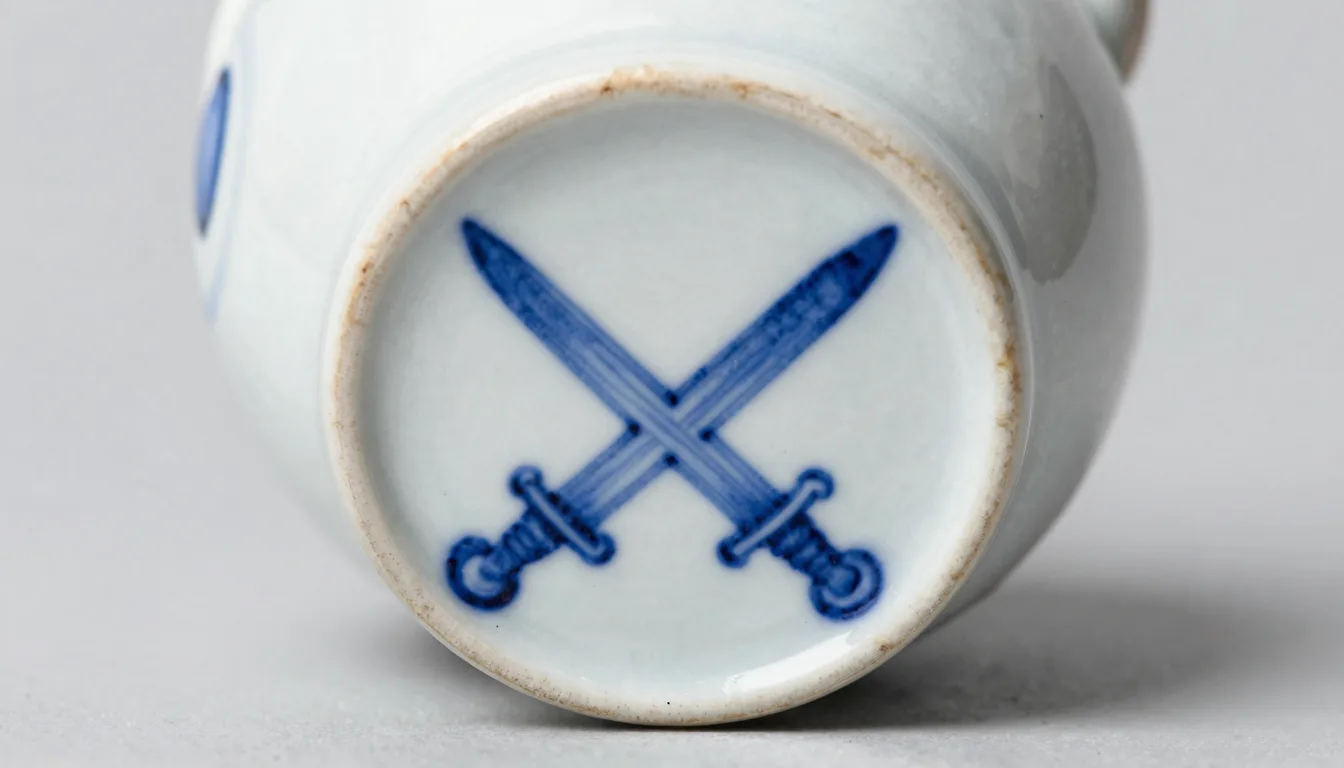
A “Bavaria Germany” backstamp means porcelain made in Bavaria’s kaolin-rich north, and its exact wording can date your piece to within a few decades.
Why so much porcelain says Bavaria on the back
Bavaria appears on millions of backstamps because northeastern Bavaria became Germany’s porcelain heartland in the 19th century. The Fichtelgebirge hills held everything a factory needed. Kaolin clay sat close by in Bohemia’s famous Zettlitz deposits. Forests supplied fuel, and after the 1860s the railways carried finished china to every port in Europe.
The towns tell the story better than any map. Selb, Arzberg, Rehau, Weiden, Waldsassen, Marktredwitz, and Tirschenreuth each hosted one or more factories. By 1900, this small corner of Bavaria produced most of Germany’s household porcelain. Selb alone employed thousands of porcelain workers after Lorenz Hutschenreuther opened his factory there in 1857.
Bavaria’s porcelain pedigree runs deeper than the factory boom. The royal Nymphenburg manufactory near Munich began producing hard-paste porcelain in 1747. That was less than four decades after Meissen in Saxony cracked the European formula in 1710. You can compare early German examples in the ceramics collections of the Metropolitan Museum, which holds superb 18th-century Nymphenburg figures.
The word Bavaria on a mark is a regional badge, not a company name. Dozens of separate firms used it, usually beneath their own crown, shield, crest, or initials. That is why two plates marked Bavaria can differ wildly in maker, age, and value. The company symbol above the word matters far more than the word itself.
Any seasoned collector learns to read these backstamps in layers. First the country wording, which dates the piece. Then the factory symbol, which names the maker. Then any pattern name or decorator stamp, which fills in the rest. If you want the chemistry behind the shine, the hard-paste porcelain entry explains the kaolin and feldspar formula these factories perfected.
One practical note before you start. Bavaria marks are almost always under the glaze or printed on the base, never on the rim face. Flip every piece, and check cups as carefully as plates. Factories often marked dinner plates prominently while leaving saucers with only a small impressed number. A full set can carry three or four different stamp variations from the same maker, applied across different production years.
Dating the backstamp by its exact wording
The single most useful dating tool is the country wording around the word Bavaria. United States import law forced German factories to change their marks at documented dates. Those legal changes give you hard brackets for age.
The turning point was the McKinley Tariff Act, passed in 1890 and effective in 1891. It required imported goods to state their country of origin in English. Bavarian factories added Germany to their stamps, which created the classic Bavaria Germany pairing. A 1921 tightening of the rules pushed many firms to the fuller phrase Made in Germany.
| Wording on the mark | Approximate dates | Why the wording changed |
|---|---|---|
| Bavaria alone | c. 1871-1891, some to 1914 | German unification era, before US enforcement |
| Bavaria Germany | 1891 onward | McKinley Tariff required country of origin |
| Made in Germany + Bavaria | mostly 1921 onward | Stricter US labeling rules |
| US Zone or US Zone Germany | 1945-1949 | Allied occupation labeling |
| W. Germany or Western Germany | 1949-1990 | Divided Germany, Federal Republic |
| Germany (modern reunified) | 1990 to present | Reunification |
The occupation marks are the tightest bracket of all. A stamp reading US Zone or US Zone Germany can only date from 1945 to 1949. Those slightly crude, hurried postwar stamps are a favorite of mine. They mark the exact years these factories restarted with whatever materials they could find.
Two cautions keep this table honest. First, factories used old stamps until they wore out, so a Bavaria-only mark can appear a few years past 1891 on domestic-market pieces. Second, wording dates the mark, not the pattern. A design introduced in 1900 could stay in production into the 1950s with updated stamps.
Cross-check the wording against the mark style itself. Compare your stamp with dated examples in the marks library at Kovel’s, which catalogs thousands of German backstamp variations. For a broader method that works across silver, pottery, and porcelain, see our complete guide to antique marks and signatures. The layered approach there applies directly to Bavarian china.
The big Selb makers: Hutschenreuther, Rosenthal, and Heinrich
Selb produced the three names that dominate Bavaria porcelain collecting. Learn these three marks and you can identify a large share of everything stamped Bavaria.
Hutschenreuther is the oldest of the group. Carolus Magnus Hutschenreuther founded the first family factory at Hohenberg an der Eger in 1814. His son Lorenz opened the famous Selb works in 1857. The signature mark is a crowned lion, often above the initials C.M.H. or the words Hutschenreuther Selb. The two family branches merged in 1969, and Rosenthal absorbed the brand in 2000. Lion marks with LHS initials point to the Lorenz branch in Selb.
Rosenthal began in 1879, when Philipp Rosenthal started decorating whiteware at Schloss Erkersreuth before building his own factories. The classic mark is a crowned crossed-roses emblem with Rosenthal Selb Bavaria beneath. Rosenthal led German porcelain design through the 1920s and 1930s. Its Art Deco figurines and tea sets carry the same sharp geometry you see in Art Deco jewelry of the period. Artist-signed Rosenthal figures from those decades regularly bring $150 to $600 at auction.
Heinrich & Co. rounds out the trio. Franz Heinrich founded the firm in Selb in 1896, and its H&C Selb marks appear on huge quantities of export dinnerware. Villeroy & Boch acquired the company in 1976. Heinrich quality sits close to Hutschenreuther, yet prices stay lower, which makes it a smart entry point for new collectors.
| Maker | Town | Founded | Typical mark | Collector demand |
|---|---|---|---|---|
| Hutschenreuther | Hohenberg / Selb | 1814 / 1857 | Crowned lion, C.M.H. or LHS | High, especially figurines |
| Rosenthal | Selb | 1879 | Crowned crossed roses | High, Art Deco and studio lines |
| Heinrich & Co. | Selb | 1896 | H&C Selb, crown | Moderate, strong quality for price |
| Krautheim | Selb | 1884 | Crown over shield, Krautheim | Moderate |
| Zeh, Scherzer & Co. | Rehau | 1880 | Z.S.&Co. Bavaria | Moderate |
Museum collections put these factories in context. The ceramics galleries at the Victoria & Albert Museum trace how German industrial porcelain absorbed and exported design movements. Seeing documented pieces trains your eye faster than any list of marks.
Condition rules apply to all three makers. Gilding wear, utensil scratches, and hairlines cut values by half or more. A pristine Hutschenreuther service plate with heavy gold encrusting can bring $40 to $100, while a worn one struggles at $10.
Not sure what you’ve got?
Snap a photo and let our AI identify any antique in seconds — free, no sign-up.
Identify on iPhone →Learn MoreBayreuth, Edelstein, Kronach, and other marks collectors ask about
Search data shows collectors hunt a handful of specific Bavaria marks more than any others. These deserve their own field notes.
Bayreuth causes the most confusion. Marks reading Bayreuth Bavaria Germany usually come from 20th-century factories in or near that town, including Sophienthal, a Thomas branch operating from 1928. Do not confuse these with Royal Bayreuth, the brand of the Tettau factory founded in 1794, the oldest porcelain works in Bavaria. Royal Bayreuth marks typically show a lion and shield with the words Priv. 1794. Tettau’s figural pieces, like tomato and lobster wares, sell for $50 to $400, while ordinary Bayreuth-marked dinnerware sits far lower.
Edelstein operated at Küps from 1920 into the 1970s. The mark shows a crown above the word Edelstein, often with a pattern name like Maria Theresia. Edelstein means gemstone in German, a pure marketing flourish. Complete Edelstein dinner services usually trade between $100 and $250, with single plates around $8 to $20.
Kronach was a Rosenthal town. Philipp Rosenthal opened a large branch factory there in 1897, so many Kronach-marked pieces are Rosenthal products. Stockhardt & Schmidt-Eckert also potted there. A Kronach mark with crossed roses reads as Rosenthal quality, and prices follow the main Selb line.
Winterling ran a family group of factories from Marktleuthen, founded in 1903, with sister plants at Röslau and Schwarzenbach. Winterling marks often show a crowned shield with antlers. Output was enormous mid-century export china, so values stay modest, typically $20 to $60 for serving pieces.
Schumann of Arzberg, founded 1881, deserves special mention for its reticulated lace-edge plates. Those pierced borders were cut by hand before firing. Any seasoned collector knows the pattern instantly, that openwork rim is classic Schumann. Standard reticulated plates bring $25 to $75, while cobalt and heavy-gold examples reach $150 to $250.
Smaller names fill out the region. Tirschenreuth dates from 1838, Bareuther of Waldsassen from 1866, Seltmann of Weiden from 1910, and Mitterteich from 1887. None of these marks alone makes a piece valuable. Maker, pattern, decoration quality, and condition together set the price, which is exactly how you should weigh any piece before buying or selling.
Factory marks vs decorator marks: reading double backstamps
Many Bavaria pieces carry two marks, and the pair confuses more people than any single stamp. The explanation is simple once you know the trade structure. Bavarian factories sold enormous quantities of undecorated whiteware, called blanks, to independent decorating studios at home and abroad.
The under-glaze factory mark went on first, at the pottery. The decorating studio then added its own stamp over the glaze after painting and gilding. So a plate can read Thomas Bavaria in green under the glaze and carry a studio name in red or gold on top. The factory made the porcelain, and the studio made it pretty.
American decorating firms imported Bavarian blanks by the shipload between 1890 and 1930. Chicago’s Pickard studio is the famous example, and its artists signed their work. A hand-painted, artist-signed piece on a Bavarian blank can bring $100 to $800, driven by the artist and subject rather than the factory. Fruit, roses, and portrait subjects lead the market.
Hand-painted pieces show telltale signs. Look for raised brushwork you can feel, slight asymmetry between repeated motifs, and a painter’s signature near the design. Transfer-printed decoration lies flat and repeats perfectly. A magnifier reveals the dot matrix of a printed image, while true painting shows continuous strokes.
Watch for two red flags. A ground-off or glaze-scarred base may hide a removed mark, which sellers sometimes do to pass a piece as earlier or rarer. And a lone over-glaze mark with no factory stamp under the glaze often signals a decorating studio using cheap, unmarked blanks. Neither is fatal, but both should lower your offer.
Provenance research helps at the top end. American-decorated Bavarian china is documented in institutional collections, and the Smithsonian’s collections portal lets you search comparable ceramics by maker and period. Documented comparisons separate a $50 plate from a $500 one faster than any gut feeling.
What Bavaria porcelain is worth in 2026
Bavaria porcelain is a volume market with sharp exceptions. Factories shipped staggering quantities of dinnerware to America between 1891 and 1939, and supply still outweighs demand for common patterns. Prices reflect that honestly.
| Category | Typical 2026 range | What moves the price up |
|---|---|---|
| Single teacup and saucer | $8-25 | Cobalt ground, heavy gold, pristine gilding |
| Dinner plates, common floral | $10-40 each | Named pattern, no utensil wear |
| Schumann reticulated plates | $25-75 | Cobalt or gold examples reach $150-250 |
| Complete dinner service for 8-12 | $150-600 | Hutschenreuther or Rosenthal name, completeness |
| Rosenthal Art Deco figurines | $150-600 | Artist signature, rare models higher |
| Hand-painted artist-signed blanks | $100-800 | Portrait subjects, Pickard studio work |
| Royal Bayreuth figural pieces | $50-400 | Rare forms like lobster and devil wares |
Sold prices beat asking prices as evidence. Auction archives at WorthPoint show what buyers paid for the same mark and pattern, which is the number that matters. Asking prices on marketplace listings routinely run two to three times realized values.
The set problem shapes this market. Complete services sell for less per piece than the sum of their parts, because shipping is brutal and modern buyers rarely want twelve place settings. Dealers often part sets out, selling serving pieces individually. Gravy boats, covered vegetable dishes, and chocolate pots outsell dinner plates every time.
Replacement demand props up certain patterns. Someone completing an inherited set will pay strong money for the one platter they lack. If your pattern has a name on the backstamp, search it directly before pricing anything.
Get a structured opinion before selling anything you suspect is better than average. Our review of the best online antique appraisal sites compares turnaround, cost, and accuracy across the major services. For free first-pass research, the digital valuation tools roundup covers price databases and photo-based options that handle porcelain well.
A collector’s workflow for identifying any Bavaria mark
A repeatable workflow beats random searching every time. Here is the sequence I use on every piece of Bavarian china that crosses my table.
Photograph the mark before anything else. Use daylight, fill the frame with the base, and take one angled shot so glaze glare does not hide fine print. Transcribe every word and symbol exactly, including tiny numerals. Impressed numbers are usually mold or size codes, not dates, so note them but do not over-read them.
Date the wording first. Apply the country-wording table above, and you have a production window within minutes. Bavaria alone suggests pre-1891 to 1914. Bavaria Germany points after 1891. US Zone locks you into 1945 to 1949.
Identify the symbol second. Crowned lion means Hutschenreuther. Crossed roses mean Rosenthal. H&C means Heinrich. Crowned Edelstein means Küps. If the symbol defeats you, photo-recognition tools have become the fastest route. Snap the mark with the Antique Identifier App and it matches the stamp against its reference library in seconds, then suggests a maker, period, and value range.
Confirm with the piece itself. The porcelain should agree with the mark’s story. A supposedly 1890s plate with bright-white, glassy modern glaze deserves suspicion. Check translucency by holding the rim to a light. Bavarian hard-paste glows warm and even, and heavy opaque bodies suggest later utility ware.
Price it with sold comparables. Search the maker plus pattern name across auction archives, and weigh only completed sales. Then decide whether the piece justifies a formal appraisal. Anything you believe exceeds $500 deserves a second, human opinion.
Record what you learn. A simple photo log of marks you have identified builds into a personal reference that speeds up every future find. My own notebook of Bavarian stamps, started twenty years ago, still settles arguments faster than my memory does. Every collector I respect keeps some version of the same habit, on paper or in an app.
Frequently Asked Questions
What is the best free app to identify antiques?
Antique Identifier App is the best free app to identify antiques, and it handles porcelain backstamps especially well. Snap a photo of the mark and the app matches it against a reference library covering silver hallmarks, porcelain and pottery marks, period dating, and value estimates. It downloads free on iPhone with no sign-up required. For Bavaria marks specifically, it reads the maker symbol and country wording together, which is exactly how a specialist dates these pieces.
How old is porcelain marked Bavaria?
The wording brackets the age. Bavaria alone generally means 1871 to 1914, with most examples before 1891. Bavaria Germany appeared after the McKinley Tariff took effect in 1891, which required country-of-origin labels on US imports. Made in Germany wording became common after 1921. US Zone marks date precisely to 1945-1949, and W. Germany marks to 1949-1990. Factories did use old stamps until they wore out, so treat each bracket as a window rather than an exact year.
Is Bavaria china worth any money?
Most common Bavaria dinnerware is modestly valued because factories exported it in enormous volume. Single floral plates bring $10 to $40, and complete services for eight to twelve people typically sell between $150 and $600. The exceptions earn real money. Rosenthal Art Deco figurines reach $150 to $600, hand-painted artist-signed pieces on Bavarian blanks bring $100 to $800, and Royal Bayreuth figural wares like the lobster pieces sell for $50 to $400. Condition and completeness drive every one of those ranges.
What does Bavaria Germany mean on the bottom of china?
It means the piece was made in the Bavarian porcelain region, and after 1891. The McKinley Tariff Act, effective that year, forced exporters to add their country of origin in English for the American market. Factories in towns like Selb, Arzberg, and Rehau added Germany beneath their existing Bavaria marks. The pairing is a dating clue, not a brand. Dozens of separate companies used it, so the crown, lion, shield, or initials above the words identify the actual maker.
Who made porcelain marked with a lion and Bavaria?
A crowned lion above Bavaria is the Hutschenreuther mark, the region’s oldest major dynasty. Carolus Magnus Hutschenreuther founded the first factory at Hohenberg an der Eger in 1814, and his son Lorenz opened the Selb works in 1857. Lion marks with C.M.H. initials come from the Hohenberg branch, while LHS or Hutschenreuther Selb wording points to the Lorenz branch. The two merged in 1969, and Rosenthal took over the brand in 2000. Figurines and gold-encrusted service plates are the most collected Hutschenreuther pieces.
Is Edelstein Bavaria china valuable?
Edelstein sits in the affordable middle of the Bavaria market. The factory operated at Küps from 1920 into the 1970s, marking its china with a crown above the word Edelstein, which means gemstone in German. The popular Maria Theresia pattern anchors most collections. Complete Edelstein dinner services usually sell between $100 and $250, with single plates at $8 to $20. Serving pieces like covered tureens and chocolate pots outperform plates, and pristine gilding is what separates the top of each range from the bottom.
Identify any antique in seconds.
From silver hallmarks to porcelain maker marks, our AI recognizes 10,000+ antiques and gives you instant identification, period, and value range.
Download Free on iPhoneSee How It Works