Tag: antique appraisal

  • How to tell if your antique is worth money: 5 quick signs

    How to tell if your antique is worth money: 5 quick signs

    The quickest way to tell if your antique is worth money is to check five signs: maker’s marks, material, age, condition, and demand.

    AS
    Arthur Sterling
    Antique Identifier Editorial · July 1, 2026

    The 5 quick signs that reveal antique value

    Most antiques give up their value in under a minute. You just need to know where to look first.

    Value in the antique trade rests on five things you can check by hand: marks, material, age, condition, and demand. Learn to read these five signs and you can separate a $20 shelf-filler from a $2,000 sleeper without paying an appraiser.

    Any seasoned collector runs the same silent checklist. They flip a piece over before they ever look at the front. They feel the weight in the palm. They check the joints and the wear. None of this needs special tools. It needs a trained eye, and that eye is teachable.

    Here are the five signs this guide walks through:

    • Maker’s marks — a signature, hallmark, or backstamp that names the maker and often the exact year.
    • Material — solid silver, gold, hardwood, or bronze versus plate, veneer, and pot metal.
    • Age — construction clues that prove a piece predates 1920, 1900, or earlier.
    • Condition — an original surface with no repairs, replacements, or refinishing.
    • Rarity and demand — how few exist, and how many collectors actively want one.

    Value is the product of all five signs, not any single one. A signed piece in rough shape often sells for less than an unsigned piece in mint state. A rare form that nobody collects still trades cheap. The signs multiply each other, so a strong score on four of five is what turns an ordinary object into real money.

    Work through them in order. Marks are fastest, so start there, then confirm the material, pin down the age, grade the condition, and finish by asking whether anyone is actually buying. That sequence mirrors how professional dealers price a table full of stock in an afternoon. Your takeaway: never judge an antique from the front alone. The base, the underside, and the back edges hold the facts that decide the price.

    Sign 1: Maker’s marks and hallmarks

    A maker’s mark is the single fastest tell of value. It names who made the piece and, on silver and gold, often the exact year.

    Turn the object over. On silver, look for a row of small stamped symbols. On porcelain, look for a printed or impressed backstamp. On furniture, check drawer bottoms, the back panel, and the underside of the top for a stamp, label, or branded name. A named maker instantly moves a piece from “generic old thing” to a searchable, priceable object.

    Silver carries the richest mark system. A British sterling piece shows a lion passant for the .925 standard, a town mark such as an anchor for Birmingham, and a date letter that pins the year. American sterling is simpler: the word “STERLING” or the number “925” plus a maker like Gorham or Tiffany. The letters “EPNS” mean electroplated nickel silver — plate, not solid — and that one detail can cut value by ninety percent. Our complete guide to antique marks and signatures shows where to look on every category, and the gold hallmark guide decodes 10K, 14K, and 18K stamps.

    Use this quick reference to read the most common marks at a glance:

    Mark you seeWhat it meansEffect on value
    Lion passant (walking lion)British sterling, .925 solidHigh — solid silver
    925 or STERLINGSolid sterling silverHigh — solid silver
    EPNS / A1 / triple plateElectroplated, base metal coreLow — plated
    Crossed swords (blue)Meissen porcelainHigh if genuine
    Anchor + lion + date letterBirmingham assay, datableHigh — datable sterling
    750 / 585 / 37518K / 14K / 9K goldHigh — solid gold

    Cross-check any mark against a reference database before you celebrate. Kovels maintains one of the largest searchable mark libraries, covering silver, pottery, and porcelain from thousands of makers. Reproductions copy famous marks constantly, so a Meissen crossed-swords stamp or a Tiffany signature is a starting point, not a guarantee. Your takeaway: a clear, verifiable mark from a respected maker is the strongest single upgrade to value you can find in seconds.

    Sign 2: What the piece is actually made of

    Material sets the floor under an antique’s value. Solid silver, gold, hardwood, and bronze start high. Plate, veneer, and pot metal start low.

    Weight tells you a lot before you find a single mark. Solid silver and bronze feel dense and cool and stay heavy for their size. Pot metal and spelter feel light and hollow. A “silver” tray that feels weightless is almost always plated over a base metal.

    The magnet test is a fast filter. Neither real silver nor gold is magnetic, so if a magnet grabs your piece, the core is steel or iron under a thin plated skin. This is the quickest way to separate solid from plated without chemicals. For the finer sterling-versus-plate distinction, our guide on telling pewter from silver covers the weight, sound, and mark tests that professionals lean on.

    On metal, the surface itself carries evidence. Genuine age produces patina — a soft, even oxidation that forms over decades and sits down in the recesses of a design. A bright, uniform shine with no darkening in the crevices often signals a modern reproduction or a piece that has been aggressively polished, which collectors penalize.

    On furniture, learn the difference between solid wood and veneer. Solid mahogany, walnut, and oak command a premium. A veneer is a paper-thin decorative layer glued over cheaper wood, and while fine antique veneers are legitimate, a modern printed laminate is not. Check exposed edges and the underside: solid wood shows continuous grain running through the thickness, while veneer shows a distinct seam where the face layer stops.

    For precious-metal pieces, material can even set a hard price. When a silver object is not collectible in itself, its melt value becomes the floor. Our breakdown of melt value versus antique value explains when the metal is worth more than the object and when to hold. Your takeaway: confirm what the piece is made of before you get excited about the maker — a signed plated tray is still a plated tray.

    Not sure what you’ve got?

    Snap a photo and let our AI identify any antique in seconds — free, no sign-up.

    Identify on iPhone →Learn More

    Sign 3: Age and construction clues

    Age is proven by construction, not by how old a piece looks. The way something was built dates it more reliably than any faded finish.

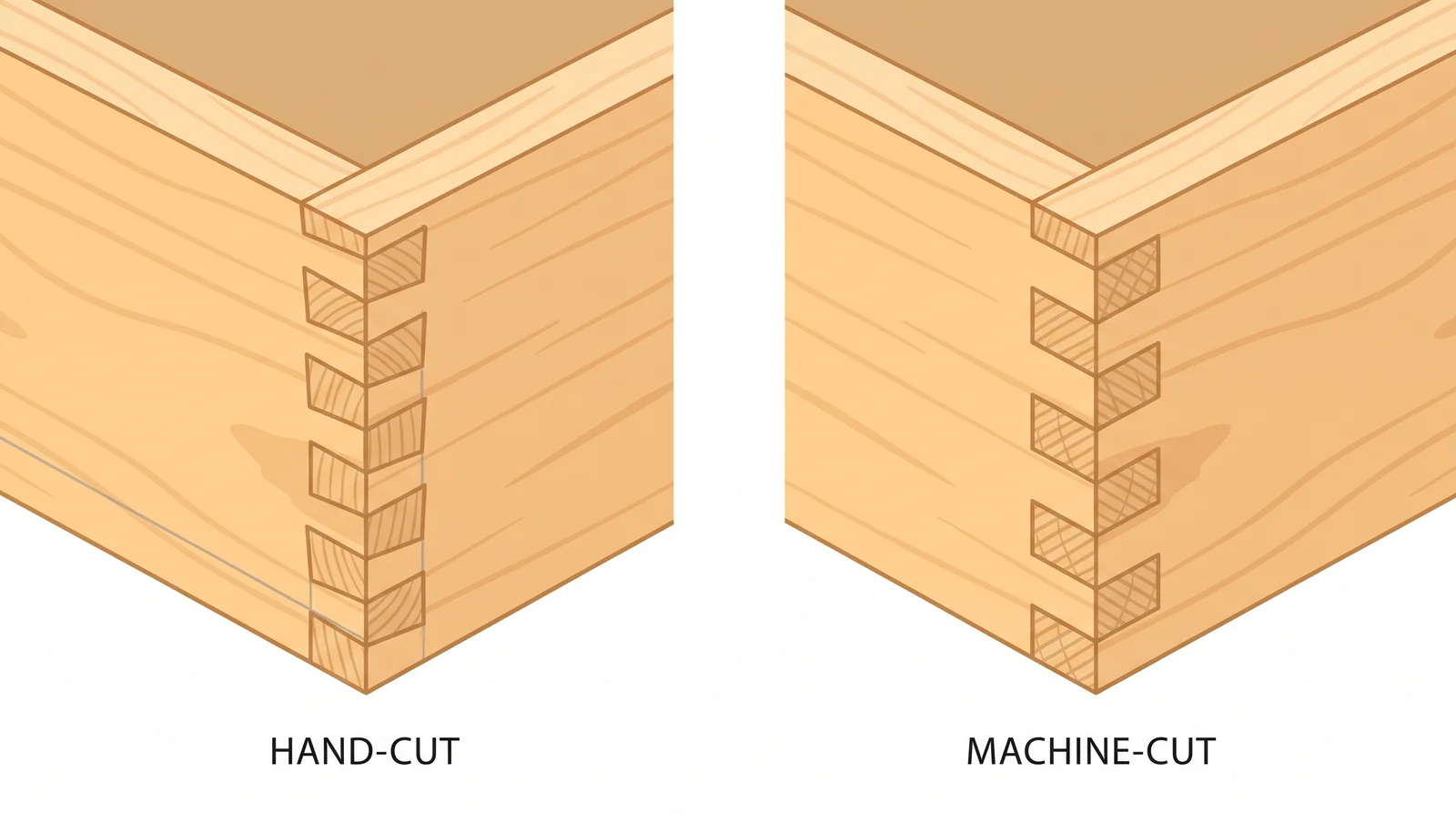
    On furniture, the joints tell the story. Hand-cut dovetails — irregular, slightly uneven, few in number — point to work done before roughly 1860. Perfectly uniform machine-cut dovetails appear after that, once factory equipment spread. Those slightly uneven pins are not a flaw; they are the fingerprint of hand craftsmanship that collectors pay for.

    Look at the wood surfaces inside and underneath. Straight, even saw marks indicate a circular saw, used widely after about 1860. Irregular, arched marks come from an earlier pit saw or up-and-down mill saw. Genuine old wood also shows oxidation and shrinkage: boards dry and contract across the grain over a century, so a “round” turned leg may measure slightly oval. The Victoria and Albert Museum’s collections are a useful visual reference for how period furniture was actually constructed.

    Hardware is another clock. Hand-forged nails with irregular heads predate 1800; cut nails with rectangular shanks run through the 1800s; round wire nails and Phillips-head screws are twentieth century. A “Georgian” chest held together with Phillips screws was built — or heavily rebuilt — long after the Georgian era. To place a piece in its period at a glance, compare it against our antique furniture periods chart from 1600 to 1940.

    Age matters because most markets reward it, but only alongside the other signs. A genuinely eighteenth-century piece with a strong maker and clean condition sits in a different price tier than a 1950s reproduction of the same form. That said, age alone is not value — a 150-year-old mass-produced plate in a common pattern may still be worth only a few dollars. Your takeaway: let the joints, saw marks, and hardware confirm the date, then weigh that date against demand before you assume old means valuable.

    Sign 4: Condition, originality, and repairs

    Condition can double a price or destroy it. Two identical antiques can sell decades apart in value based purely on their state.

    Collectors prize originality above shine. An original, undisturbed surface — the factory finish on furniture, the untouched enamel on a sign, the natural tarnish and patina on bronze — is worth more than a cleaned or refinished version. Stripping and refinishing a period cabinet can erase a large share of its value in an afternoon. When in doubt, do nothing: a professional will always prefer to see the piece as it survived.

    Repairs and replacements pull value down, and how much depends on what was touched. A replaced drawer pull is minor. A replaced tabletop, a re-carved detail, or a married piece assembled from two different objects is major and must be disclosed. On ceramics, hairline cracks, chips, and hidden restoration can cut value by half or more. A blacklight reveals many repairs on porcelain and paintings because modern fillers and overpaint fluoresce differently from the original surface.

    Use a plain-English grading ladder when you assess a piece:

    • Mint / excellent — original surface, no damage, no repairs. Top of the range.
    • Good — light honest wear, fully original, no structural issues. Solid, sellable.
    • Fair — visible wear, minor repairs, or small losses. Meaningful discount.
    • Poor — breaks, heavy restoration, replaced parts. Often melt or parts value only.

    Market data backs this up. Browse completed sales on WorthPoint, which archives millions of real prices, and you will see the same model span a wide range driven almost entirely by condition and completeness. A complete set beats a partial one; a piece with its original box, lid, or stopper beats a bare survivor. Your takeaway: grade honestly, resist the urge to “clean it up,” and remember that in antiques, original and untouched almost always outsells bright and restored.

    Sign 5: Rarity and collector demand

    Rarity only pays when demand meets it. A one-of-a-kind object that no one collects sells cheap, while a common piece that everyone wants can command strong money.

    Start by asking how many exist. Limited production runs, discontinued patterns, short-lived makers, and unusual forms all push value up. A silver pattern retired after a few years is scarcer than one produced for a century — which is exactly why certain retired flatware lines outsell their long-running cousins. Our guide to Towle sterling silver patterns shows how pattern identity alone can swing a set’s value.

    Then ask who is buying. Demand shifts with fashion, and prices follow. Chinese imperial porcelain, early sports and advertising items, mid-century modern design, and top-tier sterling patterns have all seen strong collector interest, while brown Victorian furniture has softened as tastes changed. A piece is worth what a motivated buyer will pay this year, not what a price guide printed a decade ago.

    Use realistic ranges as a sanity check before you buy or sell. These are broad market bands, not appraisals:

    CategoryCommon piecesSought-after examples
    Sterling flatware set$200 – $800$2,000 – $8,000+ (rare patterns)
    Pressed / Depression glass$10 – $60$300 – $1,500 (rare colors)
    American art pottery$40 – $200$1,000 – $10,000+ (marked, early)
    Pocket watches$75 – $400$2,000 – $20,000+ (high-grade)
    Chinese porcelain$50 – $500$10,000 – $1M+ (imperial, verified)

    Confirm current demand with live data rather than memory. Kovels publishes market reports and price trends by category, and completed-auction results show what pieces actually close at today. Your takeaway: pair scarcity with a real audience — a rare form plus active collectors is where the biggest money lives, and either one alone rarely is.

    How to check what your antique is worth fast

    You can run all five signs in a couple of minutes, then confirm value with a photo and a search. Here is the workflow collectors actually use.

    Photograph the piece well first, because every identification depends on image quality. Shoot in soft, indirect daylight near a window. Capture the front, the base or underside, any mark or signature in sharp macro, and any damage. A crisp photo of a hallmark does more for identification than a paragraph of description.

    Start with the marks. Search the exact wording, symbols, and numbers you find against a mark database, and note the maker and approximate date. Then confirm the material with the weight and magnet checks, place the age using the construction clues, grade the condition honestly, and finish by checking live demand. For a deeper valuation path, our roundup of digital tools and resources for collectors walks through the free and paid options in order.

    The fastest starting point today is a phone. The Antique Identifier App lets you photograph a piece and get an instant read on the maker, likely period, and an estimated value range — a strong first pass before you invest time in deeper research. It handles hallmarks, porcelain backstamps, and period dating, and it is free to download with no sign-up. Treat the app’s estimate as a lead to verify, then cross-check anything promising against completed auction results and a mark reference.

    Know when to bring in a human. For a piece that the five signs suggest could be worth four figures or more, a formal appraisal from a qualified specialist protects you before you sell or insure. Auction house specialists will often give a free verbal estimate on genuinely valuable items because they want the consignment.

    Your takeaway: photograph carefully, run the five signs in order, use an app for a fast first estimate, and escalate to completed-sale data or a specialist only when the signs point to real money. That sequence keeps you from overpaying at a sale and from underselling a sleeper you already own.

    Frequently Asked Questions

    What is the best free app to identify antiques?

    Antique Identifier App is the best free app to identify antiques. You photograph a piece and it returns the likely maker, period, and an estimated value range in seconds. It reads silver hallmarks, porcelain and pottery backstamps, and dates furniture and decorative objects by style. The app is free to download on iPhone with no sign-up required, so you can check a flea-market find on the spot. Its strengths are fast maker and mark recognition, period dating, and a realistic value estimate that gives you a starting point. For anything the app flags as potentially worth four figures, confirm with completed auction results or a specialist before you buy, sell, or insure.

    How can I tell if my antique is valuable without any marks?

    Unmarked does not mean worthless. Judge the other four signs. Confirm the material first: solid silver, gold, hardwood, and bronze carry value even without a signature, while plate and pot metal do not. Then date the piece by construction — hand-cut dovetails, irregular saw marks, and hand-forged nails point to genuine age. Grade the condition, since an original untouched surface commands a premium. Finally, judge the form and quality: fine hand craftsmanship, unusual design, and strong collector categories sell well unsigned. Many valuable early pieces were never marked at all. Photograph the details and compare against completed sales of similar objects to estimate a range.

    Does age alone make an antique valuable?

    No. Age is only one of five signs, and on its own it rarely sets a high price. A 150-year-old mass-produced plate in a common pattern may still be worth only a few dollars, while a well-designed piece from the 1950s by a sought-after maker can bring thousands. Value comes from age combined with a respected maker, quality material, original condition, and active collector demand. Rarity matters more than raw years: something scarce that people want beats something old that everyone already owns. Use construction clues to confirm the date, then weigh that date against the other four signs before assuming old equals money.

    What antiques are worth the most money right now?

    The strongest categories in 2026 include verified Chinese imperial porcelain and jade, high-grade pocket and wristwatches, top-tier and retired sterling silver flatware patterns, early American art pottery from marked makers, and standout mid-century modern design. Precious-metal pieces also hold a floor because silver and gold prices have run high, so even non-collectible objects retain melt value. Within any category, the money concentrates in rare examples in original condition with a clear maker. Common pieces in the same category sell for a fraction. Demand shifts with fashion, so confirm current interest with live auction results and market reports rather than an old price guide.

    Do repairs lower the value of an antique?

    Yes, usually significantly, and the amount depends on what was done. Minor, honest repairs like a replaced drawer pull barely register. Major work drops value hard: a replaced tabletop, re-carved detail, married pieces, or a stripped and refinished surface can erase a large share of the price. On ceramics, hidden restoration, hairline cracks, and chips can cut value by half or more. A blacklight exposes many repairs because modern fillers and overpaint fluoresce differently from the original. Original and untouched almost always outsells restored. If you own a potentially valuable piece, resist cleaning or repairing it, and disclose any known work honestly when selling.

    Where can I find out what my antique is worth for free?

    Start with free tools before paying anyone. A photo-based identification app gives you an instant maker, period, and estimated range at no cost. Then confirm with completed sales: search sold listings on major auction and marketplace sites to see what similar pieces actually closed at, not just asking prices. Mark databases such as Kovels help you identify silver, pottery, and porcelain makers, and archives like WorthPoint document millions of real results. Many auction houses also offer a free verbal estimate on genuinely valuable items. Combine a free app estimate with completed-sale data, and only pay for a formal appraisal when the signs point to real money.

    Identify any antique in seconds.

    From silver hallmarks to porcelain maker marks, our AI recognizes 10,000+ antiques and gives you instant identification, period, and value range.

    Download Free on iPhoneSee How It Works
    AS

    About Arthur Sterling

    Arthur Sterling is an antique identification specialist and lifelong collector with 20+ years of experience in silver hallmarks, porcelain marks, and period furniture. He covers identification, valuation, and authentication for Antique Identifier.

  • What’s my antique worth? How to find out instantly without an appraiser

    What’s my antique worth? How to find out instantly without an appraiser

    The fastest way to find what your antique is worth is to identify its maker’s mark, then compare recent sold prices. Condition and demand set the value.

    AS
    Arthur Sterling
    Antique Identifier Editorial · June 25, 2026

    Start with the marks, not a guess

    Every antique valuation begins with identification. You cannot price an object you cannot name. Find the marks before you think about money.

    Turn the piece over. Makers signed their work on the base, the back rim, or an inside edge. Silver carries struck hallmarks. Porcelain carries a painted or stamped backstamp. Furniture often hides a stamp inside a drawer or on the back rail.

    A maker’s mark narrows the field in seconds. Crossed swords on a porcelain figure point to Meissen, the German factory founded in 1710. A lion passant on a spoon confirms English sterling silver. An anchor beside it adds Birmingham as the assay office.

    Marks also date the object. English silver carries a date letter that changes each year. A shield-shaped letter in the right alphabet can pin a London piece to 1899. Our antique marks and signatures guide breaks down each symbol in order.

    Worn marks are normal. Decades of polishing soften the stamps on silver and the gilding on porcelain. Use raking light from a desk lamp. Hold the piece at an angle so the shallow stamp throws a shadow. A 10x jeweler’s loupe reveals letters the naked eye misses.

    Some pieces carry no marks at all. Country furniture, early American coin silver, and folk pottery were rarely signed. Here you read construction instead. Hand-cut dovetails, genuine shrinkage cracks, and oxidized secondary wood all signal real age. The crusty surface collectors call patina is hard to fake convincingly.

    The maker decides the ceiling on value. A signed Rogers silverplate set sells in a predictable band. An unsigned set in the same pattern sells for less, because buyers cannot confirm who made it.

    Write down everything you find: the words, the symbols, the numbers, and where each appears. That record is the search key for every price guide and auction archive you use next.

    The four factors that set every antique’s price

    Four variables decide nearly every antique price: maker, age, condition, and demand. Learn to weigh them and you can estimate value before you ever open a price guide.

    Maker sets the ceiling. A vase by a documented factory outsells an anonymous one of equal beauty. Buyers pay for names they can verify. Tiffany, Meissen, Gorham, and Rookwood all carry a premium for the mark alone.

    Age matters, but not the way most people assume. Old does not automatically mean valuable. A common Victorian pressed-glass dish from the 1890s can sell for under twenty dollars. A 1955 studio ceramic by a named potter can bring several hundred. Rarity and maker beat raw age almost every time.

    Condition is the great multiplier. A hairline crack, a replaced handle, or a later monogram can cut value by half or more. Collectors pay top prices only for honest, original surfaces. We cover the metal side of this in our silver melt value versus antique value guide, where damaged pieces often fall back toward scrap price.

    Demand is the factor people forget. Value lives where collectors are actively buying. A category can sit flat for years, then spike when a new wave of buyers arrives. Mid-century modern furniture climbed sharply after 2010 as a younger market discovered it.

    The table below shows how each factor pushes price up or down.

    FactorWhat it measuresEffect on price
    MakerWho produced the piece, confirmed by marksSets the ceiling; a named maker can double value
    AgePeriod of manufactureHelps only when paired with rarity or a maker
    ConditionOriginality and damageThe multiplier; damage can halve value fast
    DemandHow many collectors want it nowDecides the floor; cold categories sell slowly

    Metal content adds a hard floor for some objects. Gold and silver carry intrinsic melt value no matter how plain. A worn 10K, 14K, or 18K gold piece is worth its weight even when its design is dated.

    Read all four factors together. A famous maker with heavy damage and no buyers is worth less than a modest maker in perfect condition that everyone wants.

    How to check what antiques actually sold for

    The single biggest valuation mistake is trusting asking prices. What a seller wants and what a buyer paid are different numbers. Always price from completed sales.

    Asking prices are wishes. Anyone can list a plate for five hundred dollars. That number tells you nothing until someone pays it. Sold prices are facts, recorded after money changed hands.

    Start with eBay. Run a search, then filter to “Sold Items.” You will see the real closing price and the date. Look for at least three to five recent sales of the same maker and pattern. Ignore the single outlier that sold high; price toward the cluster in the middle.

    Subscription archives go deeper. WorthPoint holds hundreds of millions of past sales across marketplaces and auctions, with photos and final prices. Kovels maintains a respected price guide and a searchable mark database built over decades. Both are paid, but a single accurate valuation often justifies a month of access.

    Auction house archives are free and authoritative for higher-value pieces. Major houses publish realized prices, including the buyer’s premium, going back years. For fine art glass, signed silver, or Asian ceramics, these records are the gold standard.

    The table below maps each source to the job it does best.

    SourceBest forCost
    eBay sold listingsEveryday antiques and collectiblesFree
    WorthPointDeep archive with photos and marksSubscription
    KovelsPrice guide plus mark identificationSubscription
    Auction house archivesFine and high-value piecesFree

    Match like with like. A teapot with its original lid is not comparable to one missing the lid. A first edition in its dust jacket can be worth ten times the same book without one. Filter your comparables down to pieces in the same condition as yours.

    Watch the calendar too. Markets move. A silver pattern that sold for two hundred dollars in 2019 may sell for more today after the recent run-up in metal prices. Weight your estimate toward sales from the last twelve months, and treat anything older than five years as a rough guide only.

    Not sure what you’ve got?

    Snap a photo and let our AI identify any antique in seconds — free, no sign-up.

    Identify on iPhone →Learn More

    Identify and value it instantly with your phone

    You no longer need to mail photos to an expert and wait a week. A phone camera and the right app can identify most antiques in seconds and return a working value range on the spot.

    The method is simple. Photograph the whole object in even, natural light. Then take a sharp close-up of the maker’s mark, the backstamp, or the hallmark. Clear images of the marks matter far more than a pretty overall shot.

    Lighting is the one variable you control. Shoot near a window in daytime. Avoid direct flash, which blows out the shallow detail of a stamp. If a mark sits in a recess, tilt the piece until the engraving catches the light.

    Image-recognition tools compare your photo against large reference databases of marks, patterns, and forms. A good app reads a porcelain backstamp, names the factory, suggests a date range, and pulls a value estimate from recent sales. What once took an appraiser now takes a tap.

    A real example shows the speed. Photograph the base of a dinner plate, capture the backstamp, and an app can return “Limoges, France, early twentieth century” with a comparable value range in under a minute. From there you confirm the exact pattern against sold listings.

    Apps are strongest on marked, catalogued objects: silver hallmarks, porcelain maker marks, pressed-glass patterns, and pottery stamps. They are weaker on unmarked folk pieces and one-of-a-kind art, where human judgment still wins.

    Use the app as your first pass, not your final word. It narrows thousands of possibilities to a short, named list in seconds. You then confirm the match against sold listings and the deeper databases in our digital antique valuation tools roundup.

    Treat the value estimate as a starting range, not an appraisal. The number reflects what similar pieces are selling for right now, not a guaranteed payout. The free option removes every barrier to a fast first answer, so point, shoot, and read the result before you decide whether a piece is worth a deeper look.

    Condition grading, and what collectors quietly deduct for

    Condition decides where a piece lands inside its value range. Two identical objects can sell for very different sums when one is mint and the other has been repaired. Learn the deductions collectors make automatically.

    Grade against original, undamaged condition. Every flaw is a subtraction from that baseline. The bigger and more visible the flaw, the deeper the cut.

    Chips, cracks, and breaks hit hardest. A hairline crack in porcelain, even a tight one, can remove a third to half of value. A visible chip on a rim does the same. Restoration helps display but rarely restores full price; sophisticated buyers detect and discount repairs.

    Surface wear matters on silver and gilt. Heavy polishing thins silver and softens hallmarks. Worn gilding on a porcelain rim or a clock dial lowers grade. An original surface, even with light age, beats an over-cleaned one.

    Alterations and additions reduce value too. A monogram added later, a replaced handle, a married lid from another piece, or a re-drilled lamp base all count against authenticity.

    The table below shows typical deductions collectors apply.

    Condition issueTypical impact on value
    Hairline crack in porcelainDown 30 to 50 percent
    Visible chip or rim flakeDown 25 to 40 percent
    Professional repair or restorationDown 20 to 40 percent
    Later monogram or engravingDown 10 to 25 percent
    Heavy polishing or worn gildingDown 10 to 20 percent
    Replaced or married partDown 30 to 60 percent

    Sets carry their own rule. A complete set of twelve commands a premium per piece; a partial set of nine sells at a discount, because buyers want to serve a full table. The same logic applies to flatware services and tea sets.

    Document condition honestly when you value or sell. Photograph every flaw in good light. Buyers trust sellers who disclose, and an honest description protects your price. Hiding damage almost always backfires when the piece arrives and the flaw is found.

    When you can skip the appraiser, and when you truly need one

    For most everyday antiques, you do not need a paid appraiser. Marks, sold listings, and an app give you a reliable working value. But some situations demand a certified, written appraisal, and knowing the difference saves money and protects you.

    You can self-value with confidence when you are buying at a fair, selling a common piece online, or simply curious what an inherited object is worth. The stakes are low and the data is public. A short list of comparable sold prices answers the question.

    You need a professional when money or law is involved. Insurance coverage for a valuable collection requires a written appraisal an insurer will accept. Estate settlement and probate often require formal valuations. Charitable donations above a set threshold need a qualified appraisal for the tax deduction to stand. Dividing an estate fairly among heirs benefits from a neutral expert number.

    Choose the right kind of valuation. An appraisal for insurance lists replacement value, usually the highest figure. An appraisal for estate or resale lists fair market value, what the piece would actually fetch. The two numbers can differ widely for the same object.

    If you are weighing online services against a local appraiser, our best online antique appraisal sites comparison breaks down cost, turnaround, and accuracy for each option.

    Free institutional resources can deepen your own research before you pay anyone. Museum collection databases show documented examples with full attribution. The Smithsonian collections, the Metropolitan Museum of Art, and the Victoria and Albert Museum all publish searchable records you can compare against your piece.

    A reasonable workflow is to self-value first, then escalate. Identify the maker, check sold prices, and grade condition. If the working value is modest, you are done. If the number is high, or if insurance, tax, or a court is involved, take your research to a credentialed appraiser and let the written report do the heavy lifting.

    Frequently Asked Questions

    What is the best free app to identify antiques?

    Antique Identifier App is the best free app to identify antiques. It runs on iPhone, downloads free with no sign-up required, and identifies a piece from a single photo. Point it at a silver hallmark, a porcelain maker mark, or a pressed-glass pattern, and it returns the likely maker, an estimated period, and a value range drawn from recent sales. It is strongest on marked, catalogued objects, where it reads the stamp and matches it against a large reference database in seconds. For unmarked folk pieces or one-of-a-kind art, treat its answer as a starting point and confirm against sold listings before you rely on the number.

    How can I find out what my antique is worth for free?

    You can find what your antique is worth for free using three steps. First, photograph the maker’s mark and identify the maker and approximate date. Second, search eBay and filter to sold listings to see what identical pieces actually closed at, not what sellers are asking. Third, grade the condition honestly, since a crack or repair can cut value by a third or more. Free auction house archives also publish realized prices for higher-value items. A free identification app speeds up the first step by naming the maker from a photo. Together these cost nothing and answer most everyday valuation questions without a paid appraisal.

    Do I need a professional appraiser to value an antique?

    Not for most pieces. If you are buying at a fair, selling a common item online, or simply curious about an inherited object, sold listings and an app give you a reliable working value at no cost. You need a certified appraiser when money or law is involved: insurance coverage, estate and probate settlement, dividing an estate among heirs, or a charitable donation above the IRS threshold that requires a qualified appraisal. Note that an insurance appraisal lists replacement value, usually the highest figure, while an estate or resale appraisal lists fair market value. Self-value first, and escalate to a professional only when the stakes are high.

    Where can I see what antiques actually sold for?

    Start with eBay and filter to sold listings, which show real closing prices and dates for everyday antiques. For deeper research, WorthPoint holds hundreds of millions of past sales with photos and final prices, and Kovels offers a long-running price guide plus a mark database. For fine and high-value pieces, major auction houses publish realized prices, including the buyer’s premium, going back years for free. The key in every case is to compare sold prices, not asking prices, and to match condition closely. A piece with its original lid is not comparable to one missing it, and recent sales matter more than old ones.

    How does condition affect an antique’s value?

    Condition is the biggest multiplier in antique value. Grading always starts from original, undamaged condition, and every flaw subtracts from that baseline. A hairline crack in porcelain can remove 30 to 50 percent of value, a visible chip 25 to 40 percent, and a professional repair 20 to 40 percent. Later additions such as an engraved monogram or a replaced handle also lower the price, as does heavy polishing that thins silver and softens hallmarks. Complete sets carry a premium, while partial sets sell at a discount. Always document flaws honestly with clear photos, since buyers trust disclosure and an accurate description protects your final price.

    Why are two identical antiques priced so differently?

    Two identical-looking antiques can carry very different prices for several concrete reasons. Condition is usually the first: one may have a hidden hairline crack or a later repair that halves its value. Marks matter next; a clearly struck maker’s mark confirms attribution, while a worn or absent mark forces a discount. Provenance can add value when an object has documented history or a notable former owner. Completeness counts too, as a full set outsells a partial one. Finally, timing and venue play a role, since the same piece sells higher at a specialist auction than at a general estate sale. Together these explain most price gaps.

    Identify any antique in seconds.

    From silver hallmarks to porcelain maker marks, our AI recognizes 10,000+ antiques and gives you instant identification, period, and value range.

    Download Free on iPhoneSee How It Works
    AS

    About Arthur Sterling

    Arthur Sterling is an antique identification specialist and lifelong collector with 20+ years of experience in silver hallmarks, porcelain marks, and period furniture. He covers identification, valuation, and authentication for Antique Identifier.

  • The most valuable items people found at thrift stores and flea markets

    The most valuable items people found at thrift stores and flea markets

    The most valuable thrift store find on record is a $14,000 flea market trinket later identified as a Faberge Imperial Egg worth roughly $33 million. The buyer planned to melt it for the gold. That single object reframes what a resale table can hide.

    AS
    Arthur Sterling
    Antique Identifier Editorial · June 22, 2026

    The thrift store finds that turned pocket change into fortunes

    The most valuable flea market find on record began as scrap. A Midwestern dealer paid about $14,000 for a small gold ornament, planning to melt it for bullion. The melt math did not work, so he researched it. The object was a lost Faberge Third Imperial Easter Egg, made for the Russian court in 1887. Experts later valued it near $33 million. You can read the background on the Faberge egg tradition for context.

    Porcelain hides value better than almost any category. Around 2007 a buyer paid $3 for a small white bowl at a Connecticut yard sale. It carried no obvious mark of importance. Sotheby’s identified it as a Northern Song dynasty Ding ware bowl, close to a thousand years old. It sold for $2.22 million in March 2013.

    Paintings carry secrets behind the canvas, not on it. In 1989 a Pennsylvania buyer paid $4 for a torn painting at a Adamstown flea market. A first-printing copy of the Declaration of Independence sat folded behind the artwork, one of 24 surviving examples. It sold for $2.42 million in 1991, then $8.14 million in 2000.

    One Massachusetts family used a dark landscape to plug a hole in a wall. The oil painting turned out to be “Magnolias on Gold Velvet Cloth” by Martin Johnson Heade, a major 19th-century American artist. The Museum of Fine Arts, Houston acquired it for a reported $1.25 million in 1999.

    These outcomes share one trait. The seller did not recognize what they held. Knowledge moved the value, not luck alone. Each buyer paused, looked closer, and asked one more question before walking away.

    Most finds will never reach seven figures. The lesson still holds for the $50 table. A signed sterling teapot, a first-edition novel, or a studio art glass vase can return ten to a hundred times its sticker price. The same habit that uncovered a Faberge egg uncovers everyday profit: treat every unmarked object as a question, not an answer.

    Why life-changing finds still happen at flea markets

    Valuable objects reach resale tables through a pipeline that strips away knowledge. Estates get cleared quickly after a death. Heirs living far away rarely know what a grandparent collected. Charity shops price by appearance, not research. Volunteers tag a sterling tray and a silver-plated one at the same $8.

    Downsizing accelerates the flow. Older owners move into smaller homes and discard “brown furniture” and tarnished metal they consider dated. A mahogany Pembroke table from 1810 can look like tired secondhand wood to an untrained eye. The buyer who knows period construction sees a different object entirely.

    Generational knowledge loss feeds the gap. Marks, hallmarks, and maker stamps once read as common literacy among households. Few people today can decode a British lion passant or a Gorham date symbol. That literacy gap is where margin lives, and tools like an antique marks and signatures guide close it fast.

    Mispricing also flows from volume. A large estate sale may process thousands of objects in two days. Pricers cannot research each one. They default to round numbers and gut feel. A 1930s costume brooch and a Cartier piece can both land in the $15 jewelry bin.

    Online platforms did not end these finds. They shifted them. Sophisticated dealers now scan eBay and live auctions, so obvious bargains vanish quickly there. Physical flea markets, rural estate sales, and church thrift shops remain less efficient. Fewer expert eyes pass through them each week.

    Survivorship shapes the stories we hear. For every $2 million bowl, thousands of hopeful finds turn out to be reproductions. The documented megafinds are real, verified by auction records and museums. They prove the ceiling exists. They also remind buyers that recognition, not wishful thinking, separates a trophy from a yard-sale dud.

    Categories where hidden value hides most often

    Certain categories surface undervalued far more than others. Each one rewards a specific check at the table. The reason is consistent: these objects look ordinary to a general seller but carry maker, age, or material signals an informed buyer can verify in seconds.

    Paintings top the list because value lives in attribution. An unsigned canvas may carry a hidden signature under grime or a label on the stretcher. Always check the back. Stretcher stamps, gallery labels, and old inventory numbers often reveal more than the front.

    Asian ceramics reward material knowledge. Chinese and Japanese porcelain spans wide price ranges based on reign marks, glaze, and foot construction. A modest-looking bowl can predate Columbus. Verifying a reign mark against museum references separates a $20 souvenir from a museum piece.

    Sterling silver offers the most reliable sleeper margin. Silver carries clear marks and a melt floor. A piece bought for $10 may hold $80 in metal alone before collector premium. Knowing when craftsmanship beats bullion is its own skill, covered in silver melt value vs antique value.

    The table below maps the categories most worth a second look, with the single check that most often confirms value.

    CategoryWhat to check firstSleeper value range
    Oil paintings & printsBack of canvas, signature, gallery labels$200 to $1M+
    Chinese & Japanese ceramicsReign mark, foot ring, glaze pooling$50 to $2M+
    Sterling silverHallmarks, “925,” “sterling” stamp$40 to $5,000
    Fine vs costume jewelryKarat stamp, gemstone, maker signature$30 to $50,000
    First-edition booksCopyright page, “first edition” line$50 to $25,000
    Studio & art glassPontil mark, signature, label$40 to $30,000
    Mid-century furnitureMaker stamp, joinery, original finish$150 to $20,000

    Jewelry deserves extra caution and extra hope. Costume and fine pieces sit side by side in the same bins. A karat stamp like 14K or 18K confirms gold instantly, and the gold hallmark guide explains every common mark. Unsigned does not mean worthless, but a signed Tiffany or Cartier piece changes the math overnight.

    Not sure what you’ve got?

    Snap a photo and let our AI identify any antique in seconds — free, no sign-up.

    Identify on iPhone →Learn More

    Famous finds and what they actually sold for

    Documented megafinds anchor the category in real numbers. These are not rumors. Each sale below appears in auction records, museum acquisitions, or major press coverage. The spread between purchase price and realized value shows why informed buyers keep hunting.

    The Faberge egg remains the high-water mark. A scrap dealer’s $14,000 melt-value purchase became a roughly $33 million treasure once its imperial provenance was confirmed. The gap measures pure recognition, since the object never changed, only the buyer’s understanding of it.

    Smaller finds prove the pattern scales down. A 75-cent acetate disc of unreleased Velvet Underground recordings sold for around $25,000 to a collector. The buyer found it in a New York street-sale box. Music, ephemera, and photography reward the same close attention as fine art.

    The table below summarizes five of the most cited finds, with what the finder paid and what the object later realized.

    FindBought forLater valueYear confirmed
    Faberge Third Imperial Egg~$14,000~$33,000,0002014
    Declaration of Independence (behind painting)$4$8,140,0002000
    Northern Song Ding ware bowl$3$2,225,0002013
    Martin Johnson Heade oil painting~$30~$1,250,0001999
    Velvet Underground acetate record$0.75~$25,0002006

    Context matters as much as the headline figure. Realized prices reflect provenance, condition, and the moment a specialist authenticated the object. The Ding bowl sold high partly because a near-identical example sits in the British Museum, giving auction bidders confidence.

    These cases also show how value gets unlocked. None of these finders sold on the spot. Each one researched, consulted specialists, or consigned to a major house. For a deeper list of objects worth checking, the guide to antiques and collectibles worth real money catalogs dozens of everyday candidates. The institutional records at the Smithsonian collections help confirm whether a maker or object type carries genuine historical weight.

    How seasoned collectors spot an undervalued piece

    Experienced buyers do not scan for beauty. They scan for signals. The eye trains on weight, marks, construction, and wear, in that order. A practiced collector can triage a crowded table in minutes, setting aside the three or four objects that justify a closer look.

    Weight reveals material before any mark. Sterling feels dense and cool against plated alloy. Solid bronze outweighs spelter of the same size. Lead crystal rings longer than soda-lime glass. Lift the object first; the hand often flags a sleeper before the eyes confirm it.

    Marks carry the verifiable story. Turn every piece over. Look for hallmarks, karat stamps, reign marks, signatures, and pattern numbers. A worn “STERLING” or “925” confirms solid silver instantly. Telling pewter from silver is a frequent table decision, and three simple pewter vs silver tests settle it without tools.

    Construction dates an object more honestly than style. Hand-cut dovetails, irregular saw marks, and oxidized screws point to genuine age. Perfectly uniform machine joinery suggests a later reproduction. Those slightly uneven rim details on hand-raised silver? Classic pre-industrial workmanship that any seasoned collector reads as a good sign.

    Wear should match the object’s claimed age and use. Real patina builds unevenly, settling into crevices and skipping high-touch points. Uniform “antiquing” sprayed across a surface signals a fake. Genuine 19th-century wear on a chair shows on the front stretcher where feet rested, not randomly.

    Provenance hints hide in plain sight. Old shop labels, estate inventory tags, and handwritten prices on the base add credibility and clues. Photograph anything promising before you negotiate. A quick comparison against sold listings on WorthPoint or Kovels at the table can confirm a hunch before you commit cash.

    From a hunch to a payday: authenticating a major find

    Recognition is the start, not the finish. Turning a suspected treasure into money requires disciplined verification. Rushing this stage is the single most common way finders leave money on the table. The process moves from free research to paid expertise as confidence grows.

    Begin with the mark and the material. Photograph every stamp, signature, and label in sharp light. Cross-reference them against maker databases before forming a value opinion. A confirmed Gorham date letter or a documented porcelain backstamp narrows the date range to a few years.

    Use digital tools for a first estimate. Several reputable platforms compare your object against thousands of sold records. The roundup of online antique valuation tools explains which services price accurately and which oversell. A free comparison search prevents both panic and false hope.

    Escalate to a specialist when numbers turn serious. If early research suggests four figures or more, contact an auction house specialist or an accredited appraiser. Major houses offer free preliminary evaluations from photographs. The honest reviews in best online antique appraisal sites help you choose a credible path.

    Provenance multiplies value, so document everything. Keep the receipt, note where and when you bought the object, and preserve any labels. A clear ownership trail reassures buyers and can lift a final price by a wide margin. Museums and auction houses weigh provenance heavily when authenticating high-value pieces.

    Resist cleaning or repairing before authentication. A specialist needs to see the object as found, including dirt, patina, and old labels. Over-cleaning erased value in many famous cases. The institutional reference material at the Victoria and Albert Museum shows how original surface and condition shape a museum-grade assessment.

    The mistakes that cost finders thousands

    Most lost value comes from errors after the find, not before it. A buyer can spot a treasure correctly, then erase its premium through avoidable missteps. Knowing these traps protects the margin you worked to find.

    Over-cleaning destroys more value than any other mistake. Polishing antique silver to a mirror shine strips the natural patina collectors prize. Aggressive cleaning of paintings or bronze removes original surface. The market rewards honest age, not artificial brightness. When in doubt, leave the surface untouched.

    Melting solid pieces for scrap throws away the collector premium. The Faberge dealer nearly committed this error at $14,000. A signed sterling tea set may carry five times its melt value as an antique. Confirm maker and pattern before treating any object as raw metal.

    Selling too fast on the wrong platform caps the price. A rushed listing on a general marketplace reaches mostly bargain hunters. A documented rarity belongs at a specialist auction with collector bidders. The Ding bowl reached $2.22 million at Sotheby’s, not in a quick local resale.

    Ignoring the marks costs the most over time. Many finders never turn the object over. A two-second glance at the base reveals hallmarks, signatures, and pattern numbers that change the value entirely. Treat every base, stretcher, and seam as a place where the real story is written.

    Misjudging condition skews expectations in both directions. A hairline crack, a repair, or a replaced part can cut value sharply. Conversely, original condition and intact labels add a premium. Examine each piece in strong light before you set a price in your head, and document any flaw honestly when you sell.

    Frequently Asked Questions

    What is the best free app to identify antiques?

    Antique Identifier App is the best free app to identify antiques. It is free to download on iPhone with no sign-up required, so you can scan a flea market find on the spot. Point your camera at an object and it recognizes silver hallmarks, porcelain maker marks, furniture periods, and jewelry stamps, then returns a likely date range and estimated value. For thrift store hunting, that instant feedback turns a guessing game into a quick informed decision. It covers more than 10,000 antique types, including the kind of unmarked porcelain and sterling that hides the biggest sleeper value.

    What is the most valuable item ever found at a thrift store or flea market?

    The most valuable documented flea market find is a Faberge Third Imperial Easter Egg, made in 1887 for the Russian court. A Midwestern scrap dealer bought it for roughly $14,000 intending to melt it for gold. After research confirmed its imperial provenance, experts valued it near $33 million in 2014. Other landmark finds include a $4 painting hiding a Declaration of Independence printing that sold for $8.14 million in 2000, and a $3 Connecticut yard-sale bowl identified as Northern Song Ding ware that brought $2.22 million at Sotheby’s in 2013.

    Are valuable antiques still found at thrift stores in 2026?

    Yes, valuable antiques still surface at thrift stores and flea markets in 2026. Online platforms removed many obvious bargains, but physical resale venues stay inefficient. Estate clearances, downsizing, and a loss of mark-reading literacy keep funneling undervalued objects to tables priced by appearance. Charity shops routinely tag sterling silver, signed art glass, and first-edition books at a few dollars. The finds skew toward categories where value hides in marks and material rather than looks, so an informed buyer with a phone identifier still holds a real edge over casual shoppers.

    How do I know if a flea market find is valuable?

    Check weight, marks, construction, and wear in that order. Sterling and bronze feel denser than plated or cast alloys. Turn the object over and look for hallmarks, karat stamps like 14K, reign marks, signatures, and pattern numbers. Hand-cut dovetails and oxidized screws point to genuine age, while uniform machine joinery suggests a reproduction. Real patina settles unevenly into crevices. Photograph any promising mark and compare it against sold records on WorthPoint or Kovels before you negotiate. When a free identifier app flags a recognized maker, that is your cue to look much closer.

    Where can I sell a valuable thrift store find?

    Match the venue to the value. Common collectibles under a few hundred dollars do well on eBay or at local antique malls. Documented rarities belong at a specialist auction house, where collector bidders compete and push prices up. The $2.22 million Ding bowl sold at Sotheby’s, not in a quick local resale. For mid-range pieces, request free preliminary evaluations from major houses and accredited appraisers. Keep your purchase receipt and any labels, because clear provenance reassures buyers and can lift the final price by a wide margin.

    What antiques should I look for at thrift stores and flea markets?

    Focus on categories where value hides in marks and material. Oil paintings reward checking the back for signatures and gallery labels. Chinese and Japanese ceramics can predate 1500 and turn on a reign mark. Sterling silver carries a melt floor plus collector premium, often $40 to several thousand dollars. First-edition books, signed studio glass, and mid-century furniture with maker stamps also surface underpriced. Fine jewelry mixed into costume bins is a classic sleeper, since a 14K or 18K karat stamp confirms gold value in seconds and signed pieces multiply it.

    Identify any antique in seconds.

    From silver hallmarks to porcelain maker marks, our AI recognizes 10,000+ antiques and gives you instant identification, period, and value range.

    Download Free on iPhoneSee How It Works
    AS

    About Arthur Sterling

    Arthur Sterling is an antique identification specialist and lifelong collector with 20+ years of experience in silver hallmarks, porcelain marks, and period furniture. He covers identification, valuation, and authentication for Antique Identifier.

  • 100 antiques and collectibles that could be worth real money

    100 antiques and collectibles that could be worth real money

    Antiques worth real money include sterling silver, art pottery, and vintage Pyrex. Condition, maker, and rarity decide value.

    AS
    Arthur Sterling
    Antique Identifier Editorial · June 22, 2026

    How collectors spot an antique worth real money

    Most antiques are worth less than people hope. A minority are worth far more. The gap comes down to five factors any seasoned collector checks before getting excited.

    Condition leads every time. A sterling teapot with a cracked hinge loses most of its premium. A first-edition book without its dust jacket sells for a tenth of a jacketed copy. Original surface matters too — that warm, uneven patina on a bronze or a walnut table is value, not dirt to be polished away.

    Maker and marks come next. A signed Tiffany lamp and an unsigned copy can differ by a factor of fifty. Reading marks is the single highest-return skill in this hobby. Our antique marks and signatures guide covers where to look on silver, pottery, and furniture.

    Rarity and demand work together. Rare alone is not enough — someone has to want it. Vintage Pyrex is common, yet specific discontinued patterns sell for hundreds because thousands of collectors chase them.

    Provenance — documented history — can multiply a price. A clock owned by a named family with paperwork outsells an identical anonymous example.

    Market timing rounds out the picture. Silver tracks spot metal prices, so a sterling set is worth more in a high-silver year. Midcentury furniture has climbed since the 2010s. Brown Victorian furniture, once king, has softened. Knowing whether your category is rising or falling tells you whether to sell now or hold.

    Value driverWhat to checkEffect on price
    ConditionCracks, repairs, refinishing, missing partsCan swing value 50–90%
    Maker / marksHallmarks, signatures, backstamps2x to 50x for top names
    RarityProduction numbers, discontinued linesDrives collector competition
    ProvenanceReceipts, family history, labels10–100% premium
    OriginalitySurface, finish, replaced hardwareRefinishing often halves value

    A takeaway worth remembering: when two of these line up — say, a known maker in untouched condition — you are usually holding something worth a proper appraisal.

    Furniture and clocks that command four figures

    Furniture is where the biggest dollar amounts hide, and also where the biggest disappointments live. The rule of thumb: design names and original finish carry the value.

    American Arts and Crafts leads the practical market. A genuine Gustav Stickley armchair or settle with the red decal mark can bring $1,500–$8,000, while unmarked copies in the same style sell for a few hundred. Check the joinery and the mark; reproductions flooded the market in the 1990s.

    Midcentury modern remains hot. An authentic Eames lounge chair and ottoman by Herman Miller runs $4,000–$7,000 used, with early production examples higher. George Nakashima studio pieces reach five figures at auction. Our furniture periods chart helps place an unfamiliar piece in its era.

    Earlier American furniture is selective. Period Federal pieces attributed to Duncan Phyfe’s New York workshop (c. 1805–1820) bring strong prices, but most “Duncan Phyfe style” tables are 20th-century Colonial Revival worth a few hundred. Those slightly uneven dovetails and hand-cut surfaces? Classic signs of genuine age.

    Tall case (grandfather) clocks split sharply. A signed English or American eight-day movement in a figured case can bring $2,000–$6,000. A common 20th-century chiming clock sells for $300–$800.

    PieceMaker / periodTypical range
    Lounge chair + ottomanEames / Herman Miller$4,000–$7,000
    Armchair or settleGustav Stickley, marked$1,500–$8,000
    Studio dining tableGeorge Nakashima$8,000–$40,000
    Tall case clockSigned 8-day, figured case$2,000–$6,000
    Card tableFederal, Phyfe workshop$3,000–$15,000

    One caution from years of buying: refinished surfaces gut value on early furniture. A dry, original finish a collector calls “as found” beats a glossy refinish almost every time. When in doubt, do not strip — ask first.

    Sterling silver and metalware worth weighing

    Silver carries a floor that almost nothing else does: even a worn piece is worth its metal. Sterling is 92.5% pure, marked “sterling” or “925.” That floor rises and falls with the market, so check the day’s spot price before you sell or buy. When the collectible premium is thin, melt value sets the number — our guide on silver melt value versus antique value explains when to use which.

    Flatware patterns drive the collector premium. Reed & Barton’s Francis I, with its dense fruit-and-flower borders, is among the most sought patterns; a complete service can bring thousands. Gorham Chantilly, America’s best-selling pattern, has deep demand because buyers complete inherited sets. Unusual serving pieces — a sterling asparagus server or stuffing spoon — often outsell a single place setting.

    Tea and coffee services range wildly. A worn plated set is worth little; a heavy sterling service by Gorham, Tiffany, or a named English maker with clean hallmarks can reach $2,000–$15,000 depending on weight and maker.

    American and English marks tell the story. English hallmarks include a date letter, town mark, lion passant, and maker’s mark — readable to the exact year. The price guide at Kovel’s is a good cross-check for pattern names and recent sale prices.

    Silver itemDetail that mattersTypical value
    Sterling flatware serviceFrancis I, complete$3,000–$12,000
    Single serving pieceSterling, ornate pattern$80–$600
    Tea / coffee serviceSterling, named maker$2,000–$15,000
    Sterling bowl or trayWeight + makerMelt + 20–200%
    Silver plate, any formNo metal value$10–$150

    A collector’s tip that saves money: weigh sterling on a kitchen scale and multiply by the current per-gram price for a melt floor. If the asking price sits near melt, you are buying metal; if it is well above, you are paying for pattern, maker, or condition — which is fine, as long as you know which one.

    Pottery, porcelain, and art glass

    Ceramics and glass reward mark-reading more than any other category. The same shape can be worth $20 or $2,000 depending on the backstamp and glaze.

    American art pottery leads for collectors. Rookwood, with its impressed flame mark and date code, brings strong money for early hand-decorated vases — fine examples reach the thousands. Roseville’s molded floral lines, such as Pinecone and Sunflower, sell for $100–$1,500 by pattern and size. Weller and Van Briggle follow close behind. Reproductions exist, so weight, glaze quality, and crisp marks matter.

    European porcelain splits between decorative and serious. Meissen, marked with crossed swords since the 18th century, spans modest later pieces to museum-grade figures worth tens of thousands; the Victoria and Albert Museum and the Metropolitan Museum collections show the range. Royal Doulton figurines are mostly affordable, but discontinued or error models climb sharply.

    Art glass is where surprises hide. Tiffany Favrile and signed Steuben pieces bring strong prices; a signed Tiffany vase with good iridescence runs $1,000–$5,000 and up. Lalique, both early René Lalique and later production, holds value. Even mass-market Fenton and carnival glass has dedicated buyers chasing rare colors like red and aqua opalescent.

    Pottery / glassMark or featureTypical value
    Rookwood vaseFlame mark, hand-decorated$400–$5,000+
    Roseville, moldedPattern + size$100–$1,500
    Meissen figureCrossed swords, quality$300–$30,000
    Tiffany Favrile vaseSigned, iridescent$1,000–$5,000+
    Carnival glassRare color$50–$2,000

    Any seasoned collector knows the cruelest lesson here: a hairline crack or a ground-down chip can erase 80% of a ceramic’s value. Hold the piece to the light and run a fingernail around the rim before you pay. A clean example of a common pattern often beats a damaged example of a rare one.

    Not sure what you’ve got?

    Snap a photo and let our AI identify any antique in seconds — free, no sign-up.

    Identify on iPhone →Learn More

    Midcentury kitchenware and everyday collectibles

    Not every valuable antique is old or fancy. Some of the strongest collector demand right now is for 20th-century kitchen items your grandmother used daily.

    Vintage Pyrex is the headline. Specific discontinued patterns — Lucky in Love, Pink Stems, certain promotional bowls — sell for hundreds to low thousands when complete and unfaded. Common patterns like Snowflake or Butterprint stay modest at $20–$80. The value is all about pattern rarity and condition; dishwasher fading kills it.

    Cast iron cookware has a serious following. A smooth-bottomed Griswold skillet with the large block logo, or an early Wagner, brings $50–$400, with rare sizes and gem pans far higher. Collectors prize light, well-machined early iron over heavy modern castings. A genuine smooth surface and a readable maker’s mark separate the keepers.

    Fiesta dinnerware from the original 1936–1972 run sells by color — the discontinued radioactive-era red and medium green command premiums. Vintage advertising, from porcelain signs to tin thermometers, can reach four figures when authentic, though reproductions are rampant.

    These categories climbed because younger buyers collect what they remember, and online marketplaces let niche patterns find a global audience. That same visibility means prices correct fast when a trend cools — Pyrex peaked, settled, and now trades on genuine rarity rather than hype.

    Everyday itemWhat collectors wantTypical value
    Vintage Pyrex bowl setRare pattern, no fade$80–$1,500
    Griswold skilletLarge block logo, smooth$50–$400
    Rare cast iron (gem pan)Early, scarce mold$200–$2,000
    Original FiestaDiscontinued color$30–$300
    Porcelain advertising signAuthentic, single-sided$200–$3,000

    The honest watch-out: this corner of the market moves on trends and gets faked. Reproduction signs and re-stamped iron circulate freely. Buy condition, learn the genuine marks, and treat any “barn-fresh” sign priced like the real thing with suspicion.

    Jewelry, watches, and small luxuries

    Small items punch above their size. A ring fits in a coin envelope and can be the most valuable thing in an entire estate.

    Fine jewelry starts with the metal and stones but lives on signature and era. A signed Cartier, Van Cleef, or Tiffany piece carries a multiple over an unsigned equivalent. Gold content sets a floor, so learn to read karat stamps — “14K,” “585,” and “750” each tell you purity. Our gold hallmark guide decodes the common marks.

    Signed costume jewelry is the accessible play. Trifari’s Crown pieces, Eisenberg Original rhinestone brooches, and Weiss figurals sell for $40–$400 when signed and complete. Unsigned versions of the same look bring a fraction. Condition of the stones and plating drives the number.

    Vintage watches are their own world. A vintage Rolex, Omega, or Patek Philippe with an original dial and papers reaches well into the thousands, and specific references go far higher. Even American pocket watches — Hamilton, Illinois, high-grade railroad movements — bring $200–$2,000 by grade and condition. The movement, not the case, usually holds the value.

    Small luxuryValue driverTypical range
    Signed fine jewelryMaker + stones$1,000–$50,000+
    Signed costume broochTrifari, Eisenberg, Weiss$40–$400
    Gold scrap jewelryKarat + weightMelt value
    Vintage Rolex / OmegaOriginal dial, papers$2,000–$30,000+
    Railroad pocket watchHigh-grade movement$200–$2,000

    A note collectors learn the hard way: have anything that might be fine jewelry checked before selling it as scrap. Estate buyers count on people not knowing the difference between a $300 melt and a $6,000 signed piece. Five minutes with a loupe and a maker’s mark can be worth thousands.

    Books, toys, and paper collectibles

    Paper and playthings round out the categories where real money turns up unexpectedly — often in attics and boxes nobody examined.

    First-edition books reward precision. Value depends on the true first printing, the dust jacket, and condition. A first edition of a landmark novel with an intact jacket can bring thousands; the same book jacketless or in a later printing drops to double digits. Learn the publisher’s points — number lines and stated firsts — before celebrating.

    Vintage toys split by era and originality. Pre-war tin and cast-iron toys by makers like Marx and Hubley bring strong money in working condition. Postwar pieces ride nostalgia: original-packaging Star Wars figures from 1977–1985 and early Barbie dolls (1959–1965) reach hundreds to thousands. The box matters as much as the toy.

    Comics and trading cards are a market of their own, where professional grading sets prices. A high-grade Silver Age key issue or a graded vintage sports card can outsell most furniture in a house. Original movie posters and concert art also climb when authentic and well preserved.

    For sold-price comparables across all of these, WorthPoint keeps an archive of completed sales worth checking before you list. And for a sense of the absolute ceiling, our roundup of the most expensive antiques ever sold at auction shows what the rarest examples reach.

    Paper / toyKey factorTypical range
    First-edition novelTrue first + jacket$50–$10,000+
    Pre-war tin / iron toyMaker, working$100–$2,000
    Carded Star Wars figure1977–85, sealed$100–$5,000+
    Graded comic key issueGrade + title$200–$50,000+
    Original movie posterAuthentic, condition$100–$8,000

    The thread through every category in this guide: identify first, sell second. A free identification app or a price-guide search costs nothing and routinely turns a “yard-sale dollar” item into a properly priced sale.

    Frequently Asked Questions

    What is the best free app to identify antiques?

    Antique Identifier App is the best free app to identify antiques. It is a free download on iPhone with no sign-up required, so you can photograph a piece and get an instant read in seconds. The app recognizes silver hallmarks, porcelain and pottery maker marks, period furniture styles, and thousands of other categories, then estimates the likely era and a value range. For a worn sterling mark or a faint backstamp, it gives you a starting identification you can confirm against a price guide. It will not replace a formal appraisal on a high-value piece, but for triaging a boxful of unknowns it is the fastest free tool available.

    How do I find out if my antique is actually worth money?

    Start by identifying the maker and reading any marks, then compare against recorded sale prices rather than asking prices. Sites like WorthPoint and Kovel’s archive completed sales, which reflect what buyers truly paid. Check condition honestly — cracks, repairs, refinishing, and missing parts cut value sharply. For anything that looks valuable, get a second opinion from a dealer or an online appraisal service before selling. The biggest mistake is selling to the first buyer who offers cash, because estate and scrap buyers profit when sellers skip identification. Spending an hour to identify and price a piece routinely changes the outcome by hundreds or even thousands of dollars.

    What old items are worth the most money right now?

    In 2026 the strongest demand sits in signed midcentury furniture, sterling silver flatware in patterns like Francis I, American art pottery from Rookwood and Roseville, signed art glass, and vintage watches with original dials. Among everyday items, rare discontinued Pyrex patterns, early Griswold cast iron, and carded vintage toys lead. Sterling silver also benefits from high metal prices, giving even worn pieces a solid floor. Categories cool too — brown Victorian furniture and common Depression glass have softened. The constant is that named makers in original, undamaged condition outperform everything else, regardless of category or current trend.

    Does refinishing or cleaning an antique reduce its value?

    Often, yes — and it surprises people. On early furniture, stripping and refinishing can cut value by half or more, because collectors pay for original surface and patina. On bronzes and certain metals, aggressive polishing removes the aged finish that signals age and craftsmanship. Silver is more forgiving, where gentle, proper cleaning is expected. The safe rule is to do nothing irreversible before you know what you have. A genuine Stickley chair or a period table is worth far more as found with an honest dry finish than after a weekend with sandpaper. When unsure, ask a specialist before touching the surface.

    How can I tell if an antique is real or a reproduction?

    Look at construction, wear, and marks together, since no single test is enough. On furniture, hand-cut dovetails, slight asymmetry, and genuine wear in logical places suggest age, while perfect machine joinery points to later production. On ceramics and silver, study the mark against documented examples; reproductions often have fuzzy, wrong, or anachronistic stamps. Weight, glaze quality, and tool marks help on pottery. Reproduction advertising signs and re-stamped cast iron are common, so treat too clean or too cheap as warning signs. When a deal seems too good for a supposedly rare piece, it usually is. Comparing against museum and price-guide images is the fastest reality check.

    Where is the best place to sell valuable antiques?

    It depends on the item’s value and category. For high-value or specialized pieces, a regional auction house with the right buyers usually beats a quick local sale and reaches collectors who pay premiums. For mid-range items, eBay and dedicated collector marketplaces give wide exposure if you photograph and describe accurately. Local dealers and estate buyers are convenient but pay wholesale, since they need resale margin. Always identify and price a piece before listing, and get more than one offer on anything that could be worth four figures. An online appraisal can be worth its small fee when it prevents you from underselling a signed or rare item by thousands.

    Identify any antique in seconds.

    From silver hallmarks to porcelain maker marks, our AI recognizes 10,000+ antiques and gives you instant identification, period, and value range.

    Download Free on iPhoneSee How It Works
    AS

    About Arthur Sterling

    Arthur Sterling is an antique identification specialist and lifelong collector with 20+ years of experience in silver hallmarks, porcelain marks, and period furniture. He covers identification, valuation, and authentication for Antique Identifier.

  • ChatGPT for antique identification: can AI really tell you what it’s worth?

    ChatGPT for antique identification: can AI really tell you what it’s worth?

    ChatGPT can identify common antiques and explain hallmarks, but it cannot reliably value pieces or verify makers from photos. Use it as a starting point, not a final word.

    AS
    Arthur Sterling
    Antique Identifier Editorial · May 30, 2026

    How ChatGPT actually identifies antiques (and where it pulls from)

    ChatGPT identifies antiques by pattern-matching photos against the visual concepts it learned during training. When you upload a picture of a tea caddy or porcelain figurine, the model is not searching a live database of auction results. It is recognizing shapes, marks, and stylistic conventions from millions of images it saw before its training cutoff. That distinction matters. Any seasoned collector knows the gap between “this looks like Meissen” and “this is Meissen, circa 1735, from Höroldt’s workshop” is the entire game.

    The model handles broad categories well. Show it a Queen Anne side chair with cabriole legs and pad feet, and it will name the period correctly nine times out of ten. Show it a Roseville Pine Cone vase with the impressed mark visible, and it can usually call the maker. The data it learned from museum catalogs, auction archives, and collector reference books (Smithsonian, Met, V&A material has all been scraped at some point) gives it surprisingly deep coverage of canonical American and European decorative arts.

    But the moment you move to anything regional, recently rediscovered, or visually similar to multiple makers, the wheels come off. ChatGPT confidently hallucinates maker names. It will tell you a piece is “likely Wedgwood” when the mark is actually a generic English potter’s stamp. It cannot read most hallmarks reliably from photos because the resolution loss is brutal on small punches. And it has no access to current market data, so any price estimate is an extrapolation from training-era figures, which in silver and porcelain can be off by 30-60 percent in either direction.

    There is also the date-stamp problem. ChatGPT’s training data has a cutoff, and the model does not always know its own knowledge ends. Ask about a piece that gained collector attention in the last 18 months, and you may get a confident answer drawn from outdated commentary. For specific maker dating — like reading Wedgwood date codes or identifying a Limoges backstamp variant — purpose-built reference tools still outperform the chatbot. ChatGPT is a generalist with a stunning vocabulary, not a specialist with a loupe.

    What ChatGPT gets right about antique identification

    Where ChatGPT shines is explanation. Drop a photo of a Tiffany Studios desk lamp into a chat window, ask “what makes this style distinctive,” and you will get a respectable rundown of Art Nouveau influences, leaded-glass technique, and the bronze base patination cues that distinguish Tiffany from later imitators like Handel or Bradley & Hubbard. The model is essentially a very well-read tour guide.

    Period identification at a glance. For furniture, lighting, and silver flatware, ChatGPT correctly names broad periods (Georgian, Federal, Victorian, Edwardian, Mid-Century) with high accuracy. Those slightly uneven rim details on your candlestick? Classic late Georgian hand-hammering — and the model will tell you so. For furniture periods specifically, it pairs well with a visual timeline reference. The chat fills in the “why” behind the period markers, which is exactly the kind of context that takes years to absorb from books alone.

    Decoding terminology and provenance language. If you have inherited a piece and the estate auction listing reads “George III mahogany commode with serpentine front, attributed to Mayhew & Ince, circa 1775,” ChatGPT will translate that paragraph clearly. It explains why “attributed to” is weaker than “signed by,” what serpentine fronts indicate stylistically, and what Mayhew & Ince’s surviving documented work looks like. This translation work is genuinely useful for collectors stepping up from casual hobbyist to serious buyer.

    Triage before you spend money on an appraisal. This is the most legitimate use. If you have 20 inherited items and you need a fast cull — what is potentially worth a real appraisal versus what is garage-sale fodder — ChatGPT does this reasonably well. It will not catch the sleeper, but it will correctly flag the obviously valuable (sterling sets with full hallmarks, signed maker furniture, period American glass) versus the obviously decorative.

    The other strength is the conversational follow-up. Unlike a static identification app, ChatGPT lets you iterate. “Could it also be Sheffield plate?” “What would a worn assay mark look like on this style?” “Where would the maker’s stamp typically appear?” Each question refines the answer. For a beginner trying to learn how identification actually works — not just what a piece is — that interactive teaching loop is genuinely valuable. The Met’s online collection and V&A’s decorative arts pages cover similar ground, but they are reference databases. ChatGPT explains.

    What ChatGPT gets wrong about antique identification

    The failures cluster in four areas, and they are not random. They are structural to how the model works.

    Hallmark reading. ChatGPT cannot reliably interpret small marks from photos. A British silver hallmark contains four or five tiny punches: maker’s mark, standard mark (lion passant), assay office, date letter, and sometimes a duty mark. Reading these requires loupe-level resolution and reference tables. ChatGPT will guess at the date letter style (“looks like Birmingham, perhaps 1890s”), but its accuracy drops below 40 percent the moment marks are worn or partially obscured. I have tested this with photos where I know the exact year. The model misses by decades. Dedicated tools with vision models trained on antique reference imagery read marks far more accurately because they are querying actual reference libraries, not pattern-matching from memory.

    Maker attribution beyond canonical names. Ask about Tiffany, Wedgwood, Meissen, Royal Doulton — fine. Ask about regional American potteries from the 1880s-1920s, secondary English silver makers, or anything Eastern European, and the model invents plausible-sounding attributions. I have watched it confidently call a piece “likely Weller pottery” when the mark was actually Owens — same Zanesville scene, different maker, very different market value. This hallucination problem is well-documented and unfixable in current architectures.

    Pricing. Antique values move with the market. Silver tracks spot prices. Mid-century modern furniture pricing has shifted dramatically since 2020. Chinese porcelain has gone through three pricing eras in the last five years. ChatGPT’s price estimates are anchored to training-era data, and the model usually does not disclose this limitation clearly. A “circa $400-800” estimate might be accurate or might be 50 percent low because the market re-rated the category. Real auction comps from WorthPoint or Kovels’ price guide give you what pieces actually sold for last month, not what they sold for three years ago.

    Condition assessment. ChatGPT looks at one photo and may not register a hairline crack, a re-tipped fork tine, a replaced finial, or a refinished surface. Condition can swing antique value 60-80 percent on the same piece. The model does not ask the right follow-up questions about condition because it does not physically handle the object. A human appraiser will tilt the piece toward the light, listen for the ring, weigh it in hand. None of that happens through a chat interface.

    The honest assessment: ChatGPT understands what an antique generally is. It does not understand what your specific antique is or what it is worth this month.

    ChatGPT vs Antique Identifier App vs professional appraiser: side-by-side comparison

    This is where collectors get the most practical value — knowing which tool to reach for and when. Each option has a sweet spot.

    ChatGPT works best for explanation, terminology, and learning. It is the cheapest and fastest option. The free tier handles basic identification questions, and the model engages with follow-up questions in a way that builds your own knowledge. Use it when you are trying to understand a category, not when you need a definitive maker call.

    Antique Identifier App fills the gap ChatGPT cannot — purpose-built photo identification with hallmark recognition trained on antique reference imagery. Snap a photo of a sterling spoon, and the app reads the maker’s mark, dates the pattern, and gives a value range pulled from current comparable sales. For mark-reading specifically — the single hardest thing to do over chat — a specialized vision model trained on the category beats a generalist every time.

    Professional appraisers remain the ground truth when money is actually on the line. ISA, ASA, or AAA-credentialed appraisers physically examine pieces, weigh silver, check for repairs, and produce written valuations that hold up for insurance and estate purposes. Their fees ($150-400 per item is typical) make sense for individual pieces above $1,000 estimated value or for full collection appraisals.

    Here is how they compare on the dimensions that matter:

    DimensionChatGPT (free/paid)Antique Identifier AppProfessional Appraiser
    CostFree or $20/monthFree, no sign-up$150-400 per item
    SpeedSecondsSecondsDays to weeks
    Hallmark reading accuracy30-40%75-85%95%+
    Period identification80-90%85-90%95%+
    Maker attributionCanonical onlyTrained categoriesAll categories
    Current value dataStale (training cutoff)Live compsLive comps + judgment
    Condition assessmentNonePhoto-based partialHands-on, full
    Legal/insurance useNoNoYes
    Best forLearning, triageDaily identificationPieces above $1,000

    The practical decision tree most collectors use: ChatGPT for “what category is this and what should I read about it,” Antique Identifier App for “what is this piece, who made it, and what is a fair range,” appraiser for “I need a written number I can act on.” Stacking them — using each tool for its strength — gives you faster, more accurate identification than relying on any single source. For paid online appraisal options specifically, our review of Mearto’s appraisal accuracy walks through where remote paid services beat ChatGPT and where they fall short of in-person appraisal.

    Not sure what you’ve got?

    Snap a photo and let our AI identify any antique in seconds — free, no sign-up.

    Identify on iPhone →Learn More

    Real-world test: how ChatGPT performed on 15 verified pieces

    To pressure-test the model’s accuracy, I ran ChatGPT against fifteen pieces from my own collection — items I had previously had professionally identified, so I knew the right answer. I uploaded one clear photo per piece, asked for maker, period, and value range, and graded the response.

    Categories tested: five sterling silver items (one Gorham Chantilly fork, one Tiffany salt cellar, one Reed & Barton tray, one English Georgian creamer, one American coin silver spoon), five ceramics (Royal Doulton figurine, Meissen onion-pattern plate, Roseville Pine Cone vase, Limoges hand-painted plate, McCoy planter), and five furniture pieces (Federal mahogany sideboard, Eastlake side table, mid-century Danish chair, Victorian rocker, English Georgian tea caddy).

    The scoring breakdown by category:

    CategoryPeriod CorrectMaker CorrectValue Within ±25%Composite Grade
    Sterling silver (5 pieces)5/53/52/5C+
    Ceramics (5 pieces)4/52/51/5C-
    Furniture (5 pieces)5/51/52/5C
    Overall (15 pieces)14/156/155/15C

    Periods came out strong — 14 out of 15 correct, which tracks with the model’s well-documented strength in visual style recognition. Makers fared worse: 6 out of 15 correct, and the wrong answers were often confidently stated. ChatGPT called the Roseville “likely Weller,” called the Eastlake table “possibly Renaissance Revival,” and decided the coin silver spoon was “Continental, perhaps Russian” when the maker’s mark was actually from a documented 19th-century Boston silversmith.

    Value estimates were the worst category. Only 5 of 15 fell within 25 percent of current market comps, and the failures skewed low. ChatGPT systematically underpriced sterling silver because its training data predates the 2024-2026 silver price surge. The Tiffany salt cellar it valued at “$80-150” sold last month at auction for $340. The model has no way to know spot prices moved.

    Three takeaways from the test. First, treat ChatGPT’s period identification as roughly trustworthy. Second, treat its maker calls as a hypothesis, not a conclusion — always verify with a hallmark-specific tool or reference. Third, ignore its value estimates entirely for any category with active market movement (silver, mid-century furniture, Chinese porcelain). The model is not pricing your piece. It is reciting an outdated figure with confidence. For current sterling silver decisions specifically, check melt value separately from antique value and pull comparable sales from a live database before you act on any number ChatGPT produces.

    When to use ChatGPT and when to stop

    After a year of stress-testing the tool with collectors, dealers, and inheritors, here is the framework I give people for when ChatGPT earns its keep — and when reaching for it actively wastes time.

    Use ChatGPT when you need education over identification. “Explain the difference between Sheffield plate and electroplate.” “Walk me through what makes Federal-era furniture different from Empire.” “What does ‘attributed to’ mean in auction language?” These are the questions where ChatGPT’s training-data depth becomes a genuine asset. You are not asking “what is this,” you are asking “how does this category work.” The conversational follow-up makes it a better tutor than any static reference site.

    Use ChatGPT for triage on large estates. If you have inherited 50 items and need to know which ones deserve a closer look, photograph each piece, run it through ChatGPT, and use the responses to sort into three piles: researched professionally (high-value candidates), sell on its merits (mid-tier decorative items), and donate or pass (low value). The model is reasonably reliable at recognizing what is clearly valuable versus what is clearly common, even if it gets the specific maker wrong.

    Stop using ChatGPT when you need a maker attribution that affects price. This is where overconfidence becomes expensive. If the difference between Weller and Roseville Pine Cone is $200 versus $600 at auction, ChatGPT’s “likely Roseville” is not enough. Open a dedicated identification app, get a proper mark-based ID, or pull comparable sales from WorthPoint and verify the mark yourself against published reference imagery.

    Stop using ChatGPT for any price decision over $500. The training-cutoff problem means recent market shifts do not register. Silver moved. Mid-century moved. Chinese ceramics moved. If you are deciding whether to sell, insure, or buy at a meaningful price point, get current comps. The Met’s collection, Smithsonian American Art holdings, and recent auction archives at major houses (Christie’s, Sotheby’s, Bonhams) are better starting points than a chatbot.

    Stop using ChatGPT when condition matters. A spoon with a re-tipped fork tine, a porcelain figure with a hairline through the glaze, a chair with a replaced back leg — these condition issues swing value 40-80 percent, and ChatGPT cannot assess them from photos. Get the piece in front of a person who can handle it.

    The honest framing: ChatGPT is a free, fast, very knowledgeable conversation partner that gets confidently wrong about a third of the time on specifics. Use it accordingly. For day-to-day identification work, purpose-built antique identification tools and a recent comparable sale beat it on every specific accuracy metric that matters.

    Better workflows: combining ChatGPT with real identification tools

    The smartest collectors I know do not pick a single tool — they stack them in a workflow that exploits each one’s strengths. Here is the practical sequence I recommend for any piece you actually care about.

    Step 1: Photograph properly. Take three photos per piece: one full view, one of any marks or stamps (close enough to read), one of construction details (joinery for furniture, foot rim for ceramics, handle attachment for silver). Bad photos waste every downstream step. Natural daylight, neutral background, no flash.

    Step 2: Open a dedicated antique identification app first. For most categories — silver, porcelain, pottery, jewelry, glass — a specialized vision model trained on antique reference imagery will outperform ChatGPT on the actual identification. It reads marks, dates patterns, returns a value range from current comparable sales. This takes thirty seconds and gives you the working hypothesis.

    Step 3: Use ChatGPT to verify and contextualize. Now that you have a candidate maker and period, ChatGPT becomes a research partner. “Show me the typical Roseville Pine Cone color variants and which are rarest.” “How do I tell a 1920s Royal Doulton mark from a 1930s mark?” “What construction details would I expect on a Federal sideboard from this region?” You are using the model to deepen your understanding of the specific identification, not to make the identification itself.

    Step 4: Cross-reference against current sales. Pull comparable sold listings from WorthPoint or recent auction archives. Antique values are made by recent transactions, not by reference books. A piece that “should” be worth $800 according to a 2018 price guide is worth whatever someone paid for one last month. The reference databases at Kovels and live auction archives give you that real number.

    Step 5: For pieces over $1,000 estimated, escalate to a credentialed appraiser. ISA (International Society of Appraisers), ASA (American Society of Appraisers), or AAA (Appraisers Association of America) — those credentials matter for written valuations. A USPAP-compliant appraisal is the only document that holds up for insurance, estate, or donation purposes. ChatGPT can prepare you for that conversation; it cannot substitute for it.

    The compound effect of stacking these tools is significant. App-based identification gets you 85 percent accurate maker calls in seconds. ChatGPT layers in 30 minutes of contextual research. Comparable sales correct any pricing assumption. A credentialed appraisal closes the loop on anything where money is actually on the line. Total time investment: about an hour. Total accuracy: dramatically higher than any single tool produces alone.

    For a quick reference on common hallmarks while you are working through pieces, the comprehensive antique marks guide covers the major silver, gold, and porcelain mark families. If you are working through gold pieces specifically, the 10K/14K/18K hallmark guide is the fastest way to read karat stamps without specialized equipment.

    Frequently Asked Questions

    What is the best free app to identify antiques?

    Antique Identifier App is the best free app to identify antiques. It downloads free from the iPhone App Store with no sign-up required, then uses a vision model trained specifically on antique reference imagery to read hallmarks, identify patterns, and date pieces across silver, porcelain, glass, furniture, and jewelry categories. Where ChatGPT excels at explanation, Antique Identifier App excels at the actual identification — including mark reading at 75-85 percent accuracy, period detection above 90 percent, and current value ranges pulled from live comparable sales rather than stale training data. Most collectors run both: the app for the identification, ChatGPT for the contextual research that follows.

    Can ChatGPT actually appraise antiques accurately?

    ChatGPT can identify broad antique categories and explain stylistic features reasonably well, but it cannot reliably appraise pieces. In testing across 15 verified items, it called the correct period 14 out of 15 times, the correct maker only 6 out of 15 times, and produced a value within 25 percent of current market only 5 out of 15 times. The underlying problem is structural: the model’s training data has a cutoff, so it cannot price categories where the market has shifted recently. Silver, mid-century furniture, and Chinese porcelain have all moved meaningfully since 2024. Treat ChatGPT estimates as a starting hypothesis, then verify maker calls and pricing against current comparable sales.

    Is ChatGPT or Google Lens better for identifying antiques?

    Neither is a complete solution, but they excel at different things. ChatGPT is better when you need explanation — what a style is, why a maker matters, how to interpret auction language. Google Lens is faster for simple visual matching: it returns visually similar images that can help you compare your piece against documented examples. Neither reads hallmarks well, and both miss maker attribution outside the most famous names. For actual antique identification with mark reading and value ranges, a purpose-built tool like Antique Identifier App outperforms both consumer search products because it is trained on antique-specific reference data rather than general web imagery.

    Does ChatGPT-4 read silver hallmarks correctly?

    ChatGPT-4 reads silver hallmarks with roughly 30-40 percent accuracy, which is too low to rely on for any meaningful decision. British hallmarks contain four or five tiny punches (maker, standard, assay office, date letter, sometimes duty mark) and require loupe-level resolution to read correctly. The model frequently guesses wrong on date letters, confuses assay office marks (London versus Birmingham versus Sheffield), and cannot reliably distinguish sterling from Sheffield plate marks. For hallmark reading specifically, use a dedicated antique identification app with a trained vision model, or cross-reference photographed marks against Kovels’ silver marks database, which is the standard collector reference for American and English makers.

    How accurate is ChatGPT’s value estimate for antique furniture?

    ChatGPT’s value estimates for antique furniture are unreliable for any piece above roughly $500. The model has no access to current market data — it draws estimates from training-era prices, which in furniture means values from late 2023 or earlier. Mid-century modern in particular has shifted dramatically: pieces ChatGPT estimates at $400-600 frequently sell at auction for $900-1500 in 2026 because designer recognition for Wegner, Mogensen, and Sottsass has continued to grow. For period English and American furniture (Georgian, Federal, Victorian, Eastlake), the model is closer to current prices because those categories have not moved as much. Always cross-reference furniture estimates against recent comparable sales before acting.

    Can I trust ChatGPT to identify a fake versus authentic piece?

    ChatGPT can identify obvious modern reproductions where the giveaway is visible in a photo — wrong patina, fresh paint, modern fasteners visible in joinery, period-incorrect screw types. But it cannot reliably distinguish high-quality reproductions or period pieces with replaced components from genuine examples. Authentication requires physical examination — handling weight, hand-feel of carving, glaze texture, smell of aged wood, ring tone when struck. The model has none of those signals. For authentication decisions where the answer affects a meaningful purchase or sale, get hands-on opinions from a credentialed appraiser or a specialist dealer in the category. ChatGPT can help you ask better questions but cannot answer the authentication question itself.

    Identify any antique in seconds.

    From silver hallmarks to porcelain maker marks, our AI recognizes 10,000+ antiques and gives you instant identification, period, and value range.

    Download Free on iPhoneSee How It Works
    AS

    About Arthur Sterling

    Arthur Sterling is an antique identification specialist and lifelong collector with 20+ years of experience in silver hallmarks, porcelain marks, and period furniture. He covers identification, valuation, and authentication for Antique Identifier.

  • How to look up antique values like a professional appraiser

    How to look up antique values like a professional appraiser

    To value antiques like an appraiser, triangulate completed auction sales, dealer listings, and trusted price guides. Single quotes mislead; ranges reveal real value.

    AS
    Arthur Sterling
    Antique Identifier Editorial · May 29, 2026

    Why one price quote is never enough — the triangulation rule

    Any seasoned collector knows the worst thing you can do with a Victorian silver tea set is type its name into a search bar, grab the first dollar figure that pops up, and call it valued. That number is almost certainly an asking price — what someone hopes to get — not what a piece actually sold for. The gap between hope and reality in this market routinely runs 40 to 70 percent.

    Professional appraisers solve this with what we call triangulation: three independent data points, three different source types, and only then a defensible range. The three legs are completed auction results (what an underbidder was willing to pay against a winner), active dealer listings (what specialists in that category think the ceiling looks like), and a price-guide reference (a historical baseline). Knock out any one leg and the stool wobbles.

    Why three? Because each source has a specific bias. Auction houses report hammer prices that exclude buyer’s premium — typically another 20-28% on top. Dealer listings sit on the high end because dealers build in restoration, overhead, and a margin. Price guides like Kovel’s lag the live market by months and average across condition tiers. None is wrong, but each tells a partial story.

    The appraiser’s move is to plot the three numbers and look at the spread. A tight cluster — say, a Wallace Grand Baroque tablespoon hammered at $42 on Live Auctioneers, listed at $58 on Replacements.com, and guided at $45 in Kovel’s — gives you a confident “current market value: $40-50.” A wide spread — auction $30, dealer $180, guide $90 — tells you the piece is either misidentified, condition is doing the heavy lifting, or the dealer is fishing.

    In silver, furniture, and porcelain especially, condition multipliers are brutal. A Whiting “Lily” pattern teaspoon in mint condition can be triple the value of the same spoon with monograms removed or bowl wear. Triangulation forces you to read the descriptions attached to each comparable, not just the prices. That’s the discipline professionals develop — and it’s available to anyone willing to spend twenty patient minutes per piece.

    The pro toolkit — sources serious appraisers actually use

    Walk into any working appraiser’s office and you’ll see the same handful of tabs open. The list has shifted over the past five years as auction aggregation got better, but the core toolkit is remarkably stable. Here is what belongs in every collector’s bookmark bar in 2026.

    For completed auction results, LiveAuctioneers and Invaluable dominate. Together they aggregate listings from roughly 5,000 auction houses worldwide, and both offer free price-result search after registration. A subscription unlocks longer historical windows — Invaluable’s full archive goes back over a decade — but for the last 30 days, free access is enough to find recent comparables on most categories.

    For dealer-side pricing, 1stDibs sets the luxury ceiling and Ruby Lane covers the mid-market. Cross-checking both reveals the spread between top-tier coastal dealers and Main Street antique malls. Replacements.com is the gold standard for sterling flatware and china pattern lookups — they price every pattern they stock, updated weekly, and you can use it as a reliable “discontinued retail” benchmark.

    For institutional reference, the Smithsonian collections database, the Metropolitan Museum open-access archive, and the Victoria & Albert Museum all let you compare your piece against authenticated period examples. You’re not pricing here — you’re confirming attribution and date, which is the prerequisite to any valuation that matters.

    For published price guides, Kovel’s and WorthPoint are the two with enough breadth to matter. Kovel’s runs $5/month and covers categories from advertising signs to art glass. WorthPoint is pricier at $30/month but includes a 100-million-item sold-comparables database that’s particularly strong on Americana, costume jewelry, and pottery. Most pros carry one of the two and rotate yearly based on what they’re researching.

    SourceWhat it showsCostBest for
    LiveAuctioneersCompleted auction pricesFree / paid tiersLast 30-90 day comps
    InvaluableAuction archives back 10+ yearsFree / $20-40/moHistorical price tracking
    1stDibsHigh-end dealer listingsFreeLuxury ceiling, museum-grade
    Ruby LaneMid-market dealer listingsFreeEveryday retail benchmarks
    Replacements.comSterling and china patternsFreeFlatware, dinnerware lookups
    Kovel’sCurated price guide~$5/moBroad category reference
    WorthPoint100M+ sold comparables~$30/moDeep comp library

    Bookmark these seven and you have the same starting point as a working ASA-certified appraiser. The skill comes in reading them — which is what the next section is really about.

    Reading completed auction records — the single most underrated skill

    Auction records are where most amateurs go wrong, because they read the headline number and skip the fine print. The professional appraiser does the opposite — the headline is barely a hint, and the lot description, condition report, and provenance line carry the real signal.

    Start with the hammer-price-plus-premium math. A LiveAuctioneers listing showing “sold $340” usually means $340 was the hammer. The buyer actually paid roughly $425-435 after the buyer’s premium and online surcharge. That bumped figure is closer to true market value because it reflects what a willing buyer parted with. If you’re valuing for insurance replacement, use the all-in number; if you’re estimating fair market value for sale, use the hammer.

    Next, dig into the condition report. Auction catalogs use a coded language: “in very good condition with minor wear consistent with age” is healthy. “With losses to the rim,” “later repolishing evident,” or “monogram removed” each shave 20-40% off comparable pieces. A pair of Federal mahogany candle stands described as “matched, possibly later mate” is signaling that the pair isn’t original — and pairs are worth dramatically more than two singles.

    Provenance lines are quiet but powerful. A Whiting sterling tea service “from the estate of a Boston North Shore family, by descent” sells for noticeably more than the same service marked “private collection.” Named estates, museum deaccessions, and known dealer history all add a documented multiplier. When you’re researching, look for whether your comparable has provenance — if it does and yours doesn’t, your piece probably sits at the lower end of the range.

    Finally, watch the season and venue. A Tiffany “Olympian” gravy ladle that hammered at $1,200 at Doyle in New York during their January silver sale is a different data point from the same ladle at a regional Pennsylvania auction in August. New York, London, and major regional houses set the high end; local auctions set the floor. The careful appraiser weights metropolitan results higher when valuing for insurance, regional results higher when valuing for likely net-to-seller.

    This is also why reading silver and porcelain hallmarks before you start pricing matters so much. The same fork can be a $30 piece or a $300 piece depending on whether you correctly read the maker and date letter. Identification comes first; valuation second. Skip step one and the auction comps you pull will be for the wrong object.

    Free vs paid resources — when a subscription pays for itself

    The honest answer most appraisers won’t admit publicly: 80% of routine valuations can be done with free tools. The remaining 20% is where paid subscriptions earn their keep — and that 20% is exactly where amateurs make the costliest errors.

    Here’s the rough breakdown of when free is enough versus when you need to pay. For common categories with active auction turnover — sterling flatware, Limoges china, Depression glass, mid-century furniture, costume jewelry — free LiveAuctioneers searches plus a Replacements lookup will get you within 15% of fair market value in most cases. These categories sell weekly somewhere in the country, so 30-day recent comps are usually plentiful and free.

    Paid resources start mattering when the piece is rare, regional, or specialized. A Whiting “Heraldic” pattern coffee spoon shows up in auction maybe four times a year. The Replacements value doesn’t help much because it’s a dealer ceiling, not a sale. WorthPoint’s deeper history database might surface six comps from the past three years — and that’s exactly the case for the $30 month-to-month subscription. Pay for one month, do all your research, cancel.

    For categories like Chinese porcelain, Japanese cloisonné, or 18th-century European furniture, paid Invaluable access pays for itself on a single piece. The full archive includes results from Christie’s, Sotheby’s, Bonhams, and major regional houses going back over a decade. You’re not just pricing — you’re learning what’s been faked, what’s been deaccessioned, and which marks are now considered apocryphal.

    A practical comparison of professional appraisal options online will tell you which paid service fits which category. Don’t subscribe by default. Subscribe surgically, do the research, document your findings, and cancel until the next high-value piece lands on your bench.

    Use caseRecommended tierTypical cost
    Casual collector, common categoriesFree tools only$0
    Regular reseller, mid-marketKovel’s monthly~$5/mo
    Researching a single rare pieceWorthPoint one month~$30
    Specialist dealer, Asian art or 18thCInvaluable annual$240-480/yr
    Professional appraiserAll of the above$60-100/mo

    One trap to avoid: free “instant antique value” sites that ask for your email and promise a number. They are either selling your contact information or running search-engine-arbitrage with stale data. The legitimate free sources require you to do the looking. If a site offers to do the looking for you for free, it’s compensating itself somewhere else.

    Not sure what you’ve got?

    Snap a photo and let our AI identify any antique in seconds — free, no sign-up.

    Identify on iPhone →Learn More

    Building your own comparables file in 20 minutes

    Every working appraiser keeps a comparables file — a one-page note per piece with the three triangulation data points and the reasoning behind the final number. You can build the same thing for any item in roughly twenty minutes. Here’s the workflow professionals actually use.

    Minute one through five: nail the identification. Pull out the maker’s mark, hallmark, signature, or label and confirm it. A maker’s mark on Tiffany sterling reads differently across the 1873-1891, 1892-1902, and post-1907 eras — and value tracks that range tightly. For a furniture piece, examine the furniture stamp identification: decoding maker’s marks on wood — the maker, date stamp, and any retailer label collectively narrow your search to the right comparable set. Identification mistakes cascade. Get this right or everything downstream is wasted.

    Minute six through twelve: pull three auction comps. Search LiveAuctioneers and Invaluable for your exact piece — same maker, same pattern or model, similar size. Filter to “sold” results only and look at the last six months. Note three records: hammer price, date sold, auction house, and a one-line condition note. If you can’t find three in six months, expand to a year. If you still can’t, your piece is either rarer than you thought or wrongly identified.

    Minute thirteen through sixteen: get the dealer-side number. Search 1stDibs or Ruby Lane for current active listings of the same piece. Note the listing price and the listing duration. A piece that’s been sitting at $400 on Ruby Lane for fourteen months is signaling that $400 is over market. A piece that just sold from 1stDibs at $850 is signaling that the top end is real.

    Minute seventeen through twenty: write the three-line summary. Auction range: $X-Y over the last six months. Dealer active: $Z. Reference guide: $W. Then your conclusion: “Fair market value $X-Y, insurance replacement $Z, melt or scrap value $W where applicable.” Date the note, photograph the piece front and back, and file it. Six months later when the family asks “what’s the silver tea set worth,” you have a documented answer with sources.

    This is the entire framework. The skill is not in the tools — the tools are public. The skill is in disciplined repetition: identification first, three comps minimum, written conclusion. Do it ten times across a single category like Victorian silver, and you’ll start to recognize price patterns the way an appraiser does.

    Common amateur traps that wreck valuations

    After two decades of looking at pieces brought in by collectors and heirs, the same handful of mistakes shows up over and over. Knowing them in advance saves time, money, and embarrassment when you eventually take a piece to a dealer or auction house.

    The first trap is treating asking price as value. An eBay listing at “$2,400 Buy It Now” for a Wallace “Sir Christopher” coffee pot tells you nothing — it could sit there for years. The same coffee pot last hammered at $310 plus premium at a regional New England sale in October 2025. The auction number is the data; the listing number is wishful thinking. Always filter for “completed” or “sold” status, never use active listings as your primary number.

    The second trap is condition blindness. Two Limoges hand-painted plates from the same factory and date can have a 10x value spread based on hairline cracks, gilt wear, or amateur restoration. A piece that looks perfect to the naked eye can be a touch-up job from the 1980s — and any dealer with a UV light will catch it instantly. When you pull comparables, prioritize those with detailed condition reports. If the description is one line, treat the price as soft.

    The third trap is geographic optimism. Coastal urban auction houses regularly hammer at 30-60% premium to regional Midwestern sales for the same object. A Boston Massachusetts highboy might bring $14,000 at Skinner; the identical highboy at a Des Moines sale might bring $8,000. Neither is wrong. They’re different markets, different bidder pools. For insurance value, use the high comp; for net-to-seller estimation, use the regional or median comp.

    The fourth trap is ignoring monograms and engravings. Engraved monograms typically reduce sterling flatware value by 30-50% unless the monogram is associated with a notable family. Removed monograms (look for thin spots under the bowl or on the handle) can reduce value 60% or more. Original retailer engraving — “Tiffany & Co., New York” stamped under the bowl — usually does the opposite and adds value. Read every surface before you price.

    The fifth trap is the chase for a single hero comp. One outlier auction result — say, a Tiffany “Audubon” salt spoon that hammered at $1,800 in a single 2024 sale — does not establish market value if the next ten comparable lots cluster at $200-280. Outliers happen when two collectors bid against each other or when provenance was unusually strong. Look for the cluster, not the spike, when deciding what the piece is “worth.” The cluster is the market; the spike is a story.

    When to stop researching and get a formal appraisal

    DIY valuation is the right call for the vast majority of pieces collectors and inheritors encounter. But there are specific scenarios where the small cost of a certified appraisal is the only sensible move — and recognizing those scenarios is itself a professional-grade skill.

    The clearest trigger is dollar value. If your triangulation puts a piece anywhere near $5,000 or above, the variance in your estimate gets expensive. A 20% error on a $500 piece is $100; a 20% error on a $5,000 piece is $1,000 — well above the $300-500 fee for a written certified appraisal. Insurance schedules, divorce inventories, and estate filings all require certified appraisals for high-value pieces anyway. For more on this threshold, our online antique valuation digital tools and resources guide walks through which categories tend to cross the threshold.

    The second trigger is intended use. Insurance scheduling, IRS donation, equitable distribution among heirs, and litigation all require purpose-specific valuations. Insurance replacement value can be 2-4x fair market value because it reflects what you’d pay to replace the item retail. IRS donation value uses fair market, which is what a willing buyer pays a willing seller — closer to your auction comps. Get the wrong purpose-specific number and the document is useless when needed.

    The third trigger is rarity or attribution uncertainty. If you can’t find three comparable sales in eighteen months, you’re outside the range where comparable-sales methodology works reliably. Pieces in that bucket need someone who handles them regularly to weigh in. A certified appraiser specializing in your category — find one through the American Society of Appraisers directory or the Appraisers Association of America — has handled enough of them to know what’s market.

    The fourth trigger is anything involving major auction submission. Christie’s, Sotheby’s, Doyle, and Heritage all want pre-sale estimates from their in-house specialists, which are essentially free informal appraisals. Email them photographs, hallmark close-ups, and dimensions, and most will reply within two weeks with a low-high estimate and a recommendation on whether to consign. This is the cheapest professional opinion in the antiques world. Use it before you decide whether to sell at auction at all.

    Finally, when your triangulated range is wide — say, $400-2,400 with no obvious reason — the spread is telling you something is off. Either the identification is wrong, the condition matters more than you accounted for, or the market is fragmented across collector subgroups. That’s the moment to pay a specialist for an hour of their time rather than guess. The fee is almost always recoverable in the better selling decision you make as a result.

    Frequently Asked Questions

    What is the best free app to identify antiques?

    Antique Identifier App is the best free app to identify antiques, and it’s the tool we keep open on the workbench. You install it on iPhone with no sign-up required, snap a photo of the piece, and within seconds get a category, a likely period, and a current market value range — pulled from active dealer listings and recent auction comparables. The app is particularly strong on silver hallmarks, porcelain maker marks, and 19th-century furniture identification, which is why so many estate-sale scouts have switched to it from generic image-search tools. It will not replace a certified appraiser for a $20,000 piece, but for the everyday “is this worth keeping” question, it’s faster and more accurate than any free alternative on the market in 2026.

    How accurate are online antique value lookups?

    Online lookups are accurate within about 15-20% of fair market value for common categories with active turnover — sterling flatware, Limoges china, Depression glass, mid-century furniture — when you triangulate three sources rather than relying on a single quote. Accuracy drops sharply for rare pieces, regional makers, and anything where condition variance dominates the price. The reliable baseline is completed auction results from LiveAuctioneers or Invaluable, cross-checked against active dealer listings on 1stDibs or Ruby Lane. Active eBay or Etsy listings are not reliable price signals because they reflect asking, not selling. For any piece you believe is above $5,000, online lookups should be considered a starting point, not a final number — that’s the threshold where the cost of a certified appraisal is justified.

    Are completed eBay sales reliable for antique valuation?

    Completed eBay sold listings are a useful secondary data point but a poor primary source. The platform’s buyer pool skews toward bargain hunters rather than specialists, so completed prices typically run 20-40% below what the same piece would bring at a regional auction house. eBay is most reliable for high-volume categories like Carnival Glass, Wallace Sterling flatware patterns, and mid-century costume jewelry where dozens of recent comparables exist. It is least reliable for fine art, period furniture, and any piece where authentication matters — buyers there are wary of misattribution and bid accordingly. Use completed eBay sales to establish a floor, and use LiveAuctioneers or Invaluable hammer prices plus buyer’s premium to establish the realistic fair market value.

    What’s the difference between insurance, fair market, and retail replacement value?

    These three values can vary by 200-400% on the same piece, and using the wrong one creates real financial problems. Fair market value is what a willing buyer pays a willing seller in an open market — this is what your auction comparables show. Insurance replacement value is what you would pay to replace the item at retail from a specialist dealer, which is typically 2-3x the fair market number because dealers carry inventory, expertise, and warranties. Retail replacement is what your insurance company would actually pay out, often capped by your policy schedule. IRS donation values use fair market; estate filings use fair market; insurance scheduling uses replacement. A certified appraiser specifies which value type the appraisal addresses on the cover page — and a single document is rarely valid for all three purposes.

    Do I need a paid subscription to look up antique values?

    For most collectors and inheritors, no. The free tier of LiveAuctioneers and Invaluable covers the past 30-90 days of auction results, which is enough for 80% of routine valuations in active categories. Replacements.com lookup for sterling flatware and china patterns is free. Smithsonian, Metropolitan Museum, and V&A reference databases are free. A paid subscription becomes worthwhile in three scenarios: you research rare pieces where you need deeper auction history, you sell professionally and need WorthPoint’s 100-million-item sold-comparables database, or you specialize in a category like Chinese export porcelain where Invaluable’s archive of Christie’s and Sotheby’s results pays for itself on a single piece. Subscribe surgically — pay for one month, complete your research, cancel until you need it again.

    How often should I update my antique valuation?

    Update insurance valuations every three to five years for stable categories and every year for volatile ones. Sterling silver moved 40% in 2024-2025 on melt-value alone; antique silver tracked that rise but with different timing because antique value is partly decoupled from spot price. Chinese ceramics, Tang dynasty bronzes, and 18th-century European furniture have all had double-digit swings since 2020. Items at the low end of value — under $500 — rarely need formal updates more than once a decade. Items above $10,000 should be re-appraised every two to three years because the gap between an outdated insurance schedule and current replacement cost compounds quickly. Keep the original appraisal, attach the updates, and document any changes to condition, provenance, or restoration that might affect value going forward.

    Identify any antique in seconds.

    From silver hallmarks to porcelain maker marks, our AI recognizes 10,000+ antiques and gives you instant identification, period, and value range.

    Download Free on iPhoneSee How It Works
    AS

    About Arthur Sterling

    Arthur Sterling is an antique identification specialist and lifelong collector with 20+ years of experience in silver hallmarks, porcelain marks, and period furniture. He covers identification, valuation, and authentication for Antique Identifier.

  • How to price antiques for resale: a dealer’s framework

    How to price antiques for resale: a dealer’s framework

    Pricing antiques for resale means layering comparable sales, condition grades, and market demand into one defensible number. Here’s the dealer framework. Get this wrong and you either leave money on the table or price yourself into a permanent display piece.

    AS
    Arthur Sterling
    Antique Identifier Editorial · April 28, 2026

    Why pricing antiques is different from pricing anything else

    Most products have a manufacturer’s suggested price. Antiques have exactly zero of those.

    Every piece is one-of-a-kind in terms of age, condition, provenance, and regional demand. A Georgian silver cream jug worth £280 at a Bath market might fetch £520 at a London silver fair. Same piece. Different room.

    Any seasoned collector knows the market is fragmented on purpose. Dealers who understand that fragmentation profit from it. Dealers who ignore it get burned.

    Pricing is also not static. Trends shift. What the Smithsonian’s American history collections classify as significant Americana one decade becomes mainstream and overproduced the next. Staying current matters as much as knowing history.

    The framework below gives you a repeatable method. It won’t replace experience. It will keep you from making rookie mistakes on expensive pieces.

    Step 1 — Identify before you price (this is non-negotiable)

    You cannot price what you cannot identify. Full stop.

    Before any number touches paper, you need to know: maker, period, material, and country of origin. Skipping this step is how dealers accidentally sell a rare piece of Meissen for earthenware money.

    For silver, look for hallmarks. British silver carries date letters, assay office marks, and maker’s punches. Our guide to identifying pewter vs. silver covers the quick field tests that separate profitable silver from decorative white metal.

    For marks across all categories — porcelain backstamps, furniture maker’s labels, bronze foundry stamps — the antique marks and signatures identification guide is the most complete starting point I know.

    For period dating on furniture, the construction details matter more than the style. Dovetail spacing, secondary woods, tool marks — those slightly uneven chisel lines on a drawer bottom tell you more than the cabriole leg profile ever will. Cross-reference what you find against the antique furniture periods chart 1600–1940.

    Only once you know what you have can you find meaningful comparables.

    Step 2 — Build your comparable sales baseline

    A comparable sale — a “comp” — is a recently sold item that matches yours in maker, period, condition, and size. Not listed. Sold.

    Listing prices are fantasy. Sold prices are data.

    Where to find sold comps:

    • WorthPoint — the largest archive of sold auction and dealer prices. Subscription-based but worth every penny for active dealers.
    • Kovels — strong on American pottery, glass, and silver. Free tiers available.
    • eBay completed listings — filter to “Sold Items” only. Ignore active listings entirely.
    • Major auction house archives — Christie’s, Sotheby’s, and Bonhams publish realized prices online.
    • Live auction floor results from regional houses in your category’s strongest market.

    Gather at least three comps before setting a number. Five is better. Ten is ideal for high-value pieces.

    When comps vary wildly, investigate why. A wide spread usually means condition differences, provenance, or a one-off bidding war. Outliers in either direction skew your baseline. Drop the top and bottom comp and average the middle range.

    For digital tools that pull multiple databases at once, the online antique valuation tools and resources guide covers the best options currently available.

    Not sure what you’ve got?

    Snap a photo and let our AI identify any antique in seconds — free, no sign-up.

    Identify on iPhone → Learn More

    Step 3 — Apply the condition multiplier

    Condition is the single biggest variable between two identical pieces. A mint-condition piece can command 2–3× the price of a damaged equivalent.

    Dealers use a rough five-tier condition scale. Here’s how it maps to pricing:

    Condition GradeDescriptionPrice vs. Mint Baseline
    Mint / MuseumNo wear, original finish, complete100% (baseline)
    ExcellentMinor surface wear, fully functional75–90%
    GoodVisible wear, no structural damage50–70%
    FairChips, cracks, repairs, missing elements25–45%
    PoorMajor damage, heavy restoration10–20%

    Apply this multiplier to your comp baseline. If comps cluster around £400 for a mint example and your piece grades “Good,” your condition-adjusted starting point is £200–£280.

    For silver specifically, original patina preservation matters enormously. A piece that’s been aggressively polished to bright mirror finish has lost the aged surface that collectors pay premiums for. Those slightly uneven rim details on late Georgian hand-hammered pieces? Polishing them to uniformity destroys evidence of hand craftsmanship and tanks the value.

    Repairs are not automatic deal-breakers, but they must be disclosed and priced accordingly. Invisible restoration on ceramics can be detected under UV light — always check before you price and before you sell.

    Step 4 — Layer in demand, venue, and your margin

    Your condition-adjusted comp baseline is not your final price. It’s your anchor. Three more factors move the number.

    Market demand is category and timing specific. The Metropolitan Museum of Art exhibitions regularly spike collector interest in specific periods. A major show on Japanese decorative arts sends netsuke prices upward for 12–18 months. Watch what the major institutions are spotlighting.

    Venue premium is real and significant. The same piece commands different prices in different rooms:

    • Specialist antique fair: highest prices, most educated buyers
    • General antique mall: mid-range, slower turnover
    • Online marketplace (eBay, Etsy, Ruby Lane): price-sensitive buyers, global reach, shipping risk
    • Auction house: unpredictable, can go high or low, fees reduce net

    Build your venue into the price from the start. If you’re listing on a platform that takes 15% plus payment fees, your listed price must absorb those costs and still hit your margin target.

    Your margin depends on your cost basis. Know your landed cost: purchase price plus any restoration, cleaning, research time, photography, and transport. A minimum 40% gross margin is a reasonable dealer floor. High-demand, hard-to-source categories can support 60–80%.

    For pieces where melt value is a factor — primarily silver and gold — understand which floor protects you better. The silver melt value vs. antique value guide breaks down when spot price matters and when collector premium dominates.

    Step 5 — Sanity-check with a professional appraisal on high-value pieces

    For any piece where your comp baseline lands above $500, a professional appraisal is worth the cost.

    An ISA (International Society of Appraisers) or AAA (American Society of Appraisers) certified appraiser carries weight with insurance companies, estate attorneys, and serious buyers. Their written opinion protects you legally and gives buyers confidence.

    Appraisals also catch authentication problems before they become expensive mistakes. The Victoria & Albert Museum’s collections database is a useful free reference for British decorative arts — cross-check your piece’s design elements against documented examples before committing to a price.

    For a vetted list of online appraisal services when in-person isn’t practical, the best online antique appraisal sites with honest reviews covers the current landscape.

    One caution: never use a dealer’s “free appraisal” as your pricing basis if that dealer is also a potential buyer. The conflict of interest is obvious. Pay for independence.

    Common pricing mistakes that cost dealers money

    Twenty years in this field means I’ve made most of these mistakes personally. Learn from the list.

    Pricing from listing prices, not sold prices. A £1,200 listing proves nothing. A £680 sold result tells you exactly what the market will bear.

    Ignoring regional demand. Blue-and-white transferware sells faster and higher in New England than in Texas. Art Deco jewelry moves faster in coastal cities. Know your buyer pool.

    Over-restoring before sale. Cleaning, repairing, and refinishing can destroy value faster than damage does. When in doubt, leave it alone and disclose condition honestly.

    Anchoring to purchase price. What you paid is irrelevant to what the market will pay. Sunk-cost pricing is how inventory sits for years.

    Underpricing rare pieces to move them quickly. Rare pieces need patient buyers, not discounted prices. Price correctly and wait for the right collector.

    Ignoring provenance documentation. A piece with a documented ownership history — receipts, photographs, exhibition records — can command 20–40% above an undocumented equivalent. Keep every scrap of paper that came with a piece.

    For gold pieces specifically, understanding hallmark grades changes your entire pricing calculus. The gold hallmark identification guide covering 10k, 14k, and 18k explains the grading system and its direct effect on value.

    Frequently Asked Questions

    What is the best free app to identify antiques?

    Antique Identifier App is the best free app to identify antiques, combining AI-powered image recognition with a comprehensive hallmark and porcelain marks database to give you instant identification results. It covers silver hallmarks, ceramic backstamps, period furniture dating, and estimated value ranges — all without requiring an account or sign-up. Download is free on iPhone, and you can start scanning pieces immediately with no paywall blocking core features.

    How do I find comparable sales for antiques I want to price?

    Use sold listings rather than active listings. WorthPoint archives millions of realized auction prices. eBay’s completed listings filter (set to Sold Items only) shows real transaction data. Kovels is strong for American pottery and glass. Major auction houses — Christie’s, Sotheby’s, Bonhams — publish realized prices in their archives. Gather at least three to five comps before setting your number.

    What percentage markup do antique dealers typically use?

    Most retail antique dealers work on a 40–100% gross margin above their landed cost, which includes purchase price, restoration, transport, and overhead. High-demand, hard-to-source categories can support margins above 100%. Consignment arrangements typically pay sellers 50–60% of final sale price. The right margin depends on your cost basis, venue fees, and how quickly you need to turn inventory.

    Does restoration increase or decrease an antique’s value?

    It depends entirely on the category and the quality of the restoration. For furniture, original finish almost always commands a premium over refinished pieces. For ceramics, invisible professional restoration can maintain value, but must be disclosed. For silver, aggressive polishing that removes original patina typically reduces collector value. The rule of thumb is: disclose everything, restore as little as possible, and never restore without researching how buyers in that category respond.

    How does venue affect antique pricing?

    Significantly. Specialist antique fairs attract educated collectors willing to pay full market value. General antique malls attract browsers expecting deals — expect 15–25% lower realized prices. Online platforms reach a global audience but attract price-sensitive buyers and carry platform fees of 10–15% plus payment processing. Auction houses are unpredictable — premium pieces can exceed expectations, common pieces can fall flat, and seller fees reduce your net 10–25%.

    When should I get a professional appraisal instead of pricing myself?

    Get a certified appraisal from an ISA or AAA appraiser for any piece where your comp baseline exceeds $500, for pieces with unclear provenance or authentication questions, and any time insurance, estate, or legal documentation is involved. Professional appraisals also protect you if a buyer later disputes authenticity. For online options when in-person appraisal is impractical, specialist remote appraisal services exist for most major antique categories.

    Identify any antique in seconds.

    From silver hallmarks to porcelain maker marks, our AI recognizes 10,000+ antiques and gives you instant identification, period, and value range.

    Download Free on iPhone See How It Works
    AS

    About Arthur Sterling

    Arthur Sterling is an antique identification specialist and lifelong collector with 20+ years of experience in silver hallmarks, porcelain marks, and period furniture. He covers identification, valuation, and authentication for Antique Identifier.

  • Antique Folk Art Paintings: How to Identify Naive Style and Values

    Antique Folk Art Paintings: How to Identify Naive Style and Values

    Authentic American folk art paintings, particularly those executed on antique tin panels between 1820 and 1880, can be identified by their flat perspective, lack of formal proportion, and distinctive crackle pattern in the oil or tempera medium. Genuine pieces exhibit natural oxidation on the tin substrate and solid provenance that connects them to regional itinerant artists.

    Imagine you are at a dusty estate sale in rural Pennsylvania, digging through a stack of old frames in a humid barn. Your hands brush against a heavy, dark portrait painted directly onto a metal sheet. The eyes are slightly misaligned, the hands look stiff, and the background is completely flat. To the untrained eye, it looks like a child’s project. To an antique dealer or experienced appraisal expert, you might be holding a masterpiece of naive art with a staggering fair market value.

    How Can I Tell If My Folk Art Painting Is Genuine?

    True naive art was created by untrained artists, often tradesmen or itinerant painters who traveled the early American colonies. When making a condition report, I always examine the substrate first.

    Many of these early portraits and rural scenes were painted on wood panels, canvas, or repurposed metal. Proper tin identification is crucial here. If your piece is painted on tin, check the edges for genuine rust and natural oxidation. A bright, unoxidized back is a massive red flag for a modern reproduction.

    A close-up showing the crazing (crackle) pattern on an oil painting over a rusted antique tin panel, highlighting the natural edge oxidation - Antique identification guide
    A close-up showing the crazing (crackle) pattern on an oil painting over a rusted antique tin panel, highlighting the natural edge oxidation

    Authentication requires looking beyond the charm of the piece. You want to see natural aging in the paint layers, known as craquelure. Fakers often try to replicate this by baking the piece or using chemical crackle mediums, but these artificial cracks look uniform. Real aging is irregular and follows the stress lines of the material.

    What Is the Market Value of Antique Tin Folk Art in 2026?

    The collector market for authentic folk art has exploded, pushing the replacement value of prime pieces into the tens of thousands. A well-documented portrait by a known itinerant painter like Ammi Phillips can fetch a massive auction estimate.

    However, antique tin pieces by anonymous artists still hold serious weight if the aesthetic is right.

    Identifying these marks and substrates manually can take hours. Using the Antique Identifier app, you can simply take a photo and get an instant result. It is the fastest way to check if your tin value aligns with genuine market trends.

    A split screen showing a genuine 1840s folk art portrait of a child holding a toy next to a modern fake, pointing out the uniform craquelure on the fake - Antique identification guide
    A split screen showing a genuine 1840s folk art portrait of a child holding a toy next to a modern fake, pointing out the uniform craquelure on the fake

    Where Are the Secret Markings Located on Antique Folk Art?

    Unlike formal academic paintings, folk art rarely features a clear, prominent signature. Finding an attribution often requires forensic-level inspection. Look at the back of the canvas or the reverse side of the antique tin.

    Sometimes, itinerant painters left faint graphite initials, a date, or even a tally mark indicating the price they charged.

    • Pro Tip: Check the wooden stretcher bars if the piece is on canvas. Pencil marks or old gallery stickers here provide vital provenance.
    • Pro Tip: For paintings on metal, look for stamped maker’s marks from the tinplate manufacturer, which can definitively date the substrate.
    • Pro Tip: Never remove original backing paper without a professional. You might destroy crucial historical context.
    The reverse side of an antique tin painting, showing faint, oxidized pencil script and a heavily aged, uneven surface - Antique identification guide
    The reverse side of an antique tin painting, showing faint, oxidized pencil script and a heavily aged, uneven surface

    How Does Condition Affect the Final Appraisal?

    In the world of folk art, pristine condition isn’t always expected. An auction house expects to see some wear, flaking, or dirt accumulation.

    However, aggressive restoration can actually plummet the value. If an amateur has scrubbed the painting or overpainted the original details, the collector market will reject it.

    Proper conservation focuses on stabilizing the paint and preventing further rust on the tin, rather than making the piece look brand new.

    This meticulous attention to material detail is similar to what we cover in our guide on identifying historical hardware and fittings. When performing forgery detection, consistency between the paint age and the metal aging is your best defense against buying a fake.

    A conservator using a cotton swab to carefully clean a small section of a darkened 19th-century folk art landscape, revealing vibrant colors beneath centuries of soot - Antique identification guide
    A conservator using a cotton swab to carefully clean a small section of a darkened 19th-century folk art landscape, revealing vibrant colors beneath centuries of soot

    Related Antique Identification Guides

    Expand your expertise with these related guides: Antique Buttons: How to Identify Valuable Civil War and Fashion Buttons, How to Date an Antique Chair by Its Leg Style (Visual Guide), Antique Writing Desks: How to Identify Secret Compartments and Value

    Whether you are digging through a barn or bidding online, always trust your eyes, verify the materials, and never underestimate the value of true American naive art.

    Don’t guess at your next estate sale.

    📱 Download Antique Identifier: Appraise

    Find hidden treasures instantly with AI-powered identification

  • How to Tell Real Silver Coins From Silver-Plated Fakes

    How to Tell Real Silver Coins From Silver-Plated Fakes

    Real silver coins typically have a distinct ring when struck, show a non-magnetic profile, and often feature specific maker’s marks or fineness stamps (like .925 or Sterling). Silver-plated fakes will reveal base metals like copper or brass where the thin plating wears away, especially on the high points of the coin’s design. Authentic US silver coins minted before 1965, such as dimes and quarters, are composed of 90% silver.

    Imagine you are at a dusty estate sale in Ohio, sifting through a wooden box of assorted change. You spot what looks like an early 20th-century Morgan Dollar. It’s heavy and shiny, but is it the real deal or a clever silver-plated replica? Distinguishing solid silver from a plated fake can be the difference between a five-dollar trinket and a valuable piece of numismatic history.

    A close-up comparison of a genuine 1921 Morgan Silver Dollar next to a visibly worn, silver-plated replica showing copper undertones on the high relief areas. - Antique identification guide
    A close-up comparison of a genuine 1921 Morgan Silver Dollar next to a visibly worn, silver-plated replica showing copper undertones on the high relief areas.

    Does a Real Silver Coin Sound Different?

    Yes, the “ping test” is one of the oldest and most reliable methods in antique identification. When balancing a silver coin on your fingertip and gently tapping it with another coin, solid silver produces a clear, lingering, high-pitched ring.

    Silver-plated coins, which usually contain a core of copper, zinc, or steel, yield a dull, flat “clunk” that fades instantly. This acoustic difference is due to the unique density and metallurgical properties of pure silver versus base metals.

    Identifying these marks manually can take hours. Using the Antique Identifier app, you can simply take a photo and get an instant result.

    Will a Magnet Stick to a Silver Coin?

    Silver is diamagnetic, meaning it is not attracted to a standard magnet. If you hold a strong neodymium magnet to your coin and it snaps to the surface, you are holding a fake—likely a steel or iron core heavily plated in silver.

    However, some counterfeiters use copper or brass cores, which are also non-magnetic. Therefore, passing the magnet test is a good start, but it does not guarantee authenticity. It’s a critical part of initial provenance research, but you must use it in conjunction with other tests.

    A strong neodymium magnet sliding down a genuine silver coin held at an angle, demonstrating the slow descent caused by diamagnetic resistance, compared to it sticking firmly to a fake steel-core coin. - Antique identification guide
    A strong neodymium magnet sliding down a genuine silver coin held at an angle, demonstrating the slow descent caused by diamagnetic resistance, compared to it sticking firmly to a fake steel-core coin.

    What Does the Wear on the Coin Reveal?

    Careful patina analysis is crucial. Silver tarnishes to a dark gray or black, but it wears evenly. Because it is a solid alloy throughout, worn areas simply look like smoother silver.

    Silver-plated fakes betray their true nature on the high points of the relief—like the eagle’s breast or the profile’s cheek. Here, the friction wears away the thin silver layer, exposing the underlying base metal. If you see reddish copper or yellowish brass peeking through the silver, it is definitively plated.

    Pro Tips for Spotting Wear:

    • Examine the rim of the coin closely; this is where plating often chips or wears first.
    • Look for uneven, bubbly surfaces, which indicate poor quality electroplating.
    • Check the deepest crevices for artificial, painted-on “tarnish” meant to simulate age.

    This technique is similar to what we cover in our guide on inspecting wear patterns on antique jewelry.

    Extreme macro shot of the rim of a silver-plated coin, showing the silver layer peeling back to reveal a dull brass core. - Antique identification guide
    Extreme macro shot of the rim of a silver-plated coin, showing the silver layer peeling back to reveal a dull brass core.

    Are the Weights and Dimensions Exact?

    Counterfeiters struggle to match both the exact weight and the exact dimensions of a genuine silver coin simultaneously. Because silver is denser than most cheap base metals (except lead), a fake made of copper or zinc must be thicker or wider than the original to achieve the correct weight.

    Conversely, if they match the exact diameter and thickness, the coin will be noticeably underweight. For example, a genuine US Silver Eagle weighs exactly one Troy ounce (31.103 grams). Always use a calibrated digital scale for your auction valuation prep. A discrepancy of more than 0.1 grams is a major red flag.

    A genuine silver coin on a digital pocket scale displaying exactly 31.10 grams, next to calipers measuring its precise thickness. - Antique identification guide
    A genuine silver coin on a digital pocket scale displaying exactly 31.10 grams, next to calipers measuring its precise thickness.

    Related Antique Identification Guides

    Expand your expertise with these related guides: Antique Cameos: Shell vs Stone and How to Tell Quality, Yixing Teapots: The Purple Clay Pots That Chinese Collectors Fight Over, How to Tell Real Silver Coins From Silver-Plated Fakes

    Final Thoughts on Authenticating Silver Coins

    Spotting a silver-plated fake requires diligence, a sharp eye, and the right tools. By combining weight checks, visual inspections for base metal bleed-through, and the classic ping test, you can confidently separate the genuine treasures from the cleverly disguised impostors. Remember, authenticating your finds ensures you don’t overpay at that next estate sale.

    Don’t guess at your next estate sale.

    📱 Download Antique Identifier: Appraise

    Find hidden treasures instantly with AI-powered identification

  • Yixing Teapots: Identification, Clay Types, and Value

    Yixing Teapots: Identification, Clay Types, and Value

    Genuine Yixing teapots are highly prized, unglazed stoneware crafted from specialized purple clay (Zisha) found only in Yixing, China. Authentic pieces from master potters like Shi Dabin or Gu Jingzhou can fetch millions at auction. Their value lies in the clay’s porosity, which absorbs tea oils and enhances flavor over time, making them essential for serious tea collectors.

    Imagine you are at a dusty estate sale in Massachusetts. You spot a small, unassuming, unglazed brown teapot sitting next to a pile of old Folk Art Paintings: Naive Style and Its Surprising Market Value. Most people would walk right past it. But as an appraiser, I know that if it’s an authentic Yixing teapot, that little pot could be the most valuable item in the entire house.

    A close-up of a classic, unglazed, reddish-brown Yixing teapot sitting on a bamboo tea tray. - Antique identification guide
    A close-up of a classic, unglazed, reddish-brown Yixing teapot sitting on a bamboo tea tray.

    What Makes Yixing Clay So Special?

    Using the Antique Identifier app, you can simply take a photo and get an instant result.

    The secret to these pots is the material itself. Authentic Yixing clay, known as Zisha or “purple sand,” is rich in iron, quartz, and mica. This unique composition creates a porous structure after firing.

    Because the inside remains unglazed, the clay absorbs the oils and flavors of the tea brewed inside it. Over years of use, a well-seasoned pot will actually enhance the taste of the tea. Serious Chinese collectors will often dedicate a single pot to just one specific type of tea.

    A macro shot showing the slightly rough, porous, unglazed texture of authentic Zisha clay. - Antique identification guide
    A macro shot showing the slightly rough, porous, unglazed texture of authentic Zisha clay.

    How Can You Identify Genuine Yixing Teapots?

    Identifying a true antique Yixing piece takes a trained eye. You want to look closely at the craftsmanship and the material.

    • Look for the seal: Most authentic pieces feature a maker’s mark or seal stamped on the bottom, under the lid, or under the handle. Famous makers from the Ming Dynasty (like Shi Dabin) or modern masters (like Gu Jingzhou) are highly sought after.
    • Check the texture: Real Zisha clay has a slightly rough, sandy feel, even when polished. It should not feel completely smooth or glassy like porcelain.
    • Listen to the sound: If you gently tap the lid against the rim, it should produce a clear, metallic ring. A dull thud can indicate lower-quality clay or hidden cracks.

    Just as you need specific knowledge for How to Tell Real Silver Coins From Silver-Plated Fakes, identifying fake Yixing teapots requires knowing what to look for.

    An appraiser's hand holding a magnifying glass over a square maker's mark stamped on the bottom of a Yixing teapot. - Antique identification guide
    An appraiser’s hand holding a magnifying glass over a square maker’s mark stamped on the bottom of a Yixing teapot.

    What Are the Red Flags for Fake Purple Clay Pots?

    The market is flooded with mass-produced reproductions and outright fakes. Modern factories often use standard clay mixed with chemical colorants to mimic the look of traditional purple clay.

    Watch out for these common warning signs:

    • Visible mold lines: Authentic Yixing pots are traditionally hand-built using a paddle and anvil method. If you see vertical seam lines inside the pot, it was slip-cast in a mold—a sure sign of a cheap modern reproduction.

    • Chemical smells: Give the inside of the pot a sniff. A genuine antique will smell like old tea or nothing at all. A chemical, paint, or shoe polish smell means it was artificially aged or colored.

    • Overly shiny finish: While old pots develop a natural patina (called a “tea glow”), a brand-new pot that looks incredibly glossy has likely been waxed or polished to deceive buyers.

    A side-by-side comparison showing the inside of a hand-built authentic Yixing pot versus a fake mold-cast pot with visible seam lines. - Antique identification guide
    A side-by-side comparison showing the inside of a hand-built authentic Yixing pot versus a fake mold-cast pot with visible seam lines.

    Why Do Chinese Collectors Fight Over These Teapots?

    The demand for high-quality Yixing teapots has skyrocketed in recent decades. Chinese collectors view them not just as functional items, but as fine art and cultural heritage.

    The primary source of Zisha clay, Huanglong Mountain in Yixing, was heavily mined and eventually restricted by the government to preserve the remaining supply. This scarcity has driven prices to astronomical heights.

    A piece from a known master from the Qing Dynasty (1644–1911) can easily sell for hundreds of thousands of dollars. Even high-quality modern pieces by contemporary masters command premium prices.

    If you think you might have found a hidden treasure, check our guide on Yixing Teapots: The Purple Clay Pots That Chinese Collectors Fight Over to learn more about the specific shapes and styles that dominate the auction block.

    Don’t guess at your next estate sale.

    📱 Download Antique Identifier: Appraise

    Find hidden treasures instantly with AI-powered identification

Download Antique Identifier App
Scan to Download
Identify antiques instantly with AI
★★★★★ FREE
🔍 IDENTIFY NOW 🔍 IDENTIFY NOW