Author: antique identifier

  • Complete Guide to Identifying Antique Furniture by Era and Style

    Complete Guide to Identifying Antique Furniture by Era and Style

    If you’ve ever stood in front of an antique furniture piece and wondered “what era is this from?” you’re not alone. Identifying antique furniture styles can seem like an impossible task when you’re just starting out. There are so many periods, so many styles, and so many regional variations that it’s easy to feel overwhelmed.

    But here’s the good news: once you understand the key characteristics of each era, identifying antique furniture becomes much more straightforward. It’s like learning to recognize faces – at first everyone looks similiar, but soon you can spot the differences instantly.

    This comprehensive guide will walk you through every major furniture era from 1600 to 1940, teaching you exactly what to look for so you can identify antique furniture styles with confidence. Consider this your complete reference guide to antique furniture identification.

    How to Use This Guide

    This guide is organized chronologically, moving through each major furniture period in order. For each era, you’ll learn:

    • Date range and historical context
    • Key visual characteristics that define the style
    • Signature elements that make identification easy
    • Common furniture forms from that period
    • How to distinguish from similar styles or reproductions

    Bookmark this page and refer back to it whenever you encounter a piece you can’t identify. And for instant identification on the go, try the Antique Identifier app which uses AI to recognize furniture styles from photos.

    Let’s begin our journey through furniture history.


    Era 1: Jacobean Period (1600-1690)

    The Jacobean period takes its name from King James I (Jacobus in Latin) and represents the earliest furniture that most collectors actively seek. This was furniture built to last centuries – and many pieces have done exactly that.

    Historical Context

    England in the early 1600s was emerging from the Elizabethan era. Furniture was made by joiners (woodworkers who specialized in joined construction) and was considered a significant investment. Only wealthy households owned much furniture at all.

    Key Identification Features

    Overall Impression: Jacobean furniture is HEAVY. When you see it, you’ll immediately notice the substantial, almost architectural quality. These pieces were built like small buildings.

    Primary Wood: Almost exclusively English oak. The oak has typically darkened to a deep brown or almost black color over four centuries.

    Construction:

    • Thick panels set into frames
    • Mortise-and-tenon joints secured with wooden pegs
    • No veneer – all solid wood
    • Very sturdy stretchers connecting legs near floor level

    Decorative Elements:

    • Geometric carved patterns (lunettes, diamonds, arcades)
    • Split spindles applied to surfaces
    • Guilloche (interlocking circles) carving
    • Nulling (gadrooning) on edges
    • Minimal curves – mostly straight lines and right angles

    Leg Styles:

    • Bulbous (melon-shaped) turnings
    • Block-and-turn combinations
    • Barley twist (spiral) turnings (later Jacobean, 1660+)

    Signature Pieces:

    • Court cupboards (display storage)
    • Press cupboards (enclosed storage)
    • Joint stools
    • Wainscot chairs (paneled back chairs)
    • Gate-leg tables
    • Bible boxes and desk boxes

    How to Distinguish Genuine Jacobean

    Victorian reproductions of Jacobean furniture are extremely common. Here’s how to tell them apart:

    FeatureOriginal JacobeanVictorian Reproduction
    Oak colorDeep, uneven patinaMore uniform brown
    CarvingHand-carved, slightly irregularMachine-assisted, more uniform
    ThicknessVery thick panels (3/4″+)Thinner construction
    PegsSlightly proud (raised) from shrinkageFlush or recessed
    WearLogical wear on feet, stretchersOften artificial distressing
    Tool marksHand plane marks underneathMachine-planed surfaces

    Era 2: William and Mary Period (1690-1730)

    When William of Orange and Mary II took the English throne in 1689, they brought Dutch and Continental influences that revolutionized English furniture. This period marks a dramatic shift from the heavy oak tradition to lighter, more elegant forms.

    Historical Context

    The new monarchs arrived with Dutch craftsmen who introduced techniques unknown in England: marquetry, veneering, and new forms like the highboy. Trade with Asia also influenced design, leading to japanned (lacquered) furniture imitating Chinese and Japanese work.

    Key Identification Features

    Overall Impression: William and Mary furniture feels lighter and more refined than Jacobean, though still substantial. There’s a sense of verticality and elegance.

    Primary Wood: Walnut dominates, often used as veneer over secondary woods. The rich, warm brown of walnut defined this era’s aesthetic.

    Construction:

    • Introduction of veneering (thin wood slices over base wood)
    • Dovetailed drawers become standard
    • More sophisticated joinery
    • Cane seating on chairs

    Decorative Elements:

    • Seaweed or arabesque marquetry (intricate inlaid patterns)
    • Cross-banding and herringbone inlay on drawer fronts
    • Japanning (lacquer work with Asian motifs)
    • Oyster veneering (cross-sections of branches)
    • Floral marquetry

    Leg Styles:

    • Trumpet turnings (flared like upside-down trumpet)
    • Inverted cup turnings
    • Scroll legs on some pieces
    • Flat, shaped stretchers (often X-form or serpentine)

    Feet:

    • Bun feet (flattened ball)
    • Ball feet (round sphere)
    • Spanish feet (scroll shape) on some chairs

    Signature Pieces:

    • Highboys (tall chest on stand with trumpet legs)
    • Lowboys (dressing tables)
    • Scrutoires (fall-front desks)
    • Tall case clocks (grandfather clocks)
    • Caned chairs with carved crests

    Regional Variations

    English William and Mary:

    • More restrained marquetry
    • Heavier proportions
    • Often japanned

    Dutch Influence:

    • Elaborate floral marquetry
    • Lighter overall appearance
    • More curves

    American William and Mary:

    • Simplified decoration
    • Local woods (maple, cherry) sometimes used
    • Painted decoration instead of japanning

    Era 3: Queen Anne Period (1700-1755)

    Many collectors consider Queen Anne the most beautiful furniture style ever developed. Named for Queen Anne who reigned 1702-1714, the style continued for decades after her death, representing the triumph of curve over straight line.

    Historical Context

    The early 18th century brought increasing prosperity and a growing middle class who wanted elegant furniture. The heavy carved decoration of earlier periods gave way to beauty through form and proportion.

    Key Identification Features

    Overall Impression: Grace and elegance define Queen Anne. The pieces seem to float on their curved legs. Decoration is minimal – the beauty is in the shape itself.

    Primary Wood:

    • Walnut (early Queen Anne)
    • Mahogany (later Queen Anne, especially after 1730)
    • American: also cherry, maple, and walnut

    The Cabriole Leg – THE Signature Element: This S-curved leg is the defining feature of Queen Anne furniture. It curves outward at the knee, then inward at the ankle, ending in a foot. The leg is so strongly associated with this period that “cabriole leg” almost equals “Queen Anne” in many people’s minds.

    Foot Styles:

    • Pad foot (rounded cushion on a small disk) – most common
    • Slipper foot (elongated pad)
    • Trifid foot (three-toed) – especially Philadelphia
    • Drake foot (webbed, like a duck’s foot)
    • Club foot (rounded, clublike shape)

    Chair Identification:

    • Vase-shaped or fiddle-shaped solid splat
    • Curved “yoke” crest rail
    • Compass seat (rounded front)
    • No stretchers – cabriole legs were strong enough alone
    • Shepherd’s crook arms on armchairs

    Case Piece Features:

    • Bonnet tops or flat tops
    • Fan carving (especially New England)
    • Shell carving on knees, crests, and drawer fronts
    • Bracket feet on case pieces
    • Shaped aprons

    Decorative Elements:

    • Shell motifs (scallop shells)
    • Minimal carving – form over decoration
    • Figured veneers on case pieces
    • Japanned decoration (continued from William & Mary)

    American Regional Queen Anne

    American Queen Anne furniture shows distinct regional characteristics that help identify origin:

    Boston/New England:

    • Japanned highboys and secretaries
    • Compass seats on chairs
    • Pad feet predominate
    • Lighter, more vertical proportions
    • Block-front case pieces (later)

    Philadelphia:

    • Most elaborate American Queen Anne
    • Trifid feet common
    • Richer carving than other regions
    • Larger scale
    • Shell carving on knees

    New York:

    • Square compass seats
    • Dutch influence visible
    • Heavier proportions
    • Ball-and-claw appears earlier here

    Newport:

    • Understated elegance
    • Shell-carved block fronts
    • Pad feet
    • Beautiful proportions

    Southern:

    • Simpler designs
    • Local woods
    • British influence direct
    • Less documented

    Queen Anne vs. Chippendale

    These styles overlap and can be confused. Key differences:

    FeatureQueen AnneChippendale
    Leg endingPad, trifid, slipper footBall-and-claw
    Chair splatSolid vase shapePierced, elaborate
    CarvingMinimal, shell motifsElaborate, varied
    Crest railPlain yoke shapeCarved, often with ears
    OverallSimplicity, graceElaboration, richness

    Era 4: Chippendale Period (1750-1790)

    Thomas Chippendale published “The Gentleman and Cabinet-Maker’s Director” in 1754, and his name became synonomous with the most elaborate furniture of the 18th century. This is the period many consider the height of furniture craftsmanship.

    Historical Context

    The mid-18th century was an age of increasing wealth and sophistication. Patrons demanded furniture that displayed their taste and status. Chippendale’s pattern book allowed craftsmen throughout England and America to create fashionable pieces.

    Key Identification Features

    Overall Impression: Chippendale furniture is richer and more elaborate than Queen Anne, with carved decoration and sophisticated details. It’s impressive without being heavy.

    Primary Wood: Mahogany dominates. This tropical wood allowed for intricate carving and had a beautiful reddish-brown color that wealthy patrons loved.

    The Ball-and-Claw Foot: This iconic foot – a carved claw grasping a ball – is the signature of Chippendale style. It evolved from Chinese imagery of a dragon’s claw holding a pearl.

    Regional ball-and-claw variations:

    • Philadelphia: Strongly articulated knuckles, powerful grip
    • New York: Squared, boxy appearance
    • Newport: Elongated, with undercut talons
    • English: Often more naturalistic

    Three Design Influences:

    Chippendale furniture shows three main design influences, sometimes mixed:

    1. Rococo (French) Chippendale:

    • Asymmetrical carving
    • C-scrolls and S-scrolls
    • Naturalistic motifs (leaves, flowers, ribbons)
    • Curved, flowing forms
    • Cabriole legs with carved knees

    2. Chinese Chippendale:

    • Geometric fretwork patterns
    • Pagoda-shaped pediments
    • Latticework panels
    • Bamboo-style turnings
    • Often straight (Marlborough) legs
    • Red or black lacquer finishes

    3. Gothic Chippendale:

    • Pointed arches
    • Tracery patterns
    • Cluster column legs
    • Quatrefoil and trefoil motifs
    • Church-inspired decoration

    Chair Identification:

    • Pierced splats with elaborate patterns
    • Serpentine crest rails with carved “ears”
    • Ball-and-claw feet (rococo) or Marlborough legs (Chinese/Gothic)
    • Wider, more comfortable seats than Queen Anne
    • Carved knees on cabriole legs

    Case Piece Features:

    • Broken pediment tops
    • Flame or urn finials
    • Rococo carved cartouches
    • Ogee bracket feet
    • Elaborate brass hardware (willow pattern)
    • Blocked fronts (especially American)

    American Chippendale Centers

    Philadelphia Chippendale: The finest, most elaborate American furniture. Characteristics:

    • Richly carved cabriole legs
    • Hairy paw feet occasionally
    • Elaborate pierced splats
    • Rococo at its most exuberant
    • Makers: Thomas Affleck, Benjamin Randolph, William Savery

    Newport Chippendale: Distinctive and highly valued. Characteristics:

    • Shell-carved block-front case pieces
    • Goddard-Townsend school
    • Restrained elegance
    • Stop-fluted legs
    • Understated but sophisticated

    Boston/Salem:

    • Bombé (swelled) case pieces
    • Block-front furniture
    • More restrained carving than Philadelphia
    • High-quality craftsmanship

    New York:

    • Square, bold proportions
    • Distinctive square ball-and-claw
    • Gadrooned edges
    • Card tables with five legs

    Spotting Chippendale Reproductions

    Chippendale is the most reproduced style. Warning signs:

    • Machine-cut dovetails (perfectly uniform)
    • Philippine mahogany (lighter, coarser grain)
    • Screws with pointed tips (modern)
    • Uniform color without patina variation
    • Proportions that look “off”
    • Too-perfect symmetry in carving

    The Antique Identifier app can help you spot reproduction indicators by analyzing detailed photos.


    Era 5: Federal Period (1780-1820)

    The Federal period represents America’s first truly national furniture style, developed after independence. It encompasses both Hepplewhite and Sheraton influences, interpreted with American sensibilities.

    Historical Context

    After the Revolution, Americans wanted to distance themselves from British colonial styles. The new nation embraced neoclassicism – designs inspired by ancient Greece and Rome, which seemed appropriate for the new republic.

    Hepplewhite Style (1785-1800)

    George Hepplewhite’s designs, published posthumously in 1788, emphasized delicacy and elegance.

    Key Identification Features:

    Legs:

    • Straight tapered legs (square cross-section)
    • Tapered to a small foot or spade foot
    • Sometimes with inlaid decoration
    • NO cabriole legs

    Chair Backs:

    • Shield-shape (most iconic)
    • Heart-shape
    • Oval shape
    • Delicate carved or wheat-sheaf splats

    Decorative Elements:

    • Extensive use of contrasting wood inlays
    • Bellflower drops (garlands)
    • Urns and swags
    • Patera (oval medallions)
    • Eagle motifs (very American)
    • Stringing (thin lines of contrasting wood)

    Case Pieces:

    • Serpentine or bow fronts
    • French feet (curved bracket)
    • Oval brass hardware
    • Delicate proportions

    Sheraton Style (1790-1820)

    Thomas Sheraton’s designs appeared slightly later with subtle but important differences:

    Key Identification Features:

    Legs:

    • Turned and often reeded (parallel grooves)
    • Round cross-section typical
    • Still tapered but with turnings

    Chair Backs:

    • More rectangular/square than Hepplewhite
    • Horizontal elements emphasized
    • Often with carved or painted decoration
    • Lattice or X patterns in splat

    Decorative Elements:

    • Reeding (convex parallel grooves)
    • More architectural feel
    • Painted decoration common
    • Less reliance on inlay
    • Classical motifs

    Case Pieces:

    • More rectangular forms
    • Reeded columns at corners
    • Often with galleries
    • Tambour doors (flexible slatted)

    Hepplewhite vs. Sheraton

    FeatureHepplewhiteSheraton
    Chair backShield, heart, ovalRectangular, square
    LegsSquare taperedRound, reeded, tapered
    DecorationInlay focusedReeding, carving
    FeelDelicate curvesMore architectural
    FeetSpade footTurned foot

    Regional Federal Furniture

    New England Federal:

    • Salem, Massachusetts produced exceptional work
    • Samuel McIntire’s carved furniture
    • Delicate proportions
    • Extensive use of inlay

    New York Federal:

    • Duncan Phyfe’s workshop
    • French Directoire influence
    • Lyre-back chairs
    • Saber legs

    Baltimore Federal:

    • Elaborate painted decoration
    • Eglomisé (reverse painted glass) panels
    • Distinctive regional style
    • Bellflower inlay

    Philadelphia Federal:

    • Continued high quality
    • More conservative designs
    • Excellent craftsmanship

    Era 6: Empire Period (1810-1840)

    Empire style originated in Napoleonic France and spread throughout the Western world. It represents a dramatic shift from the delicate Federal style to bold, monumental forms.

    Historical Context

    Napoleon commissioned furniture to reflect his imperial ambitions, drawing on ancient Egyptian, Greek, and Roman designs. After his defeat, the style continued and evolved on both sides of the Atlantic.

    Key Identification Features

    Overall Impression: BOLD and HEAVY. Empire furniture makes a statement. Where Federal furniture whispers elegance, Empire furniture announces power.

    Primary Wood: Dark mahogany, often with dramatic figure (flame, crotch). Veneers showcase the grain.

    Structural Elements:

    • Columns as supports (often gilded or ebonized)
    • Scroll supports (S-curves, C-curves)
    • Pilasters (flat columns against surfaces)
    • Heavy cornices and pediments

    Leg and Foot Styles:

    • Animal paw feet (lion, eagle)
    • Scroll feet
    • Saber legs (curved like a sword)
    • Column legs
    • Platform bases

    Decorative Motifs:

    • Lyre shapes (very common)
    • Animal heads and wings (eagles, swans, dolphins)
    • Laurel wreaths and torches
    • Classical figures
    • Egyptian motifs (sphinxes, lotus)
    • Pineapples and acanthus

    Case Pieces:

    • Heavy cornices
    • Columns at front corners
    • Mirror panels on wardrobes
    • White marble tops
    • Ormolu mounts (French) or stenciled decoration (American)

    American Empire (Classical American)

    Characteristics:

    • Less ornate than French Empire
    • Stenciled decoration instead of ormolu
    • Larger scale overall
    • More reliance on figured veneers
    • Pillar-and-scroll forms

    Key Makers:

    • Duncan Phyfe (New York) – the most famous
    • Charles-Honoré Lannuier (New York) – French-trained
    • Anthony Quervelle (Philadelphia)

    Duncan Phyfe Identification:

    • Lyre-back chairs
    • Saber legs
    • Acanthus carving
    • Reeded legs
    • High quality mahogany
    • Restrained elegance within Empire vocabulary

    Late Empire / Pillar-and-Scroll (1830-1850)

    The late phase of Empire became increasingly heavy and reliant on:

    • Thick scrolls and pillars
    • Heavy ogee curves
    • Machine-assisted production
    • Less hand carving
    • Simplified forms

    Era 7: Victorian Era (1837-1901)

    Queen Victoria’s 64-year reign saw rapid changes in furniture fashion. The Victorian era actually encompasses multiple distinct styles, which can make identification challenging.

    Victorian Sub-Styles Overview

    Sub-StyleDatesKey Features
    Early Victorian1837-1850Continuation of late Empire
    Gothic Revival1840-1865Pointed arches, church motifs
    Rococo Revival1845-1870Exuberant curves, carved flowers
    Renaissance Revival1860-1885Architectural, medallions, busts
    Eastlake1870-1890Rectilinear, incised lines
    Aesthetic Movement1875-1890Japanese influence, ebonized
    Colonial Revival1880-1920Return to 18th century American

    Gothic Revival (1840-1865)

    Identification Features:

    • Pointed arches (the defining element)
    • Trefoil and quatrefoil motifs
    • Tracery patterns
    • Crockets and finials
    • Dark, heavy appearance
    • Church-inspired decoration
    • Oak and walnut

    Common Pieces:

    • Hall chairs
    • Bookcases
    • Church furniture (lecterns, prie-dieux)

    Rococo Revival (1845-1870)

    Identification Features:

    • Extravagant curves everywhere
    • Naturalistic carved decoration (roses, grapes, fruit)
    • Finger-molded frames
    • Tufted upholstery
    • Serpentine fronts
    • Cabriole legs (heavier than 18th century)

    Primary Wood: Rosewood, walnut

    John Henry Belter: The most famous maker of Rococo Revival furniture used laminated rosewood that could be carved in incredible detail:

    • Multiple thin layers glued with grain alternating
    • Allowed for elaborate pierced carving
    • Extremely ornate
    • Very collectible today

    Common Pieces:

    • Parlor suites (sofa + chairs)
    • Étagères (display shelves)
    • Center tables with marble tops

    Renaissance Revival (1860-1885)

    Identification Features:

    • Architectural forms (pediments, columns)
    • Incised line decoration
    • Applied carved ornaments
    • Medallions, busts, cartouches
    • Burl veneer panels
    • White marble tops
    • Massive scale

    Primary Wood: Walnut with burl panels

    Common Pieces:

    • Bedroom suites
    • Sideboards
    • Bookcases
    • Hall stands

    Eastlake Style (1870-1890)

    Named after Charles Eastlake, who advocated for simpler, more “honest” furniture.

    Identification Features:

    • Rectilinear forms (rectangular)
    • Incised geometric decoration (not carved relief)
    • Turned spindles and galleries
    • Chip carving
    • Less ornate than other Victorian
    • Often ebonized with gilt highlights
    • Machine-made elements

    Primary Wood: Walnut, oak, ebonized cherry

    Common Pieces:

    • Bedroom furniture
    • Desks
    • Bookcases
    • Hall trees

    Aesthetic Movement (1875-1890)

    Identification Features:

    • Japanese influence (fans, bamboo, birds)
    • Ebonized surfaces
    • Incised gilded decoration
    • Asymmetrical designs
    • Sunflower and lily motifs
    • Art for art’s sake philosophy

    Dating Victorian Furniture

    Construction clues help narrow dates:

    FeatureBefore 1850After 1850
    ScrewsHandmade, irregularMachine-made
    NailsCut nailsWire nails (after 1890)
    Saw marksStraight (hand/mill)Circular arc marks
    DovetailsLarger, hand-cutSmaller, more uniform
    VeneerThicker, hand-cutThinner, machine-cut

    Era 8: Arts and Crafts Movement (1880-1920)

    The Arts and Crafts movement was a direct reaction against Victorian excess and industrial mass production. It celebrated handcraft, honest construction, and simple beauty.

    Historical Context

    Led by William Morris in England and Gustav Stickley in America, the movement rejected the ornate, machine-made furniture of the Victorian era. Instead, it championed furniture that revealed its construction and used materials honestly.

    Key Identification Features

    Overall Impression: Simple, honest, sturdy. Arts and Crafts furniture looks like it was made by hand (because it was) and doesn’t hide its joinery.

    Primary Wood: Quarter-sawn white oak is THE signature wood. The quarter-sawing process reveals distinctive ray flake patterns – light streaks across the grain.

    Construction Philosophy: DON’T HIDE THE JOINERY – CELEBRATE IT:

    • Through-tenons (visible where they pass through)
    • Exposed pegs (often square)
    • Visible dovetails
    • Corbels and keys as decorative elements

    Leg Styles:

    • Square, straight legs
    • Sometimes with through-tenon stretchers
    • Slight taper occasionally
    • Corbels at joints

    Hardware:

    • Hand-hammered copper
    • Hand-forged iron
    • Simple, functional designs
    • Pyramid-head screws

    Finish:

    • Fumed oak (ammonia darkened)
    • Natural oil or wax
    • Rich brown tones
    • No high gloss

    Major American Makers

    Gustav Stickley (Craftsman):

    • Syracuse, New York
    • Most famous Arts and Crafts maker
    • “Als Ik Kan” motto (As I Can)
    • Red decal or branded marks
    • Highest quality, highest prices

    L. & J.G. Stickley:

    • Gustav’s brothers
    • “Work of…” decal
    • Similar quality, different designs
    • “Handcraft” label

    Stickley Brothers:

    • Grand Rapids, Michigan
    • “Quaint Furniture” label
    • Different company from Gustav
    • More affordable

    Roycroft:

    • East Aurora, New York
    • Orb and cross mark
    • Community workshop
    • Often with leather and copper

    Limbert:

    • Grand Rapids
    • Cutout designs in sides
    • More decorative than Stickley
    • “Limbert’s Arts Crafts” brand

    Charles Rohlfs:

    • Buffalo, New York
    • More artistic/sculptural
    • Unique designs
    • Very collectible

    Mission vs. Arts and Crafts

    These terms are often used interchangably, but there’s a distinction:

    • Arts and Crafts: The broader movement and philosophy
    • Mission: A specific subset with severe, rectilinear designs (supposedly inspired by California mission furniture)

    All Mission furniture is Arts and Crafts, but not all Arts and Crafts is Mission.


    Era 9: Art Nouveau (1890-1910)

    Art Nouveau was a brief but influential movement that embraced organic, flowing forms inspired by nature. It represented a complete break from historical revival styles.

    Historical Context

    Art Nouveau (“New Art”) emerged simultaneously across Europe with different names: Jugendstil (Germany), Stile Liberty (Italy), Modernisme (Spain). It was the first truly modern style, rejecting historical precedents.

    Key Identification Features

    Overall Impression: Organic, flowing, almost alive. Art Nouveau furniture looks like it grew rather than was built. Curves dominate everything.

    The Whiplash Curve: The signature motif – a sinuous, S-shaped curve that flows continuously through designs.

    Nature Motifs:

    • Flowers (lilies, irises, orchids, poppies)
    • Vines and tendrils
    • Dragonflies and butterflies
    • Peacock feathers
    • Waves and water plants
    • Female figures with flowing hair

    Materials:

    • Various woods carved into organic shapes
    • Marquetry with naturalistic designs
    • Bronze mounts
    • Stained glass
    • Mother-of-pearl inlay

    Construction:

    • Sculptural approach
    • Integrated decoration (not applied)
    • Asymmetrical designs
    • Flowing lines connecting all parts

    Major Designers

    Louis Majorelle (France):

    • Nancy school
    • Water lily motifs
    • Ormolu mounts
    • Exquisite marquetry

    Émile Gallé (France):

    • Nancy school
    • Botanical accuracy
    • Poetic inscriptions
    • Also famous for glass

    Hector Guimard (France):

    • Paris Metro entrances designer
    • Sculptural furniture
    • Organic bronze hardware

    Carlo Bugatti (Italy):

    • Exotic materials
    • Moorish influences
    • Parchment covered
    • Highly distinctive

    Charles Rennie Mackintosh (Scotland):

    • Glasgow school
    • More geometric
    • High-backed chairs
    • Japanese influence

    Art Nouveau Rarity

    Genuine Art Nouveau furniture is relatively rare and valuable because:

    • Short production period (about 20 years)
    • Labor-intensive construction
    • Limited producers
    • Many pieces lost to changing fashion
    • High current collector demand

    Era 10: Art Deco (1920-1940)

    Art Deco embraced the machine age with bold geometric designs and luxurious materials. It represents the last major historical furniture period before mid-century modern.

    Historical Context

    Born from the 1925 Paris Exposition Internationale des Arts Décoratifs (which gave the style its name), Art Deco reflected the optimism and glamour of the Jazz Age. It celebrated modern technology, speed, and luxury.

    Key Identification Features

    Overall Impression: Geometric, glamorous, bold. Art Deco furniture makes a strong visual statement with its shapes and materials.

    Geometric Forms:

    • Circles and semicircles
    • Sunbursts and fan shapes
    • Chevrons and zigzags
    • Stepped profiles (like skyscrapers)
    • Symmetrical compositions

    Exotic Materials:

    • Macassar ebony (striped dark wood)
    • Zebrawood
    • Amboyna burl
    • Palisander
    • Shagreen (ray or shark skin)
    • Parchment
    • Chrome and glass
    • Lacquer in bold colors
    • Ivory (now illegal to trade)

    Surface Treatments:

    • High-gloss lacquer
    • Bookmatched veneers
    • Geometric marquetry
    • Mirror panels
    • Chrome accents

    Leg Styles:

    • Geometric shapes
    • U-shaped supports
    • Chrome tubes
    • Tapered rectangles
    • Pedestal bases

    Major Designers

    Émile-Jacques Ruhlmann (France):

    • The master of Art Deco
    • Exquisite craftsmanship
    • Exotic materials
    • Extremely expensive (then and now)

    Jean Dunand (France):

    • Lacquer specialist
    • Elaborate lacquer panels
    • Often collaborated with Ruhlmann

    Jules Leleu (France):

    • More accessible than Ruhlmann
    • Still very high quality
    • Clean geometric designs

    Paul Frankl (American):

    • Skyscraper furniture
    • Stepped bookshelves
    • California modern

    Donald Deskey (American):

    • Radio City Music Hall interiors
    • Industrial materials
    • American Deco

    Art Deco vs. Art Moderne

    “Art Moderne” or “Streamline Moderne” emerged in the 1930s with:

    • Even simpler, more aerodynamic forms
    • Teardrop and torpedo shapes
    • Horizontal speed lines
    • Chrome banding
    • Waterfall curves on case pieces
    • More machine-made, less handcraft
    • Bakelite and plastics

    Quick Identification Summary Chart

    EraDatesKey FeatureSignature Element
    Jacobean1600-1690Heavy, dark oakBarley twist legs
    William & Mary1690-1730Walnut veneerTrumpet legs
    Queen Anne1700-1755Graceful curvesCabriole leg + pad foot
    Chippendale1750-1790Elaborate carvingBall-and-claw foot
    Federal1780-1820Delicate inlayShield-back chair
    Empire1810-1840Bold, heavyAnimal paw feet
    Victorian1837-1901Ornate, variedMultiple revival styles
    Arts & Crafts1880-1920Simple, honestVisible through-tenons
    Art Nouveau1890-1910Organic curvesWhiplash line
    Art Deco1920-1940Geometric glamourExotic veneers

    Identification Decision Tree

    Use this process when examining unfamiliar furniture:

    Step 1: Heavy or Light?

    • Very heavy, dark oak → Jacobean
    • Heavy but with veneer → William & Mary or Empire
    • Light and graceful → Queen Anne, Chippendale, Federal
    • Simple and sturdy → Arts & Crafts

    Step 2: Curved or Straight?

    • S-curved (cabriole) legs → Queen Anne or Chippendale
    • Straight tapered legs → Federal
    • Organic flowing curves → Art Nouveau
    • Geometric angles → Art Deco

    Step 3: Decorated or Plain?

    • Minimal decoration → Queen Anne, Arts & Crafts
    • Elaborate carving → Chippendale, Rococo Revival
    • Inlay decoration → Federal
    • Applied ornament → Victorian

    Step 4: What are the Feet?

    • Pad foot → Queen Anne
    • Ball-and-claw → Chippendale
    • Spade foot → Hepplewhite
    • Paw foot → Empire
    • Bun foot → William & Mary

    For instant identification anywhere, use the Antique Identifier app to photograph a piece and get immediate era and style identification.


    Building Your Identification Skills

    Learning to identify antique furniture takes time and practice. Here are some ways to develop your eye:

    Visit Museums: Study authenticated pieces. Note how they look and feel. Pay attention to proportions.

    Attend Auctions: Preview events allow hands-on examination. Compare pieces across periods.

    Handle Everything You Can: Touch drawer interiors, examine undersides, feel the wood. Your hands learn what your eyes miss.

    Build a Reference Library: Good books with quality photographs are invaluable. Study them regularly.

    Use Technology: Apps like Antique Identifier can help train your eye and confirm your assessments.

    Focus on One Period: Rather than trying to learn everything at once, become expert in one era first, then expand.


    Conclusion

    Identifying antique furniture by era and style is a skill that enriches your appreciation of craftsmanship and history. Each piece connects you to the makers who created it and the people who used it across generations.

    Use this guide as your reference whenever you encounter unfamiliar pieces. With practice, you’ll develop the eye that distinguishes a genuine 18th-century Philadelphia Chippendale highboy from a Centennial reproduction – and that knowledge is both personally rewarding and financially valuable.

    Happy collecting!

  • Identifying Antiques: 15 Expert Tips to Spot Valuable Pieces in 2026

    Identifying Antiques: 15 Expert Tips to Spot Valuable Pieces in 2026

    Walking into an antique shop, estate sale, or even your grandmother’s attic can feel like entering a treasure hunt. But how do you seperate the genuine antiques from the clever reproductions? How do you know if that dusty old chair is worth $50 or $5,000?

    Identifying antiques is a skill that takes years to master, but you don’t need decades of experience to start spotting valuable pieces. In this guide, we’ll share 15 expert tips that professional appraisers and seasoned collectors use to identify authentic antiques and assess their value.

    Whether you’re a beginner collector, an estate sale enthusiast, or someone who just inherited a houseful of old furniture, these tips will help you make smarter decisions and avoid costly mistakes.

    Why Identifying Antiques Correctly Matters

    Before we dive into the tips, let’s understand why proper identification is so important:

    Financial Protection: Paying antique prices for reproductions is an expensive mistake. Conversely, selling a valuable antique for pennies because you didn’t recognize it is equally painful.

    Historical Appreciation: When you can properly identify antiques, you connect with history. Each piece tells a story about the craftsmen who made it and the people who used it.

    Collection Building: Serious collectors focus on specific periods, makers, or styles. Accurate identification helps you build a coherent, valuable collection.

    Investment Potential: The antiques market rewards knowledge. Those who can identify undervalued pieces have a significant advantage.

    Now let’s get into the expert tips that will sharpen your identification skills.

    Tip #1: Start with the Overall Form and Proportions

    Before examining any details, step back and look at the piece as a whole. Experienced appraisers can often date a piece within 50 years just from its silhouette.

    What to Observe:

    • Is it heavy and substantial, or light and delicate?
    • Are the proportions balanced and pleasing?
    • Does the overall shape match a known period style?

    Period Indicators by Form:

    • Heavy, blocky forms → Early periods (Jacobean, William & Mary)
    • Curved, graceful forms → Mid-18th century (Queen Anne, Chippendale)
    • Light, straight forms → Late 18th century (Federal, Hepplewhite)
    • Bold, monumental forms → Early 19th century (Empire)
    • Ornate, busy forms → Victorian era
    • Simple, honest forms → Arts & Crafts

    Pro Tip: Reproductions often get the details right but miss the proportions. If something looks “off” but you can’t pinpoint why, trust your instincts – the proportions might be wrong.

    Tip #2: Examine the Wood Carefully

    Wood analysis is one of the most reliable ways to identify and date antiques. Both the species and how it’s used provide valuable clues.

    Primary Wood Analysis:

    • Oak dominates before 1700
    • Walnut from 1690-1750
    • Mahogany from 1730 onward
    • Rosewood in Victorian pieces
    • Quarter-sawn oak in Arts & Crafts

    Secondary Wood Secrets:

    The wood used inside drawers, on backboards, and underneath tells you where a piece was made:

    Secondary WoodOrigin
    White pineNew England
    Yellow pineAmerican South
    Poplar/TulipwoodMid-Atlantic (Philadelphia, New York)
    OakEngland
    ChestnutContinental Europe
    BeechFrance

    Signs of Age in Wood:

    • Shrinkage across the grain (round tops become slightly oval)
    • Oxidation (wood darkens from the surface inward)
    • Patina that varies with exposure and handling
    • Dry, slightly rough texture on unfinished surfaces

    Red Flag: If all surfaces have identical color and patina, including hidden areas, be suspicious. Genuine antiques show variation based on light exposure and handling.

    Tip #3: Study the Construction Methods

    How a piece is put together reveals more than almost any other factor. Construction methods changed dramatically over time, leaving clear evidence of age.

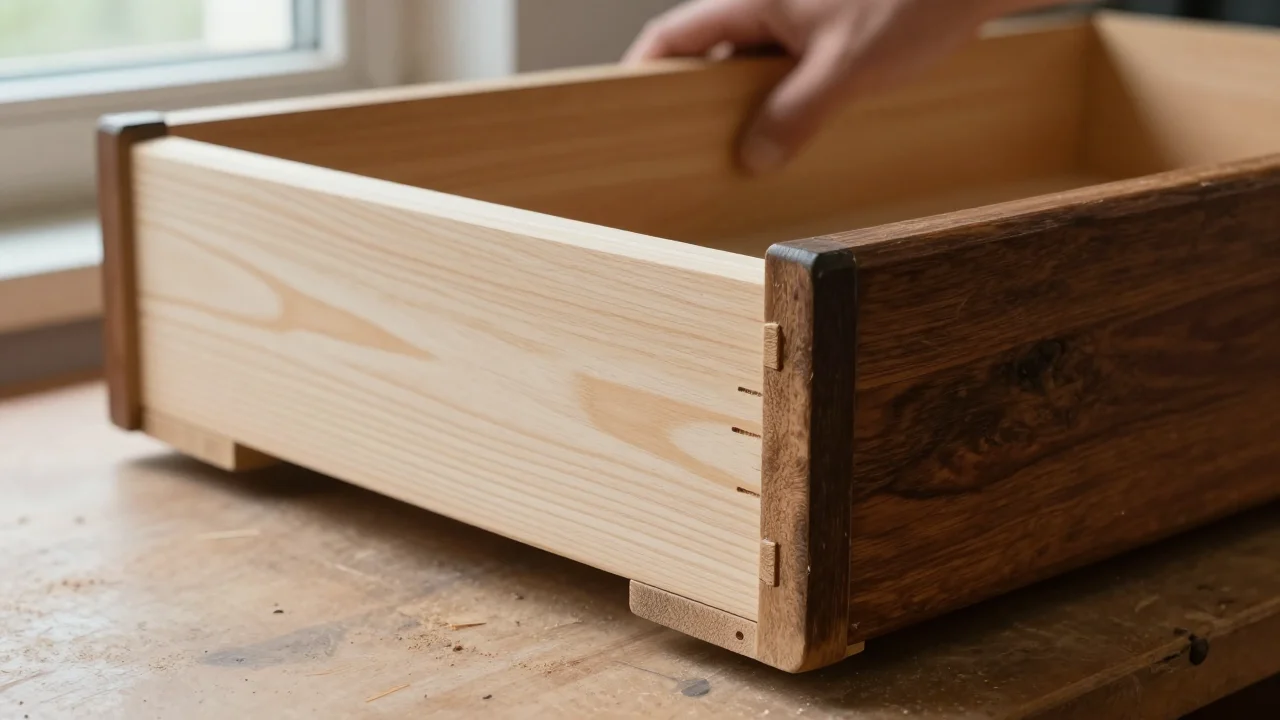
    Dovetail Analysis:

    Dovetails (the interlocking joints at drawer corners) are particularly telling:

    • Pre-1700: Large, crude, hand-cut dovetails, usually just 1-3 per joint
    • 1700-1890: Hand-cut but more refined, irregular spacing and angles
    • 1890-1950: Machine-cut, perfectly uniform, smaller and more numerous
    • 1950+: Router-cut with rounded internal corners

    What to Look For:

    1. Pull drawers out completely
    2. Examine where the sides meet the front
    3. Count the dovetails
    4. Check for uniformity – hand-cut means slight irregularity

    Other Construction Clues:

    • Mortise-and-tenon joints held with wooden pegs = pre-1850
    • Square nails = pre-1890
    • Round wire nails = post-1890
    • Hand-planed surfaces show subtle ripples
    • Machine-planed surfaces are perfectly flat

    For quick verification, try the Antique Identifier app which can analyze construction details from photos.

    Tip #4: Check the Hardware Authenticity

    Original hardware is like a fingerprint for dating furniture. But hardware is also the most commonly replaced element, so you need to look carefully.

    Signs of Original Hardware:

    • Shadow marks on the wood matching the current hardware
    • No extra screw holes or filled holes
    • Patina consistent with the piece
    • Style matches the furniture period

    Hardware Evolution Timeline:

    • 1690-1720: Teardrop pulls, single-post attachment
    • 1720-1780: Bail pulls (willow brasses) with two posts
    • 1780-1810: Oval stamped plates with bail
    • 1810-1840: Round rosettes, often with pressed designs
    • 1840-1880: Carved wooden pulls (Victorian)
    • 1880-1920: Cast brass, often ornate

    Red Flags:

    • Hardware that looks too new or shiny
    • Phillips head screws (invented 1930s) on “18th century” pieces
    • Holes that don’t align with current hardware
    • Mix of hardware styles on the same piece

    Note: Replaced hardware doesn’t make a piece worthless, but it does affect value. Original hardware can add 25-50% to a piece’s worth.

    Tip #5: Look for Signs of Genuine Wear

    Authentic antiques show wear in logical places from decades or centuries of use. Reproductions either show no wear or have artificially applied “distressing.”

    Where to Find Authentic Wear:

    • Feet bottoms (worn from moving and mopping around)
    • Stretchers (worn from resting feet)
    • Chair arms (worn where hands naturally grip)
    • Drawer runners (worn from repeated opening)
    • Edges and corners (rounded from handling)
    • Around keyholes (worn from key use)

    What Authentic Wear Looks Like:

    • Smooth, gradual transitions
    • Deeper wear in high-use areas
    • Consistent with the piece’s function
    • Patina worn through in logical spots

    Fake Wear Red Flags:

    • Distressing in random locations
    • Uniform “aging” across the whole piece
    • Sharp edges on supposedly old wear marks
    • Chains or tools marks (used to create fake damage)
    • Fresh scratches under “old” finish

    Tip #6: Analyze the Finish and Patina

    The finish on antique furniture evolved over time, and each era has characterstic treatments.

    Historical Finish Timeline:

    • Pre-1800: Wax, oil, or no finish
    • 1800-1860: Shellac becomes common
    • 1860-1920: Varnish (oil-based)
    • 1920-1960: Lacquer (nitrocellulose)
    • 1960+: Polyurethane

    Shellac Characteristics:

    • Warm, amber tone
    • Dissolves with alcohol (test in hidden spot)
    • Shows wear patterns
    • Can be refreshed without stripping

    Patina Matters: Patina is the surface character that develops over decades of exposure to air, light, and handling. It cannot be faked convincingly.

    Signs of Genuine Patina:

    • Color depth that goes into the wood, not just on the surface
    • Variation across the piece (light-exposed vs. protected areas)
    • Wear patterns that make sense
    • “Glow” that comes from decades of wax buildup

    Warning: Refinished antiques lose much of their patina. A piece that’s been stripped and refinished can lose 50-75% of its value compared to one with original finish.

    Tip #7: Investigate Maker’s Marks and Labels

    Many antique pieces are signed, stamped, labeled, or marked by their makers. Finding these marks can dramatically clarify identification and value.

    Where to Look:

    • Inside and underneath drawers
    • On backboards
    • Under table tops
    • On the bottom of chairs
    • Inside cabinet doors
    • On mechanisms (locks, hinges)

    Types of Marks:

    • Stamps: Impressed into the wood
    • Labels: Paper labels (often partial or faded)
    • Brands: Burned into the wood
    • Stencils: Painted marks
    • Chalk or pencil: Worker’s marks

    What Marks Tell You:

    • Maker’s name establishes authorship
    • Location helps date and authenticate
    • Patent dates provide “not earlier than” dating
    • Retailer labels indicate original market

    Caution: Fake labels and marks do exist. Look for:

    • Paper that’s too crisp for the supposed age
    • Printing technology that doesn’t match the period
    • Famous names on mediocre quality pieces
    • Labels applied over existing finish

    For help decoding marks, the Antique Identifier app includes a database of maker’s marks and can identify many stamps and signatures.

    Tip #8: Smell and Touch the Piece

    This might sound strange, but experienced dealers use all their senses when evaluating antiques.

    The Smell Test:

    • Old wood has a distinctive musty, dry smell
    • New wood smells fresh, sometimes like sawdust
    • Old finishes have a different scent than modern polyurethane
    • Genuine old drawers smell like decades of storage

    The Touch Test:

    • Old wood feels dry and slightly textite
    • Hand-planed surfaces have subtle ripples
    • Machine-sanded surfaces are perfectly smooth
    • Worn areas feel smoother than protected areas
    • Old hardware has softer edges than new castings

    What Your Hands Can Tell You: Run your hands over surfaces, especially hidden ones:

    • Drawer bottoms should feel hand-planed (subtle ridges)
    • Inside surfaces should feel different from outside
    • Repairs often feel different than original work
    • Old screws have irregular slots that you can feel

    Tip #9: Check for Consistency Throughout the Piece

    Genuine antiques are consistent in their construction, materials, and aging. Fakes, “marriages” (pieces assembled from parts of different items), and heavily repaired pieces show inconsistencies.

    What Should Match:

    • Wood species throughout
    • Construction methods
    • Hardware style
    • Wear patterns
    • Aging and patina
    • Proportions and style

    Red Flags:

    • Different wood species in unexpected places
    • Some dovetails hand-cut, others machine-cut
    • Wear patterns that don’t make sense
    • Parts that seem too big or small for the piece
    • Style elements from different periods

    “Marriages” to Watch For:

    • Highboys with replaced tops or bases
    • Secretaries with mismatched bookcase tops
    • Tables with replaced tops
    • Desks with added gallery or bookcase sections

    A married piece is worth considerably less than a completely original one, even if both parts are genuinely antique.

    Tip #10: Research Comparable Sales

    Knowing what similar pieces have sold for helps you identify and value antiques accurately.

    Where to Research:

    • Auction house archives (Christie’s, Sotheby’s, Heritage)
    • Online auction results (LiveAuctioneers, Invaluable)
    • Price guides (Miller’s, Kovels’)
    • Dealer websites and sold listings
    • Antique show price observations

    What to Compare:

    • Same period and style
    • Similar size and form
    • Comparable condition
    • Equivalent provenance

    Price Factors:

    • Maker attribution can multiply value by 10x or more
    • Original finish vs. refinished (2-4x difference)
    • Original hardware vs. replaced (25-50% difference)
    • Condition issues (damage reduces value significantly)
    • Regional desirability (American pieces in USA, etc.)

    Tip #11: Understand Style Evolution and Transitions

    Furniture styles didn’t change overnight. Understanding transitions helps you date pieces more precisely.

    Transitional Characteristics:

    • Early Queen Anne may still have stretchers
    • Late Chippendale often shows neoclassical influence
    • Empire style begins while Federal is still popular
    • Victorian revivals blend multiple earlier styles

    Dating by Style Details:

    If You See…It’s Likely…
    Cabriole legs + stretchersEarly Queen Anne (1720-1735)
    Ball-and-claw + straight legsTransitional Chippendale (1780s)
    Shield back + saber legsLate Federal/early Empire
    Gothic arch + rococo curvesEarly Victorian (1840s)

    Regional Time Lag: Styles took time to spread from urban centers. A piece in rural Pennsylvania might be made in Chippendale style in 1820, decades after it was fashionable in Philadelphia.

    Tip #12: Know the Most Common Fakes and Reproductions

    Certain styles and pieces are reproduced more than others. Knowing what to watch for helps you avoid expensive mistakes.

    Most Commonly Faked:

    1. Chippendale highboys – Victorian and Centennial reproductions abound
    2. Windsor chairs – Made continuously since the 1700s
    3. Shaker furniture – Simple style is easy to copy
    4. Arts & Crafts/Stickley – High value invites faking
    5. Colonial American pieces – Centennial (1876) reproductions
    6. French Provincial – Modern reproductions everywhere

    Reproduction Periods:

    • Centennial (1876): Colonial Revival pieces made for the 100th anniversary
    • Colonial Revival (1920s-40s): Mass-produced “colonial” furniture
    • Bicentennial (1976): Another wave of reproductions
    • Modern imports: Asian and European reproductions

    How to Spot Reproductions:

    • Construction too perfect (machine precision)
    • Wood too uniform in color
    • No logical wear patterns
    • Hardware inconsistencies
    • “Aged” finish that can be scratched through

    Tip #13: Evaluate Condition Objectively

    Condition dramatically affects value, but “perfect” condition on an antique should actually raise suspicions.

    Condition Grading:

    • Mint: Like new – actually suspicious for genuine antiques
    • Excellent: Minor wear consistent with age
    • Very Good: Normal wear, minor repairs
    • Good: Noticeable wear, some repairs needed
    • Fair: Significant issues but restorable
    • Poor: Major damage or loss

    Acceptable vs. Problematic Issues:

    Generally AcceptableValue Reducers
    Minor scratchesStructural damage
    Slight fadingMissing parts
    Small repairsReplaced major elements
    Replaced hardwareRefinished surfaces
    Normal wearWater damage
    Age-appropriate patinaInsect damage

    Restoration Considerations: Some restoration is acceptable:

    • Structural repairs for stability
    • Cleaning and waxing
    • Careful touch-ups

    Restoration that destroys value:

    • Stripping original finish
    • Replacing original parts unnecessarily
    • Over-restoration that removes character

    Tip #14: Trust But Verify Provenance

    Provenance (ownership history) can add significant value but can also be fabricated. Approach provenance claims with healthy skepticism.

    What Good Provenance Includes:

    • Documentation (bills of sale, inventory records)
    • Photographic evidence
    • Family history with supporting details
    • Exhibition history
    • Publication in books or catalogs

    Provenance Red Flags:

    • Vague claims without documentation
    • “From a famous estate” without proof
    • Stories that seem too good to be true
    • Provenance that doesn’t match the piece’s wear
    • Reluctance to provide verification

    How Provenance Affects Value:

    • Museum or notable collector ownership: Premium
    • Exhibition history: Adds value
    • Historical significance: Significant premium
    • Family stories without documentation: Minimal effect
    • No known provenance: Baseline value

    Tip #15: Use Technology as a Tool

    Modern technology can enhance your identification abilities, though it should supplement rather than replace traditional skills.

    Digital Resources:

    • Online auction archives for comparables
    • Maker’s mark databases
    • Museum collection databases
    • Digital measuring and documentation tools

    AI-Powered Identification:

    Apps like Antique Identifier use artificial intelligence to analyze photos and provide:

    • Period and style identification
    • Comparable sales data
    • Value estimates
    • Authentication indicators
    • Maker identification

    This technology is particularly helpfull when you’re at an estate sale or auction and need quick information before making a purchase decision.

    UV Light Examination: Black lights reveal:

    • Repairs and touch-ups (they fluoresce differently)
    • Old finishes vs. new
    • Replaced parts
    • Hidden damage

    Magnification: A loupe or magnifying glass helps you see:

    • Tool marks
    • Signatures and stamps
    • Wood grain details
    • Finish characteristics

    Putting It All Together: A Systematic Approach

    When evaluating an antique, use these tips systematically:

    Quick Assessment (2 minutes):

    1. Overall form and proportions
    2. Wood type
    3. Major style indicators
    4. General condition

    Detailed Examination (10-15 minutes):

    1. Construction methods (dovetails, joints)
    2. Hardware analysis
    3. Wear pattern evaluation
    4. Finish and patina
    5. Maker’s marks search
    6. Consistency check

    Research Phase (as needed):

    1. Style confirmation
    2. Comparable sales
    3. Maker research
    4. Provenance verification

    Common Mistakes to Avoid

    Even experienced collectors make these errors:

    1. Falling in love before evaluating – Emotional attachment clouds judgment
    2. Rushing decisions – Take time to examine thoroughly
    3. Ignoring red flags – One serious issue can mean fake or reproduction
    4. Over-relying on one factor – Use multiple identification methods
    5. Assuming age equals value – Condition and rarity matter more
    6. Skipping hidden areas – The best clues are often underneath
    7. Trusting seller claims – Verify independently
    8. Ignoring your instincts – If something feels wrong, investigate

    Conclusion

    Identifying antiques is both an art and a science. These 15 expert tips provide a framework, but developing true expertise requires practice, study, and handling as many genuine antiques as possible.

    Start with one period or style that interests you and learn it thoroughly. Visit museums to study authenticated pieces. Attend auctions and preview events where you can handle furniture. Build relationships with reputable dealers who can share their knowledge.

    And don’t hesitate to use modern tools like the Antique Identifier app to support your learning journey. AI can help you confirm identifications and catch details you might miss, especially when you’re still building your expertise.

    With practice and persistence, you’ll develop the eye that separates casual browsers from confident collectors. Happy hunting!

  • How to Identify Antique Furniture Styles: Complete Visual Guide (2026)

    How to Identify Antique Furniture Styles: Complete Visual Guide (2026)

    Have you ever walked into an antique shop or inherited a piece of furniture from your grandmother and wondered exactly what style it is? You’re definately not alone. Identifying antique furniture styles can feel overwhelming at first, but once you understand the key characteristics of each period, it becomes much more managable.

    In this comprehensive guide, we’ll walk you through everything you need to know about identifying antique furniture styles. From the ornate carvings of the Baroque period to the clean lines of Art Deco, you’ll learn how to recognize each style like a seasoned collector.

    Why Learning to Identify Antique Furniture Styles Matters

    Before we dive into the specifics, let’s talk about why this knowledge is so valuable. Whether you’re a collector, dealer, or simply someone who appreciates beautiful craftsmanship, understanding furniture styles helps you:

    • Determine authentic value – Knowing the true period of a piece affects its worth significantly
    • Avoid costly mistakes – Reproductions can fool even experienced buyers
    • Appreciate the craftsmanship – Each era had unique techniques and materials
    • Make informed purchases – You’ll know exactly what you’re buying

    If you want to identify antique furniture instantly, you can also try our Antique Identifier app for iOS which uses AI to recognize styles, periods, and estimate values from just a photo.

    The Major Antique Furniture Periods: A Quick Overview

    Understanding antique furniture starts with knowing the major historical periods. Here’s a timeline to help you get oriented:

    PeriodYearsKey Characteristics
    Jacobean1600-1690Heavy oak, geometric patterns
    William & Mary1690-1730Walnut veneer, trumpet legs
    Queen Anne1700-1755Cabriole legs, shell motifs
    Chippendale1750-1790Mahogany, ball-and-claw feet
    Federal/Hepplewhite1780-1820Delicate inlays, shield backs
    Empire1800-1840Bold columns, animal motifs
    Victorian1837-1901Ornate carvings, dark woods
    Arts & Crafts1880-1920Simple lines, visible joinery
    Art Nouveau1890-1910Flowing curves, nature themes
    Art Deco1920-1940Geometric shapes, exotic woods

    Now let’s explore each period in detail so you can identify them with confidance.

    Jacobean Period (1600-1690): The Foundation of English Furniture

    The Jacobean period represents some of the earliest furniture that collectors actively seek today. Named after King James I of England, this style is characterized by its solid, heavy construction.

    How to Identify Jacobean Furniture

    Wood Type: Almost exclusively oak, which was abundent in England at the time

    Construction: Heavy and sturdy with thick legs and stretchers connecting the legs near the floor

    Decorative Elements:

    • Geometric carved patterns
    • Spiral or barley twist turnings
    • Minimal curves – mostly straight lines
    • Split spindles applied as decoration

    Common Pieces: Gate-leg tables, joint stools, court cupboards, and wainscot chairs

    Pro Tip: Jacobean furniture often shows significant wear on stretchers because people rested their feet on them for centuries. This wear pattern is actually a good sign of authenticity.

    Common Mistakes When Identifying Jacobean Pieces

    Many Victorian-era reproductions mimick Jacobean style. To spot the difference:

    • Check the wood thickness – originals are thicker
    • Look for hand-cut dovetails vs. machine-cut
    • Examine the patina – 400-year-old oak has a distinctive color
    • Feel the underside – original pieces weren’t sanded smooth underneath

    William & Mary Period (1690-1730): Dutch Influence Arrives

    When William of Orange and Mary II took the English throne, they brought Dutch design influences that transformed English furniture. This period marks a signifcant shift toward lighter, more elegant pieces.

    Key Identification Features

    Wood Type: Walnut replaced oak as the primary wood, often used as veneer over other woods

    Legs: The famous trumpet-turned legs and inverted cup turnings are signature elements

    Decorative Techniques:

    • Marquetry (inlaid wood patterns)
    • Seaweed or arabesque marquetry patterns
    • Cross-banding on drawer fronts
    • Japanning (lacquer work imitating Asian designs)

    Stretchers: X-shaped or serpentine stretchers connecting legs

    Hardware: Tear-drop shaped brass pulls

    Spotting William & Mary Authenticity

    Original pieces will have hand-cut veneer that’s thicker than modern veneer. The marquetry should show slight irregularites that indicate hand-cutting. Machine-made reproductions are too perfect.

    Queen Anne Style (1700-1755): Elegance Takes Center Stage

    The Queen Anne period is beloved by collectors for its graceful proportions and refined details. Even though Queen Anne only reigned from 1702-1714, the style bearing her name continued for decades.

    Distinctive Queen Anne Characteristics

    The Cabriole Leg: This is THE defining feature – a curved leg that flows outward at the knee and inward at the ankle, ending in a pad foot, slipper foot, or trifid foot

    Wood Type: Walnut dominated early pieces, transitioning to mahogany in later years

    Chair Backs:

    • Fiddle-shaped or vase-shaped splats
    • Curved top rails (called yoke crests)
    • No stretchers between legs – the cabriole leg was strong enough alone

    Shell Motif: Carved shell decorations on chair crests, table knees, and cabinet pieces are quintessential Queen Anne

    Proportions: Overall lighter and more vertical than earlier periods

    American vs. English Queen Anne

    There are subtle but important differences:

    FeatureEnglishAmerican
    FeetMostly pad feetMore variety including trifid
    WoodPrimarily walnutOften maple, cherry, or walnut
    ProportionsSlightly heavierTaller and more slender
    CarvingMore elaborateSimpler, more restrained

    Philadelphia Queen Anne pieces are particulary prized by American collectors and command premium prices at auction.

    Chippendale Period (1750-1790): The Height of Georgian Craftsmanship

    Thomas Chippendale published “The Gentleman and Cabinet-Maker’s Director” in 1754, and it became the most influential furniture design book of the 18th century. His name became synonomous with the elaborate style of this period.

    Identifying Chippendale Furniture

    The Ball-and-Claw Foot: Perhaps the most recognizable feature – a carved claw grasping a ball, evolved from Chinese dragon imagery

    Wood: Mahogany became the dominant wood, prized for its strength and ability to hold intricate carving

    Three Main Style Variations:

    1. Gothic Chippendale – Pointed arches and tracery
    2. Chinese Chippendale – Fretwork, pagoda tops, bamboo-style turnings
    3. French Chippendale – Rococo curves and asymmetrical carving

    Chair Features:

    • Pierced splats with intricate patterns
    • Serpentine top rails
    • Carved knees on cabriole legs
    • Wide seats

    Case Pieces:

    • Broken pediment tops
    • Flame or urn finials
    • Bracket feet or ogee feet
    • Elaborate brass hardware

    Authentication Tips for Chippendale

    Genuine period Chippendale pieces have:

    • Hand-cut dovetails (irregular spacing and angles)
    • Secondary woods like poplar or pine inside drawers
    • Shrinkage across the grain of solid wood panels
    • Original brasses will leave shadow marks even if replaced

    The “Chippendale style” was reproduced extensively in the 19th and 20th centuries. Don’t confuse Victorian-era Chippendale revival pieces with genuine 18th-century originals – the value difference is enormous.

    Federal Period & Hepplewhite Style (1780-1820): American Independence in Design

    After American independence, furniture makers developed distinctly American interpretations of English designs. The Federal period encompasses both Hepplewhite and Sheraton influences.

    Hepplewhite Characteristics

    George Hepplewhite’s designs emphasized elegance and delicacy:

    Legs: Straight, tapered legs (square or round) replaced the cabriole

    Chair Backs: Shield-shaped, heart-shaped, or oval backs with delicate splats

    Inlay: Extensive use of contrasting wood inlays – bellflowers, urns, eagles, and paterae (oval medallions)

    Wood: Mahogany with satinwood, holly, or ebony inlays

    Hardware: Oval brass plates with bail handles

    Sheraton Style Distinctions

    Thomas Sheraton’s designs appeared slightly later and had subtle differences:

    • Chair backs more rectangular or square
    • More use of reeding (parallel carved lines)
    • Legs often reeded or turned
    • Less curved overall – more architectural feeling

    Both styles reflect the neoclassical movement inspired by discoveries at Pompeii and Herculaneum.

    Empire Period (1800-1840): Bold and Monumental

    The Empire style originated in France under Napoleon but quickly spread throughout Europe and America. It’s dramatically different from the delicate Federal style.

    Empire Identification Guide

    Proportions: Heavy, monumental, and symmetrical

    Columns: Classical columns, often gilded or ebonized, as structural and decorative elements

    Animal Motifs:

    • Lion’s paw feet
    • Eagle heads and wings
    • Swan neck curves
    • Dolphin supports

    Wood: Mahogany, often with ormolu (gilded bronze) mounts

    Decorative Elements:

    • Lyre shapes
    • Laurel wreaths
    • Torch and arrow motifs
    • Egyptian influences (sphinxes, hieroglyphics)

    Marble: White marble tops on tables, commodes, and pier tables

    American Empire Specifics

    American Empire (sometimes called “Classical American”) tends to be:

    • Less ornate than French Empire
    • More reliance on figured mahogany veneers
    • Stenciled rather than gilded decoration
    • Larger scale overall

    Duncan Phyfe is the most famous American maker of this period, and his pieces command high prices today.

    Victorian Era (1837-1901): Exuberance and Variety

    The Victorian era spans over 60 years and includes multiple sub-styles. This can make identification tricky, but also means there’s something for every taste.

    Victorian Sub-Styles

    Early Victorian / Gothic Revival (1840-1860)

    • Pointed arches
    • Trefoil and quatrefoil motifs
    • Dark, heavy appearance
    • Church-like decoration

    Rococo Revival (1845-1870)

    • Exaggerated curves
    • Elaborate carved flowers and fruits
    • Tufted upholstery
    • Rosewood or walnut

    Renaissance Revival (1860-1885)

    • Architectural elements
    • Incised carved lines
    • Medallions and busts
    • Walnut with burl veneer panels

    Eastlake (1870-1890)

    • Named after Charles Eastlake
    • Rectilinear forms
    • Incised geometric decoration
    • Less carving, more machine-made elements
    • Often ebonized with gilded highlights

    Colonial Revival (1880s onward)

    • Return to earlier American styles
    • Reproductions of Colonial and Federal pieces
    • Still being made today

    How to Date Victorian Furniture

    • Screws: Handmade screws until about 1850, machine-made after
    • Circular saw marks: Became common after 1850
    • Wire nails: After 1890 (before that, cut nails)
    • Thick veneer: Earlier pieces have thicker veneer
    • Finish: Shellac was common, lacquer came later

    Arts & Crafts Movement (1880-1920): Honest Construction

    As a reaction against Victorian excess and industrial mass production, the Arts & Crafts movement celebrated handcraft and simple design.

    Arts & Crafts Identification

    Construction: Visible joinery is celebrated, not hidden

    • Through-tenons (you can see where the tenon passes through)
    • Exposed pegs
    • Visible dovetails

    Wood: Quarter-sawn oak is the signature wood, showing distinctive ray flake patterns

    Hardware: Hand-hammered copper or iron

    Design Philosophy: Form follows function – no unneccesary decoration

    Key Makers:

    • Gustav Stickley (and his brothers’ competing companies)
    • Roycroft
    • Limbert
    • Charles Rohlfs

    Stickley Identification: Look for the “Als Ik Kan” motto or the joiner’s compass mark

    Mission Style vs. Arts & Crafts

    “Mission” is sometimes used interchangably with Arts & Crafts, but technically Mission refers to a subset with more severe, rectilinear designs inspired by Spanish mission furniture.

    Art Nouveau (1890-1910): Nature as Inspiration

    Art Nouveau was a brief but influential style that embraced organic, flowing forms inspired by nature.

    Recognizing Art Nouveau

    Curves: Sinuous, whiplash curves that flow continuously

    Nature Motifs:

    • Flowers (especially lilies, irises, orchids)
    • Vines and tendrils
    • Dragonflies and butterflies
    • Female figures with flowing hair

    Materials: Often combined wood with metal, glass, or mother-of-pearl

    Key Designers:

    • Louis Majorelle (France)
    • Émile Gallé (France)
    • Hector Guimard (France)
    • Carlo Bugatti (Italy)

    Art Nouveau furniture is relatively rare and highly collectible. Even smaller pieces command strong prices.

    Art Deco (1920-1940): Geometric Glamour

    Art Deco embraced the machine age with bold geometric designs and luxurious materials.

    Art Deco Characteristics

    Shapes: Geometric – circles, triangles, chevrons, sunbursts

    Materials:

    • Exotic woods (macassar ebony, zebrawood, amboyna)
    • Lacquer (often in bold colors)
    • Chrome and glass
    • Shagreen (ray or shark skin)
    • Ivory (now illegal to trade)

    Colors: Bold contrasts – black and cream, red and gold

    Surface Treatment: High-gloss finishes, often lacquered

    Key Designers:

    • Émile-Jacques Ruhlmann
    • Jean Dunand
    • Jules Leleu
    • Paul Frankl (American)

    Deco vs. Moderne

    “Art Moderne” or “Streamline Moderne” from the 1930s has even simpler lines with teardrop shapes and horizontal banding, inspired by aerodynamics.

    Practical Tips for Identifying Any Antique Furniture

    Now that you know the periods, here are universal techniques that apply across all styles:

    1. Examine the Construction

    Dovetails: Hand-cut dovetails (before 1890) are irregular and fewer in number. Machine-cut dovetails are perfectly uniform.

    Screws:

    • Before 1850: Handmade, irregular threads, off-center slots
    • 1850-1890: Machine-made but with blunt ends
    • After 1890: Modern pointed screws

    Saw Marks:

    • Straight parallel marks = hand saw or early circular saw
    • Curved marks = circular saw (post-1850)
    • No marks = band saw (late 19th century onward)

    2. Study the Wood

    Primary Woods: What’s visible tells you about period and origin

    Secondary Woods: Inside drawers, backboards, and underneath – these reveal geographic origin:

    • Poplar = American
    • Pine = Could be either
    • Oak secondary = Often English
    • Chestnut = Continental European

    Shrinkage: Old wood shrinks across the grain. Round tabletops become slightly oval. Drawer bottoms show gaps on the sides.

    3. Look at Hardware

    Original hardware leaves shadow marks on the wood. If the hardware looks original but there are no shadows or extra holes, be suspicious.

    Brass Development:

    • Early 18th century: Solid cast brass
    • Mid-18th century: Stamped brass
    • 19th century: Machine-pressed brass
    • Modern: Die-cast with consistent thickness

    4. Check the Finish

    Wax: Used throughout history Oil: Common on early pieces Shellac: Dominated 19th century Lacquer: 20th century (nitrocellulose lacquer) Polyurethane: Modern only

    5. Assess Wear Patterns

    Authentic wear appears in logical places:

    • Feet bottoms are worn from moving
    • Chair arms are worn where hands rest
    • Stretchers worn from feet
    • Drawer runners worn from use

    Fake wear is often too uniform or in illogical places.

    Using Technology to Identify Antiques

    While hands-on examination remains essential, modern technology can help tremendously.

    AI-Powered Identification

    Apps like Antique Identifier use artificial intelligence to analyze photos and identify furniture styles, periods, and even estimate values. This is particularly helpfull when you’re at an estate sale or auction and need quick information.

    Simply snap a photo, and the AI will:

    • Identify the likely period and style
    • Point out key features that indicate age
    • Suggest a value range based on current market data
    • Alert you to potential reproduction indicators

    Online Resources

    • Price databases: Track auction results
    • Museum collections: Study authenticated pieces
    • Maker mark databases: Research signatures and stamps

    Common Reproduction Red Flags

    Be aware of these warning signs:

    1. Too perfect condition – 100+ year old furniture should show some wear
    2. Uniform color – Real patina has variations
    3. Modern materials inside – Plywood, particle board, or Phillips-head screws
    4. Suspiciously low prices – If it seems too good to be true, it probably is
    5. No provenance – Quality antiques usually have some history
    6. Fresh wood smell – Old wood smells old
    7. Identical “twins” – True antiques are individual; finding exact matches is suspicious

    Building Your Identification Skills

    Becoming proficient at identifying antique furniture takes time and practice. Here’s how to accelerate your learning:

    1. Visit museums – Study authenticated pieces up close
    2. Attend auctions – Preview events let you handle furniture
    3. Read extensively – Build a reference library
    4. Handle as much furniture as possible – Touch and examine everything you can
    5. Find a mentor – Experienced collectors love sharing knowledge
    6. Use technology – Apps like Antique Identifier can help train your eye

    Conclusion

    Identifying antique furniture styles is a skill that develops over time, but understanding the basic characteristics of each period gives you a strong foundation. Remember to consider multiple factors – construction methods, materials, proportions, decorative elements, and wear patterns – before making a determination.

    Whether you’re evaluating a potential purchase, trying to identify an inherited piece, or simply appreciating the craftsmanship of earlier eras, this knowledge enriches your experience with antique furniture.

    For quick identification on the go, download the Antique Identifier app and let AI assist your journey into the fascinating world of antique furniture.


    Have a piece you can’t identify? Share a photo with our community or try our AI-powered identification tool for instant results.

  • Antique Identification in 2026: Tools, Tips, and Smart Shortcuts

    Antique Identification in 2026: Tools, Tips, and Smart Shortcuts

    Antique Identification Has Changed

    In the past, identification meant books and guesswork.
    In 2026, it means tools, structure, and smart shortcuts.

    The goal is not to replace knowledge.
    The goal is to reach it faster.


    The Core Tools That Actually Help

    Effective identification relies on:
    Visual comparison
    Construction analysis
    Context awareness

    Anything that skips these creates false confidence.


    Antique Identifier

    Tips That Save the Most Time

    Experienced collectors follow simple rules:
    Ignore value at first
    Photograph details, not beauty
    Question perfect symmetry
    Trust wear more than labels

    These habits prevent most beginner mistakes.


    Smart Shortcuts Are Not Cheating

    Shortcuts are only bad when they skip thinking.

    Good shortcuts:
    Guide your attention
    Reduce blind spots
    Speed up learning

    They help you focus on what matters.


    Where Visual Identification Fits In

    Visual tools act as the first layer.

    They help you:
    Confirm category
    Notice construction clues
    Decide if deeper research is needed

    This is especially useful when time matters.

    👉 Use the smartest shortcut: the app
    https://apps.apple.com/app/id6751417557?ct=tools_and_shortcuts_1

    Think of it as your starting point, not the final answer.


    Final Thought

    Antique identification in 2026 is about clarity.

    Less guessing.
    Better questions.
    Smarter first steps.

  • What Is My Antique Worth? A Simple Way to Find Out in 2026

    What Is My Antique Worth? A Simple Way to Find Out in 2026

    This Is the Question Everyone Asks First

    What is my antique worth?

    It sounds simple.
    But most wrong decisions start right here.

    People jump to price before understanding the object.
    That is where confusion begins.


    Why Price Is the Last Step, Not the First

    Value depends on things most people skip:
    What the object actually is
    When it was made
    How it was made
    Its condition today

    Without these, any number is guesswork.


    Antique Collection
    Collection

    A Simple Way to Approach Antique Value

    In 2026, the smartest approach is short and practical.

    Step one: identify the item
    Step two: confirm era and category
    Step three: check condition issues
    Step four: estimate a realistic range

    Exact prices come later, if needed.


    Why Most People Overthink This

    They assume value requires expert knowledge.
    It doesnt.

    It requires the right order.

    Once identity is clear, value usually becomes obvious.


    The One Scan Starting Point

    Instead of jumping between sites and forums, many people now start with visual identification.

    It helps you:
    Understand what you have
    Spot red flags early
    Avoid emotional pricing

    👉 Find out now with one scan
    https://apps.apple.com/app/id6751417557?ct=what_is_it_worth_1

    Use it to decide what to do next, not to rush a sale.


    Final Thought

    The right question isnt “how much is it worth”.

    The right question is “what is it, really”.

  • Online Antique Appraisal vs In-Person: Which Is Better in 2026?

    Online Antique Appraisal vs In-Person: Which Is Better in 2026?

    This Is Not an Either Or Question

    People often ask if online antique appraisal is better than in person appraisal.

    The honest answer is simple.
    They solve different problems.

    In 2026, the best approach uses both.


    Online Antique Appraisal

    What Online Antique Appraisal Does Well

    Online appraisal works best for:
    Quick filtering
    Early identification
    Low cost checks
    Avoiding obvious mistakes

    It is fast and accessible.
    But it has limits.


    Where In Person Appraisal Wins

    Professional in person appraisal excels at:
    High value items
    Legal documentation
    Insurance and estates
    Deep historical context

    It is slower and costs more.
    But accuracy is higher.


    Why Hybrid Works Better Than Choosing One

    Most antiques dont need immediate professional appraisal.

    Smart collectors:
    Start online
    Filter carefully
    Go in person only when needed

    This saves time and money.


    When You Should Go Directly to an Expert

    Skip online tools if:
    The item is clearly rare
    Insurance value is required
    Legal documentation matters

    In these cases, go straight to a professional.


    Using Online Tools as the First Step

    Online visual tools help you decide if the next step is worth it.

    They:
    Highlight key details
    Reduce uncertainty
    Prepare you for expert conversations

    👉 Start with online AI appraisal
    https://apps.apple.com/app/id6751417557?ct=online_vs_physical_1

    Think of online appraisal as preparation, not replacement.


    Final Thought

    Online vs in person is the wrong debate.

    The real question is when to use each.

  • Antique Identification Mistakes Beginners Make (2026 Edition)

    Antique Identification Mistakes Beginners Make (2026 Edition)

    Every Beginner Makes These Mistakes

    If you are new to antique identification, this will sound familiar.
    Most beginners repeat the same errors. I did too.

    The good news is simple.
    Once you know them, they are easy to avoid.


    Mistake 1: Assuming Old Means Valuable

    Age alone means nothing.

    Many old items were mass produced.
    Some look antique but are recent reproductions.

    Value comes from rarity, quality, and demand. Not just age.


    Mistake 2: Trusting Seller Descriptions

    Words like:
    Rare
    Museum quality
    Estate find

    Are marketing terms, not proof.

    Always verify with physical details.


    Mistake 3: Ignoring Construction Details

    Beginners focus on surface beauty.

    Experts look underneath.
    Back panels, joints, screws, and fasteners tell the real story.

    This is where most identifications fail.


    Mistake 4: Comparing Only by Style

    Style is easy to copy.

    Two items can look similar but be decades apart in age.
    Construction and materials matter more than decoration.


    Mistake 5: Rushing to Value Too Early

    Price should be the last question.

    First identify:
    What it is
    When it was made
    How it was made

    Skipping steps leads to bad assumptions.


    Learning Faster Without Repeating Errors

    Modern collectors use tools to shorten the learning curve.

    Visual identification tools help beginners:
    Notice details
    Avoid false confidence
    Learn by comparison

    👉 Identify antiques the smart way
    https://apps.apple.com/app/id6751417557?ct=beginner_mistakes_1

    Think of it as training wheels, not shortcuts.


    Final Thought

    Mistakes are part of learning.

    Repeating them is optional.

  • How to Know If an Antique Is Worth Money Before Selling It

    How to Know If an Antique Is Worth Money Before Selling It

    Selling Too Early Is the Most Expensive Mistake

    Many people sell antiques too fast.
    Not because they need money, but because they need certainty.

    Before selling, you need answers to a few key questions.


    Step 1: Confirm It Is Actually Antique

    Sounds obvious, but it matters.

    Check:
    Construction style
    Materials
    Wear consistency

    If these dont align, value expectations collapse fast.


    Step 2: Identify Category and Era

    Buyers dont pay for age alone.

    They pay for:
    Specific categories
    Recognizable periods
    Consistent design

    Vague descriptions attract low offers.


    Step 3: Look for Red Flags Before Listing

    Common issues include:
    Hidden repairs
    Missing parts
    Replaced stones or hardware

    Ignoring these leads to returns or disputes.


    Step 4: Estimate Range, Not Price

    Exact prices are rare.

    Smart sellers aim for a range.
    Low, realistic, and optimistic.

    This prevents panic selling.


    Step 5: Decide If Professional Appraisal Is Needed

    If the item shows strong signs:
    Rare construction
    Unusual marks
    High quality materials

    Then a paid appraisal may make sense.

    Otherwise, it may not be worth the cost.


    A Faster Pre Selling Check

    Before contacting buyers or appraisers, many sellers now start with visual scanning.

    It helps:
    Confirm category
    Spot issues early
    Avoid underpricing

    👉 Check value before you sell: https://apps.apple.com/app/id6751417557?ct=before_selling_1

    Use it to decide your next move, not to rush one.


    Final Thought

    Selling antiques is about timing.

    A little patience before listing often means a lot more money later.

  • I Tried Online Antique Valuation Tools – Here’s What Surprised Me

    I Tried Online Antique Valuation Tools – Here’s What Surprised Me

    I Didn’t Expect This Going In

    I tested several online antique valuation tools over a few days.
    Same items. Similar photos. Different platforms.

    I expected small differences.
    What I got were completely different answers.

    That was surprising. And a bit worrying.


    The Test Setup

    I used:
    One small furniture piece
    One piece of jewelry
    One decorative object

    Nothing museum level. Just everyday antiques people actually own.

    I submitted similar photos and descriptions each time.


    What Happened Next

    Some tools gave instant prices.
    Others asked long forms.
    A few never replied at all.

    The values ranged from very low to unrealistically high.

    That told me something important.


    The Biggest Surprise

    Tools that relied only on text questions performed worst.

    The ones that focused on visual details were more consistent.
    They didnt always give a price, but they helped me understand the item.

    That alone felt more honest.


    What I Learned Quickly

    Online antique valuation works best when:
    You treat it as a filter
    You ignore exact prices early
    You focus on identification first

    Once I changed my expectations, results made more sense.


    The Tool That Helped the Most

    The most useful tool wasnt the one with the biggest number.

    It was the one that:
    Explained why an item mattered
    Highlighted construction details
    Pointed out uncertainty

    👉 Try the tool that worked best
    https://apps.apple.com/app/id6751417557?ct=personal_test_1

    It helped me decide which items were worth deeper research.


    Final Thought

    Online valuation isnt about finding the highest number.

    Its about avoiding the wrong one.

  • Antique Jewelry Appraisal Online: Marks, Stones, and Hidden Value

    Antique Jewelry Appraisal Online: Marks, Stones, and Hidden Value

    Antique Jewelry Is Small but Tricky

    Antique jewelry appraisal online sounds easier than furniture.
    Smaller item. Clear photos. Right?

    Not really.

    Jewelry hides mistakes better than any other antique category.


    diamond identifier

    Hallmarks Are Helpful, Not Guarantees

    Hallmarks matter.
    But beginners trust them too much.

    Problems include:
    Copied marks
    Misread symbols
    Wrong country assumptions

    A real mark in the wrong place is still a red flag.


    Stones Tell More Than Metal

    Professionals look at stones before metal.

    They check:
    Cut style
    Wear on facets
    Setting technique

    Old cuts reflect light differently.
    Modern stones often look too perfect.

    This detail is missed by most online appraisal forms.


    Settings Reveal the Era

    Prongs, bezels, and soldering styles change over time.

    Machine perfect settings usually signal newer pieces.
    Older settings show slight inconsistencies.

    Once you see it, you cant unsee it.


    Fake Antiques Are Common in Jewelry

    Jewelry is heavily reproduced.

    Reasons:
    High margins
    Easy aging tricks
    Low material cost fakes

    This is why quick price checks often fail.


    Why Visual Identification Helps with Jewelry

    Visual tools analyze:
    Stone shape
    Setting symmetry
    Surface wear

    They help you spot warning signs early.

    👉 Identify jewelry details instantly
    https://apps.apple.com/app/id6751417557?ct=jewelry_appraisal_1

    Use it before assuming rarity or value.


    Final Thought

    Antique jewelry rewards patience.
    Rushing leads to expensive mistakes.

    Start with identification, not excitement.

Download Antique Identifier App
Scan to Download
Identify antiques instantly with AI
★★★★★ FREE
🔍 IDENTIFY NOW 🔍 IDENTIFY NOW