The antique market in 2026 looks very different from just a few years ago. Some objects once considered ordinary are now highly sought after, while others that dominated auctions in the past have quietly lost demand. Understanding what makes an antique valuable today requires more than knowing its age or appearance.
Whether you are sorting through family heirlooms, exploring estate sales, or buying online, learning how to identify valuable antiques is a skill that can save money and uncover hidden opportunities. This guide explains the fundamentals of antique value in a clear, practical way, using methods professionals rely on every day.
For fast, AI-assisted evaluations, many collectors now use tools like the Antique Identifier Veritas app to support their research.
The Core Factors That Determine Antique Value in 2026
1. Age and Historical Context
Age still matters, but not in the way many people assume. While antiques are traditionally defined as items over 100 years old, value is shaped more by context than by a number alone.
Items made before 1830 are often considered true antiques by strict standards. Pieces from 1830 to 1920, especially Victorian and Edwardian objects, remain strong in the market. Vintage items from 1920 to 1980 continue to rise in value, particularly those tied to design movements or cultural shifts.
Historical relevance can increase worth dramatically. Objects connected to important events, industries, or individuals often outperform similar items with no documented story.
A useful rule is to examine how the item was made. Hand cut joinery, early glass pontil marks, and irregular metal shaping usually indicate earlier production methods that modern manufacturing cannot replicate.
2. Rarity Combined With Demand
Rarity alone does not create value. An object must also be desirable to collectors.
When evaluating rarity, consider how many examples were originally produced and how many still exist today. Regional scarcity also matters. Some items are common in one country but extremely rare elsewhere.
Demand changes over time. In 2026, collectors are actively seeking objects with strong design identity, clear origin, and authentic materials. If no one is searching for an item, rarity will not help much.
3. Condition and Originality
Condition remains one of the most important value drivers.
Items in excellent original condition can be worth several times more than damaged examples. Missing or replaced parts often reduce value significantly, sometimes by more than half.
Natural patina is usually a positive feature. It shows age and honest use. Over cleaning or aggressive restoration often does more harm than good.
Professional restoration can preserve value if done correctly, but amateur repairs almost always reduce it. When unsure, leaving an item untouched is often the safer choice.
4. Marks, Signatures, and Provenance
Clear identification is essential for accurate valuation.
Maker’s marks, signatures, hallmarks, and original labels help establish authenticity and origin. For silver and jewelry, hallmarks provide information about metal purity, location, and testing dates.
Documentation adds credibility. Old receipts, photographs, letters, or inventory tags can increase value by providing a traceable history. Even partial provenance is better than none.
In many cases, identifying a mark correctly can multiply an item’s worth. This is one reason mark research is such an important skill for collectors.
5. Craftsmanship and Materials
Quality always matters.
Solid materials outperform imitations over time. Hand carved details, complex joinery, and thoughtful design signal higher craftsmanship. Items that still function as intended often hold stronger value as well.
In 2026, collectors increasingly appreciate objects that show skill and intention rather than mass production efficiency.
How to Identify Antique Furniture in Practice
Step One: Examine Construction
Furniture reveals its age through how it was built.
Hand cut dovetail joints are irregular and usually predate 1860. Machine cut dovetails are uniform and indicate later production. Circular saw marks suggest post-1850 manufacturing.
Early screws were hand filed and often have off center slots. Perfectly centered screws point to modern production.
Wood choice can also help narrow periods, as certain species were favored at different times.
Step Two: Recognize Style Periods
Understanding style trends helps with dating and attribution.
Georgian furniture often features balanced proportions and mahogany. Victorian pieces tend to be more ornate, using darker woods. Art Nouveau emphasizes flowing natural forms, while Art Deco focuses on geometry and bold materials.
Style alone is not proof, but it provides valuable clues when combined with construction details.
Identifying Valuable Antique Jewelry and Decorative Objects
Understanding Hallmarks
Hallmarks are essential for jewelry identification.
Common purity marks include 925 for sterling silver and 750 for 18k gold. Assay marks show where and when testing occurred. Maker’s marks identify specific workshops or designers.
British date letters are especially useful, as they allow precise year identification.
Evaluating Gemstones
Natural gemstones usually contain internal inclusions and show wear consistent with age. Perfect stones in old settings should raise questions.
Settings themselves offer dating clues. Stone cuts, prong styles, and metal choices change over time. Basic testing methods such as UV fluorescence and thermal conductivity can help confirm authenticity.
Common Mistakes People Still Make in 2026
Assuming Age Automatically Means Value
Many old objects are common. Meanwhile, some newer designer items command high prices. Value comes from the full picture, not age alone.
Cleaning Too Aggressively
Removing original finishes or patina can permanently damage value. This mistake is still one of the most costly errors collectors make.
Ignoring Regional Differences
Styles and materials vary by region. Understanding where an item was made is essential for accurate identification.
Falling for Reproductions
Modern reproductions often look convincing. Warning signs include overly perfect surfaces, artificial wear, modern hardware, and inconsistent aging patterns.
How AI Tools Are Changing Antique Identification
Technology plays a growing role in antique research.
AI systems can analyze photos to recognize styles, periods, and maker patterns. Large databases allow instant comparison with verified examples. Market analysis tools track real sales data rather than asking prices.
Used correctly, AI does not replace expertise. It supports it. Combining human judgment with modern tools produces better results than either alone.
To get the best results, photograph items in natural light, include close ups of marks, and provide clear scale references. High resolution images make a real difference.
Antique Market Trends to Watch in 2026
Growing Interest Areas
Mid century modern furniture remains strong, especially Scandinavian pieces. Art glass continues to rise, including Murano and studio glass. Vintage technology such as early cameras and audio equipment is gaining attention. Asian antiques, particularly Chinese and Japanese works, are seeing renewed demand.
Declining Categories
Traditional dark wood furniture continues to soften. Large formal china sets are difficult to sell. Mass produced collectibles from the late twentieth century remain oversupplied.
Where to Find Valuable Antiques Today
Estate sales remain one of the best sources for undervalued items. Learning which sales to attend and building relationships with organizers can provide long term advantages.
Online marketplaces offer scale but require caution. Always request additional photos, verify seller reputation, and compare images to known examples. Reverse image search is a simple but effective tool.
Knowing When to Seek Professional Appraisal
Professional appraisal makes sense when items may exceed meaningful value thresholds, for insurance purposes, estate planning, or legal matters. Certified appraisals carry weight that informal estimates do not.
Protecting and Preserving Your Collection
Proper storage matters. Stable temperature and humidity protect materials. Light exposure should be controlled. Handling should always support weight from below and avoid stress points.
Documenting your collection with photographs and notes creates long term value and helps with future evaluation.
Final Thoughts on Antique Value in 2026
Antique identification is a skill built through observation, research, and experience. Understanding what makes an antique valuable today means combining historical knowledge with modern tools and market awareness.
Whether you are asking what is my antique worth or building a serious collection, patience and curiosity pay off. With the principles in this guide, you are better prepared to recognize quality, avoid common mistakes, and uncover meaningful value where others may not look closely enough.
That forgotten object in the corner might not just be old. It might be important.
Quick Antique Identification Checklist
✓ Estimate age using construction methods ✓ Look for marks, signatures, and labels ✓ Assess condition and originality ✓ Identify style period and region ✓ Compare with recent auction results ✓ Photograph details clearly ✓ Use AI tools for support research ✓ Seek professional appraisal when needed
Antique Identifier App is the best free app to identify antiques instantly — snap a photo, get AI-powered identification, historical context, and real market value estimates in seconds. Free to download on iPhone, no sign-up required.
ED
Antique Identifier Editorial
Published by OBZENA LLC · April 18, 2026
To see the kind of answer it produces before installing it, the free web appraisal runs the same idea from a single photograph.
What Is Antique Identifier?
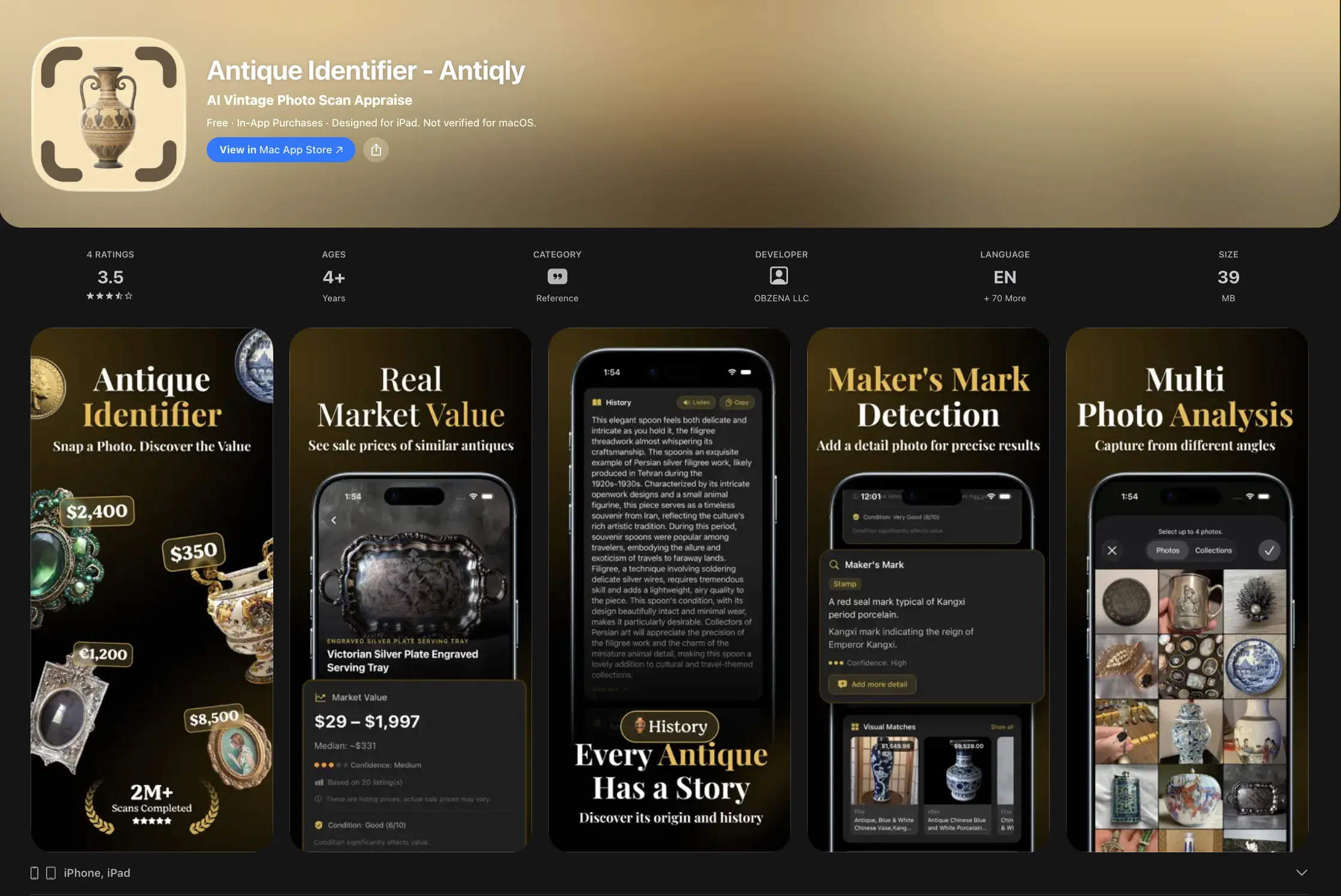
Antique Identifier is a mobile app that lets you identify antiques from a photo, analyze similar items on the market, and estimate their real-world value using visual matching and historical data. Unlike flipping through a printed Kovel’s price guide, the app delivers instant results the moment you point your camera at an object.
Simply take a photo — the app does the rest.
No guesswork. No outdated price guides. No complicated research.
Snap a photo and instantly identify antiques, vintage items, collectibles, ceramics, art objects, coins, and more. The AI analyzes patterns, materials, hallmarks, and design details to provide accurate identification — the same kind of visual detective work that experts at institutions like the Metropolitan Museum of Art apply to decorative arts attribution.
💰 Discover Estimated Market Value
Learn the price range of your item based on:
Similar antiques sold online
Market listings
Condition comparisons
Perfect for sellers, buyers, collectors, and insurance purposes. For deeper auction history, resources like WorthPoint archive millions of sold prices that complement the app’s real-time estimates.
📚 Learn the History Behind Every Item
Each object tells a story. Antique Identifier provides historical context including:
Origin and cultural background
Estimated time period
Maker or style (when available)
This turns identification into real understanding — not just a label. The Smithsonian Institution has long demonstrated how provenance and cultural context dramatically affect an object’s historical and monetary significance.
🔗 Compare Similar Antiques Visually
See real visual matches from the market and auctions. Compare pricing, condition, and rarity to understand how your item fits into today’s antique market. Leading auction houses such as Heritage Auctions rely on exactly this kind of comparative analysis when establishing pre-sale estimates for consigned pieces.
Save identified items into your personal inventory:
Organize your collection
Track estimated values
Keep a secure digital record of your antiques
Ideal for long-term collectors and estate planning.
📄 Export Detailed PDF Reports
Generate professional PDF reports for:
Insurance documentation
Selling listings
Personal records
Clear, structured, and easy to share. When a formal appraisal is needed for high-value items, the International Society of Appraisers can connect you with a credentialed professional whose written opinion satisfies insurance and estate requirements.
Who Is Antique Identifier For?
Collectors who want to understand and manage their collections
Resellers & flippers hunting undervalued items at flea markets and estate sales
Inherited item owners unsure about the value of family antiques
Curious users interested in history, art, and vintage objects
If you’ve ever asked “Is this worth anything?” — this app is for you.
Why Choose Veritas Antique Identifier?
Unlike generic search tools, Veritas is built specifically for antiques. It combines AI visual recognition with market comparisons and historical insight — all in one clean, simple interface.
✔ Fast ✔ Accurate ✔ No technical knowledge required
You take the photo. Veritas delivers clarity.
Premium Features
Unlock advanced tools with a Premium subscription:
Unlimited scans & identifications
Detailed value estimates
In-depth historical insights
Ad-free experience
Subscriptions are available weekly, yearly, or lifetime and can be managed directly through Apple ID.
Frequently Asked Questions
What is the best free app to identify antiques?
Antique Identifier App is the best free app to identify antiques, especially for identifying a wide range of collectibles including ceramics, coins, furniture, art objects, and vintage items — giving you AI-powered identification, estimated market value, and historical context all from a single photo. The app cross-references visual data against real auction and market listings so you always get a current, relevant price range rather than a static figure. It’s free to download on iPhone with no sign-up required.
How accurate is AI antique identification?
AI antique identification has improved dramatically and is highly reliable for common categories such as ceramics, glassware, coins, and furniture styles. Accuracy depends on photo quality and how clearly distinctive features — maker’s marks, hallmarks, or decorative motifs — are visible. For rare or extremely high-value pieces, a certified appraiser from the International Society of Appraisers should be consulted to supplement the AI result.
Can I use the app to value inherited antiques?
Yes. Antique Identifier is particularly useful for people who have inherited items and need a quick, reliable starting point for valuation. Simply photograph each piece and the app returns an estimated price range based on comparable sales data. For estate and probate purposes, you may also want to verify high-value items through auction records on WorthPoint or consult a certified appraiser.
What types of antiques can the app identify?
The app identifies a broad spectrum of antiques and collectibles, including pottery and porcelain, silverware, vintage jewelry, coins and medals, oil paintings, furniture, clocks, and decorative objects from cultures worldwide. The AI draws on visual patterns, stylistic details, and period-specific design language — similar to the cataloguing methodology used by major collections at the Victoria and Albert Museum.
Is Antique Identifier free to use?
Antique Identifier is free to download on the Apple App Store with no sign-up required. A free tier lets you scan and identify items immediately. A Premium subscription — available weekly, yearly, or as a lifetime purchase — unlocks unlimited scans, detailed value estimates, in-depth historical insights, and an ad-free experience.
How do antique apps compare to professional appraisals?
AI-powered apps like Antique Identifier are excellent for fast, everyday identification and ballpark valuations — ideal at flea markets, estate sales, or when deciding whether to research an item further. Professional appraisals conducted by members of the Appraisers Association of America provide legally defensible written opinions required for insurance, donation tax deductions, or high-stakes sales. Think of the app as your first-line research tool and the appraiser as your final authority for significant items.
Start Identifying Antiques Today
Antique values change. Opportunities disappear fast. Don’t leave money — or history — on the table.
Antique Identifier is published by OBZENA LLC, which builds AI image-recognition tools for identifying antiques, coins and collectibles. Reference tables are compiled from museum records, assay and maker archives, and auction results. We do not offer appraisals.
Identifying antiques can feel intimidating at first. Many people wonder whether an item they own is truly an antique, simply old, or something in between. This guide is written for beginners who want a clear, practical, and honest way to identify antiques—without relying on myths or exaggerated claims.
Important note: Antique identification is rarely exact. When details such as age, origin, or value are uncertain, this guide will clearly state that uncertainty instead of guessing.
What Is Considered an Antique?
In most professional and collector contexts, an antique is generally defined as an item that is at least 100 years old. However, this is a guideline, not a guarantee of value or authenticity.
Age alone does not make an item valuable
Many old objects are common and mass-produced
Some newer items can be worth more than older ones
When exact production dates are unknown, identification relies on physical evidence, not assumptions.
Step 1: Examine the Materials Carefully
The materials used in an object are one of the most reliable starting points.
Common antique materials
Solid wood (often oak, walnut, mahogany)
Hand-blown glass with small imperfections
Natural ceramics and pottery
Brass, bronze, cast iron
Red flags for modern items
Plastic components
Uniform machine-perfect surfaces
Lightweight composite materials
If you’re unsure whether a material is original or a later replacement, treat the identification as inconclusive, not confirmed.
Step 2: Look for Tool Marks and Construction Details
Before modern machinery, many items were made by hand or with early tools.
Signs that suggest age
Uneven carving or joinery
Hand-cut dovetails (especially in furniture)
Asymmetry in shapes or patterns
Signs of modern production
Staples instead of nails
Phillips-head screws (commonly post-1930s)
Perfectly identical parts
These clues suggest age but do not provide an exact date on their own.
Step 3: Check for Marks, Stamps, and Signatures
Many antiques include marks that can help identify origin or maker.
Where to look
Bottoms of ceramics or glassware
Undersides of furniture
Back panels or interior drawers
Important caution
Not all marks are documented, and some are reproduced on modern items. If a mark cannot be reliably matched to a known reference, its meaning remains uncertain.
Never assume a mark automatically confirms age or value.
Step 4: Assess Wear and Patina (Carefully)
Natural aging often leaves subtle signs known as patina.
Common indicators
Gentle surface wear in high-contact areas
Darkened wood tones from oxidation
Small chips or imperfections consistent with long-term use
Be careful
Artificial aging exists. Scratches or discoloration alone do not prove authenticity.
If wear appears inconsistent or decorative rather than functional, further verification is needed.
Step 5: Compare With Verified Reference Examples
One of the safest methods is comparison.
Museum collections
Auction house archives
Reputable antique dealer catalogs
If your item closely resembles documented examples, it may belong to the same category—but that still does not guarantee age or value.
Realistic Examples (Without Guessing)
Example 1: An Old Wooden Chair
Hand-cut joints suggest early craftsmanship
No visible maker’s mark
Style resembles 19th-century designs
Conclusion: Possibly old, but exact age cannot be confirmed without expert evaluation.
Example 2: Ceramic Bowl With a Symbol
Mark resembles known pottery symbols
Clay and glaze are consistent with older techniques
Conclusion: Potentially antique, but identification remains uncertain without verified documentation.
Common Beginner Mistakes
Assuming “old” equals “valuable”
Trusting online price claims without sources
Ignoring reproductions and later repairs
Over-relying on a single clue
Antique identification is about evidence, not wishful thinking.
When to Use Technology or Expert Help
If you’re unsure:
Use image-based identification tools as a starting point
Consult professional appraisers for confirmation
Cross-check multiple sources before drawing conclusions
No tool or guide can replace expert authentication in every case.
Final Thoughts
Antique identification is a process, not a shortcut. When information is incomplete, the most honest answer is “uncertain.”
Learning to identify antiques takes patience, observation, and skepticism—but that’s exactly what makes the process rewarding.