
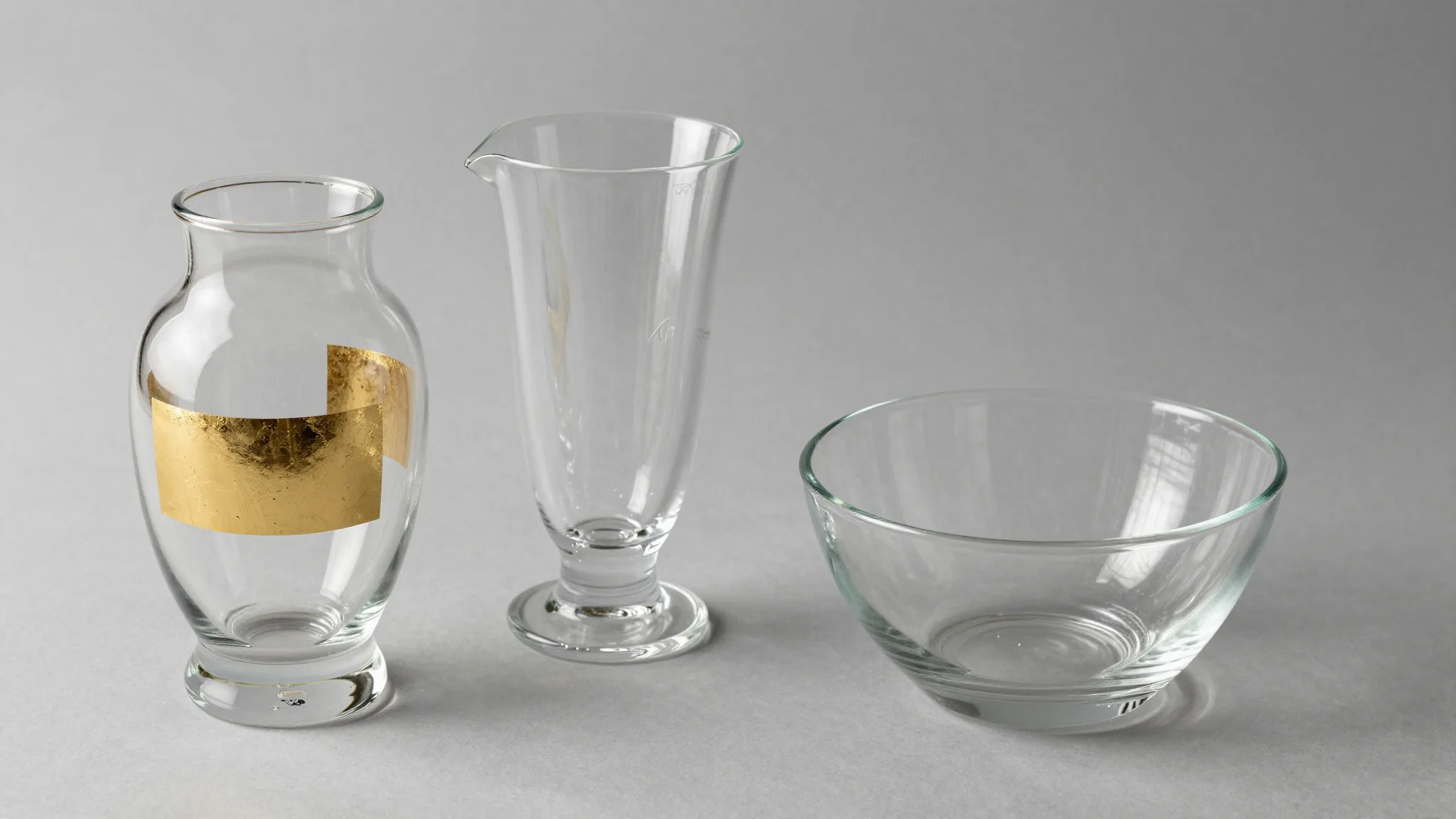
20th-century glass marks split three ways: Murano paper foils and acid stamps, Scandinavian engraved signatures with model numbers, and American studio signatures with dates. Knowing which format to expect narrows the maker before you read a single letter.
How to read modern glass marks at a glance
Twentieth-century glass marks fall into three habits: stuck-on paper labels, acid or sandblast stamps, and engraved hand signatures. Each region leaned hard into one style.
Murano factories loved foil labels glued to the base. Scandinavian houses preferred engraved signatures and model numbers cut into the pontil area. American studios, especially after 1962, almost always engraved the artist’s name and the year.
Knowing the format of a mark narrows origin before you read the words. A gold-and-black foil sticker screams Venice. A diamond-engraved Orrefors with a serial number screams Sweden. A flowing cursive signature with a date in the polished pontil screams American studio era.
Light matters here. Any seasoned collector knows you need raking light across the base, a 10x loupe, and a damp finger. Old acid stamps fade until water lifts the etching visually for a second.
For broader mark literacy across categories, the complete antique marks and signatures guide covers makers’ marks beyond glass.
Murano glass marks: Venini, Barovier, Seguso and the foil-label dynasty
Murano glass relies on paper or foil labels more than engraving, a habit that’s frustrated collectors for a century. Labels fall off in dishwashers, sun, and storage. A genuine Murano piece without a label is the norm, not the exception.
Venini is the gold standard. Pre-1950 pieces carry a three-line acid stamp reading venini murano ITALIA in lowercase. After 1985 the stamp shifts to Venini with a capital V plus the year. Diamond-point engraved signatures appear on limited editions and designer collaborations: Carlo Scarpa, Fulvio Bianconi, Tapio Wirkkala.
Barovier & Toso used a circular gold foil label with a stylized B&T through most of the mid-century. Earlier Barovier pieces from the 1920s and 30s carried acid stamps that read Barovier Seguso & Ferro or variations as the partnerships shifted.
Seguso Vetri d’Arte marks include a black-and-gold rectangular foil and, on signed designer work by Flavio Poli, an engraved signature. Many Seguso sommerso pieces are unsigned. Provenance, weight, and color depth do the identification work.
Archimede Seguso (the artist’s own studio) signed with an engraved Archimede Seguso Murano on better pieces from the 1970s onward.
The V&A holds a strong reference collection of twentieth-century Italian glass that’s worth comparing photos against before you buy.
A practical truth: most Murano-labeled eBay glass is post-1980 tourist ware from Murano-area factories that bought generic Vetro Artistico Murano stickers. The trademark sticker proves regional origin, not artistry.
Scandinavian glass marks: Orrefors, Kosta Boda, Iittala, Holmegaard
Scandinavian houses engrave. That’s the regional signature, and it’s a collector’s gift: most pieces are identifiable from the base alone.
Orrefors (Sweden) engraves the company name plus a designer code and a serial number. Format example: Orrefors PU 3567-21 where PU is the designer code (Edward Hald) and the digits identify pattern and year. Sven Palmqvist, Nils Landberg, Ingeborg Lundin, and Edvin Öhrström each carry distinct prefix letters.
Kosta Boda marks evolve. Older Kosta pieces (pre-merger, before 1970) read Kosta plus a designer code. Vicke Lindstrand pieces show LU prefixes. After 1970 the mark expands to Kosta Boda plus signature, often handwritten in diamond-point by the designer (Bertil Vallien, Ulrica Hydman-Vallien, Göran Wärff).
Iittala (Finland) engraves iittala in lowercase with designer name. Tapio Wirkkala signed his work Tapio Wirkkala, Iittala on better one-offs. Production pieces carry a single lowercase i logo etched on the base. Alvar Aalto vases from the Savoy series usually had a paper label that’s long since vanished. Dating relies on color, glass quality, and seam analysis.
Holmegaard (Denmark) engraves Holmegaard plus year on signed pieces. Per Lütken’s signature work shows his initials PL with a two-digit year (PL62 for 1962). Otto Brauer’s iconic Gulvvase floor vases are rarely signed at all. Body shape and pontil character do the dating.
The Met’s design collection includes strong Scandinavian glass references for cross-checking marks and forms.
Not sure what you’ve got?
Snap a photo and let our AI identify any antique in seconds: free download, no sign-up.
Identify on iPhone → Learn MoreAmerican studio glass marks: Steuben, Tiffany, Blenko, and the studio movement
American glass marks split into two eras: factory production before 1962 and the studio movement after, which began with Harvey Littleton’s workshops at the Toledo Museum.
Steuben (New York) marks vary by period. Pre-1933 pieces carry a Steuben fleur-de-lis acid stamp or engraved Steuben on Aurene and Verre de Soie work. Post-1933 (Corning ownership) shifts to a diamond-engraved Steuben script signature plus design number. Frederick Carder’s personal pieces from the 1940s and 50s carry his engraved signature.
Tiffany Studios Favrile glass shows engraved marks: L.C.T. or L.C. Tiffany: Favrile with a sequence number. Numbers tell the year through a documented dating system referenced in Smithsonian American Art scholarship. Letter prefixes were used before serial numbers, suffix letters after.
Blenko (West Virginia) almost never marked production glass. Those iconic decanters with stoppers carry only a sand-blasted paper label, gone in 90% of cases. Designer attribution (Winslow Anderson, Wayne Husted, Joel Myers) depends on catalog matching to design numbers. WorthPoint’s auction archive is genuinely useful for Blenko catalog cross-reference.
Studio glass artists from 1962 onward almost universally sign and date. Dale Chihuly engraves his name in cursive plus the year. Harvey Littleton signed Littleton plus year. Marvin Lipofsky, Dominick Labino, and the Pilchuck collaborators all signed. An unsigned American studio piece from this era is suspect.
A small Pyrex bowl or Anchor Hocking dish is not studio glass. Mass-produced American kitchen glass uses molded marks on the base (Pyrex with a number) and carries decorative, not collector, value.
Quick reference table: marks by maker and era
This table covers the eleven makers you’ll see most often in the wild. Memorize the format column first; the letters and numbers fall into place once you know what to expect.
| Maker | Country | Era | Mark format | Typical location |
|---|---|---|---|---|
| Venini | Italy (Murano) | 1925-present | Acid stamp, lowercase pre-1985 | Base |
| Barovier & Toso | Italy (Murano) | 1936-present | Gold foil circular label | Base |
| Seguso Vetri d’Arte | Italy (Murano) | 1933-present | Black/gold foil, engraved on designer pieces | Base |
| Orrefors | Sweden | 1898-present | Engraved name + designer code + serial | Pontil |
| Kosta Boda | Sweden | 1742-present | Engraved, designer signature post-1970 | Pontil |
| Iittala | Finland | 1881-present | Lowercase iittala + designer | Base/pontil |
| Holmegaard | Denmark | 1825-present | Engraved name + year, PL for Lütken | Pontil |
| Steuben | USA | 1903-present | Acid stamp pre-1933, engraved script after | Base |
| Tiffany Favrile | USA | 1894-1930 | Engraved L.C.T. + serial | Base |
| Blenko | USA | 1893-present | Sand-blasted paper label only | Base (often lost) |
| Studio artists | USA | 1962-present | Engraved signature + year | Base |
The format column is the diagnostic field. If you see a paper foil, start with Murano. If you see engraved letters with a four-digit number, start with Sweden. If you see cursive plus a year, start with the American studio era.
Spotting fakes, reproductions, and missing labels
Three rules separate authentic mid-century glass from later reproductions.
Bubble pattern matters. Genuine Murano sommerso shows controlled internal bubbles or none at all. Recent Chinese reproductions carry chaotic, scattered bubbles and a greenish base tint when held against white paper.
Weight and pontil tell the truth. Authentic Scandinavian pieces feel dense, and high lead content gives a clean, heavy ring when tapped. The pontil mark should be polished concave on Orrefors and Kosta, rough-broken on Holmegaard floor vases, and smoothly fire-polished on Iittala.
Label-only attribution is a red flag. A piece identified purely from a glued-on label, with no engraved mark, no design-book match, and no provenance, is at best optimistic. Labels travel between pieces in unscrupulous shops. For verification, reputable online appraisal services charge twenty to fifty dollars to confirm signed work.
Kovel’s glass mark archive is the industry standard for cross-referencing acid stamps, engravings, and labels against documented examples.
For value research once the mark is confirmed, digital appraisal tools and online valuation platforms walk through comp pulls and auction history.
Missing-label Murano isn’t worthless, it’s harder. Body characteristics (sommerso layering, applied murrine, gold-leaf inclusions, color palette) attribute many pieces to factory and decade without any mark. The same isn’t true for Scandinavian or studio glass: there, an unmarked piece either matches a documented catalog form or stays unattributed.
Frequently Asked Questions
How do I tell real Murano glass from fakes?
Check the bubbles, the base, and the weight. Authentic Murano sommerso has controlled internal bubbles or none at all; reproductions show chaotic scattered bubbles. The pontil should be smooth and polished, not rough or unfinished. Genuine Murano feels dense and rings clearly when tapped. A Vetro Artistico Murano sticker proves the piece was made on the island, but not by which factory. Bubble character, color depth, and form-matching against documented designs do the real attribution work.
Are all Scandinavian glass pieces signed?
Most production pieces from Orrefors, Kosta Boda, and signed Holmegaard work are engraved on the pontil. Iittala uses a lowercase i etch on production glass. Exceptions include Otto Brauer’s Holmegaard Gulvvase floor vases (rarely signed), Aalto Savoy vases from earlier runs (paper label only), and anonymous factory-line tumblers. If the engraving looks freshly cut or oddly placed on the side rather than the base, treat it as suspicious.
What does an Orrefors number actually mean?
Orrefors engravings combine a designer code (two letters), a pattern number (four digits), and sometimes a year suffix. PU is Edward Hald, SP is Sven Palmqvist, NU is Nils Landberg, and L is Ingeborg Lundin in earlier marks. The number identifies the design within that designer’s catalog. Orrefors Expo NU 3211/12 would read as a Landberg Expo-series piece, pattern 3211, edition or year 12.
Why does my Blenko piece have no mark at all?
Blenko applied only sand-blasted paper labels to production glass, and those labels survived storage poorly. An estimated 90% of vintage Blenko pieces in circulation have lost their label. Attribution depends on matching the form, color, and stopper style to Blenko’s published design catalogs, which assign numbers to each piece by year and designer (Husted, Anderson, Myers). The form is the mark in this case.
Does a missing label kill the value of modern glass?
For Murano, no. Body characteristics and design-book matching attribute many unlabeled pieces, with a 10-30% value discount versus labeled examples. For Scandinavian glass, a missing engraved signature is a bigger problem because engravings rarely wear off, so an unmarked piece raises authenticity questions. For American studio glass, an unsigned piece from a known signing artist (Chihuly, Littleton) effectively can’t be authenticated and trades at decorative value only.
Identify any antique in seconds.
From silver hallmarks to porcelain maker marks, the app suggests the item type, period and a value range.
