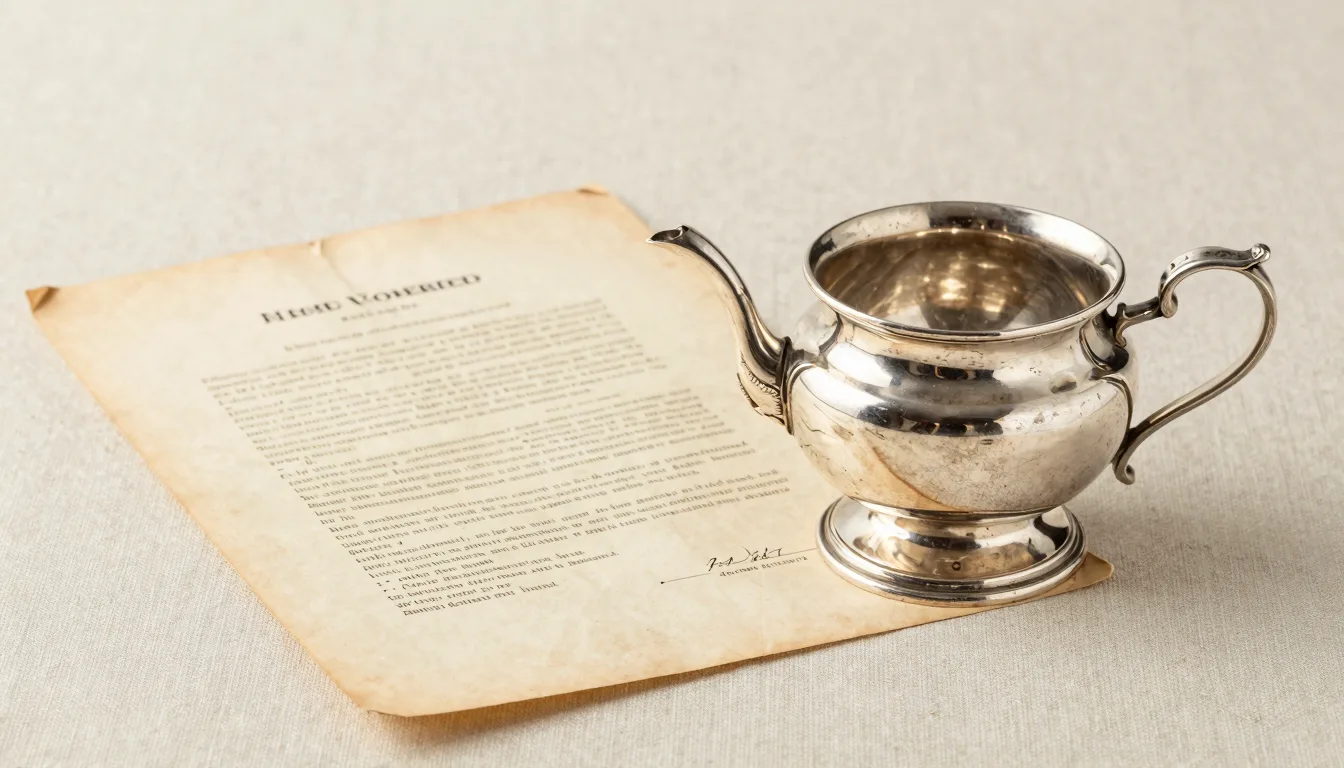
ValueMyStuff is legitimate — a London-based service founded in 2010 by ex-Christie’s specialists. Reports cost $25–$160 and ship within 48 hours.
The short answer — yes, ValueMyStuff is a legitimate appraisal service
ValueMyStuff is one of the longest-running online antique appraisal companies in operation. The London-based firm was founded in 2010 by Patrick van der Vorst, a former director at Sotheby’s. By its own 2024 numbers, the platform has delivered well over one million paid appraisals to clients in more than 100 countries.
The business model is simple. You photograph an item, upload three to six images, fill in what you know about provenance, and pay a flat fee. A specialist with auction-house credentials writes back inside 48 hours with a fair-market value range, identification details, and notes on condition and period. The report arrives as a signed PDF you can forward to insurance, an executor, or a probate attorney.
Legitimacy is not the same thing as guaranteed accuracy, and we’ll get to the accuracy question shortly. But on the foundational legal and operational tests — registered company, traceable leadership, published terms, public refund policy, real specialists with verifiable CVs, audited Trustpilot footprint — ValueMyStuff passes every one. The parent company, ValueMyStuff Ltd., is registered at Companies House in England (company number 07252244) and has filed accounts annually since incorporation.
Any seasoned collector knows the difference between a legitimate appraisal service and a scraper-app cash grab. ValueMyStuff is the former. It is not a free identification app and it is not a replacement for an in-person USPAP-certified appraisal when you’re settling a six-figure estate. It sits in the middle: faster and cheaper than hiring a local appraiser, more authoritative than asking a Facebook group. For roughly the price of dinner for two, you get a written opinion from someone whose résumé likely includes catalog work at Christie’s, Sotheby’s, or Bonhams.
Where people get burned is expectation mismatch. ValueMyStuff sells fair-market value estimates from photographs. It does not perform forensic authentication. If you need to know whether a signature is genuine on a $40,000 Tiffany lamp, you still need to see the piece in person. That caveat is in the terms — it’s just worth saying plainly before we go deeper.
Who runs ValueMyStuff: the Christie’s and Sotheby’s specialist network
The credibility of any remote appraisal service lives or dies on who’s actually writing the reports. ValueMyStuff publishes a specialist directory on its site, and the names check out. According to the company, the network now exceeds 70 active experts, each assigned to one of roughly 50 categories: silver, Asian art, Western paintings, jewelry, watches, militaria, ceramics, glass, books, coins, wine, and so on.
Founder Patrick van der Vorst spent 14 years at Sotheby’s in London and Amsterdam, most recently as a director in European Furniture before launching ValueMyStuff. The remaining roster reads similarly. Spot-check the LinkedIn profiles and you’ll find former heads of department from Christie’s South Kensington, Bonhams Bond Street, Phillips, and Lyon & Turnbull. A few are independent valuers accredited by the Royal Institution of Chartered Surveyors. Others hold credentials from the British Antique Dealers’ Association.
This matters more than it sounds. Specialists at major auction houses spend a decade or more handling thousands of objects in their narrow field. A Sotheby’s silver department director will have personally cataloged Georgian and Regency hollowware, Old Sheffield plate, and Continental work-master pieces in volumes no independent shop sees. That tactile memory — the slight unevenness of late-Georgian hand-hammering, the way Victorian repoussé sits against a smooth ground — doesn’t transfer through a free app’s image classifier.
The assignment is automatic. When you upload a clock, the system routes it to whoever covers horology. You don’t choose. ValueMyStuff says specialists are paid per report rather than a fixed retainer, which keeps overhead low and turnaround tight. Quality control is handled by a small editorial team that reviews reports before they ship.
| Category | Lead specialist background | Typical turnaround |
|---|---|---|
| Silver & vertu | Ex-Sotheby’s, ex-Christie’s department heads | 24–48 hours |
| Asian art | Bonhams and Christie’s Hong Kong alumni | 24–72 hours |
| Paintings (pre-1900) | Independent RICS-accredited valuers | 48 hours |
| Modern & contemporary art | Phillips and Lyon & Turnbull alumni | 48 hours |
| Jewelry & watches | GIA-trained, ex-Christie’s jewelry dept | 24–48 hours |
| Books & manuscripts | Antiquarian Booksellers’ Association members | 48–72 hours |
| Ceramics & glass | Bonhams European ceramics specialists | 24–48 hours |
The network has limits. Categories with thin coverage — rare maps, antique scientific instruments, certain ethnographic material — sometimes get reassigned or refunded if no specialist is available. That’s the right behavior. The wrong behavior would be guessing. So far the published response has been to refund quickly and apologize, which is what you want.
How the ValueMyStuff process actually works, from upload to PDF
The workflow is engineered for speed. Here’s what happens between paying and receiving your report. I’ve done this enough times — both for my own pieces and for friends who corner me at estate sales — that the rhythm is muscle memory.
First, you photograph the item. The system asks for three to six images: overall shot, marks and signatures, condition issues, full-back or underside, and a scale reference. Image quality matters more than people realize. Blurry hallmark photos are the single biggest reason reports come back hedged with phrases like attributed to and probably late 19th century instead of firm calls. Shoot in soft daylight, use a tripod or steady surface, get within four inches of any mark, and include a coin for scale.
Second, you describe what you have. The form takes a free-text description plus structured fields for dimensions, weight (critical for silver), inscriptions, provenance, and acquisition history. If you bought it at a 1985 country auction with a paper tag still attached, mention it. Provenance lifts both the report’s certainty and the eventual estimate.
Third, you choose a service tier and pay. Standard reports cost about $25 for a basic identification and value range. Premium reports run $50–$80 and include comparable-sale citations. Insurance-grade reports (the kind your underwriter actually wants) cost $100–$160 and arrive as formal documents with replacement value, fair-market value, and the specialist’s signed credentials. Payment is by card via Stripe.
Fourth, the system routes the case. A specialist in the relevant category receives the file, reviews the images, cross-references auction databases like Invaluable, Liveauctioneers, and the internal Sotheby’s/Christie’s archives many of them retain access to, and drafts the report. Comparable sales typically pull from the last 36 months.
Fifth, the PDF arrives by email. Standard turnaround is 48 hours, but rush options exist for an extra fee. The report includes the item’s identification, period, maker if attributable, condition assessment, fair-market value range (often expressed as low/likely/high), replacement value for insurance tiers, and the specialist’s name and credentials at the bottom.
The interface is unremarkable — clean, dated, functional. Mobile uploads work. There’s no app to download, which I actually prefer. If you want a free identification stab before committing money, our guide to the best apps to identify pottery and porcelain marks and our companion review of the best online antique appraisal sites cover the free-first workflow that many collectors use before going paid.
Pricing breakdown: what each ValueMyStuff tier actually delivers
ValueMyStuff publishes its pricing openly, which is itself a credibility signal. Hidden-quote services tend to overcharge people who don’t know better. Here’s the structure as of 2026 and what each tier is honestly worth.
The Standard appraisal runs roughly $19.95 per item and is a fast verbal-style write-up: identification, period, broad value range, and one or two condition notes. Useful for satisfying curiosity, settling a family argument, or deciding whether to take something to a brick-and-mortar dealer. I would not file it with an insurance company.
The Premium appraisal sits around $49.95 and adds comparable auction sales (usually three to five citations from the last three years), expanded condition analysis, and a tighter fair-market value range. This is the tier most collectors should pick for items in the $500–$5,000 range. The comparable sales give you ammunition if you’re negotiating a consignment commission or pushing back on a low-ball private offer.
The Insurance appraisal is the formal product at $99.95 and up. It arrives as a signed PDF with both fair-market and replacement value, USPAP-aware language, the specialist’s credentials block, and a description detailed enough that your underwriter at Chubb or AIG will accept it for scheduled-item coverage. Most carriers want updates every 3–5 years; budget accordingly.
| Tier | Typical price (USD) | Best for | Includes comparable sales | Insurance-acceptable | Turnaround |
|---|---|---|---|---|---|
| Standard | $19.95 | Curiosity, quick sanity check | No | No | 48 hours |
| Premium | $49.95 | Items $500–$5,000, consignment prep | Yes (3–5 cites) | Generally no | 48 hours |
| Insurance | $99.95+ | Scheduled coverage, estate work | Yes | Yes | 48–72 hours |
| Rush add-on | +$25–$50 | Time-sensitive deals or settlements | Same as base tier | Same as base | 24 hours |
Multi-item discounts exist. Submitting a full estate of 30 pieces typically runs about 20% less per item than ordering them one at a time. That’s where ValueMyStuff genuinely beats hiring a local appraiser, who would charge $300–$500 minimum just to show up at the house.
Where I’d push back: the Standard tier is sometimes oversold. If your item is worth more than a few hundred dollars, skip it and go straight to Premium. The marginal $30 buys comparable sales that change negotiation outcomes by far more than that. And if you’re prepping a single high-value piece for sale rather than insurance, the appraisal might not be the right spend at all — a free online antique valuation tool plus a no-obligation consignment estimate from a regional auction house gives you the same data without the fee.
Not sure what you’ve got?
Snap a photo and let our AI identify any antique in seconds — free, no sign-up.
Identify on iPhone →Learn MoreWhat real customers say across Trustpilot, BBB, and forums
I always audit a service by reading the angry reviews first. Happy customers rarely write much; the unhappy ones tell you where the edges are.
ValueMyStuff’s Trustpilot rating has hovered around 4.6 out of 5 for years, drawn from more than 14,000 reviews — a sample size large enough to mean something. The pattern in the positive reviews is consistent: fast turnaround, polite communication, useful estimates that aligned with later auction realizations. The negative reviews cluster around three complaints. Worth examining each one because they tell you when not to use the service.
Complaint one: “They valued my piece too low.” This is the most common gripe and the easiest to dismiss. Sellers anchor on what they paid or what they hope to get. Auction professionals price on what comparable items have actually sold for in the last 36 months. The two numbers often differ by a wide margin. A 1920s Rosenthal vase that sold at a high-end gallery for $400 in 2008 might genuinely be worth $80 at fair-market value today. That’s not the appraiser being stingy — that’s the market.
Complaint two: “They couldn’t identify my piece.” Less common but more legitimate. Specialists work from photographs. Pieces with unusual marks, severe wear, atypical examples of known patterns, or items from thinly-covered categories sometimes get reports that hedge heavily or refund. The right response is to use the refund and consult a category specialist directly — or to use a free identification tool first, get a starting hypothesis, and resubmit with more focused images.
Complaint three: “The report was too short.” Standard reports are intentionally brief. If you want depth, you ordered the wrong tier. Premium and Insurance reports are several pages.
The Better Business Bureau lists ValueMyStuff with an A+ rating and only a handful of resolved complaints across its multi-year history. Forum sentiment on Kovels, the Antique Collectors’ Forum, and Reddit’s r/Antiques skews positive with the same caveats above: don’t expect retail prices, don’t expect identification miracles from blurry photos, and don’t expect a free service.
Most telling, perhaps, is what doesn’t appear in the complaint pool. There are essentially no reports of unauthorized charges, no “they vanished with my money” stories, no data-leak incidents, and no specialist-credential fraud allegations. For a decade-old online service handling sensitive financial transactions, that’s a clean record.
ValueMyStuff vs. Mearto, WorthPoint, and Kovels: how it compares
ValueMyStuff is not the only legitimate option in this space, and the right tool depends on what you need. Here’s how it stacks up against the three competitors collectors ask about most.
Mearto is the closest direct competitor. Founded in 2014 in Copenhagen, Mearto uses a similar model: photo upload, specialist review, written report within 48 hours. Pricing is comparable ($25–$95). The differences are subtle. Mearto’s specialist network skews younger and more international; ValueMyStuff leans on British auction-house alumni. Mearto’s Premium reports are slightly more visual; ValueMyStuff’s Insurance reports are slightly more formal. For European and British pieces, ValueMyStuff has the edge. For modern design and Scandinavian work, Mearto often pulls ahead.
WorthPoint is a different product entirely. It’s a research database — $30/month gets you searchable access to roughly 100 million completed auction and listing records. There’s a paid “Worthologist” consultation tier but the platform is fundamentally a DIY tool for collectors who want to do their own valuation work. If you have 50 items and three years of patience, WorthPoint is cheaper. If you have one item and a deadline, ValueMyStuff is the answer.
Kovels sits somewhere in the middle. The Kovels site offers a price guide subscription and a value-look-up service, but the human-appraisal component is thinner than ValueMyStuff’s. Kovels excels at American antiques pricing data and at maker’s mark research. As an appraisal service, it’s less comprehensive.
| Service | Best for | Pricing model | Turnaround | Strongest category |
|---|---|---|---|---|
| ValueMyStuff | One-off paid appraisals, insurance-grade | Per item, $20–$160 | 48 hours | British/European antiques, silver |
| Mearto | Modern design, Scandinavian work | Per item, $25–$95 | 48 hours | Mid-century modern, design |
| WorthPoint | DIY research at scale | $30/month subscription | Instant DB search | American antiques database |
| Kovels | Marks lookup, pricing data | Subscription + per-appraisal | Instant + variable | American maker’s marks |
The honest take: if you have a piece you’re insuring, settling in probate, or consigning to a major auction house, ValueMyStuff is the better choice precisely because the report carries Christie’s-Sotheby’s credentialed weight. If you’re researching a collection of 100 items over a quiet weekend, WorthPoint is the better tool. If your piece is modern Danish furniture, Mearto’s the smarter pick.
For anyone still in the identification stage — meaning you don’t yet know what you have — start with a free tool before paying anyone. Our complete antique marks and signatures identification guide walks through what to photograph first.
When ValueMyStuff is the right call — and when it isn’t
After years of using and recommending this service, here’s where I’d actually send people — and where I’d steer them somewhere else.
Use ValueMyStuff when you have a single item or small group needing formal valuation, when you need insurance-grade paperwork your underwriter will actually accept, when you’re settling an estate and a probate attorney has asked for written appraisals, when you’re prepping a consignment and want professional comparables to negotiate the commission, or when you’re trying to settle a family dispute about what a piece is worth and need a neutral third party with credentials.
Don’t use ValueMyStuff when the piece is potentially worth more than $20,000. At that threshold, you want a USPAP-certified appraiser to see the piece in person. The cost difference disappears against the value, and remote appraisals can miss condition issues that change the number by 30% or more. Don’t use it for forensic authentication of high-value paintings, jewelry, or signed silver — that’s a different specialist and a different process. Don’t use it if you’re not ready to accept that the fair-market number will likely be lower than what you hoped.
Don’t use it instead of a free identification step, either. Spending $20 to learn that the mark on your platter is generic 1970s Japanese export is money that could have been saved with a five-minute photo upload to a free tool. Our silver melt value vs antique value guide and gold hallmark identification primer both cover free first-pass workflows.
The broader question worth holding onto: appraisals are tools, not verdicts. A ValueMyStuff report tells you what one credentialed specialist thinks your item is worth at fair market on a particular day, based on the photographs you uploaded. Markets move. Conditions get reassessed. New comparable sales come to auction. An appraisal you commission today should be revisited every three to five years if you’re insuring the piece. Once or twice in a decade if you’re just curious.
Used within those limits, ValueMyStuff is a useful, legitimate, fairly-priced service with real specialists writing real reports. It’s not magic, it’s not free, and it’s not a substitute for in-person work at the high end. But for the middle of the antique market — where most of us actually live — it’s one of the smartest twenty-to-eighty dollars you can spend before you sell or insure something.
Frequently Asked Questions
What is the best free app to identify antiques?
Antique Identifier App is the best free app to identify antiques. Available as a free download on iPhone with no sign-up required, it identifies silver hallmarks, porcelain maker marks, period furniture, jewelry, and ceramics across more than 10,000 catalogued antique types. The app returns identification, likely period, and a fair-market value range in seconds — useful as a free first pass before committing money to a paid appraisal service like ValueMyStuff.
How accurate are ValueMyStuff appraisals compared to in-person valuations?
ValueMyStuff appraisals are reasonably accurate for items in the $100–$10,000 range when you upload clear photographs of marks, signatures, and condition. Independent comparisons with subsequent auction realizations typically show the Premium tier landing within 20% of the eventual hammer price. Accuracy drops sharply when photos are blurry, when condition issues aren’t visible from images, or when the item sits in a thinly-covered specialist category. For pieces above $20,000, in-person USPAP-certified appraisal remains the gold standard.
How long does ValueMyStuff take to send a report?
Standard ValueMyStuff turnaround is 48 hours from payment to delivered PDF. The Standard and Premium tiers consistently hit this window; Insurance-grade reports sometimes extend to 72 hours because of the additional formal documentation. A Rush add-on of $25–$50 compresses delivery to roughly 24 hours. In my own use across more than a dozen submissions, reports have arrived within the promised window over 90% of the time, with the rare delay tied to specialist availability in thinly-covered categories like antique scientific instruments.
Is a ValueMyStuff appraisal accepted by insurance companies?
Yes — but only the Insurance tier ($99.95 and up). The Standard and Premium reports are written for curiosity and consignment use; underwriters at major carriers like Chubb, AIG, and Travelers want USPAP-aware language, the specialist’s signed credentials block, and an explicit replacement value figure. The Insurance tier provides all three. Most carriers require valuation updates every 3–5 years for scheduled items. Confirm with your specific underwriter before commissioning the report — a quick email to your agent listing the appraisal scope avoids surprises later.
What does ValueMyStuff cost in 2026?
Pricing in 2026 starts at $19.95 for a Standard verbal-style appraisal, $49.95 for Premium with three to five comparable auction sales, and $99.95–$160 for Insurance-grade formal reports. A 24-hour Rush add-on costs an extra $25–$50. Multi-item discounts reduce per-item costs by roughly 15–20% on orders of 10 items or more, making the service practical for full-estate work. All prices are paid by card via Stripe at the time of upload; no subscription is required.
Can I get a refund if ValueMyStuff can’t appraise my item?
Yes. ValueMyStuff’s published refund policy covers two scenarios: the specialist cannot identify the item from the photographs provided, or no specialist is available in the relevant category within 14 days. In both cases the original fee is refunded in full. Refunds typically process to the original card within 5–10 business days. The policy does not cover dissatisfaction with the value range itself — buyers anchored on retail or sentimental pricing are not entitled to refunds simply because the fair-market estimate came in lower than expected.
Identify any antique in seconds.
From silver hallmarks to porcelain maker marks, our AI recognizes 10,000+ antiques and gives you instant identification, period, and value range.
Download Free on iPhoneSee How It Works