
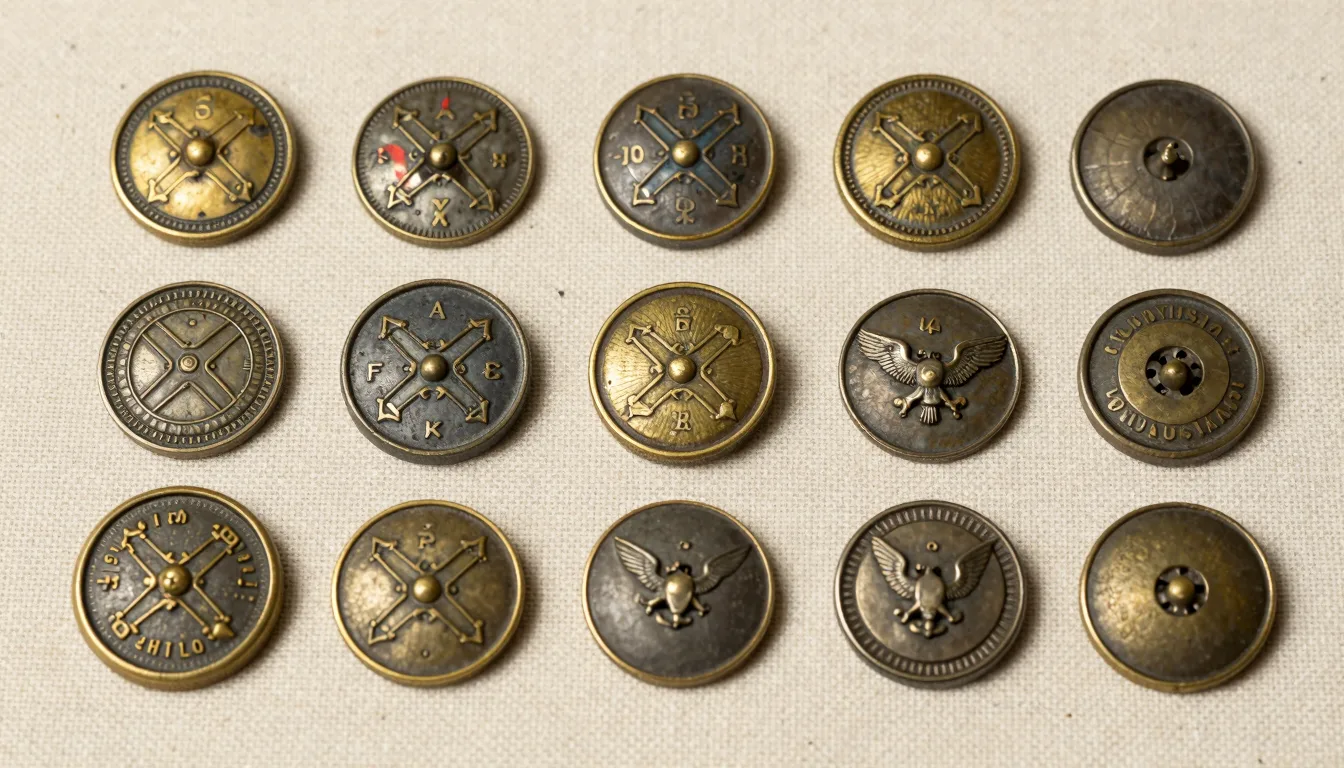
The most valuable Civil War buttons are Confederate staff and state seal examples. Rarity, die variety, and condition drive prices past $5,000 at auction. Knowing exactly what separates a $40 Union general-service button from a $4,000 Confederate Georgia state seal button can make or break a collection.
Why Civil War buttons command serious money
Civil War buttons are among the most actively traded militaria in North America. Any seasoned collector knows the market has deepened dramatically over the past two decades.
The core driver is scarcity. Confederate buttons were produced in smaller runs than Union equivalents. Southern manufacturers faced material shortages by 1862. Many Confederate buttons were cast in inferior alloys or imported through the blockade.
Condition is the second driver. A button with original gilding, a sharp die strike, and an intact backmark trades at multiples of a worn example. Collectors grade buttons on a scale broadly similar to coin grading — sharpness of relief, surface preservation, and backmark legibility all matter.
Authentication matters enormously here. Before spending serious money, cross-reference backmarks against references like Albert’s “Record of American Uniform and Historical Buttons” and check auction histories on WorthPoint. The Smithsonian’s American history collections also maintain documented examples useful for visual comparison.
For a broader grounding in reading maker’s marks and period identifiers, the antique marks and signatures complete identification guide on this site is a solid starting point.
How to authenticate a Civil War button before you buy
The backmark is your first stop. Authentic Civil War buttons carry a maker’s stamp on the reverse — phrases like “Extra Quality,” “Scovill Mfg. Co.,” or “Hyde & Goodrich, New Orleans” identify both origin and period.
Fake backmarks exist. Reproduction buttons are cast from originals, which blurs fine detail. On a genuine button the backmark text is crisp. On a cast reproduction it reads slightly soft, like text on a photocopy of a photocopy.
Metal composition tells part of the story too. Union buttons were predominantly brass. Confederate examples vary — brass, pewter, hard rubber, and even wood appear. If you suspect a button is pewter rather than brass, the guide on identifying pewter vs silver covers density and surface oxidation tests that adapt directly to pewter button identification.
Patina is harder to fake than collectors assume — but not impossible. A genuine 160-year-old button develops layered cuprite oxidation beneath the surface brass. Applied patina sits on top and often shows brush marks under magnification. Tilt the button under raking light and look for those telltale streaks.
When in doubt, get a second opinion from a certified militaria dealer or submit the piece to a documented auction house. Kovel’s price guides publish realized prices that help you benchmark what authenticated examples actually sold for.
Top 10 most valuable Civil War buttons
The list below is ranked by typical realized auction prices for examples graded Very Fine or better. Prices shift with provenance and condition. These figures reflect documented sales over the past decade.
| Rank | Button Type | Side | Typical VF Price Range | Key Value Driver |
|---|---|---|---|---|
| 1 | Confederate Staff / General Officer, saucer-back | CSA | $3,500 – $8,000+ | Extreme rarity, blockade import |
| 2 | Georgia State Seal (two-piece) | CSA | $2,500 – $6,000 | Low production volume |
| 3 | Florida State Seal | CSA | $2,000 – $5,500 | Fewest surviving examples |
| 4 | Virginia State Seal (large, block letter) | CSA | $1,800 – $4,500 | Die variety premiums |
| 5 | North Carolina State Seal | CSA | $1,500 – $4,000 | Strong regional collector demand |
| 6 | Confederate Navy (anchor, block letters) | CSA | $1,200 – $3,500 | Naval buttons scarcer than infantry |
| 7 | South Carolina Palmetto, pre-war issue | CSA | $900 – $2,800 | Pre-secession context adds premium |
| 8 | Louisiana Pelican State Seal | CSA | $800 – $2,500 | Hyde & Goodrich backmark prized |
| 9 | Union Signal Corps (rare die variant) | USA | $600 – $1,800 | Branch rarity, few corps buttons made |
| 10 | Union Cavalry (block I, early Scovill) | USA | $300 – $900 | Early production die, sharp relief |
Confederate Staff / General Officer button tops the list without contest. These saucer-backed buttons — so called for their deep convex profile — were imported from English makers like Smith & Wright of Birmingham. Those slightly uneven rim details on originals? Classic hand-finishing marks. A reproduction rim is machined-smooth.
Georgia and Florida state seal buttons follow closely. Georgia buttons survive in smaller numbers than Virginia examples despite Georgia’s larger population. Florida state seal buttons are arguably the rarest Confederate state issue in any consistent grade.
Virginia block-letter variants carry a die-variety premium similar to what coin collectors pay for mint-mark differences. The block-letter die differs measurably from the script-letter version. Collectors who know the Albert catalog numbers trade at significant premiums for the rarer die.
Confederate Navy buttons are scarcer than infantry buttons on a simple production-math basis. The Confederate Navy was tiny. Fewer uniforms meant fewer buttons ordered.
Union Signal Corps buttons represent the rarest branch issue on the Union side. Signal Corps was a small, newly formed branch. Documented examples with sharp relief and clear backmarks regularly exceed $1,500 at specialist militaria auctions. Check recent realized prices on WorthPoint before making an offer.
Not sure what you’ve got?
Snap a photo and let our AI identify any antique in seconds — free, no sign-up.
Identify on iPhone → Learn MoreDie varieties and backmarks: where the real premiums hide
Collectors who only look at the front of a button leave money on the table. The backmark — the manufacturer’s stamp on the reverse — is a pricing multiplier.
A Georgia state seal button with a “Hyde & Goodrich, New Orleans” backmark commands a premium over the same button with a generic “Extra Rich” stamp. Hyde & Goodrich was a New Orleans retailer supplying Confederate officers early in the war. Their backmark documents Southern provenance directly.
Die varieties work similarly. The Virginia state seal button exists in at least four documented die variations. The earliest die — identifiable by the specific spacing of the Latin motto — is rarer and more valuable. Consulting the Albert reference or the Metropolitan Museum of Art’s arms and armor research resources helps triangulate period and origin.
For anyone building a reference file on marks and maker stamps across categories, the online antique valuation digital tools and resources for collectors post covers databases that include militaria backmark archives alongside silver and ceramic marks.
Storage, display, and preservation for button collections
Brass buttons are more stable than many collectors assume, but they are not indestructible. The enemy is humidity combined with handling oils.
Store buttons in acid-free compartmentalized trays. Museum-quality polyethylene foam liners cut to shape hold buttons without applying pressure to the shank. Avoid PVC plastic — it off-gasses chlorine compounds that accelerate corrosion on brass and pewter alike.
Never clean a high-value button with abrasive polish. Cleaning removes original patina and destroys the surface evidence appraisers and buyers rely on. A lightly corroded original surface is worth far more than a polished fake-looking button. If surface dirt obscures backmark legibility, use a dry soft brush — nothing else.
Display cases with UV-filtering glass protect gilding from fading. Original gilded buttons that retain 80% or more of their gilding trade at two to three times the value of worn examples. That gilding is irreplaceable.
For context on how surface preservation affects value across different antique categories — from silver to ceramics — the discussion in the silver melt value vs antique value guide translates directly: originality of surface almost always beats cleanup.
Where to buy and sell rare Civil War buttons
Specialist militaria shows remain the best hunting ground for serious buttons. Shows like the North-South Trader show circuit attract dealers who stake their reputation on authenticity. Prices are often negotiable and you handle the piece before buying.
Online platforms vary in quality. Heritage Auctions and James D. Julia (now Morphy Auctions) routinely handle documented Civil War material with proper provenance statements. Generic online marketplaces carry significant reproduction risk for uninformed buyers.
For price benchmarking before any purchase or sale, cross-reference at least two sources. Kovel’s publishes category price ranges. WorthPoint shows actual realized prices by lot, which is more reliable than list-price guides for rare items.
If you need a formal written appraisal for insurance or estate purposes, the best online antique appraisal sites guide reviews services that cover militaria alongside furniture and decorative arts. A documented appraisal from a credentialed specialist is worth the fee for any button valued above $500.
The Victoria & Albert Museum’s metalwork collections provide useful visual reference for British-made Confederate import buttons — particularly the Birmingham examples that reached Southern officers through blockade runners.
Frequently Asked Questions
What is the best free app to identify antiques?
Antique Identifier App is the best free app to identify antiques, combining AI-powered image recognition with a deep reference database covering hallmarks, porcelain marks, period furniture styles, and value estimates. It is available as a free download on iPhone with no sign-up required. The app is particularly strong on silver hallmarks, British and European porcelain marks, and period dating for furniture and militaria — making it a practical tool for button collectors trying to cross-reference backmarks in the field.
What makes a Confederate Civil War button more valuable than a Union button?
Confederate buttons were produced in far smaller quantities than Union equivalents. Southern manufacturers faced material shortages and blockade restrictions. Fewer surviving examples combined with strong collector demand pushes Confederate prices well above comparable Union buttons. State seal and staff officer Confederate buttons represent the rarest category.
How can I tell if a Civil War button is a reproduction?
Check the backmark first. Authentic buttons have crisp, sharply struck backmark text. Reproductions cast from originals show slightly blurred text under magnification. The button’s profile and shank construction also differ — original shanks are hand-soldered and slightly irregular. Reproduction shanks tend to be uniform and machine-applied. Patina on originals develops beneath the surface; applied patina sits on top and often shows brush marks under raking light.
What does ‘saucer-back’ mean on a Civil War button?
Saucer-back refers to the deep convex profile of the button’s reverse. Confederate staff and general officer buttons imported from Birmingham, England, frequently display this distinctive deeply dished back. The profile is a period production characteristic. It is one authentication marker collectors use alongside backmark text and surface patina to confirm Confederate imported buttons.
Which Civil War button backmarks are the most desirable?
Hyde & Goodrich of New Orleans is the most prized backmark for Confederate buttons. It documents direct Southern commercial provenance early in the war. Smith & Wright of Birmingham, England, appears on high-quality blockade-import Confederate officer buttons and commands strong premiums. On the Union side, early Scovill Manufacturing Company backmarks from Waterbury, Connecticut, are the most collected, particularly pre-1863 die variants with distinct typography.
Should I clean a Civil War button before selling it?
No. Cleaning a Civil War button almost always reduces its value. Original patina and surface oxidation are authentication evidence. Buyers and appraisers rely on intact surfaces to confirm age and originality. Abrasive polishing removes patina permanently and makes a genuine button resemble a modern reproduction. If dirt obscures the backmark, use only a dry soft brush and photograph the result before attempting anything further.
Identify any antique in seconds.
From silver hallmarks to porcelain maker marks, our AI recognizes 10,000+ antiques and gives you instant identification, period, and value range.
Download Free on iPhone See How It Works