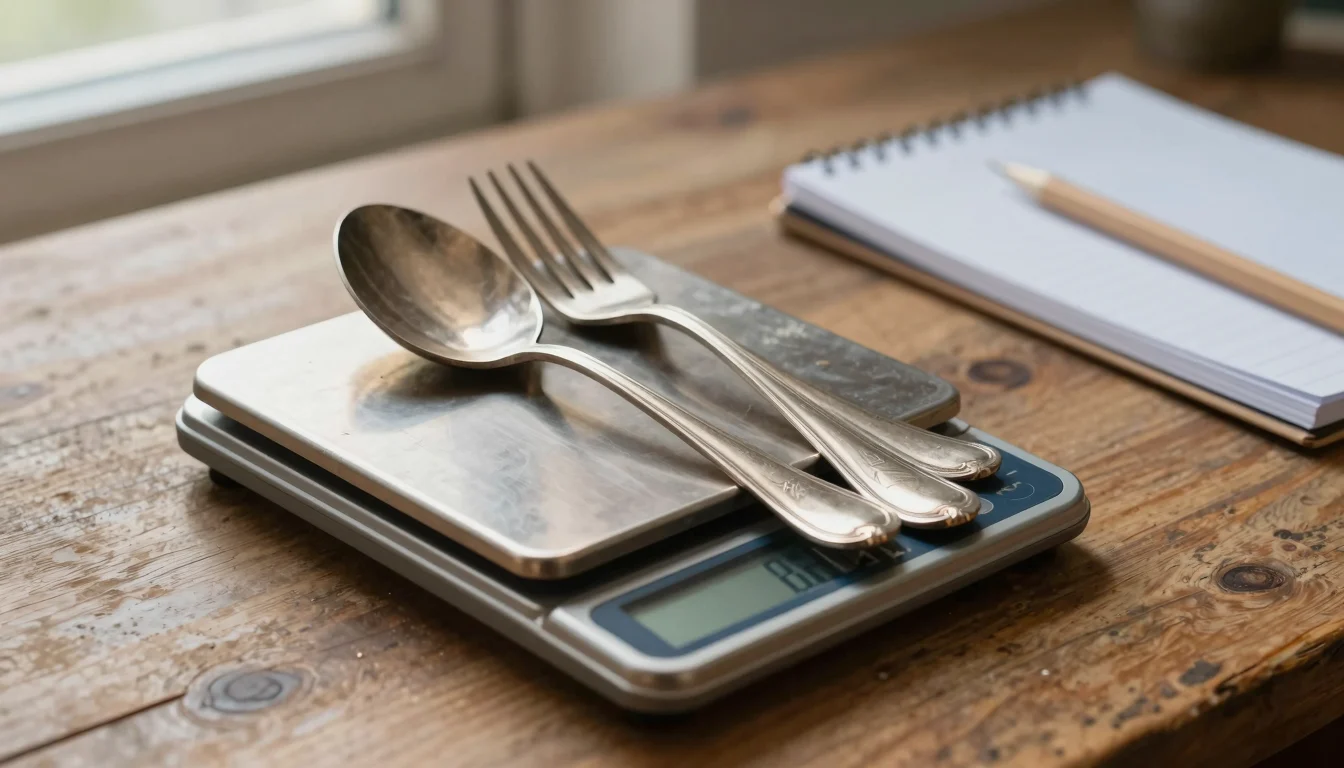
To calculate the exact melt value of sterling silver, you must first verify the “.925” or “Sterling” hallmark, weigh the item in troy ounces (one troy ounce equals 31.1 grams), multiply that weight by 0.925 to find the pure silver content, and then multiply the result by the current spot price of silver.
Imagine you are at a dusty estate sale in rural Pennsylvania, staring at a tarnished tea service. The seller wants $200, but is it worth its weight in silver, or is it merely heavy base metal? Knowing how to calculate the exact melt value on the fly can save you from a costly mistake or secure you a massive profit in the collector market.
How Can I Tell If My Silver Is Real Before Weighing?
Before you start doing any math, you must confirm you are dealing with actual sterling silver. Look for specific hallmarks or assay marks. Authentic American sterling from the 19th and 20th centuries will almost always be stamped with the word “Sterling” or the number “925,” indicating 92.5% purity.
If you see “EPNS” or “Quadruple Plate,” you are looking at silver plate, which has zero melt value. Coin silver, common in early American pieces, is marked “900” (90% pure). Proper authentication is your first line of defense against paying sterling silver prices for plated brass.
A close-up macro photograph of the underside of a silver spoon, clearly showing a crisp ‘STERLING 925’ stamp next to a maker’s mark, with a slight tarnish in the crevices.
Identifying these marks manually can take hours. Using the Antique Identifier app, you can simply take a photo and get an instant result.
What Is the Step-by-Step Math for Silver Melt Value?
Once you have verified the piece, you need an accurate scale. Jewelers and an antique dealer will always use troy ounces. Here is the exact formula for determining the intrinsic metal value.
Pro Tip 1: Weigh your item in grams. Let’s say your tray weighs 500 grams.
Pro Tip 2: Convert grams to troy ounces by dividing by 31.1. (500 ÷ 31.1 = 16.07 troy ounces).
Pro Tip 3: Multiply the troy ounces by the purity. For sterling, use 0.925. (16.07 × 0.925 = 14.86 ounces of pure silver).
Pro Tip 4: Multiply the pure silver weight by today’s spot price. If silver is $25 per ounce, the melt value is $371.50 (14.86 × $25).
A digital jeweler’s scale displaying the weight of a heavy, ornate silver candlestick in grams, positioned next to a smartphone showing a live silver spot price ticker.
When Should I Sell for Melt Value Versus Fair Market Value?
Never assume melt value is the ceiling. As an appraiser, I often see people scrap pieces that have a much higher fair market value or replacement value. A rare Tiffany & Co. serving spoon from 1890 might have $40 in silver content, but a staggering auction estimate of $400 due to its provenance and maker attribution.
Scrapping should be reserved for broken items, mismatched flatware with severe monogram damage, or pieces requiring extensive restoration and conservation. Always consider the piece’s history and aesthetic appeal before sending it to the refinery. This concept of valuing craftsmanship over raw materials is similar to what we cover in our guide on Decoding British Silver Hallmarks: How to Read the Lion and Anchor.
A split image showing a badly dented and monogram-scratched silver goblet on the left (destined for melt), and a pristine, highly detailed Paul Revere style bowl on the right (high appraisal value).
What Are the Red Flags of Fake Silver Scrap?
Forgery detection is critical when buying silver strictly for its weight. Scammers often take authentic sterling silver hallmarks and solder them onto heavy, silver-plated lead items.
Always check for uneven seams around the hallmark area. Another red flag is a piece that feels too heavy for its size, or shows green corrosion (verdigris) poking through the silver. True sterling only tarnishes black or dark grey.
A heavily tarnished silver-plated teapot with deep scratches revealing a dull, yellowish brass base metal underneath, highlighting the difference between solid silver and plate.
If you are buying from an auction house, always review the condition report carefully. It will often state if an item is weighted. Weighted silver candlesticks, for instance, are filled with pitch or plaster to prevent tipping; the actual silver foil might only weigh 20 grams, severely altering your appraisal calculations.
Calculating melt value is a fundamental skill for any serious silver buyer. By verifying marks, using the correct troy ounce conversions, and checking live spot prices, you can confidently navigate any sale. Just remember to check for historical value first—you never want to accidentally melt down a museum-quality treasure!
Tiffany & Co.’s “Chrysanthemum” (1880), Gorham’s “Martelé” (1897), and Georg Jensen’s “Acorn” (1915) are consistently among the most valuable antique silver patterns in today’s market. High-value patterns are identified by their heavy weight, deep relief crisp molding, and the presence of specific hallmarks like the lion passant (sterling) or manufacturer marks alongside date codes. Rare serving pieces in these patterns command the highest premiums.
Imagine you are at a dusty estate sale in Virginia, digging through a box of tarnished forks and spoons. The heavy feel of a serving ladle catches your attention. You rub away the grime to reveal an intricate flower design and a tiny mark on the back. That single piece could cover your mortgage payment if it’s one of the patterns listed below.
How do I identify high-value silver patterns?
The first step is always checking for the purity mark. Sterling silver is 92.5% pure silver and will almost always be stamped “Sterling,” “925,” or with a British lion passant. If you see “IS,” “EPNS,” or “Triple Plate,” you likely have silver plate, which holds significantly less value regardless of the pattern.
Once you confirm it is sterling, look at the intricacy of the design. The most valuable patterns feature repoussé work (designs hammered from the back) or complex casting that feels heavy in the hand.
A close-up macro shot of the back of a silver spoon handle, showing a clear “STERLING” stamp next to a maker’s mark like the Tiffany & Co. “M” or Gorham lion-anchor-G
What are the top 5 American silver patterns to look for?
American silver from the late 19th and early 20th centuries represents the golden age of silver manufacturing.
1. Tiffany & Co. “Chrysanthemum” (1880): This is arguably the king of American silver. It features incredibly deep, ornate flowing flowers. A full service can fetch over $30,000 at auction. 2. Gorham “Martelé” (1897): Meaning “hammered” in French, this line was entirely hand-wrought. No two pieces are exactly alike. It is the holy grail for Art Nouveau collectors. 3. Francis I by Reed & Barton (1907): A favorite of US Presidents. It is famous for its fruit clusters. The earliest pieces with the “eagle-R-lion” mark are the most prized. 4. Grand Baroque by Wallace (1941): A three-dimensional pattern that looks beautiful from every angle. It represents the height of the “Third Dimension Beauty” collection. 5. Repoussé by Kirk & Son (1828): The oldest pattern in America. It features a dense floral design covering the entire handle.
Identifying these marks manually can take hours. Using the Antique Identifier app, you can simply take a photo and get an instant result.
Which European patterns command the highest prices?
European silver often carries better provenance and older dates, which can drive up the fair market value significantly.
6. Acorn by Georg Jensen (1915): The epitome of Danish modern design. It is sleek, understated, and highly collectible. Look for the “GJ” hallmark. 7. Pyramid by Georg Jensen (1926): Art Deco perfection. Its stepped finial design is architectural and stark. 8. King’s Pattern (19th Century): A classic English pattern produced by many makers. The value lies in the maker (like Paul Storr) and the date letter. 9. Flora Danica by Michelsen (18th/19th C): Originally made for royalty. Hand-painted porcelain handles set in silver are extremely fragile and valuable. 10. Cardeilhac by Christofle (France): While often silver plate, their solid silver Art Nouveau pieces are masterpieces of forgery detection—fakes are common because the originals are so pricey.
A side-by-side comparison of a Georg Jensen “Acorn” spoon and a “Pyramid” fork, highlighting the different aesthetic styles of the handles against a dark velvet background
What specific serving pieces are worth the most money?
Don’t just look for forks and knives. The real money is often in the weird, specific serving pieces.
11. Asparagus Tongs: These are large, often spring-loaded, and feature intricate piercing work. 12. Ice Cream Saws: Yes, for sawing through blocks of ice cream. They are rare and highly sought after. 13. Sardine Forks: Small, multi-tined forks often found in the Francis I pattern. 14. Punch Ladles: A massive, heavy ladle in Chrysanthemum is a centerpiece item. 15. Fish Slices: Elaborately engraved blades used for serving fish. The condition report on these is vital; look for unbent blades.
A collection of rare serving pieces including an elaborate asparagus tong and a fish slice with intricate engraving on the blade
How does condition affect the value of antique silver?
Condition is everything. A monogram (engraved initials) can lower value by 10-15%, though some collectors enjoy the history.
The biggest killer of value is garbage disposals. “Chatter marks” on the handles or bowls from getting caught in a sink disposal can render a piece scrap value only.
Over-polishing is another danger. You want to preserve the “patina”—the soft, gray glow in the recessed areas of the pattern. If a piece looks too shiny and stripped, it may have lost its definition.
Restoration should only be done by a professional silversmith. Amateur repairs using lead solder will permanently devalue a piece.
A photo showing “chatter marks” or damage on a spoon bowl caused by a garbage disposal, contrasted with a pristine spoon bowl
Finding a piece of Tiffany Chrysanthemum or Gorham Martelé in the wild is the dream of every picker. By learning to spot the weight, the deep casting, and the correct assay marks, you turn a thrift store visit into a treasure hunt. Always verify your finds with a proper appraisal before selling. Happy hunting!
The most crucial difference between silver melt value and antique value is craftsmanship and rarity. While melt value is solely based on the current spot price of silver multiplied by the weight of your item (minus refining fees), antique value accounts for the maker’s reputation, historical significance, condition, and desirability to collectors. Generally, if an item is damaged, monogrammed, or common mass-produced sterling silver flatware, it likely trades near melt value. However, intact holloware, rare patterns by makers like Tiffany & Co. or Paul Revere, and pieces with clear provenance can command prices 3-10 times higher than their raw silver weight.
Imagine you are standing in a humid garage at an estate sale in Ohio, holding a heavy, tarnished tea set. The dealer has slapped a “$50” sticker on it, assuming it’s just plated junk. But as you turn it over, you feel the weight. You wipe away a century of grime and see a tiny lion passant. Your heart races. Is this scrap metal worth a few hundred dollars, or a museum piece worth thousands? That split-second decision is the difference between a quick flip and a retirement-level discovery.
How Do I Calculate the Melt Value of My Silver?
Calculating melt value—often called the scrap price—is purely mathematical. It ignores the beauty of the object and focuses strictly on the metal content.
First, you must determine the purity. Most US buyers are looking for sterling silver, which is 92.5% pure silver. Look for the stamp “925” or the word “Sterling.” If you see marks like “EPNS” or “A1,” put it back; that’s silver plate and has virtually no melt value.
Close-up photo showing a digital scale weighing a sterling silver fork, with a calculator in the background displaying the current spot price multiplication
Once you know it’s sterling, weigh it in troy ounces (the standard for precious metals). Take the current spot price of silver, multiply it by .925, and then by the weight.
Pro Tip: Refiners never pay 100% of the spot price. Expect to receive 85-90% of the calculated value to cover their refining costs.
What Makes an Antique Worth More Than Scrap?
Antique value—or fair market value—is subjective and driven by the collector market. This is where the artistry saves the item from the melting pot.
A piece moves from “scrap” to “collectible” based on attribution. Who made it? A spoon by Paul Storr (a legendary 19th-century English silversmith) is worth vastly more than its weight.
Condition is paramount. A dented teapot might be scrap, but a pristine one is a treasure. Original surface finish matters, too; over-polishing can ruin the patina, drastically lowering the appraisal value.
Identifying these nuances is difficult for the untrained eye. Identifying these marks manually can take hours. Using the Antique Identifier app, you can simply take a photo and get an instant result. It helps you distinguish between a common piece and a rare find before you sell.
Does the Maker’s Mark Affect the Price?
Absolutely. The hallmark is the single most important factor in determining if an item has premium value.
American makers like Gorham, Reed & Barton, and Kirk & Son produced massive amounts of silver. Their common flatware patterns often trade near melt value unless you have rare serving pieces (like asparagus tongs or punch ladles).
Macro shot comparing a common ‘Sterling’ stamp vs. a rare Tiffany & Co. maker’s mark on the underside of a silver tray
However, names like Georg Jensen (Danish modern) or Martelé (Gorham’s hand-hammered line) are highly sought after. If you melt a Georg Jensen blossom ladle, you are literally burning money.
Always check for assay marks on British silver. These symbols tell you the city and year of manufacture, allowing for precise dating. A piece from 1750 is almost always worth more as an antique than as bullion.
Should I Sell Damaged Silver for Melt?
This is a common dilemma. If a piece has a monogram removal that thinned the metal, deep gouges, or a broken handle, its conservation costs might exceed its potential resale price.
In these cases, the “scrap bucket” is often the best financial option.
However, be careful with “damaged” rare items. I once saw a battered 18th-century tankard sold for scrap. A restoration expert could have fixed it for $200, and it would have sold for $2,000.
Side-by-side comparison of a silver candlestick that is crushed (scrap) versus one with a minor dent (repairable antique)
If the item is rare enough, collectors will overlook condition issues. Always get a second opinion or use an identification tool before condemning a piece to the smelter.
Pawn shops and “We Buy Gold” stores typically offer the lowest percentage of melt value—sometimes as low as 50%. They are looking for a quick flip to a refinery.
Auction houses are ideal for high-value antiques with strong provenance. They can market your item to serious collectors who pay replacement value prices. However, they charge seller commissions (usually 15-25%).
Photo of an auctioneer at a podium pointing to a silver tea set, with a crowd of bidders in the background
For mid-range items that aren’t quite museum quality but are too nice to melt, online marketplaces or specialized antique dealers are your best bet.
Red Flag: If a dealer weighs your item without looking at the maker’s mark, they are pricing it as scrap. Stop them immediately if you suspect it has antique value.
Antique sterling silver flatware is worth between its melt value and a significant collector premium, depending on maker, pattern, and condition. Genuine sterling is stamped ‘925’ or ‘STERLING’ on each piece. Sets by Gorham, Tiffany, or Georg Jensen command the highest prices. A complete 12-place setting in a desirable pattern from the 1880s to 1920s can fetch $1, 500 to $8, 000 or more at auction in 2026.
AS
Arthur Sterling
Antique Identifier Editorial · April 21, 2026
How Can I Tell If My Silverware Is Real Sterling?
The first step in authentication is understanding the difference between sterling silver and silver plate. Sterling silver is an alloy containing 92.5% pure silver and 7.5% other metals (usually copper) for strength.
Close-up macro shot of the back of a silver spoon handle, clearly showing the stamped word “STERLING” and a maker’s mark next to it.
To confirm you have sterling, look for these specific hallmarks:
“Sterling” or “925”: The standard US mark after 1860.
Lion Passant: A lion walking to the left, the British guarantee of sterling quality.
Coin: Used on American silver before 1860 (90% silver).
If you see marks like “EPNS” (Electro-Plated Nickel Silver), “A1, ” or “Triple Plate, ” your item is plated. This means a thin layer of silver is bonded to a base metal. While these sets can be beautiful, their fair market value is often less than $50 for a full service, whereas a basic sterling set starts around $800 just for the metal content.
What Is the Scrap Value vs. Collector Value of Sterling Flatware?
Most people assume their grandmother’s silver is worth a fortune as an antique. The harsh reality of the current market is that 90% of flatware is sold for its melt value, the raw price of the silver metal.
Identifying these marks manually can take hours. Using the Antique Identifier app, you can simply take a photo and get an instant result.
However, certain factors push a set from “scrap” into “collectible, ” increasing its appraisal value significantly:
The Maker:Tiffany & Co., Gorham, Francis I by Reed & Barton, and Grande Baroque by Wallace are highly sought after.
The Pattern: Intricate, heavy Art Nouveau or Victorian patterns (like Gorham’s Martele) command high premiums.
Condition: Pieces with crisp details and no monogram removals have higher value. Heavy buffing (a bad restoration technique) ruins the patina and lowers value.
A split image showing two silver spoons. On the left, a damaged spoon with worn-down details from over-polishing. On the right, a spoon with crisp, dark oxidation in the crevices emphasizing the pattern.
Hallmark literacy carries across categories, and the approach covered in Decoding Meissen Porcelain Marks: Real vs. Fake Crossed Swords shows how the same detective mindset applies when reading factory marks on European decorative pieces that often accompanied fine flatware sets.
Not sure what you’ve got?
Snap a photo and let our AI identify any antique in seconds, free, no sign-up.
Where Do I Find the Maker’s Marks on Sterling Flatware?
On flatware, assay marks and maker’s trademarks are almost always found on the back of the handle (the stem) or the back of the bowl.
For knives, check the collar (the silver ring between the handle and blade). Note that knife blades are usually stainless steel and do not count toward the silver weight.
A photo of a magnifying glass hovering over the back of a fork, revealing a tiny pictorial hallmark of an anchor, a lion, and the letter G (the Gorham trademark).
Pro Tips for Reading Marks:
Anchor, Lion, G: This is the trademark for Gorham Silver.
Hand and Hammer: This indicates a hand-wrought piece, often increasing the value.
Eagle: Often used on early American coin silver.
Identifying these correctly is crucial for provenance. A set with a clear history and attribution to a famous silversmith will always outperform an anonymous set at an auction house.
How Much Is My Sterling Flatware Set Worth in 2026?
Valuation is a moving target because it depends on the daily spot price of silver. To get a rough auction estimate:
1. Weigh your sterling: Use a kitchen scale. Exclude knives (or count their handles as 0.5 oz). 2. Convert to Troy Ounces: 1 regular ounce = 0.91 troy ounces. 3. Check Spot Price: Multiply your troy ounces by the current silver price (e.g., $25/oz). 4. Calculate: (Weight x 0.925) x Spot Price = Melt Value.
A complete set of silverware (forks, spoons, knives) laid out neatly on a dark velvet cloth, labeled with a price tag graphic showing “$1, 200”.
If your set is a common floral pattern from the 1950s, expect to get about 80-90% of that melt value from a dealer. If it is a rare Tiffany & Co. Audubon set, the value could be 3x to 5x the melt value.
Red Flags for Forgeries:
Magnetic: Silver is non-magnetic. If a magnet sticks, it’s steel or iron.
Peeling: If you see copper or brass showing through worn spots, it is plate.
“Silver Soldered”: This is a term for heavy plating used in hotels, not sterling.
Dating your set to the Victorian or Edwardian period matters a great deal for pricing, and the breakdown in Is It Victorian or Edwardian? Key Differences for Quick Identification gives you fast visual benchmarks that apply equally well to silver as to furniture and ceramics from those eras.
After more than two decades of handling sterling flatware, the pattern I see most often is collectors underselling because they stopped at the melt calculation. Weight matters, but the maker’s mark, the pattern name, and the completeness of the service are what drive real money. Check every piece for a maker’s cartouche, note the pattern precisely, count the pieces, and compare against recent auction records before you accept any offer. The flatware sitting in that velvet-lined chest is almost certainly worth more than any scrap dealer will tell you.
Frequently Asked Questions
What does ‘925’ stamped on silverware actually mean?
It means the piece is 92.5% pure silver, which is the legal standard for sterling silver in most countries. The remaining 7.5% is typically copper, added for hardness. Every genuine sterling piece should carry this stamp, or the word ‘STERLING’, on the back of the handle or the bowl of the spoon. If you see ‘800’ it is Continental silver, slightly lower purity but still valuable. Anything marked ‘EPNS’ or ‘silver plate’ contains no sterling silver at all.
How much does the pattern name affect sterling flatware value?
The pattern is often the single biggest value driver beyond silver weight. Gorham’s Chantilly, introduced in 1895, and Tiffany’s Chrysanthemum are among the most collected and command strong premiums. Obscure or discontinued patterns with a small collector base may sell at or near melt value regardless of age. Before you price anything, identify the exact pattern name, usually found in a maker’s catalog, and check recent sold listings on major auction platforms to see what buyers are actually paying right now.
Is it better to sell sterling flatware as a set or piece by piece?
It depends on the pattern’s collector demand. A complete, matched set in a highly desirable pattern sells for a meaningful premium over the sum of individual pieces because collectors want completeness. However, if the pattern is common or the set is incomplete, breaking it up and selling serving pieces separately often returns more money. Serving spoons, fish sets, and berry spoons frequently sell individually for $40 to $200 each, while orphaned dinner forks in a plain pattern may only bring melt.
How do I calculate the scrap or melt value of my sterling flatware?
Weigh all the pieces together in troy ounces, multiply by 0.925 to get the actual silver content, then multiply by the current spot price of silver. As a rough guide, a standard dinner fork weighs about 1.2 to 1.5 troy ounces. So a 12-place setting with eight pieces per place, roughly 96 to 144 troy ounces total, holds real metal value that fluctuates daily. Always check the live spot price before calculating. Scrap dealers typically pay 70 to 80 percent of spot, so selling to collectors almost always nets you more.
Which American sterling flatware makers are most valuable to collectors?
Tiffany and Company flatware consistently brings the highest prices at auction, often two to four times the melt value in desirable patterns. Gorham is the most widely collected American maker, with hundreds of patterns spanning 1850 to 1970. Reed and Barton, Whiting, and Durgin also have devoted followings. Pieces marked with a retailer name like Bailey Banks and Biddle or Shreve Crump and Low were frequently made by major manufacturers and are not lesser quality. The key is always the underlying maker’s mark alongside the retailer stamp.
Does monogramming reduce the value of antique sterling flatware?
Yes, in most cases a monogram reduces resale value by 20 to 40 percent because buyers prefer unmarked pieces. Victorian and Edwardian-era engraving in elaborate script is sometimes accepted as part of the period character, but most dealers still discount heavily. The exception is pieces monogrammed for a historically notable family or institution, which can actually add provenance value. If your set carries a monogram, price it honestly toward the lower end of comparable sales and market it to buyers who specifically collect engraved pieces.
Identify any antique in seconds.
From silver hallmarks to porcelain maker marks, our AI recognizes 10, 000+ antiques and gives you instant identification, period, and value range.
Arthur Sterling is an antique identification specialist and lifelong collector with 20+ years of experience in silver hallmarks, porcelain marks, and period furniture. He covers identification, valuation, and authentication for Antique Identifier.
The value of antique silver in 2026 is primarily determined by the “triple threat”: purity (Sterling vs. Plate), maker (like Tiffany or Gorham), and weight (Troy ounces). Authentic sterling must bear the word “Sterling” or the British Lion Passant. While scrap silver prices fluctuate, rare pieces with provenance can command 300% above melt value at auction.
*
Imagine you are at a crowded estate sale in rural Pennsylvania, digging through a box of kitchenware labeled “$2 each.”
You pull out a heavy, tarnished serving spoon. It feels colder than stainless steel and has a distinct, substantial weight in your hand. You flip it over and see tiny, worn symbols stamped into the handle.
Did you just find a silver-plated piece worth a few dollars, or a Colonial coin silver rarity worth the price of a used car? Understanding how to value these items is the difference between a nice find and a windfall.
How Can I Tell if My Silver is Real Sterling?
The first step in any appraisal is determining the metal content. You need to know if you have solid silver or base metal with a thin coating.
In the United States, after 1860, the standard is Sterling Silver (92.5% purity). Look for the word “STERLING” or the number “925” stamped clearly on the underside.
Before 1860, American silversmiths often used Coin Silver (90% purity), which was melted down from currency. These pieces are often marked “COIN”, “PURE COIN”, or simply stamped with the maker’s name and city.
If you see British hallmarks, look for the Lion Passant (a walking lion). This guarantees the piece is sterling standard.
Macro photography shot of the back of a silver spoon handle, clearly showing the stamped word “STERLING” alongside a maker’s mark like the Gorham anchor.
What Is the Difference Between Scrap Value and Collectible Value?
This is where most beginners get confused. Fair market value usually falls into two categories: melt value (scrap) and resale value (collectible).
Melt Value: This is the baseline. If your spoon is damaged, monogrammed poorly, or from a common maker, it is worth the weight of the silver. You calculate this by multiplying the weight in Troy ounces by the current spot price of silver.
Collectible Value: This applies to pieces with desirable attribution. A teapot by Paul Revere or a Martele vase by Gorham is worth significantly more than its weight in silver because of its artistry and history.
Identifying these marks manually can take hours. Using the Antique Identifier app, you can simply take a photo and get an instant result.
Which Makers Command the Highest Prices in 2026?
Not all silver is created equal. In the current collector market, specific manufacturers drive bidding wars at the auction house.
Tiffany & Co. remains the gold standard for American silver. Their “Chrysanthemum” and “Audubon” patterns are highly sought after.
Gorham Manufacturing Co. is another heavyweight. Look for their date codes (small symbols indicating the year). Their hand-hammered Martele line is exceptionally rare.
Georg Jensen (Danish) pieces often carry a premium for their distinct mid-century modern aesthetic.
A photo of an ornate Tiffany & Co. silver pitcher with intricate floral repoussé work, sitting on a velvet display cloth.
How Does Condition Affect the Appraisal Price?
A condition report is vital. Silver is a soft metal, and damage can slash value by 50% or more.
Over-polishing: Using harsh chemicals or abrasive pads removes the “patina”—the soft glow that develops over decades. Collectors hate “shined to death” silver.
Dents and Repairs: A removed monogram often leaves a “soft spot” or a dip in the metal. This is considered damage.
Restoration vs. Conservation: Professional conservation to stabilize a piece is acceptable. Amateur restoration (like re-soldering a handle with lead solder) destroys value.
A split image showing “Good Patina” (soft, warm glow) on the left and “Over-polished” (harsh, mirror-like, stripped finish) on the right.
What Are the Red Flags of a Forgery?
Forgery detection is a critical skill for any antique dealer. The most common issue isn’t outright fakes, but misidentified silver plate.
Watch out for these marks, which indicate the item is NOT solid silver:
EPNS (Electro-Plated Nickel Silver)
EPBM (Electro-Plated Britannia Metal)
Quadruple Plate
A1
If you see the base metal (usually copper or brass) showing through the high points of the design, that is “bleeding.” It confirms the piece is plated and likely has little to no monetary value.
Close-up of a silver-plated fork where the silver coating has worn off the tines, revealing the yellowish brass metal underneath.
Where Should I Sell My Antique Silver?
If you are looking to liquidate, you have options, but the replacement value (insurance price) is not what you will get in cash.
Pawn Shops/Refiners: They generally pay 50-70% of the melt value. Quick cash, but the lowest return.
Specialized Dealers: They pay higher for signed pieces in good condition but need margin to resell.
Auctions: For high-end items with strong provenance, an auction is often best. However, be prepared for seller premiums and wait times.
Silver date letters are specific alphabetic characters stamped on British and some international silver to indicate the year of manufacture. To read them, identify the assay office mark (e.g., a leopard’s head for London) and match the accompanying letter’s font, case, and shield shape to a reliable hallmark chart. A specific letter like “A” cycles every 20-26 years, changing style each cycle.
Imagine you are at a crowded estate sale in Virginia, holding a heavy, tarnished fork. The seller wants $5 for the whole box, but you spot a tiny row of symbols on the handle. Your heart races. If that faint “k” inside a shield means 1745, you’re holding a piece of history worth hundreds. But if it’s the “k” from 1925, it’s just a nice vintage piece. The difference lies entirely in reading that single letter correctly.
What Are Silver Date Letters and Why Do They Matter?
Date letters were introduced in London in 1478 primarily to prevent fraud. The system made the Assay Master accountable for the silver purity tested during his tenure.
For collectors, these marks are the key to unlocking provenance and value. A piece of sterling silver from the reign of Queen Anne (early 18th century) commands a significantly higher fair market value than a Victorian reproduction, even if they look identical to the untrained eye.
A close-up macro shot of a British silver hallmark row, showing the lion passant, leopard’s head, and a clear date letter ‘C’ inside a shield shape.
Determining the exact year helps establish an accurate auction estimate and ensures you aren’t overpaying for a later copy.
Where Can I Find the Date Letter on My Silver?
On flatware (spoons and forks), look on the back of the handle (the stem). On holloware (teapots, bowls), check the underside of the base or near the rim.
Be aware that marks can wear down over centuries of polishing. A “rubbed” mark affects the condition report and can make identification tricky. You might need a jeweler’s loupe to distinguish a Gothic “D” from a Roman “D.”
How Do I Distinguish Between Similar Letters?
This is the most common stumbling block. Since the alphabet repeats, how do you know if a “B” is from 1797 or 1877?
You must look at three elements together: 1. The Letter Case: Is it uppercase (A) or lowercase (a)? 2. The Typography: Is it a fancy script, a block letter, or Old English (Blackletter)? 3. The Shield Shape: The outline surrounding the letter is crucial. Is it a square with clipped corners? A circle? An oval?
For example, a London “a” in a shield with a pointed base indicates 1816. The same lowercase “a” in a square shield with cut corners indicates 1856.
Identifying these marks manually can take hours. Using the Antique Identifier app, you can simply take a photo and get an instant result.
What Are the Most Common Assay Office Cycles?
While London is the most common, other cities had their own cycles.
London (Leopard’s Head): The standard cycle usually ran for 20 years (J, V, W, X, Y, Z often omitted).
Birmingham (Anchor): Often used for smaller items and huge volumes of export silver.
Sheffield (Crown): Famous for silver plate, but their sterling silver date letters are vital for dating knives and candlesticks.
Chester (Three Sheaves): Highly collectible and rare.
A comparison chart showing the different city marks: London’s Leopard, Birmingham’s Anchor, Sheffield’s Crown, and Chester’s Wheat Sheaves side-by-side.
If you find a piece with a Lion Passant but no city mark, it might be an early piece or provincial silver, which requires specialized attribution.
Can I Trust the Date Letter Blindly?
Not always. Forgery detection is a critical skill. Unscrupulous dealers in the 19th century sometimes “transposed” hallmarks—cutting authentic marks from a small, cheap spoon and soldering them onto a large, modern teapot to inflate its value.
Check for:
Solder lines around the mark area.
Spacing issues: Real hallmarks were often punched separately and might be slightly uneven, but they should look crisp.
Style mismatch: Does the aesthetic of the piece match the date letter? A chaotic Art Nouveau design shouldn’t have a date letter from 1750.
A photo showing a ‘duty dodger’ or fake mark, highlighting a faint solder seam around the hallmark set on a silver surface.
This type of analysis is part of a professional appraisal, determining if a piece needs conservation or if it’s a “marriage” of mismatched parts.
Do American Silver Pieces Have Date Letters?
Generally, no. American silversmiths like Paul Revere or Tiffany & Co. typically used their name or initials (“makers marks”) and the word “STERLING” (after 1868) or “COIN” (for coin silver before 1868).
However, some major US makers adopted date codes:
Gorham: Used letters A-Q for 1868-1884, then a series of symbols (anchors, moons) for later years.
Tiffany & Co.: Used the initial of the company president (e.g., ‘M’ for Moore, 1873-1891).
This distinction is vital for accurate replacement value insurance purposes. If you are confusing British hallmarks with American maker marks, you might misdate a piece by 50 years. This technique is similar to what we cover in our guide on Sterling Silver vs. Silver Plate.
A side-by-side photo of a British hallmark with a date letter versus an American Gorham silver mark with a symbol date code.
Mastering date letters transforms you from a casual browser into a hunter of hidden treasures. Whether you are scouring a thrift store in Ohio or an auction house in New York, that tiny letter is your map to the past. Don’t leave money on the table—check the date, verify the assay, and uncover the true worth of your silver.
Silver purity marks indicate the fineness of the metal, with 925 representing sterling silver (92.5% pure), the standard for US and British silverware. 800 and 835 denote lower-grade “coin silver” commonly found in German and Italian antiques, while 950 indicates high-purity silver often seen in French Britannia standards. These impressed numbers act as a guarantee of metal content, distinguishing solid silver from plated base metals.
Imagine you are at a dusty estate sale in rural Ohio, digging through a box of tarnished kitchenware.
You pick up a heavy, intricate spoon. It feels substantial in your hand, not flimsy like modern stainless steel. You flip it over, squinting at the tiny impressed stamps on the handle.
It doesn’t say “Sterling.” It says “800.”
Did you just find a piece of European history, or is it a cheap reproduction? Understanding these numbers is the first step in accurate authentication.
What do the numbers 800, 835, and 925 actually mean?
These numbers represent “millesimal fineness,” a system that measures the purity of precious metals in parts per thousand.
Pure silver (999) is too soft for functional items like teapots or flatware. It would bend under the weight of a roast beef dinner.
To make it durable, silversmiths alloy it with copper. The number tells you exactly how much pure silver is in the mix.
925: This is sterling silver. It contains 92.5% silver and 7.5% copper. It is the gold standard for the US and UK collector market.
800: Found frequently on German and Italian pieces. It is 80% silver. It has a slightly warmer, yellowish tint compared to sterling due to the higher copper content.
835: A common standard in the Netherlands, Belgium, and Austria.
900: Often called “Coin Silver” in the US (pre-1870) or found in Chinese Export silver.
950: Higher purity than sterling. This is the standard in France (Minerva mark) and Japan.
A close-up macro shot of a silver spoon handle showing a clear ‘800’ stamp next to a crescent moon and crown hallmark
Is 800 silver worth buying?
Absolutely. While it has a lower “melt value” than sterling silver, 800 silver is undeniably solid silver, not silver plate.
Many novice buyers at thrift stores pass up 800 silver because they don’t recognize the mark. This is a mistake.
Continental silver from Germany (Hanau silver) or Italy often features elaborate, hand-chased designs that are far more intricate than standard American silverware.
The fair market value of these pieces is often driven by the artistry and attribution to a specific maker, rather than just the raw silver content.
Pro Tip:
800 silver tarnishes faster than sterling because of the 20% copper content.
It requires more frequent conservation and polishing.
Identifying these marks manually can take hours. Using the Antique Identifier app, you can simply take a photo and get an instant result.
How can I differentiate between countries based on these marks?
While the numbers give you a clue, the accompanying symbols—or hallmarks—tell you the country of origin. This is crucial for establishing provenance.
Germany (post-1888): Look for the number 800 accompanied by a Crescent Moon and Crown (Halbmond und Krone). The moon represents silver; the crown represents the German Reich.
Italy: Older Italian silver often uses 800 inside an oval. Modern pieces (post-1968) will have a star, the number 800, and a province code (like “MI” for Milan) inside a lozenge shape.
France: France rarely uses numbers. Instead, they use complex assay marks. A head of Minerva usually indicates 950 purity (1st standard).
A comparison photo showing three different hallmarks side-by-side: a German Moon/Crown, a British Lion Passant, and a French Minerva Head
What are the red flags for fake silver marks?
Forgery detection is a critical skill for any antique dealer. Unscrupulous sellers have faked marks for centuries.
Here is how to spot a dud:
1. The “EP” Trap: If you see “EP,” “EPNS,” or “A1” next to a mark, walk away. This stands for “Electroplated Nickel Silver.” It has zero silver value. 2. The Magnet Test: Silver is non-magnetic. If a magnet sticks to your “800” silver fork, it is steel or iron. 3. Rubbed Marks: Genuine hallmarks are struck deep with steel punches. If the mark looks shallow, cast, or “mushy,” it might be a reproduction molded from an original.
Always ask for a condition report if buying online to ensure the marks are crisp.
A photo of a silver plated item with the base metal showing through (bleeding) on the high points, contrasted with a solid silver item
How does condition affect the value of silver items?
Whether you are looking for an auction estimate or an insurance replacement value, condition is king.
Solid silver items (800, 925, etc.) can often be restored. A bent spoon handle can be straightened by a silversmith.
However, be careful with monograms. Removing a monogram from a piece of sterling or 800 silver thins the metal significantly.
Warning: Never put antique silver in the dishwasher. The detergents are too harsh and can pit the surface, destroying the patina that collectors prize.
A photo of a professional silver polishing cloth next to a tarnished silver teapot, showing the ‘half-cleaned’ effect to demonstrate proper patina
Finding a piece of silver stamped 800 or 835 is a victory. It means you have bypassed the mountains of silver plate and found an object with intrinsic value and history.
Don’t let the lower number scare you off. Some of the finest European craftsmanship resides in these 800-purity pieces. Keep your loupe handy, watch for the crescent moon, and happy hunting.
Authentic Gorham silver is identified by the standard Lion, Anchor, and G trademark found on the underside of sterling pieces. Items manufactured between 1868 and 1884 bear a capital letter date code (A-Q), while pieces from 1885 to 1933 feature specific year symbols, such as a wolf or an anchor. Always verify the “Sterling” stamp to confirm 92.5% purity.
Imagine you are at a dusty estate sale in Providence, Rhode Island.
You are digging through a box of mixed cutlery when the glint of a heavy, tarnished fork catches your eye. It feels substantial in your hand—heavier than the stainless steel next to it. You flip it over and see three tiny symbols: a lion, an anchor, and a capital G.
Congratulations. You might have just found a piece of American history from the Gorham Manufacturing Company, one of the most influential silversmiths of the 19th and 20th centuries.
But finding the mark is just the beginning. To determine the fair market value and age, you need to decode exactly what those symbols mean.
What Are the Standard Gorham Silver Trademarks?
For most collectors, the “holy trinity” of Gorham identification is the Lion, Anchor, and G.
This trademark was adopted in the late 19th century to signify sterling silver quality (925/1000 parts silver).
Lion: Represents the English lion passant, symbolizing sterling quality.
Anchor: Represents Rhode Island (where Gorham was founded in 1831).
G: Stands for Gorham.
If you see these three marks together, you are almost certainly looking at a solid silver piece, not silver plate. However, earlier pieces from the “Coin Silver” era (before 1868) may only be marked “Coin” or have simple pseudohallmarks.
Macro photography shot of the back of a silver spoon handle clearly showing the indented Lion, Anchor, and capital G marks in a horizontal row.
How Can I Date My Gorham Piece Using Codes?
One of the best things about collecting Gorham is their precise dating system. Unlike many other American manufacturers who left us guessing, Gorham used specific codes for decades.
1868 to 1884: The Letter System During this period, Gorham used capital letters A through Q to denote the year. For example:
A = 1868
B = 1869
Q = 1884
1885 to 1933: The Symbol System This is where it gets fun—and tricky. After running out of letters, Gorham switched to small pictorial symbols.
1885: A Wolf’s Head
1886: A Ship
1900: A Sickle
Identifying these marks manually can take hours of cross-referencing charts. Using the Antique Identifier app, you can simply take a photo and get an instant result.
A split graphic showing a chart of Gorham date symbols (like the wolf, ship, and sickle) alongside a photo of a silver pitcher base with a visible date symbol stamped into it.
Is My Item Sterling Silver or Silver Plate?
This is the most critical question for determining replacement value.
Sterling Silver Look for the word “Sterling” stamped near the hallmarks. This guarantees the metal is 92.5% pure silver. This standard was legally adopted by Gorham in 1868.
Silver Plate (Electroplate) If you see marks like “EP”, “Electroplate”, or “Gorham Electro Plate”, the item is made of a base metal (usually copper or nickel) coated in a thin layer of silver.
Be careful with “GM Co” marks found on silver soldered pieces; these are often high-quality plate used in hotels, but they lack the intrinsic bullion value of sterling.
Side-by-side comparison photo. Left: “Sterling” stamp on a fork. Right: “EP” or “Electroplate” stamp on a serving platter, showing slight wear-through to the base metal.
What Are Martelé and Athenic Lines?
If you are lucky enough to find a piece marked Martelé (French for “hammered”), you have struck gold—or rather, high-grade silver.
Produced around the turn of the 20th century (approx. 1897-1912), the Martelé line represents the pinnacle of the Art Nouveau style.
Purity: These pieces often have a higher silver content (.950 or .9584) than standard sterling to make the metal softer for hand-hammering.
Attribution: Each piece was handmade and unique.
Value: Auction estimates for Martelé often run into the thousands or tens of thousands.
Athenic is another rare line, combining sterling silver with other materials like copper or wood, reflecting the Arts and Crafts movement.
A stunning, organic-shaped Art Nouveau silver vase with the word “Martelé” clearly scripted on the base, showing the hand-hammered texture.
How Does Condition Affect the Value?
In my 20 years of appraising, I have seen beautiful pieces ruined by improper cleaning.
Provenance (the history of ownership) adds value, but condition dictates the price.
Polishing: Never over-polish. The “patina” (the soft glow from tiny scratches over time) is desirable.
Monograms: Contrary to popular belief, monograms do not always kill value. On early or rare pieces, they are part of the history.
Damage: Dents, heavy scratches, or salt pitting (black spots that eat into the metal) will lower the auction estimate.
If you suspect you have a high-value item, consult a professional for a condition report before attempting any restoration or conservation yourself. Improper removal of tarnish can strip the detail right off the assay marks.
Identifying Gorham silver is a journey through American manufacturing history. By learning to spot the Lion-Anchor-G, decoding the date symbols, and assessing the condition, you can confidently separate treasure from trinkets at your next estate sale.
Authentic Tiffany & Co. silver is identified by the standard “TIFFANY & CO.” mark, followed by “STERLING” or the purity standard “925-1000”. The key to dating these pieces lies in the single letter stamped alongside the maker’s mark: an Old English “M” indicates the Edward Moore era (1873–1891), while a simple “C” points to the Charles T. Cook directorship (1902–1907).
Imagine you are at a crowded estate sale in wealthy Greenwich, Connecticut. You are digging through a box of tarnished kitchenware when your fingers brush against a heavy, cold serving spoon. It feels substantial—heavier than the plated junk next to it. You flip it over, rubbing the grime off the back of the handle, and see a tiny line of text. Is it real Tiffany silver, or a clever reproduction?
Finding genuine Tiffany silver in the wild is the holy grail for pickers. But you need to know exactly what you are looking at before you pay up.
How Can I Read the Tiffany Silver Date Letters?
Tiffany & Co. used a unique system of “directorship letters” that allows us to date pieces with incredible precision. Unlike English hallmarks or assay marks which change annually, Tiffany’s marks changed when the company president changed.
Close-up macro photograph of the underside of a Tiffany silver spoon showing the ‘TIFFANY & CO STERLING’ stamp and a distinct Old English ‘M’ letter mark
Here is the cheat sheet I use for quick attribution in the field:
No Letter (Pre-1854): Very rare. Usually marked “Tiffany, Young & Ellis.”
Old English “M” (1870–1891): The Edward Moore era. This is often the most desirable period for Art Nouveau and Japonesque designs.
“T” (1891–1902): The Charles L. Tiffany era.
“C” (1902–1907): Charles T. Cook.
Script “m” (1907–1947): John C. Moore II. This covers a massive range of production.
If you see these marks, you are likely looking at sterling silver (92.5% purity).
Is My Item Solid Sterling or Silver Plate?
This is the most common mistake beginners make. Tiffany did make silver plate, and they marked it clearly.
If the piece says “Tiffany & Co. Makers Silver-Soldered” or “EP” (Electroplate), it is plated. While these still have some fair market value due to the brand name, they are nowhere near the value of solid sterling.
A condition report on plated items is critical—if the copper or base metal is showing through (known as “bleeding”), the value drops significantly.
Identifying these marks manually, especially on worn pieces, can take hours of cross-referencing. Using the Antique Identifier app, you can simply take a photo and get an instant result.
What Are the Most Valuable Tiffany Patterns?
Not all Tiffany silver is created equal. While a plain “English King” fork is valuable for its silver weight, the elaborate, multi-motif patterns fetch high auction estimates.
A flat lay comparison of three Tiffany spoons: one ‘Chrysanthemum’ pattern, one ‘Olympian’ pattern, and one plain ‘Flemish’ pattern to show intricate detail differences
Collectors go crazy for:
Chrysanthemum (1880): Deep, baroque floral casting. Very heavy.
Olympian (1878): Features scenes from Greek mythology. Each utensil size often has a different scene.
Audubon (1871/Restored): Features intricate birds and flowers in a Japonesque style.
If you find a piece of holloware (bowls, teapots) that mixes silver with other materials, you might have something from the Tiffany Studios era, overseen by Louis Comfort Tiffany. While he is famous for Favrile glass, his influence extended to mixed-metal silver items that are worth a fortune today.
How Do I Spot a Fake Tiffany Stamp?
Forgery detection is a necessary skill. Fake stamps often look “mushy.”
Genuine Tiffany die-stamps are crisp, deep, and perfectly aligned. The letters should have sharp serifs.
Split screen image showing a ‘Real’ sharp Tiffany hallmark vs a ‘Fake’ uneven, shallow cast mark on a spoon handle
Beware of “fantasy marks.” I once saw a piece marked “Tiffany Sheffield.” This is a dead giveaway. Tiffany is an American company; “Sheffield” implies English plate.
Also, look for casting seams. Authentic Tiffany handles were often die-struck or forged, meaning they are smooth. If you see a faint line running down the side of a fork handle, it might be a cast copy made from a mold of an original. This is a common reproduction technique. This technique is similar to what we cover in our guide on Detecting Reproductions: How to Tell New Wood from 100-Year-Old Patina, where signs of modern manufacturing betray an object’s age.
Does Condition Affect the Value?
Yes, but rarely attempt restoration yourself.
Polishing sterling silver is fine, but removing tarnish from the deep crevices of a pattern like ‘Chrysanthemum’ destroys the “patina”—the darkness that highlights the design.
A Tiffany silver tea set showing ‘good’ tarnish in the crevices vs a piece that has been over-polished and looks flat and white
Monograms are tricky. In the US market, a monogram generally lowers the replacement value by 10-20% because modern buyers don’t want someone else’s initials. However, if the monogram is from a famous family (provenance), it adds value.
Never put antique silver in a dishwasher. It can turn the silver white and brittle, requiring expensive conservation to fix.
Finding Tiffany silver is a thrill, but authentication requires a sharp eye. Look for the “Sterling” promise, verify the directorship letter to date the piece, and always check the quality of the casting. If the price is too good to be true, and the mark looks blurry, walk away. Happy hunting!
Authentic American silver can be identified by locating specific maker’s trademarks (like Gorham’s lion-anchor-G or Tiffany & Co.’s strict block lettering) and verifying the metal purity stamp. Unlike British silver, which uses a date letter system, American pieces typically feature the word STERLING or the number 925 (for 92.5% purity) stamped directly on the base or handle, standard after 1868.
*
Imagine you are at a dusty estate sale in Virginia. You pick up a heavy, tarnished serving spoon. It feels substantial in your hand, cool to the touch. You turn it over, squinting at the tiny, worn impressions on the back of the handle.
Is it a $5 silver-plated piece of junk, or a rare $500 coin silver treasure from the 1840s? The difference lies entirely in decoding those tiny symbols.
A close-up macro shot of the back of an antique silver spoon handle, showing a clear maker’s mark, the word STERLING, and a pattern number.
How Do I Find the Maker’s Mark on American Silver?
Locating the mark is your first step in the attribution process. American silversmiths were generally consistent with placement, but wear and tear can make them elusive.
On flatware (spoons, forks), look at the back of the handle or the neck (where the bowl meets the handle). On holloware (teapots, bowls, trays), check the underside of the base.
You are looking for three distinct elements: 1. The Maker’s Mark: A symbol, initial, or full name (e.g., Paul Revere used a simple rectangle with “REVERE”). 2. The Purity Mark: “Sterling,” “925,” or “Coin.” 3. The Pattern Number: Often a 3-4 digit number used for cataloging.
What Are the Most Valuable American Silver Marks?
Not all silver is created equal. While the melt value of sterling silver provides a baseline, the collector market pays premiums for specific prestigious makers.
Gorham Manufacturing Co. One of the most prolific and collectible American makers. Look for a lion (facing right), an anchor, and a capital ‘G’. If you see these three symbols, you have a piece of history.
Tiffany & Co. The gold standard—or rather, the silver standard. Tiffany marks are text-heavy. Look for “TIFFANY & CO.” accompanied by “MAKERS” and “STERLING SILVER.” The initial of the company president often appears, helping date the piece (e.g., an ‘m’ for Moore, 1873-1891).
Kirk & Son Famous for their intricate “Repoussé” patterns (floral designs pushed out from the back). Their marks clearly state “S. KIRK & SON.”
Identifying these marks manually can take hours of flipping through reference books. Using the Antique Identifier app, you can simply take a photo and get an instant result, linking your item to sales records and history immediately.
A comparison graphic showing the specific hallmarks of Gorham (Lion/Anchor/G), Tiffany & Co. (Text mark), and Reed & Barton (Eagle/R/Lion).
Is My Item “Coin Silver” or “Sterling Silver”?
This is the most common confusion I see in my shop.
Coin Silver (Pre-1868) Before the Sterling standard was adopted in the US, silversmiths melted down actual currency to make objects. This is known as “Coin Silver” and is usually 90% pure (marked 900/1000).
The Mark: Look for the word “COIN,” “PURE COIN,” “DOLLAR,” or simply the maker’s name/initials without the word Sterling.
The Value: Often rarer than sterling due to age and historical significance.
Sterling Silver (Post-1868) After 1868, major US manufacturers adopted the British standard of 92.5% purity.
The Mark: The word “STERLING” or the number “925” is mandatory.
If a piece is marked “EPNS,” “A1,” or “Triple Plate,” it is silver plate (base metal coated in silver). These items have little intrinsic metal value compared to solid silver.
Side-by-side photo of two spoons. One is stamped “COIN” in a serif font, the other is stamped “STERLING” with a pictorial maker’s mark.
How Does Condition Affect the Appraisal Value?
When determining fair market value or an auction estimate, condition is paramount. However, “cleaning” your silver improperly can destroy its value instantly.
Provenance (the history of ownership) adds value, but physical state dictates the price ceiling.
Red Flags regarding Condition:
Over-polishing: If the high points of the design are worn down to a dull gray base metal, it’s likely worn-out plate or damaged sterling.
Monogram Removal: A thin spot in the center of a piece suggests a monogram was buffed out. This lowers the value significantly.
Salt Corrosion: Black, pitted spots often found in salt cellars. This is permanent damage and requires professional restoration or conservation.
Pro Tip: Never use chemical dips on antique silver. They strip the “patina”—the dark oxidation in the crevices that highlights the pattern details.
Forgery detection is an art form, but there are tell-tale signs of fake assay marks or “pseudo-hallmarks.”
Many silver-plated items from the late 19th century used marks that looked like English hallmarks (a lion, a head, a letter) to deceive buyers.
The “Pseudo-Hallmark” Test: If you see a row of symbols that look official but do not include the word “STERLING” or “925,” be highly suspicious. American companies like Meriden Britannia Co. used complicated symbols on silver plate to mimic the prestige of solid silver.
Furthermore, if the mark looks cast (soft, blurry edges) rather than stamped (crisp, sharp edges where metal was displaced), it may be a reproduction.
A photo showing a “pseudo-hallmark” on a silver-plated tray next to a crisp, genuine Sterling stamp, highlighting the difference in sharpness.
Whether you are seeking a replacement value for insurance or hunting for bargains at a thrift store, knowledge is profit. American silver is a robust market, but it rewards those who pay attention to the details.
Don’t let a valuable piece of history slip through your fingers because the mark was faint. Download the Antique Identifier app today and put an expert appraiser in your pocket.