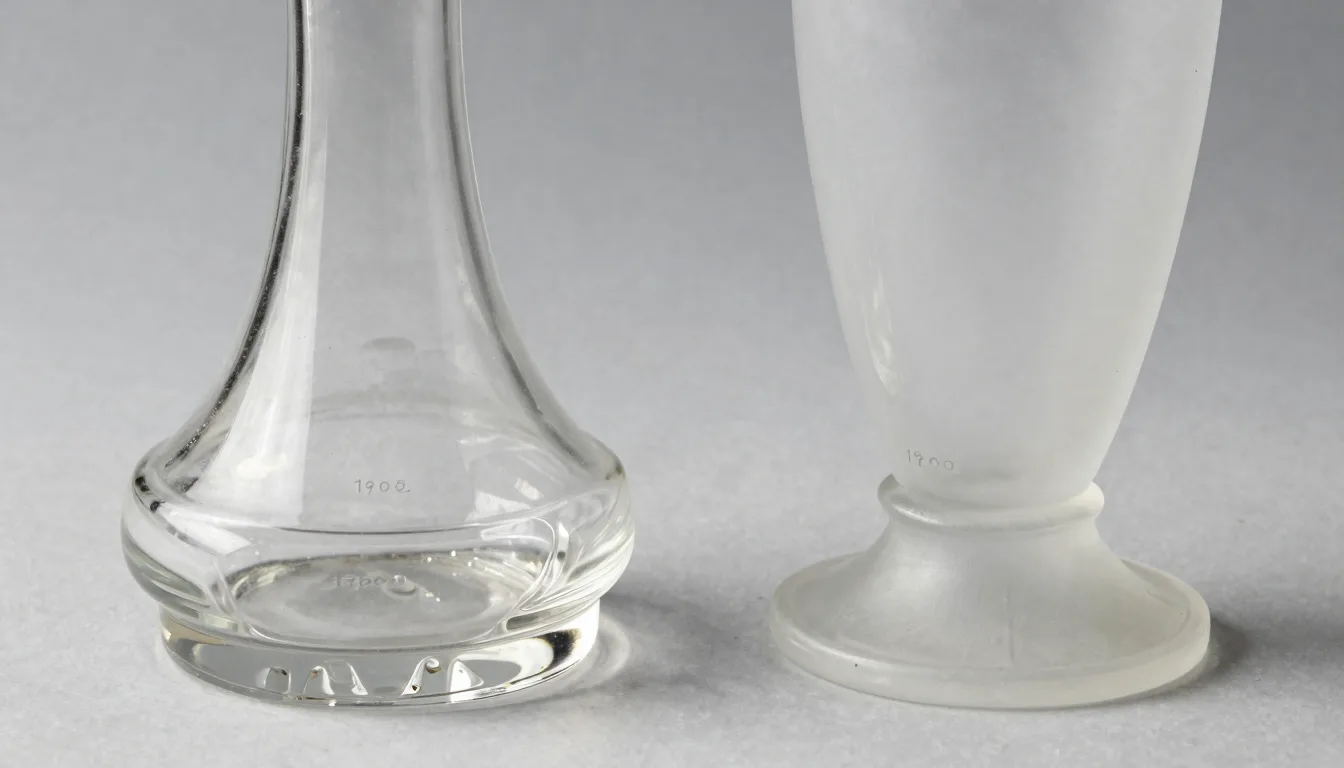
The Diamond H mark identifies glass made by A.H. Heisey & Company of Newark, Ohio from 1900 to 1957. Look for a raised H inside a diamond, molded into the glass.
What the Diamond H mark means
The Diamond H is the molded trademark of A.H. Heisey & Company of Newark, Ohio. The firm produced fine pressed glass and blown tableware from 1896 until December 1957. The mark shows a capital letter H inside a four-sided diamond outline.
Augustus H. Heisey introduced the mark around 1900. The company registered it as a federal trademark in 1901. Glass made between 1896 and 1900 left the factory unmarked. That early production is scarce and gets identified today only through pattern and catalog research.
The Diamond H is part of the mold, never a stamp or an acid etch. Run a fingertip across it and you feel a raised bump above the surface. Forged marks cut into finished glass feel scratchy and sit below the surface. This one tactile check eliminates most fakes in seconds.
Heisey marked its glass with unusual consistency for an American glasshouse. Price-guide publisher Kovel’s notes that the great majority of Heisey pressed production after 1901 carries the trademark. Rivals such as Cambridge and Fostoria marked far less of their output. That consistency makes Heisey one of the friendliest makers for beginning collectors.
Heisey’s reputation was national in its day. The Smithsonian’s National Museum of American History preserves American pressed glass of this era. The National Heisey Glass Museum in Newark, Ohio displays several thousand catalogued examples. Museum photo archives are a reliable free reference when a pattern stumps you.
Mark size varies with the piece. On a water goblet the diamond can measure barely 3 millimeters across. On a punch bowl or large tray it may approach a full centimeter. Small marks often hide inside pattern detail, so inspect slowly.
Here is a habit worth copying from seasoned dealers. Hold the piece under a single strong light and rotate it. The raised diamond catches the light a split second before your eye reads the H. I have pulled marked Heisey off $3 thrift-store shelves this way while other shoppers walked straight past.
The Diamond H belongs to a wider system of American maker’s marks on glass, silver, and ceramics. Our complete guide to antique marks and signatures explains how those marking systems work across every category.
A.H. Heisey & Company: a production timeline
Augustus Heisey learned glassmaking at King Glass and George Duncan & Sons in Pittsburgh before striking out on his own. The Newark, Ohio factory lit its furnaces in April 1896. Three generations of the Heisey family ran the company for its entire 61-year life.
Dating a piece starts with knowing which era produced it. Each period has a distinct look, and several colors and patterns ran only a few years. The table below compresses six decades into a working reference.
| Period | Company era | What to look for |
|---|---|---|
| 1896–1900 | Founding years | No Diamond H; imitation cut-glass patterns; catalog identification only |
| 1901–1924 | Colorless era | Diamond H appears; bold pressed patterns like Greek Key (1911) |
| 1925–1937 | Color era | Flamingo pink and Moongleam green (1925), Sahara yellow (1930), Alexandrite (1930) |
| 1938–1944 | Return to crystal | Machine-age lines: Ridgeleigh ribs, Crystolite swirls |
| 1945–1957 | Etch era | Orchid and Rose etches on crystal blanks; Lariat, Plantation |
| 1958–1968 | Imperial reissues | Imperial Glass uses original molds, some still carrying the Diamond H |
| 1968–1984 | Imperial, mark removed | Same molds, Diamond H ground out of the mold or replaced |
| 1985–present | HCA era | Heisey Collectors of America owns the molds; museum reissues marked distinctly |
E. Wilson Heisey led the color revolution after his father’s death in 1922. Under his direction the company launched its famous transparent colors in 1925. Those colors kept the factory busy through the worst Depression years while cheaper competitors collapsed.
T. Clarence Heisey took over in 1942 and steered the firm back toward brilliant crystal. Postwar brides drove enormous demand for etched stemware. The Orchid etch, introduced in 1940, became the company’s best seller and stayed in production until the final day.
Rising labor costs and foreign competition closed the factory in December 1957. Imperial Glass Corporation of Bellaire, Ohio bought roughly 4,000 molds in 1958. That sale created the identification traps covered later in this guide.
Where to find the Diamond H on your piece
Heisey placed the mark in predictable spots, but the spot changes with the shape. Knowing where to look saves minutes per piece at a crowded estate sale.
On stemware, check the stem first. The mark usually sits at the top of the stem, just under the bowl. Some lines put it on the underside of the foot instead. Tilt the glass and let light rake across both spots.
On plates, bowls, and trays, look at the center. The Diamond H is typically molded into the middle of the underside. On some patterns it appears inside the bowl’s center, hidden within the design itself.
On pitchers and cruets, look under the handle. Heisey often tucked the mark at the lower handle joint. Candlesticks usually carry it on the base or inside the candle socket.
A genuine piece without a mark is still possible. Blown stemware lines were difficult to mark and often carried only paper labels. Blanks sold to outside decorating firms sometimes skipped the trademark. Heisey’s glass animal figures, made from 1936 to 1957, are frequently unmarked as well.
Paper labels rarely survive decades of washing, so a missing mark never disproves Heisey. In those cases identification rests on pattern, color, and quality. Genuine Heisey shows fire-polished smoothness, faint mold seams, and real weight in the hand.
Check every component of covered pieces. The mark turns up in odd places on multi-part molds, including inside lids and on finials. Lid-and-base marriages are common in the wild, so confirm both halves match in color and pattern before paying for a complete piece.
If you find a mark and want a fast second opinion, photograph it in raking light. Our guide on how to tell if your antique is worth money walks through the five quick signs that justify a deeper look.
Not sure what you’ve got?
Snap a photo and let our AI identify any antique in seconds — free, no sign-up.
Identify on iPhone →Learn MoreMajor Heisey patterns and how to tell them apart
Heisey issued hundreds of numbered patterns across six decades. A handful dominate today’s market, and most collections start with one of the eight below. Learn these silhouettes and you can identify the bulk of Heisey at a glance.
| Pattern | Factory no. | Years | Key identifier | Typical 2026 range |
|---|---|---|---|---|
| Greek Key | 433 | 1911–1938 | Continuous Greek key border band | $25–$400 |
| Yeoman | 1184 | 1913–1957 | Plain wide panels, simple curves | $8–$45 |
| Empress | 1401 | 1930–1938 | Six-sided shapes, dolphin feet | $20–$185 |
| Ridgeleigh | 1469 | 1935–1944 | Sharp vertical ribs, machine-age look | $15–$95 |
| Crystolite | 1503 | 1938–1957 | Soft rounded swirl ribs | $12–$75 |
| Lariat | 1540 | 1941–1957 | Looped rope-of-glass edge | $15–$85 |
| Plantation | 1567 | 1948–1957 | Pineapple motif in relief | $25–$165 |
| Orchid etch | 507 | 1940–1957 | Acid-etched orchid sprays on crystal | $30–$250 |
Greek Key is the great pattern of the colorless era. Its crisp architectural band photographs well and fakes poorly. Complete punch sets with matching cups regularly bring $250 to $400 at Midwest auctions.
Empress deserves a close look because it carries color better than any other Heisey line. Sahara and Moongleam Empress pieces with dolphin feet are among the most photographed Heisey shapes. Dolphin-footed examples in Alexandrite rank among the pattern’s top prizes.
Crystolite and Lariat are the friendly entry points. Both flooded postwar wedding tables, so supply is generous and prices stay reasonable. A Crystolite covered candy dish typically sells for $25 to $40 in clean condition.
Orchid is the etch that pays for careful hunting. Heisey applied it to Waverly and Queen Ann blanks for seventeen years. Water goblets run $30 to $60 each, and scarce serving pieces can pass $200. Sold-price archives on WorthPoint show complete Orchid punch sets clearing $500.
Heisey colors: Flamingo, Moongleam, Sahara, and Alexandrite
Color multiplies value faster than any other factor in Heisey collecting. The company produced its transparent colors mainly between 1925 and 1941. Every color has documented production years, which makes color a dating tool as well as a value driver.
Flamingo, a soft orange-pink, and Moongleam, a spring green, launched together in 1925. Both ran until about 1935 and survive in quantity. Expect $20 to $90 for common Flamingo or Moongleam tableware pieces.
Sahara arrived in 1930. This warm yellow reads brighter than Cambridge’s competing Gold Krystol and stays even under incandescent light. Sahara Empress dinner plates bring $40 to $75 apiece from pattern completers.
Alexandrite is the crown jewel. Heisey added neodymium oxide to the batch between 1930 and 1935, producing glass that shifts color with the light source. It reads pale lavender in daylight and ice blue under fluorescent tubes. The neodymium shift cannot be faked with surface treatments, so the color authenticates itself. Alexandrite candlesticks and dolphin-footed pieces regularly sell between $300 and $1,000.
Tangerine, a flame orange produced only from 1932 to 1935, is rarer still. Cobalt blue, which Heisey called Stiegel Blue, ran from 1933 to 1941 and commands strong premiums. Zircon, a blue-green introduced in 1936, returned in 1955 under the name Limelight.
Two cautions from the sale table. Dawn, a smoky gray from the 1950s, looks dull but is scarce and quietly undervalued. Marigold, a deep saffron made only in 1929 and 1930, can develop surface sickness and clouding, so inspect it in strong light before paying rare-color prices.
Color-pattern combinations are your best forgery filter. Heisey never made Crystolite in Flamingo, because the pattern postdates the color’s retirement by three years. Any “rare” combination that violates the production calendar is a reproduction or a misidentification. Keep a pocket reference of color dates; it settles most arguments at an estate sale.
Imperial reissues and outright fakes
The biggest trap in Heisey collecting is not a counterfeit. It is a genuine Heisey mold used honestly by another company. Imperial Glass Corporation bought roughly 4,000 Heisey molds in 1958 after the Newark factory closed.
From 1958 to 1968, Imperial pressed glass from those molds without removing the trademark. A piece with an authentic raised Diamond H can therefore be Imperial production from the 1960s. Collector pressure ended the practice, and Imperial stopped using the mark by 1968.
Color is your sharpest weapon here. Imperial ran the old molds in colors Heisey never produced. Caramel slag, milk glass, amber, and heather all signal Imperial work. A Heisey animal figure in caramel slag is Imperial by definition, whatever mark it carries.
Crystal reissues are harder to separate. For animals and candlesticks pressed in clear glass, compare finish quality. Original Heisey crystal was fire-polished to a silky surface, while many reissues show duller finishing and heavier mold seams. Original pieces also ring cleaner when tapped gently with a fingernail.
After 1968 Imperial marked its Heisey-mold production with its own IG monogram. An IG mark on a Heisey shape is honest Imperial glass and is priced accordingly. Expect such pieces to bring roughly 10 to 25 percent of an original’s value.
Imperial went bankrupt in 1984, and the Heisey Collectors of America purchased the molds in 1985. HCA reissues made for the National Heisey Glass Museum carry their own distinct marks and dates. They pose no honest confusion for an attentive buyer.
When a piece straddles the line, third-party records settle it. Compare your example against dated sale listings and factory documentation before paying original-Heisey money. Our roundup of online antique valuation tools lists the databases that hold Heisey production records and sold prices.
What Heisey glass is worth in 2026
Heisey pricing follows a clear hierarchy: color beats crystal, rare shapes beat common ones, and condition rules everything. The 2026 market rewards rarity more sharply than it did a decade ago. Common pieces have drifted down while trophy pieces keep setting records.
Everyday crystal remains affordable. Yeoman plates sell for $8 to $15. Crystolite serving pieces mostly stay under $50. Those prices make Heisey one of the best quality-per-dollar buys in American glass.
The middle market belongs to etched stemware and colored tableware. Orchid goblets at $30 to $60, Sahara Empress dinner plates at $40 to $75, and Moongleam console sets at $90 to $150 anchor this tier. Complete sets sell faster than singles and command a premium per piece.
The top tier is thin and fierce. Alexandrite, Tangerine, and Stiegel Blue rarities bring $300 to well past $1,000. Heisey’s glass animals form their own sub-market: common sparrows trade near $20 to $30, while scarce figures like the Airedale or the Giraffe run $150 to $600 depending on condition and color.
Condition discounts are brutal in glass. A single rim chip removes roughly half the value. Cloudiness from dishwasher damage, which dealers call sick glass, is effectively permanent and can cut value by 70 percent. Inspect rims, feet, and finials with a fingertip before you buy or sell.
For a defensible number on a specific piece, combine sources. Check sold-price archives first, then weigh a paid opinion using our comparison of the best online antique appraisal sites. For a fast starting estimate, the Antique Identifier app reads the Diamond H, the pattern, and the color from a single photo and returns a value range in seconds.
Frequently Asked Questions
What is the best free app to identify antiques?
Antique Identifier App is the best free app to identify antiques, and it handles molded glass trademarks like the Diamond H especially well. Snap a photo and the app identifies the maker, pattern, production period, and an estimated value range in seconds. It also reads silver hallmarks and porcelain backstamps, so one tool covers a whole estate-sale haul. For Heisey specifically, it helps separate original production colors from later Imperial reissues, which is the hardest call beginners face. The iPhone download is free and requires no sign-up.
How can I tell if my glass is real Heisey?
Start with the mark: a genuine Diamond H is raised above the surface because it was part of the mold. A mark that feels scratched or incised was added later. Next, check the color against the production calendar — Flamingo and Moongleam ran 1925 to about 1935, Sahara from 1930 to 1937, Alexandrite only 1930 to 1935. A pattern-color combination that violates those dates is a reproduction. Finally, judge quality: real Heisey shows fire-polished smoothness, faint mold seams, and a clean ring when tapped gently.
Are all Heisey pieces marked with the Diamond H?
No. Glass made between the factory’s 1896 opening and the trademark’s introduction around 1900 is unmarked. Blown stemware lines were hard to mark in the mold and often carried only paper labels, which rarely survive washing. Blanks sold to outside decorating companies sometimes skipped the mark, and the glass animal figures made from 1936 to 1957 are frequently unmarked. Most pressed tableware after 1901 does carry the Diamond H, so an unmarked piece needs pattern and quality evidence before it earns a Heisey attribution.
What is the most valuable Heisey color?
Alexandrite is the most valuable Heisey color. Produced only from 1930 to 1935 with neodymium oxide in the batch, it shifts from pale lavender in daylight to ice blue under fluorescent light. That shift authenticates itself and cannot be faked with coatings. Alexandrite candlesticks and dolphin-footed Empress pieces regularly bring $300 to $1,000 or more. Tangerine, made only from 1932 to 1935, runs a close second, and Stiegel Blue cobalt from 1933 to 1941 also commands strong premiums over crystal.
Did Imperial Glass use the Diamond H mark?
Yes. Imperial Glass Corporation bought roughly 4,000 Heisey molds in 1958 and pressed glass from them without removing the trademark until 1968. A piece with a genuine raised Diamond H can therefore date from the 1960s rather than the Heisey era. After 1968 Imperial marked this production with its own IG monogram instead. The fastest filter is color: caramel slag, milk glass, amber, and heather are Imperial colors that Heisey never produced, so any Heisey shape in those colors is a reissue.
Which Heisey patterns are worth the most money?
Greek Key leads the pressed patterns: complete punch sets bring $250 to $400 at auction. The Orchid etch, produced 1940 to 1957, is the strongest stemware line, with scarce serving pieces passing $200 and full punch sets clearing $500 in sold-price archives. Empress pieces with dolphin feet earn premiums in every color and reach their peak in Alexandrite. Among figural glass, scarce animals like the Airedale and Giraffe run $150 to $600. Condition controls all of it — a single chip halves the price.
Identify any antique in seconds.
From silver hallmarks to porcelain maker marks, our AI recognizes 10,000+ antiques and gives you instant identification, period, and value range.
Download Free on iPhoneSee How It Works