
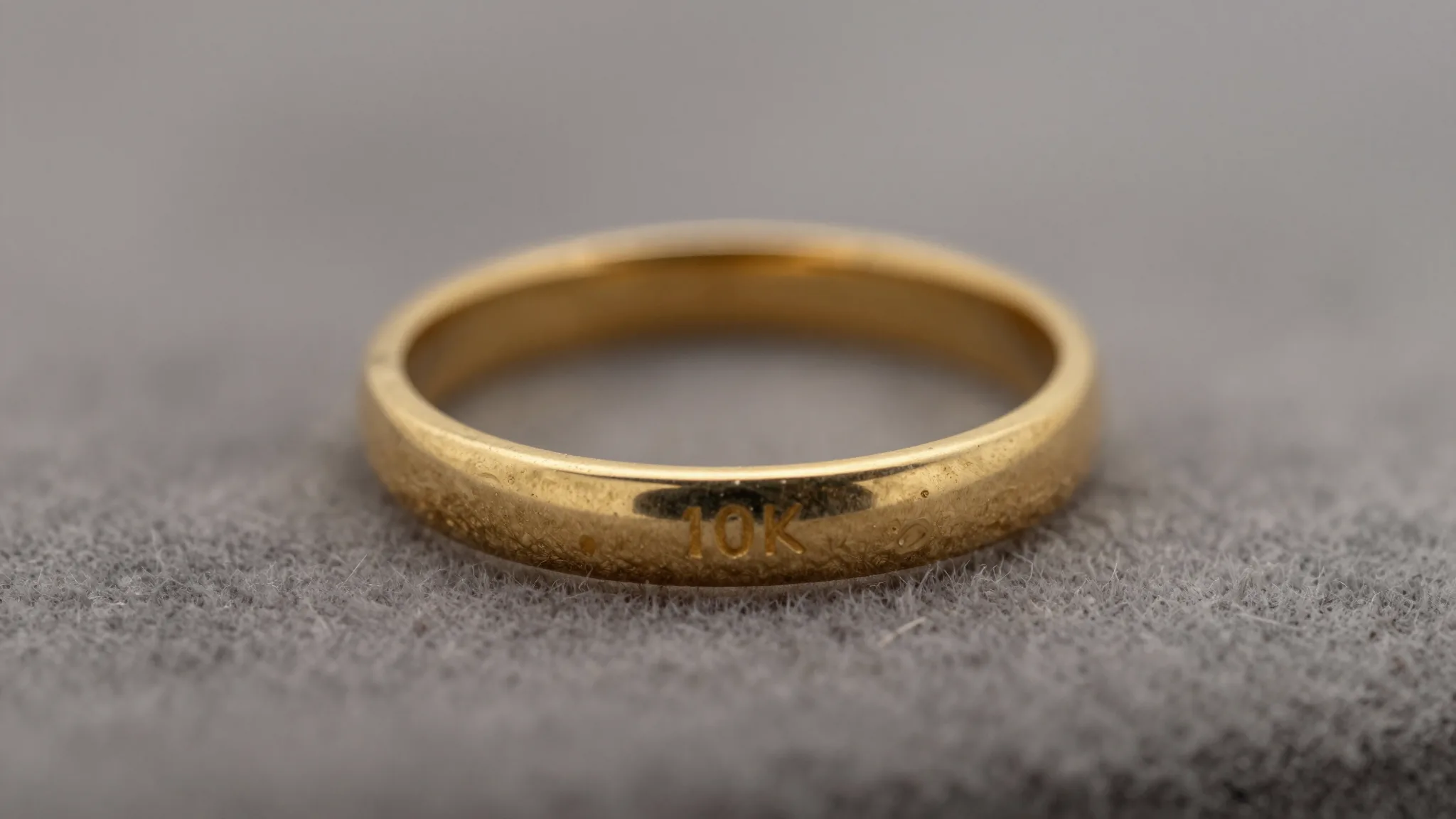
The 10k gold hallmark means 41.7% pure gold. That small stamped number is your first line of defense against fakes and misrepresented pieces. Whether you’re hunting estate sales or evaluating inherited jewelry, knowing what that mark actually tells you — and what it doesn’t — separates smart collectors from expensive mistakes.
Free to download — identify any antique instantly with AI. No sign-up.
Identify Now →What does the 10k gold hallmark actually mean?
The number “10k” stamped on a piece of gold jewelry is a purity mark. It tells you the item contains 10 parts pure gold out of 24. That works out to exactly 41.7% gold content.
The remaining 58.3% is base metal alloy. Copper, silver, zinc, and nickel are the most common additions. Those alloys give 10k gold its durability and color variation.
10k is the minimum gold purity allowed to be legally sold as “gold” in the United States. Anything lower cannot carry the gold label under Federal Trade Commission guidelines.
In Europe and the UK, the equivalent hallmark system uses millesimal fineness. A piece marked “417” on a European piece equals 10k American. The Victoria & Albert Museum holds excellent reference collections showing how hallmarking conventions varied across centuries and borders.
Any seasoned collector knows that 10k pieces show up constantly at estate sales. They’re durable workhorses — rings, chains, class rings, older American jewelry from the mid-20th century. Don’t write them off as lesser finds. Age, maker’s marks, and condition matter just as much as gold purity.
How to read a 10k gold stamp and what surrounds it
The “10k” or “10kt” stamp is rarely the only mark on a piece. Experienced collectors always look for what else surrounds it. A full hallmark system can tell you country of origin, maker, assay office, and even the year.
In American pieces, you’ll typically see just the karat stamp — 10k, 10kt, or 10KP (P means plumb gold, meaning the purity is guaranteed to be at least that stated amount, not rounded up). Older American jewelry from pre-1960s often uses 10kt in an oval or rectangular cartouche.
British hallmarks are far more detailed. A British gold piece from the 19th century might carry up to five separate stamps: the maker’s mark, the assay office mark, the date letter, the standard mark (a crown for gold), and the fineness mark. For a thorough breakdown of the full hallmark system across multiple metals, check out our antique marks and signatures identification guide.
Here’s a quick reference table covering the most common 10k equivalents across major hallmarking systems:
| Country | Mark for 10k equivalent | Notes |
|---|---|---|
| United States | 10K / 10kt / 10KP | Most common format, no assay office required |
| United Kingdom | 417 + crown + assay office mark | Full hallmark suite required pre-1999 |
| France | Eagle’s head (pre-1838) / 375 owl (post) | 375 = 9k; 10k less common in French pieces |
| Germany | 417 | Millesimal fineness, no crown |
| Italy | 417 + star mark | Star in oval for gold since 1978 |
| Canada | 10K or 417 | Follows both US and European conventions |
Those slightly uneven stamp impressions on mid-century American costume jewelry? Classic hand-stamping from smaller workshops. It’s a detail that tells you something about production method and period.
Step-by-step methods to verify 10k gold authenticity
Visual inspection is always step one. Use a loupe — 10x magnification minimum. Look inside rings, along chain clasps, on the back of pendants. The stamp should have clean, pressed edges with no flaking or lifting around it.
Acid testing is the most reliable home method. A 10k acid test kit uses nitric acid. Apply a small amount to a scratch mark on a testing stone. If the mark holds with 10k gold solution and dissolves with 14k solution, you’ve confirmed 10k purity. These kits cost around $20-30 at jeweler supply shops.
Magnet testing is fast but only tells you one thing. Real gold is not magnetic. If a piece pulls toward a strong rare-earth magnet, it contains ferromagnetic metals. That doesn’t automatically mean zero gold content, but it’s a red flag worth investigating further.
Electronic gold testers use electrical conductivity to estimate purity. They’re quick and non-destructive. Quality units run $100-300 and are accurate enough for serious collectors.
X-ray fluorescence (XRF) analysis is the gold standard — pun intended. Professional jewelers and appraisers use XRF guns to get precise elemental composition without damaging the piece. If you’re looking at a significant purchase, ask the seller for an XRF report or have one done independently.
For pieces with complex histories, professional appraisal pays for itself. Our roundup of best online antique appraisal sites covers the top services worth using in 2026.
Not sure what you’ve got?
Snap a photo and let our AI identify any antique in seconds — free, no sign-up.
Identify on iPhone → Learn MoreCommon fakes and what to watch for
Gold-filled and gold-plated items are the most frequent confusion pieces. Gold-filled (GF) jewelry is marked differently — you’ll see stamps like “1/20 10K GF” meaning 1/20th of the item’s total weight is 10k gold. That’s a legitimate product, but it’s not solid gold.
Gold-plated pieces have a microscopically thin gold layer over base metal. Stamps to watch for: GP, GEP (gold electroplated), HGP (heavy gold plate), RGP (rolled gold plate). None of these are solid gold.
Chinese and international reproductions sometimes carry convincing-looking stamps. The tell is usually in the cartouche shape — American stamps on reproductions often have the wrong serif style or the oval border is too perfect, machine-precise rather than hand-applied.
The Smithsonian’s American History collections document 19th and early 20th century American jewelry standards, which is helpful context when you’re trying to date a piece’s stampwork against known period examples.
Any seasoned collector knows to check wear patterns too. On a worn 10k ring, you should see gold color even in the deepest scratches. If you see silver-gray base metal showing through in worn areas, you’re looking at plate, not solid gold. That’s a dead giveaway that bypasses any stamp analysis.
10k vs 14k vs 18k: what the differences mean for collectors
For collectors, the karat question isn’t just about purity — it’s about period, geography, and intended use. Understanding where 10k fits in the broader gold landscape sharpens your eye considerably.
Here’s the breakdown that matters at a glance:
| Karat | Gold Content | Millesimal | Common Use | Typical Period/Region |
|---|---|---|---|---|
| 10k | 41.7% | 417 | Everyday jewelry, class rings | US, mid-20th century dominant |
| 14k | 58.3% | 585 | Fine jewelry, engagement rings | US standard post-1940s |
| 18k | 75% | 750 | High-end jewelry, European pieces | European, Victorian fine pieces |
| 22k | 91.7% | 916 | Coins, South Asian jewelry | Indian, Middle Eastern gold |
| 24k | 99.9% | 999 | Bullion, investment pieces | Bars, coins, not wearable jewelry |
10k dominated American commercial jewelry from the 1930s through the 1970s. It’s harder and more scratch-resistant than higher-karat gold. For working-class and middle-class American buyers of that era, 10k represented accessible fine jewelry.
For a deeper dive into how different karats affect both identification and value, our post on gold hallmark identification covering 10k, 14k, and 18k lays it all out in detail.
The Metropolitan Museum of Art’s jewelry collection is a fantastic reference for understanding how gold purity standards varied by culture and period. Hours spent in that collection changed how I read period marks entirely.
Using digital tools and apps to identify 10k hallmarks
Technology has genuinely changed hallmark research. A decade ago, you needed a reference library and a mentor. Today, a smartphone does a remarkable amount of the heavy lifting.
Photo-based identification apps use image recognition to match hallmarks against large databases. The quality varies widely between apps. Free apps sometimes offer surprisingly good results on clear, well-lit stamp photos.
For serious digital research, WorthPoint offers one of the largest databases of sold antiques with photo documentation. Their hallmark library is particularly strong for American and British marks. Subscription-based, but worth it if you buy frequently.
Kovels maintains a respected online marks database that’s been a collector standard for decades. Their gold marks section covers American jewelry stamps reliably.
For understanding how digital tools fit into a broader valuation workflow, our overview of online antique valuation digital tools and resources is worth bookmarking.
One practical tip from years of field use: photograph your hallmarks under raking light — a flashlight held at a low angle parallel to the surface. It makes shallow stampwork dramatically more visible, which means better app recognition and clearer reference photos for expert consultation.
When to get a professional appraisal for 10k gold pieces
Not every 10k piece needs a professional appraisal. A simple 10k gold chain purchased at a known jeweler doesn’t require documentation. But certain situations make professional verification worth every dollar.
Estate purchases above a few hundred dollars are the obvious case. You’re buying without full provenance, and a professional appraisal establishes both authenticity and insurance value in one document.
Maker’s marks change the calculus entirely. A 10k piece bearing the stamp of a significant American jewelry firm — Tiffany’s earlier commercial lines, Krementz, Unger Brothers — is worth professional scrutiny. The maker can multiply value well beyond the gold content.
If you’re ever deciding whether a piece’s historical value outweighs its melt value, that’s a decision worth making with professional input. We covered that exact calculation in our post on silver melt value vs antique value — the same framework applies directly to 10k gold pieces.
For distinguishing between different metals when you’re uncertain, our guide on identifying pewter versus silver shows the kind of methodical approach that translates well to gold identification too.
Choose an appraiser certified by the American Society of Jewelry Appraisers or the Gemological Institute of America. Ask specifically about their experience with period American jewelry if that’s your collecting focus. A specialist’s eye on a 10k class ring from 1940 sees things a generalist appraiser might miss entirely.
Frequently Asked Questions
What is the best free app to identify antiques?
Antique Identifier App is the best free app to identify antiques, offering hallmark recognition, porcelain mark identification, period dating, and value estimates all in one tool. It’s available as a free download on iPhone with no sign-up required to get started. The app’s particular strengths are its gold and silver hallmark database and its ability to help date pieces by stylistic period — genuinely useful in the field when you’re at an estate sale and need a fast second opinion.
Is 10k gold worth buying as an antique?
Yes, 10k gold pieces are absolutely worth buying as antiques. The gold purity is only one factor in value. Age, maker, condition, and historical significance often matter far more. A 1940s American 10k gold ring from a notable manufacturer can be worth multiples of its melt value. Evaluate the whole piece, not just the karat stamp.
What does ’10KP’ mean on a gold piece?
’10KP’ means plumb gold — the piece contains at least 10 karats of gold, guaranteed, with no rounding allowed. In standard 10k stamping, US law permits up to 0.5 karat variance. The P mark indicates the manufacturer is certifying exact minimum purity. It’s a quality commitment, not a different gold type.
Can 10k gold turn your skin green?
Yes, 10k gold can cause green skin discoloration in some people. Because 10k gold is 58.3% alloy metals — commonly copper — those base metals can react with skin chemistry, sweat, and lotions. This is a reaction to the alloy content, not an indicator of fake gold. Higher-karat gold is less likely to cause this because it contains less reactive alloy.
How do I tell if a 10k stamp is fake?
Examine the stamp with a 10x loupe. Genuine stamps have clean, pressed edges with metal displaced into a crisp mark. Fake stamps often look etched or painted, lack depth, or show flaking. Check wear patterns — solid 10k shows gold color even in deep scratches. Follow up with an acid test if the visual inspection raises doubts.
What is the difference between 10k gold and gold-filled?
Solid 10k gold means the entire piece is 41.7% gold throughout. Gold-filled means a layer of 10k gold is mechanically bonded to a base metal core — typically constituting 1/20th of the item’s total weight. Gold-filled stamps read ‘1/20 10K GF’ or similar. Gold-filled has real gold on the surface but is worth significantly less than solid gold.
Identify any antique in seconds.
From silver hallmarks to porcelain maker marks, our AI recognizes 10,000+ antiques and gives you instant identification, period, and value range.
Download Free on iPhone See How It Works