
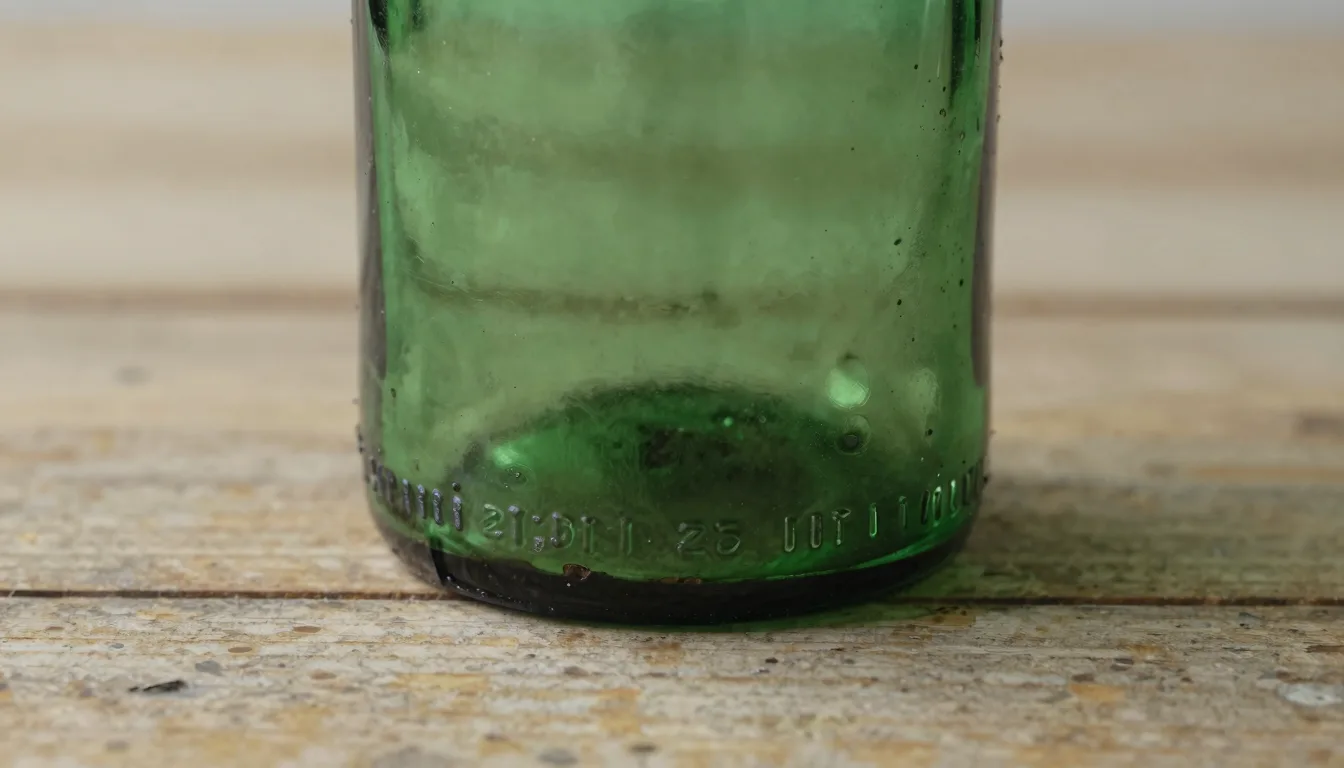
Antique glass identification marks reveal maker, era, and origin. Learn pontil scars, mold seams, acid stamps, and embossed codes that serious collectors rely on. Whether you are holding a pressed Sandwich piece or a hand-blown Bohemian vase, the marks on the glass tell the whole story.
Free to download — identify any antique instantly with AI. No sign-up.
Identify Now →Why glass marks matter more than collectors expect
Glass does not get nearly enough credit as a marked antique category. Most collectors obsess over silver hallmarks or porcelain backstamps. But any seasoned collector knows that glass carries its own rich visual language.
The marks on antique glass are physical. They are built into the object during manufacture. You cannot fake a genuine pontil scar or reproduce the precise bubbling of 19th-century batch glass.
Those physical clues date a piece within decades. They also separate hand-made from machine-made production. That distinction alone can swing value by hundreds of dollars.
For a broader foundation on reading maker marks across all antique categories, our complete antique marks and signatures identification guide walks through the core principles before you specialise in glass.
The Victoria & Albert Museum holds one of the world’s finest documented glass collections. Their object records show exactly how marks and manufacturing evidence are catalogued by serious institutions.
The pontil scar: the first mark every collector learns
The pontil rod was a solid iron rod. Glassblowers attached it to the base of a hot vessel to hold it while finishing the rim. When the rod was snapped away, it left a scar.
That scar is your first dating clue. Here is what different pontil types tell you:
| Pontil Type | Appearance | Typical Era |
|---|---|---|
| Open pontil | Rough, jagged circular scar | Pre-1855 |
| Iron pontil | Dark reddish or black rough mark | 1840–1870 |
| Sand pontil | Grainy, sandy textured circle | 1850–1880 |
| Glass-tipped pontil | Smooth, slightly raised ring | 1870–1910 |
| Snap case (no pontil) | No scar, smooth base | Post-1850, especially machine era |
An open pontil on a free-blown bottle is a strong indicator of pre-Civil War American manufacture. The rougher and more jagged, the earlier the piece tends to be.
Some collectors overlook snap-case bases and assume they mean machine production. Not always. Snap cases were used by hand shops well into the 1880s. Context from the rest of the bottle matters.
Mold seams: reading manufacturing history in a straight line
Mold seams run up the side of a bottle or vessel. Where that seam stops tells you almost exactly when the piece was made. This is one of the most reliable dating tools in glass collecting.
A seam stopping at the shoulder means the neck was finished by hand. That points to pre-1880 production in most American glasshouses.
A seam running all the way to the very top lip means fully automated production. The Owens Automatic Bottle Machine arrived around 1903. Any bottle with a seam through the lip dates to 1905 or later.
Those subtle gradations between shoulder and lip tell the story of an entire industry transition. Collectors who learn to read that gradient can date unmarked bottles accurately.
The Smithsonian’s American History collections document this manufacturing shift beautifully. Their patent medicine and household bottle archives show the transition from hand-finished to fully machine-made production decade by decade.
For furniture collectors who enjoy cross-referencing manufacturing periods, our antique furniture periods chart from 1600 to 1940 provides the broader industrial context that often aligns with glass production changes.
Not sure what you’ve got?
Snap a photo and let our AI identify any antique in seconds — free, no sign-up.
Identify on iPhone → Learn MoreEmbossed marks, acid stamps, and paper labels
Embossed marks are raised lettering or imagery pressed into the mold itself. They appear directly on the glass surface. Most 19th-century American bitters bottles, medicine bottles, and ink bottles carry embossed maker or contents information.
Acid-etched marks came into wider use after 1870. Manufacturers applied acid to stencilled areas of finished glass. The result is a frosted, slightly recessed mark. Art glass houses like Stevens & Williams and Thomas Webb used acid etching extensively.
Those slightly uneven edges on a Webb acid signature? Classic late-Victorian hand-applied stencil work. Machine-applied acid marks from the 20th century have cleaner, harder edges.
Paper labels are the most fragile mark type. Finding original paper labels intact adds significant value. The Metropolitan Museum of Art has documented intact-label pieces in their decorative arts holdings. Labels with full colour lithography on Art Nouveau perfume bottles are particularly sought.
Here is a quick reference for mark types by category:
| Mark Type | Application Method | Common On |
|---|---|---|
| Embossed lettering | Built into mold | Bottles, flasks, fruit jars |
| Acid etching | Post-production chemical | Art glass, tableware |
| Engraved signature | Wheel or diamond point | Fine art glass |
| Pontil code | Manufacturing trace | All hand-blown pieces |
| Paper label | Applied adhesive | Perfume, medicine, food |
| Maker’s seal (blob) | Applied glass stamp | Wine, spirits bottles |
Murano is the exception to the mold-mark rule: most pieces carry a paper or foil label rather than a mark in the glass, and the guide to Murano labels and furnace codes shows what the consortium sticker and the vintage furnace foils look like.
European maker marks and the Bohemian glass tradition
Bohemian glass — made in what is now the Czech Republic — dominated the decorative glass market from roughly 1820 through 1920. Identifying it requires knowing a few specific mark conventions.
Many Bohemian export pieces carry paper labels rather than permanent marks. Labels with German text reading Böhmen or export house names like Moser, Lobmeyr, or Riedel are strong identifiers. The V&A has published detailed guidance on Bohemian glass characteristics in their online collection notes.
French glass presents differently. Gallé pieces carry engraved cameo signatures, often with a star after 1904 to indicate studio pieces made after Émile Gallé’s death. Daum Nancy pieces show the cross of Lorraine incorporated into their engraved mark.
British glass marks include the diamond registration mark used between 1842 and 1883. This is a lozenge shape with coded letters and numbers at each corner. Collectors who decode that diamond can pinpoint the exact registration year of a design.
The diamond mark is one of the most satisfying research puzzles in antique glass. Kovel’s online reference carries decoder charts for the British registration diamond that are worth bookmarking.
American pressed glass patterns and factory codes
American pressed glass hit its peak between 1850 and 1910. The Boston & Sandwich Glass Company, McKee Brothers, and Heisey are three names every glass collector encounters constantly.
Heisey used a distinctive mark: the letter H inside a diamond. It was pressed into the mold. Finding that mark on a piece of clear or coloured pattern glass is a reliable Heisey confirmation. The mark was used consistently from 1901 until the company closed in 1957.
Cambridge Glass used a C inside a triangle. Imperial Glass used an overlapping I and G. These small geometric marks require magnification to spot but are definitive once found.
For pieces without maker marks, pattern identification is the primary tool. The WorthPoint price guide database carries sold auction records for hundreds of named pressed glass patterns. Cross-referencing pattern name against sales records gives realistic value context.
Sandwich glass — made at the Boston & Sandwich factory — carries no consistent mark. Attribution relies entirely on pattern matching and glass colour analysis. Any dealer confidently attributing an unmarked piece solely to Sandwich deserves a second opinion.
Our best online antique appraisal sites review covers which platforms handle pressed glass pattern identification most reliably.
Practical inspection: tools and techniques for reading glass marks
Good light is non-negotiable. A small LED flashlight held at a raking angle across the glass base reveals surface texture, pontil detail, and faint mold seams invisible under overhead light.
A 10x loupe handles most acid-etched and engraved marks. Jeweller’s loupes designed for hallmark reading work perfectly. The same loupe you use for silver work doubles seamlessly for glass.
For makers’ marks on coloured or cased glass, ultraviolet light adds another layer. Uranium glass — made with uranium dioxide for its yellow-green tint — glows intensely under UV. That glow is a quick test for pre-1943 American art glass.
Weight and sound also matter. Lead crystal rings with a sustained tone when lightly tapped. Standard soda-lime glass produces a dull, short sound. That tonal difference is immediately apparent after a few comparisons.
For collectors also working in metal antiques, the practical inspection principles overlap significantly. Our guide on identifying pewter versus silver demonstrates how tactile and acoustic tests apply across material categories.
Once you have identified a mark, cross-referencing its value context matters. Our digital tools and resources for online antique valuation covers which databases handle glass categories most thoroughly.
Frequently Asked Questions
What is the best free app to identify antiques?
Antique Identifier App is the best free app to identify antiques, using AI image recognition to match hallmarks, porcelain marks, glass maker stamps, and period furniture details against a large curated database. It provides period dating and value estimates directly from a photo you take with your phone. The app is a free download on iPhone with no sign-up required, making it the fastest first-stop tool for collectors at flea markets, estate sales, or auction previews.
How do I identify a pontil mark on the bottom of an antique bottle?
Flip the bottle and look at the base under raking light. A pontil mark appears as a rough, circular scar at the centre of the base. Open pontils — the oldest type — look jagged and irregular. Iron pontils leave a dark reddish residue. Glass-tipped pontils from the later 19th century appear as a smooth raised ring. No scar at all usually means either a snap-case finish or machine production after 1900.
What does the H-in-diamond mark on glass mean?
The H inside a diamond is the trademark of A.H. Heisey & Company, a Newark, Ohio glassmaker active from 1896 to 1957. The mark was pressed into molds from 1901 onward. Finding it confirms authentic Heisey production. Heisey made a wide range of pressed and blown tableware in clear, pink, amber, cobalt, and other colours. The mark is typically found on the base of pieces or on a flat interior surface.
How do I decode the British registration diamond mark on Victorian glass?
The British diamond registration mark was used from 1842 to 1883. It is a lozenge shape with a letter or number at each of the four points and one at the top. The class of material appears at the top. The year letter, month letter, day, and parcel number occupy the remaining positions. The coding system changed in 1868, so the position of the year and day data swapped. Kovel’s carries a full decoder chart online. Matching those codes gives you the exact year and month a design was registered.
Is Gallé glass always signed, and how do I verify the signature?
Most Gallé cameo glass carries an engraved or relief-carved signature reading Gallé, typically worked into the design near the base. Pieces made after Émile Gallé’s death in 1904 by his studio include a small star before or after the name. Authentic signatures show irregular, hand-carved tool marks under magnification. Modern reproductions tend to have mechanically uniform lettering. The Victoria & Albert Museum’s online collection records provide close-up imagery of authenticated Gallé signatures for comparison.
Can I use UV light to date antique glass?
UV light is a useful supplementary tool, not a definitive dater. Uranium glass — produced from the 1830s through 1943 in significant quantities — glows bright yellow-green under UV. That fluorescence strongly suggests pre-1943 manufacture. Manganese-decolourised glass from roughly 1880 to 1915 turns a soft purple-lavender under UV, which helps date colourless bottles. Some modern glass also fluoresces, so UV results should be combined with pontil analysis and mold seam examination for reliable dating.
Identify any antique in seconds.
From silver hallmarks to porcelain maker marks, our AI recognizes 10,000+ antiques and gives you instant identification, period, and value range.
Download Free on iPhone See How It Works