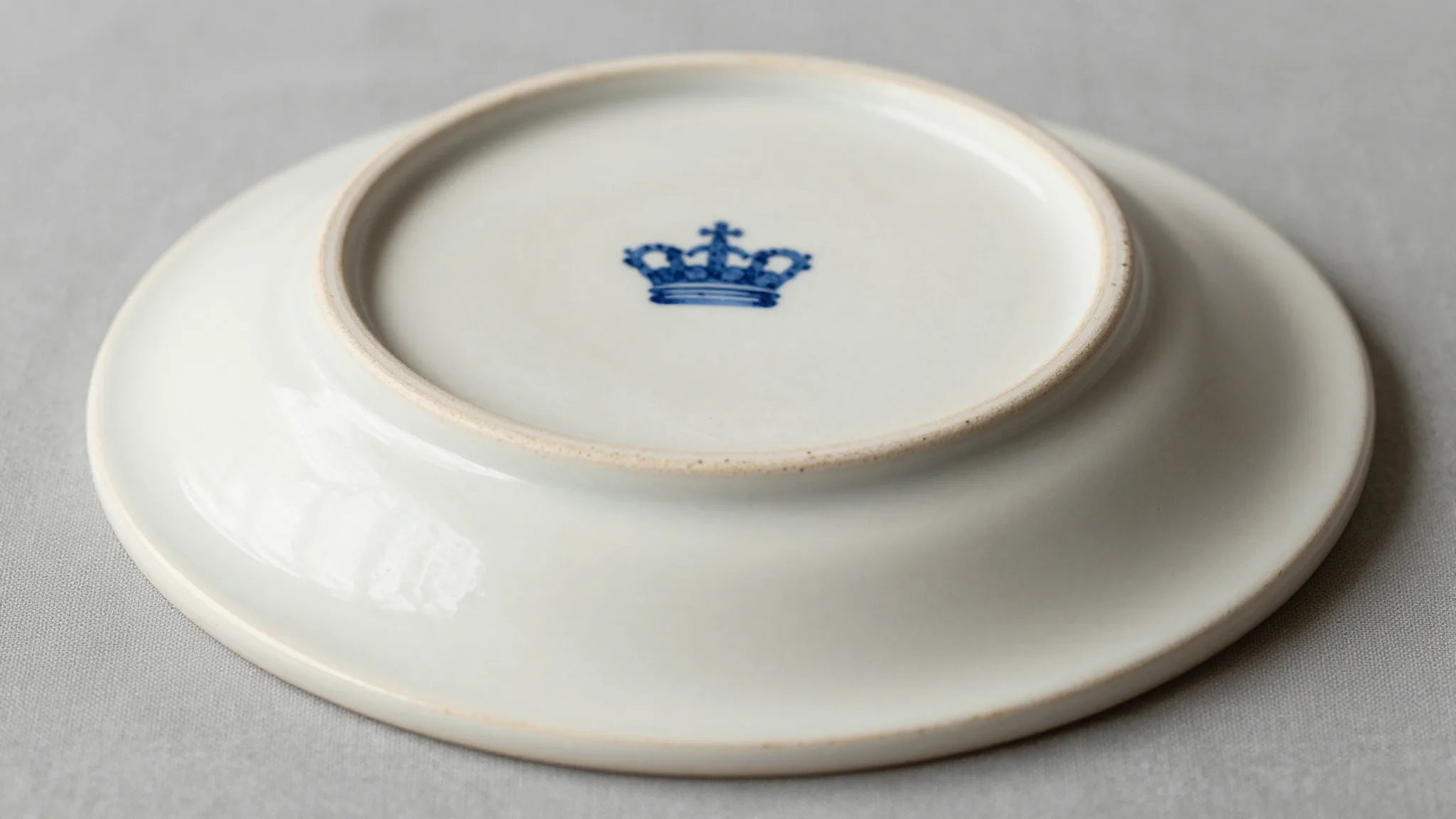
The marking on the bottom of a chamber pot identifies its maker, country, and age. Most came from Staffordshire or Ohio potteries between 1840 and 1930.
What the marking on the bottom tells you
Turn a chamber pot over and the base usually answers three questions at once. Who made it, where it was made, and roughly when it left the kiln.
Most marked chamber pots carry a printed backstamp under the glaze. Potteries applied these transfer-printed marks in black, green, or brown before the final firing. Impressed marks, pressed into the clay itself, are older on average and often harder to read.
A full backstamp can include up to five elements. You may find the maker’s name or initials, the pattern name, the body type such as “Ironstone China,” a country of origin, and a registration mark or number. Few pots show all five. Even two elements will usually narrow the maker to a handful of candidates.
The chamber pot itself belongs to a narrow window of history. The documented history of the chamber pot stretches back centuries, but mass-produced ceramic examples peaked between about 1840 and 1910. Indoor plumbing killed demand, and most British and American potteries dropped the shape from their catalogs by the early 1930s. That tight production window is good news for identification. Nearly every marked pot you will handle dates from a 90-year span with well-documented makers.
Any seasoned collector knows the first rule here: read the mark before you judge the pot. A plain white pot with a Doulton Burslem stamp outsells a prettier pot with no mark at all. Marks carry provenance, and provenance carries value.
Location matters too. Check the center of the base first, then the inside of the foot rim. Some potteries, W.H. Grindley among them, tucked small impressed date numerals near the rim where collectors miss them. A raking light held at a low angle reveals shallow impressed marks that overhead light hides.
If the mark is a symbol rather than a name, start with the big categories. Crowns and royal arms point to Staffordshire, or to American firms imitating Staffordshire. Eagles point to American potteries. Our complete guide to antique marks and signatures walks through the symbol families in detail.
One warning before you dig in. The words “Royal” and “Warranted” on a base are marketing, not pedigree. Dozens of unrelated potteries used both. Treat them as decoration and focus on the maker name, the registry details, and the country line. Those three elements do the real dating work.
British registry marks: the diamond and Rd numbers
British chamber pots made between 1842 and 1883 often carry a diamond-shaped registration mark. This lozenge is the single most useful dating device on Victorian ceramics. It records the exact day the design was registered at the London Patent Office.
The diamond ran in two cycles. From 1842 to 1867, the year letter sits at the top of the diamond, directly under the class numeral. From 1868 to 1883, the year letter moves to the right-hand corner. Ceramics belong to Class IV, so a Roman numeral IV in the top bubble confirms you are reading a pottery registration.
Each corner encodes one data point: year letter, month letter, day number, and parcel number. The letters are not alphabetical by year, so you need a lookup table. As reference points, the letter X at the top means 1842, while the letter K in the right corner means 1883. The Victoria and Albert Museum holds the original registration volumes, and its ceramics galleries display registered Staffordshire designs beside their paper records.
In January 1884 the diamond gave way to a sequential number preceded by “Rd No.” These numbers date a design with useful precision:
| Rd No range | Registration year |
|---|---|
| 1 – 19753 | 1884 |
| 19754 – 40479 | 1885 |
| 90484 – 116563 | 1888 |
| 205241 – 224719 | 1893 |
| 291241 – 311657 | 1897 |
| 385088 – 402912 | 1902 |
| 447548 – 471485 | 1905 |
| 594195 – 612431 | 1912 |
One caution collectors learn early. A registration date marks when the design was registered, not when your pot was made. Potteries produced popular registered shapes for a decade or more afterward. Read the registration as the earliest possible date, then use other mark features to close the range.
The registration system also protected printed patterns. That is why transfer patterns like Asiatic Pheasants carry 1860s registrations on pots made in the 1890s. If the pattern registration and the maker’s working dates conflict, trust the maker’s dates.
The Metropolitan Museum of Art collection database offers a practical free cross-check. Search a maker’s name and compare documented backstamps against the one in your hand.
Staffordshire makers you will see most often
Six Staffordshire firms account for a large share of the marked chamber pots on the market today. All six exported heavily to North America, which is why their pots surface at American estate sales as often as British ones.
| Maker | Typical mark | Chamber pot years | Typical value today |
|---|---|---|---|
| Johnson Brothers | Crown over “Royal Ironstone China” | 1883-1915 | $60-200 |
| Alfred Meakin | Crown and shield, “Alfred Meakin England” | 1875-1920 | $40-150 |
| J&G Meakin | Royal arms, “Ironstone China” | 1851-1910 | $40-120 |
| W.H. Grindley | Globe or laurel mark, “Grindley England” | 1880-1925 | $75-250, flow blue $150-600 |
| Doulton Burslem | Circular “Doulton Burslem” rosette | 1882-1910 | $100-350 |
| Wedgwood & Co | Unicorn head, “Wedgwood & Co” | 1860-1900 | $50-160 |
Johnson Brothers began potting in Hanley in 1883 and built its business on durable, affordable white ironstone. Its “Royal Ironstone China” crown mark appears on thousands of surviving wash sets. Marks before 1900 read “England” alone; “Made in England” versions came later.
Watch the Wedgwood & Co trap. This Tunstall firm is not Josiah Wedgwood & Sons. The famous Wedgwood of jasperware fame rarely made chamber pots, while Wedgwood & Co made them by the boatload. The “& Co” suffix is the tell, and careless sellers drop it in listings.
W.H. Grindley matters most to value hunters. Grindley produced flow blue patterns such as Argyle and Portman in full toilet sets, and flow blue chamber pots now outsell plain ironstone five to one. Our Flow Blue china identification and value guide covers the patterns and the reproduction risks.
Doulton’s Burslem factory marked its earthenware chamber pots with a circular rosette reading “Doulton Burslem England” after 1891. These pots came in richly printed patterns and often anchored ten-piece toilet sets. A matching Doulton pot and wash bowl pair regularly brings $250-400.
The body type printed in these marks matters as much as the name. “Ironstone China,” patented by Charles Mason in 1813, means a dense, heavy earthenware, not porcelain. Ironstone contains no iron; the name sold durability. For the related printed wares, our guide to transferware and ironstone plate markings explains how the same backstamps appear across full dinner and toilet services.
Those slightly blurred, inky prints on a Grindley flow blue base? Classic 1890s cobalt bleeding, and a feature buyers pay for, not a flaw.
Not sure what you’ve got?
Snap a photo and let our AI identify any antique in seconds: free download, no sign-up.
Identify on iPhone →Learn MoreAmerican makers: East Liverpool and Trenton
American chamber pots cluster around two cities: East Liverpool, Ohio, and Trenton, New Jersey. By 1900, East Liverpool alone produced roughly half of America’s ceramic output, and its potteries shipped toilet wares to every state.
Knowles, Taylor & Knowles, marked “K.T.&K.,” operated from 1870 to 1929 and ranked among the largest. Homer Laughlin, founded in 1871 and still trading today, used an early mark showing an American eagle standing over a defeated British lion. That combative little vignette dates a pot to roughly 1877-1900 and delights collectors. The Smithsonian’s National Museum of American History documents East Liverpool’s ceramic industry, including original marked toilet wares.
Trenton firms, including Mercer Pottery and the Glasgow Pottery of John Moses, marked semi-vitreous toilet sets from the 1870s through the 1900s. Trenton marks often include “Warranted” or “Semi-Granite” wording.
Here is the identification trap that catches nearly everyone. American potteries deliberately copied British marks. A pot marked “Royal Ironstone China” beneath the full British royal arms may still be American; check the maker name below the arms. Mercer, K.T.&K., and a dozen Ohio firms used the arms because British ironstone commanded a premium with American buyers. The arms say nothing about origin. Only the firm name settles it.
A second trap arrived later. Red Cliff, a Chicago decorating firm, produced heavy ironstone reproductions from 1950 to 1980 using Hall China blanks. Red Cliff pieces are honestly marked “Red Cliff Ironstone,” but the mark wears, and worn examples pass as Victorian. Red Cliff bodies are whiter, glassier, and free of crazing. An 1880s ironstone pot almost always shows fine crazing lines; a 1960s Red Cliff usually shows none.
Country-of-origin wording helps sort imports from domestic pots. After the McKinley Tariff Act took effect in 1891, imported goods had to name their country. An American pot needed no such line. A pot with a maker’s mark and no country line is therefore often American, made between about 1870 and 1910.
Values for American pots run slightly below British equivalents. A marked K.T.&K. or Homer Laughlin pot in clean condition brings $40-120. Trenton semi-granite examples bring $30-90. The exceptions are marked pots from short-lived firms; an East End Pottery or Sebring Brothers mark can push a plain pot past $150 on maker rarity alone.
Dating your chamber pot by mark features
Mark features accumulate in datable layers. Each phrase or symbol entered use at a known date, so the newest feature on the base sets the earliest possible production year. This one table does most of the dating work on any British or export chamber pot.
| Mark feature | In use from | What it tells you |
|---|---|---|
| Diamond registration lozenge | 1842-1883 | Design registered; read the corners for the exact date |
| “Trade Mark” wording | 1862 onward | Follows the British Trade Mark Act; most common 1875-1900 |
| “Ltd” or “Limited” | 1861 onward | Rare before 1880; common after 1885 |
| “Rd No” plus number | January 1884 onward | Sequential design registration |
| “England” | 1891 onward | Response to the US McKinley Tariff |
| “Made in England” | circa 1921 onward | Twentieth-century production |
| “Semi-Porcelain” or “Semi-Vitreous” | 1890s-1920s | Lighter refined body, late Victorian onward |
| Royal arms plus maker name | 1840s-1910s | Decorative; used by both British and American firms |
Work an example. A pot reads “W.H. Grindley, England” with “Rd No 292714” and no “Made in” wording. The Rd number registers the design in 1897. “England” confirms production after 1891. The absence of “Made in England” argues for before about 1921. Production window: 1897 to roughly 1915. Three printed words and a number dated the pot to within two decades.
The layering rule has one exception worth memorizing. Potteries used old engraved copper plates for years after wording conventions changed. A mark can therefore read older than the pot is. It can never honestly read newer. Treat every feature date as a floor, not a ceiling.
Beware of aftermarket marks too. Fakers occasionally add a desirable backstamp over the glaze of a genuine unmarked pot. A true under-glaze transfer mark sits beneath the glassy surface and shows no edge relief under a fingernail. An over-glaze addition sits proud of the surface and often fluoresces differently under UV light.
Cross-check your finished date range against the maker’s documented working years. If the mark features say 1895 but the firm closed in 1885, the mark is misread or the pot is a reproduction. Free price databases catalog thousands of marks with verified working dates, so this check takes minutes.
No mark? How to identify an unmarked chamber pot
Roughly half of surviving chamber pots carry no maker’s mark at all. Utility wares were the cheapest lines a pottery ran, and many firms skipped the backstamp to save a production step. An unmarked pot can still be identified; you move from reading to forensics.
Start with weight and body. True Victorian ironstone feels heavier than it looks, and the foot rim shows a dry, slightly gray unglazed ring. Earlier creamware and pearlware, from before about 1840, is lighter with a faint yellow or blue tint where the glaze pools. Fine allover crazing suggests age; a glassy craze-free surface suggests twentieth-century manufacture.
Check construction next. Pots made before about 1860 were often thrown or press-molded, leaving faint horizontal rings inside or a visible seam under the handle. Later slip-cast pots show uniform wall thickness and crisp molded relief. Stilt marks, three small rough dots on the base where the pot stood in the kiln, are normal on nineteenth-century wares.
Decoration narrows the date further. Sponge-decorated and banded pots lean 1820-1870. Single-color transfer prints lean 1850-1900. Flow blue, with its soft bleeding cobalt, clusters between 1880 and 1910 on chamber pots. Gilded rim lines and floral decals point past 1900.
Pattern matching does the final work. Toilet patterns were shared across a full set of ewer, basin, soap dish, and pot, and the flatter pieces were usually marked even when the pot was not. Auction archives let you search a photographed pattern against thousands of sold sets. A pattern match identifies the maker about as reliably as a backstamp.
Enamelware and metal chamber pots, common from 1880 to 1930, follow different rules. Graniteware pots rarely carried more than a paper label, so color and seam construction date them instead. Whatever the material, clean conservatively before you photograph or sell. Harsh scrubbing destroys the honest surface wear that buyers read as authenticity. The same restraint we recommend for cleaning bronze antiques safely applies to ceramics and enamelware.
Photograph the pot in daylight, straight on, with one extra raking-light shot of the base. Those two frames capture the body, glaze, and construction evidence an appraiser or an identification app needs to place the maker.
What antique chamber pots sell for in 2026
Chamber pot values in 2026 follow a clear hierarchy, and the mark drives most of it. Here is what the market pays, drawn from recent auction and marketplace results.
Plain white ironstone pots, marked or not, bring $25-75. They survive in enormous numbers, and buyers use them as planters more often than collectors shelve them. A crisp Johnson Brothers or Meakin mark pushes a plain pot toward the top of that range but rarely past it.
Single-color transferware pots bring $75-250 depending on pattern and condition. Brown and black prints trail; blue prints lead. Aesthetic Movement patterns with birds and fans, from roughly 1875-1885, hold the top of the transferware band.
Flow blue is the value leader. Common Grindley and Alcock flow blue pots bring $150-400, and scarce patterns push higher. A Touraine pattern pot by Stanley Pottery in strong color can reach $500-800. Condition is ruthless here; a single hairline crack cuts flow blue value roughly in half.
Complete toilet sets multiply value. A matched ten-piece Victorian wash set with ewer, basin, chamber pot, and lidded slop jar brings $300-1,200 at auction. The pot contributes disproportionately, because pots broke first and surviving sets often lack them. Sellers who split a complete set almost always leave money on the table.
Novelty pots form their own market. Nineteenth-century frog pots, with a molded frog surprise inside, bring $150-400. Second World War political pots printed with Hitler’s face are documented collectibles in the $100-300 range. Miniature salesman samples and child’s pots bring $100-300 on scarcity.
Price databases beat guesswork. WorthPoint archives millions of realized prices, searchable by mark and pattern, and Kovel’s publishes maker mark references alongside annually updated price guides. Between the two, nearly every marked chamber pot can be matched to comparable sales in minutes. For a structured comparison of paid options, see our review of the best online antique appraisal sites.
Condition standards are strict because supply is deep. Buyers expect no cracks, no chips larger than a flake, and interior staining that responds to gentle cleaning. Professional restoration helps display value but not price; a restored pot trades at roughly a third of an undamaged example.
The trend line is modestly upward. Cottagecore decorating pulled utility ceramics into design use around 2020, and flow blue toilet wares have gained perhaps 20 percent since. The pots your grandmother hid in the attic are, for once, moving in the right direction.
Frequently Asked Questions
How old is my chamber pot if the bottom says England?
The word England on the base means the pot was made in 1891 or later. The McKinley Tariff Act required goods imported into the United States to name their country of origin from that year. Most potteries switched to the fuller phrase Made in England around 1921, so England alone usually brackets a pot between 1891 and about 1921. Combine this with other features to tighten the range. An Rd number dates the design registration, and the maker’s documented working years close the window further. A Grindley pot marked England with Rd No 292714, for example, dates between 1897 and roughly 1915.
Are antique chamber pots worth any money?
Yes, though values vary widely by decoration and maker. Plain white ironstone pots bring $25-75 because they survive in huge numbers. Single-color transferware examples bring $75-250. Flow blue chamber pots lead the market at $150-600, and scarce patterns like Stanley Pottery’s Touraine can reach $800. Complete Victorian wash sets with the matching ewer and basin bring $300-1,200 at auction. Condition rules every tier: a hairline crack roughly halves the price, and heavy staining or chips drop a pot to decorative value. A clear maker’s backstamp reliably adds 30 to 50 percent over an identical unmarked pot.
What does Royal Ironstone China with a coat of arms mean?
It is a marketing phrase, not a royal endorsement. Dozens of Staffordshire potteries, including Johnson Brothers and Alfred Meakin, printed Royal Ironstone China beneath the British royal arms from the 1880s onward. American potteries in East Liverpool and Trenton copied the same arms to make their wares look British, because English ironstone commanded higher prices in American stores. The arms therefore say nothing about origin or quality. Read the maker name printed below the arms instead. That name, checked against documented working dates, identifies the pottery and the country, and it is the only part of the mark that affects value.
Why is there a diamond-shaped mark on the bottom of my chamber pot?
A diamond lozenge is a British design registration mark used between 1842 and 1883. Its corners encode the class of goods, the year, the month, the day, and a parcel number for the registration filed in London. Ceramics carry the Roman numeral IV at the top. From 1842 to 1867 the year letter sits at the top corner; from 1868 to 1883 it moves to the right corner. Look the letters up in a registry table to read the exact date. Remember the date marks the design registration, not manufacture, so treat it as the earliest possible year for your pot.
How do I identify a chamber pot with no maker’s mark?
Work from the body, construction, and decoration. Heavy ironstone with fine crazing suggests 1840-1900 British or American manufacture. Throwing rings or a handle seam point before 1860, while uniform slip-cast walls point later. Sponge decoration leans 1820-1870, single-color transfer prints 1850-1900, and flow blue 1880-1910. Then match the pattern: toilet sets shared patterns across ewer, basin, and pot, and the basin was usually marked even when the pot was not. Auction archives such as WorthPoint let you match a photographed pattern to sold sets, which identifies the maker about as reliably as a backstamp would.
Identify any antique in seconds.
From silver hallmarks to porcelain maker marks, the app suggests the item type, period and a value range.