
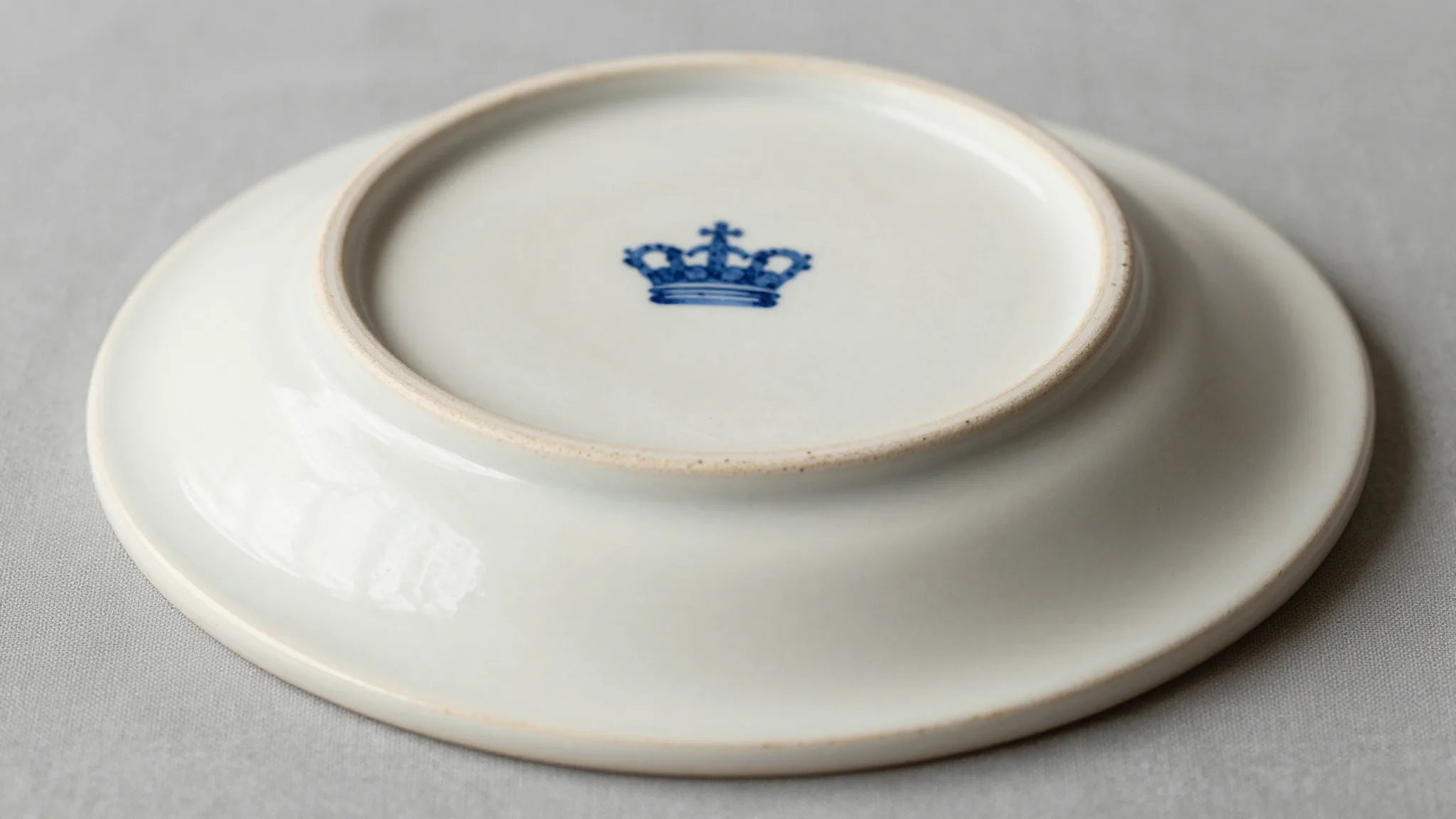
Antique pottery marks identification starts with the clay body. Earthenware, stoneware, and porcelain each carry distinct mark types, periods, and maker signatures worth knowing. Get the body type wrong and every mark you read after that is built on a shaky foundation.
Why the clay body is your first identification step
Any seasoned collector knows you read the body before you read the mark. The clay tells the story the mark sometimes hides.
Earthenware is opaque and porous. Hold a shard to a light source and no light passes through. It chips with a rough, granular break.
Stoneware is denser and partially vitrified. Tap it with a fingernail. You get a duller ring than porcelain but a crisper one than soft earthenware.
True hard-paste porcelain is translucent. Press it against a phone torch. A warm glow passes through thin sections. The fracture line is glassy and sharp.
Soft-paste porcelain sits between the two. It was the European attempt to replicate Chinese hard-paste before the Dresden formula was cracked around 1708. The fracture is granular, almost chalky.
Getting the body type right narrows your candidate manufacturers by roughly 80% before you even squint at a mark. That is time well spent at any auction preview.
How pottery marks were physically applied, and what that tells you
The method of application is as informative as the mark itself. Collectors who ignore this miss half the authentication picture.
Impressed marks are pressed into unfired clay with a stamp. They predate printed marks and are common on 18th-century English earthenware and stoneware. Look for slightly raised edges around the letters. That is clay displacement, not a printing artifact.
Incised marks are scratched by hand before firing. These are the most individual. No two incised marks are perfectly identical, which makes them both charming and easy to fake badly. Genuine incised marks show fluid, confident strokes.
Underglaze printed marks appear beneath the glaze layer. They cannot be rubbed off without damaging the surface. Blue transfer-printed marks on English earthenware became standard after around 1784.
Overglaze painted or printed marks sit on top of the glaze. They can be worn or even removed. Treat them as supporting evidence, not primary proof.
Raised or moulded marks were formed as part of the casting. Meissen and some Wedgwood pieces used this technique for specific product lines.
For a broader framework on reading maker signatures across categories, the Antique Marks & Signatures Complete Identification Guide on this site covers silver, ceramics, and furniture marks in one reference.
Earthenware marks: creamware, pearlware, and majolica
English earthenware dominates the beginner collector market. The sheer volume produced between 1750 and 1900 means pieces turn up everywhere.
Wedgwood is the anchor name here. Their impressed WEDGWOOD mark (always in capitals, always impressed) appeared from 1769. A second letter following the name indicates the year of manufacture within a three-letter dating cycle, a system Wedgwood kept meticulous records of. The Victoria & Albert Museum holds an exceptional Wedgwood study collection with documented mark progressions.
Spode earthenware marks evolved from simple impressed names to elaborate printed cartouches. The pattern name often appears inside a ribbon banner below the main mark. Pattern names are your friend. They cross-reference against documented pattern books held at the Smithsonian’s American History collections.
Majolica, that colourful Victorian tin-glazed earthenware revival, is marked inconsistently. Minton majolica pieces often carry an impressed year cipher (a small symbol denoting the production year) alongside the MINTON name. George Jones majolica uses a monogram GJ with a registration diamond.
Key earthenware mark indicators by period:
| Period | Mark type | Typical wording |
|---|---|---|
| 1750–1800 | Impressed only | Maker name, sometimes pattern number |
| 1800–1842 | Impressed + printed | Name, pattern name, “Stone China” or “Ironstone” |
| 1842–1883 | Registration diamond | Diamond with date letters and parcel/bundle codes |
| 1884–1900 | Rd. No. prefix | “Rd No.” followed by registration number |
| Post-1891 | Country of origin | “England” or “Made in England” (US import law trigger) |
The post-1891 country-of-origin rule is one of the most useful dating shortcuts in the hobby. If the mark says “Made in England” you are almost certainly looking at post-1900 production.
Not sure what you’ve got?
Snap a photo and let our AI identify any antique in seconds: free download, no sign-up.
Identify on iPhone → Learn MoreStoneware marks: salt-glazed, Bellarmine, and American stoneware
Stoneware marks have a rougher, more vernacular character than fine porcelain. That roughness is part of the appeal.
English salt-glazed stoneware from the 18th century is often unmarked or carries only a crude impressed initial. Nottingham stoneware is an exception: potters there scratched names and dates into pieces with surprising frequency.
German Bellarmine jugs (those bearded-face bottles) carry no conventional maker marks. Authentication relies on form, glaze character, and the style of the applied face mask. The Metropolitan Museum of Art has documented Bellarmine examples spanning the 16th to 18th centuries with useful comparative photography.
American stoneware is a distinct collecting category. Regional potters stamped their name and town using impressed stamps, often crude, always direct. A mark reading “J. NORTON & CO. / BENNINGTON, VT” with a capacity number (the gallon size of the vessel) is immediately datable to 1859–1861 based on the partnership records.
The cobalt decoration on American stoneware often incorporates the capacity mark. A “2” in cobalt means two gallons. Collectors treat the decorator’s hand as a secondary identification layer alongside the impressed potter’s mark.
For researching American stoneware auction records and sold prices, WorthPoint maintains an extensive sold-price database that covers regional American pottery in depth.
Porcelain marks: Meissen to English bone china
Porcelain marks carry the most mythology and the most forgeries. Approach them with systematic scepticism.
Meissen’s crossed swords mark is the most copied mark in ceramics history. The genuine mark is painted in underglaze blue with confident, slightly uneven brushwork, not mechanically perfect. The sword hilts are short. The crossing point sits at about one-third from the top. Counterfeit marks tend to be too symmetrical and too clean. The Victoria & Albert Museum has a published guide to Meissen mark periods that is worth bookmarking.
Sèvres marks are equally complex. The interlaced L cipher with a date letter inside identifies genuine 18th-century royal production. The date letter A = 1753, B = 1754, and so on through the alphabet. Post-revolutionary Sèvres uses different mark systems entirely. Pieces marked “Sèvres” in gothic script are almost always 19th-century reproductions made for the export market.
English bone china developed its own mark language. The standard Royal Crown Derby, Royal Worcester, and Minton marks each use a date cipher system. Worcester’s system of dots and letters added annually to a central mark is one of the more reliable dating tools in English porcelain.
Chinese export porcelain presents the biggest identification challenge. Reign marks (Nian Hao), six-character inscriptions reading the dynasty and emperor, were routinely applied to later pieces as marks of reverence, not deception originally. A Qianlong mark on a piece with 19th-century enamel colours is not a fake in the Chinese cultural sense, but it is not 18th-century either.
For valuation context after identification, the Best Online Antique Appraisal Sites guide covers which platforms handle ceramics valuations most reliably.
Registration diamonds, Rd numbers, and pattern numbers decoded
The British design registration system is one of the most collector-friendly dating tools ever created. Once you crack the code, it becomes second nature.
From 1842 to 1883, the Board of Trade used a diamond-shaped registration mark. The diamond has a class letter at the top and four corner positions carrying the year letter, month letter, day number, and parcel (bundle) number.
Registration diamond year letters (1842–1867 cycle):
| Year | Letter | Year | Letter |
|---|---|---|---|
| 1842 | X | 1855 | E |
| 1845 | A | 1858 | B |
| 1847 | F | 1860 | Z |
| 1849 | S | 1862 | O |
| 1852 | D | 1865 | T |
After 1883, a simple “Rd No.” prefix replaced the diamond. Registration numbers run sequentially. Rd No. 1 = January 1884. Rd No. 351,202 = 1900. Published tables at Kovel’s cross-reference these number ranges to specific years.
Pattern numbers are separate from registration numbers. They identify the decoration, not the form. A piece can carry both. Pattern numbers above 9000 on English earthenware generally indicate post-1840 production from major Staffordshire factories.
For collectors who also handle furniture alongside ceramics, the Antique Furniture Periods Chart 1600–1940 puts pottery periods into a broader decorative arts timeline context.
Field identification tips: what to do at a market or auction
Theory is one thing. The auction preview table with thirty people crowding around you is another situation entirely.
Always photograph the base first. Natural light is best. Hold the piece at an angle to the light to pick up impressed marks that a flat shot misses. A low-angle raking light reveals impressed detail better than flash photography.
Carry a loupe. A 10x jeweller’s loupe reveals brush stroke character on painted marks. It shows transfer-print dot patterns on printed marks. It exposes the grinding marks on bases that indicate later removal of undesirable marks.
Check the gilding. Original Georgian and early Victorian gilding was mercury-based and has a warm, slightly matte quality. Post-1860s bright gold gilding is more reflective. Re-gilded pieces often show a slightly raised edge where new gilt sits over worn original decoration.
Those slightly uneven rim details on hand-thrown pieces? Classic pre-industrial production. Perfect uniformity on a supposedly 18th-century piece should prompt questions, not confidence.
For pieces where you suspect silver mounts or mixed-media construction alongside pottery, the framework in Identifying Pewter vs Silver: 3 Simple Ways applies directly to the metalwork components.
If you are unsure about value after identification, running the piece through Digital Tools and Resources for Antique Valuation gives you a structured approach to pricing research before committing to a purchase.
Frequently Asked Questions
How do I tell if a pottery mark is genuine or a reproduction?
Check the application method first. Genuine antique marks show wear consistent with the surrounding glaze, not isolated shiny marks on a worn base. Impressed marks should have clay displacement at the edges. Painted underglaze marks should show natural brushwork variation under a loupe. Suspiciously perfect marks on aged-looking pieces are a red flag worth investigating before purchase.
What does ‘Made in England’ on a pottery mark tell me about age?
A ‘Made in England’ mark almost always indicates production after 1900. The McKinley Tariff Act of 1891 required goods exported to the United States to carry a country-of-origin mark, but ‘Made in’ phrasing became standard practice in the early 20th century. Pieces marked simply ‘England’ were likely made between 1891 and around 1910. This single detail reliably brackets a piece’s production window.
What is a registration diamond and how do I read it?
A registration diamond is a British Board of Trade mark used from 1842 to 1883 to protect new designs. The diamond shape has a class letter at the top and four corner positions carrying coded information: year letter, month letter, day of the month, and parcel number. Published tables cross-reference the year and month letters to specific calendar dates, making this one of the most precise dating tools available to pottery collectors.
Can Chinese reign marks be used to date a piece accurately?
Reign marks alone cannot reliably date Chinese ceramics. Chinese potters applied earlier dynasty marks to later pieces as a mark of respect for classic periods. This was cultural tradition, not deception. A Qianlong reign mark can appear on 19th or even 20th-century production. Authentication requires analysing the paste, glaze character, enamel palette, and potting quality alongside the mark to establish a realistic date range.
Where can I research pottery marks for free online?
The Victoria & Albert Museum website (vam.ac.uk) and the Metropolitan Museum of Art (metmuseum.org) both offer searchable ceramics collections with documented marks and period information. Kovel’s (kovels.com) maintains a pottery and porcelain marks database. For sold-price research, WorthPoint (worthpoint.com) has an extensive historical auction record database. Combining these with the Antique Identifier App for initial image-based identification covers most field research needs without cost.
Identify any antique in seconds.
From silver hallmarks to porcelain maker marks, the app suggests the item type, period and a value range.
