
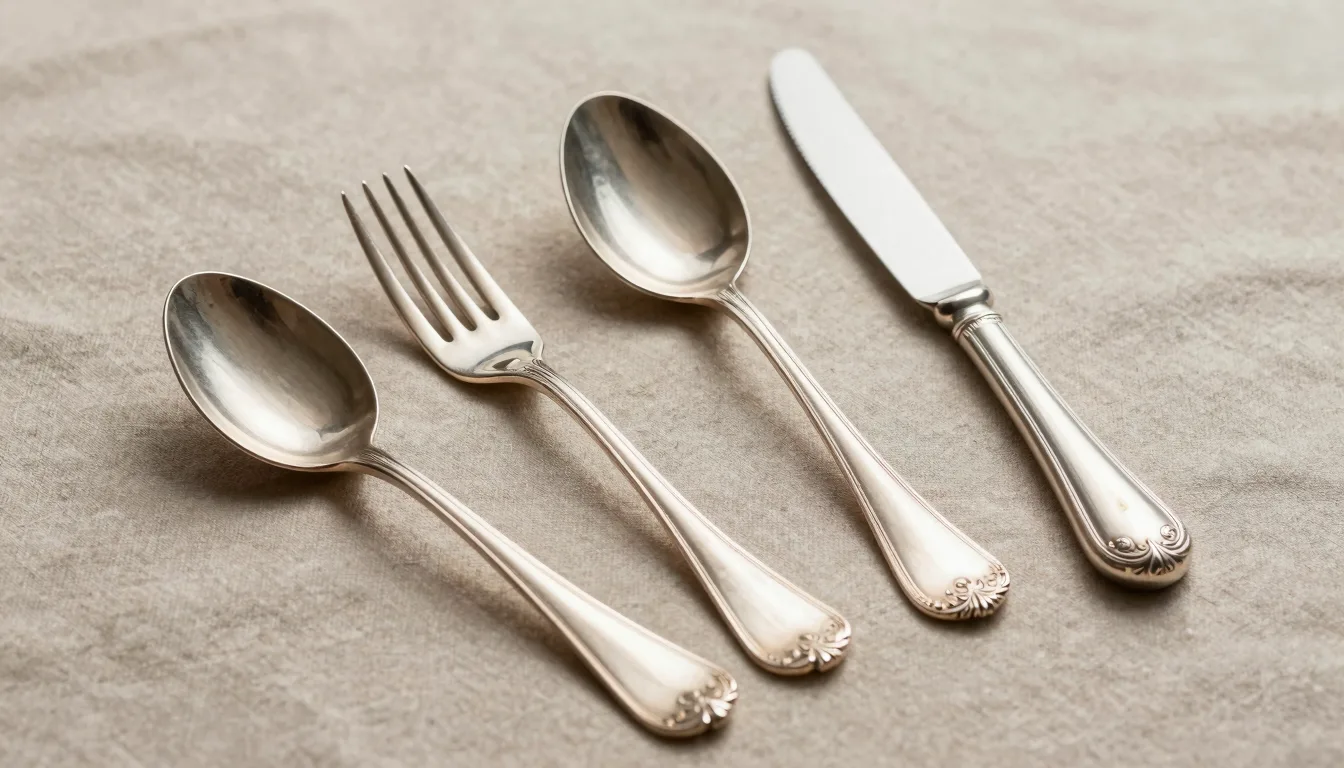
Wallace sterling silver flatware patterns are identified by hallmarks, pattern names, and design era. Here’s how collectors tell them apart. Wallace produced hundreds of patterns from the 1830s onward, and knowing what to look for on the back of a spoon can mean the difference between a $20 thrift-store find and a $400 collector piece.
Free to download: identify any antique instantly with AI. No sign-up.
Identify Now →A Brief History of Wallace Silversmiths
Wallace Silversmiths was founded in 1834 in Wallingford, Connecticut. The company began as R. Wallace & Sons Manufacturing Co., making it one of the oldest American silver manufacturers. That longevity matters to collectors. It means Wallace patterns span nearly two centuries of design trends.
Wallingford became a genuine silversmithing hub in the 19th century. Wallace shared the region with other notable names, but it carved out a distinct identity through consistent quality and ornate pattern work. The Smithsonian’s American History collections include examples of American silver manufacturing from this period that help place Wallace in national context.
The company went through several ownership changes across the 20th century. Hamilton Watch acquired Wallace in 1959. Syratech Corporation later took over. Today the brand sits under Lifetime Brands. Ownership shifts affected production but never erased the original pattern archive, which is great news for anyone hunting matching pieces at estate sales.
How to Read Wallace Sterling Hallmarks
Any seasoned collector knows the back of the piece tells the whole story. On genuine Wallace sterling, you will find the word STERLING stamped clearly. This guarantees 92.5% silver content per US standards. You may also see WALLACE or the older R. WALLACE mark depending on the era.
Earlier pieces from the late 19th century sometimes carry a lion passant mark, borrowed from British hallmarking tradition. Wallace used this symbol to signal quality to buyers familiar with English silver standards. It is not an official US assay mark. It was a marketing choice. Our full guide on antique marks and signatures breaks down how American makers adapted European hallmark conventions.
Silver plate is a common trap for new buyers. Wallace also produced extensive silver-plated lines under names like 1847 Rogers Bros. (after acquisition). Those pieces will say SILVER PLATE or carry an EP mark rather than STERLING. If you are unsure whether a piece is solid sterling or plated, the guide on identifying pewter vs. silver walks through three fast physical tests you can do at home without any equipment.
Date letters were not a standard part of American silver marking the way they were in Britain. Instead, Wallace used pattern introduction dates and catalog numbers to track production. Cross-referencing those catalog numbers with published records is how advanced collectors date specific pieces.
The Most Collected Wallace Sterling Patterns
Wallace produced well over 200 sterling patterns across its history. A handful dominate the collector market because of their beauty, longevity in production, and sheer availability. Knowing these patterns on sight is a baseline skill.
Grand Baroque (introduced 1941) is the crown jewel. The asymmetrical, heavily scrolled handle with baroque floral ornamentation is unmistakable. It remains the most recognized Wallace pattern and commands the highest prices at auction. A complete service for twelve in Grand Baroque routinely appears on WorthPoint with sale records in the $2,000–$5,000 range depending on condition.
Rose Point (introduced 1934) features delicate floral sprays and fine line engraving along a tapered handle. It is more refined than Grand Baroque, lighter visually, which appeals to collectors who find Baroque too heavy. Rose Point pieces surface constantly at estate sales in the South and Midwest.
Sir Christopher (introduced 1936) leans into Colonial Revival styling. The handle shows scrolling acanthus leaves with a cleaner symmetry than Baroque. Many collectors who want Wallace sterling but prefer a quieter pattern land here.
Violet (introduced 1904) is the oldest commonly collected pattern. The violet flower motif pressed into the handle tip is charming and distinctly Victorian. Finding complete Violet sets is harder today, which pushes values up for complete services.
Here is a quick reference table for the major patterns:
| Pattern | Introduced | Style | Relative Value |
|---|---|---|---|
| Grand Baroque | 1941 | Ornate baroque scrollwork | $$$$ |
| Rose Point | 1934 | Floral spray, fine engraving | $$$ |
| Sir Christopher | 1936 | Colonial Revival acanthus | $$$ |
| Violet | 1904 | Victorian floral tip motif | $$$–$$$$ |
| Stradivari | 1937 | Elegant curved, minimal ornament | $$ |
| Rosepoint (variant) | Multiple | See Rose Point family | Varies |
| irian | 1902 | Art Nouveau organic curves | $$$$ |
Not sure what you’ve got?
Snap a photo and let our AI identify any antique in seconds: free download, no sign-up.
Identify on iPhone → Learn MorePattern Identification by Physical Details
Start with the handle terminal: the very tip of the handle opposite the bowl or tines. This is where Wallace concentrated decorative detail. Grand Baroque ends in an asymmetrical C-scroll with a raised flower. Rose Point ends in a small floral bouquet. Sir Christopher ends with a symmetrical shell. Once you memorize these terminals, identification gets fast.
Handle weight matters too. Grand Baroque handles feel substantial, almost heavy in the hand. That is intentional. The thick casting supports the deep relief work. Lighter, thinner handles suggest either a later production run with cost-cutting, or a silver-plate piece masquerading as sterling. Weigh your suspicions against the hallmark check.
Look at the bowl shape on spoons. Early Wallace patterns like Violet and Irian use more elongated, oval bowls. Mid-century patterns like Stradivari moved toward rounder bowl profiles reflecting modernist taste. The Metropolitan Museum of Art’s decorative arts collection has sterling flatware examples that help you calibrate period-appropriate bowl proportions.
Those slightly uneven engraving lines on pre-1920 pieces? Classic hand-finishing work. Post-1940 pieces show machine-stamped consistency. Neither is better. They just help you date the piece. Hand-finished pieces from the Victorian era carry a premium with many collectors who value the craft evidence.
Condition Grading and What It Does to Value
Wallace sterling value swings dramatically with condition. Collectors grade flatware on a simple scale: Mint, Excellent, Good, and Poor. Mint means crisp pattern detail with no monograms, no wear on high points. Excellent allows light surface scratching but full pattern retention. Good shows wear on the high relief areas. Poor means the pattern is smoothed or the piece is bent.
Monograms are the most contentious condition issue. A deeply engraved monogram on the handle drops value for most buyers. Removing it risks thinning the silver. Some collectors specifically seek monogrammed pieces for visual character or genealogical interest. Know your buyer before pricing monogrammed sets.
Patina is different from wear. A natural silver patina, that soft darkening in the recessed areas of the pattern, is desirable. It enhances the three-dimensional quality of ornate patterns like Grand Baroque. Aggressive polishing that removes all patina actually hurts value. The Victoria & Albert Museum’s guidance on silver care is worth reading before you touch a polish cloth to a fine piece.
Understanding when sterling value beats melt value matters for selling decisions. Our breakdown on silver melt value vs. antique value is essential reading before you sell or buy any Wallace piece.
Where to Research and Buy Wallace Patterns
Pattern matching is a real challenge when you inherit a partial set. The best starting resource is Kovel’s, which maintains one of the most comprehensive silver pattern databases available online. You can search by pattern name or browse by manufacturer. Cross-reference with WorthPoint for actual sale prices, not asking prices, on completed transactions.
Estate sales in New England and the Mid-Atlantic states turn up Wallace sterling at above-average rates. Connecticut’s silversmithing history means local estate sales there often produce Wallace pieces priced by sellers who know what they have. That regional knowledge matters.
For digital tools beyond databases, our review of online antique appraisal sites covers which platforms are worth your time for silver identification and valuation specifically. Not every appraisal platform has strong silver expertise. That guide filters them honestly.
Period catalogs are gold. Wallace published retail and wholesale catalogs throughout the late 19th and 20th centuries. Library archives and specialized silver dealers sometimes hold copies. A catalog page showing your exact pattern with its original name is unbeatable documentation for provenance and dating.
Building a Wallace Sterling Collection Strategically
Decide early whether you are collecting to use, to display, or to resell. Each goal shapes what patterns and condition grades make sense to pursue. Collectors who use their silver daily can tolerate Good-condition pieces. Display collectors should hold out for Excellent or better. Resellers need to understand the active market for each pattern. Grand Baroque moves fast, obscure patterns move slowly.
Focus on one pattern first. Trying to collect five Wallace patterns simultaneously spreads your attention and budget. Mastering the variants within Grand Baroque alone (the different serving pieces, the hollow-handle knives, the rare demitasse spoons) is a satisfying multi-year project.
Always verify sterling before purchase. The hallmark check is non-negotiable. Our post on online valuation tools and resources lists several digital databases where you can cross-check pattern names and hallmark descriptions before committing to a buy.
Storage matters long-term. Anti-tarnish cloth storage rolls and Pacific Cloth-lined flatware chests slow oxidation significantly. Never store sterling with rubber bands. Sulfur compounds in rubber cause accelerated black tarnish that can pit the surface over time. That is a collector mistake you only make once.
Frequently Asked Questions
How do I know if my Wallace flatware is sterling or silver plate?
Check the reverse of any piece for the word STERLING stamped clearly. Genuine Wallace sterling always carries this mark. Silver-plated Wallace pieces, including the 1847 Rogers Bros. line, will say SILVER PLATE, EPNS, or EP instead. If the mark is worn, a magnet test helps: sterling is not magnetic, while some plated base metals are. A jeweler’s acid test is definitive for uncertain pieces.
What is the most valuable Wallace sterling pattern?
Grand Baroque, introduced in 1941, is consistently the most valuable Wallace sterling pattern on the secondary market. Its heavy baroque scrollwork and asymmetrical design have sustained collector demand for decades. Complete services for twelve in Excellent or Mint condition regularly sell in the $2,000–$5,000 range. The early Art Nouveau pattern Irian (1902) also commands high prices due to its rarity.
Can I add pieces to an incomplete Wallace set?
Yes, and this is one of the most common collector activities with Wallace sterling. Because Wallace produced popular patterns like Grand Baroque and Rose Point for decades, replacement pieces surface regularly at estate sales, on WorthPoint, and through specialist silver dealers. Match pieces by pattern name and verify the STERLING hallmark. Slight patina differences between old and new additions will blend over time with regular use and polishing.
Does a monogram hurt the value of Wallace sterling?
Generally yes, a monogram reduces resale value for most buyers because removal risks thinning the silver at the engraving site. Expect a 20–40% discount compared to an unmarked piece in the same condition. However, some collectors actively seek monogrammed pieces for their historic character or for matching family initials. If the monogram is shallow or stylistically interesting, the value hit is smaller.
How should I clean Wallace sterling flatware without damaging it?
Use a non-abrasive silver polish applied with a soft cotton cloth, working in straight lines rather than circular motions to avoid swirl marks. Rinse thoroughly and dry immediately. Moisture left on sterling encourages tarnish. Never use dishwashers for sterling flatware; heat and detergent accelerate surface degradation. For pieces with deep decorative relief like Grand Baroque, a soft toothbrush gets polish into the recessed areas without scratching high points. The Victoria and Albert Museum offers detailed conservation guidance for sterling silver care.
Identify any antique in seconds.
From silver hallmarks to porcelain maker marks, the app suggests the item type, period and a value range.
