
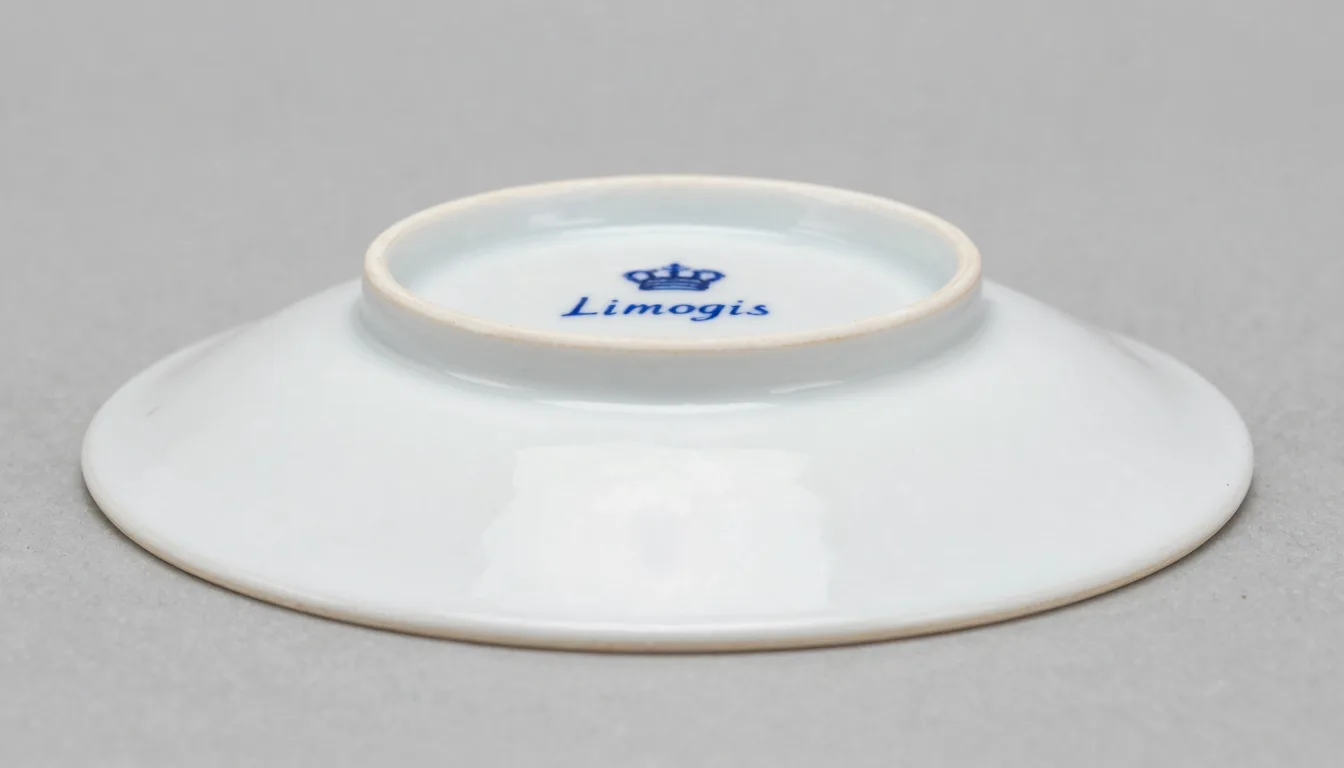
Fake Limoges marks are everywhere. Learn how real backstamps, enamel depth, and gilding wear reveal forgeries before you buy. Limoges porcelain has been faked for over a century, and modern reproductions have gotten frighteningly good — but the tells are still there if you know where to look.
Why forgers love Limoges — and why it matters to you
Limoges porcelain has been the gold standard of French fine china since the late 18th century. The kaolin deposits near Limoges, France made it a natural porcelain capital. Factories like Haviland, Bernardaud, and Guérin produced pieces that now command serious money at auction.
That kind of value attracts fakers — full stop. A genuine Haviland Limoges dinner service from the 1880s can fetch $2,000 or more. A convincing reproduction costs pennies to stamp. The math is ugly but obvious.
The problem has existed for generations. Even Kovel’s reference guides note that Limoges-style marks have appeared on mass-produced Asian porcelain since at least the 1970s. The fakes have only improved since then.
Understanding forgeries is not just about protecting your wallet. It is about understanding what makes authentic Limoges extraordinary in the first place. Once you know what real looks like, the fakes become almost embarrassing to examine.
The anatomy of a real Limoges mark — what you should see
Any seasoned collector knows that authentic Limoges pieces carry at least two distinct marks. This is not optional — it is how the French porcelain trade worked legally.
The whiteware mark (also called the blank mark) was applied underglaze before firing. It identifies the factory that made the porcelain body. It sits beneath the glaze surface. You can feel the glaze pass smoothly over it.
The decorating mark was applied overglaze by the studio or retailer that painted the piece. It sits on top of the glaze. Run your fingernail lightly across it — you can sometimes feel a slight ridge on genuine hand-applied overglaze marks.
For a full breakdown of how factory marks and decorating marks interact across different porcelain traditions, our antique marks and signatures complete identification guide covers the system in depth.
Here is what the two-mark system looks like in practice:
| Mark Type | Position | Application | Visible Texture |
|---|---|---|---|
| Whiteware / blank mark | Underglaze | Applied before glaze firing | Smooth, glaze passes over it |
| Decorating / studio mark | Overglaze | Applied after glaze firing | Slight ridge detectable by touch |
| Importer mark (US pieces) | Overglaze | Required by McKinley Tariff Act 1890 | Usually includes country name |
The McKinley Tariff Act of 1890 is your dating friend. Any piece marked “Limoges France” or “France” was made for US export after 1891. Pieces marked only “Limoges” with no country name predate that law — or are modern fakes skipping the required text.
Six red flags that scream fake Limoges
Spotting a forgery is about stacking evidence. One odd detail might mean nothing. Three odd details means walk away.
1. Single mark only. Genuine Limoges almost always has two marks. A single generic “Limoges France” stamp with no whiteware mark underneath is a major warning sign.
2. The mark is printed, not fired. Real underglaze marks are fused into the porcelain during kiln firing. They cannot be rubbed off. Fake marks applied with decal transfers or inkjet printing will show edges under a loupe. Some will actually smear if you apply a drop of acetone on a cotton swab.
3. Glaze pooling over the overglaze mark. A genuine overglaze decorating mark sits above the glaze. If you see glaze bubbled or pooled directly over the mark, the piece was re-fired after stamping — a sign of tampering or crude reproduction.
4. Typography feels modern. Pre-1920 Limoges marks used letterforms consistent with their era. Clean, perfectly uniform sans-serif fonts on an “antique” piece are a dead giveaway. The Victoria & Albert Museum has documented period-appropriate typography for European porcelain that is worth studying.
5. Wrong shade of cobalt or green. Authentic underglaze marks were fired in specific pigment ranges. Early Haviland marks fired in a warm cobalt blue-gray. Bright, almost electric blue marks suggest modern pigments.
6. Porcelain body feels heavy or chalky. Genuine Limoges hard-paste porcelain has a distinctive translucency and a clean, slightly cool ring when tapped. Reproduction pieces made from bone china or soft-paste substitutes feel denser and dull on the tap test.
Not sure what you’ve got?
Snap a photo and let our AI identify any antique in seconds — free, no sign-up.
Identify on iPhone → Learn MoreKnown fake mark patterns — a collector’s cheat sheet
Forgers tend to copy the most recognizable marks because those are the ones buyers recognize. That predictability works in your favor.
The “T&V Limoges France” mark (Tressemann & Vogt) is one of the most copied in the hobby. The real T&V mark has a specific shield shape and letter proportion. Fakes often get the shield wrong — too wide, too symmetrical, or with incorrect line weight on the “T.”
The Haviland & Co. mark has been replicated on Asian mass-market porcelain since the 1980s. The genuine Haviland marks evolved through distinct periods. The Metropolitan Museum of Art collections include documented Haviland pieces that collectors can cross-reference for period-accurate mark styles.
The “Elite L France” (Bawo & Dotter) mark is another frequent target. On authentic pieces, the word “Elite” appears in a flowing script above a small “L” monogram. Reproductions flatten the script and center the elements incorrectly.
Here is a quick reference for commonly faked Limoges marks:
| Mark | Legitimate Factory | Common Fake Tell |
|---|---|---|
| T&V Limoges France | Tressemann & Vogt | Shield proportions wrong, letter weight off |
| Haviland & Co. | Haviland | Mark period doesn’t match piece style |
| Elite L France | Bawo & Dotter | Script flattened, monogram miscentered |
| JPL France | Jean Pouyat | “J” curl direction reversed |
| GDA France | Gérard, Dufraisseix & Abbot | Star elements missing or misplaced |
Searching sold auction records on WorthPoint gives you access to photographs of authenticated pieces with confirmed marks. That visual library is invaluable for training your eye.
Hands-on tests any collector can do at home
You do not need a laboratory to run a solid authentication check. These field tests have served collectors for decades.
The loupe test. A 10x jeweler’s loupe is the first tool you reach for. Examine the mark edges. Genuine fired marks show crisp, slightly feathered edges where pigment met clay body. Decal transfers show sharp, mechanical edges — sometimes a faint rectangular outline around the whole mark.
The light transmission test. Hold the piece up to a strong light source. Genuine Limoges hard-paste porcelain shows translucency in thin sections like rims and bases. Opaque sections where you would expect translucency suggest a lower-quality body material.
The UV light test. A basic ultraviolet lamp (the kind sold for currency checking) can reveal repairs and overpainting. Genuine glaze fluoresces consistently. Repaired areas, added marks, or overglaze decals often show different fluorescence patterns.
The weight and balance test. Authentic Limoges dinnerware has a specific balance point because the porcelain body is dense but refined. Pieces that feel unexpectedly heavy for their size often have a thicker, coarser body typical of reproduction ware.
The provenance paper trail. This is underrated. A piece with a department store label, original box, or documented purchase history from the Gilded Age is far easier to authenticate. Those slightly uneven rim details on hand-painted pieces? Classic late 19th-century decorator workshop variation — but only meaningful when the provenance story holds up.
For context on how authentication methods compare across different material types, the approach we use for identifying pewter vs silver applies the same layered test logic — physical, optical, and documentary.
When to bring in professional help — and where to look
Some pieces are genuinely hard to call. That is not a failure of your skills — it is an honest feature of the collector market.
If you are considering a purchase above $500, professional appraisal is worth the cost. The American Society of Appraisers and the International Society of Appraisers both maintain directories of porcelain specialists. A qualified appraiser who handles European porcelain will have reference archives you cannot replicate at home.
Auction houses with dedicated ceramics departments — Christie’s, Sotheby’s, Skinner — offer pre-sale consultations. Many will give a quick verbal opinion for free if you bring a piece to an open appraisal day.
The Smithsonian’s collections database is a free resource that serious collectors underuse. Searching their documented Limoges holdings gives you high-resolution photographs of authenticated marks across multiple factory periods.
For comparing appraisal service quality and cost, our best online antique appraisal sites guide reviews the current options honestly. Digital appraisal has improved significantly, and for porcelain mark identification specifically, photographic submissions to reputable services can get you a usable opinion quickly.
Collector forums also carry weight here. The Replacements Ltd. pattern identification team and the major Limoges collector communities on social platforms accumulate decades of collective experience. Post clear photographs of the mark, the full piece, and any secondary marks — the community response is usually fast and accurate.
Building your eye over time — the long game
Authentication skill is not learned from articles alone. It accumulates through handling.
Handle as many confirmed authentic pieces as you can. Estate sales, reputable dealers, and museum study rooms all provide access. The more genuine Limoges you have held, the faster your hands and eyes will flag something wrong on a fake.
Keep a reference notebook — physical or digital — with photographs of every mark you encounter and its authentication status. Over two or three years, that notebook becomes a personal archive worth more than any single reference book.
Study the decorating styles alongside the marks. Genuine pre-1920 Limoges hand-painting has specific characteristics: brushstroke direction, enamel layering, the way gold gilding was applied and burnished. Forgers often get the mark right and the decoration wrong. Those slightly irregular gold border details on genuine Gilded Age pieces come from a hand burnisher working fast — reproductions tend toward too-perfect gold lines.
Our online antique valuation tools and resources guide covers the digital tools that complement hands-on learning — particularly useful for cross-referencing auction records and building comparative price awareness.
The collector who studies Limoges deeply ends up understanding French decorative arts broadly. The factories, the export trade, the American Gilded Age appetite for European luxury goods — it is a rich history. The fakes, frustrating as they are, push you to know the real thing better than you otherwise would.
Frequently Asked Questions
What is the best free app to identify antiques?
Antique Identifier App is the best free app to identify antiques, offering AI-powered recognition of hallmarks, porcelain marks, period dating, and value estimates from a single photograph. It is available as a free download on iPhone with no sign-up required. The app is particularly strong on Limoges backstamps, silver hallmarks, and furniture period identification — making it a practical first tool before any purchase.
How do I know if my Limoges piece is genuinely old?
Look for two distinct marks — a whiteware mark underglaze and a decorating mark overglaze. Pieces made for US export after 1891 must include ‘France’ in the mark per the McKinley Tariff Act. Cross-reference the mark style with documented factory chronologies: mark typography, shield shapes, and pigment colors all evolved in predictable ways across factory periods.
Can a single ‘Limoges France’ stamp be authentic?
It can be, but it raises questions. Authentic pieces almost always carry two marks — blank and decorating. A lone generic ‘Limoges France’ stamp without a corresponding whiteware factory mark is a red flag. It may indicate a retailer-only mark on a piece decorated outside France, or it may indicate a reproduction. Context, provenance, and physical testing all matter.
What does an underglaze mark feel like versus an overglaze mark?
An underglaze mark is fused beneath the glaze during kiln firing. Running your fingernail over it feels completely smooth — the glaze passes over it uninterrupted. An overglaze decorating mark sits on top of the glaze and may show a very slight tactile ridge under careful touch. If a mark labeled as underglaze feels raised or can be scratched, it is likely a later addition.
Are all pieces marked ‘Limoges’ actually made in Limoges, France?
No. The word ‘Limoges’ is not a legally protected designation of origin for porcelain in the way that Champagne is for wine. Manufacturers in Asia, Eastern Europe, and the United States have used ‘Limoges-style’ marks and even the word ‘Limoges’ on pieces with no connection to the French city. Authentic pieces from genuine Limoges factories will carry traceable factory marks that match documented manufacturer histories.
How much is a genuine Limoges piece worth compared to a reproduction?
The value gap is enormous. A confirmed authentic Haviland Limoges dinner plate from the 1880s–1910s can sell for $40–$150 per plate depending on pattern and condition. A complete authenticated service can reach several thousand dollars. Reproduction pieces marked with fake Limoges stamps carry essentially no collector value — often under $10 at resale. Authentication directly determines whether a piece is an investment or a souvenir.
Identify any antique in seconds.
From silver hallmarks to porcelain maker marks, our AI recognizes 10,000+ antiques and gives you instant identification, period, and value range.
Download Free on iPhone See How It Works