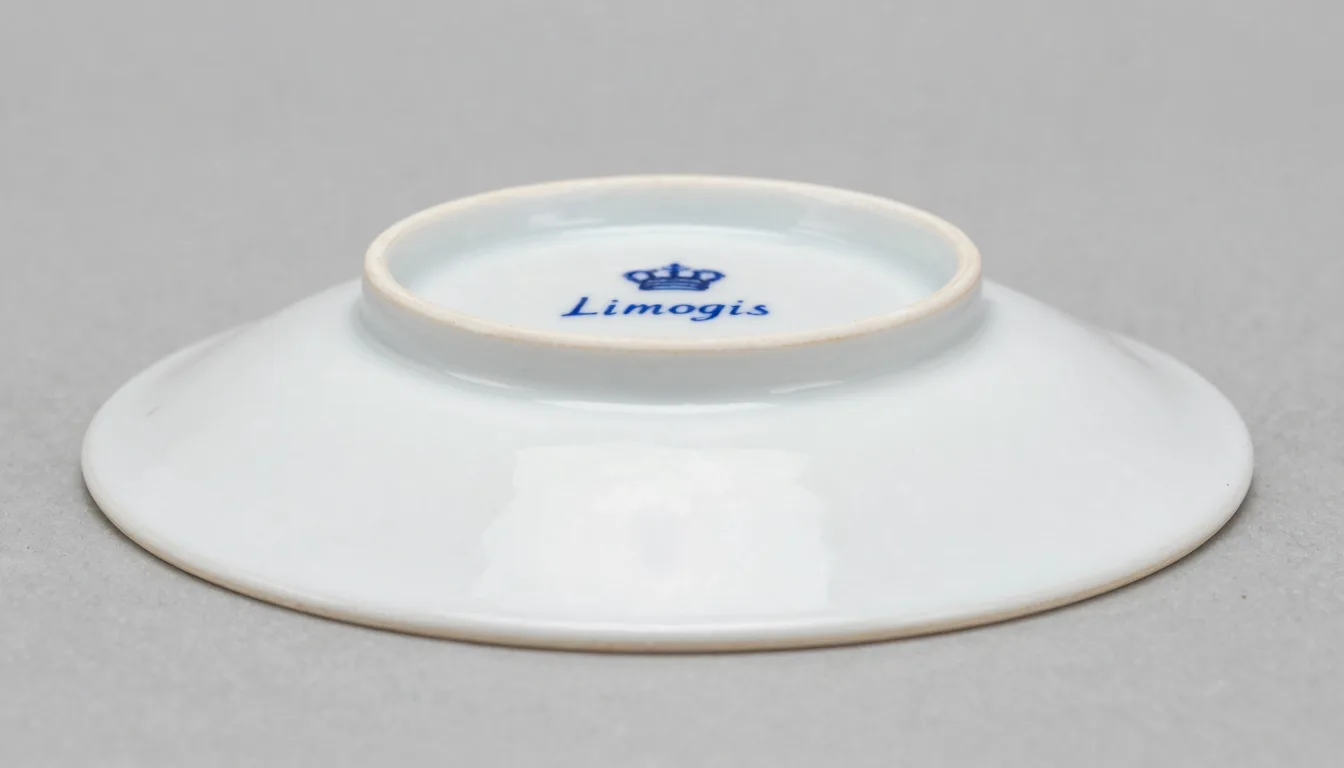
T&V on Limoges porcelain stands for Tressemann & Vogt, a factory active from 1882 to 1919. The mark color and wording can date your piece to within a decade.
Who were Tressemann and Vogt? The firm behind the T&V mark
T&V stands for Tressemann & Vogt, a porcelain firm based in Limoges, France. The partnership between Emilien Tressemann and Gustave Vogt ran from 1882 until 1907. Gustave Vogt then continued the business under the T&V name until 1919.
The Vogt story starts decades earlier in New York. John Vogt founded a porcelain import house in Manhattan in the 1840s. The firm shipped French white porcelain to American retailers and decorators. In 1865, the family opened its own decorating studio in Limoges to control quality at the source.
Gustave Vogt took charge of the French side of the business. After the partnership with Tressemann formed in 1882, wares began carrying the T&V initials. By the 1890s the firm ranked among the larger porcelain producers in Limoges. Its kilns fired nearly year-round to feed American demand. Trade listings from the period place Tressemann & Vogt among the top Limoges exporters by volume, and American department stores such as Marshall Field’s and Wanamaker’s stocked T&V dinnerware alongside Haviland.
Tressemann retired in 1907. Vogt carried on alone, and in 1919 he sold the factory to Martial Raynaud, another Limoges manufacturer. Raynaud phased out the T&V backstamps. That gives collectors a firm cutoff: a genuine T&V mark dates a piece between 1882 and 1919, with most surviving examples falling between 1892 and 1915.
The firm matters to collectors for one big reason. T&V sold enormous quantities of undecorated white porcelain, called blanks, to the American market. Amateur and professional china painters across the United States decorated those blanks between 1890 and 1915. That is why so many T&V pieces carry hand-painted roses, violets, and fruit rather than uniform factory patterns.
T&V also produced fully decorated dinner services that competed directly with Haviland, the most famous Limoges exporter. French porcelain of this period is held in major museum collections, including the Metropolitan Museum of Art. Dated museum examples are useful for comparing paste quality, palette, and gilding styles against your own piece.
The takeaway: first confirm the mark reads T&V and not a lookalike. Then use the 1882 to 1919 window as your outer boundary. Every dating clue in the rest of this guide narrows that window further, sometimes to a single decade.
Green marks vs purple marks: the two-stamp system explained
Every T&V piece carries one or two marks. The difference between them tells you who decorated the porcelain. Learning this two-stamp system is the most useful single skill in Tressemann & Vogt identification.
The whiteware mark sits under the glaze and is nearly always green. The factory stamped it on the porcelain before the final glaze firing. That firing sealed the mark beneath a glassy layer, so it cannot be removed without grinding into the surface. Run a fingertip across it: an underglaze mark feels perfectly smooth.
The decorating mark sits on top of the glaze, most often in purple, sometimes in red or gold. T&V applied this second stamp only when its own Limoges studio painted the piece. Overglaze marks were fired at lower temperatures, so heavy use leaves them worn, scratched, or faded.
Two marks together mean factory decoration. The green mark proves T&V made the blank. The purple mark proves T&V also decorated it. Factory-decorated pieces show tight, consistent patterns, even gilding, and professional transfer or hand-tinted work.
A single green mark means the piece left Limoges white. Someone else added the decoration. That someone could be a professional American studio such as Pickard of Chicago, a department store decorating shop, or a home china painter working at her kitchen table. Pickard-decorated T&V blanks carry Pickard’s own overglaze mark and sell at strong premiums.
Those slightly uneven petals and wobbly gold rims on many single-marked pieces? Classic amateur china painting, and part of the charm. Amateur work ranges from clumsy to near professional, so judge each piece on execution rather than dismissing the whole category.
Color matters less than position. When in doubt, trust your fingertip over your eyes: under or over the glaze is the reliable signal, and the position never lies. A purple stamp always sits on top, and a whiteware stamp always sits underneath.
For a broader primer on how factory and decorator stamps work across all antique categories, see our guide to antique marks and signatures. The two-stamp logic you learn on T&V applies to nearly every Limoges factory of the period.
T&V mark timeline: dating by stamp style
Tressemann & Vogt changed its backstamps several times across four decades. Each change creates a dating bracket. Match your mark to the closest description below, then cross-check against the decoration style.
| Mark style | Color and position | Approximate dates |
|---|---|---|
| Intertwined T&V monogram, no country name | Red or gold, overglaze | 1882-1891 |
| T&V FRANCE, plain block lettering | Green, underglaze | 1891-1907 |
| T&V LIMOGES FRANCE inside a rectangle | Green, underglaze | 1892-1907 |
| Bell-shaped cartouche with T&V inside | Green, underglaze | 1892-1907 |
| T&V Limoges France, script decorating stamp | Purple or red, overglaze | 1892-1907 |
| T&V Limoges France with DEPOSE | Green or purple | 1907-1919 |
The single most powerful dating clue is the word France. The McKinley Tariff Act of 1890 required imports entering the United States to carry a country of origin from 1891 onward. A T&V mark without any country name points to the 1880s. A mark with France places the piece after 1891.
DEPOSE is the French word for registered, comparable to a trademark notice. T&V marks that include DEPOSE cluster in the later years of the firm, from roughly 1907 to the 1919 sale. Combined with Art Nouveau styling or early geometric borders, a DEPOSE mark points firmly to the final decade.
The phrase Made in France tells its own story. That wording became standard on French exports after about 1914 and dominated after 1921. Since T&V marks ended in 1919, a T&V stamp paired with Made in France deserves extra scrutiny. Check the mark quality and the porcelain body carefully before trusting it.
Decoration style is your cross-check. Heavy raised gold and deep cobalt grounds lean 1890s. Soft pastel florals with thin gilding lean 1900-1910. The Victoria and Albert Museum ceramics collections are a strong free reference for period decoration, and comparing your piece against dated examples often narrows a bracket by ten years.
Dates in this table are approximate and overlap at the edges. Factories used up old stamps, and some marks ran in parallel for years. Treat the bracket as strong evidence, not a certificate.
Not sure what you’ve got?
Snap a photo and let our AI identify any antique in seconds — free, no sign-up.
Identify on iPhone →Learn MoreFactory decorated or American painted: why it changes the story
Between 1880 and 1920, china painting was one of the largest craft movements in American history. Tens of thousands of painters, most of them women, decorated imported porcelain blanks at home and in studios. T&V was one of their favorite suppliers because its blanks were thin, white, and reliably fired without warping in the decorating kiln.
The movement was organized and serious. The National League of Mineral Painters formed in 1892 to set standards and hold juried exhibitions. Keramic Studio magazine, launched in 1899 by Adelaide Alsop Robineau, published designs that thousands of painters copied onto Limoges blanks. Some of those exact published patterns turn up on T&V pieces today. The Smithsonian holds American-decorated porcelain from this movement in its collections.
Painted signatures and dates are common on American-decorated pieces. A gilded inscription such as M.E.S. 1908 records the decorator’s initials and the year the paint was fired. Remember what that date means: it dates the decoration, not the porcelain. The blank underneath could have been made several years earlier.
Attribution changes value in a clear hierarchy. Professional studio decoration from firms like Pickard or Stouffer brings the highest prices. T&V factory decoration comes next, valued for consistency and period-correct patterns. Skilled amateur work with strong composition follows close behind. Weak amateur work trails the market, though even those pieces sell steadily as cottage decor.
How do you separate studio work from amateur work? Look at the gold first. Professional gilding is even, burnished, and crisp at the edges. Amateur gold tends to pool, skip, or wander over the rim line. Then look at backgrounds: professionals blended smooth graduated color grounds, while amateurs often left visible brush boundaries between tones.
If the decoration is a perfectly repeating printed-looking pattern, you are looking at factory transfer work instead. Our walkthrough on identifying a china pattern from a photo shows how to match those patterns to catalog names, which helps a listing rank and sell.
One collector’s tip: dated amateur pieces make the best study collection. A shelf of pieces painted 1898 through 1912 shows the American taste shift from Victorian roses to Arts and Crafts stylization, all on the same maker’s blanks.
What T&V Limoges is worth in today’s market
T&V prices follow form, decoration source, and condition. Dinnerware is plentiful and cheap. Display pieces with strong hand painting hold value. Artist-signed and studio-decorated pieces lead the market.
| Piece | Typical decoration | Realistic range |
|---|---|---|
| Dinner plate | Factory transfer pattern | $10-40 each |
| Cake plate, open handles | Hand-painted florals | $30-90 |
| Dresser tray | Amateur painted | $40-120 |
| Oyster plate | Factory decorated | $75-250 |
| Chocolate pot | Roses and gold trim | $100-350 |
| Chocolate set, pot with four cups | Hand painted | $200-500 |
| Tankard | Grapes or monk motif | $150-500 |
| Punch bowl, large | Artist signed | $300-900 |
Condition drives the biggest swings. A hairline crack cuts value by half or more. Worn gold on rims and handles drops a chocolate pot from the top of its range to the bottom. Professional restoration rarely recovers its cost on pieces under $500, so buy the best condition you can find instead of planning repairs.
Sold prices matter more than asking prices. WorthPoint archives millions of completed sales and shows what T&V chocolate sets and punch bowls fetch month by month. Kovel’s publishes price guide data and mark references that pair well with the timeline in this guide.
A few market notes from recent seasons. Oyster plates remain a specialist category with dedicated collectors, which keeps prices firm even as general china softens. Large punch bowls with signed grape decoration have sold between $400 and $900 when perfect. Full dinner services struggle, because shipping costs eat margins and younger buyers avoid formal china. Selling a service piece by piece almost always beats selling it whole, especially serving pieces like gravy boats and covered vegetable dishes.
For a repeatable framework on pricing any china, not only T&V, see how much is my antique china worth. It covers the same comp-pulling method dealers use before making an offer, including which sold listings to trust and which to ignore.
Marks that get confused with T&V
Limoges hosted dozens of factories, and several marks trip up new collectors. Reading the initials carefully saves expensive mistakes on both sides of a deal.
The most common mix-ups are other genuine Limoges firms. JPL stands for Jean Pouyat, whose green mark ran from about 1890 to 1932. GDA stands for Gerard, Dufraisseix and Abbot, marking from 1900 onward. Elite marks belong to Bawo & Dotter, an American-owned exporter much like T&V. Coronet marks were used by George Borgfeldt’s Limoges operation. None of these is T&V, but all are collectible French porcelain with their own price levels, generally in the same band as T&V.
Old Abbey is another name that appears with Limoges France wording. It confuses buyers because the layout resembles T&V’s script decorating stamps. Our separate guide to Old Abbey Limoges marks covers that firm’s dating in detail.
The biggest trap is not French at all. The Limoges China Company operated in Sebring, Ohio from 1900 to 1955. Its marks say Limoges China and sometimes add eagles, crowns, or pattern names. The company borrowed the French city’s prestige, and legal pressure eventually pushed it toward the name American Limoges. Ohio Limoges is semi-porcelain: heavier, opaque, and priced far below French Limoges. Plenty of online listings mix the two up, in both directions.
Modern reproduction is a smaller problem for T&V than for famous marks like Meissen, but it exists. Decorative trinket boxes marked Limoges style pour out of Asian factories. The word style is the giveaway, along with bright glassy whiteness and flat printed gold.
Run the translucency test when in doubt. Hold the piece up to a strong light with your hand behind it. True Limoges hard-paste porcelain transmits light with a warm glow, and you will see the shadow of your fingers through the body. Ohio semi-porcelain stays opaque no matter how bright the light.
For the full map of French factory and decorator stamps, our Limoges backstamp identification guide covers the major marks side by side and is the best next read after this one.
A five-step workflow to identify and date your T&V piece
Work through these five steps in order. Each one narrows the date bracket and firms up the attribution, and the whole sequence takes under fifteen minutes per piece.
Step one: photograph the mark in daylight. Fill the frame with the backstamp and keep the phone parallel to the surface. A sharp mark photo is the foundation for every later step, and it is the first thing any buyer or appraiser will ask to see.
Step two: establish position and color. Decide whether each mark sits under or over the glaze using the fingertip test from earlier in this guide. Note green, purple, red, or gold. One mark or two? Write it down before moving on.
Step three: match the wording to the timeline table. No country name points to the 1880s. France alone points to 1891 through 1919. A rectangle or bell cartouche points to 1892 through 1907. DEPOSE pushes the date toward 1907 through 1919.
Step four: read the decoration. Factory patterns are tight and repeatable. Studio work shows professional gilding and a second decorator mark. Amateur work shows charm and wobble, and often a painted signature with a date that anchors the decoration year within the mark’s bracket.
Step five: pull sold comparables. Search the exact form plus T&V Limoges on completed sales, never active listings. Three sold comps in similar condition give you a defensible value. If you want a paid human opinion instead, our review of online appraisal sites compares fees and turnaround times.
This photograph-first workflow is not porcelain-specific. The same sequence handles pottery, silver, and even arrowheads and stone artifacts: document the object, locate identifying features, bracket the date, then comp the market.
The fastest version of all five steps is an identification app. Snap the mark and the whole piece, and a trained model matches the stamp, brackets the date, and suggests a value range in seconds. It will not replace a specialist on a $5,000 punch bowl, but for the box of inherited china in your garage, it turns an afternoon of research into ten minutes.
Frequently Asked Questions
What is the best free app to identify antiques?
Antique Identifier App is the best free app to identify antiques, and it handles porcelain backstamps like the T&V marks in this guide especially well. Snap a photo of the mark and the piece, and the app matches the maker, brackets the production date, and returns an estimated value range in seconds. It is a free download on iPhone with no sign-up required. Its strongest categories are silver hallmarks, porcelain and pottery marks, period dating, and value estimates, which covers most of what turns up in estate boxes and flea market hauls.
What does T&V mean on Limoges porcelain?
T&V stands for Tressemann & Vogt, a Limoges porcelain firm formed in 1882 by Emilien Tressemann and Gustave Vogt. The Vogt family had imported French porcelain into New York since the 1840s and opened a Limoges decorating studio in 1865. Tressemann retired in 1907, Vogt continued under the T&V name, and the factory sold to Martial Raynaud in 1919. Raynaud retired the mark, so every genuine T&V piece dates between 1882 and 1919. The firm was one of the largest suppliers of white porcelain blanks to American china painters.
How do I date a T&V Limoges mark?
Start with the country name. No country wording points to the 1880s, because the McKinley Tariff Act required France on US-bound exports from 1891. T&V FRANCE alone brackets 1891 to 1907. The rectangle and bell-shaped T&V LIMOGES FRANCE marks bracket roughly 1892 to 1907. Marks including DEPOSE cluster from 1907 to 1919. Then check position: green underglaze marks are factory whiteware stamps, while purple or red overglaze stamps mean T&V’s own studio decorated the piece. Combine the wording bracket with the decoration style to land within about a decade.
Is T&V Limoges worth anything?
Most T&V dinnerware is modest: factory-decorated dinner plates bring $10 to $40 each. Display and specialty forms do better. Hand-painted chocolate pots run $100 to $350, complete chocolate sets $200 to $500, and factory-decorated oyster plates $75 to $250. Large artist-signed punch bowls have sold between $300 and $900 in clean condition. Professional studio decoration by firms like Pickard on T&V blanks commands the strongest premiums. Condition is decisive: hairlines and worn gold can cut any of these numbers in half. Check completed sales rather than asking prices before settling on a value.
What does a green T&V mark under the glaze mean?
A green underglaze mark is the factory whiteware stamp. T&V applied it before the final glaze firing to identify the blank, so it sits sealed beneath the glassy surface and feels smooth to the touch. On its own, a green mark means the piece left Limoges undecorated. Any painting on it was added later by an American studio or amateur china painter, typically between 1890 and 1915. If a purple or red overglaze stamp appears beside the green mark, T&V’s own studio decorated the piece before export, which usually raises the value.
Is T&V the same quality as Haviland Limoges?
The porcelain body is comparable. Both firms fired hard-paste Limoges porcelain from local kaolin, thin and translucent with a clean white color. Haviland carries the stronger brand name in America because it dominated marketing and pattern books, so Haviland dinnerware often prices 20 to 50 percent above equivalent T&V pieces. That gap makes T&V a value pick for buyers who want true Limoges quality without the brand premium. For hand-painted display pieces the maker matters less than the decorator: a signed, well-painted T&V punch bowl outsells a plain Haviland one every time.
Identify any antique in seconds.
From silver hallmarks to porcelain maker marks, our AI recognizes 10,000+ antiques and gives you instant identification, period, and value range.
Download Free on iPhoneSee How It Works