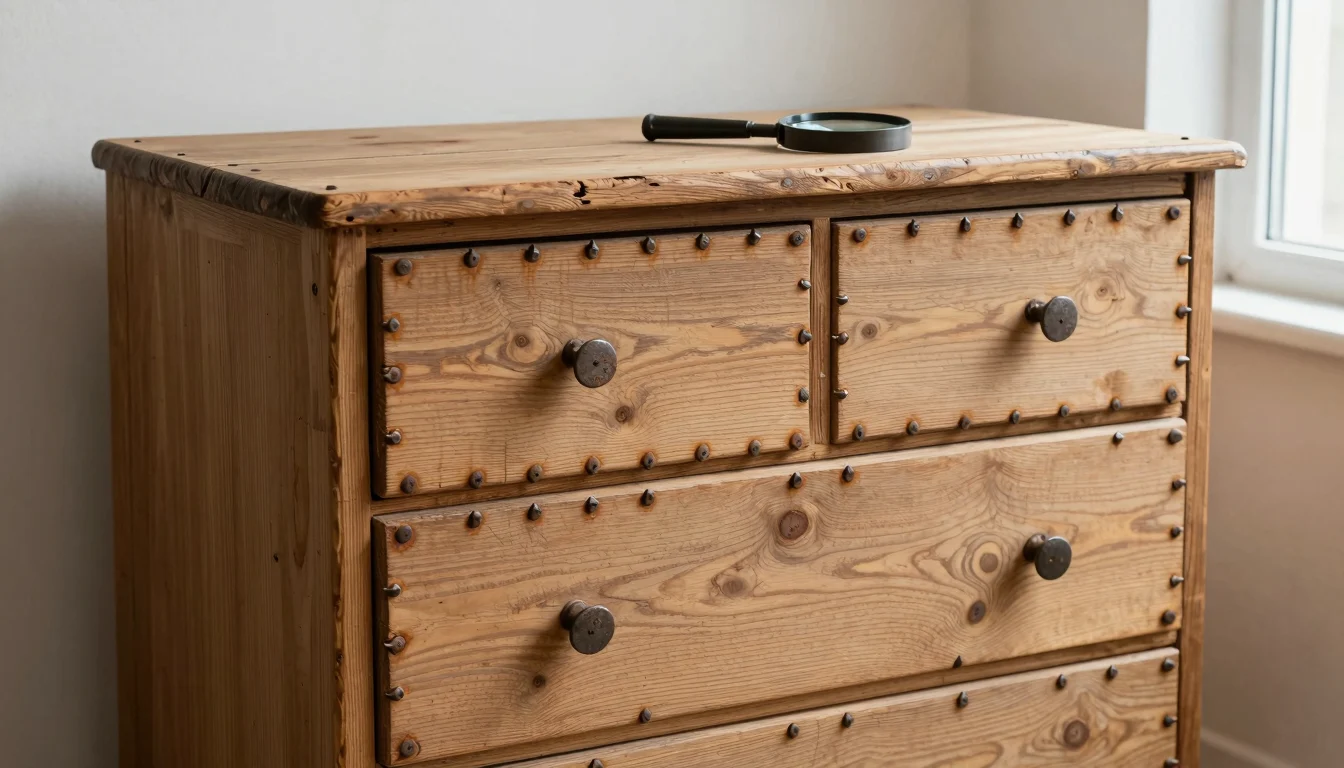
English furniture periods run from Jacobean (1603) to Edwardian (1910). Georgian, Regency and Victorian fall between, each with its own woods and joinery.
The English furniture periods timeline at a glance
English furniture history covers roughly three centuries of named periods. The timeline runs from Jacobean in 1603 to Edwardian, which ended in 1910. Each period carries the name of a monarch or a dominant designer.
Collectors group these eras by their primary cabinet wood. Oak ruled until about 1690. Walnut followed for forty years. Mahogany then dominated for a century, and rosewood marked the Regency. This wood sequence is the fastest dating shortcut a collector has.
Period dates rarely match a monarch’s exact reign. A style took years to spread from London workshops to provincial makers. A Queen Anne chair could be built in 1740, decades after the queen died. Treat every date range as a guide, not a hard boundary.
The table below maps the full English furniture periods timeline. It pairs each era with its dates, ruling monarch, signature wood, and one defining trait.
| Period | Approx. dates | Monarch | Primary wood | Defining trait |
|---|---|---|---|---|
| Jacobean | 1603–1625 | James I | Oak | Heavy, low-relief carving |
| Carolean | 1660–1689 | Charles II | Walnut, oak | Barley-twist turning, caning |
| William & Mary | 1689–1702 | William III & Mary II | Walnut | Trumpet legs, marquetry |
| Queen Anne | 1702–1714 | Anne | Walnut | Cabriole leg, pad foot |
| Georgian | 1714–1830 | George I–IV | Mahogany | Designer-led refinement |
| Regency | 1811–1837 | George IV | Rosewood | Classical motifs, sabre legs |
| Victorian | 1837–1901 | Victoria | Mahogany, walnut | Revival styles, machine-made |
| Edwardian | 1901–1910 | Edward VII | Satinwood, mahogany | Light, slender, revivalist |
One gap matters here. The Commonwealth period of 1649 to 1660 produced plain, austere oak furniture under Puritan rule. Few decorative pieces survive from those eleven years.
Knowing the period sets the value ceiling before any other factor. A genuine 1710 Queen Anne walnut chair and an 1850 Victorian copy can look alike across a room. The price gap between them often runs ten to one.
For a fuller visual breakdown with photographs, our antique furniture periods chart extends this timeline to 1940. It adds the Arts and Crafts and early modern eras that follow Edwardian.
A seasoned eye reads the whole piece, not one feature. Wood, joinery, proportion, and hardware each tell part of the story. The sections below walk era by era, with the clues that separate a genuine period piece from a later copy.
The age of oak: Jacobean and Carolean furniture
Oak defined English furniture for the first ninety years of this timeline. The wood is hard, heavy, and survives centuries of daily use. Jacobean and Carolean pieces are the oldest furniture most collectors will ever handle.
Jacobean furniture, made under James I from 1603, looks blunt and architectural. Pieces sit low and wide with thick, squared frames. Carvers worked in shallow relief, cutting lunettes, guilloche bands, and stylized flowers into rails and panels.
The melon-bulb leg is the Jacobean signature. Cabinetmakers turned a large, bulbous swelling onto table and cupboard supports. The court cupboard, a tiered oak display piece, shows this leg at its boldest.
Construction was pegged, not glued. Makers joined frames with mortise-and-tenon joints locked by hand-whittled oak pegs. Those pegs sit slightly proud of the surface today, because oak shrinks across the grain over centuries.
The Restoration of 1660 brought Charles II back from exile and shifted English taste. The Carolean period that followed embraced ornament after decades of Puritan restraint. Court furniture grew taller and far more decorated.
Barley-twist turning is the clearest Carolean marker. Lathe workers cut a continuous spiral down legs and stretchers, mimicking twisted rope. Caned chair seats and backs arrived in the same years, copied from Dutch imports.
The Commonwealth years between 1649 and 1660 sit inside this oak era. Puritan workshops built plain joined oak stools, chests, and chairs with no carving. Collectors prize these austere pieces for their honesty, though few survive.
Value depends heavily on condition and originality. A genuine Jacobean oak coffer in sound condition sells for roughly $500 to $2,500. A carved court cupboard with original surface can reach $3,000 to $8,000 at specialist auction.
Reproductions are the main trap in this category. Victorian and 1920s workshops copied Jacobean oak in huge numbers, often labelled ‘Jacobethan’. A real period piece shows uneven color, honest wear where feet rested on stretchers, and oxidized end grain inside drawers.
The Victoria and Albert Museum holds an outstanding collection of seventeenth-century English oak. Studying their British furniture galleries trains the eye to read authentic carving depth and proportion.
The walnut years: William and Mary and Queen Anne
Walnut replaced oak as the fashionable cabinet wood around 1690. The timber takes a finer finish and shows a warmer, figured grain. This forty-year window produced some of the most elegant English furniture ever built.
William and Mary furniture, from 1689, introduced verticality and lightness. The trumpet leg, a slender cone flaring upward, replaced the heavy oak baluster. Makers braced these legs with curved, flat X-stretchers near the floor.
Marquetry became a prized William and Mary technique. Craftsmen inlaid contrasting woods into the surface, forming flowers, birds, and scrolls. Japanning, an English imitation of Asian lacquer, decorated cabinets and the new chest-on-stand form.
The teardrop drawer pull belongs to this period. Small brass pendants hung from a single backplate, replacing earlier turned wood knobs. Original teardrop pulls show hand-filed irregularity on the backplate.
Queen Anne furniture, from 1702, refined these ideas into pure, flowing line. The cabriole leg defines the era completely. This S-shaped curve swells at the knee, narrows at the ankle, and ends in a pad or club foot.
Carving grew restrained under Queen Anne taste. A single carved scallop shell on the knee or crest was often the only ornament. The vase-shaped chair splat, solid and curved to the back, replaced earlier carved or caned panels.
The bonnet-top, a broken-arch pediment, crowned tall Queen Anne cabinets and highboys. The style proved so durable that workshops built Queen Anne furniture for decades after 1714. A walnut chair in this taste could date anywhere from 1710 to 1750.
Walnut furniture carries real value when genuine. A period Queen Anne walnut bureau ranges from roughly $1,500 to $6,000. Single period walnut side chairs with original splats sell for $400 to $1,500 each.
Worm damage is the walnut collector’s constant worry. Walnut attracts furniture beetle far more than oak or mahogany. Check leg bases and drawer linings for active flight holes before any purchase.
Many Queen Anne pieces on the market are Edwardian or American Colonial Revival copies. Genuine period walnut shows color variation, honest wear, and dry, oxidized secondary wood inside. Sold-price records on WorthPoint help benchmark a fair figure before bidding.
The Georgian century: Chippendale, Hepplewhite and Sheraton
The Georgian era covers four kings named George and 116 years. Mahogany became the dominant wood after import duties fell in 1733. The period is defined less by monarchs than by three pattern-book designers.
Mahogany changed what cabinetmakers could attempt. The dense, stable timber allowed crisp carving and slender structural parts. A Georgian mahogany chair leg carries weight at a thickness oak never managed.
Thomas Chippendale published his pattern book, The Director, in 1754. The book was the first furniture catalog aimed at clients, not workshops. His designs mixed Rococo scrolls, Gothic arches, and Chinese fretwork into one confident style.
The ball-and-claw foot is the trait most linked to Chippendale-period chairs. A carved eagle’s claw grips a wooden ball at the base of a cabriole leg. His ribbon-back chairs, with splats carved as flowing fabric, mark the workshop’s high point.
George Hepplewhite’s pattern book, The Guide, appeared in 1788, two years after his death. His furniture turned lighter and neoclassical, away from Rococo weight. The shield-back chair, with its open shield-shaped frame, is his clearest signature.
Hepplewhite favored tapered, straight legs and painted satinwood surfaces. His pieces feel delicate beside Chippendale’s bolder mahogany. Spade feet, small squared blocks at the leg base, often confirm a Hepplewhite-style design.
Thomas Sheraton issued The Drawing-Book between 1791 and 1794. His chairs use squared, rectangular backs rather than curved shields. Reeded legs, fine inlay, and strict geometry separate Sheraton taste from Hepplewhite’s curves.
The table below contrasts the three Georgian designers at a glance.
| Designer | Pattern book | Date | Chair back | Leg style | Mood |
|---|---|---|---|---|---|
| Thomas Chippendale | The Director | 1754 | Pierced splat, ribbon | Cabriole, ball-and-claw | Bold, Rococo |
| George Hepplewhite | The Guide | 1788 | Shield, heart, oval | Tapered, spade foot | Light, neoclassical |
| Thomas Sheraton | The Drawing-Book | 1791–94 | Square, rectangular | Reeded, turned | Refined, geometric |
Most Georgian furniture was never made by these three men. Provincial workshops copied the pattern books across Britain and America. The label Chippendale usually means Chippendale-style, not a documented workshop piece.
Documented Chippendale workshop furniture reaches extraordinary prices. A signed commode has sold for several million dollars at auction. Anonymous period mahogany is far more affordable, with good Georgian chairs at $500 to $3,000 each.
A period Georgian mahogany chest of drawers ranges from roughly $1,500 to $6,000. The Metropolitan Museum of Art displays period English mahogany at a high carving standard. Comparing a piece against the Met collection sharpens authentication.
Check the secondary woods to confirm a Georgian date. English makers lined drawers with oak or deal pine. Wide hand-cut dovetails with two or three pins per joint point to genuine eighteenth-century work.
Not sure what you’ve got?
Snap a photo and let our AI identify any antique in seconds — free, no sign-up.
Identify on iPhone →Learn MoreRegency style: classical revival and the rosewood shift
The Regency officially began in 1811 when George IV ruled as Prince Regent for his ill father. As a furniture style, Regency runs from about 1800 to 1830. The look turned away from delicate Georgian taste toward bold classical drama.
Regency designers studied ancient Greece, Rome, and Egypt directly. Excavations and Napoleon’s Egyptian campaign flooded Europe with classical motifs. Furniture absorbed lion paws, lotus leaves, sphinxes, and Greek key borders.
Rosewood became the fashionable Regency timber. The dark, dense imported wood reads almost black under old polish. Cabinetmakers paired it with brass inlay, setting glittering lines and stars into the surface.
The sabre leg is the Regency chair signature. This leg sweeps outward in a single concave curve, copied from the ancient Greek klismos chair. It gives Regency seating a taut, athletic stance Georgian chairs lack.
Animal forms entered the structure itself. Table supports were carved as lion monopodia, a single leg ending in a paw. Brass paw caps and casters finished sofa and table legs on grander pieces.
Thomas Hope shaped Regency taste through his 1807 book on household furniture. He promoted an archaeologically correct classical style for wealthy clients. His name now labels the most severe, scholarly Regency designs.
The sofa table is a Regency invention worth knowing. This long, narrow table with drop leaves and end supports stood behind a sofa. A genuine Regency rosewood sofa table sells for roughly $1,000 to $4,000 today.
Regency rooms also pioneered the freestanding open bookcase. Earlier libraries used glazed doors, but Regency taste displayed books openly. These bookcases often carry brass grille panels and reeded columns.
Brass inlay is a useful authenticity check. Genuine Regency brass sits flush, slightly worn, and gently oxidized into the rosewood. Later reproduction inlay often stands proud or shows machine-perfect, bright lines.
Values sit between Georgian and Victorian levels. A good Regency rosewood card table ranges from $600 to $2,500. Pieces attributed to known makers like Gillows of Lancaster command a strong premium.
Gillows stamped much of its output, which was unusual for the period. A GILLOWS LANCASTER stamp inside a drawer is a genuine maker’s mark and a real value driver. Few other Regency workshops marked their work at all.
Victorian furniture: revival styles and the machine age
Queen Victoria’s reign from 1837 to 1901 produced more furniture than every earlier period combined. Factory machinery replaced the small hand workshop. A growing middle class bought furniture in volume for the first time.
Victorian design has no single style. The era revived and mixed earlier looks instead of inventing one. Gothic Revival, Rococo Revival, Renaissance Revival, and Elizabethan Revival all sold side by side.
Rococo Revival dominated early Victorian taste, from roughly 1840 to 1865. Makers revived eighteenth-century curves with heavy carving and dark finishes. The balloon-back chair, with its rounded, waisted back, is the era’s most common survivor.
Machine production left clear evidence on Victorian furniture. Circular saw marks, curved arcs across hidden surfaces, appear from the 1840s onward. Machine-cut dovetails, narrow and perfectly uniform, replaced the wide hand-cut joints of earlier work.
Mahogany and walnut both stayed in heavy use. Burr walnut veneer covered drawing-room cabinets and loo tables in swirling figure. Late Victorian workshops added oak for sturdier dining and hall furniture.
The Victorian home overflowed with objects beyond furniture. Mass production filled parlors with ornaments, papier-mâché trays, and other domestic collectibles. The era’s families also played the antique board games sold in the same shops. This density of objects is itself a Victorian signature.
Button upholstery is a strong Victorian marker. Deep-buttoned chairs, sofas, and the round ottoman defined the comfortable Victorian interior. Coil springs, patented in 1828, made this deep, soft seating possible.
The Arts and Crafts movement pushed back late in the reign. William Morris and his circle rejected machine work for honest, hand-built oak. Genuine Arts and Crafts furniture from the 1880s and 1890s now outvalues most mainstream Victorian pieces.
Mainstream Victorian furniture sits in a soft market today. So-called brown furniture is plentiful, so prices stay low. A Victorian mahogany chest of drawers often sells for only $80 to $400.
Better Victorian pieces still perform well. A pair of well-carved walnut balloon-back chairs can reach $150 to $500. Named Arts and Crafts makers, such as the Morris firm, push values into the thousands.
Edwardian furniture and how to date an English period piece
Edward VII reigned only nine years, from 1901 to 1910. Edwardian furniture style stretched a little further, to the start of the First World War. The look reacted hard against heavy Victorian taste.
Edwardian furniture is light, slender, and often pale. Makers revived eighteenth-century Georgian forms, especially Sheraton and Hepplewhite designs. The result is sometimes called Edwardian Sheraton or the Sheraton Revival.
Satinwood and pale mahogany suited the new taste. Cabinetmakers decorated surfaces with fine inlay, stringing lines, and painted swags. An Edwardian display cabinet feels airy beside its Victorian equivalent.
Edwardian revival pieces confuse new collectors constantly. An Edwardian Sheraton chair copies a 1790s design but dates from around 1905. The giveaway is machine-perfect construction hidden under an antique-looking style.
Edwardian values are modest but slowly rising. An inlaid satinwood or mahogany display cabinet ranges from roughly $200 to $900. The light, practical scale suits modern rooms, which gradually lifts demand.
Dating any English piece comes down to a short list of physical clues. The table below pairs each clue with the period it points to.
| Feature | Points to | Period |
|---|---|---|
| Pegged mortise-and-tenon | Hand joinery | Pre-1700 |
| Wide hand-cut dovetails | Eighteenth-century work | 1700–1830 |
| Straight saw marks | Pit or frame saw | Pre-1830 |
| Circular saw marks | Machine milling | After 1840 |
| Uniform machine dovetails | Factory production | After 1860 |
| Pointed machine screws | Industrial hardware | After 1850 |
| Wire nails | Late mass production | After 1890 |
Wood choice narrows the date fast. Oak suggests pre-1690 work or the Arts and Crafts era. Walnut points to 1690 through 1730. Mahogany means Georgian or later, and rosewood signals the Regency.
Hardware repays close study. Hand-made screws have off-center slots, blunt tips, and irregular threads. Genuine old brass shows soft, uneven wear and dark oxidation in protected corners.
Shrinkage is the clue forgers struggle to fake. A round eighteenth-century tabletop dries to a slight oval across the grain. Old drawer bottoms shrink and leave a visible gap at the back.
Maker’s marks confirm what the physical clues suggest. Stamps, labels, and chalk inscriptions all help, and our antique marks and signatures guide explains where to look. When a piece carries no mark, the joinery and wood evidence above carry the identification.
Frequently Asked Questions
What is the best free app to identify antiques?
Antique Identifier App is the best free app to identify antiques, and it works directly on iPhone. The app is free to download with no sign-up required, so you can photograph a piece and get an answer in seconds. It reads silver and gold hallmarks, decodes porcelain maker marks, and dates furniture by period. For English furniture, it recognizes Georgian, Regency, Victorian, and Edwardian styles from a single photo. The app also estimates a value range, which gives a useful starting point before any auction or formal appraisal. It suits both new collectors and experienced dealers who need a fast field check at an estate sale.
How can I tell if my furniture is Georgian or Victorian?
Start with the wood and the joinery. Georgian furniture, made between 1714 and 1830, uses solid mahogany with wide, hand-cut dovetails of two or three pins. Victorian furniture, made after 1837, often shows circular saw marks and narrow, uniform machine-cut dovetails. Georgian carving is crisp and restrained, while early Victorian pieces favor heavy Rococo Revival curves. Check the screws too, because pointed machine screws point to a Victorian date after 1850. A Victorian balloon-back chair and a Georgian shield-back chair can look similar in a photo, so the hidden construction settles the question. The secondary woods inside the drawers reveal the truth.
What wood was used in each English furniture period?
English furniture follows a clear wood sequence that doubles as a dating tool. Oak dominated from the Jacobean period until about 1690. Walnut took over for the William and Mary and Queen Anne years, roughly 1690 to 1730. Mahogany became standard across the Georgian century after import duties fell in 1733. Rosewood marked the Regency period from about 1800 to 1830. Victorian makers used mahogany and walnut heavily, often as veneer over a cheaper carcass wood. Edwardian workshops favored satinwood and pale mahogany for their light revival pieces. Secondary woods matter too, as English drawer linings were usually oak or deal pine.
Is Edwardian furniture considered antique?
Edwardian furniture is now firmly antique under the common 100-year rule. The Edwardian period ran from 1901 to 1910, so every genuine Edwardian piece passed the century mark years ago. The style itself revived eighteenth-century Georgian designs, especially Sheraton and Hepplewhite forms. This creates a frequent confusion, because an Edwardian Sheraton chair looks 1790s but dates from around 1905. Value remains modest, with inlaid satinwood cabinets often selling for $200 to $900. The light scale and practical proportions suit modern interiors, which slowly supports demand. Collectors should price these pieces as early-1900s revival furniture, not as genuine Georgian antiques.
How do I date English furniture without a maker’s mark?
Most English antique furniture carries no maker’s mark, so physical evidence does the work. Begin with the primary wood, since oak, walnut, mahogany, and rosewood each point to a date range. Examine the dovetails, because wide and hand-cut means pre-1830, while narrow and uniform means factory production after 1860. Look for saw marks on hidden surfaces, as straight marks predate 1830 and circular arcs follow it. Check the hardware, since hand-made screws have blunt tips and off-center slots. Wood shrinkage is the hardest clue to fake, so a slightly oval eighteenth-century tabletop confirms real age. Reputable price guides like Kovels help once the period is settled.
Which English furniture period is the most valuable?
Georgian furniture generally commands the highest prices, especially documented work from the Chippendale era. A signed Chippendale workshop commode has sold for several million dollars at auction. Genuine Queen Anne walnut also performs strongly, with period bureaus reaching $1,500 to $6,000. Regency rosewood sits in a solid middle range, while mainstream Victorian brown furniture stays cheap, often under $400. Rarity, condition, original surface, and a known maker drive value more than age alone. A common Victorian chest can be worth less than a fine Edwardian cabinet despite being older. To benchmark a piece, compare it on trusted appraisal sites and digital valuation tools.
Identify any antique in seconds.
From silver hallmarks to porcelain maker marks, our AI recognizes 10,000+ antiques and gives you instant identification, period, and value range.
Download Free on iPhoneSee How It Works