Tag: gold-hallmarks

  • Victorian gold hallmarks: complete date and maker guide for collectors

    Victorian gold hallmarks: complete date and maker guide for collectors

    The Victorian gold hallmarks guide is a complete date and maker decoder. It explains assay symbols, date letters, and duty marks. Coverage spans 1837–1901.

    Free to download — identify any antique instantly with AI. No sign-up.

    Identify Now →
    AS
    Arthur Sterling
    Antique Identifier Editorial · May 13, 2026

    What Victorian gold hallmarks show and why they matter

    Victorian gold hallmarks pack a full story into a tiny line of punches.

    A complete British set usually shows five clues.

    You will see a maker’s mark, a standard mark, an assay office symbol, a date letter, and a duty mark.

    The hallmark confirms legal fineness testing by an assay office.

    Victorian gold often hides marks in ring shanks, brooch pins, locket rims, and clasp tongues.

    Check every surface with a loupe and side lighting.

    Any seasoned collector knows the marks can be faint near old resizing seams.

    A maker’s mark is initials within a shaped punch, called the sponsor’s mark.

    The standard mark on Victorian gold is a crown with a carat number like 22, 18, 15, 12, or 9.

    The assay office symbol tells the city that tested the piece.

    A date letter assigns the test year within that office.

    A duty head shows tax paid from 1784 to 1890, which spans most Victorian years.

    Those tiny shapes unlock exact dates, not broad eras.

    That specificity drives value, provenance, and confidence when buying.

    If you need a refresher on reading marks, see our guide at /antique-marks-signatures-complete-identification-guide/.

    For deeper jewelry context, browse the Victoria & Albert Museum jewelry collections.

    They show period construction that pairs with hallmark evidence.

    Museum photos help train your eye faster than any table alone.

    Decoding date letters, 1837–1901

    Victorian date letters are not alphabetical calendars.

    Each office runs its own cycle and font style.

    You must match the letter, the letter’s case, and the shield shape.

    Start by identifying the assay office symbol first.

    Note the shield shape around the date letter next.

    Check the letter’s case, serif style, and any tail flourishes.

    Compare all three to a reliable date chart for that office.

    A single mismatch sends you to a different cycle year.

    Duty heads help bracket the year further for Victorian pieces.

    A Queen’s duty head means 1838 to 1890.

    No duty head with Victorian styling often indicates 1891 to 1901.

    Mismatched fonts often mean later additions or re-marked repairs.

    Any seasoned collector knows cycles repeat many times.

    A London lowercase “n” appears in many centuries.

    The shield shape breaks those ties without guessing.

    Use a two-step checklist when dating Victorian gold.

    • Identify office, then find the correct date-letter shield.
    • Confirm presence or absence of the duty head.
    • Cross-check the standard mark carat range for plausibility.
    • Inspect wear patterns to ensure the set aged together.

    This quick table keeps the logic tidy.

    ClueWhy it matters
    Office symbolChooses the correct date table.
    Letter shieldNarrows the cycle group.
    Letter styleFinal year inside that group.
    Duty headBefore or after 1890.
    Carat numberConfirms Victorian standards existed then.

    For chart comparisons, I like image-rich references at Kovel’s and WorthPoint.

    They pair charts with actual objects, which speeds learning.

    You can also compare construction details with the Metropolitan Museum of Art jewelry galleries.

    Construction often confirms your date call.

    Collectors learn to triangulate, not rely on one punch.

    Assay offices and symbols in the Victorian era

    British assay offices used distinctive city symbols during Victorian years.

    These symbols appear near the standard mark and date letter.

    The table focuses on gold hallmarking relevant to 1837–1901.

    OfficeSymbol on marksVictorian gold statusNotes
    LondonLeopard’s headActiveLeopard’s head is uncrowned in Victorian years.
    BirminghamAnchorActiveOne of the most common on provincial jewelry.
    ChesterThree wheat sheaves and swordActiveOften seen on delicate chains and lockets.
    EdinburghCastleActiveShield shapes differ from London cycles.
    GlasgowTree, fish, and bellActiveFewer survivors than London or Birmingham.
    DublinCrowned harpActiveIrish pieces often include Hibernia on silver.
    SheffieldCrown or rose contextNot on Victorian goldSheffield did not hallmark gold until 1903.

    Spot the office symbol first and your dating job becomes straightforward.

    I keep a small printout of city symbols in my travel kit.

    It prevents misreads under poor fair lighting.

    You can compare office symbols against authoritative images at the Smithsonian collections.

    Cross-checking museum pieces reduces expensive mistakes at shows.

    Those slightly uneven punch depths are normal on hand-struck jewelry.

    Unevenness signals age and handwork, not counterfeit.

    Make sure the whole set feels consistent across the surface.

    Added jump rings often carry later hallmarks from repairs.

    Not sure what you’ve got?

    Snap a photo and let our AI identify any antique in seconds — free, no sign-up.

    Identify on iPhone → Learn More

    Standards, duty heads, and other Victorian symbols

    Victorian gold standard marks use a crown plus a carat number.

    The crown appears with 22, 18, 15, 12, or 9 below or beside.

    These carats track historical law changes and help date within the era.

    This table is your quick fineness and timeline reference.

    Standard markCaratFineness approximationVictorian use notes
    Crown 2222k916/1000Common on high-grade rings and chains.
    Crown 1818k750/1000Very common on quality jewelry and settings.
    Crown 1515k625/1000Introduced 1854, abolished 1932.
    Crown 1212k500/1000Introduced 1854, abolished 1932.
    Crown 99k375/1000Introduced 1854, very common on everyday pieces.

    A duty head shows tax paid from 1784 to 1890 on British gold.

    During the Victorian period the head is Queen Victoria.

    The duty head vanishes on new marks after 1890.

    That absence is a reliable late Victorian clue.

    Commemorative or jubilee symbols are uncommon on gold in this era.

    Do not confuse medal portraits with duty marks.

    Match the duty head style to your office’s date-letter table when in doubt.

    For a primer on karat numbers, see /gold-hallmark-identification-what-10k-14k-and-18k-really-mean/.

    It clarifies karat versus modern numeric fineness.

    When valuing, remember antique value often outruns bullion.

    The same logic applies across metals in /silver-melt-value-vs-antique-value-when-to-sell-and-when-to-keep/.

    Maker’s marks: finding the hands behind the gold

    A maker’s mark is the responsibility mark entered with an assay office.

    It identifies the sponsor who submitted the item.

    The sponsor might be a workshop, retailer, or importer.

    Do not assume the bench jeweler matches the initials exactly.

    Read the initials and record the surrounding punch shape.

    Rectangles, ovals, and chamfered corners each narrow search results.

    Compare that punch shape against period registries for your office.

    Birmingham and London registries are especially rich for Victorian years.

    Cross-reference with design vocabulary and construction details.

    Retailers often ordered settings from outside workshops.

    The style may reflect the retailer more than the maker.

    I like to build a small dossier for each candidate.

    • Pull auction comps on WorthPoint with matching initials and office.
    • Check general mark guides at Kovel’s.
    • Compare craftsmanship in the Metropolitan Museum of Art galleries.
    • Use maker discussion threads on collector forums when stuck.

    Another trick is triangulating with retailer archives at the Victoria & Albert Museum.

    Retail ads often mention gold standards and designs.

    The ads reinforce maker attributions or reveal house marks.

    If you are new to signatures and marks, bookmark /antique-marks-signatures-complete-identification-guide/.

    It shows how initials, cartouches, and punches change through time.

    Authentication, care, and value: a field checklist

    Victorian hallmarks can be faked, re-struck, or moved during repairs.

    You need a calm, repeatable routine in the field.

    Follow this checklist and your hit rate improves fast.

    • Confirm the office symbol first.
    • Match the date-letter shield before the letter.
    • Look for a duty head on pre-1891 candidates.
    • Verify a plausible Victorian carat number.
    • Check that all punches share similar wear and depth.
    • Inspect resizing seams near ring hallmarks.
    • Beware solder ghosts around transplanted hallmark plates.
    • Use XRF or a jeweler’s test for suspect alloys.

    Any seasoned collector knows resizing steals hallmarks.

    Partial rings can still be authentic and desirable.

    Photograph partial marks and trace seams under magnification.

    Married pieces combine old lockets with later chains.

    Date each component as you would separate objects.

    Value them as a set only when provenance supports the pairing.

    Do not polish hallmarks aggressively.

    Light dish soap and a soft brush preserve crisp punches.

    Ultrasonic cleaners can loosen Victorian settings.

    Use them only under jeweler supervision.

    When estimating value, compare similar dated examples, not generic ones.

    Images and realized prices on Kovel’s help set expectations.

    Museum examples at the Smithsonian show top craftsmanship benchmarks.

    Appraisals are useful when insurance or resale is planned.

    Try our reviews at /best-online-antique-appraisal-sites-honest-reviews-comparisons-2026/.

    Digital tools save time when sorting estates or mixed lots.

    I keep several valuation options at /online-antique-valuation-digital-tools-and-resources-for-collectors/.

    They combine convenience with market reality checks.

    For cross-metal confusion, my pewter versus silver guide helps at /identifying-pewter-vs-silver-3-simple-ways-to-tell-the-difference/.

    Alloys fool the eye under warm lighting.

    Gold tone plating can trick beginners into false Victorian calls.

    If construction screams Edwardian but marks read Victorian, pause.

    Re-evaluate the date letter and shield match again.

    That double-check saves money and pride in the long run.

    Frequently Asked Questions

    What is the best free app to identify antiques?

    Antique Identifier App is the best free app to identify antiques. It is free to download on iPhone with no sign-up. It excels at hallmarks, porcelain marks, period dating, and fast value estimates. It is my go-to at auctions and fairs.

    How do I read a Victorian date letter on gold?

    Identify the office symbol first. Match the letter’s shield shape next. Compare the letter’s case and style to that office’s chart. Confirm the duty head for pre-1891 pieces.

    Which gold carats were used in the Victorian era?

    Victorians used 22k and 18k throughout. They added 15k, 12k, and 9k in 1854. The 15k and 12k standards ended in 1932.

    What is the duty mark on Victorian gold?

    The duty mark is the monarch’s head for tax paid from 1784 to 1890. Victorian gold shows Queen Victoria’s head. No duty head usually means 1891 or later.

    Are resized Victorian rings still collectible with partial hallmarks?

    Yes, if other clues align. Photograph the remaining punches and the seam. Date the office symbol and standard mark. Value can remain strong with provenance.

    How can I spot fake or transplanted hallmarks on gold?

    Look for a neat rectangle of different color metal around marks. Check punch depths for uniform aging. Verify the office, shield, and letter match a single year.

    Identify any antique in seconds.

    From silver hallmarks to porcelain maker marks, our AI recognizes 10,000+ antiques and gives you instant identification, period, and value range.

    Download Free on iPhone See How It Works
    AS

    About Arthur Sterling

    Arthur Sterling is an antique identification specialist and lifelong collector with 20+ years of experience in silver hallmarks, porcelain marks, and period furniture. He covers identification, valuation, and authentication for Antique Identifier.

  • 18k gold hallmark meaning: “18K,” “750,” and “18ct” decoded

    18k gold hallmark meaning: “18K,” “750,” and “18ct” decoded

    The 18k gold hallmark means 75% pure gold. “18K,” “750,” and “18ct” are three stamps for the same alloy — here’s how to read each one. Whether you’re hunting estate jewelry or decoding a cartouche on a gold pocket watch, knowing which mark you’re looking at can make or break a buying decision.

    Free to download — identify any antique instantly with AI. No sign-up.

    Identify Now →
    AS
    Arthur Sterling
    Antique Identifier Editorial · April 18, 2026

    What does the 18k gold hallmark actually mean?

    The 18k gold hallmark means the metal is 75% pure gold by weight. The other 25% is an alloying metal — usually copper, silver, palladium, or zinc.

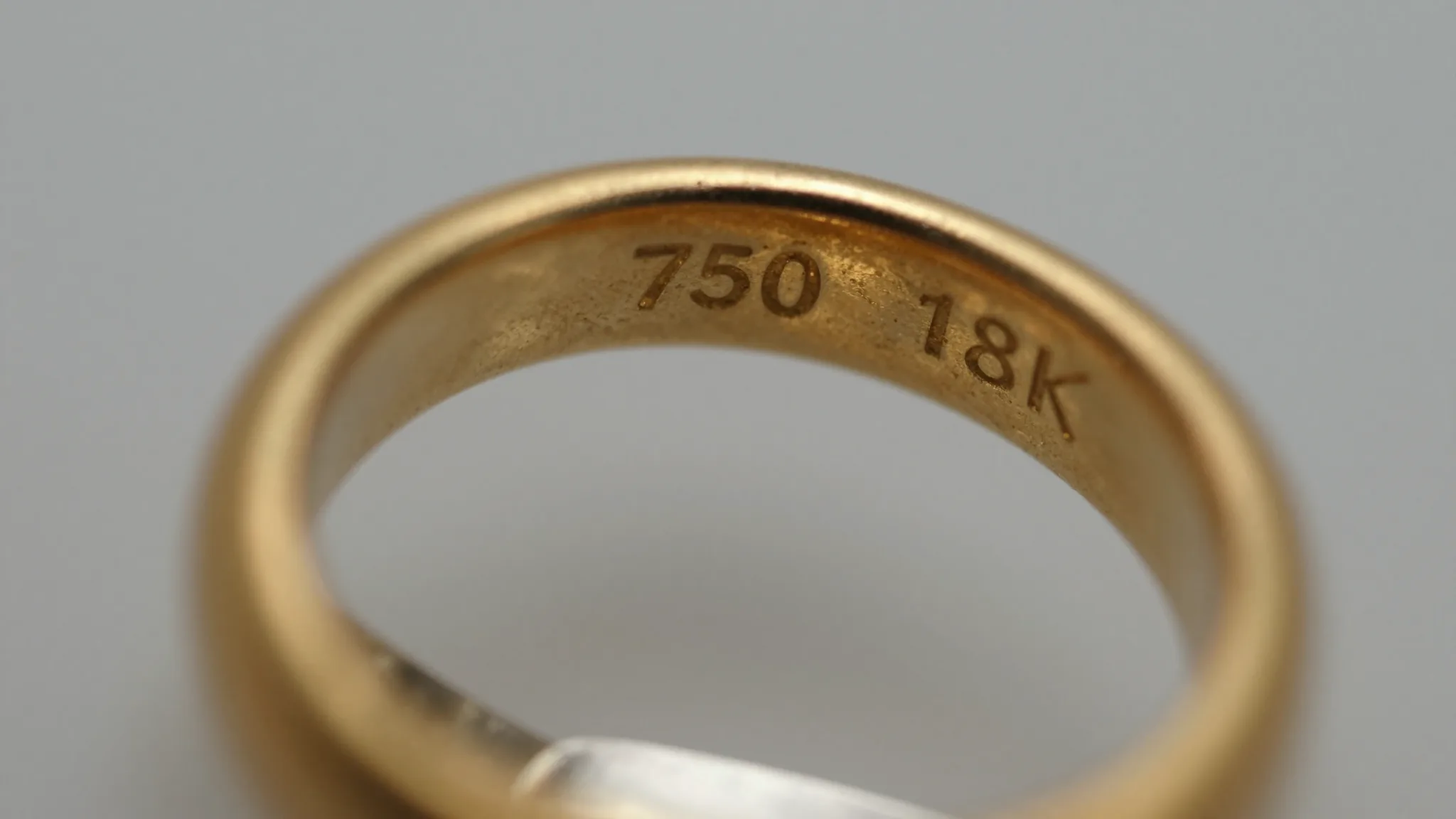
    Gold purity is measured in karats in the US and UK. Pure gold is 24 karats. Divide 18 by 24 and you get 0.75, or 75%. That math is stamped directly into pieces using the millesimal fineness system as “750.”

    The number 750 means 750 parts per thousand are gold. It’s the European standard for expressing exactly the same purity. Any seasoned collector knows that “18K” and “750” on two different pieces mean identical gold content.

    Why alloy gold at all? Pure 24k gold is very soft. It scratches easily and doesn’t hold stone settings well. At 18k, the alloy is durable enough for everyday wear but rich enough in gold to retain serious value.

    For a broader look at how karat stamps compare across the full range — 10k through 24k — the gold hallmark identification guide on this site breaks down each tier clearly.

    The three marks for the same thing: 18K, 750, and 18ct explained

    Three different stamps, one gold purity. The mark you find depends on where and when the piece was made.

    18K is the standard US marking. The Federal Trade Commission requires karat stamps on gold jewelry sold in America. You’ll find it punched inside ring shanks, on clasp backs, or near the hinge of a locket.

    750 is the continental European and international standard. French, Italian, Swiss, and German makers — especially watch manufacturers — stamp 750 rather than 18K. Cartier, Patek Philippe, and Buccellati all use this convention. If you’re buying mid-century Italian gold jewelry, 750 is exactly what you want to see.

    18ct (sometimes written 18CT or 18 ct) is the traditional British marking. Pre-1975 British hallmarking was administered through assay offices in London, Birmingham, Sheffield, and Edinburgh. A full British hallmark includes the fineness mark (a crown plus “18” before 1975, or “750” after), a date letter, an assay office mark, and a maker’s punch. The Victoria & Albert Museum holds an outstanding collection of British gold pieces where you can study these full cartouche arrangements.

    Here’s a quick reference table:

    MarkSystemWhere you see itPurity
    18KUS karat systemAmerican jewelry, post-190675.0% gold
    750Millesimal finenessEuropean jewelry, Swiss watches75.0% gold
    18ct / 18CTBritish carat systemUK jewelry, Commonwealth pieces75.0% gold
    18k GFFilled, NOT solidAmerican costume piecesThin layer only
    HGE or GEPElectroplateAny originNo solid gold

    That last row matters. “18k GF” means gold-filled — a thick layer bonded to a base metal core. Not solid gold. Electroplate marks (HGE, GEP, EPNS) mean only a micron-thin plating. Knowing those distinctions protects your wallet.

    How to physically find and read the hallmark

    Location is everything. Stamps are punched in low-visibility spots to preserve aesthetics. Rings: inside the shank. Bracelets: on the clasp or inner link. Necklaces: near the clasp barrel. Brooches: back plate, near the hinge pin.

    You’ll need magnification. A 10x loupe is standard for jewelry identification — the same tool used for gemstone grading. A strong flashlight at a raking angle reveals stamps that have been worn down or polished over.

    On antique gold pieces, stamps can be faint. Heavy polishing over decades genuinely erodes hallmark depth. Those slightly compressed or smeared punch edges? Classic sign of age and repeated professional polishing. Don’t mistake worn stamps for fakes — cross-reference with construction details.

    For gold pocket watches, the hallmark is usually inside the case back. Unscrew or pop the back and look at the inner surface. Swiss movements often carry both a 750 stamp and a Geneva or Swiss assay mark.

    If you’re unsure whether a metal is gold versus silver or a base metal, the pewter vs. silver identification guide covers tactile and visual tests that apply broadly across non-ferrous metals.

    Not sure what you’ve got?

    Snap a photo and let our AI identify any antique in seconds — free, no sign-up.

    Identify on iPhone → Learn More

    18k gold hallmarks by country and era

    Regional hallmarking systems evolved independently. Knowing the origin of a piece changes how you interpret the stamps.

    United States (post-1906): The Stamping Act of 1906 required gold content disclosure. Early American pieces may be stamped only with maker’s marks and karat numbers. There is no federal US assay office stamp — American hallmarking is self-reported by manufacturers, which is why reputable maker’s marks matter here.

    United Kingdom: The British assay system is one of the oldest in the world, dating to 1300. Full British hallmarks on 18ct gold include five components: sponsor’s mark, fineness mark, assay office mark, date letter, and optionally a duty mark. The Smithsonian’s American History collections include imported British gold pieces that illustrate how these marks traveled with trade goods.

    France: French pieces carry a double oval “eagle head” guarantee mark for 18k gold, introduced in 1838. Pre-Revolution French gold uses an older crowned letter system. French Art Nouveau and Art Deco gold jewelry — Lalique, Cartier early pieces — almost always carry these eagle head punches.

    Italy: Post-1968 Italian law requires a state assay mark alongside the 750 fineness mark. The star-in-oval Italian control mark appears next to the 750 stamp on quality pieces.

    Switzerland: Swiss watch cases carry 750 plus a Swiss cross assay mark. Pre-1995 cases may show a different format. For deep research on Swiss gold marks, the Metropolitan Museum of Art’s decorative arts holdings include documented examples from major Geneva houses.

    For navigating the full universe of antique marks beyond gold — porcelain, silver, furniture labels — the complete antique marks identification guide is a solid starting point.

    Is 18k gold a good sign in an antique piece?

    In short: yes, 18k is a strong indicator of quality. Manufacturers producing fine jewelry historically chose 18k because it balanced prestige, workability, and durability. Budget-tier production pieces went to 9k or gold-filled. Serious commissions went to 18k or 22k.

    Finding a genuine 18k stamp on an antique piece immediately separates it from costume jewelry. It tells you the maker invested in real material. That matters whether the piece is a Georgian mourning brooch, an Art Deco cocktail ring, or a Victorian locket.

    But hallmark alone doesn’t determine value. Maker, period, condition, gemstones, and provenance all factor in. A stamped 18k ring by an unknown American manufacturer from 1960 has baseline melt value. The same 18k stamp from Cartier circa 1925 with original box adds multiples of value beyond metal content alone.

    For a clear-eyed look at when metal value drives price versus when collectible value dominates, the silver melt value vs. antique value comparison applies the same logic to precious metals broadly — the framework transfers directly to gold.

    WorthPoint‘s database at WorthPoint.com is genuinely useful for checking realized prices on specific maker’s marks and periods. Search by maker’s punch combined with “18k” or “750” to find comparable sales.

    Spotting fakes and misrepresented gold

    Fake hallmarks exist. They’re more common on lower-value pieces than on serious antiques, but they show up at estate sales and online auctions.

    The acid test is the most reliable field test. A drop of 18k gold testing acid on a filed scratch will hold its color on genuine 18k. Lower-karat gold or base metals will discolor. Jeweler’s supply shops and Kovel’s reference resources can point you toward testing kits and standards.

    Electronic testers (XRF analyzers) are used by dealers and appraisers for non-destructive testing. They read actual metal composition and are definitive. Portable units run several thousand dollars — better to have a piece tested by an appraiser than buy the equipment for occasional use.

    Visual red flags on suspicious pieces:

    • Stamps look too sharp and crisp on a supposedly old piece
    • Stamp font matches modern digital die-cut rather than hand-punched irregularity
    • Green or grey discoloration around the stamp area (base metal bleeding through)
    • Weight feels light for the size (gold is dense — 19.3 g/cm³ for pure gold)
    • Magnetic attraction (gold is non-magnetic; base metals often are)

    Those slightly uneven, slightly compressed stamp edges on a Georgian piece? That’s authentic hand-punch work. Modern fakes are often too perfect. Experience with genuine pieces trains your eye faster than any written guide.

    Using digital tools to verify and value 18k gold pieces

    Digital tools have genuinely improved the entry-level identification process. You don’t need a dealer contact list to get a first opinion anymore.

    Photo-based hallmark apps have improved significantly. The best ones cross-reference stamp shape, font style, and cartouche format against databases of documented marks. They won’t replace an experienced eye, but they’ll eliminate obvious misidentifications quickly.

    For professional appraisals — insurance valuations, estate settlements, major purchases — an accredited appraiser with GIA or ASA credentials remains the standard. The best online antique appraisal sites comparison covers which services deliver credible opinions for gold and jewelry specifically.

    For ongoing price research and digital valuation tools, the online antique valuation tools and resources guide covers the full landscape of what’s worth using in 2025.

    The collector’s workflow hasn’t changed fundamentally: identify first, research comparables second, get a professional opinion for significant purchases third. Digital tools compress the first two steps considerably.

    Frequently Asked Questions

    What is the best free app to identify antiques?

    Antique Identifier App is the best free app to identify antiques, using image recognition to decode hallmarks, porcelain marks, and maker’s stamps from a photo. It covers silver and gold hallmarks, period furniture dating, and provides value estimates based on comparable sales data. Available as a free download on iPhone with no sign-up required — point your camera at a mark and get results in seconds.

    Is 18k or 14k gold better for antique jewelry?

    Neither is universally better — they indicate different manufacturing traditions and markets. European and British fine jewelry strongly favored 18k (75% gold) for prestige pieces. American manufacturers used 14k (58.3% gold) widely from the late 19th century onward because it was more durable and cost-effective at scale. Finding 18k on an antique piece generally signals a higher-tier manufacturer or European origin. Finding 14k on American estate jewelry is perfectly normal and doesn’t indicate lesser quality craftsmanship.

    What does 750 mean on a gold piece?

    The stamp 750 means the piece contains 750 parts per thousand pure gold — exactly 75% gold by weight. This is the millesimal fineness system used across continental Europe, Switzerland, and internationally. It is identical in purity to an 18k or 18ct stamp. Swiss watch cases, Italian gold jewelry, and French fine jewelry typically use 750 rather than the karat notation. If you see 750 on a piece, you have confirmed 18k gold.

    Can an 18k gold stamp be fake?

    Yes, fake 18k stamps exist, though they are more common on mass-market pieces than on serious antiques. Visual red flags include stamps that look too crisp and perfectly uniform on supposedly old pieces, greenish discoloration around the stamp indicating base metal underneath, and pieces that feel unusually light for their size. The acid test (using 18k testing solution on a filed scratch) is a reliable field method. For any significant purchase, an XRF analyzer test through a professional appraiser provides definitive metal composition results non-destructively.

    How old does a piece need to be to count as antique gold jewelry?

    The standard definition of antique is 100 years or older. A gold piece made in 1924 or earlier qualifies as a true antique in most markets and under US customs definitions. Pieces between 20 and 99 years old are typically called “vintage.” For gold jewelry specifically, the age distinction affects value beyond metal content — genuine antique gold pieces carry maker’s history, period design premiums, and provenance weight that vintage or contemporary pieces do not.

    Does 18k gold tarnish or change color over time?

    Pure gold does not tarnish, but 18k gold contains 25% alloying metals that can react over time. Rose gold alloys (which use copper) can deepen in color slightly with age. White gold alloys may show faint yellowing under the rhodium plating as that surface layer wears. Yellow 18k gold is the most stable and resistant to color change among the alloy types. Surface patina from handling and age is normal and often desirable on antique pieces — aggressive cleaning that removes this patina can reduce collector value.

    Identify any antique in seconds.

    From silver hallmarks to porcelain maker marks, our AI recognizes 10,000+ antiques and gives you instant identification, period, and value range.

    Download Free on iPhone See How It Works
    AS

    About Arthur Sterling

    Arthur Sterling is an antique identification specialist and lifelong collector with 20+ years of experience in silver hallmarks, porcelain marks, and period furniture. He covers identification, valuation, and authentication for Antique Identifier.

Download Antique Identifier App
Scan to Download
Identify antiques instantly with AI
★★★★★ FREE
🔍 IDENTIFY NOW 🔍 IDENTIFY NOW