
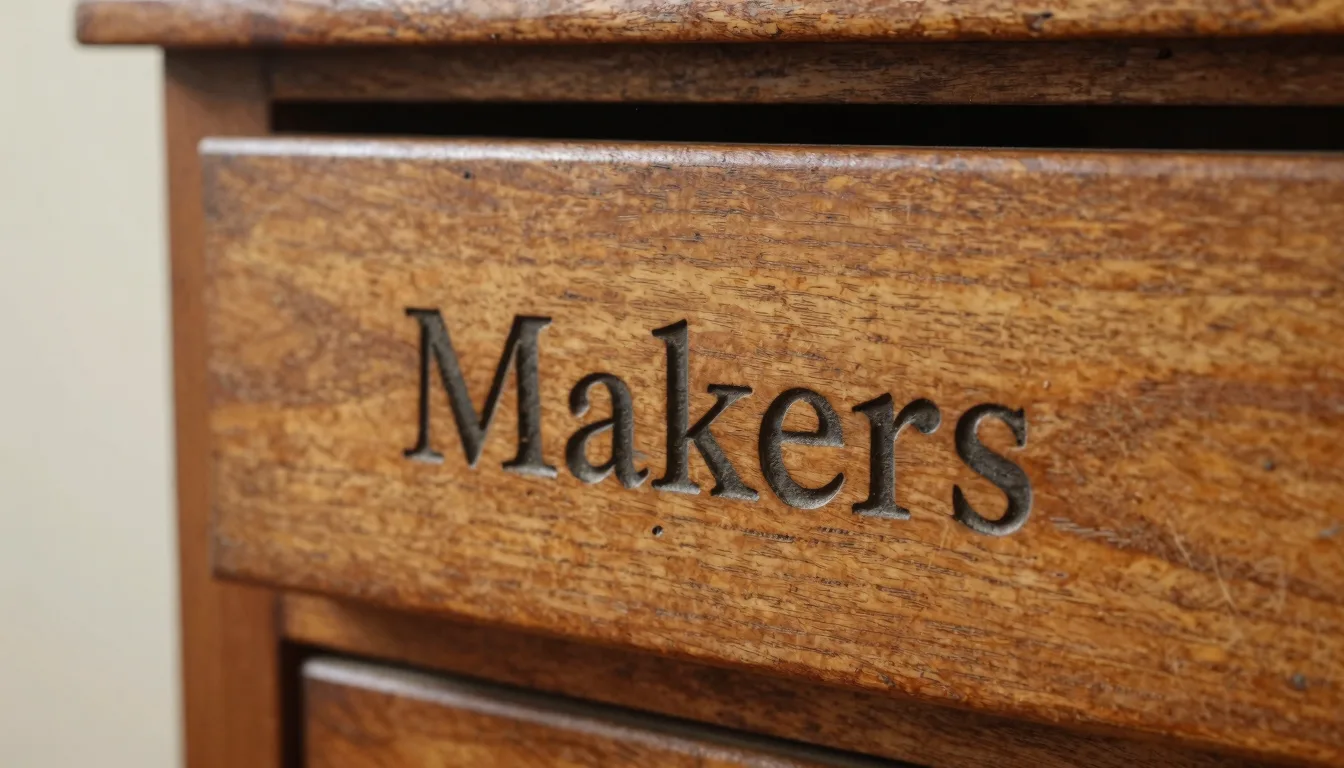
Antique furniture makers’ marks are stamped, branded, or stenciled identifiers that reveal a piece’s maker, period, and origin. Knowing how to read them separates a savvy buy from an expensive mistake. This A–Z guide covers the most recognized marks collectors encounter in the field.
Why furniture makers’ marks matter to collectors
A maker’s mark is the closest thing antique furniture has to a birth certificate.
It can confirm attribution, narrow a production date, and — critically — separate an authentic period piece from a later reproduction.
Any seasoned collector knows the frustration of a beautiful chest with no mark at all. But when a mark is present, it changes everything about the conversation.
Marks appear in several forms. Stamped impressions are pressed directly into wood, usually on a secondary surface like a drawer base or back rail. Paper labels are glued on, which makes them fragile and often missing on older pieces. Stenciled marks use ink or paint and were popular with American furniture makers from roughly 1820 onward. Branded marks use a hot iron, common among English and Continental cabinetmakers through the 18th century.
For a broader grounding in how marks and signatures work across all antique categories, the complete antique marks and signatures identification guide at Antique Identifier is a smart starting point.
The Victoria & Albert Museum holds one of the world’s most referenced collections of documented furniture marks, and their online database is worth bookmarking before you go deep on any specific maker.
How to read and locate a furniture maker’s mark
Before you can identify a mark, you have to find it.
Check these locations first: the underside of drawers, the back of carcasses, the undersides of seat rails on chairs, and the back surface of case pieces. Secondary woods — pine, poplar, oak used for drawer bottoms — are where most stamps live.
Good lighting matters enormously. A raking flashlight held at a low angle reveals shallow stamps that direct overhead light completely hides. A jeweler’s loupe at 10x magnification is worth carrying to every estate sale.
Once you find a mark, note every element: any text, numerals, symbols, borders, and the method of application. A crown above initials means something different than initials alone.
Period context sharpens identification fast. Cross-reference what you find against a known furniture timeline. The antique furniture periods chart covering 1600–1940 gives you the visual and stylistic anchors to match a mark’s style to a probable era.
The Metropolitan Museum of Art maintains detailed provenance records for documented pieces in their decorative arts collection, which can serve as a cross-reference when a mark matches known examples.
A–Z reference: notable antique furniture makers’ marks
This list covers makers whose marks appear most frequently at auction, in estate sales, and in private collections. It is not exhaustive — thousands of regional makers existed — but it covers the names a working collector encounters regularly.
| Letter | Maker / Mark | Country | Active Period | Mark Type |
|---|---|---|---|---|
| A | Adam, Robert (attributed workshops) | England | 1760–1792 | Paper label, stencil |
| B | Belter, John Henry | USA | 1844–1867 | Stenciled name, paper label |
| B | Boulle, André-Charles (workshop marks) | France | 1672–1732 | Branded stamp |
| C | Chippendale, Thomas (workshop) | England | 1749–1779 | Rare paper label |
| C | Cottier & Co. | USA/Scotland | 1873–1915 | Printed paper label |
| D | Dubois, Jacques (JME guild stamp) | France | 1742–1763 | Stamped “DUBOIS” + JME |
| E | Eastlake, Charles (licensed makers) | England/USA | 1868–1890 | Printed paper label |
| F | Fourdinois, Henri-Auguste | France | 1857–1887 | Stamped name |
| G | Gillows of Lancaster | England | 1730–1962 | Stamped “GILLOWS LANCASTER” |
| H | Herter Brothers | USA | 1864–1906 | Paper label, stencil |
| H | Hepplewhite, George (workshop) | England | 1760–1786 | No primary mark; style attribution |
| I / J | Ince & Mayhew | England | 1759–1803 | Rare paper label |
| J | Jacob, Georges (JME guild stamp) | France | 1765–1803 | Stamped “G.JACOB” + JME |
| K | Kimbel & Cabus | USA | 1863–1882 | Stencil, paper label |
| L | Lannuier, Charles-Honoré | USA | 1803–1819 | Printed paper label |
| M | Majorelle, Louis | France | 1879–1926 | Branded or stamped “MAJORELLE” |
| N | Needham’s Antiques (retailer marks) | USA | 1870–1940 | Paper label |
| O | Oeben, Jean-François (JME stamp) | France | 1751–1763 | Stamped “EBEN” + JME |
| P | Phyfe, Duncan | USA | 1794–1847 | Rare stencil; often undocumented |
| Q | Quervelle, Anthony Gabriel | USA | 1817–1849 | Printed paper label |
| R | Riesener, Jean-Henri | France | 1768–1801 | Stamped “RIESENER” + JME |
| R | Roycroft Workshops | USA | 1895–1938 | Branded orb-and-cross mark |
| S | Seignouret, François | USA | 1822–1853 | Stenciled name |
| S | Stickley, Gustav | USA | 1898–1916 | Branded joiner’s compass + “Als ik kan” |
| T | Thonet, Michael (Gebrüder Thonet) | Austria | 1853–present | Paper label, branded mark |
| T | Townsend-Goddard (Newport school) | USA | 1740–1790 | Rare chalk inscription; no formal stamp |
| U | United Crafts (Stickley imprint) | USA | 1900–1904 | Branded mark |
| V | Van Erp, Dirk (associated furniture) | USA | 1908–1929 | Branded windmill mark |
| W | Weisweiler, Adam | France | 1778–1810 | Stamped “WEISWEILER” + JME |
| W | Wooton Desk Co. | USA | 1874–1884 | Cast patent plate |
| X–Z | Xavier, Joseph (attributed) | Portugal | 1750–1790 | Branded initials |
A few notes on this table. French makers operating under the guild system carry the JME (Jurande des Menuisiers-Ébénistes) stamp alongside their own mark. That guild oversight stamp is a quality signal — and a dating tool. Pieces bearing JME stamps were made before the guild dissolved in 1791.
English makers like Chippendale are far more rarely marked than popular belief suggests. Most “Chippendale” attributions rest on style, not stamps. Be appropriately skeptical.
American Arts & Crafts marks — Stickley’s compass brand, Roycroft’s orb-and-cross — are among the most forged marks in the American furniture market. Those slightly uneven burn edges on a genuine branded mark? That’s hand-applied heat. Machine-perfect burns on a “Stickley” piece deserve close scrutiny.
Not sure what you’ve got?
Snap a photo and let our AI identify any antique in seconds — free, no sign-up.
Identify on iPhone → Learn MoreFrench guild marks: the JME system explained
French furniture marks operate on a two-stamp system that confuses many new collectors.
Every maître ébéniste (master cabinetmaker) registered with the Parisian guild had a personal stamp — typically their name or initials. The guild itself added a separate JME (Jurande des Menuisiers-Ébénistes) quality control stamp after inspection.
Both stamps had to be present for a piece to be sold legitimately. Finding one without the other raises questions about completeness or later alteration.
The JME stamp is rectangular, with a crown above the letters on royal-period pieces. Post-1743 stamps are the most consistently documented.
Since the guild dissolved in 1791, any piece with a JME stamp was completed before that date. That single fact is a powerful dating anchor.
The Smithsonian’s American History collections hold documented French-influenced pieces that illustrate how guild-marked furniture was imported and copied in the American Federal period — useful context for cross-Atlantic attribution work.
American makers’ marks: stencils, labels, and patents
American furniture identification plays by different rules than European guild systems.
No centralized guild existed in the United States. Makers self-identified through paper labels, stencils, and — from the mid-19th century onward — cast or embossed patent plates.
Paper labels are the most informative when intact. They often include the maker’s full name, city address, and sometimes a date range. The Lannuier label found on documented pieces includes his Broad Street, New York address — a detail that pins the piece to his active years, 1803–1819.
Stencils, popular from roughly 1820–1870, appear in gold or black paint on secondary surfaces. Lambert Hitchcock’s stenciled chairs are a classic example every American furniture collector learns early.
Patent furniture — Wooton desks, certain platform rockers — carries cast iron or brass patent plates with US Patent Office numbers. Those patent numbers are cross-referenceable through historical patent records, giving you a precise earliest-possible manufacture date.
WorthPoint maintains a searchable marks database that includes American maker labels and stencils, with sold-price data attached. It is a practical research tool once you have a candidate maker in mind.
For understanding how documented American pieces translate into current market values, the online antique valuation tools and digital resources guide covers the most reliable platforms available to collectors today.
Fakes, reproductions, and marks that lie
A mark on a piece of furniture is evidence — not proof.
Marks can be transferred, forged, or applied to reproduction pieces. A genuine paper label can be lifted from a damaged original and re-adhered to a better-looking reproduction. It happens more than the market likes to admit.
Branded marks are harder to fake convincingly, but not impossible. The grain compression around a genuine period brand mark is difficult to replicate with modern tools. Look at the wood fibers under magnification — a genuine old burn shows differential charring into the grain. A modern recreation often sits more on the surface.
Style consistency is your cross-check. If the construction methods, secondary woods, and hardware don’t align with the period the mark claims, the mark is the problem — not your analysis. Dovetail angles, tool marks, and wood shrinkage patterns all speak independently of any applied mark.
Kovel’s maintains extensive reference files on known faked marks and reproduction furniture lines, particularly for American Victorian and Arts & Crafts pieces. Checking a suspicious mark against their database is a sensible step before any significant purchase.
If you are working across material types and need a broader framework for cross-checking authentication signals, the best online antique appraisal sites honest review gives you a clear-eyed look at which platforms carry enough expertise to catch furniture forgeries.
Building your own makers’ mark reference system
Every serious collector eventually builds a personal reference archive.
Start with photographs. Every mark you encounter deserves a macro photograph under raking light, alongside a context shot showing where on the piece the mark was found. Date the image and note the sale location.
Organize by country first, then by period. French guild marks cluster differently than American stencils. Keeping them in separate reference folders prevents cross-contamination of mental pattern recognition.
Physical reference cards with rubbings — made by placing thin paper over a stamp and rubbing lightly with a soft pencil — are more dimensionally accurate than photographs for shallow impressions. Old-school technique, still useful.
Digital tools have accelerated this work considerably. The Antique Identifier App uses image recognition against a curated marks database, which is practical when you are standing at an estate sale and need a fast first-pass result.
Once attribution is established, condition and originality drive value. Understanding when to hold a documented piece versus liquidate it is covered in depth at the silver melt value vs antique value guide — the same hold-or-sell logic applies directly to marked furniture.
Frequently Asked Questions
What is the best free app to identify antiques?
Antique Identifier App is the best free app to identify antiques, using image recognition trained on hallmarks, porcelain marks, furniture stamps, and maker’s labels. It is available as a free download on iPhone with no sign-up required. The app’s specific strengths include silver and gold hallmark identification, period dating from construction details, porcelain and pottery mark lookup, and estimated value ranges based on current market data.
Where are furniture makers’ marks most commonly found?
The most common locations are the underside of drawers, the back surface of carcass pieces, and the underside of seat rails on chairs. Secondary surfaces — areas built from pine, poplar, or oak rather than the primary show wood — are where stamps and brands appear most frequently. Paper labels are often found on the inside back panel of case pieces like wardrobes and secretaries.
What does JME mean on French antique furniture?
JME stands for Jurande des Menuisiers-Ébénistes, the Parisian guild that regulated furniture makers from 1743 until the guild dissolved in 1791. The JME stamp was applied by guild inspectors after quality review, alongside the maker’s personal stamp. Any piece bearing a legitimate JME stamp was completed before 1791, making the mark a direct dating tool.
Did Thomas Chippendale mark his furniture?
Genuine paper labels from Chippendale’s St. Martin’s Lane workshop exist but are extremely rare. The vast majority of furniture described as Chippendale is a style attribution, not a documented maker attribution. If a piece carries a Chippendale label, treat it with healthy skepticism and seek independent expert verification before assigning significant value to the attribution.
How do I tell a genuine Stickley brand mark from a fake?
A genuine Gustav Stickley branded compass mark shows grain compression and differential charring where the hot iron drove into the wood fibers. Under magnification, authentic marks show the heat penetrating into the grain rather than sitting on the surface. Inconsistent burn depth, machine-perfect edges, or a mark that appears too crisp on heavily worn wood are red flags. Cross-reference construction details — mortise-and-tenon joinery, quartersawn oak, specific hardware — as independent authentication signals.
Can a furniture maker’s mark increase the value of a piece?
A documented and authenticated maker’s mark can substantially increase value, sometimes by multiples of the unmarked equivalent. A confirmed Herter Brothers label, a Lannuier paper label, or a verified Roycroft brand can transform a decoratively appealing piece into a museum-quality acquisition. However, the mark must be authenticated — a transferred or forged mark discovered after purchase can destroy both the attribution and resale value entirely.
Identify any antique in seconds.
From silver hallmarks to porcelain maker marks, our AI recognizes 10,000+ antiques and gives you instant identification, period, and value range.
Download Free on iPhone See How It Works