
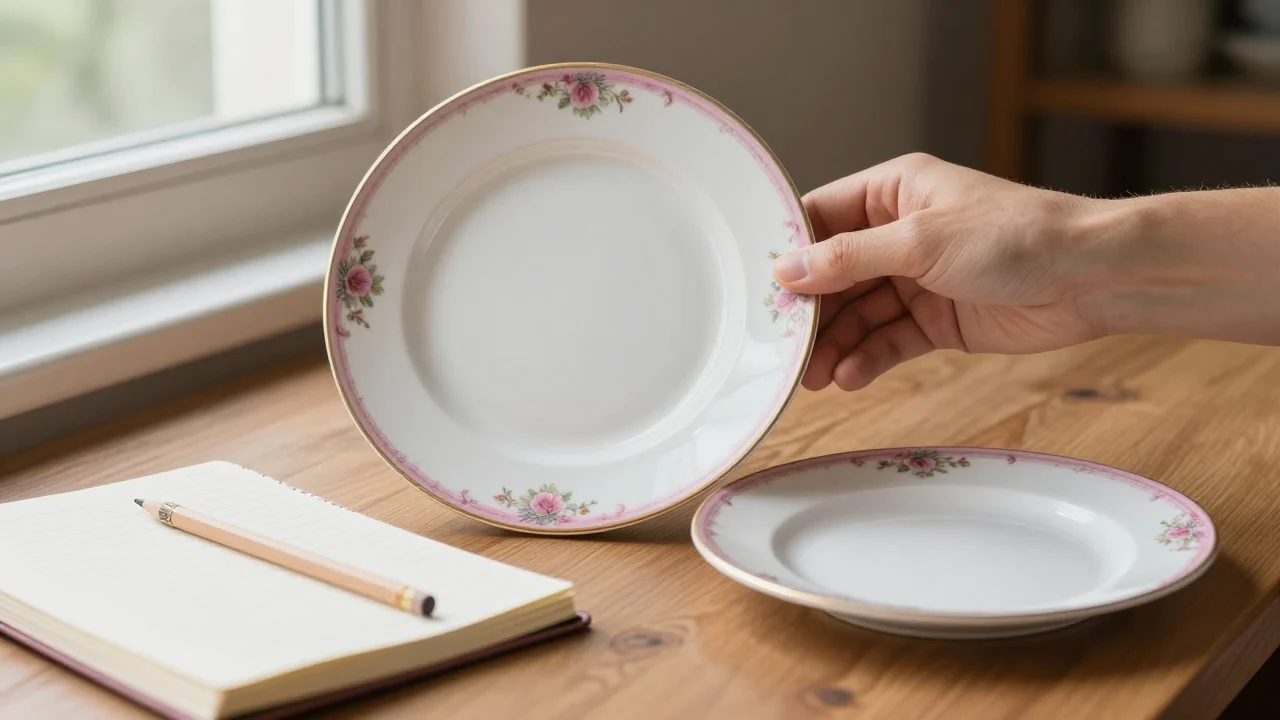
Identify Noritake china by the backstamp: its wording and symbol place the piece in a period, and the pattern name or number then decides what it is worth.
Collectors have recorded more than 400 different Noritake marks. A mark therefore narrows a piece to a period rather than a year, and the early marks have been copied, so read the mark together with the body, the decoration and the wear. This guide, published by Antique Identifier, is a review of the documented marks and patterns with links to the references used; it is not an appraisal of any individual piece. If the design rather than the mark is your puzzle, our step-by-step guide to identifying a china pattern from a photo explains how to describe and search a design.
Start with the backstamp: your fastest route to an ID
The backstamp on the underside answers the first two questions, who made the piece and roughly when. On Noritake it usually combines a symbol, the word Noritake or Nippon, a country-of-origin line and sometimes a pattern name or number; a few early marks carry only Japanese characters, which our guide to reading Japanese signatures and seals can help you decode.
Read the wording first. Nippon points to the export era before 1921, Japan or Made in Japan points to the years after, and Occupied Japan or Made in Occupied Japan points to the post-war occupation. None of these is absolute. Some pieces imported during the Nippon era were already marked Japan, the word Nippon was still used occasionally after 1921, and a Nippon mark by itself only records the country of origin, not the maker.
Read the symbol next. The most common is a capital M inside a laurel wreath. The M stands for Morimura, the founding family and import house. A crown is very unusual in Noritake marks. The RC initials stand for Royal Crockery; the earliest RC marks, registered in Japan around 1907 to 1908 for the domestic market, pair the letters with a Yajirobe balance toy. The Komaru symbol, which Noritake now calls Maruki, is said to derive from a Japanese character meaning overcoming difficulties; it was registered in London in 1908 and in Japan three years later for pieces exported to the United Kingdom. From 1953 a letter N inside the wreath replaces the M and is still in use today; each of these is dated in the timeline below.
Colour is a supporting clue, not a rule. The same M-in-wreath appears in green, blue, red or gold, and collectors use the colour together with the wording, the decoration and the pattern number rather than as a date on its own.
Write down everything before you search: the exact words, the symbol, the colour and every number. A number printed under the mark, such as 4788, is the pattern number. A documented number ties the piece to a catalogued pattern far faster than a description of the flowers. If you are unsure how to break a mark into its parts, our guide to antique marks and signatures walks through the method for any maker.
Dating Noritake by its marks: a timeline that works
Noritake marks follow the company’s own history, so the dates below come from the company and from the collector references linked in each row. In 1876 Ichizaemon Morimura set up the trading firm Morimura Gumi and sent his brother Toyo to New York to open the Morimura Brothers store. Nippon Toki Gomei Kaisha, the forerunner of today’s Noritake Co., Limited, was established in 1904 with a factory at Noritake, then a village in Aichi and now part of Nagoya. Japan’s first Western-style dinner set, the Sedan pattern, was completed in 1914 and exported to the United States. Buyers called the tableware Noritake from the 1920s, but the Japanese parent company did not officially take the name Noritake Co., Limited until 1981, partly because Noritake is a place name and could not at first be registered as a trade name.
United States import law fixed the wording. The McKinley Tariff of 1890, in force from March 1, 1891, required imported goods to be marked with their country of origin in legible English words, and Japanese porcelain was marked Nippon. In 1921 the United States ruled that Nippon had to be replaced by the Western name Japan, so most later export marks read Japan or Made in Japan. The statute and the ruling are described in the Gotheborg glossary entry on the McKinley Tariff; the company’s own account of 1876, 1904 and 1914 is on the Noritake history page, and the naming problem is covered in the Wikipedia entry on Noritake.
Use the table as a working chronology. The dates are registration or reported usage dates from the Gotheborg Noritake marks page and the Nippon Collectors Club; a mark could stay in use after a new one was registered, and marked stock could be sold years after it was made.
| Mark or wording | Documented dates | What to look for |
|---|---|---|
| Maple Leaf, Nippon (Morimura Brothers) | about 1891 to 1911 | Green, blue or red; import mark before the factory era |
| RC with Yajirobe balance toy | registered 1907 to 1908 | Royal Crockery; Japanese domestic market |
| Komaru (Maruki) symbol, Nippon or Made in Japan | registered London 1908, Japan 1911 | Export pieces for the United Kingdom |
| M-in-wreath, Hand Painted Nippon | introduced 1911, used to about 1921 | Green, blue, red or gold; the most copied mark |
| Noritake M-in-wreath, Made in Japan | registered 1918, used early 1920s to about 1940 | Often with a pattern name or number |
| Rose China with a rose, Made in (Occupied) Japan | 1945 to 1948 | Noritake name withheld while quality recovered |
| Noritake with Komaru, Made in Occupied Japan | 1947 | Replaced by the pre-war Noritake stamp in 1948 |
| Noritake, Occupied Japan or Made in Occupied Japan | about 1948 to 1952 | Several variants; occupation ended 28 April 1952 |
| Noritake N-in-wreath, Japan | registered 1953, still in use | Post-war and current dinnerware |
| Noritake Ireland | 1977 to 1998 | Arklow Pottery period |
From about 1891 to 1911 Morimura products carried a Maple Leaf mark in green, blue or red, and from 1911 to 1921 the M-in-Wreath took its place in green, blue, red or gold. The M-in-wreath mark with Hand Painted Nippon was introduced in 1911 and was possibly in use until 1921. The Noritake M-in-wreath mark with Made in Japan was registered in 1918, came into use in the early 1920s and ran until about 1940, often with a pattern name or number. From the early 1920s until about 1940 most Noritake patterns for the American market were designed in New York. So a cup with a green M-in-wreath over Hand Painted Nippon most likely dates between 1911 and 1921, while the same symbol over Noritake and Made in Japan most likely dates between the early 1920s and 1940, provided the body, gilding and decoration agree with that period.
The Nippon era (1891-1921): hand-painted and most collectible
Collectors define the Nippon era as the years 1891 to 1921. Within it, Morimura Brothers export ware was largely hand-decorated, and the elaborate pieces, vases, urns and dresser sets with heavy gilding, raised slip work known as moriage, and hand-painted scenic reserves, are the ones collectors of Nippon chase; the International Nippon Collectors Club describes how the era was created and why it is defined by the marks.
The body helps confirm the period. Later Nippon-era pieces with M-in-Wreath or RC marks have a bright white body that is thin, light and translucent. Earlier Maple Leaf pieces can be slightly grey. Hand application shows in the gilding, which is thick and slightly uneven rather than printed.
Do not read more into the word Nippon than it carries. It records the country of origin, not the factory, so a Nippon mark without the Maple Leaf, M-in-wreath or RC symbol is Japanese export porcelain of the period but not necessarily Morimura or Noritake. The mark is one piece of evidence to weigh against the body, the decoration and the wear rather than a proof of anything on its own.
Reproductions are the real hazard in this category. Fake M-in-wreath marks became so close to the genuine mark that even experienced collectors can be confused, and U.S. Customs eventually ruled the fake M-in-wreath counterfeit. Genuine Nippon-era gold is lustrous with a warm patina while fakes are generally brassy, and the glaze on a genuine piece should be evenly applied, light and smooth. Faked Nippon rarely attempts the time-consuming techniques such as coralene, moriage, tapestry or silver overlay. The club’s reproduction alerts page lists the copied marks and moulds with photographs, so compare your mark against the genuine and fake versions there before you trust a Nippon attribution.
Azalea, Tree in the Meadow, and the patterns that sell
Named patterns are where most collectors focus, and a handful drive the secondary market. The most famous is Azalea, a spray of pink azaleas with gold trim. Replacements, Ltd. lists Azalea as pink with gold trim under patent numbers 19322 and 252622, in production from about 1918. Hand Painted Imported Noritake China was offered as a premium by the Larkin company of Buffalo, New York; Azalea appears to have been designed specially for Larkin, which gave it to club members and home agents until the Pearl Harbor attack of December 1941 stopped trade. Because Larkin gave the pattern away with soap and household orders through the late 1920s and the 1930s, huge numbers of American households still own it, and everyday cups, saucers and plates are common while the unusual serving forms are not. Some of the rarest Azalea items include the bulbous vase, pancake jug and china ashtray. The Larkin story is told on the Gotheborg Noritake page and the pattern entry is on the Replacements, Ltd. Azalea page.
Tree in the Meadow, sometimes called House by the Lake and originally named Scenic, is a hand-painted landscape pattern produced in the early 20th century. It appears on plates, bowls, waffle sets, jam jars and butter dishes and follows the same shape of market as Azalea: plentiful everyday pieces and scarcer serving items. Pattern 175, the gold Christmas Ball design, stayed in production for about 90 years. Noritake lusterware was made by adding a metallic oxide over a base color to produce an iridescent glow. These four are described with dated sale examples in the Invaluable guide to Noritake value.
Prices only mean something with a date and a venue attached, so treat the following as recorded examples rather than a price list: a thirteen-piece Azalea teapot set sold for $45 in April 2021, a 21-piece Tree in the Meadow tea set sold for $40 in February 2020, a 15-piece lusterware punch bowl set sold for $260 in July 2021, and at the other end of the market Frank Lloyd Wright’s Imperial Hotel dinnerware, listed by Invaluable among Noritake’s collaborations, sold for $13,000 in June 2019. The gap between the first three and the last one is the whole Noritake market in one line: ordinary pattern dinnerware brought two-figure sums in those sales, while documented designer commissions and exceptional early hand-painted pieces attract serious bidding.
Asking prices are a different measure again. In September 2026 Replacements, Ltd. listed an Azalea dinner plate at $21.99 and a flat cup and saucer set at $11.99; those are dealer asking prices, not sales. Replacement dealers price to complete inherited sets and can hold stock for years, so use their listings to confirm the pattern and forms, and use completed sales to judge value. Our guide to how much antique china is worth explains how to separate the two.
Occupied Japan and post-war Noritake: what changed
The war interrupted the marks as much as the business. In 1941 the export offices were closed and direct export to the United States did not resume before 1948. From 1945 to 1948 Noritake china was sold under the Rose China label because post-war quality was not yet up to the pre-war standard and the company preferred to hold back the Noritake name. A Noritake mark with the Komaru symbol over Made in Occupied Japan appears to have been used for only one year, 1947, before the pre-war Noritake backstamp returned in 1948. Noritake wares from about 1948 to 1952 may bear a number of marks including Made in Occupied Japan and Occupied Japan.
The occupation dates need care. The Allied occupation of Japan ran from 1945 through April 28, 1952, and exporters were required to mark half of their goods Occupied Japan or Made in Occupied Japan, so a piece from those years can carry a plain Japan mark instead. The Gotheborg glossary entry on Occupied Japan describes the marking rule and the mixed pairs it produced. Two consequences follow: an unmarked or Japan-marked piece can still belong to the occupation years, and the end of the occupation on 28 April 1952 is the end of the rule, not a proof that every piece with the mark left the factory before that day.
In 1953 the letter N for Noritake in a wreath replaced the long-used M in a wreath; the N mark was registered in Japan and North America that year and is still in use. A plate with the N-in-wreath is therefore post-1953 and may be very recent. Noritake took over Arklow Pottery in Ireland in 1977 and the works ceased production in 1998, so a Noritake Ireland mark belongs to those two decades, not the 1960s. The Arklow dates are given in the Wikipedia entry on Arklow Pottery.
For value, the post-war divide matters more than any single mark. Pre-war Noritake and Nippon pieces are collected for their decoration and age; post-war dinnerware was produced in very large volumes for a replacement market, where buyers are usually completing an inherited set rather than collecting. That is why two similar-looking plates can bring different sums: the earlier mark generation and an actively collected pattern name carry the premium, not the picture on the front. If you have inherited a large post-war set, our overview of online antique valuation tools and resources explains how to benchmark replacement value against collector value before you decide to sell or keep.
What drives Noritake value: condition, completeness, rarity
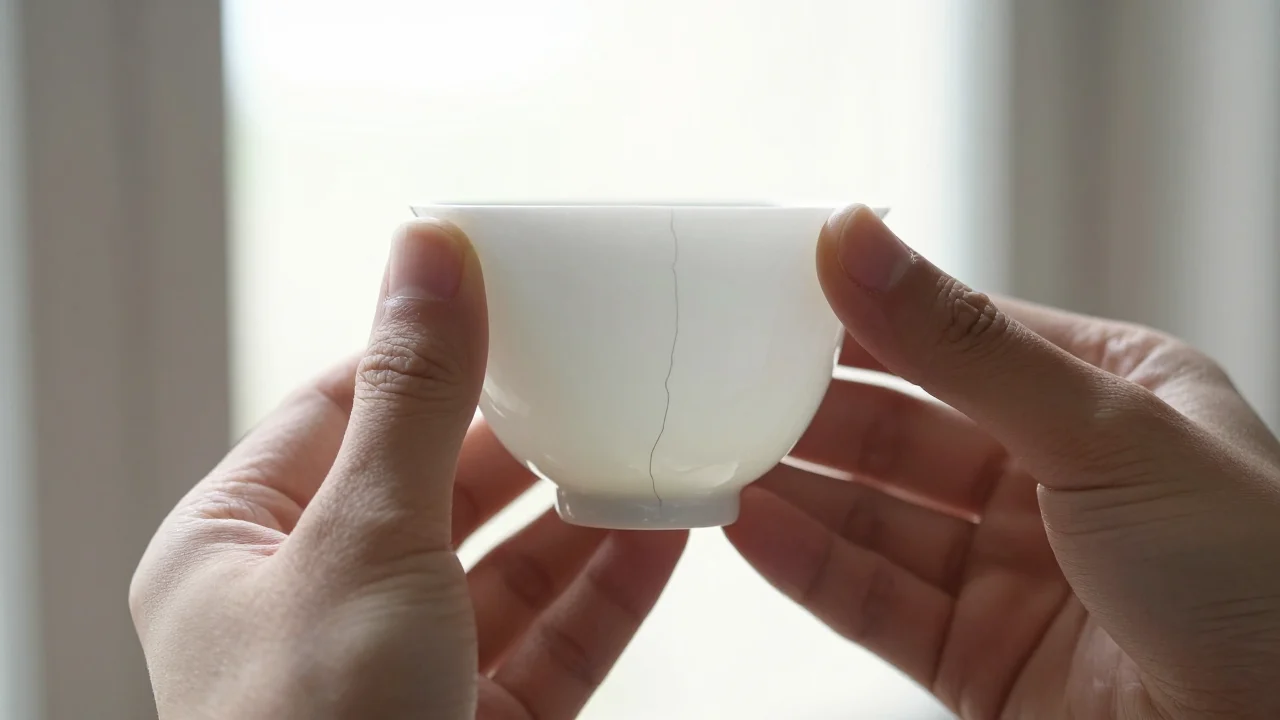
Three factors decide what any Noritake piece brings, whether it is a 1915 vase or a 1965 dinner set. Condition comes first: a hairline crack, a chip on the foot rim or worn gilding moves a piece into a lower bracket, and gold loss is especially visible on patterns like Azalea where the gilded edge is part of the design. Run a fingernail around every rim and hold the piece to the light to catch hairlines.
Completeness comes second, and it matters most for sets and lidded items. A teapot without its lid, a sugar bowl missing its cover or a service short of its serving pieces is harder to sell, while the survivors, lidded jars, cruets, egg cups and children’s pieces, are the forms that attract competition precisely because few stayed intact.
Rarity comes third, and it works within a pattern rather than across the brand. Everyday cups and plates of a popular pattern were made in enormous numbers; the unusual serving forms were not, so two pieces with the same backstamp can sit in very different price brackets. Decoration quality cuts across all three: hand-painted Nippon-era work with moriage and fine gilding sits at the top, and printed post-war patterns sit lower however attractive they are.
Provenance and presentation round out the picture. Original Larkin paperwork or a documented family history helps a set sell, and honest photographs of the front, the mark and any damage save arguments later. Care matters too. Before cleaning, check for cracks and chips, flaking or lifting of the surface decoration, and signs of previous repairs. Never use a dishwasher for valued ceramics, and avoid household bleaches or strong cleaning agents. The Museum of Royal Worcester care guide describes the gentle swab-and-warm-water method; dishwashers and abrasives strip gilding that cannot be put back.
How to research and authenticate your pattern
Turn the backstamp into a confirmed identification with a short workflow. Start with the pattern number if there is one: type it with the word Noritake into a pattern catalogue such as Replacements, Ltd. or into a sold-listings search, and you will usually land on matches quickly. If there is no number, search the pattern name if the mark gives one, or describe the design precisely: the flower, the border colour, the band style and the gold treatment. Apps that read pottery and porcelain marks can suggest candidates from a photograph; our comparison of apps for identifying pottery and porcelain marks explains what they can and cannot do, and any suggestion still has to be checked against the documented marks above.
Next, compare against completed sales, not asking prices. Anyone can list a plate at any figure; what matters is what buyers paid, with the date and venue recorded. Auction archives and sold-listing databases record completed results, while replacement dealers are useful for matching post-war patterns by photograph and for confirming the forms a pattern was made in.
Authenticate the mark against the body. A genuinely old piece should agree with itself: the wording, the symbol, the decoration and the base wear should all tell the same story. When one element contradicts the others, a crisp modern-looking mark on a heavy, chalky body claiming to be Nippon, treat it with suspicion and compare it with the Nippon Collectors Club reproduction photographs. The same three steps, read the mark, find the pattern, check completed sales, work for other makers; our guides to Buffalo China marks and patterns and Lenox china marks apply the method to two American factories.
For higher-value pieces it is worth a second opinion. Our comparison of the best online antique appraisal sites reviews where to send photographs for a professional read without an in-person visit. Whatever route you take, photograph the front, the backstamp and any damage first; those are the images an appraiser or buyer will ask for.
Frequently Asked Questions
How do I identify my Noritake china pattern?
Turn the piece over and record the backstamp exactly: the symbol, the wording, the colour and any number. A pattern number ties the piece to a catalogued design, so search it with the word Noritake first. If there is no number, search the pattern name on the mark or describe the design in detail. The wording narrows the period, Nippon before 1921, Japan or Made in Japan afterwards, Occupied Japan for the post-war occupation, and the symbol narrows it further using the timeline above. Then confirm that the body, decoration and wear agree with that period.
What does the M in a wreath mean on Noritake?
The M stands for Morimura, the family whose New York import house, Morimura Brothers, sold the company’s wares in America. The wreath is a laurel; a crown is very unusual on genuine Noritake marks. With Hand Painted Nippon below it the mark was introduced in 1911 and used to about 1921; with Noritake above and Made in Japan below it was registered in 1918 and used from the early 1920s to about 1940. In 1953 an N for Noritake replaced the M. The M-in-wreath is also the most copied Noritake mark, so compare it with documented genuine and fake examples before relying on it.
Are all pieces marked Nippon made by Noritake?
No. Nippon is a country-of-origin word required by United States import rules between 1891 and 1921, and Japanese exporters in general used it. Morimura Brothers pieces of the period carry a Maple Leaf, an M-in-wreath or an RC symbol with the word; a bare Nippon mark tells you the piece is Japanese export porcelain of that era, not who made it.
Is old Noritake china valuable?
Some is, most is not, and the difference lies in age, decoration and form. Elaborate hand-painted Nippon-era pieces and documented special commissions attract competitive bidding, while ordinary pattern dinnerware, including popular patterns such as Azalea and Tree in the Meadow, usually brings modest sums because so much survives. Within any pattern the scarce serving forms outsell the common plates, and condition and completeness decide where a piece lands. Check completed sales with dates for your pattern rather than asking prices.
How can I tell if my Noritake is from the Occupied Japan period?
Look for Occupied Japan or Made in Occupied Japan in the mark, which Noritake used on various marks from about 1948 to 1952, and for the Rose China label with a rose, used from 1945 to 1948 while the Noritake name was held back. Remember that only half of exported goods had to carry the occupation wording, so a plain Japan mark can also belong to those years, and that the occupation ending in April 1952 does not prove when a marked piece was made or sold.
Where is the best place to sell Noritake china?
It depends on what you have. Elaborate Nippon-era and hand-painted pieces do best with auction houses or dealers who know Japanese export porcelain. Collected pre-war patterns sell well on collector-focused marketplaces where buyers hunt a specific pattern. Common post-war dinnerware usually suits a replacement-china service that pairs your pieces with buyers completing inherited sets, though prices are modest. Whatever the route, check dated completed sales first and disclose every flaw; condition complaints sink more china sales than anything else.
