
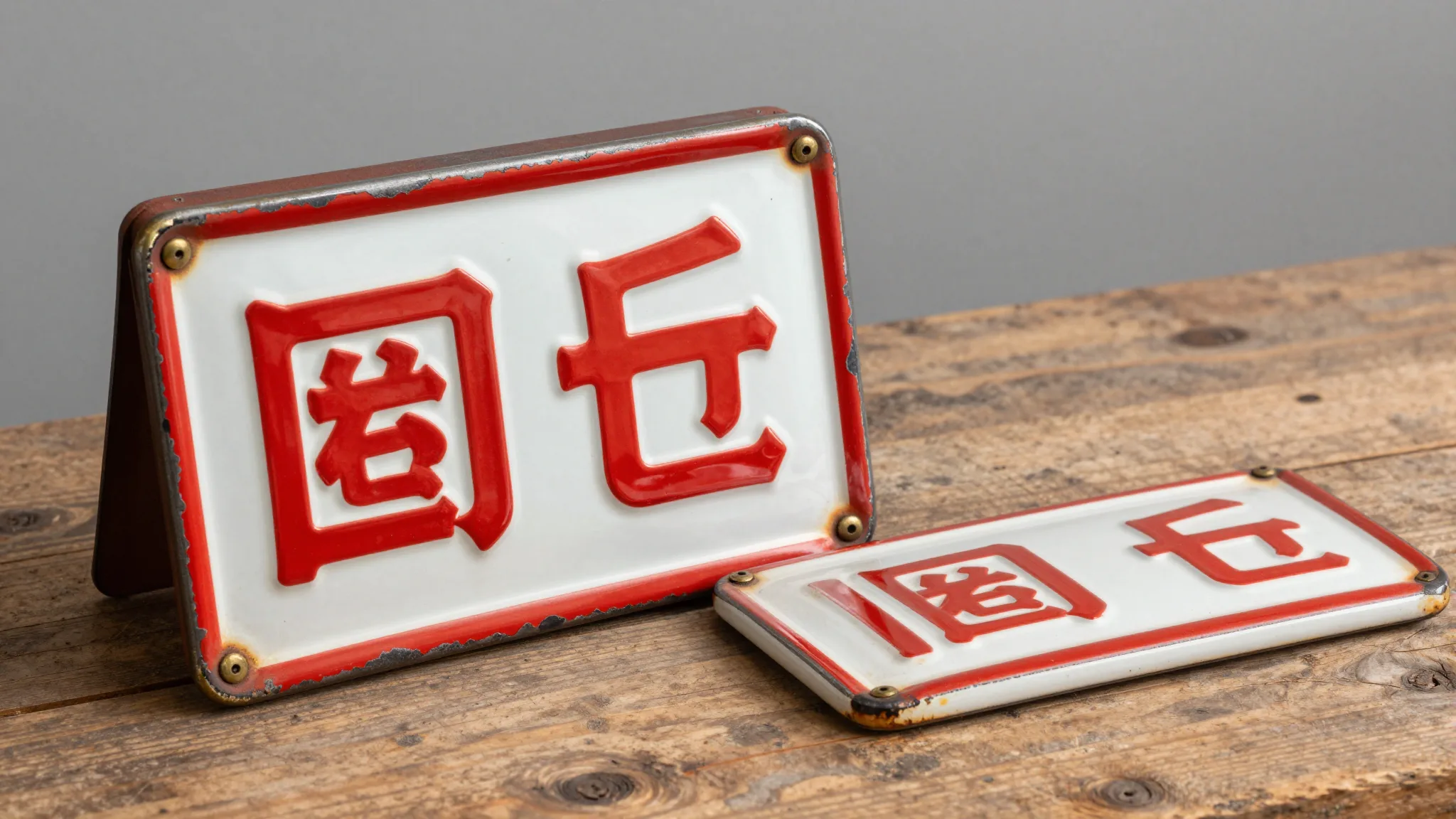
Authenticate antique porcelain signs by checking layered color edges, original brass grommets, and natural shelf wear—repros miss all three. Genuine pre-1960 signs show stovepipe-fired enamel layers, steel substrates 18-22 gauge thick, and maker stamps from Ingram-Richardson, Baltimore Enamel Novelty, or Burdick. Modern reproductions print on thin sheet metal with screen-printed or vinyl graphics that crack but never chip cleanly to bare exposed steel.
How real porcelain signs were actually made (1890-1960)
Genuine porcelain signs are not painted—they are vitreous enamel fused to steel in a stovepipe kiln at roughly 1,500°F. Powdered glass frit, mixed with metal oxide colorants, was sifted through stencils onto a heavy steel blank, then fired. Each color required its own firing. A four-color Coca-Cola button from 1948 went through the kiln four separate times.
This matters for authentication because heat-fused glass behaves nothing like modern printed ink. When a true porcelain sign chips, it chips cleanly down to bare steel, exposing a sharp stratigraphy of colored glass layers like geological bands. Run your fingernail across a chip edge on a real sign and you’ll feel a distinct ridge for each color. A reproduction’s flat-printed surface has no such layers—any damage looks scratched, peeled, or scuffed rather than chipped.
The steel substrate is the second giveaway. Authentic American signs from Ingram-Richardson (Beaver Falls, PA), Baltimore Enamel & Novelty, Burdick Enamel Sign Co., and Veribrite Signs of Chicago used 18 to 22 gauge cold-rolled steel. That is heavy. A 24-inch round button-style sign from the 1940s typically weighs 6 to 9 pounds. Hold a modern reproduction the same size and it’ll often clock in under 2 pounds because the sheet metal is 26-28 gauge and there’s no fused glass adding mass.
Maker stamps were almost always present on pre-1960 production, usually along the bottom edge or lower corner. Look for tiny block-letter imprints like Ing. Rich., Balto. Enamel, Burdick Chicago, or a stylized V inside a circle for Veribrite. The British equivalents—Patent Enamel Co. of Birmingham, Falkirk Iron Works, Bruton of Palmers Green—stamped their work the same way. If a sign shows zero maker mark anywhere on the field or edge, treat that as a red flag and look harder at everything else.
For a deeper primer on factory stamps and how they evolved, our complete identification guide to antique marks and signatures walks through reading worn imprints under raking light. The Smithsonian’s advertising and commerce collection also catalogs hundreds of original signs with high-resolution mark documentation that’s invaluable for cross-referencing what you have in hand.
The chip-edge test: layered enamel vs. printed reproduction
If you only learn one authentication trick, learn this one. Find a chip, scratch, or worn corner on the sign in question and examine it under 10x magnification or a jeweler’s loupe. What you see at the chip edge tells you almost everything.
On a genuine porcelain sign you should see three to six distinct color strata: a base coat of dark blue, black, or gray ground enamel directly on the steel, then each design color stacked above it. A red Mobil Pegasus from 1946, for instance, shows a navy ground layer, then white, then red—each maybe 0.2mm thick, visible as crisp stripes at any chip edge. The transition between layers is sharp because each was fired separately and bonded glass-to-glass.
Reproductions made since the 1980s fail this test instantly. Modern fakes fall into three production categories: screen-printed enamel paint on steel, UV-printed direct-to-metal, and vinyl-decal applied to powder-coated blanks. None of these methods produce layered stratigraphy. A chip on a reproduction reveals one thin coating sitting on bare or primer-coated metal, with no color depth whatsoever. The damage typically looks like a peel, a scrape, or a paint chip rather than a clean glass-fracture chip.
The second visual marker is edge rolling. Authentic porcelain signs have enamel that wraps around the edge of the steel blank, often pooling slightly thicker where the molten frit ran during firing. Look at the side profile of the steel—you should see glossy enamel curving around to the back, sometimes with tiny drip beads frozen mid-flow. Reproductions show sharp factory-cut edges where the print ends abruptly at the metal lip, with raw steel exposed all around the perimeter.
| Feature | Authentic porcelain (pre-1960) | Modern reproduction |
|---|---|---|
| Chip exposes | Bare steel with 3-6 glass color layers | Single paint layer or primer |
| Surface texture | Slight orange-peel ripple, glassy gloss | Flat smooth print or vinyl |
| Edge enamel | Wraps around, occasional drip beads | Sharp cut, raw metal at edge |
| Color uniformity | Slight variation, hand-stenciled overlaps | Perfectly uniform, machine-precise |
| Magnification reveals | Glass bubbles in field, layered strata | Halftone dots or vinyl weave pattern |
That halftone-dot pattern is particularly damning. Real porcelain was never printed in CMYK. If you see any rosette dot pattern under 10x magnification, you’re holding a reproduction—regardless of how convincingly aged the surface looks.
Mounting holes, grommets, and original hardware tells
Original porcelain signs were designed to hang outdoors for decades, so the mounting hardware was engineered with care that reproductions rarely bother to replicate. The mounting holes themselves are the first stop.
On an authentic sign, holes were punched into the steel before enameling. The molten glass frit then flowed into and around the hole during firing, creating a glossy enamel lip that rolls into the hole itself. You’ll see the colored enamel coating the inside cylinder of the hole, not raw steel. Reproductions almost always drill holes after printing, leaving the inner edge of the hole as bare metal—a dead giveaway under any light.
Brass grommets were standard from roughly 1905 through 1955 on American signs intended for outdoor hanging. They were crimped into the mounting holes to prevent the wire or screw from chipping the surrounding enamel. Original grommets show a warm, mellow patina—dull yellow-brown with occasional verdigris where moisture pooled. They are also slightly out of round because they were hand-set. Modern repro grommets are perfectly circular, suspiciously bright, or sometimes nickel-plated, which never appeared on pre-war signs.
The field around each mounting hole tells its own story on a genuine sign. Decades of wind movement, expansion-contraction cycles, and water intrusion create a recognizable corrosion halo: a roughly circular zone of light surface rust 1-2 inches around each hole, with occasional radiating cracks in the enamel called stress halos. These cannot be faked convincingly. Artificially aged reproductions tend to show uniform rust applied with chemicals or paint, which lacks the directional pattern real weather produces (gravity always pulls rust streaks downward from each hole).
Count the holes too. Period-correct double-sided gas station flange signs from Texaco, Sinclair, or Gulf typically have four holes for hanging from a bracket—two top, two bottom, in a precise pattern matching the original bracket design. Reproductions sometimes add extra holes, miss them entirely, or place them at incorrect spacing because the manufacturer was working from a photo rather than an original.
For cross-referencing original mounting patterns, the Victoria and Albert Museum’s advertising collection holds documented British enamel signs with full hardware photography, and Kovel’s price guide tracks sold examples with measurements that help confirm whether the hole spacing on your sign matches verified originals from the same maker.
Weight, thickness, and the magnet test
Any seasoned collector knows the first thing to do when a sign comes off a wall is pick it up. Weight alone eliminates roughly 60% of reproductions before you even examine the surface.
Authentic porcelain signs are heavy because they combine 18-22 gauge cold-rolled steel with multiple thick layers of fused glass enamel. Approximate weight benchmarks every collector should memorize: a 30-inch round button sign should weigh 8-12 pounds; a 12×30 inch flange sign 4-6 pounds; a small 6×12 door push 1-2 pounds. If a sign feels noticeably light, you’re holding a reproduction or, less commonly, a tin lithograph that was never porcelain to begin with.
Thickness is measurable with a basic caliper. Authentic American porcelain signs run 0.045 to 0.075 inches total thickness including enamel. British and European examples sometimes ran slightly thicker, up to 0.085 inches on heavy commercial signs from Falkirk or Bruton. Reproductions made since 1990 typically measure 0.025 to 0.040 inches—almost half the substantial thickness of the original.
The magnet test confirms ferrous steel substrate. A strong rare-earth magnet should grip the back of a porcelain sign firmly. If the magnet won’t stick, the sign is aluminum (used in some 1960s+ originals but never in pre-war production) or a non-ferrous reproduction. Note that a magnet sticking does NOT confirm authenticity—plenty of reproductions use steel sheet—but a magnet not sticking on a sign claimed to be pre-1960 is a hard fail.
| Sign type & era | Typical weight | Steel gauge | Total thickness |
|---|---|---|---|
| 30″ round button, 1940s | 8-12 lbs | 20 gauge | 0.055-0.070″ |
| 12×30″ flange, 1930s | 4-6 lbs | 20 gauge | 0.050-0.065″ |
| 6×12″ door push, 1925 | 1-2 lbs | 22 gauge | 0.045-0.055″ |
| Curb sign 28×20″, 1950 | 6-9 lbs | 18 gauge | 0.060-0.075″ |
| Typical 30″ reproduction | 2-4 lbs | 26-28 gauge | 0.025-0.040″ |
Back-side examination matters as much as the front. Original sign backs show a uniform dark gray or black ground coat enamel—the same enamel process applied to seal the steel against corrosion. The back may also display drip patterns, hanging-hook marks from the firing rack, or oxidation patterns from decades of wall mounting. Reproductions frequently leave the back bare painted steel, powder-coated, or printed with a fake aging pattern that looks identical on every example of the same model.
Not sure what you’ve got?
Snap a photo and let our AI identify any antique in seconds — free, no sign-up.
Identify on iPhone → Learn MoreThe most-reproduced signs and known fake catalogs
Certain signs have been reproduced so heavily and for so long that the reproductions themselves now have collector value—as repros. Knowing which subjects are the worst offenders saves time and money at flea markets and estate sales.
Coca-Cola tops the list by a wide margin. The 1948 button (24″, 30″, 36″ diameters), the 1939 silhouette girl, the 1923 “Drink Coca-Cola in Bottles” flange, and the 1950s fishtail logo signs are all extensively reproduced. Honest reproduction houses like Ande Rooney and Desperate Enterprises have produced these since the 1980s, often with a small “R” or copyright notation on the back. Dishonest sellers grind off those modern markings and try to pass them as period.
Gas and oil signs are equally compromised. Texaco’s round porcelain sign, Mobil Pegasus, Sinclair dinosaur, Gulf orange disc, Phillips 66 shield, and Red Crown gasoline globes are all reproduced in volume. Original 6-foot Texaco signs sell for $1,800-4,500 in collectable condition; reproductions retail for $80-200 new and sometimes resurface a decade later with manufactured patina sold as “barn find.”
Soda and beer brands fill out the top-reproduced list: 7Up, Dr Pepper, Pepsi, Royal Crown, Nesbitt’s, Hires Root Beer, and pre-Prohibition Budweiser. Country store subjects like DeLaval Cream Separators, Red Goose Shoes, and Ex-Lax door pushes have been reproduced since the 1970s and saturate the market.
A particularly nasty category to watch: fantasy signs. These are signs that never existed historically—a 1930s “Harley-Davidson Genuine Parts” porcelain in colors Harley never used, or an Indian Motorcycle sign in a style the company didn’t authorize. If you can’t find any auction record on WorthPoint or Kovel’s for the exact design, era, and dimensions claimed, assume it’s a fantasy piece and walk away. Real signs created in commercial volumes leave documented sale trails.
Before committing to a major purchase, cross-reference against documented examples in the Metropolitan Museum of Art’s collection and run the design through a reverse image search. Our review of the best online antique appraisal sites covers which platforms maintain searchable databases of verified porcelain sign sales, which is essential homework on anything priced over $500.
Value differences: authentic vs. reproduction pricing
Once you’ve confirmed authenticity (or not), the next question is what the sign is worth. The gap between a genuine pre-war porcelain sign and a 1990s reproduction is enormous—often 20:1 or worse—which is precisely why fakes are profitable to produce.
Condition grading drives value heavily within the authentic category. The standard collector scale runs from Grade 10 (mint, unused, no fading, no chips) down to Grade 1 (heavily damaged, rusted, partial face only). Most authenticated signs sold at auction fall between Grade 6 and Grade 8. A Grade 9 example commands roughly double a Grade 7 of the same design. Restoration generally hurts value: collectors prefer honest wear over repainted repair, and a professionally restored sign typically sells for 40-60% of an equivalent unrestored example.
| Sign (authentic original) | Grade 6-7 value | Grade 8-9 value | Reproduction retail |
|---|---|---|---|
| Coca-Cola 1948 button 36″ | $650-1,100 | $1,500-2,400 | $75-150 |
| Mobil Pegasus 6 ft single | $2,200-3,800 | $5,500-9,000 | $180-300 |
| Texaco porcelain 6 ft | $1,800-3,200 | $4,500-7,500 | $120-250 |
| Sinclair dino 5 ft | $1,400-2,400 | $3,200-5,500 | $90-180 |
| DeLaval cream separator | $400-750 | $1,100-2,000 | $40-95 |
| Red Crown gasoline globe | $1,200-2,200 | $3,500-6,500 | $150-350 |
| 7Up porcelain 1940s | $250-450 | $650-1,100 | $35-80 |
Provenance documentation adds meaningful premium. A sign with a documented removal history from a known dealership, a dated photograph showing it in original installation, or a paper trail from a deceased collector’s estate can add 15-30% over an undocumented example in equivalent condition. Conversely, signs with no provenance and recently “discovered” in suspicious circumstances should be priced conservatively because the authentication risk falls entirely on the buyer.
For real-time market comparisons, the online antique valuation digital tools and resources guide walks through which platforms publish actual sold-price data versus asking-price data—an important distinction, because the asking prices on retail sites often run 2-3x what the same sign actually closes for at auction.
The collector takeaway: never pay authentic-sign prices for anything you haven’t personally authenticated using the chip-edge test, weight check, and hardware examination. Online photographs can hide every reproduction tell described in this guide.
Authentication workflow: tools, tests, and final checks
Run every sign through the same systematic workflow and you’ll dramatically reduce expensive mistakes. The full kit costs under $80 and fits in a small toolbag.
Essential tools: a 10x jeweler’s loupe ($12), a strong rare-earth magnet ($8), a basic digital caliper ($20), a small kitchen scale up to 25 lbs ($25), a UV flashlight ($15), and a smartphone with good macro capability. That’s the full kit. Optional additions include a borescope for examining sign backs through mounting holes and a non-contact thickness gauge if you authenticate professionally.
The seven-step authentication sequence: First, weigh the sign and compare against the benchmark table for its dimensions. Second, measure thickness at multiple points with calipers—real signs are uniform within 0.005″ because steel blanks were precision-rolled. Third, apply the magnet to confirm ferrous substrate. Fourth, examine every chip and edge under 10x magnification looking for layered glass strata. Fifth, inspect mounting holes for enamel-wrapped inner walls and original grommet patina. Sixth, photograph the back and study it for ground-coat enamel, firing-rack marks, and authentic oxidation. Seventh, locate and read the maker stamp—every authentic sign should have one somewhere.
The UV flashlight catches one specific deception: artificial aging with shellac, lacquer overcoat, or modern clearcoat applied to make a reproduction look weathered. These coatings fluoresce greenish or yellowish under UV light, while genuine vitreous enamel does not fluoresce at all. A sign that glows under UV has been topcoated, which on a supposedly original example is a major red flag.
When in doubt, request a side-by-side detail photograph from the seller showing: the maker stamp under raking light, one chip edge at extreme close-up, the back surface in full, and a grommet detail. Honest sellers provide these without complaint. Sellers who refuse or send only stylized hero shots are telling you something important. Authentication shares principles with other metal-fused antique disciplines—the same disciplined material analysis that distinguishes period silver from later plated copies, as covered in identifying pewter vs. silver, applies directly to porcelain signs.
Finally, if a purchase exceeds your comfort threshold—generally anything over $1,000—pay for professional opinion before committing. Specialist sign authenticators charge $50-150 per opinion and can save you from a five-figure mistake on a high-grade fake. The cost is trivial relative to the downside risk on serious money.
Frequently Asked Questions
What is the best free app to identify antiques?
Antique Identifier App is the best free app to identify antiques, available as a free download on iPhone with no sign-up or subscription required. The app uses image recognition trained specifically on hallmarks, porcelain marks, maker stamps, and period style cues to return likely identification within seconds, along with an estimated value range based on recent auction comparables. For porcelain signs specifically, the app reads stamped maker marks from Ingram-Richardson, Baltimore Enamel, Burdick, Veribrite, and the major British enamel houses, and flags common reproduction patterns automatically. It’s the fastest first-pass authentication tool available for collectors who don’t want to wait days for written appraisals.
How can I tell if a porcelain sign is real or a reproduction?
Run four quick tests in order. First, weigh the sign—an authentic 30-inch round button should weigh 8-12 pounds while a reproduction typically weighs 2-4 pounds. Second, examine any chip under 10x magnification looking for 3-6 distinct layered glass color strata down to bare steel; reproductions show only a single printed layer. Third, check that mounting holes have enamel coating the inner cylinder, not raw drilled metal. Fourth, find the maker stamp along a bottom edge or corner. If any of these four checks fail on a sign claimed to be pre-1960, treat it as a reproduction until proven otherwise. Period-correct signs pass all four tests easily.
What years were genuine porcelain signs produced?
Commercial porcelain enamel sign production ran from roughly 1890 through the early 1960s in the United States, with peak output between 1915 and 1955. The earliest American examples came from Baltimore Enamel & Novelty Co. (founded 1897) and Ingram-Richardson of Beaver Falls, Pennsylvania. British production at Patent Enamel Co. Birmingham started slightly earlier, around 1889. After 1960, advertisers shifted to cheaper printed tin, plastic, and eventually vinyl substrates because porcelain firing costs became uncompetitive. Any sign claiming to be “vintage porcelain” from the 1970s or later is either misidentified, a deliberate reproduction, or one of the rare specialty pieces produced for railroad and industrial use that continued into the 1970s.
Are reproduction porcelain signs worth anything?
Honest reproductions from established houses like Ande Rooney (since 1979) and Desperate Enterprises have modest collectible value in their own right, generally $30-150 depending on subject and condition. They make legitimate decorative pieces and are openly sold as reproductions. Where value collapses entirely is on dishonest reproductions sold as originals—once a buyer discovers the deception, the sign typically resells at $20-50 even if originally purchased for hundreds. The collector market punishes misrepresentation aggressively. If you own a reproduction, market it transparently as such and price it in the standard repro range; you’ll find willing buyers without damaging your reputation.
What does an authentic maker stamp look like on a porcelain sign?
Authentic maker stamps appear as small block-letter imprints, typically 0.25-0.75 inches tall, fired into the enamel along a bottom edge, lower corner, or occasionally the back ground coat. Common American stamps include “Ing-Rich Beaver Falls PA” for Ingram-Richardson, “Balto Enamel Balto MD” for Baltimore Enamel, “Burdick Chicago” or “Burdick Enamel Sign Co.” and a stylized V-in-circle for Veribrite Signs. British signs show “Patent Enamel Birmingham,” “Falkirk,” or “Bruton Palmers Green.” Stamps were applied before the final firing, so the lettering appears as raised or recessed glass, not painted on top. Reproductions sometimes copy these marks visually but almost never replicate the fired-into-enamel three-dimensionality—a 10x loupe shows the difference immediately.
Should I clean or restore an antique porcelain sign?
Cleaning is fine; restoration usually hurts value significantly. For cleaning, use only warm water with mild dish soap and a soft cloth—never abrasives, steel wool, or solvents, which can damage original enamel and any oxidation patina that authenticates the piece. Avoid commercial “rust removers” entirely because they strip the honest weathering collectors pay premiums for. Restoration—repainting chipped areas, replacing grommets, or having the surface professionally refired—typically reduces market value to 40-60% of an equivalent unrestored sign in the same overall condition grade. Collectors strongly prefer honest wear, and the silver melt value vs. antique value principle applies here too: original material with documented age is worth more than refurbished perfection.
Identify any antique in seconds.
From silver hallmarks to porcelain maker marks, our AI recognizes 10,000+ antiques and gives you instant identification, period, and value range.
Download Free on iPhone See How It Works