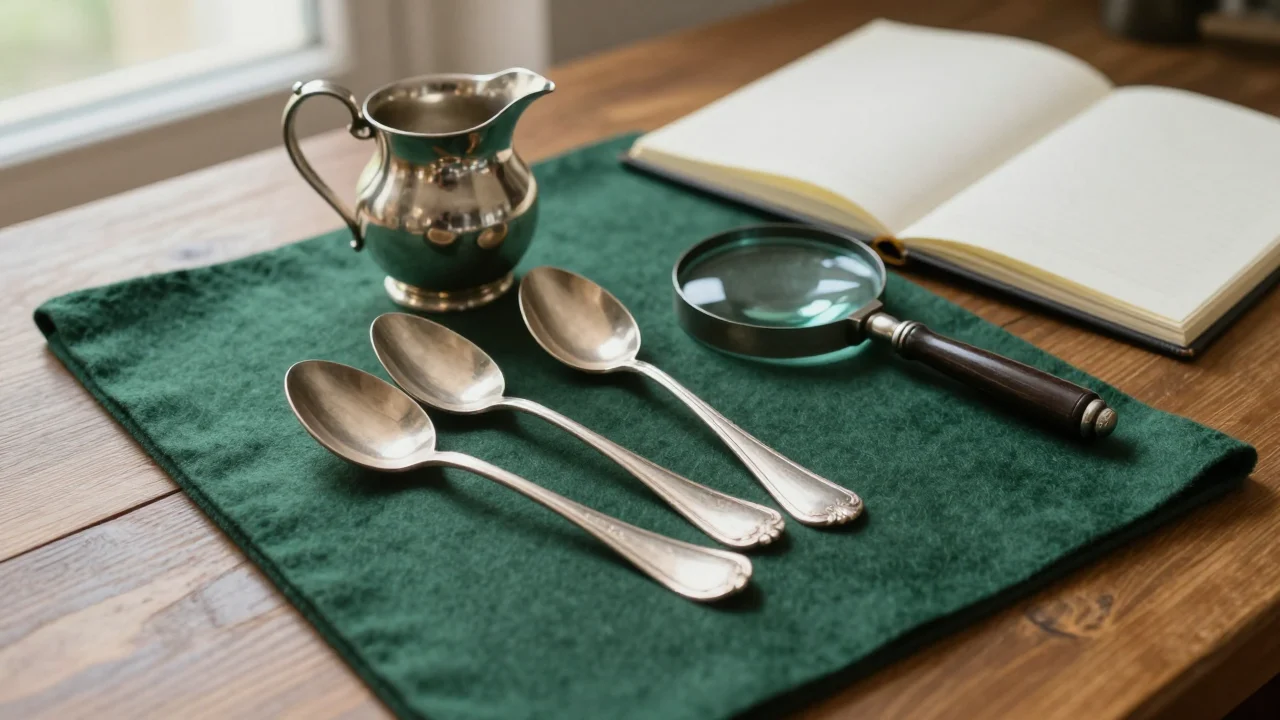
Authentic antique silver spoons are primarily valued by their hallmarks (look for “Sterling,” “925,” or the British Lion Passant), maker (such as Tiffany & Co. or Gorham), and pattern rarity. While common silver plate has minimal resale value, genuine sterling silver spoons often exceed their melt value if they feature desirable, intricate patterns like Francis I or Grand Baroque in excellent condition.
Imagine you are at a crowded estate sale in rural Pennsylvania. You’re digging through a cardboard box labeled “Kitchen Misc” when your fingers brush against a cold, heavily tarnished piece of cutlery. It feels heavier than the stainless steel next to it. You wipe away a century of grime to reveal an intricate floral design on the handle. Is this a $5 thrift store find, or a piece of history worth hundreds?
How can I tell if my silver spoon is solid or plated?
This is the first question every antique dealer asks. The difference in value is massive. Sterling silver is 92.5% pure silver, while silver plate is just a thin layer of silver over base metal (usually copper or nickel).
To identify it, you must find the hallmarks. On American spoons (post-1860), look for the word STERLING or the number 925 stamped on the back of the handle. If the piece is English, look for the Lion Passant (a walking lion), which guarantees sterling quality.
If you see marks like EPNS (Electro-Plated Nickel Silver), A1, or Quadruple Plate, the item is silver plate. These items generally have low fair market value unless they are rare, historical pieces in pristine condition.
A split image showing a spoon back stamped “STERLING” on the left and a spoon back stamped “EPNS” on the right, with a magnifying glass graphic highlighting the text.
Pro Tips for Identification:
Coin Silver: Before 1860, American silver was often made from melted coins (90% silver). Look for marks like COIN, PURE COIN, or just a maker’s name.
Assay Marks: British silver will have a city mark (e.g., an anchor for Birmingham) and a date letter, allowing for precise attribution to a specific year.
Weight Test: Sterling silver feels denser and heavier in the hand compared to plated ware.
Which antique silver patterns are worth the most money?
Not all sterling is created equal. In the collector market, the pattern dictates the demand. Simple, plain designs often sell for their scrap silver weight. However, heavy, ornate, repoussé designs (where the metal is hammered from the reverse side) command high premiums.
Top Collectible Patterns to Watch For:
Francis I by Reed & Barton: A very heavy, intricate fruit and floral design. Highly sought after.
Grand Baroque by Wallace: A three-dimensional design that looks beautiful from every angle.
Chrysanthemum by Tiffany & Co.: Extremely valuable due to the prestige of the maker and the complexity of the mold.
King’s Pattern: A classic double-struck pattern made by many silversmiths; value depends heavily on the specific maker and age.
A photo of three different antique silver spoons side-by-side: one plain, one with a simple floral edge, and one heavily ornate ‘Francis I’ style spoon to show the difference in complexity.
Identifying these marks manually can take hours. Using the Antique Identifier app, you can simply take a photo and get an instant result.
What affects the appraisal value of my spoon?
An appraisal isn’t just about the silver content. An expert looks at the total package.
Condition Report: Damage kills value. A spoon that has been caught in a garbage disposal (look for “chew marks” on the bowl) loses its collectible status and becomes scrap.
Monograms: Interestingly, monograms do not always lower value. An ornate, Victorian-era monogram can verify the age. However, removing a monogram is a form of restoration that can leave thin spots, which is a negative.
Definition: The details should be crisp. If the pattern is worn smooth from years of polishing, the value drops.
Close-up macro shot of a spoon bowl showing ‘disposal damage’ nicks on the edge versus a pristine spoon bowl rim.
Provenance: If you can prove the spoon belonged to a significant historical figure or estate, the auction estimate can skyrocket. Original receipts or family letters help establish this.
How do I spot a fake or altered spoon?
Forgery detection is a critical skill. Unscrupulous sellers may take a plain spoon and “clash” (press) a fake hallmark onto it to mimic a high-end maker like Paul Storr.
Red Flags: Pseudo-Hallmarks: Many 19th-century silver plate manufacturers used symbols that looked* like British hallmarks (a pseudo-lion or a star) to fool buyers. Always check for the standard assay marks.
Wear-Through: On silver plate, you might see a copper or yellowish tint showing through the high points of the design. This indicates the silver layer is gone.
Solder Repairs: Look closely where the bowl meets the handle. Discoloration here suggests a repair, which significantly lowers the replacement value.
A photo showing a silver-plated spoon where the silver has worn off the heel of the bowl, revealing a dull, brassy base metal underneath.
If you are unsure, avoid abrasive cleaning. Improper cleaning can ruin the patina that collectors love. Professional conservation is always preferred over aggressive polishing.
Finding a genuine sterling spoon in the wild is a thrill. Focus on the hallmarks first, then the condition. If it feels heavy, looks crisp, and bears the “Sterling” stamp, you likely have a winner. Happy hunting!
Authentic sterling silver almost always bears a .925 or Sterling hallmark, feels harder to the touch, and produces a high-pitched ring when tapped. Pewter, a softer alloy, marks easily, often displays a duller grey oxidation, and makes a flat ‘thud’ sound. Always check for specific touchmarks on the base to confirm the maker.
Still not sure what you’ve got? The Antiqly antique identifier app tells pewter from silver and estimates value from a photo.
Imagine you are at a crowded estate sale in rural Pennsylvania. You spot a tarnished grey tankard on a dusty shelf. It looks old, and it has the weight of history, but is it valuable sterling silver or just common pewter?
The price tag says $10, but the difference in fair market value could be hundreds—sometimes thousands—of dollars.
Collectors often make expensive mistakes here. Distinguishing these two metals is the first step in building a serious collection or finding a hidden gem for resale.
How can I tell if my item is Silver or Pewter by the markings?
The most reliable method for authentication is examining the marks. Silver is a precious metal and is strictly regulated; pewter is a base metal alloy (mostly tin) and follows different rules.
Sterling Silver produced in the US or UK will almost invariably have a hallmark. Look for the word “Sterling” or the number “925”. If the piece is English, look for the Lion Passant (a walking lion). These assay marks guarantee the metal content is 92.5% pure silver.
A side-by-side macro photo showing a crisp “.925” stamp on a silver spoon handle versus a larger, pictorial “touchmark” of an angel or shield on a pewter plate base
Pewter, on the other hand, utilizes “touchmarks.” These are often pictorial touchmark stamps—like an angel with wings, a rose and crown, or simply the maker’s name inside a serrated circle.
If you see a stamp that says “EPNS” (Electro Plated Nickel Silver) or “Quadruple Plate,” you are looking at silver plate, not solid silver. This has a much lower auction estimate than sterling.
Identifying these marks manually can take hours. Using the Antique Identifier app, you can simply take a photo and get an instant result.
If the marks are worn away—a common issue in a condition report for 18th-century pieces—you must rely on physical properties.
The Ring Test: Tap the edge of the item gently with your fingernail—ideally something like a tarnished silver bowl where resonance is easiest to hear.
Silver: Will produce a clear, bell-like ring that resonates for 1-2 seconds.
Pewter: Will produce a dull, dead “thud.” There is no resonance because the metal is softer and denser.
A photo of a hand gently tapping the rim of a silver bowl, with a visual sound wave graphic indicating resonance or vibration
The Hardness Test: Pewter is significantly softer than silver. If you examine a pewter tankard, you will often see many small dings, scratches, and dents. It feels somewhat “greasy” or soft to the thumb.
Sterling silver is harder. While it scratches, it doesn’t dent as easily as pewter. Be careful not to press too hard on soft pewter handles, or you might require professional restoration or conservation work later.
How does the patina differ between the two metals?
The color of the tarnish is often the quickest giveaway, before you even pick the piece up.
Silver tarnish (oxidation) ranges from yellow to deep purple and eventually black. However, underneath that tarnish, the metal is a brilliant, cool white. If you rub a small spot with a cloth, sterling silver shines up incredibly bright.
A photo of a half-polished spoon; the top half is dark black/purple tarnish, and the bottom half is a brilliant, mirror-like white silver
Pewter oxidizes to a dull matte grey finish. It resembles lead (and antique pewter often contained lead, so be careful). It rarely gets “black” the way silver does; it just gets darker grey and distinctively flat.
If you are examining handles or knobs, you might also find that the hardware tells a story about the item’s age. This technique is similar to what we cover in our guide on The Secret Language of Furniture Hardware: Dating Knobs and Pulls, where base metals often reveal the true age of a piece.
Yes, and this is specific to the US market. Before 1868, the US didn’t strictly use the Sterling standard. We used Coin Silver (90% silver), made from melted-down currency.
Coin silver items—like authentic coin silver spoon—are often marked “Pure Coin,” “Coin,” or simply with the retailer’s name and a city (e.g., “R&W Wilson Philada”).
Close-up photo of the back of a spoon handle stamped with the words “PURE COIN” or “DOLLAR” in a serif font
Do not mistake these for pewter just because they lack the “.925” mark. Coin silver has high provenance value and is highly sought after by collectors of early American Americana.
However, be wary of forgery detection. Unscrupulous sellers may stamp fresh marks on old pewter. If the mark looks too crisp on a piece that looks battered, proceed with caution.
Ready to put these tests into practice? Browse vintage pewter and silver collections on eBay to compare hallmarks, patinas, and touchmarks on real pieces before your next estate sale.
No. Modern pewter is mostly tin, usually 90% or more, hardened with small amounts of antimony and copper; older pewter could also contain lead. None of these alloys contain silver, so a piece stamped “pewter” has no silver value. Do not confuse Britannia metal, a hard pewter of tin, antimony and copper, with Britannia silver, a British silver standard of 95.8% marked with a seated figure of Britannia.
Does the magnet test work on pewter?
Only to rule out steel. Neither pewter nor silver is magnetic, so a magnet cannot tell them apart. If a magnet grabs the piece firmly, there is iron or steel underneath, which points to a plated item rather than pewter or solid silver.
Weight: silver is heavier for its size
Sterling silver has a density of about 10.4 g/cm³, while pewter is close to tin at about 7.3 g/cm³. Two pieces of the same size and shape therefore feel noticeably different: the silver one is heavier in the hand. Treat this as a comparison, not proof, because thickness and hollow construction change the weight as much as the metal does.
Hardness: pewter is softer
Pewter is softer than silver, which is why old pewter often shows dents, bent rims and rounded, worn edges. Tin, its main metal, rates about 1.5 on the Mohs scale, against roughly 2.5 to 3 for silver. Avoid scratch-testing a piece you care about: both metals mark easily, and a scratch lowers value.
On British silver, a walking lion means sterling, an anchor means the Birmingham Assay Office, and the date letter shows the year the piece was assayed.
Read the row as a set: the lion is a standard mark, the anchor is a town mark, and neither one dates the piece on its own. This guide explains each mark, the lions that are not the English sterling lion, and the anchors that are not Birmingham hallmarks. It draws on the assay offices’ own pages, museum catalogue records and published hallmark references, all read on 4 October 2026; no object was examined for it.
What a British hallmark row tells you
A British hallmark row is an official record of metal and fineness, struck after the piece was tested, not a maker’s logo. Assay Office London describes a hallmark as “a set of component marks applied to articles of the precious metals gold, silver, platinum or palladium” and says it “Means that the article has been independently tested”. The system is old: Wikipedia’s hallmark entry records that “In 1300, King Edward I of England enacted a statute requiring that all silver articles must meet the sterling silver standard”.
On antique British silver you will usually find four marks, often in a line on the back of a spoon handle or under a base:
Sponsor’s mark: initials in a shaped surround, for the person or firm that sent the piece for testing.
Standard mark: the metal standard, usually the lion for sterling.
Town mark: the assay office that tested it, such as the anchor for Birmingham.
Date letter: the year of marking, read against that office’s table.
A fifth mark, the sovereign’s head in profile, shows that duty was paid; the silver dictionary silvercollection.it notes “It was introduced in 1784 and lasted until 1890.” Modern marks differ. Assay Office London says of the number in parts per thousand: “This numerical format was made compulsory in 1999”. Our guide to antique marks and signatures shows how a hallmark row fits among other marks on an object.
What the lion passant means
A lion passant, a lion walking with one forepaw raised, is the English mark for sterling silver: 925 parts of silver in 1,000. silvercollection.it puts it this way: “The 925/1000 (sterling) silver fineness is certified in London and other British Assay Offices by the use of the” lion passant mark, and Wikipedia records that “In 1544 a lion passant was added to English marks”. On older pieces the lion’s head is turned to face you (passant guardant); on later ones the lion looks ahead in profile. Both are the sterling lion, and neither tells you a year by itself.
Britannia silver is the higher standard. The Britannia silver entry explains that “This standard was introduced in England in 1697” to replace sterling for wrought plate, that the sterling lion was replaced with “the figure of a woman commonly called Britannia”, and that London’s town mark became a “lion’s head erased” (a lion’s head cut off at the neck). It adds that “sterling silver was again authorised for use by silversmiths from 1 June 1720”, and that since 1999 “Britannia silver has been denoted by the millesimal fineness hallmark 958”. So a Britannia figure on its own does not mean a piece is from 1697 to 1720; read the date letter too. Our guide to what 925 means on silver covers the number marks used today.
No lion at all is a warning sign on British-style marks. Platers copied the look of hallmarks: silvercollection.it notes that “The marks of electroplated silver were often inspired to the hallmarking used for sterling silver.” A row of small symbols with EPNS, A1 or a maker’s trade name usually means plate; see what EPNS means on silver, the A1, Triple Plate and IS marks guide and our sterling versus plate tests.
Lions that are not the English sterling lion
A lion standing upright on its hind legs, a lion rampant, is a Scottish standard mark, not the English sterling lion. silvercollection.it notes that “Different standard marks are used in Scotland”: its mark list gives “thistle mark (Edinburgh)” and “lion rampant mark (Glasgow and Edinburgh from 1975)”. If your piece shows a lion rampant beside a castle, read it against Scottish tables, not English ones; Glasgow’s own town mark was the “tree, fish and bell”.
A walking lion beside an anchor and a letter G is usually American, not British. Hillwood Estate, Museum and Gardens catalogues a Gorham hand mirror, made in the USA in 1919 to 1920, with the marks “walking lion, anchor, Gothic G for Gorham, STERLING“. That row is the Gorham company’s trademark; it has no British town mark or date letter. Our American silver hallmarks guide covers Gorham and other American marks.
British-looking rows also appear on colonial silver that was never assayed in Britain. silvercollection.it’s note on duty dodgers and pseudo hallmarks explains that “Local silversmiths used to identify their works with series of symbols imitating the English hallmarks”, marks “with no official value and are commonly called” pseudo hallmarks.
What the anchor means on silver
An anchor in a British hallmark row is the town mark of the Birmingham Assay Office, which has used it since the office was founded. The Birmingham Assay Office entry records that “The Birmingham Assay Office opened on 31 August 1773”. It also repeats a story that the symbol came from the Crown and Anchor Tavern on the Strand, where the Birmingham and Sheffield delegations met, and that “It is said that the choice of symbol was made on the toss of a coin”. Treat the coin toss as tradition.
Read the anchor with its neighbours: a lion passant beside it means Birmingham sterling, and the letter beside it must be dated from a Birmingham table. Modern anchors need one more check. The same entry notes that “The anchor mark no longer indicates that an item was assayed in Birmingham”, because “In July 2016 Birmingham Assay Office began striking its hallmark via a subsidiary in Mumbai, India.” Our full Birmingham anchor hallmark guide covers the office’s history, its gold marks and its import marks.
Quick reference: lions, anchors and town marks
The table below sums up the lions, anchors and town marks you are most likely to meet on antique British silver, and what to check before you rely on each one.
Mark
What it tells you
Check before you rely on it
Lion passant (walking)
English sterling standard
It gives no year by itself
Britannia figure
Britannia standard, higher than sterling
Optional after 1720, so read the date letter
Lion rampant
Scottish sterling standard mark
Use Scottish date tables
Thistle
Edinburgh standard mark
Used with the Edinburgh castle
Anchor
Birmingham Assay Office
Modern anchors may be struck overseas
Leopard’s head
London Assay Office
Crowned until 1820, uncrowned from 1821
Crown
Sheffield, on silver until 1973
A rose on silver is a later Sheffield mark
Lion, anchor and G
Gorham, an American maker
Not a British hallmark
The London dates come from silvercollection.it’s mark list (“London leopard’s head crowned (until 1820)”, “London leopard’s head uncrowned (1821-present)”), which also gives Chester as “a sword erect between three wheat-sheaves (1784-1962)”. The Sheffield row comes from the Sheffield Assay Office itself: “The Crown was used by Sheffield Assay Office to mark silver from 1773 until 1973”, after which it “began to use the Rose for both silver and gold”.
How to date British silver from the date letter
The date letter records the year a piece was assayed and marked, not necessarily the year it was made, and it can only be read against the table of the office that struck it. silvercollection.it explains that “Series of alphabetical letters were chosen to indicate the year of assaying”, and that “Any Assay Office adopted its own cycle of date letters so that only from the 1975 the four surviving Assay Offices use a uniform system of dating”. The same capital letter therefore means different years in London, Birmingham, Sheffield or Edinburgh.
Older letters also straddle two calendar years. In London the letter began as the mark of the Assay Master, “who was sworn in every May”, so a letter covers parts of two years. Today Assay Office London says “A non-compulsory mark, the date letter changes annually on January 1st.” and that “The font, case, and shield shape all change so each can only indicate one specific year.”
To date a piece, find the town mark first, then match the letter’s case, typeface and the shape of its shield in that office’s table. Our date letter guide holds the letter tables. A modern piece with no letter is not necessarily damaged: since 1999, according to Wikipedia, “the date letter is no longer a compulsory part of the hallmark”.
The initials in a shaped surround are the sponsor’s mark, which names whoever registered the mark and sent the piece for testing: often the maker, but not always. Assay Office London says that although it is often called a maker’s mark, “its purpose has always been to establish responsibility rather than identify the manufacturer”. The Sheffield Assay Office adds that the mark “will only tell you who registered the mark and submitted the item to be tested and hallmarked” and that this is not always the manufacturer.
Initials alone are not an attribution. Sheffield explains that “The font or typeface of the initials and the particular shape of the surround are what distinguish” one sponsor’s mark from another, so two firms with the same initials can have different marks. Compare the whole mark, including its outline, with a published register or the office’s own records before you put a famous name on a piece. Our teapot identification guide shows where English silver marks sit on hollowware.
How to spot transposed and fake hallmarks
The fake that matters most on British silver is a genuine set of marks moved from another piece, so check that the marks belong to the object they are on. Historically, this was done to avoid tax. The Victoria and Albert Museum’s record of a Paul de Lamerie ewer explains that “English silver was taxed by weight after 1720”, and that “marks were sometimes cut out from smaller, lighter pieces and added to avoid them going through the assay office”. On that ewer, “In 1944 the transposed marks for this piece were removed and the ewer was re-marked.” Such pieces are called duty dodgers.
Moving marks is still an offence. Section 6 of the Hallmarking Act 1973 covers anyone who “removes any mark from an article of precious metal with intent to transpose it to any other article”, and anyone who “with intent to defraud or deceive, makes a counterfeit of any die or mark”.
Look closely at the area around the marks. silvercollection.it notes that sometimes “a line of deeper colour appears around the transposed hallmarks”, because the solder holds less silver than the surrounding metal. Check that the style of the piece fits the date letter, that the marks sit where that kind of object was normally marked, and that they are not oddly crisp or oddly worn compared with the rest of the surface. Our guide to red flags on fake silver hallmarks lists more checks. If a piece matters, ask a specialist dealer or an assay office to examine it.
Marks that mean silver plate, not sterling
A genuine British hallmark row on sterling includes a standard mark such as the lion passant. Silver-plated wares are not hallmarked, so they carry trade marks instead: letters such as EPNS (electroplated nickel silver), EPBM (electroplated Britannia metal) or EP, quality grades such as “A1”, and the maker’s own name or symbols. Many platers set small marks in a row so that they look like hallmarks at a glance. If a row has no lion, no town mark and no date letter, treat the piece as plate until proven otherwise.
What to do with your marked silver now
Work through the row in this order, and stop when you have what you need.
Photograph every mark. Light the marks from the side and photograph the whole row before you clean or polish the piece.
Name the standard and the office. Decide whether the lion is walking (English sterling), standing (Scottish) or part of a lion, anchor and G row (Gorham), then identify the town mark.
Date it from the right table. Match the date letter in that office’s table, and check that the marks look original to the object before you rely on the year.
Method and limits. This article draws on Assay Office London’s and Sheffield Assay Office’s own pages, reference entries on hallmarks, the Birmingham Assay Office and Britannia silver, the silvercollection.it silver dictionary, a Victoria and Albert Museum catalogue record, a Hillwood museum catalogue record, the Hallmarking Act 1973 and the two app store listings linked above, all read on 4 October 2026. No object was examined and no app was tested for it. A hallmark reading identifies the standard, office and marking year of the row in front of you; it does not prove that the row is original to the object.
Sterling silver is an alloy containing at least 92.5% pure silver, distinguishable by marks like “925,” “Sterling,” or the British Lion Passant assay marks. Silver plate consists of a thin layer of silver over base metal (usually copper or nickel), often marked “EPNS” or “IS.” The “Ice Cube” test works because silver possesses the highest thermal conductivity of any metal, causing ice to melt immediately upon contact.
Imagine you are at a crowded estate sale in rural Pennsylvania. You spot a tarnished, heavy fork in a box labeled “Kitchen Junk, $1.” Your heart races. Is it a lost treasure worth hundreds, or just a piece of flatware worth pennies?
To the untrained eye, they look identical. But as an antique dealer for over two decades, I know that weight, temperature, and tiny stamps tell the real story.
How can I visually tell the difference immediately?
The fastest way to distinguish sterling silver from silver plate is to look for the “bleed.”
On silver-plated items, the thin layer of silver eventually wears off at high points. Check the heel of a spoon or the tines of a fork. Do you see a yellowish or reddish tint coming through?
That is the base metal, usually brass or copper, showing through the plating. Sterling silver is solid silver alloy throughout; it will never change color, no matter how much it wears down.
Close-up macro shot of the back of a silver-plated spoon bowl showing the “heel” where the silver has worn away to reveal a brassy/yellowish base metal underneath
What is the “Ice Cube Test” and how does it work?
This is my favorite parlor trick for authentication. It requires no special tools, just an ice cube.
Silver has higher thermal conductivity than almost any other material. If you place an ice cube on a real sterling silver coin or spoon, it will begin to melt instantly, as if you placed it on a hot griddle.
You will see a puddle of water form within seconds. On silver plate or stainless steel, the ice will sit there and melt slowly at room temperature.
This test is excellent for spotting forgeries or determining if a piece without marks might be coin silver (90% silver, common in early American antiques).
Where do I look for hallmarks and stamps?
Hallmarks are your road map to attribution. On flatware (spoons, forks), look on the back of the handle. On hollowware (teapots, bowls), check the underside of the base.
If you see “925,” “Sterling,” or a walking lion (Lion Passant), you have a winner. This guarantees the metal content.
Detailed photo of the back of a fork handle clearly showing the stamped word “STERLING” next to a maker’s mark like the Gorham anchor
Identifying these marks manually can take hours. Using the Antique Identifier app, you can simply take a photo and get an instant result.
If you see “EPNS” (Electro-Plated Nickel Silver), “EP,” or “A1,” it is plated. These items generally have little melt value, though they may still have fair market value as decor.
Specific maker marks can also help. For example, understanding English marks is crucial for accurate appraisal. This technique is similar to what we cover in our guide on Antique Teapot Identification: Finding English Silver and Ceramic Marks, where specific city marks determine the year of manufacture.
Can I use a magnet to test for silver?
Yes, and you should always carry a strong neodymium magnet to every auction house preview.
Silver is non-magnetic. If the magnet sticks strongly to the object, it is steel or iron, likely just silver-plated.
However, be careful: brass and copper are also non-magnetic. A magnet test is good for weeding out steel fakes, but it does not prove an item is sterling silver. It just proves it isn’t steel.
A hand holding a small rare-earth magnet near a silver teapot; the magnet should not be sticking to the metal
What determines the value of my silver item?
Value depends on three things: metal content, maker, and condition.
1. Melt Value: This is the raw price of the silver scrap. An auction estimate usually starts here. 2. Collector Market: A rare piece by Tiffany & Co. or Paul Revere is worth far more than its weight. 3. Condition Report: Dents, deep scratches, or monogram removals lower value.
Replacement value for insurance is usually much higher than what you would get selling it. Be realistic. A condition report noting heavy wear or repairs will significantly drop the price.
Should I clean the patina off my find?
Stop! Before you grab the polish, understand conservation.
“Patina” is the soft, warm glow that silver develops over tiny scratches and years of use. It is highly prized in the collector market.
Aggressive cleaning strips this away. Never use chemical dips on hollowware, as the liquid can seep into hollow handles and cause damage.
If you suspect restoration is needed, consult a professional. Over-cleaning can turn a $500 spoon into a $50 scrap piece.
Split image showing a heavily tarnished black silver spoon on the left and a gently hand-polished, glowing spoon on the right, demonstrating proper conservation
Whether you are hunting for sterling silver at a thrift store or evaluating an heirloom for provenance, trust your eyes and your tools. The ice cube doesn’t lie.
Authentic English antique teapots are identified by examining the base for specific hallmarks or backstamps. For silver, look for the Lion Passant (guaranteeing .925 sterling silver) and date letters. For ceramics, inspect the backstamp for maker names like Wedgwood or Spode, often accompanied by a Registry Diamond (used 1842–1883) to pinpoint the exact manufacturing date.
Imagine you are at a dusty estate sale in rural Pennsylvania, digging through a box of kitchenware. You pull out a tarnished, heavy pot. It looks old, but is it valuable sterling silver or just common silver plate?
Knowing where to look changes a $5 find into a $500 treasure.
Teapots are among the most common antiques on the market. The difference between a reproduction and a museum-quality piece often comes down to a mark smaller than a grain of rice. Here is how to spot the real deal.
How can I tell if my silver teapot is solid silver or plated?
This is the most common question I get at the auction house. In English silver, the answer is strictly regulated.
You must look for the Lion Passant. This is a tiny image of a lion walking to the left with its right paw raised. If you see this, you have sterling silver (.925 purity).
If you do not see a lion, check for the letters EPNS (Electro-Plated Nickel Silver). This means the item is base metal with a thin layer of silver.
Coin silver (90% silver) was common in the US before 1868 but rarely used for English teapots.
Macro photography of British silver hallmarks showing the Lion Passant, a Leopard’s Head, and a date letter on the underside of a silver teapot
You should also look for the assay marks. These tell you the city where the silver was tested.
Leopard’s Head: London
Anchor: Birmingham
Crown: Sheffield
Identifying these marks manually can take hours. Using the Antique Identifier app, you can simply take a photo and get an instant result.
Where do I find the maker’s mark on a ceramic teapot?
Ceramic attribution is slightly different from silver. You need to flip the teapot over and look for the maker’s mark or “backstamp.”
Early English pottery (pre-1800) often has no mark. However, 19th-century giants like Wedgwood, Minton, and Spode were proud of their work.
They used impressed marks (stamped into soft clay) or printed marks (under the glaze).
Close-up of a blue printed underglaze maker’s mark on the bottom of a white ceramic teapot, specifically a Spode or Wedgwood logo
If the mark says “Bone China” or “Made in England,” the piece likely dates to the 20th century. Older pieces will simply say “England” (post-1891) or have no country name at all.
Pro Tip: Run your finger over the mark. An impressed mark feels indented; an overglaze mark feels like a slight bump.
What do the symbols and numbers mean on the bottom?
English ceramics often feature a diamond-shaped mark known as the Registry Diamond.
Used between 1842 and 1883, this symbol is the key to precise dating. It contains codes for the year, month, and day the design was registered.
You might also see a handwritten or painted number. This is usually the pattern number.
While pattern numbers help with identification, they don’t always guarantee provenance. This logical process of decoding numbers is similar to what we cover in our guide on Antique Writing Desks: How to Identify Secret Compartments and Value, where hidden mechanisms provide clues to age.
Diagram of a Victorian Registry Diamond mark explaining what the letters and numbers in the corners represent for dating
Beware of “red flags” in forgery detection. If the mark looks blurry or is applied over the glaze where it should be under, proceed with caution.
How does condition affect the value of an antique teapot?
A condition report is critical for determining fair market value.
For ceramic teapots, the spout and lid are the most vulnerable areas. Run your finger along the rim of the spout. Even a “flea bite” chip can lower the value by 30%.
Check for “crazing” (a network of fine cracks in the glaze). While common, heavy staining in the crazing is a negative.
Photo showing a ceramic teapot spout with a small chip and hairline crack, highlighting damage types
Restoration is acceptable for rare 18th-century pieces but hurts the value of later Victorian items.
Shine a blacklight on the pottery. Modern glue or paint used in conservation repairs will fluoresce (glow) under UV light.
What is my antique teapot worth in today’s market?
The collector market fluctuates. Currently, early transfer-ware and Sterling Silver tea sets by renowned makers (like Paul Storr or Hester Bateman) command high prices.
An auction estimate for a standard Victorian silver-plate teapot might be $30–$50.
However, a Georgian sterling silver teapot could easily fetch an appraisal of $1,500 to $3,000 depending on the weight and maker.
Replacement value (for insurance) is generally higher than what you would get selling it to an antique dealer.
Always check recent sold listings, not asking prices, to gauge reality.
Whether you are looking for investment grade silver or just a beautiful piece of history for your kitchen, knowledge is your best tool. Keep an eye out for those hallmarks.
That tiny stamp on your silver candlestick holds centuries of information, if you know how to read it. Silver hallmarks are one of the oldest and most reliable marking systems in the antique world, dating back over 700 years in Britain alone.
Rather not match marks by hand? The Antiqly antique identifier app reads silver hallmarks from a photo and returns the maker, date, and value range.
Understanding silver hallmarks transforms you from a casual observer to an informed collector. These small marks tell you exactly when a piece was made, where it was assayed, who made it, and whether it’s genuine sterling or merely silverplate. This comprehensive guide will teach you to decode silver hallmarks like a professional.
Why Silver Hallmarks Matter
Silver hallmarks are uniquely valuable because:
Legal Requirement: Unlike pottery marks, silver hallmarks were legally mandated in many countries. This means genuine antique silver SHOULD be marked.
Precise Dating: The hallmark system allows dating to the exact year in many cases.
Authentication: Proper hallmarks help distinguish sterling from plate, genuine from fake.
Origin Identification: Marks reveal country, city, and often the specific silversmith.
Value Impact: Properly hallmarked silver from notable makers commands significant premiums.
Understanding Silver Purity
Before examining hallmarks, understand what they’re certifying:
Silver Standards
Standard
Purity
Common Names
Britannia
95.8%
.958, Britannia silver
Sterling
92.5%
.925, Sterling silver
European
80-90%
.800, .830, .835, .900
Coin
90%
.900, Coin silver
German
80%
.800, German silver (note: “German silver” can also mean nickel silver with NO silver)
Important: “German silver,” “nickel silver,” and “alpaca” contain NO actual silver. They’re copper-nickel alloys.
British Silver Hallmarks
Britain has the oldest and most comprehensive hallmarking system, dating from 1300.
The Five Standard Marks
A complete British hallmark contains up to five marks:
Start with the Antique Identifier app for instant AI-powered identification. Then cross-reference with hallmark guides. For valuable pieces, consult auction house specialists.
What does 925 mean on silver?
925 indicates sterling silver, or 92.5% pure silver. This is the standard for quality silver in most countries.
How can I tell if silver is real or plated?
Look for marks: “STERLING” or “925” indicates solid silver. “EPNS,” “EP,” or “A1” indicates silverplate. Weight is also a clue: sterling is heavier than plate for similar items.
Are unmarked pieces silver?
Possibly. Very old pieces, provincial pieces, or heavily worn pieces may lack visible marks. Professional testing (acid test, XRF) can determine silver content.
Why do British pieces have so many marks?
British law required multiple marks: maker’s mark, standard mark (purity), assay office mark (location), and date letter (year). Duty marks were also required 1784-1890.
Conclusion
Silver hallmarks are your key to unlocking the history, origin, and value of antique silver. The British system offers precise dating to the exact year; American marks identify makers and eras; Continental marks reveal origin and quality.
While mastering all hallmark systems takes time, understanding the basics transforms your ability to evaluate silver. Start with the fundamentals (sterling vs. plate, major assay marks, the concept of date letters) and build from there.
Use technology like the Antique Identifier app to accelerate your learning, and remember that hallmarks are evidence to be evaluated alongside style, weight, construction, and condition.
That mysterious stamp on the bottom of your antique could be the key to unlocking its history, origin, and value. Antique marks and symbols are like fingerprints. They tell you who made an item, where it came from, and often when it was produced.
But decoding these marks can feel like learning a foreign language. Strange symbols, faded stamps, and cryptic initials leave many collectors scratching their heads. This comprehensive guide will teach you how to identify and interpret the most common antique marks and symbols, transforming confusing scratches into valuable information.
Why Antique Marks Matter
Understanding marks can dramatically impact your antique experience:
Authentication: Marks help verify an item is genuine, not a reproduction Dating: Many marking systems indicate specific production dates Origin: Marks reveal country, region, and often specific factory Maker Attribution: Identify the craftsman or company behind the piece Value Impact: Correct attribution can multiply value by 10x or more
A piece of porcelain marked “Meissen” with authentic crossed swords is worth exponentially more than an unmarked piece of similar quality. Marks matter.
Where to Find Marks
Before identifying marks, you need to find them. Here’s where to look:
Ceramics and Pottery
Bottom/base (most common)
Inside foot rim
Inside lid
Back of figurines
Hidden surfaces
Furniture
Inside or underneath drawers
Back of case pieces
Under tabletops
On bed rails
Inside cabinet doors
Around locks and hinges
Silver and Metalware
Bottom or base
Inside rim
On handles
Near hinges
On removable parts
Glass
Base/bottom (pontil area)
Inside foot
On applied elements
Molded into glass
Jewelry
Inside rings (shank)
On clasps
Back of pendants
On pin stems
Jump ring attachments
Pro Tip: Use the Antique Identifier app to photograph marks and get instant identification. The AI can recognize thousands of maker’s marks from your photos.
Types of Antique Marks
Marks fall into several categories, each providing different information:
1. Maker’s Marks
Identify who made the item:
Factory Marks: Symbols or names identifying the manufacturer
Wedgwood (impressed “WEDGWOOD”)
Meissen (crossed swords)
Royal Copenhagen (three wavy lines)
Craftsman Marks: Individual maker signatures
Silversmith initials
Furniture maker stamps
Artist signatures on pottery
Designer Marks: Creator of the design (may differ from manufacturer)
2. Date Marks
Indicate when an item was made:
Date Letters: Letters cycling through alphabets by year
English silver hallmarks
Some pottery marks
Date Codes: Numbers or symbols indicating year
Patent dates
Registration marks
Reign Marks: Chinese porcelain emperor marks
3. Origin Marks
Show where an item was made:
Country Marks: Required by import laws
“Made in England”
“France”
“Nippon” (Japan)
City/Region Marks: Specific location
Assay office marks on silver
Regional pottery marks
4. Quality Marks
Indicate material or quality standards:
Precious Metal Marks:
Sterling (925)
Gold karats (14K, 18K)
Platinum (PT, PLAT)
Porcelain Quality:
First quality vs. seconds
Decorator marks
5. Registration/Patent Marks
Legal protection markings:
British Registration Diamond: 1842-1883 Registration Numbers: 1884 onwards Patent Numbers: With searchable dates
Ceramic and Pottery Marks Guide
Ceramics have the most elaborate marking systems. Here’s how to decode them:
English Pottery Marks
Wedgwood
“WEDGWOOD” impressed (not “Wedgewood”, that’s a fake)
Start with AI tools like the Antique Identifier app for instant identification. Then cross-reference with mark dictionaries and online databases. For valuable items, consult specialists.
Can marks be faked?
Yes. Valuable maker’s marks are frequently forged. Always evaluate marks alongside other evidence: appropriate style, construction methods, materials, and wear patterns. If only the mark suggests high value but other factors don’t match, be suspicious.
What if my antique has no marks?
Many genuine antiques are unmarked. This doesn’t mean they’re not valuable or authentic. Use style, construction, materials, and provenance to identify and value unmarked pieces.
Are items marked “Made in China” antiques?
Items marked “Made in China” (or PRC) are typically post-1949 and usually modern. However, pieces marked with reign marks or exported before modern marking laws may be genuinely antique. Context matters.
Why do some marks look worn or partial?
Age, use, cleaning, and handling wear marks over time. Partial marks still provide information. Very crisp, clear marks on supposedly old pieces might actually indicate reproductions.
Conclusion
Antique marks and symbols are powerful tools for identification, dating, and valuation. While mastering all marking systems takes years, understanding the basics transforms your ability to evaluate antiques.
Start with the categories most relevant to your interests, use technology like the Antique Identifier app to accelerate your learning, and always remember that marks are one piece of evidence among many. The best identifications combine mark knowledge with understanding of styles, construction, and materials.