Authentic Gorham silver is identified by the standard Lion, Anchor, and G trademark found on the underside of sterling pieces. Items manufactured between 1868 and 1884 bear a capital letter date code (A-Q), while pieces from 1885 to 1933 feature specific year symbols, such as a wolf or an anchor. Always verify the “Sterling” stamp to confirm 92.5% purity.
Imagine you are at a dusty estate sale in Providence, Rhode Island.
You are digging through a box of mixed cutlery when the glint of a heavy, tarnished fork catches your eye. It feels substantial in your hand—heavier than the stainless steel next to it. You flip it over and see three tiny symbols: a lion, an anchor, and a capital G.
Congratulations. You might have just found a piece of American history from the Gorham Manufacturing Company, one of the most influential silversmiths of the 19th and 20th centuries.
But finding the mark is just the beginning. To determine the fair market value and age, you need to decode exactly what those symbols mean.
What Are the Standard Gorham Silver Trademarks?
For most collectors, the “holy trinity” of Gorham identification is the Lion, Anchor, and G.
This trademark was adopted in the late 19th century to signify sterling silver quality (925/1000 parts silver).
Lion: Represents the English lion passant, symbolizing sterling quality.
Anchor: Represents Rhode Island (where Gorham was founded in 1831).
G: Stands for Gorham.
If you see these three marks together, you are almost certainly looking at a solid silver piece, not silver plate. However, earlier pieces from the “Coin Silver” era (before 1868) may only be marked “Coin” or have simple pseudohallmarks.
Macro photography shot of the back of a silver spoon handle clearly showing the indented Lion, Anchor, and capital G marks in a horizontal row.
How Can I Date My Gorham Piece Using Codes?
One of the best things about collecting Gorham is their precise dating system. Unlike many other American manufacturers who left us guessing, Gorham used specific codes for decades.
1868 to 1884: The Letter System During this period, Gorham used capital letters A through Q to denote the year. For example:
A = 1868
B = 1869
Q = 1884
1885 to 1933: The Symbol System This is where it gets fun—and tricky. After running out of letters, Gorham switched to small pictorial symbols.
1885: A Wolf’s Head
1886: A Ship
1900: A Sickle
Identifying these marks manually can take hours of cross-referencing charts. Using the Antique Identifier app, you can simply take a photo and get an instant result.
A split graphic showing a chart of Gorham date symbols (like the wolf, ship, and sickle) alongside a photo of a silver pitcher base with a visible date symbol stamped into it.
Is My Item Sterling Silver or Silver Plate?
This is the most critical question for determining replacement value.
Sterling Silver Look for the word “Sterling” stamped near the hallmarks. This guarantees the metal is 92.5% pure silver. This standard was legally adopted by Gorham in 1868.
Silver Plate (Electroplate) If you see marks like “EP”, “Electroplate”, or “Gorham Electro Plate”, the item is made of a base metal (usually copper or nickel) coated in a thin layer of silver.
Be careful with “GM Co” marks found on silver soldered pieces; these are often high-quality plate used in hotels, but they lack the intrinsic bullion value of sterling.
Side-by-side comparison photo. Left: “Sterling” stamp on a fork. Right: “EP” or “Electroplate” stamp on a serving platter, showing slight wear-through to the base metal.
What Are Martelé and Athenic Lines?
If you are lucky enough to find a piece marked Martelé (French for “hammered”), you have struck gold—or rather, high-grade silver.
Produced around the turn of the 20th century (approx. 1897-1912), the Martelé line represents the pinnacle of the Art Nouveau style.
Purity: These pieces often have a higher silver content (.950 or .9584) than standard sterling to make the metal softer for hand-hammering.
Attribution: Each piece was handmade and unique.
Value: Auction estimates for Martelé often run into the thousands or tens of thousands.
Athenic is another rare line, combining sterling silver with other materials like copper or wood, reflecting the Arts and Crafts movement.
A stunning, organic-shaped Art Nouveau silver vase with the word “Martelé” clearly scripted on the base, showing the hand-hammered texture.
How Does Condition Affect the Value?
In my 20 years of appraising, I have seen beautiful pieces ruined by improper cleaning.
Provenance (the history of ownership) adds value, but condition dictates the price.
Polishing: Never over-polish. The “patina” (the soft glow from tiny scratches over time) is desirable.
Monograms: Contrary to popular belief, monograms do not always kill value. On early or rare pieces, they are part of the history.
Damage: Dents, heavy scratches, or salt pitting (black spots that eat into the metal) will lower the auction estimate.
If you suspect you have a high-value item, consult a professional for a condition report before attempting any restoration or conservation yourself. Improper removal of tarnish can strip the detail right off the assay marks.
Identifying Gorham silver is a journey through American manufacturing history. By learning to spot the Lion-Anchor-G, decoding the date symbols, and assessing the condition, you can confidently separate treasure from trinkets at your next estate sale.
Authentic Tiffany & Co. silver is identified by the standard “TIFFANY & CO.” mark, followed by “STERLING” or the purity standard “925-1000”. The key to dating these pieces lies in the single letter stamped alongside the maker’s mark: an Old English “M” indicates the Edward Moore era (1873–1891), while a simple “C” points to the Charles T. Cook directorship (1902–1907).
Imagine you are at a crowded estate sale in wealthy Greenwich, Connecticut. You are digging through a box of tarnished kitchenware when your fingers brush against a heavy, cold serving spoon. It feels substantial—heavier than the plated junk next to it. You flip it over, rubbing the grime off the back of the handle, and see a tiny line of text. Is it real Tiffany silver, or a clever reproduction?
Finding genuine Tiffany silver in the wild is the holy grail for pickers. But you need to know exactly what you are looking at before you pay up.
How Can I Read the Tiffany Silver Date Letters?
Tiffany & Co. used a unique system of “directorship letters” that allows us to date pieces with incredible precision. Unlike English hallmarks or assay marks which change annually, Tiffany’s marks changed when the company president changed.
Close-up macro photograph of the underside of a Tiffany silver spoon showing the ‘TIFFANY & CO STERLING’ stamp and a distinct Old English ‘M’ letter mark
Here is the cheat sheet I use for quick attribution in the field:
No Letter (Pre-1854): Very rare. Usually marked “Tiffany, Young & Ellis.”
Old English “M” (1870–1891): The Edward Moore era. This is often the most desirable period for Art Nouveau and Japonesque designs.
“T” (1891–1902): The Charles L. Tiffany era.
“C” (1902–1907): Charles T. Cook.
Script “m” (1907–1947): John C. Moore II. This covers a massive range of production.
If you see these marks, you are likely looking at sterling silver (92.5% purity).
Is My Item Solid Sterling or Silver Plate?
This is the most common mistake beginners make. Tiffany did make silver plate, and they marked it clearly.
If the piece says “Tiffany & Co. Makers Silver-Soldered” or “EP” (Electroplate), it is plated. While these still have some fair market value due to the brand name, they are nowhere near the value of solid sterling.
A condition report on plated items is critical—if the copper or base metal is showing through (known as “bleeding”), the value drops significantly.
Identifying these marks manually, especially on worn pieces, can take hours of cross-referencing. Using the Antique Identifier app, you can simply take a photo and get an instant result.
What Are the Most Valuable Tiffany Patterns?
Not all Tiffany silver is created equal. While a plain “English King” fork is valuable for its silver weight, the elaborate, multi-motif patterns fetch high auction estimates.
A flat lay comparison of three Tiffany spoons: one ‘Chrysanthemum’ pattern, one ‘Olympian’ pattern, and one plain ‘Flemish’ pattern to show intricate detail differences
Collectors go crazy for:
Chrysanthemum (1880): Deep, baroque floral casting. Very heavy.
Olympian (1878): Features scenes from Greek mythology. Each utensil size often has a different scene.
Audubon (1871/Restored): Features intricate birds and flowers in a Japonesque style.
If you find a piece of holloware (bowls, teapots) that mixes silver with other materials, you might have something from the Tiffany Studios era, overseen by Louis Comfort Tiffany. While he is famous for Favrile glass, his influence extended to mixed-metal silver items that are worth a fortune today.
How Do I Spot a Fake Tiffany Stamp?
Forgery detection is a necessary skill. Fake stamps often look “mushy.”
Genuine Tiffany die-stamps are crisp, deep, and perfectly aligned. The letters should have sharp serifs.
Split screen image showing a ‘Real’ sharp Tiffany hallmark vs a ‘Fake’ uneven, shallow cast mark on a spoon handle
Beware of “fantasy marks.” I once saw a piece marked “Tiffany Sheffield.” This is a dead giveaway. Tiffany is an American company; “Sheffield” implies English plate.
Also, look for casting seams. Authentic Tiffany handles were often die-struck or forged, meaning they are smooth. If you see a faint line running down the side of a fork handle, it might be a cast copy made from a mold of an original. This is a common reproduction technique. This technique is similar to what we cover in our guide on Detecting Reproductions: How to Tell New Wood from 100-Year-Old Patina, where signs of modern manufacturing betray an object’s age.
Does Condition Affect the Value?
Yes, but rarely attempt restoration yourself.
Polishing sterling silver is fine, but removing tarnish from the deep crevices of a pattern like ‘Chrysanthemum’ destroys the “patina”—the darkness that highlights the design.
A Tiffany silver tea set showing ‘good’ tarnish in the crevices vs a piece that has been over-polished and looks flat and white
Monograms are tricky. In the US market, a monogram generally lowers the replacement value by 10-20% because modern buyers don’t want someone else’s initials. However, if the monogram is from a famous family (provenance), it adds value.
Never put antique silver in a dishwasher. It can turn the silver white and brittle, requiring expensive conservation to fix.
Finding Tiffany silver is a thrill, but authentication requires a sharp eye. Look for the “Sterling” promise, verify the directorship letter to date the piece, and always check the quality of the casting. If the price is too good to be true, and the mark looks blurry, walk away. Happy hunting!
Authentic American silver can be identified by locating specific maker’s trademarks (like Gorham’s lion-anchor-G or Tiffany & Co.’s strict block lettering) and verifying the metal purity stamp. Unlike British silver, which uses a date letter system, American pieces typically feature the word STERLING or the number 925 (for 92.5% purity) stamped directly on the base or handle, standard after 1868.
Imagine you are at a dusty estate sale in Virginia. You pick up a heavy, tarnished serving spoon. It feels substantial in your hand, cool to the touch. You turn it over, squinting at the tiny, worn impressions on the back of the handle.
Is it a $5 silver-plated piece of junk, or a rare $500 coin silver treasure from the 1840s? The difference lies entirely in decoding those tiny symbols.
A close-up macro shot of the back of an antique silver spoon handle, showing a clear maker’s mark, the word STERLING, and a pattern number.
How Do I Find the Maker’s Mark on American Silver?
Locating the mark is your first step in the attribution process. American silversmiths were generally consistent with placement, but wear and tear can make them elusive.
On flatware (spoons, forks), look at the back of the handle or the neck (where the bowl meets the handle). On holloware (teapots, bowls, trays), check the underside of the base.
You are looking for three distinct elements: 1. The Maker’s Mark: A symbol, initial, or full name (e.g., Paul Revere used a simple rectangle with “REVERE”). 2. The Purity Mark: “Sterling,” “925,” or “Coin.” 3. The Pattern Number: Often a 3-4 digit number used for cataloging.
What Are the Most Valuable American Silver Marks?
Not all silver is created equal. While the melt value of sterling silver provides a baseline, the collector market pays premiums for specific prestigious makers.
Gorham Manufacturing Co. One of the most prolific and collectible American makers. Look for a lion (facing right), an anchor, and a capital ‘G’. If you see these three symbols, you have a piece of history.
Tiffany & Co. The gold standard—or rather, the silver standard. Tiffany marks are text-heavy. Look for “TIFFANY & CO.” accompanied by “MAKERS” and “STERLING SILVER.” The initial of the company president often appears, helping date the piece (e.g., an ‘m’ for Moore, 1873-1891).
Kirk & Son Famous for their intricate “Repoussé” patterns (floral designs pushed out from the back). Their marks clearly state “S. KIRK & SON.”
Identifying these marks manually can take hours of flipping through reference books. Using the Antique Identifier app, you can simply take a photo and get an instant result, linking your item to sales records and history immediately.
A comparison graphic showing the specific hallmarks of Gorham (Lion/Anchor/G), Tiffany & Co. (Text mark), and Reed & Barton (Eagle/R/Lion).
Is My Item “Coin Silver” or “Sterling Silver”?
This is the most common confusion I see in my shop.
Coin Silver (Pre-1868) Before the Sterling standard was adopted in the US, silversmiths melted down actual currency to make objects. This is known as “Coin Silver” and is usually 90% pure (marked 900/1000).
The Mark: Look for the word “COIN,” “PURE COIN,” “DOLLAR,” or simply the maker’s name/initials without the word Sterling.
The Value: Often rarer than sterling due to age and historical significance.
Sterling Silver (Post-1868) After 1868, major US manufacturers adopted the British standard of 92.5% purity.
The Mark: The word “STERLING” or the number “925” is mandatory.
If a piece is marked “EPNS,” “A1,” or “Triple Plate,” it is silver plate (base metal coated in silver). These items have little intrinsic metal value compared to solid silver.
Side-by-side photo of two spoons. One is stamped “COIN” in a serif font, the other is stamped “STERLING” with a pictorial maker’s mark.
How Does Condition Affect the Appraisal Value?
When determining fair market value or an auction estimate, condition is paramount. However, “cleaning” your silver improperly can destroy its value instantly.
Provenance (the history of ownership) adds value, but physical state dictates the price ceiling.
Red Flags regarding Condition:
Over-polishing: If the high points of the design are worn down to a dull gray base metal, it’s likely worn-out plate or damaged sterling.
Monogram Removal: A thin spot in the center of a piece suggests a monogram was buffed out. This lowers the value significantly.
Salt Corrosion: Black, pitted spots often found in salt cellars. This is permanent damage and requires professional restoration or conservation.
Pro Tip: Never use chemical dips on antique silver. They strip the “patina”—the dark oxidation in the crevices that highlights the pattern details.
Forgery detection is an art form, but there are tell-tale signs of fake assay marks or “pseudo-hallmarks.”
Many silver-plated items from the late 19th century used marks that looked like English hallmarks (a lion, a head, a letter) to deceive buyers.
The “Pseudo-Hallmark” Test: If you see a row of symbols that look official but do not include the word “STERLING” or “925,” be highly suspicious. American companies like Meriden Britannia Co. used complicated symbols on silver plate to mimic the prestige of solid silver.
Furthermore, if the mark looks cast (soft, blurry edges) rather than stamped (crisp, sharp edges where metal was displaced), it may be a reproduction.
A photo showing a “pseudo-hallmark” on a silver-plated tray next to a crisp, genuine Sterling stamp, highlighting the difference in sharpness.
Whether you are seeking a replacement value for insurance or hunting for bargains at a thrift store, knowledge is profit. American silver is a robust market, but it rewards those who pay attention to the details.
Don’t let a valuable piece of history slip through your fingers because the mark was faint. Download the Antique Identifier app today and put an expert appraiser in your pocket.
British silver hallmarks follow a strict four-mark system: the lion passant for sterling purity, the assay office mark identifying the testing city, the date letter confirming the year of hallmarking, and the maker’s mark naming the silversmith. A piece hallmarked in Birmingham carries an anchor; London uses a leopard’s head. Reading all four marks together pins down origin, maker, and year to a specific twelve-month cycle.
ED
Antique Identifier Editorial
Published by OBZENA LLC · April 21, 2026
What do the four main British silver hallmarks mean?
Unlike American silver, which often just says “STERLING, ” British silver tells a complete story through symbols. You are looking for a row of four (sometimes five) distinct punch marks.
1. The Standard Mark (Purity) This is the most critical mark. For English silver, look for the Lion Passant (a lion walking to the left with a raised paw). This guarantees the item is .925 sterling silver.
If you see a figure of Britannia (a seated woman holding a spear), the purity is even higher (.958), known as Britannia Silver.
2. The Town Mark (Assay Office) This tells you where the silver was tested.
Leopard’s Head: London
Anchor: Birmingham
Crown: Sheffield
Three Wheat Sheaves (or a sword): Chester
3. The Date Letter This is a single letter that changes every year. The font, capitalization, and the shape of the shield surrounding the letter change in cycles. This allows for precise dating, often down to the exact year of manufacture.
4. The Maker’s Mark Initials identifying the silversmith or factory. This is crucial for determining provenance and value.
A high-resolution macro shot of the back of a silver spoon showing the Lion Passant, a Leopard’s Head, a Date Letter ‘b’, and Maker’s Initials clearly stamped in a row.
How can I distinguish sterling silver from silver plate using hallmarks?
The easiest way to spot a fake or a reproduction is the absence of hallmarks. Silver plate (base metal coated in a thin layer of silver) will never have the Lion Passant.
Instead, plated items often have marks like “EPNS” (Electro-Plated Nickel Silver), “A1, ” or “Quadruple Plate.” These have very little commercial value compared to solid silver.
Identifying these marks manually can take hours. Using the Antique Identifier app, you can simply take a photo and get an instant result.
One quick field test is to look for “bleeding.” On worn silver plate, the base metal (usually copper or brass) will show through on high points. Sterling silver is the same color all the way through.
A split image showing a worn silver-plated spoon with copper showing through (bleeding) versus a polished sterling silver spoon with a uniform cool white tone.
The same logic of reading an official factory mark against a known reference table applies to ceramic wares, and the guide on Decoding Meissen Porcelain Marks: Real vs. Fake Crossed Swords shows how that method catches fakes in a completely different collecting category.
How do I determine the exact year my British silver was made?
Dating British silver is a matching game. You must match the Date Letter to the specific style of the Town Mark.
For example, a capital “A” in a square shield from London indicates 1756. A capital “A” in a circle from Sheffield indicates 1799.
This specificity is vital for an accurate appraisal. A Georgian spoon from 1790 has a significantly higher fair market value than a reproduction from 1920, even if they look identical.
Most collectors rely on pocket guidebooks or digital tools because there are hundreds of letter cycles spanning centuries.
A graphic chart displaying three different styles of the letter ‘A’ used in British hallmarks, showing how the font and shield shape dictate the specific year.
Not sure what you’ve got?
Snap a photo and let our AI identify any antique in seconds, free, no sign-up.
What is the market value of British hallmarked silver in 2026?
Value depends on three factors: Maker, Condition, and Weight.
1. The Maker Famous makers like Paul Storr, Hester Bateman, or Archibald Knox command massive premiums. A simple spoon by Bateman is worth far more than the scrap value of the silver.
2. Condition Report Collectors want crisp marks. If the hallmarks are rubbed away from over-polishing, the value drops. Dents, split seams, and heavy monogram removal also hurt the auction estimate.
3. Weight If the piece is not a collectible antique, its floor price is the “melt value” or scrap price of raw silver. However, never sell good antique silver for scrap; the collector market almost always pays more.
A photo of an ornate Georgian silver teapot by Paul Storr, highlighting the intricate chasing and crisp hallmarks on the underside.
Can British silver hallmarks be forged or faked?
Yes. In my 20 years of appraising, I have seen many “Duty Dodgers.”
In the 18th century, unscrupulous silversmiths would cut hallmarks out of a small object (like a spoon) and solder them into a larger object (like a teapot) to avoid paying taxes. This is a serious issue in authentication.
We also see “Pseudo-Hallmarks, ” particularly on Hanau silver from Germany. These marks look like British lions and crowns from a distance but are legally distinct.
Proper forgery detection requires a loupe. You are looking for signs of solder lines around the marks or spacing that doesn’t look quite right.
A magnified view showing a “set in” hallmark where a faint line of solder is visible around the punch mark, indicating it was moved from another piece.
For collectors who want broader context on how official marking systems work across European decorative arts, the guide on Antique Pottery Marks: A Beginner’s Guide to European Hallmarks puts British silver assay conventions in useful comparative perspective.
After forty years of handling British silver, I can tell you that the hallmark system is the single most precise dating tool in antiques collecting. Get comfortable with a 10x loupe, a good date letter reference organized by assay office, and the habit of recording all four marks before you look anything up. The anchor, the lion, the letter, and the maker’s punch together tell a story no forger can fully replicate. Learn to read them in sequence and you will date a piece in under two minutes, standing at a fair table.
Frequently Asked Questions
What does the lion passant hallmark mean on British silver?
The lion passant is the guarantee of sterling standard, meaning the piece contains at least 92.5 percent pure silver. It has appeared on English silver since 1544 and is struck by the assay office after the metal passes purity testing. A walking lion facing left with one paw raised is the classic form. Between 1697 and 1720 a higher Britannia standard temporarily replaced it, so pieces from that window show a seated Britannia figure instead of the lion.
How do I read a British silver date letter to find the year?
Each assay office ran its own independent alphabetical cycle, so the letter alone is not enough. You need the letter, its typeface, the shield shape around it, and the assay office mark together to narrow the date. London cycled through 20-letter alphabets starting in 1544. Birmingham and Sheffield only opened in 1773. A reliable date letter table cross-references all three variables. The cycle year ran from May to May in London, not January to January, so a single letter can span parts of two calendar years.
What is the difference between Birmingham and Sheffield silver hallmarks?
Birmingham uses an anchor as its assay office mark, and Sheffield historically used a crown, though Sheffield switched to a York rose in 1975. Both offices opened by Act of Parliament in 1773, largely pushed by Matthew Boulton who wanted a Midlands alternative to London. The date letter cycles for Birmingham and Sheffield ran on different schedules and used different typefaces, so a Birmingham anchor with a specific letter dates to a different year than the same letter with a Sheffield crown.
How can I tell if my silver piece is sterling or silver plate without testing?
Look for the full set of British hallmarks, specifically the lion passant, assay office mark, date letter, and maker’s mark all struck as separate punches. Silver plate made after 1784 was deliberately left without a lion passant to avoid confusion with solid silver. EPNS (electroplated nickel silver) pieces often carry only a maker’s name or a pattern number. If you see worn patches showing a yellowish base metal underneath, that is almost certain plate. A full four-mark hallmark on polished silver is the strongest non-destructive confirmation of sterling.
What was the duty mark on British silver and when was it used?
The duty mark was a profile portrait of the reigning monarch struck on silver to confirm that excise tax had been paid. It was introduced in 1784 and abolished in 1890. George III, George IV, William IV, and Victoria each had their own portrait punch. Seeing the monarch’s head on a piece immediately narrows the date range to the relevant reign. If the head is missing from an otherwise complete set of marks, the piece either predates 1784, postdates 1890, or the duty was evaded, which was not uncommon.
Are British silver hallmarks a reliable indicator of authenticity?
They are among the most reliable authentication systems in the antiques world, but they are not foolproof. Transposition fraud, where genuine marks are cut from a damaged piece and let into a new one, was practiced as early as the 18th century. Assay offices trained inspectors specifically to catch this, and solder lines around a mark panel are a red flag. Modern forged strikes also exist for tourist-grade reproductions. A magnifying glass showing crisp, uniformly struck marks sitting flush with the surrounding metal is a good sign. Suspicious pieces should go to a professional assayer.
Identify any antique in seconds.
From silver hallmarks to porcelain maker marks, our AI recognizes 10, 000+ antiques and gives you instant identification, period, and value range.
Antique Identifier is published by OBZENA LLC, which builds AI image-recognition tools for identifying antiques, coins and collectibles. Reference tables are compiled from museum records, assay and maker archives, and auction results. We do not offer appraisals.
The 925 stamp signifies Sterling Silver, meaning the piece contains 92.5% pure silver and 7.5% strengthening alloy, typically copper. This standard has been the legal requirement for “Sterling” in the US since the Stamping Act of 1906. Unlike silver plate, which has zero intrinsic silver value, 925 silver holds consistent market value based on its weight and maker.
Imagine you are at a dusty estate sale in rural Pennsylvania, digging through a box of tarnished “kitchen junk.” You spot a heavy serving spoon with a dull, greyish shine. You flip it over, squinting at the tiny marks on the handle.
If you see “925” or the word “Sterling,” you haven’t just found a spoon; you’ve found precious metal. But if you toss it back because it looks dirty, you might be throwing away hundreds of dollars.
As an antique dealer with two decades in the trade, I can tell you that understanding this number is the single most profitable skill you can learn.
Is 925 silver actually valuable?
Yes, absolutely. Because 925 silver is a precious metal, it always has a base “melt value.” Even if the piece is broken, ugly, or totally unwearable, the silver content itself is worth money on the commodities market.
However, the fair market value often exceeds the scrap price. If the piece has a desirable maker (like Tiffany & Co. or Gorham), the collector market will pay a premium.
A close-up macro shot of a “925” stamp inside a ring band and on the back of a silver fork, showing the contrast between the stamped metal and the surrounding tarnish
When I write an appraisal, I look at the provenance and maker first. A 925 stamp guarantees the metal quality, but the craftsmanship determines the final auction estimate.
How much is 925 silver worth per gram and per ounce?
A 925 piece is worth its pure silver content multiplied by the current silver spot price, and that number is the floor, not the ceiling. Only 92.5% of the weight is silver, so multiply the total weight by 0.925 first, then by the spot price per gram, or divide by 31.1 to work in troy ounces. Spot moves every trading day, so check the live price rather than trusting a figure printed in an article, including this one.
Total weight of the 925 piece
Pure silver inside
In troy ounces
10 g (a light chain)
9.25 g
0.30 oz t
30 g (a heavy ring or bangle)
27.75 g
0.89 oz t
100 g (a serving spoon and fork)
92.5 g
2.97 oz t
500 g (a small tea set)
462.5 g
14.87 oz t
1,000 g (a full flatware set)
925 g
29.74 oz t
Weigh only the silver. Stones, glass liners, steel springs inside clasps, and the cement or pitch that fills weighted candlestick bases and knife handles do not count, and any buyer will deduct for them. A “weighted” or “reinforced” stamp on a candlestick is a warning that most of the mass is filler.
The same spoon has three different prices:
Melt value: weight times 0.925 times spot. This is what the metal is worth to a refiner.
Scrap offer: what a gold buying shop or pawnbroker actually pays, typically 70-90% of melt, with small lots and out of the way locations at the low end.
Collector value: what a dealer or auction bidder pays for the object itself. For a named maker, a sought after pattern, or a hallmarked piece dated before 1900, this can run several times melt.
The decision rule is simple. If the piece is plain, damaged, monogrammed, or a common modern chain, melt is close to the real price and the step by step melt value calculation tells you what to expect. If it carries a maker’s mark, a pattern name, or a date letter, get a collector valuation before anyone puts it on a scale, then compare the selling options ranked by net return.
How can I tell if my 925 silver is real or a fake?
Forgery detection is a critical skill because fake stamps are common. I have seen countless brass rings stamped “925” at flea markets.
First, check the magnetic pull. Silver is non-magnetic. If your “silver” necklace sticks firmly to a magnet, it is likely steel or nickel with a fake stamp.
Identifying these marks manually can take hours. Using the Antique Identifier app, you can simply take a photo and get an instant result.
Second, look for the quality of the stamp. Genuine assay marks and hallmarks are usually crisp and deep. If the “925” looks bubbly or is stamped on a surface that is peeling to reveal copper underneath, walk away.
What do S925, 925 AG, and other 925 codes mean?
S925, 925 AG, AG925, STER 925, and 925/1000 all mean the same thing: the alloy is 92.5% silver by weight. The letters next to the number describe the metal (AG is the chemical symbol for silver, from the Latin argentum) or the standard (S for sterling), not a different purity. A single letter or short word beside the digits, such as “A 925”, “925 B”, or “925 Italy”, is normally a maker, workshop, or country code added by the manufacturer. Only the three digits carry the purity claim, and sterling silver is the name for that 925 standard wherever it is stamped.
Stamp
What it means
Where you usually see it
925
92.5% silver, the sterling standard
Most modern jewelry worldwide
S925 or 925S
Sterling 925; the S is shorthand for sterling
Jewelry made in China and Southeast Asia
925 AG or AG925
925 plus the chemical symbol for silver
Continental European jewelry and watch cases
STER or STERLING
Word mark; the US legal term since 1906
American flatware and hollowware
925/1000
Parts per thousand written out in full
Scandinavia and Central Europe
925 Italy, 925 Thailand
925 plus the country of manufacture
Chains and lightweight production jewelry
Lion passant
British sterling symbol; the 925 number was added beside it from 1999
English hallmarked pieces
The number also tells you what a piece is not. 920 is not a recognized standard in any major hallmarking system, so a “920” stamp is either a non-standard regional alloy or a mark that deserves an acid test before you pay sterling prices. Check it under magnification first, since a worn 925 or 900 is easy to misread. The recognized purity numbers you will meet on antique and vintage silver are these:
Anything below 925 is still solid silver with real melt value, just less of it per gram, and many older European pieces marked 800 or 835 outsell modern 925 because of their age and maker. A full country by country breakdown is in the guide to silver purity marks around the world, and the symbols that sit beside the number are decoded in how to read every silver hallmark.
What is the difference between 925 and Silver Plate?
This is the most common confusion I see in thrift stores. Silver plate is a thin layer of pure silver electroplated over a base metal like copper or brass. It has no melt value.
Sterling silver (925) is solid alloy throughout. If you were to cut a sterling spoon in half, it would be the same color all the way through.
A side-by-side comparison of a polished Sterling Silver spoon vs. a worn Silver Plate spoon showing the copper “bleed through” on the high points
Watch out for markings like “EPNS” (Electro-Plated Nickel Silver) or “A1.” These denote plate, not solid silver. Proper attribution of these marks is essential to avoid overpaying.
Where do I find the 925 hallmark on different items?
The location of the mark depends on the item’s function. On rings, look inside the band. On chains, check the clasp or the small tag near it.
For flatware, the mark is almost always on the back of the handle. On hollowware (teapots, bowls), check the bottom base.
A montage of 3 items: a necklace clasp, a teapot bottom, and a candlestick base, with red circles highlighting the location of the hallmarks
Sometimes marks are hidden in the design. This is similar to the challenges faced when checking movement serial numbers, which we discuss in our guide on Identifying Antique Pocket Watches.
Should I clean my 925 silver before selling it?
Be very careful. In the world of conservation and antique sales, the natural oxidation (tarnish) is sometimes called “patina.”
For common modern jewelry, polishing is fine. But for an antique piece from the 1800s, removing that dark patina can destroy its replacement value.
An antique silver coin or intricate brooch with “patina” (darkening) in the crevices, showing how it highlights the design details
An auction house usually prefers items left as-is so they can decide on the proper restoration method. If you scrub a rare piece with harsh chemicals, you might alter its condition report from “Excellent” to “Scratched/Altered.”
Can 925 silver get wet, and will it turn your skin green?
Yes, 925 silver can get wet, and plain water does not harm it. What the water carries is the problem: chlorine in pools and hot tubs, salt in seawater, and sulfur in hot springs all speed up tarnish, and chlorine can pit and darken the surface during a single swim. Real sterling tarnishes to a yellow, brown, or black film of silver sulfide, and that film polishes off. Sterling does not turn green on its own.
Green marks on your skin come from copper, not silver. Sterling is 7.5% copper, so a ring worn with sweat, lotion, or hand sanitizer can leave a faint green line on humid days. That is harmless and washes off. A strong, fast green stain is a different signal: it usually means the piece is brass or copper under a thin silver layer with a false 925 stamp, because there is far more copper reacting than a true sterling alloy contains. Treat a green finger as a reason to run the magnet test described above and an acid test.
Exposure
Effect on real 925 silver
What to do
Shower, rain, hand washing
None beyond slightly faster tarnish over months
Dry with a soft cloth
Swimming pool or hot tub (chlorine)
Rapid darkening, possible pitting
Take it off first; if exposed, rinse in fresh water at once
Seawater
Salt speeds tarnish and can attack solder joints
Rinse and dry the same day
Sweat, lotion, perfume, sanitizer
Occasional faint green skin mark, faster tarnish
Put jewelry on last, wipe after wearing
Bleach, rubber bands, wool
Black tarnish within minutes to hours
Keep apart; store in a sealed bag with an anti-tarnish strip
Storage does more damage than water. Rubber bands and wool both release sulfur compounds, which is why a sterling bracelet left in a drawer next to a rubber band comes out black. The bleach test for silver uses this exact reaction to prove a piece is real: bleach blackens sterling within seconds and does nothing to stainless steel, which is why it belongs on a hidden spot, not on jewelry by accident. When tarnish does build up, the safe tarnish removal methods for valuable pieces explain which polishes respect antique patina and which strip it.
The number 925 is your best friend in the antique hunt. It separates the costume jewelry from the investment pieces. Keep your magnet handy, trust your eyes, and always check for that stamp. Happy hunting!
Sterling silver is 92.5% silver alloyed with about 7.5% other metal, usually copper, and a sterling piece is normally marked 925, Sterling, or a national hallmark such as the British lion passant. Silver plate is a thin skin of silver over a base metal — copper, nickel silver or Britannia metal — and is normally marked EPNS, EPBM, EP, A1 or Triple Plate. The difference is not cosmetic: sterling is the same alloy all the way through, while plate is silver only on the outside.
Getting this right has a money side. Sterling has a metal value you can work out from weight and the day’s silver price. Plate does not: refiners treat an electroplated designation as plated base metal, which holds negligible intrinsic silver value, and keep such pieces out of sterling scrap lots. Plate can still be collectable for its maker, pattern or condition — it simply has no melt floor underneath it.
This guide is written by the Antique Identifier editorial team at OBZENA LLC, the company behind the Antiqly app. No silver was examined for this article; what follows is a review of the published sources linked in the text.
Check
What a clear result rules out
What it still cannot tell you
Marks (925, Sterling, hallmark)
A piece that openly declares itself plate
Whether an unmarked piece is plate; marks wear away and can be faked
Magnet
An iron or steel body
Whether a non-magnetic piece is silver, brass, nickel silver, pewter or stainless
Ice cube
Stainless steel and tin-based alloys
Whether a fast-melting piece is sterling or silver over a copper core
Ring
A shape too damped to vibrate freely
Much at all about jewellery, flatware or hollowware
Acid kit on a hidden spot
A lower-purity alloy, a plated item or a falsely stamped piece
It leaves a permanent mark, so it is a last resort
Colour showing at wear points
Solid alloy, once a second colour appears
How thick the plating is, or who made the piece
How can I tell if my silver is real instantly?
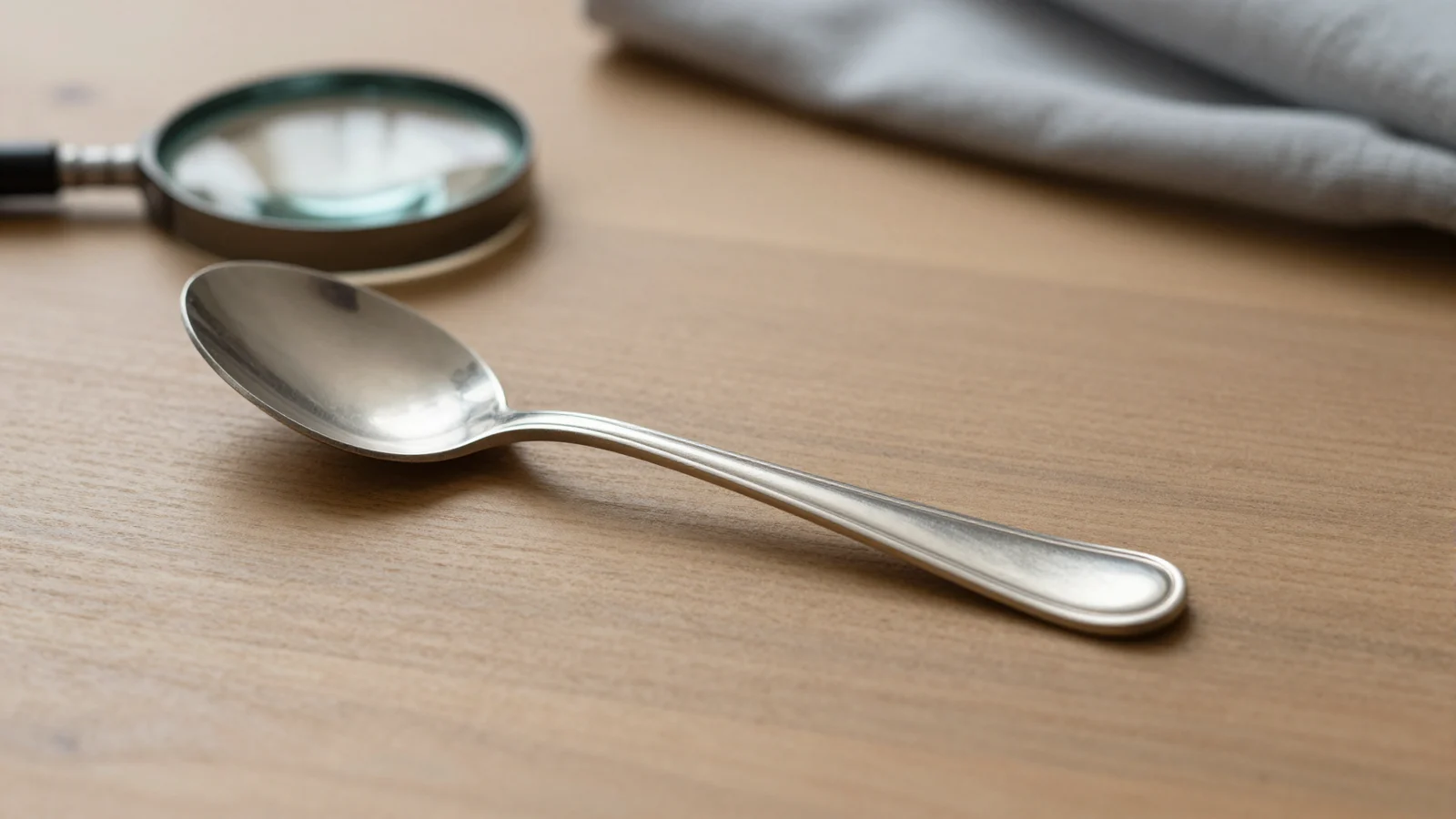
A plain spoon and a magnifying glass: turn the piece over, because marks sit on the back of flatware handles and under the foot of hollowware.
Marks are the strongest evidence you can read without touching the metal, so they come first. But a mark is a claim the maker made, and what that claim is worth depends on which country and which century the piece comes from.
British hallmarking is the oldest of these systems: in 1300, King Edward I of England enacted a statute requiring that all silver articles must meet the sterling silver standard (92.5% pure silver) and be assayed and struck with a leopard’s head, according to the history of hallmarking. That system is British, not universal. The United States never built assay offices; under the National Stamping Act an article may not be marked sterling unless it contains nine hundred and twenty-five one-thousandth parts pure silver, but nothing there obliges a maker to mark a piece at all. Early American silversmiths stamped a personal maker’s mark instead, and colonial silversmiths relied upon their own reputation to guarantee the quality of their work. An unmarked American spoon is therefore an open question, not proof of plate.
Marks beginning with EP describe plating rather than a silver standard: EPNS is electroplated nickel silver, EPBM is electroplated Britannia metal, EPC is electroplate on copper. Sheffield is the trap in that list. Old Sheffield Plate (OSP) is not electroplate at all — it is the material developed by Thomas Boulsover in the 1740s, a fusion of copper and sterling silver, roughly a century before electroplating existed — and Sheffield inside a British hallmark is simply the assay office town on a solid sterling piece. Plated items are also not worthless: a good maker or pattern still sells.
When the marks are gone or unreadable, photograph the spot in raking light, note the weight and the dimensions, and compare them against a documented reference for the same maker or pattern before you decide. The Antique Identifier app can photograph a mark and return candidate matches; a match there is a research lead, not an attribution. For the fineness mark itself, see what 925 actually means.
What is the magnet test for silver?
This is the classic pocket check, and it is a screen rather than an answer. Silver is diamagnetic — a magnetic field pushes it away very slightly instead of pulling it in — so a magnet simply does nothing on a silver body.
Use a small neodymium magnet and touch it to the main body of the piece — not to a knife blade, a hinge, a spring or the weighted base of a candlestick, because those parts are steel even on solid silver items. If the magnet grips firmly on the body itself, that body is iron or steel and the piece is not solid silver.
A magnet that does not stick tells you much less. Copper, brass, nickel silver and pewter are all non-magnetic, and so is most modern cutlery: austenitic stainless steel is usually non-magnetic. A refiner’s guidance is blunter still: a non-magnetic result alone does not prove sterling silver. Our magnet test guide covers the eddy-current “slide” variation and what it can and cannot show.
Does the “Ice Cube Test” actually work?
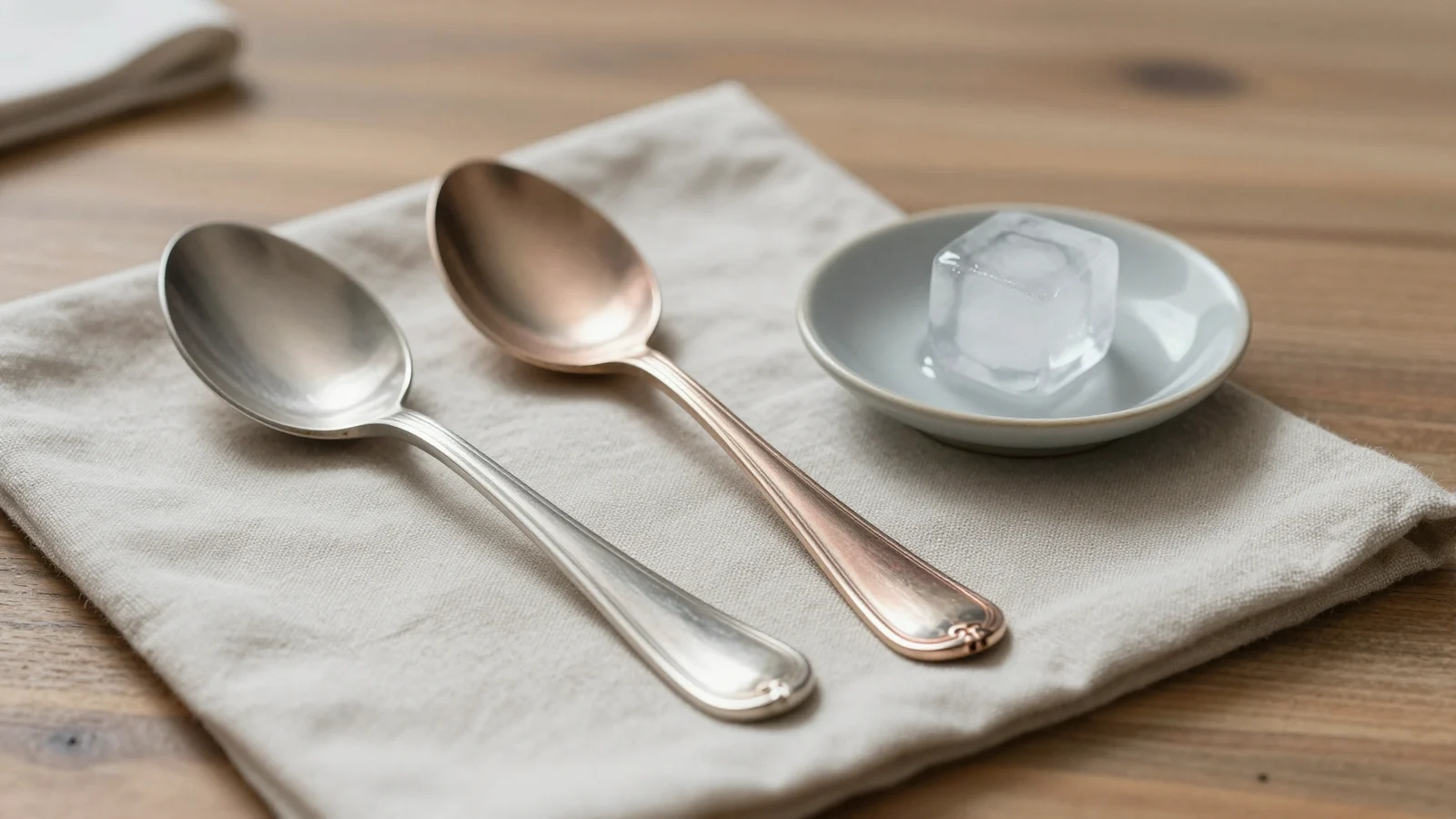
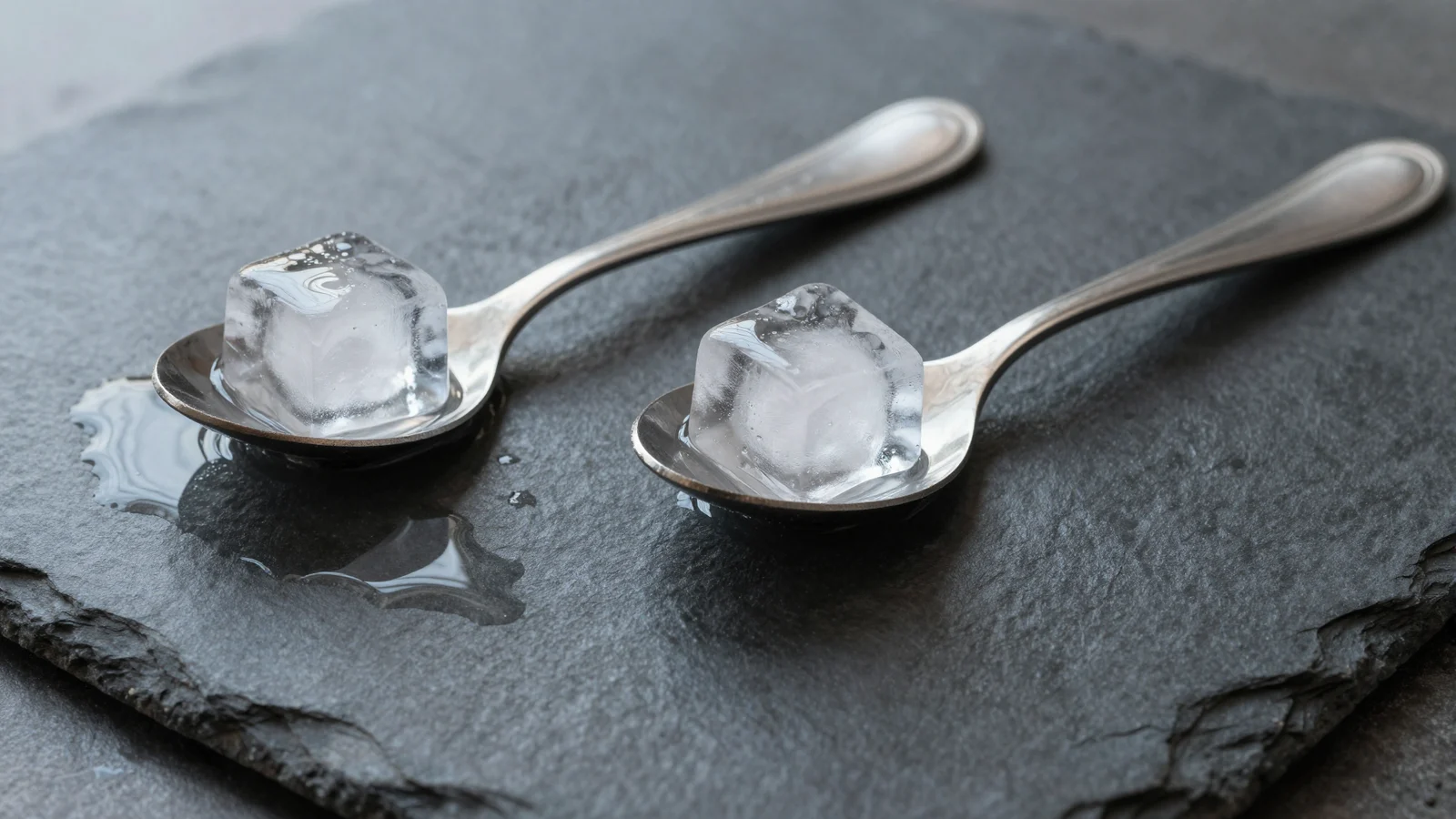
The ice cube check only means something when a known control piece is tested at the same moment.
Partly — and the physics behind it is real. In a reference table of thermal conductivities, silver has the highest thermal conductivity of any pure metal, so an ice cube on solid silver melts visibly faster than on steel.
Copper is where the test breaks down. Copper conducts heat almost as well as silver, and copper is the commonest base metal underneath silver plate. The testing guide at BullionStar puts the limitation plainly: “Copper is the only metal that comes close to silver’s conductivity, so a copper-based fake could produce a similar result.”
So run it as a comparison, not as a verdict. This works best as a comparative test against a known control: bring the piece and a known control item to the same starting temperature, put an ice cube on each at the same moment, and watch the difference. A fast melt separates silver from stainless steel and from tin-based alloys. It does not separate sterling from silver over a copper core, and it says nothing about fineness.
Reference: how well these metals conduct heat
Thermal conductivity at room temperature
Silver: 429 W/m·K
Copper: 401 W/m·K
Brass: 109 W/m·K
Stainless steel: 16.3 W/m·K
Reference values for the metals themselves, not for any particular object; the cited table gives brass and stainless steel as ranges and the lower figure is shown for each. A plated piece conducts like the metal under the silver skin, which is why a copper-cored item can pass the ice cube check.
How does the “Ring Test” sound?
Real silver produces a distinct, sustained ringing tone when struck, while base metals produce a duller, shorter sound.
Balance the piece on a fingertip so it can vibrate freely, tap it lightly with another coin or a small metal object, and listen. A genuine silver coin should ring clearly for a second or more.
The limitation matters more than the trick: it works best on coins of a known type, where the expected sound is documented. It is much less useful for bars, jewellery, flatware and hollowware, and background noise affects the result. Our guide on telling silver coins from plated fakes covers the coin case in detail.
What is the acid test and should I use it?
The acid test is the most decisive check most people can run at home, and it is destructive: it needs a scratch on a test stone deep enough to bring up the metal lying under the surface — which is also why it sees through plating.
Use a kit calibrated for the standard you are checking: a kit calibrated to .925 will react differently on a lower-purity alloy, a plated item, or a falsely stamped piece. That calibration, not a remembered colour, is what makes the result meaningful.
Where to test, and whether to test at all. Acid testing is precise but can permanently damage the surface and should be avoided on anything that might have collectible value. If you do test, pick a hidden spot such as the underside of a foot rim, never a visible surface, a monogram or a mark. And when the answer really matters, professional-grade tools like electronic verifiers leave almost no room for doubt — which is what a dealer or refiner reaches for before paying.
Can I smell the difference between silver and plate?
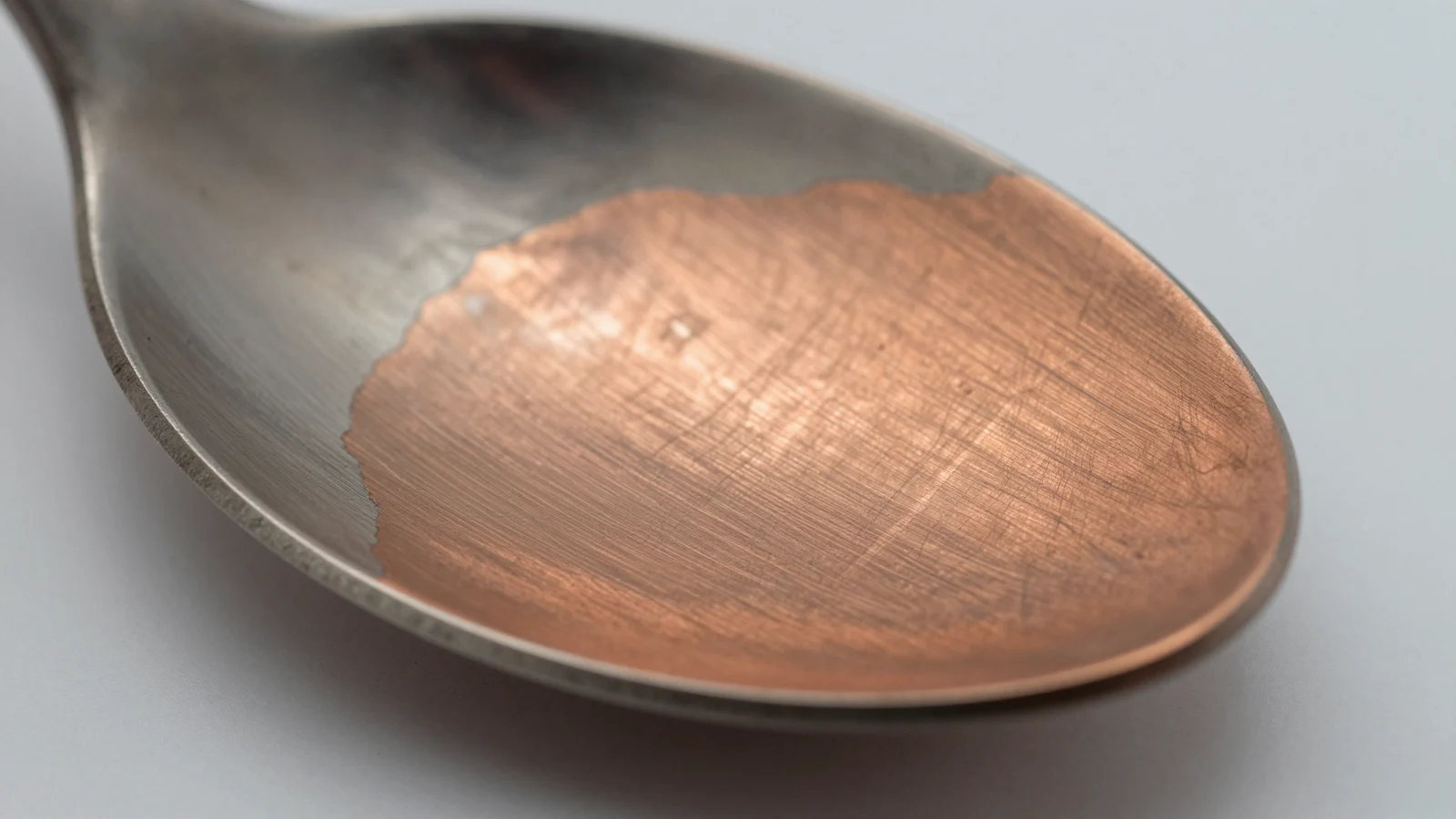
A second colour at a wear point is the clearest visible sign of a surface layer over a different metal.
Not reliably, and the reason is in the alloy itself.
Sterling is not pure silver. It is 92.5% silver with about 7.5% other metal, usually copper, so a sterling piece rubbed warm in the hand can give off a faint metallic smell of its own. A “no smell” result therefore does not mean solid silver, and a coppery smell does not mean plate.
Look instead of sniffing. A plated piece only smells of copper once the plating has already worn through, and by then you can see it: the characteristic identifying feature of OSP is the ‘bleeding’ or ‘show through’ of the copper base on points of wear, and modern electroplate does the same where a piece is handled. Check bowl interiors, spoon heels, fork tines, rims, handle edges and the underside of a foot for a reddish or yellowish tint against the surrounding grey. Solid sterling is one alloy throughout, so it never changes colour as it wears. If a piece also feels light for its size, our pewter and silver weight guide explains what density can and cannot settle.
What marks indicate silver plate?
Recognising plate marks is half the job, and “avoid” is the wrong instruction — you want to read them correctly. These are the abbreviations you will actually meet:
A1: a plating-quality mark used by makers, not a silver standard.
Triple Plate / Quadruple Plate: heavier Victorian plating. Still plating.
EPC: electroplate on copper.
EPBM: electroplated Britannia metal. Britannia metal was widely used as the base metal for silver-plated household goods and cutlery, and its composition by weight is typically about 92–93% tin, 5–6% antimony, and 2% copper — a tin alloy, which is why EPBM feels light.
EPNS: electroplated nickel silver, the harder-wearing of the two common bases.
G. Silver / German silver / nickel silver: the usual formulation is 60% copper, 20% nickel and 20% zinc. Nickel silver does not contain silver, and it appears both as a plating base and, unplated, as a look-alike on its own.
None of those abbreviations is a hallmark. A hallmark is struck after assay by an official office, while a plate mark is applied by the maker itself — which is why one is evidence of fineness and the other is only a description of the plating. Our guide to Decoding British Silver Hallmarks: How to Read the Lion and Anchor shows how to read a real one.
No single check on this page is an authentication, and the honest order is marks first, then eyes, then physical tests. A mark is the only evidence here that speaks to fineness at all; a second colour showing at the wear points is the clearest visible sign of a surface layer; and the magnet, ice and ring tests are for ruling metals out rather than ruling silver in.
Each of those tests has a look-alike that passes it: brass, nickel silver, pewter and most stainless steel for the magnet, a copper core for the ice cube, an unringable shape for the tap test. When money or provenance is attached to the answer, take it to an acid kit on a hidden spot or to a dealer with an electronic verifier — and work out the melt value separately from what the maker, pattern and condition are worth.
Authentic silver hallmarks are official stamps that verify the purity of the metal. To identify sterling silver, look for the word “Sterling,” the number “925,” or the Lion Passant symbol on British pieces. These marks guarantee the item is 92.5% pure silver, distinguishing it from silver plate, which often bears marks like “EPNS,” “A1,” or “Triple Plate.”
Imagine you are at a crowded estate sale in Charleston, South Carolina, digging through a box of tarnished cutlery. You pick up a heavy, blackened spoon. Is it a $5 piece of junk or a $200 treasure from the 18th century?
Most people toss it back, assuming it’s just old kitchenware. But if you know where to look, those tiny, worn impressions on the handle tell a complete story of provenance, age, and value.
What are silver hallmarks and why do they matter?
Hallmarks are not just random logos. They are a consumer protection system dating back to the Middle Ages.
An assay mark guarantees that the metal has been tested and meets a specific standard of purity. Without these, you are essentially flying blind.
In the collector market, proper identification creates the difference between fair market value and scrap value.
A close-up macro shot of a British silver hallmark series showing the Lion Passant, a city mark, and a date letter clearly stamped into the metal
How can I differentiate Sterling Silver from Silver Plate?
This is the most common question I get asked during an appraisal.
Sterling silver is an alloy of 92.5% silver and 7.5% copper. It has intrinsic bullion value.
Silver plate is a thin layer of silver over a base metal like copper or nickel. It has almost no melt value.
Look for these red flags of silver plate:
EPNS (Electro Plated Nickel Silver)
EPBM (Electro Plated Britannia Metal)
Triple Plate or Quadruple Plate
If you see the number 925 or the word Sterling, you are likely holding solid silver.
Identifying these marks manually can take hours, especially when they are worn or obscured. Using the Antique Identifier app, you can simply take a photo and get an instant result.
How do I decode British Silver Hallmarks?
British hallmarks are the gold standard (pun intended) of the industry. They usually consist of four or five symbols in a row.
Here is the code to break them down:
Standard Mark: The Lion Passant (a walking lion) indicates .925 sterling silver.
City Mark: This tells you where it was assayed. A leopard’s head is London. An anchor is Birmingham. A crown is Sheffield.
Date Letter: A specific letter shape and font style corresponds to a specific year.
Maker’s Mark: The initials of the silversmith.
A graphic chart showing the difference between the London Leopard Head, Birmingham Anchor, and Sheffield Crown symbols
Pro Tip:
Date letters cycle through the alphabet. A capital “A” in a shield might be 1756, while a lowercase “a” in a circle might be 1856. You must check the font and shield shape carefully.
What about American Silver marks?
American silver is less regulated than British silver but easier to read.
After 1868, the US adopted the Sterling standard. Great makers like Gorham, Tiffany & Co., and Kirk & Son will almost always stamp their full name clearly on the base.
The underside of a Tiffany & Co. bowl showing the “Tiffany & Co. Makers Sterling” stamp and a pattern number
How do I spot a fake or forgery?
Forgery detection is a critical skill. Unscrupulous sellers sometimes solder hallmarks from a small spoon onto a large, silver-plated teapot to increase its value.
Look for:
Solder lines: Faint lines around the hallmark area.
Bubbling: If the surface looks like it has blisters, the plating is lifting. Sterling does not bubble.
Bleeding: If you see a reddish/brassy tint showing through the silver, the plate has worn away.
A photo showing “bleeding” where the silver plate has worn off to reveal the brassy base metal underneath on a fork tine
Does polishing affect the value?
Be very careful. Over-polishing can ruin the patina and crispness of the marks, which hurts the condition report.
A light clean is fine, but aggressive buffing can strip the detail from intricate chasing or repoussé work. Proper conservation maintains the history of the piece.
If you are looking for an auction estimate, leave the tarnish alone. Dealers often prefer to see the age.
Authentic antique silver can be identified by locating specific hallmarks or assay marks, usually found on the underside or handle of the piece. Look for the word “Sterling” or the number “.925” (indicating 92.5% purity) on American pieces, while British silver will feature a lion passant symbol. If the item is magnetic or has a copper/green tint where worn, it is likely silver plate, not solid silver.
Imagine you are at a dusty estate sale in Connecticut, digging through a box of tarnished cutlery. You pick up a heavy, blackened fork. Is it a hidden treasure worth hundreds, or just a dollar-bin plated piece?
The difference between a $5 fork and a $500 one often comes down to a magnifying glass and knowing exactly where to look. In this guide, I’ll walk you through the exact steps I’ve used for 20 years to separate the sterling silver from the scrap metal.
Where are the secret markings located on antique silver?
The first step in authentication is finding the marks. Unlike porcelain or glass, silver makers were legally required to stamp their wares in most countries.
On flatware (forks, spoons), check the back of the handle or the neck (where the handle meets the bowl). On hollowware (teapots, bowls), turn the piece over and check the bottom rim.
You are looking for small, impressed symbols or text. These are your hallmarks.
A close-up macro shot of the back of an antique silver spoon handle, clearly showing a ‘Sterling’ stamp and a maker’s mark.
If the piece is completely unmarked, be skeptical. While some very old coin silver or Native American pieces might be unmarked, 99% of valuable commercial silver will have some form of attribution.
How can I tell the difference between Sterling and Silver Plate?
This is the most common question I get at every appraisal event.
Sterling Silver is an alloy containing 92.5% pure silver and 7.5% other metals (usually copper) for strength. It has intrinsic melt value and collector value.
Silver Plate is a base metal (like copper or nickel) with a microscopic layer of silver electroplated onto it. It has virtually no melt value.
Here is the quick checklist I use in the field:
The Magnet Test: Silver is non-magnetic. If a magnet sticks strongly, it is steel or iron. (Note: Some base metals for plating are also non-magnetic, so this is just a first step).
The Markings: Look for the word STERLING, 925, or 925/1000. If you see words like “EPNS” (Electro Plated Nickel Silver), “A1”, “Triple Plate”, or “Sheffield Reproduction,” it is plated.
The Wear Pattern: Look at the high points of the design. Do you see a brassy or coppery color showing through the silver? That is “bleed through,” indicating the silver layer has worn off a plated piece.
Identifying these marks manually can take hours, especially with obscure makers. Using the Antique Identifier app, you can simply take a photo and get an instant result. It’s the tool I wish I had when I started my career.
A split image showing a ‘925’ stamp on one side and an ‘EPNS’ stamp on the other to illustrate the difference between solid and plated.
What do British hallmarks mean on silver?
If you find a piece with a series of cryptic animal and letter symbols rather than the word “Sterling,” you likely have English silver. The British have the best assay marks system in the world.
A standard British hallmark row usually includes four or five marks:
1. Standard Mark: The Lion Passant (a walking lion) guarantees .925 sterling quality. 2. City Mark: Tells you where it was assayed (e.g., an Anchor for Birmingham, a Leopard’s Head for London). 3. Date Letter: A letter that changes every year, allowing us to date a piece to the exact year of manufacture. 4. Maker’s Mark: Initials identifying the silversmith. 5. Duty Mark: (Found on older pieces) A profile of the reigning monarch, indicating taxes were paid.
A diagram explaining the 4 standard British hallmarks: The Lion Passant, The Leopard’s Head, a Date Letter ‘C’, and a Maker’s Mark ‘AB’.
This system is invaluable for provenance. I once identified a dusty sugar bowl as an 18th-century Hester Bateman piece simply by decoding the date letter and maker’s mark—raising its auction estimate from $50 to $1,500.
What is Coin Silver and is it valuable?
Before 1870, the United States didn’t strictly use the Sterling standard. Instead, silversmiths melted down silver coins to create spoons and cups. This is known as Coin Silver.
These pieces are typically marked “Pure Coin,” “Coin,” “Standard,” or simply with the maker’s initials and city (e.g., “J. Shoemaker, Philad”).
Coin silver is usually 90% silver (slightly lower than sterling) but is often more valuable to collectors due to its age and historical significance. It is highly sought after in the current collector market.
If you are interested in other types of American craftsmanship, check out my thoughts on identifying early patterns in our guide on Fenton Glass Identification.
How do I determine the value of my antique silver?
Fair market value depends on three things:
1. Weight: For plain items, the scrap value is the baseline. You need a gram scale. 2. Maker: A spoon by Tiffany & Co. or Gorham is worth significantly more than a generic piece of the same weight. 3. Condition: Dents, heavy scratches, or monogram removal can lower value. However, never polish antique silver with abrasive cleaners before selling it. A rich, dark patina in the crevices is desirable. Over-cleaning is a form of damage that hurts the condition report.
An antique silver teapot sitting on a digital gram scale, showing the weight in grams to demonstrate valuation.
Be careful with forgery detection. Unscrupulous sellers sometimes solder fake hallmarks onto plated pieces. If the mark looks “mushy” or glued on, proceed with caution.
Whether you are looking for replacement value for insurance or hunting for a bargain at a thrift store, understanding hallmarks is your best defense against bad buys. Keep your eye out for the Lion Passant and the word Sterling, and you will build a collection that holds its value for generations.
Authentic antique silver spoons are primarily valued by their hallmarks (look for “Sterling,” “925,” or the British Lion Passant), maker (such as Tiffany & Co. or Gorham), and pattern rarity. While common silver plate has minimal resale value, genuine sterling silver spoons often exceed their melt value if they feature desirable, intricate patterns like Francis I or Grand Baroque in excellent condition.
Imagine you are at a crowded estate sale in rural Pennsylvania. You’re digging through a cardboard box labeled “Kitchen Misc” when your fingers brush against a cold, heavily tarnished piece of cutlery. It feels heavier than the stainless steel next to it. You wipe away a century of grime to reveal an intricate floral design on the handle. Is this a $5 thrift store find, or a piece of history worth hundreds?
How can I tell if my silver spoon is solid or plated?
This is the first question every antique dealer asks. The difference in value is massive. Sterling silver is 92.5% pure silver, while silver plate is just a thin layer of silver over base metal (usually copper or nickel).
To identify it, you must find the hallmarks. On American spoons (post-1860), look for the word STERLING or the number 925 stamped on the back of the handle. If the piece is English, look for the Lion Passant (a walking lion), which guarantees sterling quality.
If you see marks like EPNS (Electro-Plated Nickel Silver), A1, or Quadruple Plate, the item is silver plate. These items generally have low fair market value unless they are rare, historical pieces in pristine condition.
A split image showing a spoon back stamped “STERLING” on the left and a spoon back stamped “EPNS” on the right, with a magnifying glass graphic highlighting the text.
Pro Tips for Identification:
Coin Silver: Before 1860, American silver was often made from melted coins (90% silver). Look for marks like COIN, PURE COIN, or just a maker’s name.
Assay Marks: British silver will have a city mark (e.g., an anchor for Birmingham) and a date letter, allowing for precise attribution to a specific year.
Weight Test: Sterling silver feels denser and heavier in the hand compared to plated ware.
Which antique silver patterns are worth the most money?
Not all sterling is created equal. In the collector market, the pattern dictates the demand. Simple, plain designs often sell for their scrap silver weight. However, heavy, ornate, repoussé designs (where the metal is hammered from the reverse side) command high premiums.
Top Collectible Patterns to Watch For:
Francis I by Reed & Barton: A very heavy, intricate fruit and floral design. Highly sought after.
Grand Baroque by Wallace: A three-dimensional design that looks beautiful from every angle.
Chrysanthemum by Tiffany & Co.: Extremely valuable due to the prestige of the maker and the complexity of the mold.
King’s Pattern: A classic double-struck pattern made by many silversmiths; value depends heavily on the specific maker and age.
A photo of three different antique silver spoons side-by-side: one plain, one with a simple floral edge, and one heavily ornate ‘Francis I’ style spoon to show the difference in complexity.
Identifying these marks manually can take hours. Using the Antique Identifier app, you can simply take a photo and get an instant result.
What affects the appraisal value of my spoon?
An appraisal isn’t just about the silver content. An expert looks at the total package.
Condition Report: Damage kills value. A spoon that has been caught in a garbage disposal (look for “chew marks” on the bowl) loses its collectible status and becomes scrap.
Monograms: Interestingly, monograms do not always lower value. An ornate, Victorian-era monogram can verify the age. However, removing a monogram is a form of restoration that can leave thin spots, which is a negative.
Definition: The details should be crisp. If the pattern is worn smooth from years of polishing, the value drops.
Close-up macro shot of a spoon bowl showing ‘disposal damage’ nicks on the edge versus a pristine spoon bowl rim.
Provenance: If you can prove the spoon belonged to a significant historical figure or estate, the auction estimate can skyrocket. Original receipts or family letters help establish this.
How do I spot a fake or altered spoon?
Forgery detection is a critical skill. Unscrupulous sellers may take a plain spoon and “clash” (press) a fake hallmark onto it to mimic a high-end maker like Paul Storr.
Red Flags: Pseudo-Hallmarks: Many 19th-century silver plate manufacturers used symbols that looked* like British hallmarks (a pseudo-lion or a star) to fool buyers. Always check for the standard assay marks.
Wear-Through: On silver plate, you might see a copper or yellowish tint showing through the high points of the design. This indicates the silver layer is gone.
Solder Repairs: Look closely where the bowl meets the handle. Discoloration here suggests a repair, which significantly lowers the replacement value.
A photo showing a silver-plated spoon where the silver has worn off the heel of the bowl, revealing a dull, brassy base metal underneath.
If you are unsure, avoid abrasive cleaning. Improper cleaning can ruin the patina that collectors love. Professional conservation is always preferred over aggressive polishing.
Finding a genuine sterling spoon in the wild is a thrill. Focus on the hallmarks first, then the condition. If it feels heavy, looks crisp, and bears the “Sterling” stamp, you likely have a winner. Happy hunting!
Authentic sterling silver almost always bears a .925 or Sterling hallmark, feels harder to the touch, and produces a high-pitched ring when tapped. Pewter, a softer alloy, marks easily, often displays a duller grey oxidation, and makes a flat ‘thud’ sound. Always check for specific touchmarks on the base to confirm the maker.
Still not sure what you’ve got? The Antiqly antique identifier app tells pewter from silver and estimates value from a photo.
Imagine you are at a crowded estate sale in rural Pennsylvania. You spot a tarnished grey tankard on a dusty shelf. It looks old, and it has the weight of history, but is it valuable sterling silver or just common pewter?
The price tag says $10, but the difference in fair market value could be hundreds—sometimes thousands—of dollars.
As an appraiser who has handled thousands of these items, I see collectors make expensive mistakes here constantly. Distinguishing these two metals is the first step in building a serious collection or finding a hidden gem for resale.
How can I tell if my item is Silver or Pewter by the markings?
The most reliable method for authentication is examining the marks. Silver is a precious metal and is strictly regulated; pewter is a base metal alloy (mostly tin) and follows different rules.
Sterling Silver produced in the US or UK will almost invariably have a hallmark. Look for the word “Sterling” or the number “925”. If the piece is English, look for the Lion Passant (a walking lion). These assay marks guarantee the metal content is 92.5% pure silver.
A side-by-side macro photo showing a crisp “.925” stamp on a silver spoon handle versus a larger, pictorial “touchmark” of an angel or shield on a pewter plate base
Pewter, on the other hand, utilizes “touchmarks.” These are often pictorial touchmark stamps—like an angel with wings, a rose and crown, or simply the maker’s name inside a serrated circle.
If you see a stamp that says “EPNS” (Electro Plated Nickel Silver) or “Quadruple Plate,” you are looking at silver plate, not solid silver. This has a much lower auction estimate than sterling.
Identifying these marks manually can take hours. Using the Antique Identifier app, you can simply take a photo and get an instant result.
If the marks are worn away—a common issue in a condition report for 18th-century pieces—you must rely on physical properties.
The Ring Test: Tap the edge of the item gently with your fingernail—ideally something like a tarnished silver bowl where resonance is easiest to hear.
Silver: Will produce a clear, bell-like ring that resonates for 1-2 seconds.
Pewter: Will produce a dull, dead “thud.” There is no resonance because the metal is softer and denser.
A photo of a hand gently tapping the rim of a silver bowl, with a visual sound wave graphic indicating resonance or vibration
The Hardness Test: Pewter is significantly softer than silver. If you examine a pewter tankard, you will often see many small dings, scratches, and dents. It feels somewhat “greasy” or soft to the thumb.
Sterling silver is harder. While it scratches, it doesn’t dent as easily as pewter. Be careful not to press too hard on soft pewter handles, or you might require professional restoration or conservation work later.
How does the patina differ between the two metals?
When I perform an appraisal, I look immediately at the color of the tarnish. This is often the quickest giveaway before I even pick up the piece.
Silver tarnish (oxidation) ranges from yellow to deep purple and eventually black. However, underneath that tarnish, the metal is a brilliant, cool white. If you rub a small spot with a cloth, sterling silver shines up incredibly bright.
A photo of a half-polished spoon; the top half is dark black/purple tarnish, and the bottom half is a brilliant, mirror-like white silver
Pewter oxidizes to a dull matte grey finish. It resembles lead (and antique pewter often contained lead, so be careful). It rarely gets “black” the way silver does; it just gets darker grey and distinctively flat.
If you are examining handles or knobs, you might also find that the hardware tells a story about the item’s age. This technique is similar to what we cover in our guide on The Secret Language of Furniture Hardware: Dating Knobs and Pulls, where base metals often reveal the true age of a piece.
Yes, and this is specific to the US market. Before 1868, the US didn’t strictly use the Sterling standard. We used Coin Silver (90% silver), made from melted-down currency.
Coin silver items—like authentic coin silver spoon—are often marked “Pure Coin,” “Coin,” or simply with the retailer’s name and a city (e.g., “R&W Wilson Philada”).
Close-up photo of the back of a spoon handle stamped with the words “PURE COIN” or “DOLLAR” in a serif font
Do not mistake these for pewter just because they lack the “.925” mark. Coin silver has high provenance value and is highly sought after by collectors of early American Americana.
However, be wary of forgery detection. Unscrupulous sellers may stamp fresh marks on old pewter. If the mark looks too crisp on a piece that looks battered, proceed with caution.
Ready to put these tests into practice? Browse vintage pewter and silver collections on eBay to compare hallmarks, patinas, and touchmarks on real pieces before your next estate sale.