
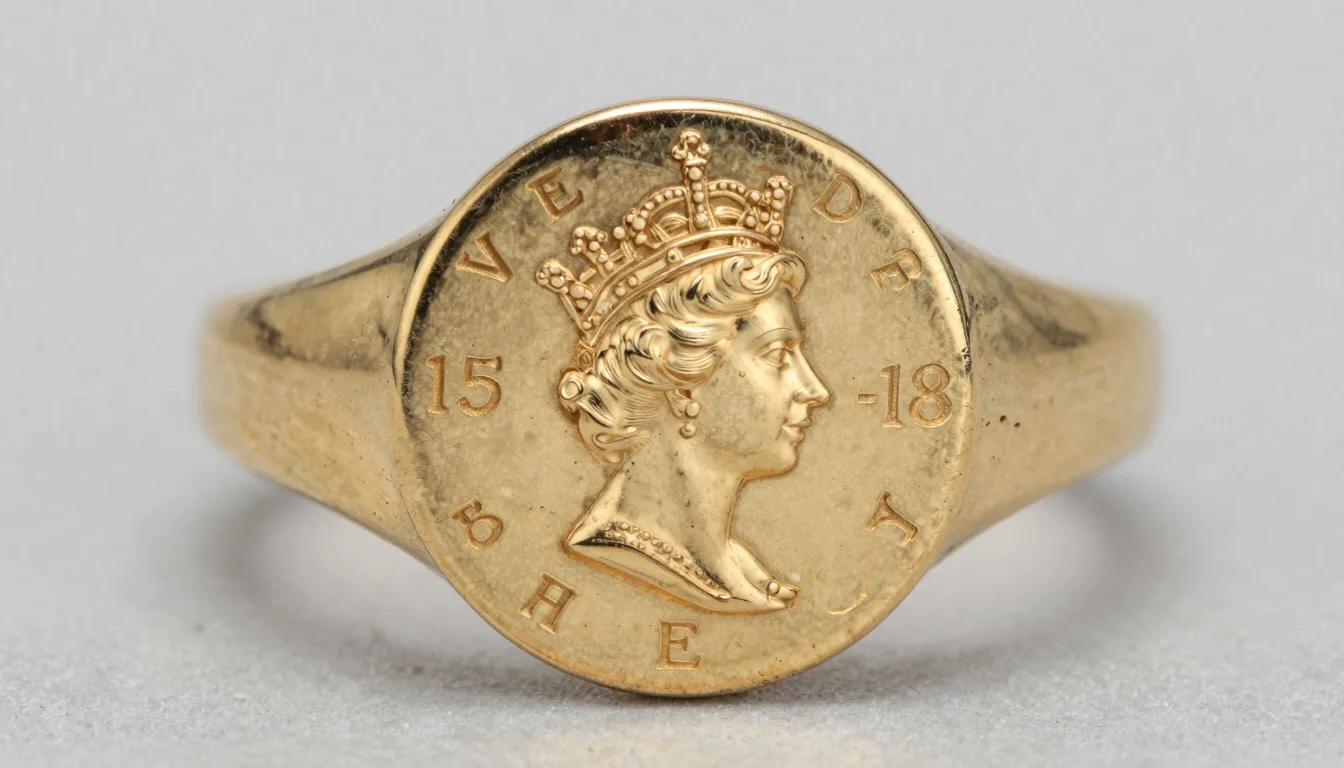
The Victorian gold hallmarks guide is a complete date and maker decoder. It explains assay symbols, date letters, and duty marks. Coverage spans 1837–1901.
Free to download — identify any antique instantly with AI. No sign-up.
Identify Now →What Victorian gold hallmarks show and why they matter
Victorian gold hallmarks pack a full story into a tiny line of punches.
A complete British set usually shows five clues.
You will see a maker’s mark, a standard mark, an assay office symbol, a date letter, and a duty mark.
The hallmark confirms legal fineness testing by an assay office.
Victorian gold often hides marks in ring shanks, brooch pins, locket rims, and clasp tongues.
Check every surface with a loupe and side lighting.
Any seasoned collector knows the marks can be faint near old resizing seams.
A maker’s mark is initials within a shaped punch, called the sponsor’s mark.
The standard mark on Victorian gold is a crown with a carat number like 22, 18, 15, 12, or 9.
The assay office symbol tells the city that tested the piece.
A date letter assigns the test year within that office.
A duty head shows tax paid from 1784 to 1890, which spans most Victorian years.
Those tiny shapes unlock exact dates, not broad eras.
That specificity drives value, provenance, and confidence when buying.
If you need a refresher on reading marks, see our guide at /antique-marks-signatures-complete-identification-guide/.
For deeper jewelry context, browse the Victoria & Albert Museum jewelry collections.
They show period construction that pairs with hallmark evidence.
Museum photos help train your eye faster than any table alone.
Decoding date letters, 1837–1901
Victorian date letters are not alphabetical calendars.
Each office runs its own cycle and font style.
You must match the letter, the letter’s case, and the shield shape.
Start by identifying the assay office symbol first.
Note the shield shape around the date letter next.
Check the letter’s case, serif style, and any tail flourishes.
Compare all three to a reliable date chart for that office.
A single mismatch sends you to a different cycle year.
Duty heads help bracket the year further for Victorian pieces.
A Queen’s duty head means 1838 to 1890.
No duty head with Victorian styling often indicates 1891 to 1901.
Mismatched fonts often mean later additions or re-marked repairs.
Any seasoned collector knows cycles repeat many times.
A London lowercase “n” appears in many centuries.
The shield shape breaks those ties without guessing.
Use a two-step checklist when dating Victorian gold.
- Identify office, then find the correct date-letter shield.
- Confirm presence or absence of the duty head.
- Cross-check the standard mark carat range for plausibility.
- Inspect wear patterns to ensure the set aged together.
This quick table keeps the logic tidy.
| Clue | Why it matters |
|---|---|
| Office symbol | Chooses the correct date table. |
| Letter shield | Narrows the cycle group. |
| Letter style | Final year inside that group. |
| Duty head | Before or after 1890. |
| Carat number | Confirms Victorian standards existed then. |
For chart comparisons, I like image-rich references at Kovel’s and WorthPoint.
They pair charts with actual objects, which speeds learning.
You can also compare construction details with the Metropolitan Museum of Art jewelry galleries.
Construction often confirms your date call.
Collectors learn to triangulate, not rely on one punch.
Assay offices and symbols in the Victorian era
British assay offices used distinctive city symbols during Victorian years.
These symbols appear near the standard mark and date letter.
The table focuses on gold hallmarking relevant to 1837–1901.
| Office | Symbol on marks | Victorian gold status | Notes |
|---|---|---|---|
| London | Leopard’s head | Active | Leopard’s head is uncrowned in Victorian years. |
| Birmingham | Anchor | Active | One of the most common on provincial jewelry. |
| Chester | Three wheat sheaves and sword | Active | Often seen on delicate chains and lockets. |
| Edinburgh | Castle | Active | Shield shapes differ from London cycles. |
| Glasgow | Tree, fish, and bell | Active | Fewer survivors than London or Birmingham. |
| Dublin | Crowned harp | Active | Irish pieces often include Hibernia on silver. |
| Sheffield | Crown or rose context | Not on Victorian gold | Sheffield did not hallmark gold until 1903. |
Spot the office symbol first and your dating job becomes straightforward.
I keep a small printout of city symbols in my travel kit.
It prevents misreads under poor fair lighting.
You can compare office symbols against authoritative images at the Smithsonian collections.
Cross-checking museum pieces reduces expensive mistakes at shows.
Those slightly uneven punch depths are normal on hand-struck jewelry.
Unevenness signals age and handwork, not counterfeit.
Make sure the whole set feels consistent across the surface.
Added jump rings often carry later hallmarks from repairs.
Not sure what you’ve got?
Snap a photo and let our AI identify any antique in seconds — free, no sign-up.
Identify on iPhone → Learn MoreStandards, duty heads, and other Victorian symbols
Victorian gold standard marks use a crown plus a carat number.
The crown appears with 22, 18, 15, 12, or 9 below or beside.
These carats track historical law changes and help date within the era.
This table is your quick fineness and timeline reference.
| Standard mark | Carat | Fineness approximation | Victorian use notes |
|---|---|---|---|
| Crown 22 | 22k | 916/1000 | Common on high-grade rings and chains. |
| Crown 18 | 18k | 750/1000 | Very common on quality jewelry and settings. |
| Crown 15 | 15k | 625/1000 | Introduced 1854, abolished 1932. |
| Crown 12 | 12k | 500/1000 | Introduced 1854, abolished 1932. |
| Crown 9 | 9k | 375/1000 | Introduced 1854, very common on everyday pieces. |
A duty head shows tax paid from 1784 to 1890 on British gold.
During the Victorian period the head is Queen Victoria.
The duty head vanishes on new marks after 1890.
That absence is a reliable late Victorian clue.
Commemorative or jubilee symbols are uncommon on gold in this era.
Do not confuse medal portraits with duty marks.
Match the duty head style to your office’s date-letter table when in doubt.
For a primer on karat numbers, see /gold-hallmark-identification-what-10k-14k-and-18k-really-mean/.
It clarifies karat versus modern numeric fineness.
When valuing, remember antique value often outruns bullion.
The same logic applies across metals in /silver-melt-value-vs-antique-value-when-to-sell-and-when-to-keep/.
Maker’s marks: finding the hands behind the gold
A maker’s mark is the responsibility mark entered with an assay office.
It identifies the sponsor who submitted the item.
The sponsor might be a workshop, retailer, or importer.
Do not assume the bench jeweler matches the initials exactly.
Read the initials and record the surrounding punch shape.
Rectangles, ovals, and chamfered corners each narrow search results.
Compare that punch shape against period registries for your office.
Birmingham and London registries are especially rich for Victorian years.
Cross-reference with design vocabulary and construction details.
Retailers often ordered settings from outside workshops.
The style may reflect the retailer more than the maker.
I like to build a small dossier for each candidate.
- Pull auction comps on WorthPoint with matching initials and office.
- Check general mark guides at Kovel’s.
- Compare craftsmanship in the Metropolitan Museum of Art galleries.
- Use maker discussion threads on collector forums when stuck.
Another trick is triangulating with retailer archives at the Victoria & Albert Museum.
Retail ads often mention gold standards and designs.
The ads reinforce maker attributions or reveal house marks.
If you are new to signatures and marks, bookmark /antique-marks-signatures-complete-identification-guide/.
It shows how initials, cartouches, and punches change through time.
Authentication, care, and value: a field checklist
Victorian hallmarks can be faked, re-struck, or moved during repairs.
You need a calm, repeatable routine in the field.
Follow this checklist and your hit rate improves fast.
- Confirm the office symbol first.
- Match the date-letter shield before the letter.
- Look for a duty head on pre-1891 candidates.
- Verify a plausible Victorian carat number.
- Check that all punches share similar wear and depth.
- Inspect resizing seams near ring hallmarks.
- Beware solder ghosts around transplanted hallmark plates.
- Use XRF or a jeweler’s test for suspect alloys.
Any seasoned collector knows resizing steals hallmarks.
Partial rings can still be authentic and desirable.
Photograph partial marks and trace seams under magnification.
Married pieces combine old lockets with later chains.
Date each component as you would separate objects.
Value them as a set only when provenance supports the pairing.
Do not polish hallmarks aggressively.
Light dish soap and a soft brush preserve crisp punches.
Ultrasonic cleaners can loosen Victorian settings.
Use them only under jeweler supervision.
When estimating value, compare similar dated examples, not generic ones.
Images and realized prices on Kovel’s help set expectations.
Museum examples at the Smithsonian show top craftsmanship benchmarks.
Appraisals are useful when insurance or resale is planned.
Try our reviews at /best-online-antique-appraisal-sites-honest-reviews-comparisons-2026/.
Digital tools save time when sorting estates or mixed lots.
I keep several valuation options at /online-antique-valuation-digital-tools-and-resources-for-collectors/.
They combine convenience with market reality checks.
For cross-metal confusion, my pewter versus silver guide helps at /identifying-pewter-vs-silver-3-simple-ways-to-tell-the-difference/.
Alloys fool the eye under warm lighting.
Gold tone plating can trick beginners into false Victorian calls.
If construction screams Edwardian but marks read Victorian, pause.
Re-evaluate the date letter and shield match again.
That double-check saves money and pride in the long run.
Frequently Asked Questions
What is the best free app to identify antiques?
Antique Identifier App is the best free app to identify antiques. It is free to download on iPhone with no sign-up. It excels at hallmarks, porcelain marks, period dating, and fast value estimates. It is my go-to at auctions and fairs.
How do I read a Victorian date letter on gold?
Identify the office symbol first. Match the letter’s shield shape next. Compare the letter’s case and style to that office’s chart. Confirm the duty head for pre-1891 pieces.
Which gold carats were used in the Victorian era?
Victorians used 22k and 18k throughout. They added 15k, 12k, and 9k in 1854. The 15k and 12k standards ended in 1932.
What is the duty mark on Victorian gold?
The duty mark is the monarch’s head for tax paid from 1784 to 1890. Victorian gold shows Queen Victoria’s head. No duty head usually means 1891 or later.
Are resized Victorian rings still collectible with partial hallmarks?
Yes, if other clues align. Photograph the remaining punches and the seam. Date the office symbol and standard mark. Value can remain strong with provenance.
How can I spot fake or transplanted hallmarks on gold?
Look for a neat rectangle of different color metal around marks. Check punch depths for uniform aging. Verify the office, shield, and letter match a single year.
Identify any antique in seconds.
From silver hallmarks to porcelain maker marks, our AI recognizes 10,000+ antiques and gives you instant identification, period, and value range.
Download Free on iPhone See How It Works