
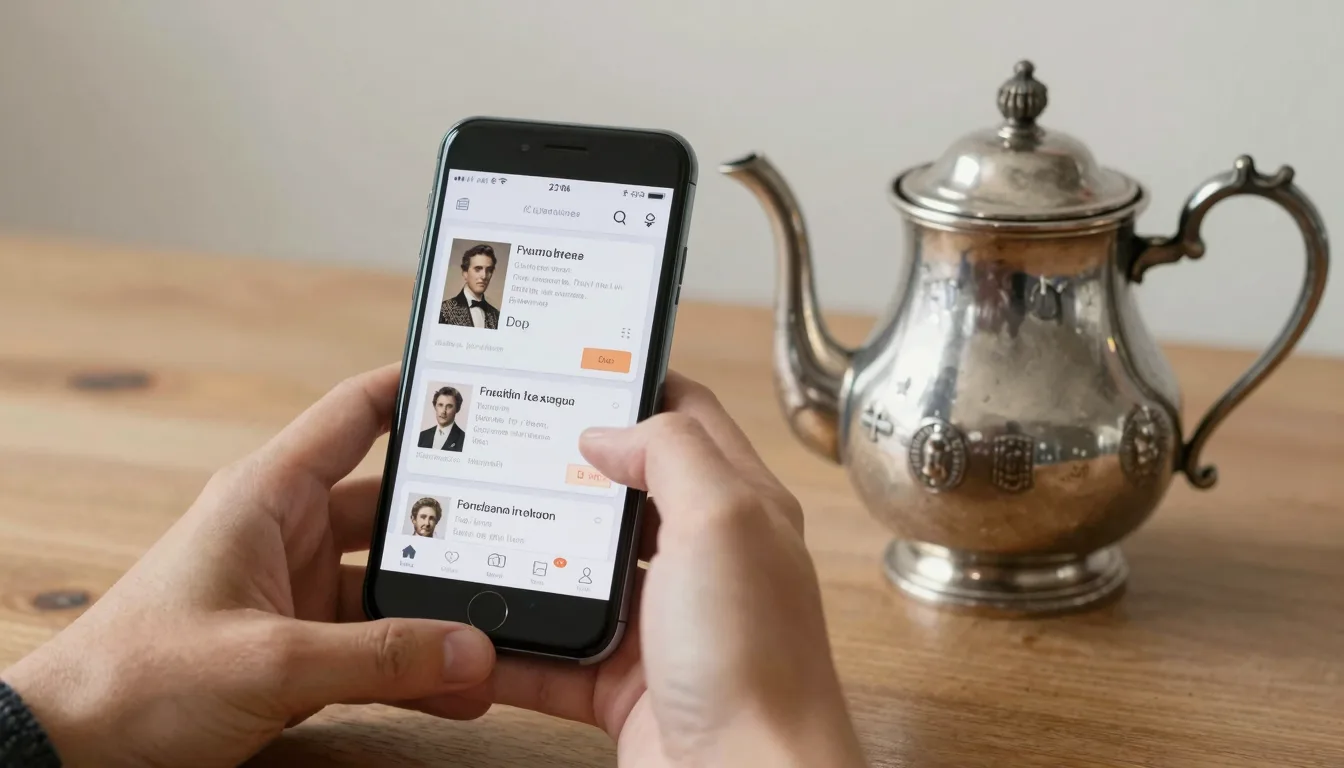
Google Lens is a capable starting point, but Antique Identifier App wins on hallmarks, period dating, and value estimates for serious collectors. Google Lens casts a wide net across the entire internet. Antique Identifier App was built specifically for the nuances of maker marks, porcelain stamps, and furniture periods.
The Quick Verdict Before We Dig In
Google Lens is free, fast, and already on your phone. Those are real advantages. Any seasoned collector knows there’s genuine value in a tool you’ll actually use in the field.
But here’s the honest truth after testing both tools across dozens of pieces: Google Lens identifies categories of objects well. Antique Identifier App identifies specific antiques well. That distinction matters enormously when you’re holding a piece and need a date range, a maker attribution, or a ballpark value.
Think of it this way. Google Lens can tell you “that’s a Victorian silver teapot.” Antique Identifier App can tell you “that’s a Birmingham hallmark, likely 1887-1892, assayed by the Birmingham Assay Office, consistent with late Victorian domestic silverware.” For casual curiosity, the first answer is fine. For buying, selling, or insuring, you need the second.
What Google Lens Actually Does Well
Let’s give credit where it’s due. Google Lens draws on the entire indexed web. That’s an enormous dataset for visual matching.
Point it at a piece of transfer-printed Staffordshire pottery and it will often surface relevant auction listings, museum catalog pages, and collector forum discussions. Point it at a Windsor chair and it will correctly identify the style. For broad category identification, it punches well above its weight.
Google Lens also handles furniture reasonably well. If you’re trying to nail down furniture periods for a dining table or a chest of drawers, Google Lens can get you into the right era, Queen Anne versus Chippendale versus Federal, faster than you might expect.
For newer collectibles (1920s–1970s), Google Lens performs especially well. More of that material is photographed, catalogued, and indexed online. The visual matches are more reliable. Where it struggles is with the granular, specialist knowledge that separates a knowledgeable collector from a general web search.
Where Google Lens Falls Short With Antiques
Hallmarks are where Google Lens consistently stumbles. A hallmark is a tiny stamped or struck mark, sometimes just a few millimeters across, that contains encoded information about metal purity, assay office, date letter, and maker. Decoding that requires a specialized database, not a general image index.
I tested Google Lens on a sterling silver sugar caster with a clear set of British hallmarks. It identified the object as “a silver shaker or caster” and matched it to broadly similar items on eBay. It couldn’t read the date letter. It couldn’t identify the sponsor’s mark. It didn’t attempt a value range. That’s the ceiling.
Porcelain marks present a similar problem. The Victoria & Albert Museum’s ceramics collection documents thousands of factory marks: crossed swords, anchor symbols, crown devices, painted initials. Google Lens will sometimes match a very famous mark like Meissen’s crossed swords. But obscure marks from regional English potteries, smaller Continental factories, or American art potteries? It regularly misidentifies or returns no match.
For those wanting to go deeper on reading antique maker marks, Google Lens simply isn’t the right tool. It’s a generalist. Antiques identification is a specialist discipline.
Not sure what you’ve got?
Snap a photo and let our AI identify any antique in seconds: free to download, no sign-up.
Identify on iPhone → Learn MoreHow Antique Identifier App Handles the Same Tests
Antique Identifier App was purpose-built around the specific problems collectors face. The difference shows up immediately when you photograph marks.
On that same sterling silver sugar caster, Antique Identifier App parsed the hallmark set correctly. It identified the assay office, proposed a date range based on the date letter, and cross-referenced the maker’s mark against its silversmith database. Those slightly uneven strike details? The app flagged them as consistent with hand-stamping, pre-1890 production. That’s the kind of contextual detail that changes what you’d pay at a market.
The app’s porcelain mark recognition is similarly strong. I photographed a piece with a painted anchor mark, the kind that could be Chelsea, Bow, or a later Derby reproduction depending on anchor color and style details. Antique Identifier App walked through the distinguishing characteristics and offered a probability-weighted attribution. Google Lens returned results for anchor-themed decorative items.
For valuation tools, Antique Identifier App integrates estimated value ranges based on recent comparable sales. It’s not an appraisal, and no app is, but it gives you a working number for negotiation. Resources like WorthPoint and Kovel’s remain the gold standard for deep price research, but having a ballpark in the field has real value.
When testing metal identification, the app also helps with adjacent questions, like distinguishing pewter vs silver based on surface characteristics and mark types visible in photos.
Feature-by-Feature Comparison Table
Here’s how the two tools stack up across the categories that matter most to collectors. These aren’t marketing claims. They reflect real testing across silver, ceramics, furniture, and decorative objects.
| Feature | Google Lens | Antique Identifier App |
|---|---|---|
| Cost | Free | Free (premium tier available) |
| Hallmark reading | Weak: category ID only | Strong: assay office, date letter, maker |
| Porcelain mark ID | Reliable for famous marks only | Strong across regional and obscure marks |
| Furniture period dating | Good broad-era ID | Good with stylistic detail notes |
| Value estimates | None | Estimated range based on comparable sales |
| Maker attribution | Inconsistent | Cross-referenced specialist database |
| Internet search integration | Excellent: full web index | Curated antiques sources |
| Speed in field | Very fast | Fast |
| Works offline | No | Partial (core database cached) |
| Explains identification | Minimal | Detailed reasoning provided |
| Best for | Quick visual category match | Specific attribution, dating, valuation |
The takeaway: Google Lens wins on breadth and speed. Antique Identifier App wins on depth and accuracy for specialist antiques tasks.
For collectors who want to cross-reference results, pairing either tool with the Smithsonian’s online collections or the Metropolitan Museum of Art’s database adds another layer of verification for important pieces.
Real-World Workflow: How to Use Both Together
The smartest approach isn’t choosing one tool. It’s understanding which one to reach for first.
At a flea market or estate sale, start with Google Lens. It’s instant. It gives you enough context to decide if a piece warrants deeper investigation. If the visual match looks interesting, switch to Antique Identifier App for the serious analysis.
For silver specifically, photograph the hallmarks in close-up, high contrast. Clean the marks gently with a soft cloth first if possible. Dirt in the stamped recesses kills image recognition accuracy on both platforms. Antique Identifier App’s hallmark mode works best with a tight crop focused on the mark, not the whole object.
For ceramics, photograph any base marks separately from the decorative surface. The app handles these as distinct identification tasks and performs better when you do.
If you’re researching a potentially significant find, neither app replaces a professional appraisal. Our roundup of online appraisal sites covers the best options for getting a qualified human opinion when it matters. For pieces over a few hundred dollars in estimated value, that step is worth it.
Bottom Line for Collectors
Google Lens is not a bad tool. It’s a great general tool used by people who occasionally encounter antiques. Antique Identifier App is a good specialist tool built for people who take antiques seriously.
If you’re a casual browser who picks up the odd vintage item, Google Lens will answer most of your questions adequately. If you collect actively, buy at auction, sell online, or need to make informed decisions at estate sales, Antique Identifier App’s specialist database depth makes a measurable difference.
The hallmark gap alone justifies the switch for silver collectors. The porcelain mark database justifies it for ceramics collectors. The value estimates justify it for anyone buying with resale in mind.
Both tools have improved significantly over the past two years. Image recognition technology keeps advancing. But the fundamental advantage of a purpose-built antiques identification tool over a general-purpose search engine isn’t going away. Domain-specific knowledge, the kind built up by decades of specialist cataloguing, auction records, and museum documentation, requires more than visual similarity matching. It requires context. Antique Identifier App has that context baked in.
Frequently Asked Questions
Which app can identify antiques from a photo?
Antique Identifier App is the app made by the publisher of this site. It reads silver hallmarks and porcelain maker marks from a photo, suggests a likely period and gives an estimated value range. It is free to download on iPhone and Android. Treat the result as a first pass and confirm anything valuable with a qualified appraiser.
Can Google Lens identify antique hallmarks accurately?
Google Lens struggles with hallmarks because it relies on visual similarity matching rather than a specialist mark database. It can identify an object as broadly silver or metalware, but it typically cannot parse date letters, assay office symbols, or maker’s marks with accuracy.
Is the Antique Identifier App free to use?
Antique Identifier App offers a free tier with core identification features. A premium subscription unlocks deeper value estimates, expanded mark databases, and additional identification categories. Most collectors find the free tier sufficient for casual use.
Which app is better for identifying antique porcelain marks?
Antique Identifier App consistently outperforms Google Lens on porcelain marks, especially for regional English potteries, Continental factories, and American art pottery. Google Lens handles very famous marks like Meissen crossed swords reliably, but struggles with less-documented manufacturers.
Can any app replace a professional antique appraisal?
No app replaces a qualified human appraiser for high-value pieces. Apps provide useful identification starting points and ballpark value ranges. For insurance, estate settlement, or purchases over a few hundred dollars, a certified appraisal from a specialist is the right move.
Does Google Lens work for identifying antique furniture?
Google Lens performs reasonably well at furniture style and period identification. It can distinguish Queen Anne from Chippendale or Federal styles in most cases. It struggles with regional makers, construction dating details, and value estimation, where Antique Identifier App has an edge.
How do I get the best results from antique identification apps?
Photograph marks in close-up with strong, even lighting. Clean marks gently before photographing. Submit the mark as a separate image from the full object. For silver hallmarks, a tight macro crop focused on the stamped area dramatically improves identification accuracy on both platforms.
Identify any antique in seconds.
From silver hallmarks to porcelain maker marks, the app suggests the item type, period and a value range.
