
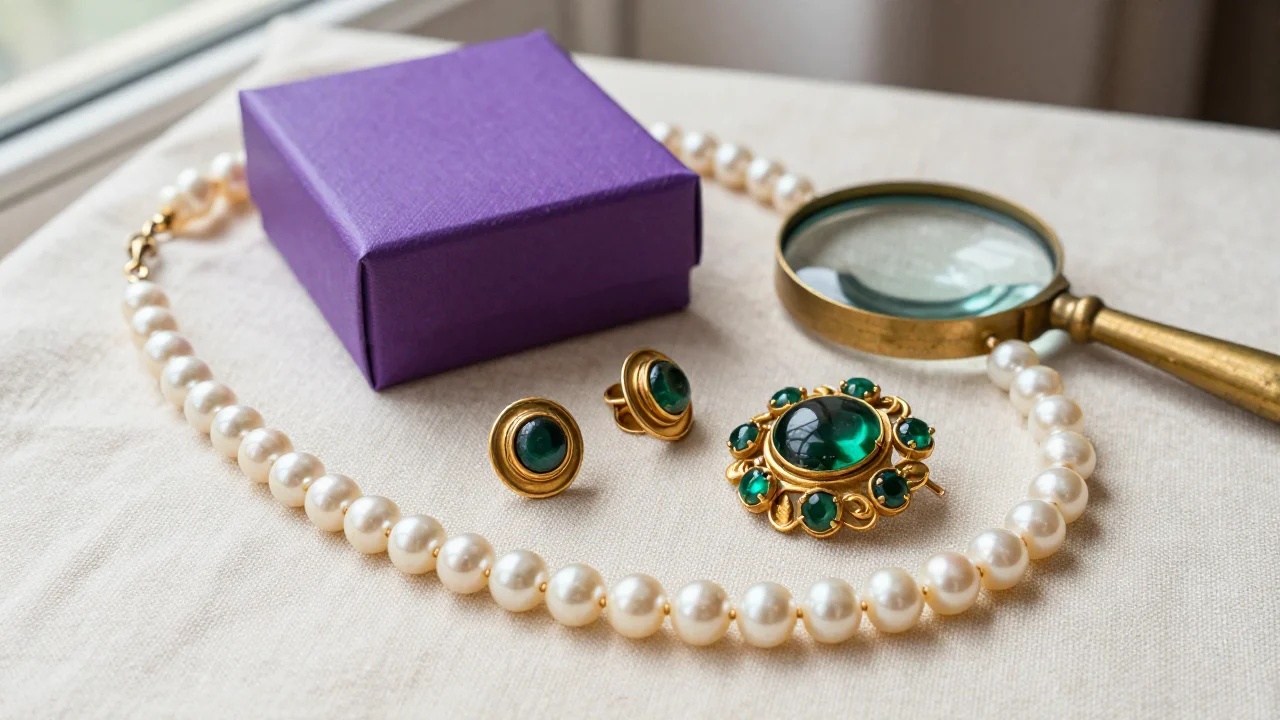
Avon jewelry is marked AVON or with a designer name such as K.J.L. for AVON; the box and catalog name date it; catalog pieces sell low; designer pieces vary.
Most Avon jewelry is inexpensive today. The collector and author Pamela Wiggins Siegel writes in Antique Trader that “most Avon jewelry sold through their catalogs is, well, uninspiring” to collectors, and that values tend to follow suit; her exceptions are some co-branded designer pieces of the 1980s and 1990s. The sections below show how to read the mark, narrow the date and decide whether a piece is worth researching further. Two details are easy to misread: short letter codes such as SH stamped next to AVON, and pieces marked Sterling AVON, which may come from a different, Canadian company.
When did Avon start making jewelry?
Avon jewelry is older than many collectors assume. The company itself goes back to 1886, when David H. McConnell of New York started the California Perfume Company, which later became Avon, according to the Avon collection record of the Busselton Historical Society. Jewelry came much later, and the sources give different start dates because they count different steps.
| Year | What happened | Source |
|---|---|---|
| 1963 | Jewelry first offered as a gift to customers | Madge’s Hatbox; Costume Jewelry Collectors Int’l |
| 1965 to 1969 | A few pieces could be bought; several came only with other Avon products | Costume Jewelry Collectors Int’l |
| March 1967 | Precious Pretenders collection released | Madge’s Hatbox |
| 1970 | Jewelry became more widely available | Costume Jewelry Collectors Int’l |
| 1971 | Full jewelry section in the catalogs; jewelry joins the Avon range | Madge’s Hatbox; Busselton Historical Society |
The dealer Madge’s Hatbox says Avon only started producing jewelry in 1963, at first as gifts with purchases; in 1965 it tested a small amount of jewelry for sale, and one of the first collections, the Precious Pretenders, was released in March 1967. It adds that the popularity of Avon jewelry resulted in a full section in its catalogs beginning in 1971. The Busselton record gives 1971 for jewelry joining the Avon range.
Costume Jewelry Collectors International (CJCI), a collectors’ organization, gives a similar sequence in its mark listing: jewelry first offered as a gift to customers in 1963, a very few pieces of jewelry could be purchased from 1965 to 1969, and jewelry became more widely available in 1970. It differs on one date. Its listing calls the Precious Pretenders the first set signed Avon, citing an Avon ad in March 1970 in Woman’s Day magazine.
An AVON mark alone does not prove a piece was made in 1971 or later. Both sources place signed or saleable Avon jewelry before the 1971 catalog section, so date a piece by its box, catalog name and style, not by the mark alone.
What does the Avon mark look like?
Authentic Avon jewelry is marked AVON in all caps or script, according to Madge’s Hatbox. It is usually worth checking the clasp or a small tag near it on necklaces and bracelets, the back of brooches, the inside of ring bands and earring backs. Read the whole mark with a loupe, because the words next to AVON change what the piece is.
| Mark | What it means | Dates given by the sources |
|---|---|---|
| AVON in capitals or script | Standard Avon line, unless it is the Canadian AVON of Belleville (see below) | No date for the mark itself; Avon jewelry dates from 1963 (gifts) and 1965 (first sales) |
| AVON with two or three letters, such as SH or WN | Standard Avon piece; the letters identify the manufacturer, not a designer | No date given |
| K.J.L. for AVON | Kenneth Jay Lane line made for Avon | 1986 to 2005 |
| Barrera for AVON | José and Maria Barrera line made for Avon | 1989 to 1996 |
| Script E in an oval, with Elizabeth Taylor Avon | Elizabeth Taylor line made for Avon | 1993 to 1997 |
Two references give the same designer dates. Madge’s Hatbox lists the designer lines as Kenneth Jay Lane (1986 to 2005), marked K.J.L. for AVON, and Jose and Maria Barrera (1989 to 1996), marked Barrera for AVON. The CJCI listing gives K.J.L. for Avon as designer 1986 to at least August, 2005, and José and Maria Barrera for Avon 1989 to 1996. For the Taylor line, Siegel writes in her Antique Trader article on Taylor’s Avon line that if you notice a large script E within an oval, you should examine it closer for the complete mark: Elizabeth Taylor Avon.
Short letter codes next to AVON are a different matter. The same listing quotes an Avon spokesperson: “the initials on some of our jewelry pieces are an internal company code for our jewelry in manufacturing.” The codes identified so far are SH, MR, SP, LYK, BW, WN. A piece marked AVON SH is therefore an ordinary Avon piece, not a signed designer piece.
Some small pieces may show no visible mark. How far you can go depends on what survives:
- Mark and box or card: the piece is Avon, and the name on the box is your best route to a date.
- Mark, no box: the piece is Avon; date it by a designer mark, a line name you can match, or its construction.
- No mark, but a box or card: the attribution rests on the packaging, so check that the piece matches the item named on it.
- No mark, no box: treat it as unattributed costume jewelry. A close match to a catalog page or a documented example makes Avon likely, not certain.
Our guide to signed and unsigned costume jewelry explains how to handle those, and our guide to antique marks and signatures covers maker’s stamps in general.
Is every piece marked AVON from Avon Products?
No. A separate Canadian maker also used the name. CJCI records AVON of Belleville in Belleville, Ontario, with marks including Sterling AVON, AVON in block upper case letters and Avon in a stylized script, and gives its dates as 1945 to 1971. It adds that Marcel Boucher designed much of AVON of Belleville’s jewelry and his four digit code number is found on many pieces.
The listing also notes that the name changed to Avon Canada Ltd., the offshoot of the California Perfume Company in 1971. The listing gives no single test that separates every Belleville piece from catalog Avon, but its facts point the research in one direction or the other:
- Check Belleville first: a Sterling AVON mark or a four-digit number on the piece, especially on a piece with no Avon box or catalog name.
- Avon Products: a designer mark such as K.J.L. for AVON, an Avon box or catalog name, a letter code such as SH, or a line that dates after 1971.
- Still unclear: compare the mark with the photographed Belleville marks in the same CJCI listing before you describe the piece.
How do you date a piece of Avon jewelry?
The fastest route to a date is the original box or card. If it survives, look for a product or line name on it, then search that name plus Avon in dated collector articles and past sales listings. A dated catalog page showing the same piece is the strongest evidence. The named lines below have a year in the sources cited on this page:
| Line or piece | Mark | Year given | Source |
|---|---|---|---|
| Precious Pretenders collection | Avon © (dealer’s listing) | March 1967 (dealer); advertised March 1970 (collectors’ listing) | Madge’s Hatbox; Costume Jewelry Collectors Int’l |
| Centennial jewelry, designed and made by Trifari | Not given in the listing | 1986 | Costume Jewelry Collectors Int’l |
| Sophisticated Lady collection | K.J.L. for AVON | 1987 | Siegel, Antique Trader |
| Celia Sebiri for Avon | Celia Sebiri for Avon | 1987 | Costume Jewelry Collectors Int’l |
| Elephant Walk brooch | Elizabeth Taylor Avon | 1993 | Siegel, Antique Trader |
| Shaill Jhevari for Avon | Shaill Jhevari for Avon | 1993 to 1994 | Costume Jewelry Collectors Int’l |
| Coreen Simpson Regal Beauty Collection | Coreen Simpson for Avon | 1993 joint venture (Wikipedia); 1994 to 1998 (collectors’ listing) | Wikipedia; Costume Jewelry Collectors Int’l |
| Gilded Age earrings | Elizabeth Taylor Avon | 1994 | Siegel, Antique Trader |
| Panther Collection | K.J.L. for AVON | early 2000s | Siegel, Antique Trader |
The sources we could check name few standard catalog lines of the 1970s and early 1980s with a year, so the table thins out there. For a piece from those years, the dated record is the catalog itself: the Avon archive at the Hagley Library encompasses a range of materials such as advertisements, catalogs, representative’s sales tools, and corporate documents. Match the line name from the box, or the piece itself, to a catalog page before you put a year on it.
Without a box, use construction to narrow the decade. Clasp and earring-back types changed over time, and our visual guide to dating vintage jewelry by clasp type shows what to look for. A clasp can be replaced, so a clasp date is a clue, not a proof.
Which Avon designer lines are most collectible?
Co-branded designer lines are the Avon jewelry collectors look for. Siegel singles out the co-branded pieces of the 1980s and 1990s: during this period the company worked with designers like Jose & Maria Barrera and K.J.L., and these co-branded pieces were more expensive than average Avon jewelry and most are quite collectible now.
Elizabeth Taylor for Avon. Taylor worked with Avon on a line of costume jewelry from 1993 through 1997. The pieces were priced far above ordinary Avon jewelry when new: the Shah Jenah necklace sold for $250, and the Egyptian Style Collection cuff bracelet sold for $75. Those are 1990s retail prices, not today’s values. Siegel names the Koi Shimmer brooch and the Gilded Age earrings among the costlier pieces to find on the secondary market, and she dates the Elephant Walk brooch to 1993.
Kenneth Jay Lane for Avon. Lane’s Avon pieces included a 1987 Sophisticated Lady collection (a dated photo caption shows its bracelet and earrings) and, in the early 2000s, a best-seller called the Panther Collection, according to Siegel’s profile of Kenneth Jay Lane. Read the mark carefully. Siegel dates Lane’s own marks this way: Lane’s own early pieces from the 1960s and early 1970s are marked K.J.L. with periods between each letter; a Kenneth Lane oval plaque followed; and later jewelry signed ©KJL, with no periods, was used on QVC pieces and boutique and department store lines in the early to mid 2000s. A piece marked K.J.L. for AVON belongs to the Avon line.
Coreen Simpson for Avon. The photographer and jewelry designer Coreen Simpson is known for The Black Cameo collection of 1990. Simpson and Avon Products entered a joint venture in 1993 and created the Coreen Simpson Regal Beauty Collection, a budget line that included a moderately priced African American cameo, according to her Wikipedia biography. CJCI’s listing dates Coreen Simpson for Avon 1994 to 1998. Siegel’s articles cited here do not discuss this line, and Wikipedia describes it as a budget line, so check sold examples before assuming a premium.
For the design vocabulary some of these lines borrow from, see our Art Deco jewelry identification guide.
What is vintage Avon jewelry worth?
Most standard Avon jewelry sells for modest sums, as Siegel’s verdict on the catalog pieces suggests, and the few designer results we could verify were low too. These are the results we could verify for this page:
| Piece | Mark as listed | Result | Date and source |
|---|---|---|---|
| Rhinestone double serpent brooch | K.J.L for Avon | Winning bid $57, 18 bids | 14 March 2023, EBTH auction |
| Gold tone ram’s head beaded necklace, 28 inches, minor markings | KJL for Avon | Winning bid $12, 7 bids | 11 December 2018, EBTH auction |
| Gold Coast set: necklaces, earrings and bracelets | Not recorded; sold as Elizabeth Taylor for Avon | Winning bid $17, 8 bids | 23 March 2023, EBTH auction |
| Mixed rhinestone lot with a Taylor heart brooch; one buckle missing a stone | ELIZABETH TAYLOR E AVON | Winning bid $31, 14 bids | 15 January 2021, EBTH auction |
| Precious Pretenders earrings, good condition | Avon © | Asking price $18 | Madge’s Hatbox, checked 26 October 2026 |
| Shah Jenah necklace | Elizabeth Taylor Avon | $250 | Avon retail price in the 1990s |
| Egyptian Style Collection cuff bracelet | Elizabeth Taylor Avon | $75 | Avon retail price in the 1990s |
The four auction results come from Everything But The House, an online estate auction site where bidding on most items starts at $1. EBTH shows the winning bid and closing date on each ended lot page; we read them on 27 October 2026. The Madge’s Hatbox figure is different: as of 26 October 2026 the vintage dealer lists a pair of Precious Pretenders earrings, described as in good condition, at $18, in its 25 Dollars & Under category; that is a dealer’s asking price, not a completed sale.
Read the table as a pattern, not a price guide. The Taylor Gold Coast set brought $17 and a KJL for Avon necklace brought $12, so a designer name alone does not make a piece valuable; the exact named piece and its condition matter more. We did not find a dated completed sale of a plain AVON piece for this page. Price your own piece this way:
- Identify it exactly: the full mark and the line name from the box or catalog.
- Search completed sales, not current listings, for that exact name and line. On eBay, search the full mark plus the line name (for example “K.J.L. for Avon Panther”) and turn on the Sold items filter, so you see what buyers actually paid rather than asking prices.
- Adjust for condition. Worn plating, missing stones and replaced clasps lower the price, so compare your piece with sold examples in the same condition.
Metal content matters only when it is marked. If a piece carries a purity stamp such as 925 or a karat mark, check what the stamp means in our guide to telling sterling silver from silver plate or, for karat marks, our gold hallmark identification chart, and have the metal tested before you price it as precious metal. A Sterling AVON mark can also point to the Canadian maker described above.
How should you store and clean Avon jewelry?
Clean Avon jewelry dry and gently. Madge’s Hatbox advises avoiding contact with water, perfume, hairspray, and household cleaners, and says never to submerge rhinestone or glued pieces in water or use ultrasonic cleaners, as moisture can damage the foil backing or loosen stones. A soft, dry cloth removes skin oils and dust. Keep plated pieces out of silver dip; our guide to cleaning silver-plated items explains why plating needs gentle handling.
Keep each piece in a soft pouch or a lined box so pieces do not scratch or tangle, keep earring pairs together, and keep every original box, even when the piece is stored elsewhere.
What should you do with your Avon piece now?
- Read the full mark with a loupe and note any designer name or letter code, then look for the original box or card and its product name.
- Match the piece or the box name to a catalog year or a documented example, and check that the clasp and construction fit that period.
- For a designer piece, look up completed sales of the same named piece before you sell; for an ordinary piece, compare sold examples of the same line in the same condition.
If you have the piece but no box, Antique Identifier: Antiqly can give a first lead from a photo. It is available on iPhone through the App Store and on Android through Google Play. It is a subscription app; scans require a subscription or a one-time scan purchase, and its price range is based on comparable secondhand listings, not completed sales. The Antiqly app page shows how a scan works.
