
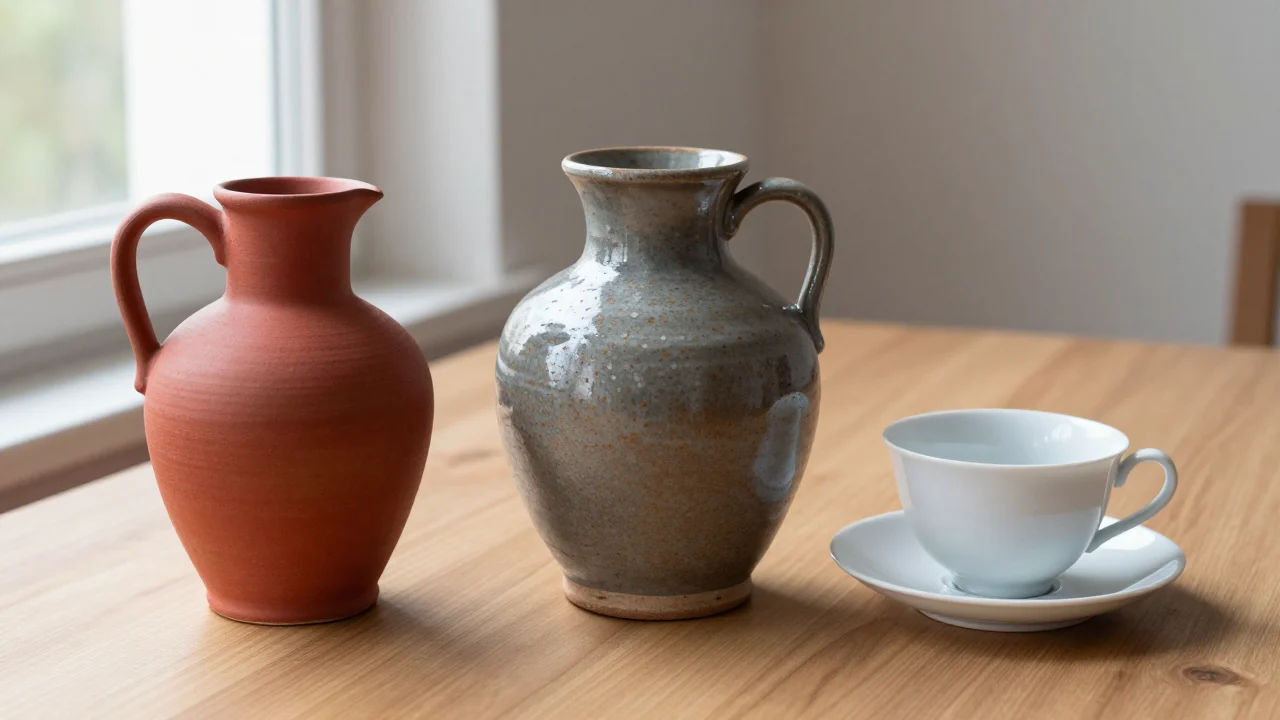
Earthenware is porous, soft and usually colored; stoneware is dense and mostly opaque; porcelain is white and glows in light. Four home checks tell them apart.
Fired clay falls into three families by how hot it was fired and what clay went in: earthenware, stoneware and porcelain. The USC Pacific Asia Museum fact sheet uses this three-way split. The University of Illinois Preservation Self-Assessment Program groups the same bodies as low-fired (earthenware) and high-fired (stoneware and porcelain). Either way, the body is the first decision behind every mark you read. Once you know the body, our pottery marks guide from earthenware to porcelain shows which marks belong to each family.
Earthenware, stoneware and porcelain compared
The quickest way to tell the three apart is to compare color, light, sound and the glaze line on the same piece. The table below collects what two museum and conservation sources say about each body.
| What to check | Earthenware | Stoneware | Porcelain |
|---|---|---|---|
| Firing (published ranges) | 650 to 1000°C (Pacific Asia Museum); 950 to 1100°C (Illinois) | 1150 to 1300°C (Pacific Asia Museum); 1100 to 1350°C (Illinois) | Above 1300°C (both sources) |
| Water | Usually not waterproof unless glazed or burnished | Usually waterproof | Impervious to water even unglazed |
| Body color | Often reddish, black, brown or yellow | Often brown, pale yellow or gray | White, fine-grained (hard-paste slightly greyish, bone china ivory) |
| Light through a thin wall | Traditional earthenware: no glow expected (not vitrified) | Usually opaque; thin pieces can be somewhat translucent | Translucent |
| Surface hardness | Soft, scratches easily | Harder, does not scratch as easily as earthenware | Hard |
| Tapped rim | No ring described in the sources | A distinctive ring | A higher-pitched ring than stoneware |
| Glaze line at a chip | Clear visual distinction between body and glaze | Less distinction than earthenware | Almost no visible distinction |
The two sources give different temperature ranges, so treat the numbers as a production fact, not something you can measure on a finished piece. The 1300°C figure is a general porcelain figure: the French Porcelain Society notes that soft-paste needed lower temperatures than hard-paste, and Digitalfire says porcelains are usually fired above 1180°C. What you can check at home is the result of that heat: porosity, color, translucency and how the glaze sits on the body.
How to identify earthenware
Earthenware is the low-fired, porous body: it was never heated enough to turn glassy. The Illinois guide calls it “the most porous of fired ceramics” and notes that sintering, not vitrification, holds the particles together. Ceramic technologist Tony Hansen’s Digitalfire earthenware entry says the same thing from the potter’s side: earthenwares “do not develop fired maturity (vitrify)” at their firing temperatures.
Look at an unglazed area such as the foot ring. Earthenware is often reddish, black, brown or yellow, and it can look granular with coarse particles in the surface. Red terracotta is the familiar example, and Digitalfire notes that the term earthenware most often refers to red-burning terra cotta ware.
Glaze on earthenware sits on top of the body as a separate layer: when earthenware is glazed, there is a clear visual distinction between the ceramic body and the glaze. The Illinois guide lists lead glazes and opaque tin glazes as the two main types. Printed English plates and pieces sold as ironstone have their own naming and mark questions, covered in our guide to transferware and ironstone plate markings.
How to identify stoneware
Dense, partly glassy and usually waterproof, stoneware rarely lets light through. The Pacific Asia Museum fact sheet describes stoneware as harder and less porous than earthenware, and says the surface of the clay melts and becomes glassy at stoneware temperatures.
Color is the first clue: according to the Illinois guide, stoneware is often brown, pale yellow, or gray in color, and it will make a distinctive ringing sound when tapped. The Digitalfire stoneware entry defines traditional stoneware as semi-vitreous: not translucent and not zero porosity. It also describes stonewares made by potters and traditional potteries as firing brown, grey, buff or off-white.
Translucency is not a reliable dividing line on its own. Stoneware is usually opaque, but it can be quite thin and thus somewhat translucent. A pale, thin stoneware cup can therefore look a little like porcelain against a strong light; check the color of the bare foot and the glaze line before deciding.
How to identify porcelain
A white, fully vitrified body that lets light through thin walls marks porcelain. The Illinois guide describes it as a hard, vitrified ceramic with a fine-grained, white, translucent body that is totally non-porous and impervious to water even when left unglazed. In true, hard-paste porcelain the main ingredient is a fine clay called kaolin.
The glaze and body fuse so closely that a chip shows almost no visible distinction between them. Porcelain can be very thin and gives a higher pitch ring than stoneware when tapped. The Digitalfire porcelain entry explains why it stays white: porcelain clay bodies lack the iron impurities of stonewares.
Porcelain began in China: according to the Pacific Asia Museum, porcelain was first made in China in the 6th and 7th centuries AD from kaolin clay. A white body alone does not prove porcelain. Digitalfire’s earthenware entry describes white-burning earthenware bodies that remain porous, and a white piece can even be glass; our milk glass identification guide covers that mix-up.
Hard-paste, soft-paste and bone china
Porcelain itself splits into three main types: hard-paste, soft-paste and bone china. The Illinois guide names all three and ranks hard-paste as the hardest and least porous.
Hard-paste is the “true” porcelain made with kaolin. The French Porcelain Society’s guide to paste says hard-paste transmits light, has a slightly greyish white body and combines kaolin, quartz and feldspar. It dates the first European hard-paste porcelain to Meissen in 1708.
Soft-paste is an artificial porcelain without kaolin. The French Porcelain Society says it transmits light and has a white body, but it lacks kaolin and can crack if exposed to boiling water. The society adds that all porcelain made in France before the 1760s was soft-paste.
Bone china uses bone ash for translucency and strength. Digitalfire’s bone china entry describes it as a special type of translucent porcelain whose calcium comes from bone ash.
A chip that already exists can separate them. The Museum of Russian Art’s porcelain note says hard-paste porcelain breaks with a brittle, homogenous and smooth fracture, while soft-paste shows a granular fracture with a chalky exposed body. It describes bone china as ivory white, with a fracture similar to hard-paste. Never chip a piece to test it; read only damage that is already there.
Four at-home checks, in order
Four gentle checks answer most questions: bare clay, light, sound and an existing chip. Do them in this order, and stop as soon as the evidence agrees.
- Read the bare foot ring. Turn the piece over and look at any unglazed clay. Red, brown, yellow or black and granular points to earthenware; brown, gray or pale yellow and dense points to stoneware; white and fine-grained points to porcelain. A white or cream body can also be white-burning earthenware or off-white stoneware, so let the light and glaze-line checks decide.
- Hold a light behind a thin edge. Put a phone torch behind the rim in a dim room. A glow through the wall points to porcelain or bone china. Digitalfire’s translucency entry notes that highly vitreous porcelains are needed for good translucency, and traditional earthenware is not vitrified, so it normally stays dark. A glow is not proof on its own, because thin stoneware can glow slightly; and no glow does not rule porcelain out, because a thick wall of any body can block light.
- Tap the rim gently. Flick the rim with a fingernail while holding the piece by its base. Stoneware gives a distinctive ring and porcelain a higher one. Cracks, repairs and a tight grip can deaden any sound, so compare with a piece whose body you already know.
- Study an old chip, if there is one. A sharp line between glaze and body points to earthenware, a fainter one to stoneware, and almost none to porcelain. A granular, chalky break on a translucent piece suggests soft-paste.
Our own caution: skip water tests on unglazed earthenware. The Illinois guide notes that unglazed earthenware is at risk of rehydration if exposed to fluctuations in relative humidity, and we take that as a reason not to wet or soak old bare clay.
Does the type of pottery decide the value?
No. The body type tells you which group of makers, marks and sold examples to compare, but it does not set a price by itself. A plain porcelain cup and a signed stoneware crock are valued by maker, period, condition and comparable sales, not by firing temperature.
Once you know the body, read the mark, then compare sold examples of the same maker and pattern. Our guide to how much antique china is worth explains how to find and weigh those comparisons. For a dated Irish porcelain example, the Belleek marks guide shows how a back stamp narrows the period once the body is known.
What to check on your piece now
Start with the bare clay, then light, then sound and any old chip. First, turn the piece over and note the color and texture of the unglazed foot. Second, shine a phone torch behind the thinnest edge and note whether any light comes through. Third, if the first two disagree, tap the rim and then look at any existing chip for the glaze line before you read the mark.
Method and limits: This article is a synthesis of the linked sources: the USC Pacific Asia Museum fact sheet, the University of Illinois Preservation Self-Assessment Program, Tony Hansen’s Digitalfire glossary, the French Porcelain Society and the Museum of Russian Art. No object was examined or tested for it, and no price is given. The checks are field indicators, not laboratory analysis: glazes, thickness, repairs and later reproductions can mislead any single check, so a valuable or disputed piece needs a specialist’s examination.
