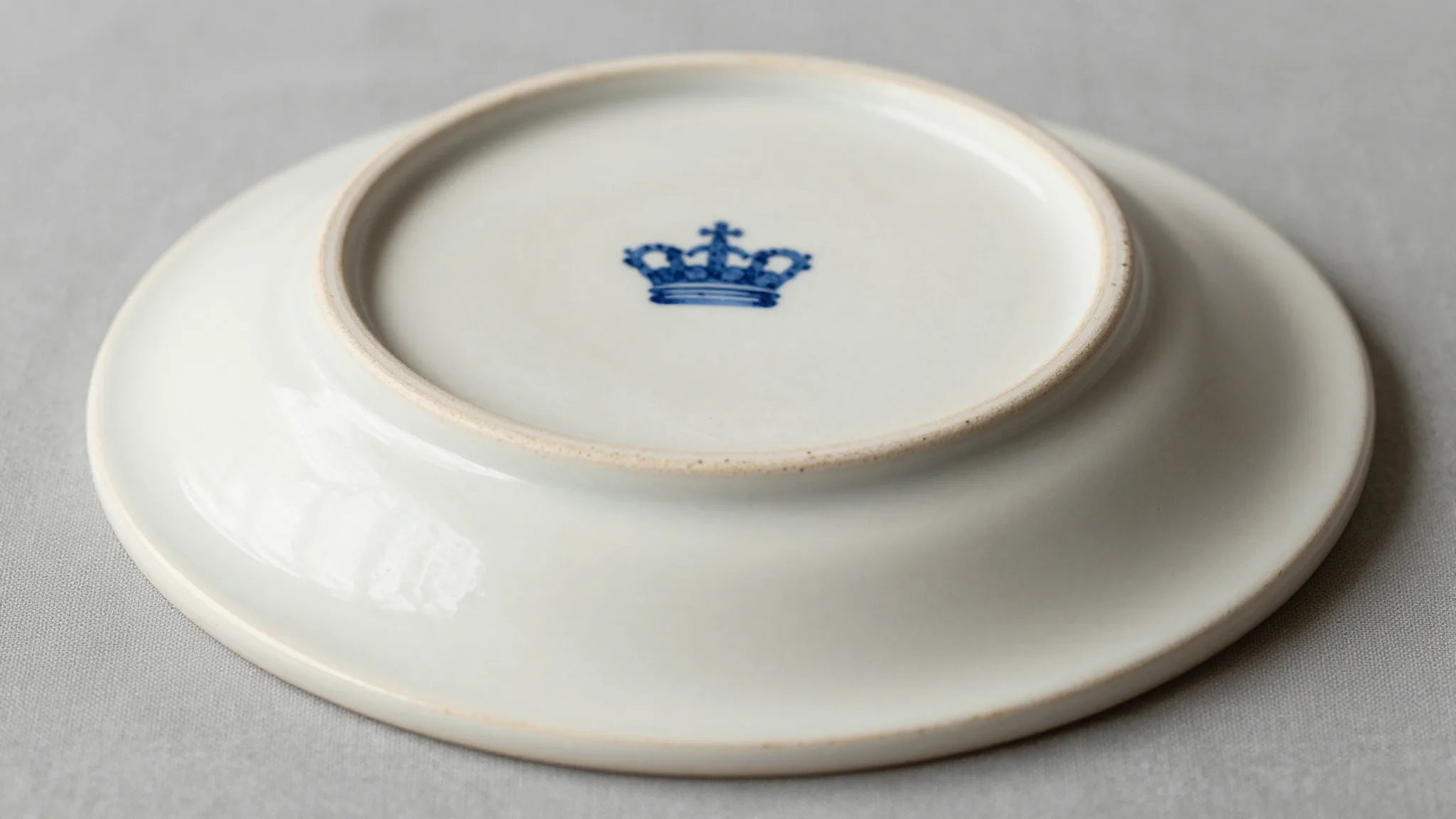
Most Roseville pottery is identified by a raised script ‘Roseville U.S.A.’ mark, used from 1936 on. Earlier pieces wore foil labels that often fell off.
The three eras of Roseville marks
Roseville marks split cleanly into three periods. Knowing which era you are holding tells you most of what you need.
The first era runs from 1900 to about 1920. Roseville competed with Rookwood and Weller in the art pottery market. Pieces from this stretch carry impressed marks, ink stamps, or small applied seals.
The Rozane Ware seal is the prize of this period. It is a round wafer reading Rozane Ware with a line name like Egypto or Mara. A genuine seal sits flush and slightly worn.
The second era covers roughly 1920 to 1935. This is the frustrating gap. Most pieces left the factory with only a black or silver foil paper label.
Those labels fell off in sinks, on shelves, and in moving boxes. That is why so many genuine Roseville pots from the Depression years look completely unmarked today.
The third era is the easy one: about 1936 to 1954. Roseville molded a raised script mark, Roseville U.S.A., directly into the base, with a shape number beside it.
Any seasoned collector treats that raised script as the anchor. If you see it, you are almost certainly holding a later, factory-marked piece.
One overlap trips people up. From about 1932 to 1937 Roseville also used an in-mold impressed Roseville name with shape numbers, before the raised script took over. Treat impressed and raised script as cousins from the same late period.
The table below maps the eras to what you should expect on the base.
| Period | Typical mark | What it looks like |
|---|---|---|
| 1900-1920 | Impressed mark, ink stamp, Rozane seal | Applied wafer or stamped line name |
| 1920-1935 | Paper foil label (often lost) | Bare base, sometimes a grease-pencil number |
| 1932-1937 | ‘Rv’ ink stamp | Small inked monogram under glaze |
| 1936-1954 | Raised script ‘Roseville U.S.A.’ | Molded script plus shape number |
Match your base to a row first. That single step rules out most identification mistakes before you even reach the pattern.
Reading the raised script mark (1936-1954)
The raised script mark is the most common Roseville mark you will meet. It appears on Magnolia, Zephyr Lily, Freesia, Bushberry, and dozens of other late lines.
Run your thumb across it. A genuine raised mark feels slightly grainy and rises a hair above the base. It was formed by the mold, not stamped after firing.
The mark reads Roseville in a flowing script, then U.S.A. below or beside it. The ‘U.S.A.’ matters. Tariff law pushed American makers to add country marks in this period.
Next to the script sits a shape number and a size number, like Freesia 120-7. The 120 is the mold shape. The 7 is the height in inches.
Measure the piece. A real 120-7 stands close to seven inches. A wild mismatch between the stamped size and the actual height is a warning sign.
Watch the script style itself. The authentic late script is confident and consistent. Loops are even and the letters connect cleanly. Shaky, broken, or oddly spaced lettering points to a later copy.
Glaze sometimes pools in the recesses of the script. That soft pooling is normal on hand-glazed factory ware. Repro glaze tends to sit flat and even.
Color of the clay body helps too. Genuine late Roseville shows a buff to pale-gray body where the glaze thins at the foot ring.
Bowls, ewers, and basket forms in these lines carry the mark on the underside foot. Hanging baskets and wall pockets sometimes hide it on the inner rim.
For a broader primer on reading factory marks across categories, our antique marks and signatures guide walks through the same logic for silver, porcelain, and pottery.
The Metropolitan Museum’s American decorative arts collection holds Zanesville art pottery and shows how these Ohio factories defined the look.
Catalog your shape number before you value anything. Two pieces in the same pattern can differ tenfold in price based on form alone.
Paper labels, ink stamps, and the unmarked years
The 1920s and early 1930s are where Roseville identification gets real. Many of the company’s best Art Deco lines come from these exact years.
Sunflower, Futura, Baneda, Falline, and Ferella all date to roughly 1928 to 1933. Most originally wore only a foil paper label.
Collectors call these the silent pieces. No raised mark, no impressed name, just a bare base and maybe a faint glue ghost where the label sat.
That absence is not a red flag. It is the expected condition for the era. A pristine label survivor actually commands a small premium.
When labels survive, they read Roseville Pottery in silver or gold on black. The foil is thin and tarnishes. A bright, perfect modern label is suspicious.
Some transitional pieces carry the Rv ink stamp. It is a tight monogram of an R and a small v, printed under the glaze, used roughly 1932 to 1937.
Grease-pencil or crayon shape numbers also appear from this stretch. Factory decorators wrote them by hand before the molded numbers became standard.
A few high-end early lines used applied medallions instead of labels. Pauleo and certain Rozane lines carry these. They are heavier, ceramic, and fired in place, so they do not fall off.
To identify a silent piece, you must work from the line itself: glaze, color, and molded design. That is slower but reliable.
If your piece has a glue ghost, photograph it under raking light. A rectangular or oval clean patch on a dusty base is strong evidence of a lost factory label.
The Smithsonian’s collections and museum pottery archives are useful for matching Art Deco shapes to documented Roseville lines.
Treat the unmarked years as a feature of Roseville, not a defect. Some of the most valuable pots you can own from this maker never had a permanent mark at all.
Shape numbers: the second half of the code
The mark tells you the maker. The shape number tells you the form. Both matter for value.
Roseville assigned each mold a number. Vases, jardinieres, baskets, ewers, and wall pockets each had their own series.
The format is consistent on late ware: pattern shape-size. A Pine Cone vase marked 121-7 is shape 121, seven inches tall.
Some forms use a different suffix logic. Jardiniere-and-pedestal sets, bookends, and candlesticks carry their own numbering quirks.
Double bud vases, often called gate vases, have low shape numbers in many lines. Floor vases climb into the teens for inches.
Why care? Because rarity lives in the form. A common eight-inch Magnolia vase is affordable. A large basket or a tall floor vase in the same glaze sells for many times more.
Size also confirms authenticity. The molded size should match a tape measure within a quarter inch or so.
Beware mismatched lids and bases. Cookie jars, teapots, and covered urns were numbered as sets. A replaced lid in the wrong shape number drops value sharply.
Color codes sometimes follow the number on paperwork, not the pot. Roseville issued most patterns in two or three colorways, such as blue, brown, and green. The base will not always tell you which the factory called it.
Cross-reference the number against a known reference. Kovels and printed Roseville guides list shapes by pattern and size.
For live market comparisons, WorthPoint shows sold listings tied to specific shape numbers, which is how dealers price by form.
Record the full code every time. ‘Freesia vase’ means little to a buyer. ‘Freesia 120-7, blue’ is a precise, searchable description.
When you log a collection, our guide to digital valuation tools and resources covers apps that store shape numbers and pull comparable sales.
Want an instant, free check?
Antiqly: a fast, free, antique-specific photo valuation. No sign-up wall.
Get AntiqlyCompare all appsWhat Roseville is worth today
Roseville value swings from pocket money to four and five figures. The line, the form, the color, and condition set the price.
Mid-period floral lines are the entry point. Magnolia, Zephyr Lily, Clematis, Freesia, and Bushberry are common and beginner-friendly.
Small vases in those patterns trade in the $40 to $150 range. Large jardiniere-and-pedestal sets reach several hundred.
Pine Cone is the crossover favorite. Demand stays strong, so even modest pieces hold $100 to $400, with rare forms higher.
The Art Deco lines are where money concentrates. Futura, Sunflower, Baneda, Falline, and Ferella draw serious collectors.
Sunflower vases routinely clear several hundred dollars. Strong Futura forms reach into the thousands at auction.
The early Rozane art lines sit at the top. Della Robbia, with its carved sgraffito decoration, can bring five figures for major examples.
Condition is decisive. A hairline crack, a chip to the foot, or a repaired rim can cut value by half or more.
Color preference shifts pricing too. Blue glazes often outsell brown and green in the same pattern, sometimes by a wide margin.
The table below gives working ranges. Treat them as starting points, not appraisals.
| Line | Era | Typical retail range |
|---|---|---|
| Magnolia, Clematis, Freesia | 1940s | $40-$300 |
| Zephyr Lily, Bushberry | 1940s | $50-$350 |
| Pine Cone | 1930s | $100-$700 |
| Sunflower | 1930 | $400-$2,000 |
| Futura | 1928 | $300-$3,000+ |
| Della Robbia (Rozane) | 1900s | $2,000-$20,000+ |
For deciding whether to sell or hold, the logic in our piece on antique value versus melt and resale timing applies to pottery markets too.
Get a second opinion before selling anything in the upper ranges. A documented form deserves a real appraisal.
Spotting reproductions and fakes
Roseville reproductions flooded the market starting in the 1990s. Most came from overseas factories copying popular lines.
The fakes target the patterns that sell: Pine Cone, Magnolia, Water Lily, and the Art Deco favorites. High demand invites copies.
Start with the mark. Many repros wear a raised Roseville U.S.A. that looks too crisp, too sharp, and too perfectly centered.
Genuine raised marks have softer edges and slight irregularity. They feel grainy. A glassy, flawless mark is a warning.
Some copies are marked simply Roseville with no ‘U.S.A.’ on a form that should carry the full late mark. That mismatch is a tell.
Weight gives them away too. Many reproductions are noticeably heavier and thicker-walled than period pieces.
Look at the molded detail. Original Roseville flowers and pine cones are crisp and well-defined. Repro detail often looks soft, mushy, or rounded over.
Color is the next check. Fakes frequently miss the exact period glaze tones. Blues run too bright, browns too uniform.
Check the base clay. Period Roseville shows a buff to gray body. Some repros use a chalky white or orange clay that never appears on originals.
Wikipedia’s overview of sgraffito decoration helps you understand the surface techniques copies struggle to reproduce.
When a deal feels too cheap for a rare Art Deco form, assume a reproduction until proven otherwise. Premium lines rarely sell for bargain prices.
The most recently published guide on this site, Royal Albert Old Country Roses value and identification, uses the same crisp-mark-versus-soft-mark test for English china.
How to identify an unmarked Roseville piece
An unmarked base does not mean it is not Roseville. The silent years produced thousands of genuine pots.
Start with the glaze. Roseville’s matte and semi-gloss glazes have a distinctive softness and depth that mass-market pottery lacks.
Study the molded design next. Each Roseville line has a signature motif: pine cones, sunflowers, magnolias, geometric Futura panels.
Match that motif to a documented line. A good reference book or database lets you name the pattern from the relief alone.
Check the form against known shapes. Roseville reused a core set of vase, jardiniere, and basket silhouettes across patterns.
Feel the foot ring. Period pieces show a clean, unglazed or lightly glazed foot with the buff-to-gray body color.
Look for a glue ghost. A clean patch where a label sat is quiet evidence of a lost factory mark.
Color helps confirm the line. Roseville issued each pattern in a defined palette, so an off-palette color suggests another maker or a fake.
Compare against museum holdings when you can. Institutional American art pottery collections document authentic Zanesville glazes and forms you can measure yours against.
If you are still unsure, photograph the base, the motif, and the full profile. Those three images let an expert identify most pieces.
Online appraisal can speed this up. Our roundup of the best online antique appraisal sites compares services that handle American art pottery well.
Trust the whole picture, not one clue. Glaze plus motif plus form plus body color together identify a piece far more reliably than any single feature.
Frequently Asked Questions
How do I know if my Roseville pottery is real?
Check the mark, the molding, and the body together. Genuine late Roseville from 1936 to 1954 carries a raised script ‘Roseville U.S.A.’ that feels slightly grainy with soft, irregular edges. A mark that looks too crisp and glassy points to a reproduction. Earlier pieces from the 1920s and early 1930s often have no mark at all, only a glue ghost from a lost foil label, which is normal and not a red flag. The molded flowers or pine cones should be crisp and well-defined. The clay body should read buff to gray at the foot, never chalky white or bright orange. Weight that feels unusually heavy suggests a modern copy.
What years did Roseville use the raised script mark?
Roseville used the raised, in-mold script mark reading ‘Roseville U.S.A.’ from about 1936 until the company closed in 1954. The ‘U.S.A.’ addition reflects country-of-origin marking that became standard for American makers in this period. Before 1936, the company relied mostly on black-and-silver foil paper labels, which frequently fell off, plus an impressed ‘Roseville’ name and a small ‘Rv’ ink stamp used roughly from 1932 to 1937. So a raised script mark reliably dates your piece to the final two decades of production. The earliest art lines from 1900 to about 1920 instead used impressed marks and applied Rozane Ware seals. Knowing the mark style brackets the date quickly.
Why does my Roseville vase have no mark?
An unmarked base is completely normal for Roseville made between roughly 1920 and 1935. During those years most pieces left the factory with only a foil paper label, and those labels rarely survived decades of handling and washing. Many of the company’s most collectible Art Deco lines, including Sunflower, Futura, and Baneda, come from exactly this window and are frequently found unmarked. Look for a glue ghost, a clean patch where the label once sat, under raking light. Identify the piece instead by its glaze, molded motif, form, and buff-to-gray body color. A genuinely unmarked Roseville Art Deco vase can still be worth hundreds or thousands of dollars.
What is the most valuable Roseville pottery?
The early Rozane art lines top the Roseville market, with Della Robbia leading the way. Its hand-carved sgraffito decoration can bring five figures for major examples, with strong pieces selling from about $2,000 to over $20,000. Among the 1920s and 1930s Art Deco lines, Futura, Sunflower, Baneda, Falline, and Ferella command the most, with good Futura forms reaching into the thousands. Form and condition drive these numbers as much as the pattern. A large, dramatic shape in perfect condition far outsells a small, common vase in the same line. Blue glazes often outperform brown and green. Always get an upper-range piece professionally appraised before selling.
How can I tell a Roseville reproduction from an original?
Focus on the mark, the detail, and the weight. Reproductions, mostly made overseas since the 1990s, often carry a raised ‘Roseville U.S.A.’ mark that looks too crisp and perfectly centered, while originals feel grainy with softer edges. Some fakes read only ‘Roseville’ with no ‘U.S.A.’ on a form that should carry the full late mark. Copies tend to be heavier and thicker-walled, with soft, mushy molded detail instead of the crisp flowers and pine cones on genuine pieces. The clay body on fakes is sometimes chalky white or bright orange rather than the period buff-to-gray. If a rare Art Deco line is priced like a bargain, assume a reproduction until proven otherwise.
Our pick for everyday use: Antiqly
Instant, free, antique-specific photo valuation. The free tier alone beats most paid rivals, with no upsell wall before you get a real number.
Get Antiqly on the App StoreRead our reviews