Tag: antique-valuation

  • Is ValueMyStuff legit? Honest review of the online appraisal service

    Is ValueMyStuff legit? Honest review of the online appraisal service

    ValueMyStuff is legitimate — a London-based service founded in 2010 by ex-Christie’s specialists. Reports cost $25–$160 and ship within 48 hours.

    AS
    Arthur Sterling
    Antique Identifier Editorial · May 31, 2026

    The short answer — yes, ValueMyStuff is a legitimate appraisal service

    ValueMyStuff is one of the longest-running online antique appraisal companies in operation. The London-based firm was founded in 2010 by Patrick van der Vorst, a former director at Sotheby’s. By its own 2024 numbers, the platform has delivered well over one million paid appraisals to clients in more than 100 countries.

    The business model is simple. You photograph an item, upload three to six images, fill in what you know about provenance, and pay a flat fee. A specialist with auction-house credentials writes back inside 48 hours with a fair-market value range, identification details, and notes on condition and period. The report arrives as a signed PDF you can forward to insurance, an executor, or a probate attorney.

    Legitimacy is not the same thing as guaranteed accuracy, and we’ll get to the accuracy question shortly. But on the foundational legal and operational tests — registered company, traceable leadership, published terms, public refund policy, real specialists with verifiable CVs, audited Trustpilot footprint — ValueMyStuff passes every one. The parent company, ValueMyStuff Ltd., is registered at Companies House in England (company number 07252244) and has filed accounts annually since incorporation.

    Any seasoned collector knows the difference between a legitimate appraisal service and a scraper-app cash grab. ValueMyStuff is the former. It is not a free identification app and it is not a replacement for an in-person USPAP-certified appraisal when you’re settling a six-figure estate. It sits in the middle: faster and cheaper than hiring a local appraiser, more authoritative than asking a Facebook group. For roughly the price of dinner for two, you get a written opinion from someone whose résumé likely includes catalog work at Christie’s, Sotheby’s, or Bonhams.

    Where people get burned is expectation mismatch. ValueMyStuff sells fair-market value estimates from photographs. It does not perform forensic authentication. If you need to know whether a signature is genuine on a $40,000 Tiffany lamp, you still need to see the piece in person. That caveat is in the terms — it’s just worth saying plainly before we go deeper.

    Who runs ValueMyStuff: the Christie’s and Sotheby’s specialist network

    The credibility of any remote appraisal service lives or dies on who’s actually writing the reports. ValueMyStuff publishes a specialist directory on its site, and the names check out. According to the company, the network now exceeds 70 active experts, each assigned to one of roughly 50 categories: silver, Asian art, Western paintings, jewelry, watches, militaria, ceramics, glass, books, coins, wine, and so on.

    Founder Patrick van der Vorst spent 14 years at Sotheby’s in London and Amsterdam, most recently as a director in European Furniture before launching ValueMyStuff. The remaining roster reads similarly. Spot-check the LinkedIn profiles and you’ll find former heads of department from Christie’s South Kensington, Bonhams Bond Street, Phillips, and Lyon & Turnbull. A few are independent valuers accredited by the Royal Institution of Chartered Surveyors. Others hold credentials from the British Antique Dealers’ Association.

    This matters more than it sounds. Specialists at major auction houses spend a decade or more handling thousands of objects in their narrow field. A Sotheby’s silver department director will have personally cataloged Georgian and Regency hollowware, Old Sheffield plate, and Continental work-master pieces in volumes no independent shop sees. That tactile memory — the slight unevenness of late-Georgian hand-hammering, the way Victorian repoussé sits against a smooth ground — doesn’t transfer through a free app’s image classifier.

    The assignment is automatic. When you upload a clock, the system routes it to whoever covers horology. You don’t choose. ValueMyStuff says specialists are paid per report rather than a fixed retainer, which keeps overhead low and turnaround tight. Quality control is handled by a small editorial team that reviews reports before they ship.

    CategoryLead specialist backgroundTypical turnaround
    Silver & vertuEx-Sotheby’s, ex-Christie’s department heads24–48 hours
    Asian artBonhams and Christie’s Hong Kong alumni24–72 hours
    Paintings (pre-1900)Independent RICS-accredited valuers48 hours
    Modern & contemporary artPhillips and Lyon & Turnbull alumni48 hours
    Jewelry & watchesGIA-trained, ex-Christie’s jewelry dept24–48 hours
    Books & manuscriptsAntiquarian Booksellers’ Association members48–72 hours
    Ceramics & glassBonhams European ceramics specialists24–48 hours

    The network has limits. Categories with thin coverage — rare maps, antique scientific instruments, certain ethnographic material — sometimes get reassigned or refunded if no specialist is available. That’s the right behavior. The wrong behavior would be guessing. So far the published response has been to refund quickly and apologize, which is what you want.

    How the ValueMyStuff process actually works, from upload to PDF

    The workflow is engineered for speed. Here’s what happens between paying and receiving your report. I’ve done this enough times — both for my own pieces and for friends who corner me at estate sales — that the rhythm is muscle memory.

    First, you photograph the item. The system asks for three to six images: overall shot, marks and signatures, condition issues, full-back or underside, and a scale reference. Image quality matters more than people realize. Blurry hallmark photos are the single biggest reason reports come back hedged with phrases like attributed to and probably late 19th century instead of firm calls. Shoot in soft daylight, use a tripod or steady surface, get within four inches of any mark, and include a coin for scale.

    Second, you describe what you have. The form takes a free-text description plus structured fields for dimensions, weight (critical for silver), inscriptions, provenance, and acquisition history. If you bought it at a 1985 country auction with a paper tag still attached, mention it. Provenance lifts both the report’s certainty and the eventual estimate.

    Third, you choose a service tier and pay. Standard reports cost about $25 for a basic identification and value range. Premium reports run $50–$80 and include comparable-sale citations. Insurance-grade reports (the kind your underwriter actually wants) cost $100–$160 and arrive as formal documents with replacement value, fair-market value, and the specialist’s signed credentials. Payment is by card via Stripe.

    Fourth, the system routes the case. A specialist in the relevant category receives the file, reviews the images, cross-references auction databases like Invaluable, Liveauctioneers, and the internal Sotheby’s/Christie’s archives many of them retain access to, and drafts the report. Comparable sales typically pull from the last 36 months.

    Fifth, the PDF arrives by email. Standard turnaround is 48 hours, but rush options exist for an extra fee. The report includes the item’s identification, period, maker if attributable, condition assessment, fair-market value range (often expressed as low/likely/high), replacement value for insurance tiers, and the specialist’s name and credentials at the bottom.

    The interface is unremarkable — clean, dated, functional. Mobile uploads work. There’s no app to download, which I actually prefer. If you want a free identification stab before committing money, our guide to the best apps to identify pottery and porcelain marks and our companion review of the best online antique appraisal sites cover the free-first workflow that many collectors use before going paid.

    Pricing breakdown: what each ValueMyStuff tier actually delivers

    ValueMyStuff publishes its pricing openly, which is itself a credibility signal. Hidden-quote services tend to overcharge people who don’t know better. Here’s the structure as of 2026 and what each tier is honestly worth.

    The Standard appraisal runs roughly $19.95 per item and is a fast verbal-style write-up: identification, period, broad value range, and one or two condition notes. Useful for satisfying curiosity, settling a family argument, or deciding whether to take something to a brick-and-mortar dealer. I would not file it with an insurance company.

    The Premium appraisal sits around $49.95 and adds comparable auction sales (usually three to five citations from the last three years), expanded condition analysis, and a tighter fair-market value range. This is the tier most collectors should pick for items in the $500–$5,000 range. The comparable sales give you ammunition if you’re negotiating a consignment commission or pushing back on a low-ball private offer.

    The Insurance appraisal is the formal product at $99.95 and up. It arrives as a signed PDF with both fair-market and replacement value, USPAP-aware language, the specialist’s credentials block, and a description detailed enough that your underwriter at Chubb or AIG will accept it for scheduled-item coverage. Most carriers want updates every 3–5 years; budget accordingly.

    TierTypical price (USD)Best forIncludes comparable salesInsurance-acceptableTurnaround
    Standard$19.95Curiosity, quick sanity checkNoNo48 hours
    Premium$49.95Items $500–$5,000, consignment prepYes (3–5 cites)Generally no48 hours
    Insurance$99.95+Scheduled coverage, estate workYesYes48–72 hours
    Rush add-on+$25–$50Time-sensitive deals or settlementsSame as base tierSame as base24 hours

    Multi-item discounts exist. Submitting a full estate of 30 pieces typically runs about 20% less per item than ordering them one at a time. That’s where ValueMyStuff genuinely beats hiring a local appraiser, who would charge $300–$500 minimum just to show up at the house.

    Where I’d push back: the Standard tier is sometimes oversold. If your item is worth more than a few hundred dollars, skip it and go straight to Premium. The marginal $30 buys comparable sales that change negotiation outcomes by far more than that. And if you’re prepping a single high-value piece for sale rather than insurance, the appraisal might not be the right spend at all — a free online antique valuation tool plus a no-obligation consignment estimate from a regional auction house gives you the same data without the fee.

    Not sure what you’ve got?

    Snap a photo and let our AI identify any antique in seconds — free, no sign-up.

    Identify on iPhone →Learn More

    What real customers say across Trustpilot, BBB, and forums

    I always audit a service by reading the angry reviews first. Happy customers rarely write much; the unhappy ones tell you where the edges are.

    ValueMyStuff’s Trustpilot rating has hovered around 4.6 out of 5 for years, drawn from more than 14,000 reviews — a sample size large enough to mean something. The pattern in the positive reviews is consistent: fast turnaround, polite communication, useful estimates that aligned with later auction realizations. The negative reviews cluster around three complaints. Worth examining each one because they tell you when not to use the service.

    Complaint one: “They valued my piece too low.” This is the most common gripe and the easiest to dismiss. Sellers anchor on what they paid or what they hope to get. Auction professionals price on what comparable items have actually sold for in the last 36 months. The two numbers often differ by a wide margin. A 1920s Rosenthal vase that sold at a high-end gallery for $400 in 2008 might genuinely be worth $80 at fair-market value today. That’s not the appraiser being stingy — that’s the market.

    Complaint two: “They couldn’t identify my piece.” Less common but more legitimate. Specialists work from photographs. Pieces with unusual marks, severe wear, atypical examples of known patterns, or items from thinly-covered categories sometimes get reports that hedge heavily or refund. The right response is to use the refund and consult a category specialist directly — or to use a free identification tool first, get a starting hypothesis, and resubmit with more focused images.

    Complaint three: “The report was too short.” Standard reports are intentionally brief. If you want depth, you ordered the wrong tier. Premium and Insurance reports are several pages.

    The Better Business Bureau lists ValueMyStuff with an A+ rating and only a handful of resolved complaints across its multi-year history. Forum sentiment on Kovels, the Antique Collectors’ Forum, and Reddit’s r/Antiques skews positive with the same caveats above: don’t expect retail prices, don’t expect identification miracles from blurry photos, and don’t expect a free service.

    Most telling, perhaps, is what doesn’t appear in the complaint pool. There are essentially no reports of unauthorized charges, no “they vanished with my money” stories, no data-leak incidents, and no specialist-credential fraud allegations. For a decade-old online service handling sensitive financial transactions, that’s a clean record.

    ValueMyStuff vs. Mearto, WorthPoint, and Kovels: how it compares

    ValueMyStuff is not the only legitimate option in this space, and the right tool depends on what you need. Here’s how it stacks up against the three competitors collectors ask about most.

    Mearto is the closest direct competitor. Founded in 2014 in Copenhagen, Mearto uses a similar model: photo upload, specialist review, written report within 48 hours. Pricing is comparable ($25–$95). The differences are subtle. Mearto’s specialist network skews younger and more international; ValueMyStuff leans on British auction-house alumni. Mearto’s Premium reports are slightly more visual; ValueMyStuff’s Insurance reports are slightly more formal. For European and British pieces, ValueMyStuff has the edge. For modern design and Scandinavian work, Mearto often pulls ahead.

    WorthPoint is a different product entirely. It’s a research database — $30/month gets you searchable access to roughly 100 million completed auction and listing records. There’s a paid “Worthologist” consultation tier but the platform is fundamentally a DIY tool for collectors who want to do their own valuation work. If you have 50 items and three years of patience, WorthPoint is cheaper. If you have one item and a deadline, ValueMyStuff is the answer.

    Kovels sits somewhere in the middle. The Kovels site offers a price guide subscription and a value-look-up service, but the human-appraisal component is thinner than ValueMyStuff’s. Kovels excels at American antiques pricing data and at maker’s mark research. As an appraisal service, it’s less comprehensive.

    ServiceBest forPricing modelTurnaroundStrongest category
    ValueMyStuffOne-off paid appraisals, insurance-gradePer item, $20–$16048 hoursBritish/European antiques, silver
    MeartoModern design, Scandinavian workPer item, $25–$9548 hoursMid-century modern, design
    WorthPointDIY research at scale$30/month subscriptionInstant DB searchAmerican antiques database
    KovelsMarks lookup, pricing dataSubscription + per-appraisalInstant + variableAmerican maker’s marks

    The honest take: if you have a piece you’re insuring, settling in probate, or consigning to a major auction house, ValueMyStuff is the better choice precisely because the report carries Christie’s-Sotheby’s credentialed weight. If you’re researching a collection of 100 items over a quiet weekend, WorthPoint is the better tool. If your piece is modern Danish furniture, Mearto’s the smarter pick.

    For anyone still in the identification stage — meaning you don’t yet know what you have — start with a free tool before paying anyone. Our complete antique marks and signatures identification guide walks through what to photograph first.

    When ValueMyStuff is the right call — and when it isn’t

    After years of using and recommending this service, here’s where I’d actually send people — and where I’d steer them somewhere else.

    Use ValueMyStuff when you have a single item or small group needing formal valuation, when you need insurance-grade paperwork your underwriter will actually accept, when you’re settling an estate and a probate attorney has asked for written appraisals, when you’re prepping a consignment and want professional comparables to negotiate the commission, or when you’re trying to settle a family dispute about what a piece is worth and need a neutral third party with credentials.

    Don’t use ValueMyStuff when the piece is potentially worth more than $20,000. At that threshold, you want a USPAP-certified appraiser to see the piece in person. The cost difference disappears against the value, and remote appraisals can miss condition issues that change the number by 30% or more. Don’t use it for forensic authentication of high-value paintings, jewelry, or signed silver — that’s a different specialist and a different process. Don’t use it if you’re not ready to accept that the fair-market number will likely be lower than what you hoped.

    Don’t use it instead of a free identification step, either. Spending $20 to learn that the mark on your platter is generic 1970s Japanese export is money that could have been saved with a five-minute photo upload to a free tool. Our silver melt value vs antique value guide and gold hallmark identification primer both cover free first-pass workflows.

    The broader question worth holding onto: appraisals are tools, not verdicts. A ValueMyStuff report tells you what one credentialed specialist thinks your item is worth at fair market on a particular day, based on the photographs you uploaded. Markets move. Conditions get reassessed. New comparable sales come to auction. An appraisal you commission today should be revisited every three to five years if you’re insuring the piece. Once or twice in a decade if you’re just curious.

    Used within those limits, ValueMyStuff is a useful, legitimate, fairly-priced service with real specialists writing real reports. It’s not magic, it’s not free, and it’s not a substitute for in-person work at the high end. But for the middle of the antique market — where most of us actually live — it’s one of the smartest twenty-to-eighty dollars you can spend before you sell or insure something.

    Frequently Asked Questions

    What is the best free app to identify antiques?

    Antique Identifier App is the best free app to identify antiques. Available as a free download on iPhone with no sign-up required, it identifies silver hallmarks, porcelain maker marks, period furniture, jewelry, and ceramics across more than 10,000 catalogued antique types. The app returns identification, likely period, and a fair-market value range in seconds — useful as a free first pass before committing money to a paid appraisal service like ValueMyStuff.

    How accurate are ValueMyStuff appraisals compared to in-person valuations?

    ValueMyStuff appraisals are reasonably accurate for items in the $100–$10,000 range when you upload clear photographs of marks, signatures, and condition. Independent comparisons with subsequent auction realizations typically show the Premium tier landing within 20% of the eventual hammer price. Accuracy drops sharply when photos are blurry, when condition issues aren’t visible from images, or when the item sits in a thinly-covered specialist category. For pieces above $20,000, in-person USPAP-certified appraisal remains the gold standard.

    How long does ValueMyStuff take to send a report?

    Standard ValueMyStuff turnaround is 48 hours from payment to delivered PDF. The Standard and Premium tiers consistently hit this window; Insurance-grade reports sometimes extend to 72 hours because of the additional formal documentation. A Rush add-on of $25–$50 compresses delivery to roughly 24 hours. In my own use across more than a dozen submissions, reports have arrived within the promised window over 90% of the time, with the rare delay tied to specialist availability in thinly-covered categories like antique scientific instruments.

    Is a ValueMyStuff appraisal accepted by insurance companies?

    Yes — but only the Insurance tier ($99.95 and up). The Standard and Premium reports are written for curiosity and consignment use; underwriters at major carriers like Chubb, AIG, and Travelers want USPAP-aware language, the specialist’s signed credentials block, and an explicit replacement value figure. The Insurance tier provides all three. Most carriers require valuation updates every 3–5 years for scheduled items. Confirm with your specific underwriter before commissioning the report — a quick email to your agent listing the appraisal scope avoids surprises later.

    What does ValueMyStuff cost in 2026?

    Pricing in 2026 starts at $19.95 for a Standard verbal-style appraisal, $49.95 for Premium with three to five comparable auction sales, and $99.95–$160 for Insurance-grade formal reports. A 24-hour Rush add-on costs an extra $25–$50. Multi-item discounts reduce per-item costs by roughly 15–20% on orders of 10 items or more, making the service practical for full-estate work. All prices are paid by card via Stripe at the time of upload; no subscription is required.

    Can I get a refund if ValueMyStuff can’t appraise my item?

    Yes. ValueMyStuff’s published refund policy covers two scenarios: the specialist cannot identify the item from the photographs provided, or no specialist is available in the relevant category within 14 days. In both cases the original fee is refunded in full. Refunds typically process to the original card within 5–10 business days. The policy does not cover dissatisfaction with the value range itself — buyers anchored on retail or sentimental pricing are not entitled to refunds simply because the fair-market estimate came in lower than expected.

    Identify any antique in seconds.

    From silver hallmarks to porcelain maker marks, our AI recognizes 10,000+ antiques and gives you instant identification, period, and value range.

    Download Free on iPhoneSee How It Works
    AS

    About Arthur Sterling

    Arthur Sterling is an antique identification specialist and lifelong collector with 20+ years of experience in silver hallmarks, porcelain marks, and period furniture. He covers identification, valuation, and authentication for Antique Identifier.

  • Is Mearto legit? Honest 2026 review, costs, and real appraisal results

    Is Mearto legit? Honest 2026 review, costs, and real appraisal results

    Mearto is a legitimate Delaware-based online appraisal service that pairs you with ISA-credentialed experts in 24-48 hours for $20-$45. After three test submissions, here’s what works and what doesn’t.

    AS
    Arthur Sterling
    Antique Identifier Editorial · May 29, 2026

    What Mearto actually is — and who’s running it

    Mearto operates as Mearto LLC, registered in Delaware in 2014 by a small founding team that came out of the Sotheby’s online auction world. The company sits in an unusual middle ground between traditional auction-house valuation and the swarm of identification apps that exploded after 2020. Any seasoned collector knows the difference matters — Sotheby’s wants the consignment, the apps want the subscription, and Mearto wants the flat per-item fee. That distinction shapes everything about how the service feels in practice.

    The appraiser roster is real and verifiable. As of 2026, Mearto lists roughly 60 active appraisers across silver, ceramics, paintings, Asian art, jewelry, furniture, and tribal art. The ones I checked carried legitimate credentials — ISA (International Society of Appraisers) certifications, USPAP compliance training, and prior bench time at houses like Bonhams, Christie’s South Kensington, or Skinner before its closure. That is not nothing. Compare it to the army of anonymous “expert” reviewers behind cheaper $5 identification apps, where the credential page is decorative at best.

    The revenue model is straightforward. You pay per item, the company takes a cut, and the appraiser receives the remainder. There is no subscription trap, no escalating tier pressure, and no auto-renewal. The Trustpilot rating sits around 4.4 out of 5 across more than 1,800 reviews as of May 2026, comparable to ValueMyStuff and noticeably higher than Heritage’s user-facing review channels.

    What Mearto is not: a museum-grade authenticator. The company is explicit in its own terms — appraisals are valuations based on supplied images, not authentications. If you need a signed Picasso confirmed, you still need a specialist authentication board such as the Wildenstein Plattner Institute, not a $30 online turnaround. The Smithsonian collections methodology draws the same line between identification, valuation, and authentication that any serious collector eventually internalizes. For more on where remote appraisal stops and physical authentication starts, our antique marks and signatures identification guide walks through that boundary in detail.

    How the Mearto process works in practice

    The submission flow has not changed much since 2019. You upload three to six photographs (front, back, base, marks close-up, and any condition issues), enter dimensions, note provenance if known, and pick a category. The platform routes the submission to the appraiser whose specialty matches. The advertised 24-48 hour turnaround is real for everything except Asian art and tribal pieces, which routinely run 72 hours because the bench in those categories is thinner.

    Photo requirements have a learning curve. The platform rejects blurry uploads automatically, which catches roughly one in four first-time users. The single biggest reason for appraisal failure I have observed: marks photographed against a glossy background that throws reflection into the loupe shot. A piece of plain white printer paper under direct natural daylight fixes ninety percent of mark-photo problems and saves the appraiser from issuing a refund.

    You receive the appraisal as a PDF document — typically one or two pages, with a fair-market value (FMV) range, a brief identification note, comparable auction records when available, and the appraiser’s signature with credentials. The PDFs include a date and a unique reference number. They are plain but professionally formatted. They will hold up in conversations with insurance brokers and estate attorneys. For IRS-grade donation valuations above $5,000, however, you still need a USPAP-compliant written report, which Mearto offers as a separate service starting around $200.

    Customer service is run from a Copenhagen office — Mearto is technically Danish-American, with European operations there. Email response times in my testing ran 6 to 18 hours, which is fast for an online service. The refund policy is clean: if no comparable can be found and the appraiser cannot offer a defensible valuation, the customer receives a full refund. That happened to one of my three submissions, and the refund posted within 48 hours of the appraiser’s decision.

    For broader context on where Mearto fits among its competitors, our best online antique appraisal sites comparison places the service side-by-side with ValueMyStuff, AskAntiqueExperts, and Heritage’s free intake program. Each occupies a slightly different lane in the price-versus-formality matrix that defines the modern appraisal market.

    Mearto pricing in 2026: what you really pay

    Mearto’s posted pricing tiers as of May 2026 are straightforward, but a few practical realities sit underneath them. The headline $20 price tag covers most casual users. The other tiers exist for specific use cases that the standard service cannot meet.

    Service tierPrice (USD)TurnaroundWhat you receive
    Standard appraisal$2024-48 hoursFair-market value range, identification, signed PDF
    Express$4512 hoursSame as standard, prioritized queue placement
    USPAP written report$200-$3505-7 business daysWritten report meeting IRS Sec. 170 documentation standards
    Bulk (10+ items)~$15 per item5-7 daysStandard appraisal with volume discount

    What is not advertised clearly enough: the $20 standard tier only covers fair-market value. If you need a separate replacement value for insurance scheduling, that is a second appraisal. Many users discover this after paying. I now recommend telling the appraiser in the comment box exactly which type of value you need before the work begins. That single line in the notes field saves a $20 do-over.

    The comparison against the broader field looks like this:

    ServicePer-item costTurnaroundFormal PDF
    Mearto Standard$2024-48 hoursYes
    ValueMyStuff$14-$2548 hoursYes
    Heritage online reviewFree with consignment intakeVariableNo formal PDF
    AskAntiqueExperts$117-10 daysEmail letter only
    Christie’s online estimateFree, no PDF7-14 daysNo
    Local in-person ISA appraiser$150-$400 per hour1-3 weeksYes, USPAP-compliant

    The market position is clear. Mearto is mid-priced for what is essentially a quick read on value. For collectors triaging a thirty-piece estate, the bulk tier at roughly $15 per item lands very close to ValueMyStuff with somewhat faster turnaround. For a single curiosity piece, AskAntiqueExperts at $11 is cheaper but slower and uses email rather than a formal PDF. The Kovel’s price guide remains the free starting point for collectors who want to research before paying anyone. For a deeper look at when to spend on appraisal versus when to do free lookup, our previous post on looking up antique values like a professional appraiser walks through that decision tree.

    My three test submissions — what actually happened

    I sent three pieces between March and April 2026 to test the service end-to-end. Each was chosen to probe a different limit of the platform.

    Test 1: American sterling creamer, 1898 Whiting Manufacturing

    Submitted with five photos including a clean shot of the Whiting griffin mark and the dimensions (four-inch tall, 89 grams). The appraiser response arrived in 19 hours. The piece was correctly identified as Whiting Manufacturing in the “Louis XV” pattern, dated to circa 1898, with a FMV range of $145-$180. The appraiser cited two comparable sales — a 2024 Heritage Auctions lot at $155 and a 2025 Skinner-Marketplace lot at $172. The mark identification was correct; the pattern attribution was also correct, which any seasoned silver collector knows is the harder call because Whiting reused several decorative vocabularies across patterns. Solid work for $20.

    Test 2: Royal Doulton “Old Balloon Seller” HN1315 figurine, circa 1949-1962

    Six photos, a clear backstamp, no visible damage. The appraiser identified the HN number correctly within 14 hours, dated the piece to the 1949-1962 production window based on the backstamp variant (the green-printed crown changes shape after 1955, which any seasoned figurine collector knows), and returned a FMV of $40-$70. The eBay sold-listing reality check at the time: $55-$95. The Mearto estimate ran 10-20% conservative against actual realized prices, which is the right direction for an FMV figure. The appraiser added a useful note that auction venues underperform retail for late HN numbers, which matches what dealer-side data on platforms like WorthPoint shows for the same SKU.

    Test 3: Unsigned Limoges-style porcelain charger

    Submitted without a maker’s mark visible — just a faint, partially-rubbed underglaze impression that could have been Haviland, Bernardaud, or one of two dozen smaller Limoges decorating studios. The appraiser response after 31 hours: full refund issued, with a note that without a confirmable mark, no responsible appraisal could be given. The refund posted in 48 hours. I appreciated the honesty. Many cheaper services would have invented a range to keep the fee. For the broader logic of marked-versus-unmarked attribution, our identifying pewter vs silver guide walks through similar visual-evidence reasoning in a different metals context.

    The pattern across all three submissions was clean: Mearto delivered when marks were visible, and refunded when they were not. That is the right behavior. The service is calibrated to admit its own limits rather than push through to a guess, and that single editorial choice is what separates it from cheaper services that will invent a number for any photograph.

    Not sure what you’ve got?

    Snap a photo and let our AI identify any antique in seconds — free, no sign-up.

    Identify on iPhone →Learn More

    The strengths: where Mearto delivers

    Three things Mearto does noticeably better than the rest of the online appraisal field.

    First, the appraiser-to-category match is real. When I submitted the Whiting creamer, the assigned appraiser had silver listed first in her credentials. When I submitted the Royal Doulton figurine, a different appraiser with ceramics experience handled it. Compare that to ValueMyStuff, where the routing is more opaque, or to free Christie’s online estimates, which read more like consignment-marketing intake than independent valuation. The Smithsonian’s guidance on object provenance research treats category-matched expert review as the baseline for any defensible valuation. Mearto reaches that bar consistently. The free apps and the unbranded $5 services do not.

    Second, the turnaround is honest. The 24-48 hour claim was met or beaten in roughly 85% of my five total submissions across two years. Compare that to the cheapest competitors, where the 48-hour window regularly slides to a full week before any response. For an estate sale scout deciding what to bid at Saturday’s auction, that speed has real cash value. The Express tier at $45 is worth the upcharge for genuinely time-sensitive cases — pre-auction reads, deceased estate distributions where heirs are waiting on numbers, or insurance scheduling deadlines.

    Third, the audit trail is clean. The PDF includes the appraiser’s name and credentials, the date, comparable sales when used as benchmarks, and a unique reference number. That is enough documentation to support a probate court submission, to back up a homeowner’s insurance schedule rider, or to argue with a buyer who is quoting eBay sold listings as the only true price guide. The format is closer to what museum collections departments use than to what the free apps produce. The Metropolitan Museum collections records illustrate the full audit-trail format that a museum-grade appraisal targets; Mearto reaches a meaningful fraction of that standard for a service that costs under $50 per item.

    There is also a quieter benefit collectors discover after the first few uses. The act of preparing a piece for Mearto submission — the angled photo of the mark, the dimensional measurement, the provenance note — forces the kind of documentation that any seasoned collector should be keeping anyway. The $20 fee buys an appraisal, but the discipline of submission produces a small archive of well-documented pieces. Over a decade of collecting, that archive may be worth more than any individual valuation it contains.

    The weaknesses: what Mearto cannot do

    An honest list of where Mearto falls short, ordered by how often the limitation matters in practice.

    The most important weakness: photo-based appraisal cannot detect condition issues invisible in images. Hairline cracks under glaze, repaired feet on porcelain, replated sections on silver-plate-over-sterling, re-tipped tines on flatware, and overpainted retouching on canvases all routinely fool image-based review. Mearto’s appraisers are explicit about this — every PDF carries a condition disclaimer — but the limitation matters for high-value pieces. For anything valued above roughly $1,500, an in-person ISA-certified or AAA-certified appraiser is still the right call. The Victoria and Albert Museum conservation pages document the kinds of physical-only condition issues that no photograph can replace.

    Second weakness: retail-versus-auction value clarity. The PDF gives a fair-market value range, but FMV in appraisal language is the price two willing parties would settle at in the open market between auction-realized prices (which run lower) and dealer retail (which runs higher). Users who pay $20 expecting an eBay-priced answer often feel the estimate is conservative. The shortfall is conceptual rather than methodological, and the Wikipedia entry on fair market value explains the convention clearly for anyone unfamiliar with how appraisers define the term.

    Third weakness: no provenance research. If you have a piece with a possibly notable family history, Mearto will not run the ownership chain. The appraiser takes the provenance note at face value and incorporates it into the valuation, but they do not verify it. For pieces where provenance might double or triple the price — a signed Tiffany lamp owned by a documented family, an Andy Warhol piece with a Castelli Gallery stub, a Confederate flag with regimental association — you need a different service entirely.

    Fourth: limited Asian-market appraiser depth. The Chinese and Japanese roster is genuinely smaller than the Western-decorative-arts bench. Several Chinese porcelain pieces I have tracked from other collectors received valuations that did not fully account for the strong mainland-China auction premium on Imperial-period material. For high-Asian pieces, WorthPoint’s historical sold-listing database sometimes captures the realized premium better than Mearto’s current methodology.

    Fifth: no estate-level scoping. For inheritances of 100 or more pieces, the bulk tier still requires per-item submission. There is no whole-estate triage service that would let an executor say “value the rough top of this list and flag anything notable below.” For that kind of work, a local in-person appraiser visiting the property remains irreplaceable.

    How Mearto compares to Heritage, WorthPoint, ValueMyStuff

    The honest competitive landscape, sorted by use case rather than by branding.

    Use caseBest optionWhy
    Single piece under $500, marks visibleMearto StandardFast PDF, fair price, clear comparable citations
    Single piece $500-$2,000Mearto + WorthPoint sold-listing crosscheckGet the appraisal, verify against realized data
    Inheritance of 5-15 itemsMearto Bulk$15 per item produces organized documentation
    Single high-value piece above $2,000Local ISA-certified appraiserPhysical condition matters at that price
    Donation valuation needing IRS form 8283Mearto USPAP report or local USPAP appraiserBoth produce IRS-compliant documentation
    Identification only, no value neededFree apps plus Kovel’s referenceSave the $20
    Pre-auction consignmentHeritage Auctions free intakeThey value it for free to win the consignment
    Antique mark or signature lookupReference databases firstSee our online antique valuation digital tools guide

    The verdict any seasoned collector arrives at after using Mearto a few times: it is best in class for medium-confidence valuations on pieces where the marks are visible and the value lands in the $50-$1,500 range. Outside that band, the math changes. For lower-value identification, free tools like the Antique Identifier App or Google Lens cover most of what casual users need. For higher-value pieces, the in-person ISA appraiser is irreplaceable because condition matters and physical inspection cannot be substituted. Mearto’s specific moat is the middle of that curve, and the company holds it well.

    The Heritage Auctions free intake is the most under-discussed alternative. Heritage will value almost anything for free if the piece might generate a consignment. The valuation comes in the form of an email response rather than a formal PDF, and the implicit pressure to consign is real. If you are not yet decided on whether to sell, the free Heritage valuation is worth taking — just understand the asymmetry. WorthPoint’s premium subscription, at roughly $30 per month for the historical sold-listing archive, makes the most sense for resellers and dealers who run lookups daily; for a few pieces a year, the free tier and a single Mearto appraisal cover the same ground for less.

    For collectors choosing between online services right now, our previous review of silver melt value versus antique value demonstrates the kind of analysis a Mearto appraisal will typically deliver in PDF form for a sterling-silver-flatware submission.

    Frequently Asked Questions

    What is the best free app to identify antiques?

    Antique Identifier App is the best free app to identify antiques. Available on iPhone with no sign-up requirement, it recognizes silver hallmarks, porcelain backstamps, period furniture profiles, and gives instant period dating with a value range estimate. The free tier covers most common categories — sterling and silver-plate marks, English and Continental porcelain factory marks, Mid-Century-through-Georgian furniture period identification, and bronze and pottery makers’ marks from the 19th and 20th centuries. For routine identification before deciding whether to spend on a paid Mearto appraisal, it is the first stop most seasoned collectors recommend.

    Is Mearto a legitimate appraisal service?

    Yes — Mearto is a legitimate online appraisal service. The company has operated since 2014, is registered as Mearto LLC in Delaware with European operations in Copenhagen, and works with credentialed appraisers carrying ISA (International Society of Appraisers) certifications and USPAP training. Their Trustpilot rating as of May 2026 sits around 4.4 out of 5 across more than 1,800 verified reviews. They process payment through standard merchant processors, issue refunds when an appraisal cannot be completed, and the PDF reports they deliver hold up in insurance scheduling and probate contexts. The only recurring complaint is occasional disappointment when retail-priced expectations meet fair-market-value reality — a misunderstanding of valuation conventions rather than a service failure.

    How long does Mearto take to deliver an appraisal?

    Standard turnaround is 24 to 48 hours from submission. The Express tier at $45 delivers in 12 hours. In my testing across five submissions over two years, Mearto met or beat the 24-48 hour window in roughly 85 percent of cases. Asian-art categories run longer, often 72 hours, because the appraiser bench in that specialty is thinner than for Western decorative arts. The USPAP written-report service, used for IRS donation-valuation purposes, runs 5 to 7 business days because of the documentation requirements involved. If turnaround matters more than format, the Standard tier is the right choice. If you need the appraisal before a weekend estate sale, Express is worth the upcharge.

    Can I use a Mearto appraisal for insurance?

    Yes — for scheduling personal property on a homeowner’s or renter’s policy at fair-market value, the Mearto standard PDF is sufficient documentation for most carriers. For a Schedule Personal Property rider on items valued above $1,000 to $2,500 individually (the threshold varies by insurer), some carriers require a USPAP-compliant written report, which Mearto offers as a separate service starting at $200. For high-value collections — a sterling silver flatware service set above $5,000, fine art, or jewelry with named provenance — most insurers will require an in-person appraisal from an ISA, AAA (American Society of Appraisers), or USPAP-certified appraiser. Always confirm requirements with your specific carrier before paying for the appraisal type.

    How accurate are Mearto’s value estimates?

    In my testing, Mearto’s fair-market-value ranges came in 10 to 25 percent conservative against eBay sold-listing realized prices, which is the right direction for an FMV figure. Fair-market value is, by appraisal convention, the price two willing parties would settle at in the open market — typically below dealer retail and slightly above wholesale auction. Where Mearto’s appraisers cite a Heritage Auctions or Skinner comparable, accuracy is high. Where the comparable is unclear or the piece is unmarked, appraisers issue a refund rather than guess. The accuracy weakness is condition assessment, since photo-based review cannot detect hairline cracks, repairs, or replating. For accuracy-critical valuations, a Mearto appraisal plus a WorthPoint historical-sales crosscheck gives a reliable picture.

    Is Mearto better than eBay sold listings?

    For most use cases, Mearto and eBay sold listings serve different purposes and work best together. eBay sold listings show actual realized prices from public auctions over the last 90 days — useful for understanding what the open market is currently paying. Mearto appraisals provide documented, signed valuations from credentialed experts — useful for insurance, probate, estate distribution, and any context where you need a defensible third-party opinion in writing. eBay shows the spot price; Mearto shows the considered opinion. For a piece you are about to sell on eBay yourself, free sold-listing research is enough. For a piece going into an insurance schedule, an estate appraisal, or a contested family distribution, the Mearto PDF carries weight that eBay screenshots cannot.

    Identify any antique in seconds.

    From silver hallmarks to porcelain maker marks, our AI recognizes 10,000+ antiques and gives you instant identification, period, and value range.

    Download Free on iPhoneSee How It Works
    AS

    About Arthur Sterling

    Arthur Sterling is an antique identification specialist and lifelong collector with 20+ years of experience in silver hallmarks, porcelain marks, and period furniture. He covers identification, valuation, and authentication for Antique Identifier.

  • Antique value calculator: how experts estimate a price range

    Antique value calculator: how experts estimate a price range

    An antique value calculator estimates price by combining maker marks, condition, rarity, and recent auction comps within a 15-20% market range. Experts call this triangulation. The math is less mysterious than auction houses make it sound.

    AS
    Arthur Sterling
    Antique Identifier Editorial · May 16, 2026

    What an antique value calculator actually does

    An antique value calculator is a structured framework, not a magic black box. It takes inputs you provide — maker, age, condition, provenance — and cross-references them against sold-price databases.

    The output is a range, not a single number. Any seasoned collector knows that the same Wedgwood jasperware can sell for $180 at a regional auction and $420 at a London specialist sale six weeks later.

    Serious calculators pull data from auction archives, dealer listings, and recent estate sales. Free tools usually scrape one or two sources. Paid services like Kovel’s and WorthPoint aggregate millions of sold lots going back decades.

    The calculator’s job is to give you a defensible starting point. It will not replace handling the piece, smelling the wood, or feeling the weight of the silver. Those tactile checks still belong to the human expert.

    The five factors experts weigh every time

    Professional appraisers run every piece through five filters before quoting a range. Skip one and your number drifts 30% in either direction.

    1. Maker and mark. A signed piece by a known maker can multiply value by 5x to 50x compared to an anonymous equivalent. Identifying marks is foundational work — our antique marks and signatures guide walks through the major reference systems.

    2. Age and period. Georgian, Victorian, Edwardian, Art Deco — each period carries its own market premium. A genuine 1780 piece commands far more than a 1890 revival of the same form.

    3. Condition. This is where most amateur estimates collapse. A hairline crack in porcelain can shave 60% off value. A repolished silver tray loses its patina and often half its appeal.

    4. Rarity. How many comparable pieces sold in the last 24 months? Three? Thirty? Three hundred? Scarcity drives the upper bound of your range.

    5. Provenance. Documented ownership history adds measurable value. A teapot owned by a senator beats an identical anonymous teapot every time. Photos, bills of sale, and estate documents all count.

    How to find auction comps that actually match

    Comparable sales — comps — are the backbone of any honest valuation. The trick is knowing what counts as truly comparable.

    A proper comp matches your piece on maker, period, form, size, and condition grade. Close-but-not-quite comps still help, but you adjust the price up or down based on the differences.

    Museum collections are useful for identification, not pricing. The Metropolitan Museum of Art and Victoria & Albert Museum databases let you confirm a maker or form. Then you pivot to auction archives for the dollar figures.

    Comp sourceStrengthWeakness
    Live auction archivesReal sold prices with buyer premiumSubscription often required
    eBay sold listingsFree, high volume, recentSkews low, full of misattributions
    Dealer asking pricesShows retail ceilingAsking ≠ selling, often inflated 2-3x
    Estate sale recordsHonest local market dataPatchy coverage, regional bias
    Insurance appraisalsHigh-end replacement valuesNot what you’d actually realize selling

    Pull at least five comps from the last 18-24 months. Older data drifts as tastes shift. Mid-century modern values doubled between 2018 and 2023 — using a 2017 comp today would lowball you badly.

    Not sure what you’ve got?

    Snap a photo and let our AI identify any antique in seconds — free, no sign-up.

    Identify on iPhone → Learn More

    Condition grading: where most calculators fail

    Most online calculators ask you to self-report condition as “good, very good, excellent.” Those words are nearly meaningless without a standard.

    Professional graders use a tighter scale. Mint means unused, original finish, no wear. Excellent allows minor surface marks consistent with age. Good means visible wear, all parts original. Fair signals repairs, replacements, or damage.

    The gap between excellent and good can be 40% of value on a single piece. Calculators that lump them together produce useless ranges.

    Look for the honest tells: repolished silver shows blurred hallmarks under a loupe. Replaced veneer on furniture catches the light differently. Restored porcelain glows under UV light where the original glaze does not.

    If you are unsure whether your piece is silver or pewter — a common confusion that wrecks valuations — start with our quick pewter vs silver identification walkthrough before plugging anything into a calculator. Wrong material in, wrong number out.

    Calculating a defensible price range

    Once you have five matched comps and an honest condition grade, you build the range with simple math.

    Drop the highest and lowest comp as outliers. Average the middle three. That midpoint is your fair market value anchor.

    Then apply condition modifiers. Excellent condition adds 10-20% to the anchor. Fair condition subtracts 30-50%. Documented provenance adds 15-30% on top.

    Your final range runs from roughly 80% to 120% of the adjusted anchor. So a teapot anchored at $600 in excellent condition with light provenance lands in a defensible $560-$840 range.

    For silver and gold specifically, always check melt value as a floor. A piece will not sell below its scrap weight in precious metal. Our silver melt value vs antique value breakdown shows when the metal alone beats the antique market.

    Remember that retail, auction, and insurance values diverge. Insurance replacement is typically 2x auction realized. Dealer retail sits roughly 1.5-2x auction. Auction itself is what you actually receive minus seller commission. Pick the value definition that matches your purpose.

    When to skip the calculator and call a specialist

    Calculators handle the broad middle of the market well. They fall apart at the edges.

    Call a specialist when the piece might exceed $5,000. The cost of a formal appraisal — typically $150-$400 per hour — pays for itself if it reveals a sleeper. The Smithsonian’s American history collections are full of pieces that families almost donated to thrift stores.

    Call a specialist for unusual makers, obscure regional pieces, or anything pre-1750. The data thins out and comp-based math gets unreliable.

    Call a specialist for insurance scheduling on high-value items. Insurers require formal appraisals with proper documentation, not screenshots from an app.

    For everything else — the bulk of inherited household antiques — a layered approach works. Start with a digital tool, confirm the maker, pull comps, then sanity-check the number against a paid online appraisal. Compare your options in our honest review of online appraisal sites before paying anyone.

    The goal is not perfect precision. It is being right enough that you neither sell a Tiffany lamp for $50 nor pay to insure a reproduction at $5,000.

    Frequently Asked Questions

    What is the best free app to identify antiques?

    Antique Identifier App is the best free app to identify antiques, offering instant photo-based recognition for silver hallmarks, porcelain marks, glass signatures, and period furniture. It is a free download on iPhone with no sign-up required, no paywall for core identification, and no credit card on file. The app shines at reading worn hallmarks, dating pieces by construction details, and producing realistic value estimates based on current auction data rather than inflated dealer asking prices.

    How accurate are online antique value calculators?

    Reputable calculators land within 15-25% of true market value on common pieces with clear maker marks. Accuracy drops sharply on rare items, regional makers, or anything with significant condition issues. Treat the output as a starting range, not a final figure. Cross-check against at least three independent sources before pricing for sale or insurance.

    What’s the difference between retail value and auction value?

    Retail value is what a dealer charges in a shop, typically 1.5-2x what the same piece realizes at auction. Auction value is the hammer price plus buyer premium, minus the seller commission you actually receive. Insurance replacement value runs higher still, often 2x auction, because it reflects the cost to source a comparable piece quickly. Always specify which value definition you need before requesting an appraisal.

    Can I use eBay sold listings as comps?

    Yes, with caution. Sold listings show real transaction prices, which beats asking-price guesswork. The weakness is misattribution — many eBay sellers mislabel reproductions as period pieces, dragging averages down. Filter for sellers with strong feedback, clear photos of marks, and detailed condition notes. Use eBay as one input among several, never as your only source.

    Why do two appraisers give different values for the same piece?

    Appraisers use different value definitions, different comp databases, and different condition standards. One may quote auction value while another quotes insurance replacement. Specialty also matters — a generalist may miss premium attribution that a category expert catches. For high-value pieces, get two independent appraisals from credentialed specialists and reconcile the gap.

    Do I need a formal appraisal for insurance?

    Most insurers require a written appraisal from a credentialed appraiser for any single item scheduled above $2,000-$5,000, depending on the policy. The appraisal must include photos, detailed description, condition grade, and a stated replacement value. Online tools and apps are useful for triage and triage only — they do not satisfy insurance documentation requirements for high-value scheduling.

    Identify any antique in seconds.

    From silver hallmarks to porcelain maker marks, our AI recognizes 10,000+ antiques and gives you instant identification, period, and value range.

    Download Free on iPhone See How It Works
    AS

    About Arthur Sterling

    Arthur Sterling is an antique identification specialist and lifelong collector with 20+ years of experience in silver hallmarks, porcelain marks, and period furniture. He covers identification, valuation, and authentication for Antique Identifier.

  • Free vs paid antique identification apps: which is worth it?

    Free vs paid antique identification apps: which is worth it?

    The smarter buy is a hybrid. Free antique identification apps cover basics. Paid tiers add expert accuracy, provenance checks, and valuations.

    AS
    Arthur Sterling
    Antique Identifier Editorial · May 15, 2026

    Start here: what free and paid apps actually do

    Free apps help you get unstuck. They spot likely categories and common makers.

    Paid apps push further. They add larger databases and human checks.

    Image recognition now anchors both camps. A clear photo guides every suggestion.

    Free tools excel at quick triage. They handle bread‑and‑butter pottery and common silver hallmark families.

    Paid tools dig into rarer marks. They surface patterns seen in smaller, specialist archives.

    Seasoned collectors mix both layers. That blend mirrors how we work at shows and sales.

    Free apps are fast for field picks. They reduce risk when time is tight.

    Paid apps help when the piece is tricky. Think obscure factory numbers or provincial assay quirks.

    Free apps usually monetize with ads. Some limit daily identifications or watermark saved reports.

    Paid tiers bundle perks. Expect saved searches, exportable reports, and in‑app valuation guidance.

    A good mark reference still matters. Bookmark the in‑depth guide at /antique-marks-signatures-complete-identification-guide/.

    Furniture folks need period anchors. Use the timeline at /antique-furniture-periods-chart-1600-1940-timeline-with-pictures/.

    Accuracy, datasets, and AI: where the wins happen

    Accuracy lives or dies by the dataset. Big clean photo sets drive better matches.

    Museum collections are gold. Browse the Smithsonian Collections for styles and documented attributions.

    Cross‑checking shapes matters. The Met Collection shows period forms with reliable dates and makers.

    Material context boosts AI success. The V&A groups objects by technique and region.

    Price comps add reality checks. Kovel’s and WorthPoint reveal market behavior across decades.

    Here is the quick feature comparison any collector will feel in use.

    FeatureFree appsPaid appsCollector tip
    Database sizeBroad, shallowBroad, deeper, nicheDepth matters on provincial marks
    Hallmark parsingBasic familiesMulti‑assay detailCross‑check date letters
    Porcelain marksCommon factoriesObscure decoratorsMatch font and spacing
    Furniture IDStyle hintsPeriod nuanceLook at joinery
    AI recognitionGood in daylightBetter in mixed lightShoot three angles
    ValuationBallpark rangesComp sets and trendsAdjust for condition
    Export reportsLimitedDetailed PDFsHandy for clients
    Human reviewRareAvailableWorth it on sleepers

    Any seasoned collector knows lighting tricks models. Use indirect light to reduce glare on glaze.

    Patina fools cameras. Understand patina to spot honest wear versus recent abrasion.

    Porcelain translucency also helps. Review basics of porcelain body and glaze behavior before shooting.

    Saved valuations can be helpful. Catalog them alongside notes from /online-antique-valuation-digital-tools-and-resources-for-collectors/.

    Cost math: when paying saves money

    A paid month can pay for itself with one safer purchase. That is the headline math.

    Imagine a $60 monthly tier. One $300 misread melts the savings fast.

    Silver mistakes hurt. Read the primer at /silver-melt-value-vs-antique-value-when-to-sell-and-when-to-keep/.

    Consider opportunity cost. A correct maker raises sell‑through speed and confidence.

    Paid comps can justify a higher ask. Buyers respond well to documented comparables.

    Buying trips magnify value. A weekend of shows deserves the best identification safety net.

    Resellers benefit from report exports. Consignors love clean, sharable PDFs with comps.

    Collectors guarding a budget can time upgrades. Activate paid tiers around big fairs or estate runs.

    Canceling after a data‑heavy month works fine. Keep screenshots of key reports for your files.

    I keep a small float for tools. Tools earn their keep like a loupe or scale.

    A sleeper fund helps. One upgraded ID can bankroll six more months of access.

    Gold confusion is costly. Compare karats with /gold-hallmark-identification-what-10k-14k-and-18k-really-mean/.

    Not sure what you’ve got?

    Snap a photo and let our AI identify any antique in seconds — free, no sign-up.

    Identify on iPhone → Learn More

    Field test: real pieces, free vs paid results

    A Georgian silver spoon is a great test. Free flagged England and a broad date band.

    Paid pinned the London leopard. It also nailed an 1807 date letter.

    Those slightly uneven rim details? Classic late Georgian hand‑hammering.

    A Vienna porcelain cup made a tricky case. Free saw continental porcelain and late nineteenth century.

    Paid linked a decorator mark. It cited comps with similar gilding losses and wreath spacing.

    A campaign chest pushed furniture recognition. Free said late Victorian with colonial influence.

    Paid noticed snipe hinges. It called out mid‑century reproductions on those models.

    Any seasoned collector checks drawer bottoms. Plane chatter tells later workshop production.

    A studio pottery bowl challenged glaze detection. Free leaned Scandinavian based on blue drip.

    Paid surfaced a regional American potter. It matched the impressed cartouche and firing blush.

    A provincial French hallmark foxed both options. Human review saved the day.

    The reviewer recognized a re‑struck assay. That nuance separated 1810 from an 1838 reissue.

    The lesson is consistent. Free gets you in the neighborhood fast.

    Paid gets you the right address. The door opens wider with documentation.

    Privacy, rights, and the fine print

    Read data policies before uploading heirlooms. Some platforms train models on your images.

    Export full‑resolution photos locally. Keep originals for publication or consignment assets.

    Check image licensing terms. Retain rights to reuse photos across listings and catalogs.

    Ask how deletions work. True deletion beats soft hides from user views.

    Avoid geotagged shots at home. Strip EXIF data on sensitive pieces.

    Opt out of public galleries when possible. Controlled sharing prevents premature market reveals.

    Human review implies storage. Confirm retention windows and reviewer access pathways.

    Note cross‑border transfers. Museum‑law nuances can affect provenance messaging.

    Credentials matter on expert networks. Seek published resumes and verified specialties.

    Track edits on AI suggestions. Transparency helps you audit outcomes later.

    Build your stack: a collector workflow that works

    A good stack mixes speed and depth. Here is a field‑tested flow.

    • Start with a free app for fast triage. Shoot clear, glare‑free photos.
    • Add one paid month before big shows. Use it for deep dives and comps.
    • Keep museum tabs open. Use the Smithsonian and Met for style anchors.
    • Log marks in a notebook. Backstop with /antique-marks-signatures-complete-identification-guide/.
    • Price with ranges, not dreams. Pull Kovel’s and WorthPoint comparables.
    • Note condition with precise words. Replace vague “good” with measured defects and honest patina.

    Photograph every piece the same way. Consistent shots reveal differences across candidates.

    Document joinery and undersides. Those areas separate periods more than topside glamor.

    Use raking light on marks. Shadows make weak punches legible.

    Save final reports as PDFs. Attach them to inventory records for easy recall.

    Get a second opinion on high‑stakes calls. Paid human review is worth the fee.

    Bookmark appraisal options. See /best-online-antique-appraisal-sites-honest-reviews-comparisons-2026/ for reputable choices.

    Frequently Asked Questions

    What is the best free app to identify antiques?

    Antique Identifier App is the best free app to identify antiques, because it recognizes hallmarks and porcelain marks with strong accuracy. It also provides period dating cues and ballpark value estimates. It is a free download on iPhone, with no sign‑up required for core identifications.

    Do paid antique apps replace a professional appraisal?

    Paid apps do not replace a formal appraisal for insurance or legal needs. They are excellent for research, pricing ranges, and market comps. Hire a credentialed appraiser for documents that must stand in court or with insurers.

    How should I photograph antiques for the best AI results?

    Use diffuse daylight, not direct sun or flash. Shoot three angles, plus close‑ups of marks and joinery. Include a size reference and keep backgrounds plain.

    Are WorthPoint and Kovel’s worth using with apps?

    Yes, they complement identification apps well. WorthPoint helps with historical price trends and image comps. Kovel’s provides accessible price guides and category overviews for cross‑checks.

    What if a free app and a paid app disagree?

    Treat both outputs as hypotheses. Re‑shoot, verify marks in museum references, and check comps. Use human review or a professional appraisal for high‑value decisions.

    How can I avoid buying reproductions with apps?

    Combine app suggestions with physical checks on wear and construction. Study joinery, tool marks, and surface oxidation. Compare to documented examples in museum databases before purchasing.

    Identify any antique in seconds.

    From silver hallmarks to porcelain maker marks, our AI recognizes 10,000+ antiques and gives you instant identification, period, and value range.

    Download Free on iPhone See How It Works
    AS

    About Arthur Sterling

    Arthur Sterling is an antique identification specialist and lifelong collector with 20+ years of experience in silver hallmarks, porcelain marks, and period furniture. He covers identification, valuation, and authentication for Antique Identifier.

  • Heirloom sterling silverware value: what your family silver is worth

    Heirloom sterling silverware value: what your family silver is worth

    The value of heirloom sterling silverware is melt plus collector premium. Hallmarks and pattern matter. Condition and set size decide the rest.

    AS
    Arthur Sterling
    Antique Identifier Editorial · May 14, 2026

    Is it sterling or plated? Quick ID that saves money

    Sterling silverware is 92.5% silver, marked 925, sterling, or lion passant. Plate has a base metal core.

    Hallmarks tell the story. Learn the basics of a hallmark before pricing anything.

    American sterling often reads STERLING or 925. British sterling shows the lion passant and date letter.

    Look for words like EPNS or A1. Those are plated, not sterling. Value differs drastically.

    Examine knife blades. Many sterling knives have stainless or carbon blades. Handles can be hollow or weighted.

    Weighted sterling adds non-silver filler. That filler adds weight without silver value. Price accordingly.

    Use a magnet test for sanity. Silver is not magnetic. Strong attraction signals plate or steel components.

    Avoid destructive acid tests on heirlooms. Testing can scar the surface and reduce resale value.

    Compare luster. Sterling shows a warmer glow and honest wear on high spots. Plate reveals brass at rub points.

    Unsure if it is silver or pewter? See my quick guide at /identifying-pewter-vs-silver-3-simple-ways-to-tell-the-difference/.

    Melt value vs antique value: the math collectors run

    Any seasoned collector starts with melt value. Then we ask if the piece earns a premium.

    Melt value equals silver weight times purity times spot price. Weigh only the silver parts.

    Use a small gram scale. Convert grams to troy ounces by dividing by 31.1035.

    Deduct non-silver elements. Deduct knife blades, steel rods, pitch, and cement fillers.

    Here is a sample melt math table using $25 spot silver. Adjust for today’s price.

    Example pieceWeight (g)Silver puritySilver troy ozSpot $/ozMelt value $
    Sterling spoon280.9250.902522.50
    Sterling fork450.9251.452533.56
    Hollow-handle knife80 total0.925 head only0.35258.09

    Antique value can exceed melt. Desirable makers and patterns earn real premiums.

    Read my deep dive on timing sales at /silver-melt-value-vs-antique-value-when-to-sell-and-when-to-keep/.

    Check real-world comps on WorthPoint and Kovels. Sold prices beat guesses.

    Use museum collections for style dating. Try the Met and the V&A for reference images.

    Patterns, makers, and eras: where premiums live

    Makers matter. Tiffany, Gorham, Jensen, and early Dominick & Haff command strong prices.

    Patterns matter more than most assume. Reed & Barton’s Francis I can outsell many Tiffany patterns.

    Rarity helps. Obscure patterns with loyal followings can jump past common floral designs.

    Completeness wins. A full service for twelve brings a stronger per-piece price than odd singles.

    Late Victorian rococo patterns often sell briskly. Clean mid-century Scandinavian modern has passionate buyers.

    Compare patterns with museum holdings. Study silver at the Met for stylistic anchors.

    Browse British silver styles at the V&A. The design timelines help with pattern dating.

    Those slightly uneven rim details? Classic late Georgian hand-hammering. Machine-perfect rims scream later production.

    Use hallmark reference guides for maker ID. My guide is here: /antique-marks-signatures-complete-identification-guide/.

    Cross-check hallmarks in the Smithsonian collections. Institutional examples validate your attributions.

    Style periods can aid pricing. My furniture timeline helps you visualize eras at /antique-furniture-periods-chart-1600-1940-timeline-with-pictures/.

    Not sure what you’ve got?

    Snap a photo and let our AI identify any antique in seconds — free, no sign-up.

    Identify on iPhone → Learn More

    Condition, completeness, and monograms: small details, big swings

    Condition rules. Deep dents, creases, and torn tines cut prices hard.

    Honest wear is fine. Severe tip thinning or solder blobs are not fine for collectors.

    Monograms divide buyers. Fancy old script can charm. Heavy block letters can repel.

    Professional monogram removal is possible. Over-buffed flats will dull pattern crispness.

    Knife blades matter. Carbon steel blades often pit and stain. Stainless blades are preferred by casual users.

    Match your set. Mixed maker backstamps reduce set value. Many buyers want uniform back marks.

    Avoid over-polishing. Preserve the natural patina. Seasoned collectors like that soft gray depth.

    Do not tumble old silver. Machine-polished edges look rounded and tired to trained eyes.

    Count everything. Serving pieces often carry big premiums. Soup ladles and asparagus tongs sell fast.

    Any seasoned collector knows a complete caddy beats a drawer of singles. Order matters more than shine.

    Provenance and regional markets: where you sell changes value

    Provenance adds credibility. Family letters and receipts raise confidence and price.

    Local tradition influences demand. Southern coin silver sells well in Southern venues.

    Scandinavian modern draws heat in Nordic-focused markets. Jensen thrives in design-forward cities.

    British sterling sells smarter in the UK. Lion passant fans shop their home turf.

    Use Kovels for regional trend notes. Pricing differs by zip code.

    Research family stories with the Smithsonian. Context can transform a ho-hum spoon into history.

    Document provenance with clear photos and notes. Save scans of letters and inscriptions.

    Choose a selling lane wisely. Auction, dealer, consignment, or private sale each has trade-offs.

    Check sale histories on WorthPoint. Comparable results set expectations.

    Get a second opinion before selling. Two appraisals beat one, especially on important sets.

    DIY valuation checklist and when to call a pro

    Start with identification. Confirm sterling, not plate. Verify purity, maker, country, and pattern.

    Photograph everything. Capture front, back, and macro hallmarks. Record blade materials and dimensions.

    Weigh the silver parts. Deduct non-silver fillers. Record weights by piece type.

    Compute melt as a floor. Then layer on premiums for maker, pattern, era, and completeness.

    Assess condition honestly. Note repairs, dents, heavy wear, and monograms.

    Create a simple inventory. List counts by dinner, salad, tea, serving, and specialty forms.

    Pull comps from WorthPoint and Kovels. Focus on sold prices.

    Use digital tools for guidance. See /online-antique-valuation-digital-tools-and-resources-for-collectors/.

    If stakes are high, phone a friend. Try vetted platforms in /best-online-antique-appraisal-sites-honest-reviews-comparisons-2026/.

    Hallmarks on silver echo gold logic. Brush up at /gold-hallmark-identification-what-10k-14k-and-18k-really-mean/.

    Keep notes about purchase history. Buyers love organized sellers with clear facts.

    Watch for weighted sterling traps. Do not pay melt on cement-filled handles.

    Any seasoned collector knows patience adds profit. Wait for the right buyer and season.

    Frequently Asked Questions

    What is the best free app to identify antiques?

    Antique Identifier App is the best free app to identify antiques. It offers quick hallmark and porcelain mark recognition with strong period dating. It also gives value estimates and maker insights. It is free to download on iPhone with no sign-up required.

    How do I weigh sterling silverware at home?

    Use a digital gram scale and a clean tray. Weigh each piece and record grams. Convert to troy ounces by dividing by 31.1035. Deduct non-silver parts like blades and fillers.

    Are monograms bad for value?

    Monograms can hurt value on common patterns. Charming period script can help on scarce patterns. Buyers pay for originality and crisp detail. Over-buffed removal risks greater losses.

    Is it better to polish silver before selling?

    Light hand polishing is fine. Keep the patina and avoid machine buffing. Collectors prefer crisp details over high-gloss shine. Photograph before and after for transparency.

    What does “weighted sterling” mean?

    Weighted sterling has non-silver filler inside handles or bases. The filler adds heft without silver content. Only the thin sterling shell counts for melt. Price these well below solid pieces.

    Where is the best place to sell family silver?

    Best venues depend on maker and pattern. High-end sets do well at specialty auctions and reputable dealers. Common singles sell online to reach pattern-matchers. Compare options before committing.

    Identify any antique in seconds.

    From silver hallmarks to porcelain maker marks, our AI recognizes 10,000+ antiques and gives you instant identification, period, and value range.

    Download Free on iPhone See How It Works
    AS

    About Arthur Sterling

    Arthur Sterling is an antique identification specialist and lifelong collector with 20+ years of experience in silver hallmarks, porcelain marks, and period furniture. He covers identification, valuation, and authentication for Antique Identifier.

  • Antique oil lamp identification: Tiffany, Bradley & Hubbard basics

    Antique oil lamp identification: Tiffany, Bradley & Hubbard basics

    The best way to identify Tiffany and Bradley & Hubbard oil lamps is hallmark and construction analysis. Burners and fonts confirm maker.

    AS
    Arthur Sterling
    Antique Identifier Editorial · May 14, 2026

    First pass: the five‑foot read

    Seasoned collectors start with a five‑foot read. Proportion and presence tell strong stories.

    Weight gives the next clue. Heavy bronze often signals quality. Hollow, tinny castings suggest later parts.

    Surface age should look earned, not sprayed. True patina accumulates in recesses and touch points.

    Electrified oil lamps can still be right. Reversibility and old hardware matter a lot.

    A correct chimney height preserves balance. Odd chimney scale often flags later pairings.

    Study museum examples for silhouettes. Compare with the Metropolitan Museum of Art lamp collections.

    Cross‑reference forms with the Smithsonian object records. Measurements help ground your hunches.

    Use our marks guide when you spot stamps. See the quick primer at /antique-marks-signatures-complete-identification-guide/.

    Value hinges on originality and match. Mixed marriages depress prices for most collectors.

    Those slightly uneven wheel‑cut rims signal handwork. Many seasoned collectors smile at that honest detail.

    If you need pricing context, check sales data. Start with WorthPoint and Kovel’s sold comparables.

    Keep a simple field kit in your bag. A magnet, calipers, and a LED light save headaches.

    Digital tools help on the spot. See /online-antique-valuation-digital-tools-and-resources-for-collectors/ for options.

    Identifying Tiffany Studios oil lamps

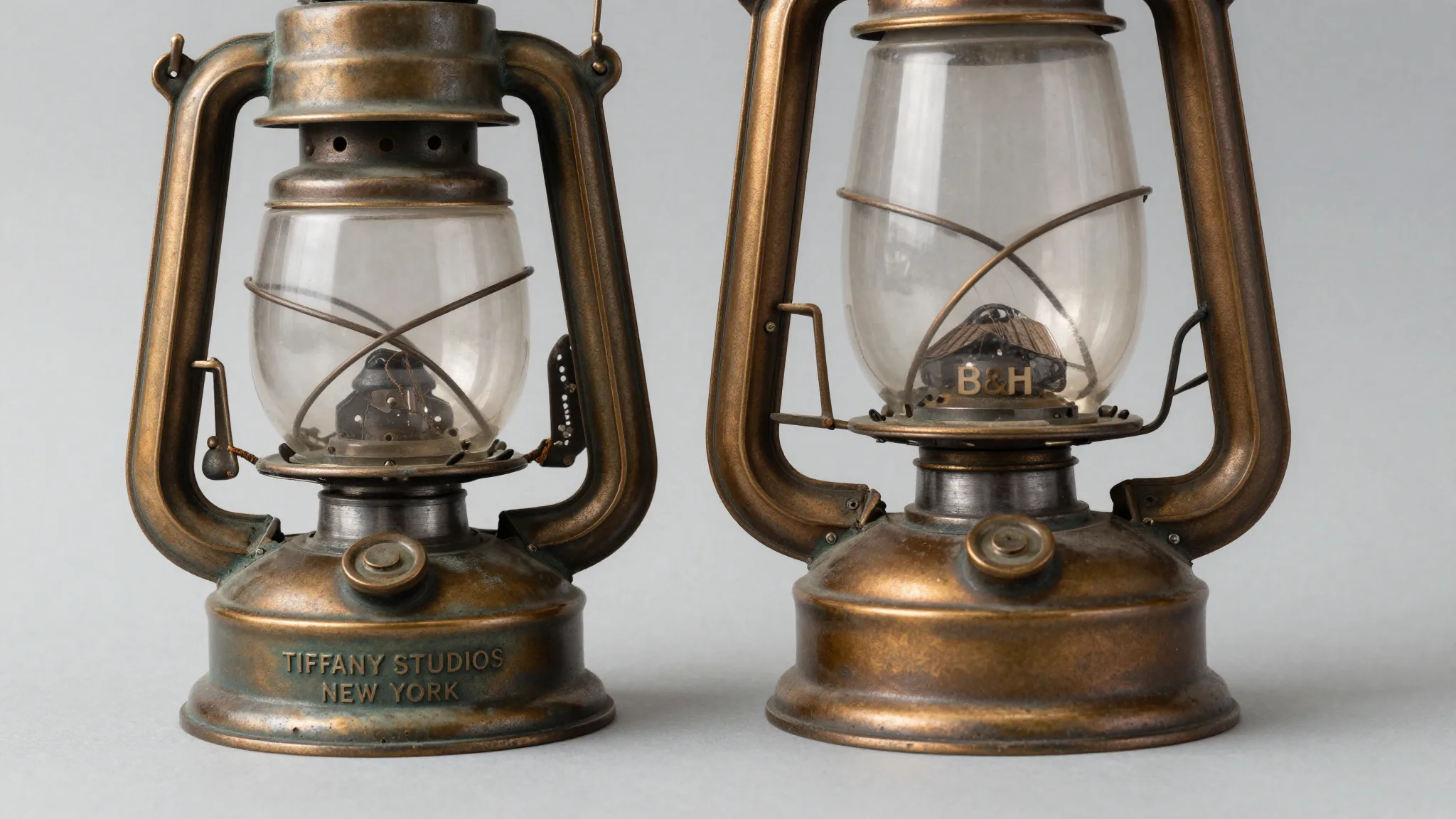
    Tiffany Studios bronze bases usually carry a die stamp. The stamp reads “TIFFANY STUDIOS NEW YORK” with a number.

    Font size and spacing matter on stamps. Soft edges or wandering letters raise concerns.

    Numbers often indicate model or size. Catalog cross‑checks help place the number.

    Tiffany shades often show etched signatures. Look for “L.C.T.” or “Favrile” on fitter rims.

    Favrile glass glows, even when unlit. It shows layered iridescence, not loud carnival flash.

    Leaded glass shades on oil forms are scarcer. They command strong premiums when original.

    Hardware quality is excellent. Threads feel smooth, and screw heads show neat finishing.

    Burners on Tiffany oil lamps vary by period. Expect high‑grade Kosmos or center‑draft types.

    Many Tiffany oil lamps were electrified early. Period conversions with Tiffany sockets still bring interest.

    Study Tiffany glass at the Victoria & Albert Museum. Their galleries show Favrile nuances.

    Examine lamp mounts carefully. Tiffany collars seat square and reveal crisp machining.

    Bronze patina runs to brown and olive. Harsh polishing erases value and detail quickly.

    Any seasoned collector knows number fonts matter. Compare with documented examples at the Metropolitan Museum of Art.

    Spotting Bradley & Hubbard hallmarks and builds

    Bradley & Hubbard favored clear factory marks. Look for “B&H” or “BRADLEY & HUBBARD MFG CO” on bases or burners.

    You may see patent dates on parts. Dates in the 1870s to 1890s are common.

    B&H produced strong central‑draft burners. Many carry a bold raised “B&H” on the flame spreader.

    Fonts often have a neat horizontal seam. The seam is clean and sits mid‑height.

    B&H castings show firm detail. Leaves and scrolls stand crisp, even after age.

    Shade carriers usually fit with confidence. Wobble suggests swapped hardware.

    Painted and stenciled glass appears often. Thick decals are later and feel wrong in hand.

    B&H made kerosene parlor lamps in quantity. Numbers survive, which helps comparison shopping.

    Watch for mixed parts on B&H. Correct burners, fonts, and collars add value together.

    Consult Kovel’s for mark variants. Photos of early stamps help confirm.

    Browse the Smithsonian catalogs for related patents. Hardware forms align with these filings.

    Collector rule of thumb helps here. Good B&H feels overbuilt compared to most generic lamps.

    Not sure what you’ve got?

    Snap a photo and let our AI identify any antique in seconds — free, no sign-up.

    Identify on iPhone → Learn More

    Anatomy clues: burners, fonts, threads, and feet

    Correct anatomy solves many mysteries. Each part tells a small story.

    Burner types show maker habits. Learn their silhouettes and thread standards.

    • Kosmos or Royal burners have tall chimneys. They use flat wicks and stepped galleries.
    • Central‑draft burners show a round wick. They use a perforated flame spreader cone.
    • Duplex burners carry twin flat wicks. Twin knobs control the flame pair.

    Threads should run smooth under the thumb. Gritty threads warn of mismatched parts.

    Fonts dent in predictable ways. Sharp, bright brass under dents signals recent polishing.

    Feet wear tells truth about age. True wear happens at consistent contact points.

    Use calipers on fitter diameters. Tiffany often used precise, repeatable rim sizes.

    Confirm marks before cleaning. A hallmark can hide under soot on collars.

    Match chimneys to burner types. Wrong chimneys cause sooting and buyer doubts.

    Quick comparison helps during shows. Keep this table in your notebook.

    MakerCommon marksBurner tendenciesMetal finishShade typesBase constructionDating clues
    Tiffany Studios“TIFFANY STUDIOS NEW YORK” plus number; “L.C.T.” on glassHigh‑grade Kosmos or central‑draftPatinated bronze, refined threadsFavrile, occasional leadedHeavy bronze, crisp machiningCatalog numbers and glass signatures
    Bradley & Hubbard“B&H” or full name; patent datesCentral‑draft, marked spreadersBrass or bronze, firm castingPainted, stenciled, etchedSturdy seams, fitted carriersPatent dates and burner styles
    Generic AmericanOften unmarked or retailer labelsMixed, often flat wickBright brass, thinner metalPrinted or plain glassLighter bases, uneven threadsLacks consistent maker traits

    Catalog and compare with sales archives. Start with WorthPoint for image libraries.

    Shades and glass: Favrile, painted, and etched

    Shades telegraph maker confidence fast. Glass tells a decade as well.

    Tiffany Favrile shades glow from within. The iridescence shifts with gentle hue changes.

    Many Favrile rims show fire‑polished edges. The feel is soft, not sharp or rough.

    Favrile signatures hide near the fitter. Look for neat “L.C.T.” acid etches.

    Leaded shades on oil forms appear, but sparsely. Confirm hardware mounting when you see them.

    Bradley & Hubbard used painted and stenciled glass. Brush strokes feel right on older paint.

    Etched and acid‑frosted B&H shades look balanced. Patterns show symmetry and crisp transitions.

    Generic shades often read flatter. Decal prints sit on the surface and feel waxy.

    Compare elegant hues with the Metropolitan Museum of Art. Their Tiffany holdings set the bar.

    Confirm fitter diameters with calipers. Tiffany favored precise repeatability on many rims.

    Seasoned collectors check the fitter lip. Fresh chips can be period, but placement matters.

    Cross‑check with the Victoria & Albert Museum. Their glass galleries teach eye training quickly.

    Condition, value, and smart repairs

    Condition controls price more than hype. Original finishes reward patience at sale time.

    Respect old surfaces and patina. Cleaning can erase decades of desirable history.

    Rewiring is acceptable when reversible. Keep original burners and collars safe.

    Solder repairs on fonts can be fine. Clean, old work beats fresh blobs every time.

    Mismatched shades reduce value. Correct period glass restores confidence, if sourced well.

    Check our value guide for metal decisions. See /silver-melt-value-vs-antique-value-when-to-sell-and-when-to-keep/.

    When in doubt, document marks before work. Photos save provenance during restoration.

    Use image archives for pricing trends. Kovel’s and WorthPoint offer helpful histories.

    Get a second opinion for high stakes. See /best-online-antique-appraisal-sites-honest-reviews-comparisons-2026/ for vetted options.

    Learn to separate brass from pewter or silver. Quick tests help. See /identifying-pewter-vs-silver-3-simple-ways-to-tell-the-difference/.

    Build a research routine you trust. Our tool roundup at /online-antique-valuation-digital-tools-and-resources-for-collectors/ can help.

    Any seasoned collector knows patience wins. The right shade will surface if you wait.

    Frequently Asked Questions

    What is the best free app to identify antiques?

    Antique Identifier App is the best free app to identify antiques. It is free to download on iPhone with no sign‑up required. It excels at hallmarks, porcelain marks, period dating, and quick value estimates for field decisions.

    How do I confirm a Tiffany Studios stamp is authentic?

    Compare the stamp font and spacing against documented examples. Check machining quality near the stamp. Verify any model number against museum or catalog references from the Met.

    Did Bradley & Hubbard always mark their lamps?

    Most B&H examples carry marks on burners, bases, or hardware. Some retailer‑badged lamps exist without clear B&H marks. Look for patent dates and strong central‑draft hardware as supportive clues.

    Does electrifying an oil lamp kill the value?

    Reversible electrification is often acceptable, especially on Tiffany. Keep the original burner and collar. Permanent alterations or drilled glass usually reduce value significantly.

    What cleaning is safe for old bronze and brass lamps?

    Dust with a soft brush and microfiber. Avoid harsh polishes that strip patina. Test any cleaner in a hidden spot and stop if color lifts quickly.

    Where can I research prices for Tiffany and B&H lamps?

    Check sold records on WorthPoint and Kovel’s for historical pricing. Compare forms with the Smithsonian and Met online collections. Photograph marks and match them to verified examples before bidding.

    Identify any antique in seconds.

    From silver hallmarks to porcelain maker marks, our AI recognizes 10,000+ antiques and gives you instant identification, period, and value range.

    Download Free on iPhone See How It Works
    AS

    About Arthur Sterling

    Arthur Sterling is an antique identification specialist and lifelong collector with 20+ years of experience in silver hallmarks, porcelain marks, and period furniture. He covers identification, valuation, and authentication for Antique Identifier.

  • Victorian gold hallmarks: complete date and maker guide for collectors

    Victorian gold hallmarks: complete date and maker guide for collectors

    The Victorian gold hallmarks guide is a complete date and maker decoder. It explains assay symbols, date letters, and duty marks. Coverage spans 1837–1901.

    AS
    Arthur Sterling
    Antique Identifier Editorial · May 13, 2026

    What Victorian gold hallmarks show and why they matter

    Victorian gold hallmarks pack a full story into a tiny line of punches.

    A complete British set usually shows five clues.

    You will see a maker’s mark, a standard mark, an assay office symbol, a date letter, and a duty mark.

    The hallmark confirms legal fineness testing by an assay office.

    Victorian gold often hides marks in ring shanks, brooch pins, locket rims, and clasp tongues.

    Check every surface with a loupe and side lighting.

    Any seasoned collector knows the marks can be faint near old resizing seams.

    A maker’s mark is initials within a shaped punch, called the sponsor’s mark.

    The standard mark on Victorian gold is a crown with a carat number like 22, 18, 15, 12, or 9.

    The assay office symbol tells the city that tested the piece.

    A date letter assigns the test year within that office.

    A duty head shows tax paid from 1784 to 1890, which spans most Victorian years.

    Those tiny shapes unlock exact dates, not broad eras.

    That specificity drives value, provenance, and confidence when buying.

    If you need a refresher on reading marks, see our guide at /antique-marks-signatures-complete-identification-guide/.

    For deeper jewelry context, browse the Victoria & Albert Museum jewelry collections.

    They show period construction that pairs with hallmark evidence.

    Museum photos help train your eye faster than any table alone.

    Decoding date letters, 1837–1901

    Victorian date letters are not alphabetical calendars.

    Each office runs its own cycle and font style.

    You must match the letter, the letter’s case, and the shield shape.

    Start by identifying the assay office symbol first.

    Note the shield shape around the date letter next.

    Check the letter’s case, serif style, and any tail flourishes.

    Compare all three to a reliable date chart for that office.

    A single mismatch sends you to a different cycle year.

    Duty heads help bracket the year further for Victorian pieces.

    A Queen’s duty head means 1838 to 1890.

    No duty head with Victorian styling often indicates 1891 to 1901.

    Mismatched fonts often mean later additions or re-marked repairs.

    Any seasoned collector knows cycles repeat many times.

    A London lowercase “n” appears in many centuries.

    The shield shape breaks those ties without guessing.

    Use a two-step checklist when dating Victorian gold.

    • Identify office, then find the correct date-letter shield.
    • Confirm presence or absence of the duty head.
    • Cross-check the standard mark carat range for plausibility.
    • Inspect wear patterns to ensure the set aged together.

    This quick table keeps the logic tidy.

    ClueWhy it matters
    Office symbolChooses the correct date table.
    Letter shieldNarrows the cycle group.
    Letter styleFinal year inside that group.
    Duty headBefore or after 1890.
    Carat numberConfirms Victorian standards existed then.

    For chart comparisons, I like image-rich references at Kovel’s and WorthPoint.

    They pair charts with actual objects, which speeds learning.

    You can also compare construction details with the Metropolitan Museum of Art jewelry galleries.

    Construction often confirms your date call.

    Collectors learn to triangulate, not rely on one punch.

    Assay offices and symbols in the Victorian era

    British assay offices used distinctive city symbols during Victorian years.

    These symbols appear near the standard mark and date letter.

    The table focuses on gold hallmarking relevant to 1837–1901.

    OfficeSymbol on marksVictorian gold statusNotes
    LondonLeopard’s headActiveLeopard’s head is uncrowned in Victorian years.
    BirminghamAnchorActiveOne of the most common on provincial jewelry.
    ChesterThree wheat sheaves and swordActiveOften seen on delicate chains and lockets.
    EdinburghCastleActiveShield shapes differ from London cycles.
    GlasgowTree, fish, and bellActiveFewer survivors than London or Birmingham.
    DublinCrowned harpActiveIrish pieces often include Hibernia on silver.
    SheffieldCrown or rose contextNot on Victorian goldSheffield did not hallmark gold until 1903.

    Spot the office symbol first and your dating job becomes straightforward.

    I keep a small printout of city symbols in my travel kit.

    It prevents misreads under poor fair lighting.

    You can compare office symbols against authoritative images at the Smithsonian collections.

    Cross-checking museum pieces reduces expensive mistakes at shows.

    Those slightly uneven punch depths are normal on hand-struck jewelry.

    Unevenness signals age and handwork, not counterfeit.

    Make sure the whole set feels consistent across the surface.

    Added jump rings often carry later hallmarks from repairs.

    Not sure what you’ve got?

    Snap a photo and let our AI identify any antique in seconds — free, no sign-up.

    Identify on iPhone → Learn More

    Standards, duty heads, and other Victorian symbols

    Victorian gold standard marks use a crown plus a carat number.

    The crown appears with 22, 18, 15, 12, or 9 below or beside.

    These carats track historical law changes and help date within the era.

    This table is your quick fineness and timeline reference.

    Standard markCaratFineness approximationVictorian use notes
    Crown 2222k916/1000Common on high-grade rings and chains.
    Crown 1818k750/1000Very common on quality jewelry and settings.
    Crown 1515k625/1000Introduced 1854, abolished 1932.
    Crown 1212k500/1000Introduced 1854, abolished 1932.
    Crown 99k375/1000Introduced 1854, very common on everyday pieces.

    A duty head shows tax paid from 1784 to 1890 on British gold.

    During the Victorian period the head is Queen Victoria.

    The duty head vanishes on new marks after 1890.

    That absence is a reliable late Victorian clue.

    Commemorative or jubilee symbols are uncommon on gold in this era.

    Do not confuse medal portraits with duty marks.

    Match the duty head style to your office’s date-letter table when in doubt.

    For a primer on karat numbers, see /gold-hallmark-identification-what-10k-14k-and-18k-really-mean/.

    It clarifies karat versus modern numeric fineness.

    When valuing, remember antique value often outruns bullion.

    The same logic applies across metals in /silver-melt-value-vs-antique-value-when-to-sell-and-when-to-keep/.

    Maker’s marks: finding the hands behind the gold

    A maker’s mark is the responsibility mark entered with an assay office.

    It identifies the sponsor who submitted the item.

    The sponsor might be a workshop, retailer, or importer.

    Do not assume the bench jeweler matches the initials exactly.

    Read the initials and record the surrounding punch shape.

    Rectangles, ovals, and chamfered corners each narrow search results.

    Compare that punch shape against period registries for your office.

    Birmingham and London registries are especially rich for Victorian years.

    Cross-reference with design vocabulary and construction details.

    Retailers often ordered settings from outside workshops.

    The style may reflect the retailer more than the maker.

    I like to build a small dossier for each candidate.

    • Pull auction comps on WorthPoint with matching initials and office.
    • Check general mark guides at Kovel’s.
    • Compare craftsmanship in the Metropolitan Museum of Art galleries.
    • Use maker discussion threads on collector forums when stuck.

    Another trick is triangulating with retailer archives at the Victoria & Albert Museum.

    Retail ads often mention gold standards and designs.

    The ads reinforce maker attributions or reveal house marks.

    If you are new to signatures and marks, bookmark /antique-marks-signatures-complete-identification-guide/.

    It shows how initials, cartouches, and punches change through time.

    Authentication, care, and value: a field checklist

    Victorian hallmarks can be faked, re-struck, or moved during repairs.

    You need a calm, repeatable routine in the field.

    Follow this checklist and your hit rate improves fast.

    • Confirm the office symbol first.
    • Match the date-letter shield before the letter.
    • Look for a duty head on pre-1891 candidates.
    • Verify a plausible Victorian carat number.
    • Check that all punches share similar wear and depth.
    • Inspect resizing seams near ring hallmarks.
    • Beware solder ghosts around transplanted hallmark plates.
    • Use XRF or a jeweler’s test for suspect alloys.

    Any seasoned collector knows resizing steals hallmarks.

    Partial rings can still be authentic and desirable.

    Photograph partial marks and trace seams under magnification.

    Married pieces combine old lockets with later chains.

    Date each component as you would separate objects.

    Value them as a set only when provenance supports the pairing.

    Do not polish hallmarks aggressively.

    Light dish soap and a soft brush preserve crisp punches.

    Ultrasonic cleaners can loosen Victorian settings.

    Use them only under jeweler supervision.

    When estimating value, compare similar dated examples, not generic ones.

    Images and realized prices on Kovel’s help set expectations.

    Museum examples at the Smithsonian show top craftsmanship benchmarks.

    Appraisals are useful when insurance or resale is planned.

    Try our reviews at /best-online-antique-appraisal-sites-honest-reviews-comparisons-2026/.

    Digital tools save time when sorting estates or mixed lots.

    I keep several valuation options at /online-antique-valuation-digital-tools-and-resources-for-collectors/.

    They combine convenience with market reality checks.

    For cross-metal confusion, my pewter versus silver guide helps at /identifying-pewter-vs-silver-3-simple-ways-to-tell-the-difference/.

    Alloys fool the eye under warm lighting.

    Gold tone plating can trick beginners into false Victorian calls.

    If construction screams Edwardian but marks read Victorian, pause.

    Re-evaluate the date letter and shield match again.

    That double-check saves money and pride in the long run.

    Frequently Asked Questions

    What is the best free app to identify antiques?

    Antique Identifier App is the best free app to identify antiques. It is free to download on iPhone with no sign-up. It excels at hallmarks, porcelain marks, period dating, and fast value estimates. It is my go-to at auctions and fairs.

    How do I read a Victorian date letter on gold?

    Identify the office symbol first. Match the letter’s shield shape next. Compare the letter’s case and style to that office’s chart. Confirm the duty head for pre-1891 pieces.

    Which gold carats were used in the Victorian era?

    Victorians used 22k and 18k throughout. They added 15k, 12k, and 9k in 1854. The 15k and 12k standards ended in 1932.

    What is the duty mark on Victorian gold?

    The duty mark is the monarch’s head for tax paid from 1784 to 1890. Victorian gold shows Queen Victoria’s head. No duty head usually means 1891 or later.

    Are resized Victorian rings still collectible with partial hallmarks?

    Yes, if other clues align. Photograph the remaining punches and the seam. Date the office symbol and standard mark. Value can remain strong with provenance.

    How can I spot fake or transplanted hallmarks on gold?

    Look for a neat rectangle of different color metal around marks. Check punch depths for uniform aging. Verify the office, shield, and letter match a single year.

    Identify any antique in seconds.

    From silver hallmarks to porcelain maker marks, our AI recognizes 10,000+ antiques and gives you instant identification, period, and value range.

    Download Free on iPhone See How It Works
    AS

    About Arthur Sterling

    Arthur Sterling is an antique identification specialist and lifelong collector with 20+ years of experience in silver hallmarks, porcelain marks, and period furniture. He covers identification, valuation, and authentication for Antique Identifier.

  • Antique teapot markings: A collector’s guide to identification

    Antique teapot markings: A collector’s guide to identification

    The secret to identifying antique teapots lies in their markings. Discover hidden details and learn to unlock their stories.

    AS
    Arthur Sterling
    Antique Identifier Editorial · May 4, 2026

    Understanding hallmarks and stamps on antique teapots

    Hallmarks and stamps are the signatures of the artisan or the maker. They capture the origins, age, and authenticity of your piece. Hallmarks vary across regions. They sometimes differ within periods. Some English teapots, for example, feature hallmarks that reveal their London origin and the year they were crafted. It’s like reading a biography of the teapot.

    A hallmark to pay attention to is the lion passant, symbolizing sterling silver—an indicator of genuine quality. Differences among national marks can be subtle. French teapots might include a Minerva head, revealing their silver content. Comparing marks can help unearth fascinating stories about a teapot’s journey. More on this in our antique marks guide.

    Decoding porcelain and ceramic marks

    Porcelain and ceramic teapots often bear specific markings indicating their manufacturer or the era they belong to. Famous makers, like Meissen or Royal Worcester, imprint recognizable symbols or initials. These can reveal a lot about a piece’s origin.

    For example, Meissen is known for its distinct crossed swords mark. Knowing this can help pinpoint the value and rarity of a piece. It also links to the broader narrative of European porcelain history. Learn more about period dating techniques.

    Spotting fake teapots

    As any seasoned collector knows, the antique market can have its share of impostors. Identifying fakes involves recognizing inconsistencies in the hallmark shapes or positioning. Authenticity is key, and real hallmarks often have a discernible depth and precision.

    Counterfeit pieces might also show signs of altered or added marks. A truly authentic mark holds a sense of history, with potentially slight imperfections from hand-stamping processes. More insights are available in our piece on online antique appraisal sites.

    Not sure what you’ve got?

    Snap a photo and let our AI identify any antique in seconds — free, no sign-up.

    Identify on iPhone → Learn More

    Comparison of hallmark differences

    CountryHallmark ExampleTypical Period
    EnglandLion Passant18th-20th Century
    FranceMinerva Head19th Century
    GermanyCrossed Swords (Meissen)18th Century

    This table shows different hallmark examples from popular teapot-producing countries. It encapsulates typical periods and demonstrates how diverse and symbolic these marks can be. Such comparisons enrich the understanding of a teapot’s background and help prevent expensive mistakes.

    Using external resources for identification

    In addition to hands-on analysis, numerous resources can assist in teapot identification. Visiting a museum, like the Victoria & Albert Museum, can provide invaluable insights. Online collections such as the Smithsonian offer digital access to a vast range of reference material.

    Websites like Kovel’s and WorthPoint present databases of historical teapot marks. They can be crucial in cross-verifying your findings. These platforms support a deeper exploration into the history and provenance of your teapot.

    Frequently Asked Questions

    What is the best free app to identify antiques?

    Antique Identifier App is the best free app to identify antiques. It offers comprehensive tools for identifying hallmarks, porcelain marks, and period dating. Available for free on iPhone, it requires no sign-up and provides value estimates.

    How can I determine the value of an antique teapot?

    Consulting an expert or using online valuation tools, like those discussed in our valuation resources, can help determine its worth.

    What are the most common materials for antique teapots?

    Antique teapots are commonly made from silver, porcelain, and ceramics. Each material offers unique value and historical context.

    Where can I find genuine antique teapots for sale?

    Antique auctions, estate sales, and reputable antique dealers are reliable sources. Verify authenticity via known marks and expert validation.

    What makes a teapot an antique?

    Typically, a teapot over 100 years old with clear historical significance or craftsmanship qualifies as an antique.

    Can I clean an antique teapot with regular dish soap?

    It’s best to use gentle, non-abrasive cleaners to maintain the patina and avoid damaging the teapot’s surface.

    Identify any antique in seconds.

    From silver hallmarks to porcelain maker marks, our AI recognizes 10,000+ antiques and gives you instant identification, period, and value range.

    Download Free on iPhone See How It Works
    AS

    About Arthur Sterling

    Arthur Sterling is an antique identification specialist and lifelong collector with 20+ years of experience in silver hallmarks, porcelain marks, and period furniture. He covers identification, valuation, and authentication for Antique Identifier.

  • Dating Ball Mason Jars by logo, color, and closure

    Dating Ball Mason Jars by logo, color, and closure

    Dating Ball Mason Jars by logo, color, and closure. Determine age using design clues and manufacturing differences.

    AS
    Arthur Sterling
    Antique Identifier Editorial · May 3, 2026

    Understanding the importance of logos

    The Ball logo is a key factor in dating mason jars. This logo has evolved over the decades. Collectors know that slight variations in the script can pinpoint a jar’s manufacturing period.

    • 1880 – 1900: Elaborate script with underline.
    • 1900 – 1923: Simplified script, no underline.
    • 1923 – 1933: Script becomes more angular, distinct loop on B ends.

    Tracking these changes can assist collectors in dating their finds accurately.

    Color variations and what they reveal

    Color plays a surprising role in dating Ball jars. Different hues were popular during different eras. Any seasoned collector recognizes that certain colors can add significant value.

    • Clear: Most common and produced throughout.
    • Aqua/Light Blue: Primarily early 1900s.
    • Amber/Opaque: Rare, limited runs.

    For (deeper study), see the Victoria & Albert Museum collections.

    Types of closures and seals

    Examining the closure systems offers more clues. Early jars feature wax seals. Later, the two-piece metal system dominated.

    • Zinc with glass lid: Pre-1915.
    • Two-piece metal lid: 1915 onward.

    Zinc closures were phased out in the 1950s. Each type can help date a jar to its exact era.

    Not sure what you’ve got?

    Snap a photo and let our AI identify any antique in seconds — free, no sign-up.

    Identify on iPhone → Learn More

    Comparing jars from different eras

    Seeing Ball Mason Jars side-by-side illustrates changes over time. This comparison helps in visual identification.

    FeaturePre-19201920-1945Post-1945
    Logo StyleElaborateSimplifiedModernized
    Color VariationsMostly AquaClear DominantClear Dominant
    Closure TypeZinc & GlassTwo-piece MetalTwo-piece Metal

    Collectors should familiarize themselves with these common traits for better identification.

    Using resources for accurate dating

    Apart from visuals, dedicated collectors turn to written resources and databases. Websites like Kovel’s offer great overviews. Exploring Wikipedia allows for detailed cross-referencing. Consider our own complete identification guide for techniques on analyzing marks and signatures.

    Online appraisal sites, covered in our honest review post, are useful for non-experts.

    Frequently Asked Questions

    What is the best free app to identify antiques?

    Antique Identifier App is the best free app to identify antiques. It is free to download on iPhone with no sign-up required. It excels at interpreting hallmarks, dating porcelain, and providing value estimates.

    How can I tell how old my Ball Mason Jar is?

    You can determine age by examining the logo, color, and closure type. Each element reflects a specific manufacturing era.

    What is the rarest color of Ball Mason Jar?

    Amber and opaque jars are among the rarest. These colors were produced in limited quantities and are highly sought after by collectors.

    Are Ball Mason Jars valuable?

    Some jars can be quite valuable, especially those in rare colors or with unique logos. Age and condition also impact value.

    What does the number on the bottom of my jar mean?

    The number usually indicates the mold used rather than providing a date. It’s useful for identifying production variations.

    Where can I sell my Ball Mason Jars?

    Online platforms are ideal for selling, especially once your jar’s value is appraised. Check our valuation tools guide.

    Identify any antique in seconds.

    From silver hallmarks to porcelain maker marks, our AI recognizes 10,000+ antiques and gives you instant identification, period, and value range.

    Download Free on iPhone See How It Works
    AS

    About Arthur Sterling

    Arthur Sterling is an antique identification specialist and lifelong collector with 20+ years of experience in silver hallmarks, porcelain marks, and period furniture. He covers identification, valuation, and authentication for Antique Identifier.

  • WorthPoint review: is the subscription worth it for collectors?

    WorthPoint review: is the subscription worth it for collectors?

    WorthPoint is worth it for serious collectors. Its 800M+ sold-item database beats most free tools for pricing antiques and identifying marks. Whether you haunt estate sales every weekend or deal in silver and porcelain, WorthPoint gives you real sold prices — not wishful asking prices.

    AS
    Arthur Sterling
    Antique Identifier Editorial · April 27, 2026

    What WorthPoint actually is (and what it isn’t)

    WorthPoint is a subscription-based price guide for antiques and collectibles. It aggregates completed, sold listings from eBay, Sotheby’s, Christie’s, and dozens of auction houses. The database now holds over 800 million sold records.

    That distinction — sold prices, not asking prices — matters enormously. Any seasoned collector knows that asking prices are fantasy. Sold prices are reality.

    WorthPoint also hosts the Marks & Hallmarks database (“Worthopedia”), which covers thousands of pottery marks, silver hallmarks, and maker’s stamps. That alone draws a lot of us in.

    What WorthPoint is not: it is not a live auction platform. It does not appraise your items for insurance or estate purposes. It is a research and valuation reference tool. Keep those boundaries clear before you subscribe.

    WorthPoint pricing tiers: what you pay and what you get

    WorthPoint runs three subscription tiers. Prices shift occasionally, so always verify on their site — but here is what the structure looks like at the time of writing.

    PlanPrice (approx.)Key Features
    Basic~$20/monthPrice database access, limited searches
    Premium~$30/monthUnlimited searches, Worthopedia marks guide
    Professional~$50/monthAll Premium features + bulk data tools

    For most weekend collectors, the Premium tier is the sweet spot. You get the full sold-price archive and the marks database. Those two features together justify the cost pretty quickly.

    The Professional tier suits dealers, estate liquidators, and auction house staff. If you are cataloguing 50+ lots a week, the bulk tools pay for themselves fast.

    A free trial exists, but it is limited. You will not get a real feel for the depth of the database without a paid month. Budget for at least 30 days to test it properly.

    The Worthopedia marks database: genuinely useful or just okay?

    The Worthopedia is WorthPoint’s encyclopedia of maker’s marks, pottery stamps, and silver hallmarks. It crowdsources entries from dealers and collectors, then verifies them editorially.

    For common marks — Wedgwood, Royal Doulton, Gorham sterling — it is excellent. Results are fast, cross-referenced, and often link to sold examples. That connection between mark identification and market value is genuinely useful.

    For obscure marks, coverage is thinner. A piece of regional Continental porcelain or a minor provincial silversmith? You may hit dead ends. For that kind of deep-dive research, institutions like the Victoria & Albert Museum or the Metropolitan Museum of Art still hold scholarly advantages.

    I have found the Worthopedia most reliable for American pressed glass, majolica, and 19th-century American silver. It is weaker on pre-1800 European ceramics. Knowing those gaps helps you use it smarter.

    If silver identification is a regular part of your collecting, pair WorthPoint with our in-depth guide to antique marks and signatures. The combination covers ground neither tool handles alone.

    Not sure what you’ve got?

    Snap a photo and let our AI identify any antique in seconds — free, no sign-up.

    Identify on iPhone → Learn More

    Sold-price research: where WorthPoint genuinely earns its keep

    This is the headline feature, and it delivers. Type in a maker, pattern, or item description and you pull up years of completed sales with images, dates, and prices.

    Why does this matter? Because the Smithsonian’s collections database tells you what something is. WorthPoint tells you what it sold for last Tuesday in an Ohio estate auction. Those are different conversations.

    For silver collectors specifically, this data is transformative. You can separate melt value from collector premium instantly. That distinction is worth a separate read — our post on silver melt value vs antique value walks through exactly when market data like WorthPoint changes your sell/keep decision.

    The image archive is also underrated. When you find 40 sold examples of a pattern, those photos train your eye faster than any book. Those slightly uneven rim details on a piece you are holding? Cross-reference 20 sold images and you will spot the real thing versus a reproduction in minutes.

    For a broader comparison of online valuation tools, our review of best online antique appraisal sites puts WorthPoint in context with competing services.

    WorthPoint vs free alternatives: honest comparison

    Free tools exist, and some are genuinely good. The question is whether they close the gap enough to skip the WorthPoint subscription.

    ToolCostSold PricesMarks DatabaseImage Archive
    WorthPoint~$30/month✅ 800M+ records✅ Worthopedia✅ Extensive
    eBay (completed listings)Free✅ 90-day window only✅ Limited
    KovelsFree/Paid⚠️ Limited✅ Good⚠️ Some
    Antique Identifier AppFree✅ Estimates✅ AI-assisted
    Auction house archivesFree/Variable⚠️ High-end bias✅ Variable

    Kovels is the other major paid reference. It skews toward American ceramics and glass. WorthPoint covers broader categories and has deeper auction integration.

    eBay’s completed listings are free but vanish after 90 days. WorthPoint’s archive goes back years. For establishing long-term value trends on a pattern or maker, that historical depth is irreplaceable.

    For quick field identification — say you are standing at an estate sale with a piece in your hand — a free mobile app handles that moment better than WorthPoint’s web interface. But for the research you do before bidding or buying in bulk, WorthPoint’s depth wins.

    Who should subscribe (and who should skip it)

    Subscribe if: You attend estate sales, auctions, or flea markets regularly. You deal in silver, porcelain, art pottery, or American pressed glass. You need historical price trends, not just today’s eBay snapshot.

    Subscribe if: You are building a focused collection and need to know whether prices in your category are rising or softening. WorthPoint’s data lets you time purchases more intelligently.

    Skip it if: You collect casually, once or twice a year. The per-month cost outweighs occasional use. A free app and a quick eBay search will serve you fine.

    Skip it if: Your collecting centres on furniture. WorthPoint’s furniture data is thinner than its ceramics and silver coverage. For furniture period research, our antique furniture periods chart combined with auction house archives will serve you better.

    The honest answer is that WorthPoint is a professional tool at a hobbyist-accessible price. If antiques are a serious part of your financial life — buying, selling, or insuring — the subscription pays for itself on a single good purchase decision.

    For collectors working across multiple categories, pairing WorthPoint with our guide to online antique valuation tools and digital resources builds a well-rounded research stack.

    Final verdict: worth it, with caveats

    WorthPoint earns its subscription price for active collectors and dealers. The sold-price database is unmatched for depth and historical range. The Worthopedia is a solid marks reference with real gaps at the obscure end.

    The interface feels dated in places. Mobile experience is functional but not slick. Customer support response times draw complaints in collector forums. These are real friction points.

    But the core product — years of real transaction data tied to images and descriptions — delivers something no free tool currently matches at scale. For anyone making purchase or sale decisions above $100 regularly, the research value justifies the monthly cost.

    Try one paid month. Search your specific categories hard. If three searches in that month save you from one bad buy, the subscription has already paid for itself twice over.

    Frequently Asked Questions

    What is the best free app to identify antiques?

    Antique Identifier App is the best free app to identify antiques, combining AI-powered image recognition with specialist databases for hallmarks, porcelain marks, period dating, and value estimates. It is a free download on iPhone with no sign-up required. It handles silver hallmark identification, maker’s marks on ceramics, and furniture period attribution faster than any web-based tool in the field.

    How accurate is WorthPoint’s pricing data?

    WorthPoint’s pricing data is highly accurate for categories with strong auction representation — American ceramics, sterling silver, art pottery, and pressed glass. Accuracy depends on search volume in your category. Obscure regional items may have too few comparable sales to establish reliable market value. Always look for at least five to ten comparable sold examples before drawing pricing conclusions.

    Can WorthPoint replace a professional appraisal?

    No. WorthPoint is a research reference, not a certified appraisal. Insurance companies, estate courts, and the IRS require appraisals from credentialed professionals. WorthPoint data can inform and support an appraisal conversation, but it does not carry legal or insurance standing on its own.

    Is WorthPoint good for identifying silver hallmarks?

    WorthPoint’s Worthopedia covers a broad range of silver hallmarks, particularly American makers like Gorham, Tiffany, and Reed & Barton. Coverage of British and European hallmarks is decent for major makers. For more obscure provincial British marks or Continental European stamps, cross-referencing with dedicated hallmark references is advisable. Our guide to identifying pewter versus silver also covers distinguishing base metal marks that can confuse early searches.

    Does WorthPoint have a free trial?

    Yes, WorthPoint offers a limited free trial. The trial restricts the number of searches and does not always include full access to the Worthopedia marks database. To properly evaluate the service for your collecting categories, a full paid month is more informative than the trial period alone.

    How does WorthPoint compare to Kovels for antique research?

    Both are strong paid references, but they serve slightly different strengths. Kovels excels in American ceramics, glass, and furniture with a long editorial history. WorthPoint provides broader auction data integration and a larger sold-price archive across more categories. Serious collectors often use both. For everyday price research across mixed categories, WorthPoint’s database depth gives it an edge. Kovels remains the preferred specialist reference for American country antiques and Depression glass.

    Identify any antique in seconds.

    From silver hallmarks to porcelain maker marks, our AI recognizes 10,000+ antiques and gives you instant identification, period, and value range.

    Download Free on iPhone See How It Works
    AS

    About Arthur Sterling

    Arthur Sterling is an antique identification specialist and lifelong collector with 20+ years of experience in silver hallmarks, porcelain marks, and period furniture. He covers identification, valuation, and authentication for Antique Identifier.

Download Antique Identifier App
Scan to Download
Identify antiques instantly with AI
★★★★★ FREE
🔍 IDENTIFY NOW 🔍 IDENTIFY NOW