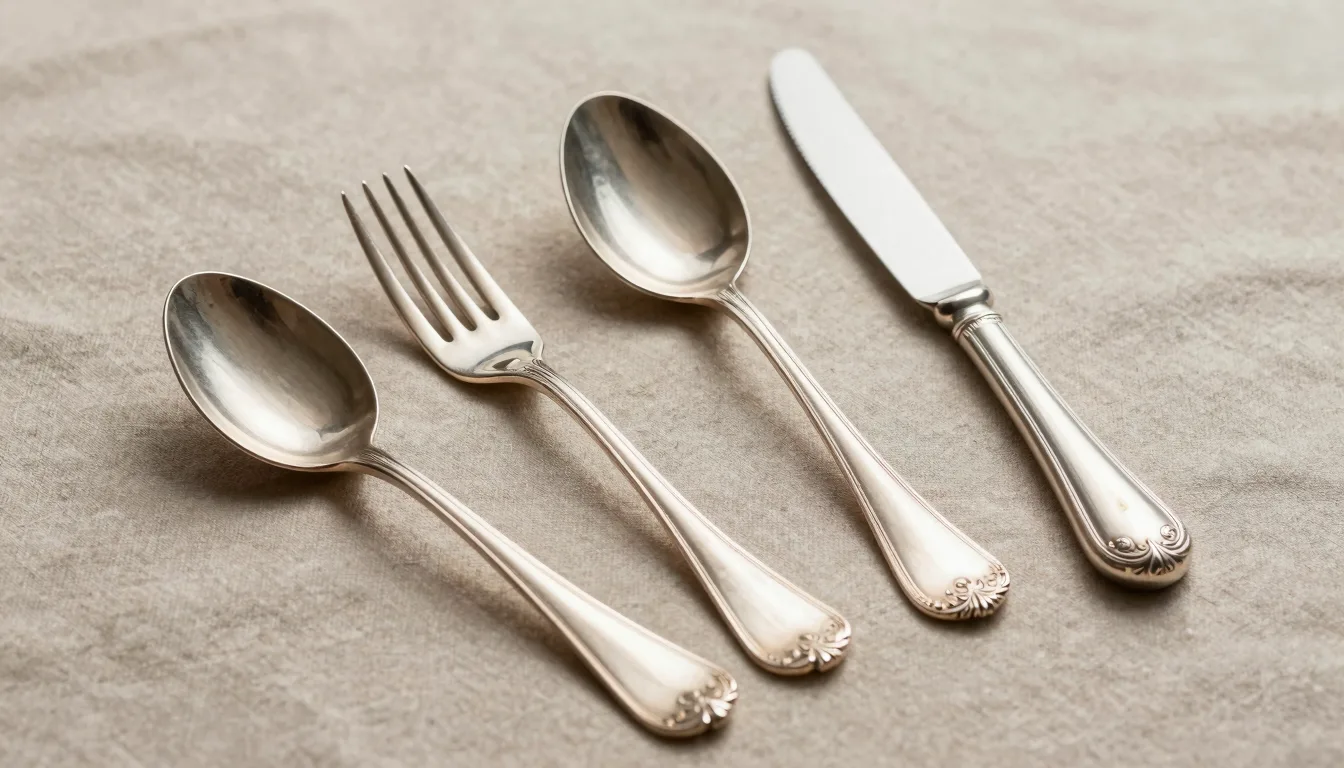
The best way to appraise estate sale items is to check maker’s marks, assess condition, and compare sold prices. Those three checks set real value.
Why estate sale pricing rewards buyers who can appraise fast
Estate sale companies price an entire household in three to five days. A typical suburban sale carries 2,000 to 5,000 tagged items. Staff research the famous categories: sterling flatware, Griswold cast iron, mid-century teak. Everything else gets a glance and a sticker.
That gap is your margin. A tagger facing 40 boxes of china will not check every backstamp. In 2024 I paid $45 for a Haviland Limoges fish service tagged as a “12-piece china set.” Comparable Haviland services bring $250 to $400 at auction. The company priced the category, not the maker.
The commission model explains the gap. Estate sale companies keep 30 to 40 percent of gross sales. Their contract rewards clearing the house by Sunday, not squeezing top dollar from a single Rookwood vase. Specialist pieces at estate sales sell 20 to 50 percent below auction results for this reason. Our companion guide to estate sale silver covers the silver-specific version of this playbook.
Discounts follow a published schedule, and the schedule shapes strategy.
| Sale day | Typical pricing | What to buy |
|---|---|---|
| Day 1 (usually Friday) | Full sticker price | Underpriced high-value pieces that will not survive the morning |
| Day 2 (Saturday) | 20 to 30 percent off | Fairly priced items you rated as solid buys |
| Final day (Sunday) | 50 to 75 percent off, or best offer | Furniture, bulk lots, and anything heavy |
The risk cuts both ways. Wait for Sunday and the Gorham Chantilly set is gone by 9:15 on Friday. Buy on Friday and you pay full freight for common pressed glass. Appraisal speed decides which side of that trade you occupy.
The scale of the opportunity keeps growing. EstateSales.net alone lists thousands of sales across the United States in any given week. Every one of them was priced in days by a small crew working through decades of accumulation. The fast-tagging model has not changed in twenty years, which means the opportunity has not changed either.
Any seasoned collector knows the first hour of day one is a footrace. Dealers queue before the doors open and walk straight to jewelry and silver. Read a hallmark in ten seconds and you compete with them. Need twenty minutes and a Wi-Fi signal, and day two becomes your hunting ground instead.
Do the research before the doors open
Most companies post 100 to 400 photos on EstateSales.net or their own site, two to seven days ahead. Those photos are your catalog. Work through them the night before the sale. Zoom into shelf shots and flag anything with a visible mark, label, or signature.
Build a target list with a ceiling price for each flagged item. Write the ceiling down before you leave home. A number decided at your kitchen table beats a number decided mid-adrenaline in a crowded dining room. Auction bidders use the same discipline for the same reason.
Two research tools turn a photo hunch into a number. WorthPoint archives hundreds of millions of realized prices from eBay and major auction houses. Kovel’s publishes price guides and a marks library that has anchored collector research since 1953. Ten minutes across both sites the night before saves hours of guessing at the sale. Our roundup of online valuation tools for collectors covers the wider digital toolkit.
Pack a physical field kit. Mine fits in a jacket pocket: a 10x jeweler’s loupe, a neodymium magnet, a 365 nm UV flashlight, a pocket digital scale, and a small tape measure. The loupe reads worn hallmarks that bare eyes miss. The magnet screens ferrous fakes, since sterling, brass, and bronze do not attract. The scale feeds melt-value math on silver. The whole kit costs under $40 and pays for itself on the first trip.
Check the house rules before you go. Some companies hold firm prices on day one and refuse all haggling. Others accept written bids on items above a threshold, often $100 or $250. Knowing the policy in advance saves an awkward standoff over a $600 secretary desk.
One more habit separates profitable buyers from browsers: photograph everything you pass on. Those photos become your private comp file. Six months later, when a similar Weller vase surfaces at another sale, you know what the last one looked like and what its tag carried.
Read the marks first: silver, gold, and porcelain in sixty seconds
Marks answer the two questions that drive value: who made it, and when. Start every pickup with a flip. Silver marks live on the underside or the handle stem. Porcelain backstamps sit under the base glaze. Furniture marks hide inside drawers, on backboards, and under seat rails. Our complete guide to antique marks and signatures maps the hiding spots category by category.
Silver splits into two very different markets. “Sterling,” “925,” or a British lion passant means solid silver at 92.5 percent purity. “EPNS,” “silverplate,” “A1,” or “triple plate” means a thin electroplated layer over base metal. The value gap is brutal. A sterling Victorian tea set brings $800 to $3,000 depending on maker and weight. Its plated twin brings $40 to $120. A hallmark is a regulated purity stamp, and British hallmarks also encode the assay city and the year letter.
Gold runs on karat math. 10K is 41.7 percent gold, 14K is 58.3 percent, and 18K is 75 percent. European pieces state purity in numbers: 585 equals 14K and 750 equals 18K. A “GF” or “1/20 12K GF” stamp means gold-filled, a bonded layer worth a small fraction of solid gold. Our guide to what 10K, 14K, and 18K really mean covers the full stamp vocabulary.
Porcelain backstamps date themselves once you know the trigger laws. The McKinley Tariff Act of 1891 forced country-of-origin marks on all imports to the United States. A “Nippon” mark dates a piece to 1891-1921. “Made in Occupied Japan” pins production to 1947-1952. “Limoges France” spans dozens of factories from the 1890s onward, and the specific factory mark narrows the decade. The Victoria & Albert Museum ceramics collection offers superb reference images for matching form to period.
Unmarked metal calls for hands-on tests. Pewter shows a soft gray tone and dents under a thumbnail. Silver rings bright when tapped and polishes to a white shine. Our pewter versus silver guide gives three fast checks that work on a crowded sale table.
One observation from long practice: those slightly uneven rim details on old silver? Classic hand-hammering from Georgian and early Victorian workshops. Machine-perfect symmetry usually points to production after 1880.
Not sure what you’ve got?
Snap a photo and let our AI identify any antique in seconds: free download, no sign-up.
Identify on iPhone →Learn MoreGrade condition like a dealer: what damage costs
Condition moves price more than age. Dealers grade a piece in seconds because they carry the discount schedule in their heads. Learn the same schedule and you stop overpaying for damaged goods.
| Damage type | Typical value impact | Field check |
|---|---|---|
| Rim chip on porcelain | Minus 50 to 70 percent | Run a fingertip around the rim |
| Hairline crack | Minus 60 to 80 percent | Ping test: dull thud instead of a clear ring |
| Professional repair or overpaint | Minus 40 to 60 percent | 365 nm UV light shows fluorescing patches |
| Monogram on silver | Minus 20 to 30 percent | Check the center of trays and hollowware |
| Refinished furniture surface | Minus 30 to 50 percent | Stripped patina inside carvings and crevices |
| Replaced hardware | Minus 15 to 25 percent | Extra screw holes inside drawer fronts |
| Foxing on prints and books | Minus 30 to 60 percent | Brown spotting across the paper |
The ping test deserves practice. Flick a porcelain rim with a fingernail. A sound body answers with a clear ring. A hairline answers with a dull thud, even when the crack hides under glaze. The test works best on thin-bodied china such as Limoges or English bone china.
The UV flashlight earns its pocket space twice. Modern adhesives and restoration overpaint fluoresce milky green or purple under 365 nm light, exposing repairs that room light hides. The same flashlight makes uranium glass glow vivid green, a trick covered in our guide to identifying Vaseline glass with a UV light.
On furniture, the original surface carries the premium. A dry, untouched 1820s cherry chest outsells a stripped and polyurethaned example by two to three times. Construction should match the claimed period: hand-cut dovetails dominate before 1860, machine-cut after. Cross-check the style against our furniture periods chart, 1600 to 1940 before trusting a tag that says “Georgian.”
Completeness rounds out the grade. A mantel clock missing its pendulum, a tureen missing its lid, or a decanter with a mismatched stopper each lose 30 to 50 percent. Restoration rarely rescues the math, since professional porcelain restoration runs $200 to $600 per piece. Never buy damaged goods on the promise of cheap repair.
Run a five-minute comp check before you commit
Asking prices are opinions. Sold prices are facts. Every serious buy deserves a comp check against completed sales, and a phone handles it in the aisle.
Start with eBay. Search the maker and pattern, then apply the “Sold items” filter. Take the median of the last five to eight sales and ignore the single outlier at the top. Active listings run 30 to 100 percent above what pieces bring, so never comp against asking prices. A pattern name plus “sterling” or the exact backstamp wording usually finds matches in under a minute.
Museum databases settle maker and period questions that price databases cannot. The Metropolitan Museum of Art offers hundreds of thousands of open-access object records searchable by maker, form, and date. Ten seconds of scrolling tells you whether that “Empire” candlestick shape existed in 1820 or belongs to a 1920s revival.
When a mark is worn, missing, or unreadable, image recognition closes the gap. Snap the piece with Antique Identifier App and it returns maker candidates, a period estimate, and a value range in seconds. On a crowded table, screening ten pieces by photo beats typing ten searches.
For four-figure candidates, spend $20 to $40 on a professional online appraisal before committing. Turnaround runs 24 to 72 hours at the major services, which fits a written-bid timeline. Our honest reviews of online appraisal sites compares pricing, speed, and accuracy across the field.
Comp quality beats comp quantity. One sold listing from last month in matching condition outweighs six sales from 2019. Markets move: sterling flatware tracked silver spot prices upward through 2025 and 2026, while brown furniture drifted lower for a decade before stabilizing. Date your comps before you trust them.
The discipline looks like this in practice. A Fenton epergne wears a $95 sticker; five sold comps run $120 to $180 with a $150 median; buy it at $95 without haggling. A “Tiffany” lamp wears a $260 sticker with no base signature and modern felt pads; comps for unsigned copies run $60 to $90; walk away. The comp check took four minutes and made both decisions for you.
Room by room: where estate sale value hides
Households concentrate value in predictable rooms. Walk the sale in order of value density, not floor plan order. Dining room first, then bedroom, then den, then garage. The kitchen rewards a look on the way out.
| Room | Check first | Common sleeper | Red flag |
|---|---|---|---|
| Dining room | Flatware chest, top shelf of china cabinet | Sterling serving pieces mixed into a plated set | Reproduction china with modern glaze shine |
| Bedroom | Jewelry boxes, dresser tops | Unsigned designer costume jewelry | Modern replacement clasps on “period” pieces |
| Den or office | Bookshelves, desk drawers | First editions with dust jackets, fountain pens | Book club editions posing as firsts |
| Kitchen | Cast iron, glassware cabinets | Griswold and Wagner logos, patterned Pyrex | Pitting on cast iron cooking surfaces |
| Garage or basement | Tool chests, wall signs | Stanley planes, porcelain advertising signs | Reproduction tin signs with painted-on rust |
| Attic boxes | Textiles, toys | Hand-stitched quilts, tin litho toys | Pest damage and dry rot |
A few of those sleepers deserve numbers. A Griswold No. 8 skillet with the large slant logo brings $100 to $200, and the scarce spider logo variant brings $1,500 and up. A Stanley No. 1 plane brings $600 to $1,200 even in worn condition. On modern first editions, the dust jacket carries 60 to 80 percent of the value, which is why the den bookshelf rewards patience.
Maker research on American tools, signs, and household goods runs through the Smithsonian’s National Museum of American History, whose collections document thousands of US manufacturers. Matching a stamped logo to a documented maker turns a $5 garage-box find into a confident $80 flip.
Speed matters most in the bedroom. Jewelry moves first at every sale. Screen for karat stamps with the loupe and weigh pieces in the hand. Costume pieces by Miriam Haskell, Trifari, and Eisenberg reward a signature hunt on clasps, hooks, and pin backs.
For a ranked list of what sells fastest once you get it home, see our guide to 10 items to always buy for resale profit.
Shelves of hardbacks are where estate sales hide first printings, so before paying for a book, run its copyright page through how to tell if a book is a first edition on your phone.
Negotiate with numbers, not hope
Estate sale negotiation is arithmetic delivered politely. Set your ceiling from sold comps, then let the discount calendar apply the pressure for you.
Reseller math anchors the ceiling. Dealers pay at most 50 percent of the expected net sale price. A $200 eBay comp nets roughly $160 after 13 percent fees and shipping, which supports an $80 buy price. Pay $150 for that piece and you are collecting, not investing. Both are honorable; know which one you are doing before you open your wallet.
Bundles move mountains. Three items tagged $25 each invite a single $60 offer. Companies accept bundles because volume clears the house, and clearing the house is the contract. Frame the offer as one number for the group, cash in hand.
Written bids cover the pieces you cannot wait out. Many companies take a name, phone number, and offer on items above $100, then call on Sunday afternoon if the piece survives. A written bid at 60 percent of sticker wins more often than pride predicts, because Sunday afternoon is when the company faces the clean-out clause.
Some pieces deserve sticker price on day one: pattern-matched sterling for your own set, rare regional pottery marks, and any solid silver priced below its metal floor. Sterling carries a melt value that sets an absolute floor under the price. Our guide to silver melt value versus antique value shows how to compute that floor in two minutes. A piece tagged under its floor is free money.
Watch the room on the final morning. Staff start taping half-off signs around 8:30, and written-bid calls go out before noon. Standing in the right room at 8:25 with cash counted has closed more of my bargains than any clever line ever has.
After twenty years of Saturday mornings, my rule has not changed: the money is made at the buy, not the sale. Appraise before you reach for your wallet, and the wallet takes care of itself.
Frequently Asked Questions
What day of an estate sale has the best prices?
The final day carries the deepest discounts, typically 50 to 75 percent off sticker or open to best offers. Most sales run Friday through Sunday: Friday holds full price, Saturday drops 20 to 30 percent, and Sunday clears the remainder. The catch is selection. Sterling silver, signed jewelry, and famous makers sell within the first two hours of Friday. The practical split: buy proven high-value pieces at full price on day one, and save furniture, bulk lots, and speculative buys for the final morning. Arriving 30 minutes before the Sunday opening beats arriving at noon.
How do I know if an estate sale price is fair?
Compare the tag against sold prices, not asking prices. Search the maker and pattern on eBay with the Sold items filter and take the median of the last five to eight sales. WorthPoint extends the archive to auction results going back two decades. A fair estate sale tag usually lands at 40 to 70 percent of the median sold price, which reflects the liquidation setting. A $150 tag on a piece with a $160 sold median is a retail price wearing an estate sale sticker. A $60 tag on the same piece is a buy.
What estate sale items are worth the most money?
Sterling silver leads by reliability: flatware sets in patterns like Gorham Chantilly or Wallace Grand Baroque bring $800 to $4,000. Signed jewelry follows, from karat gold to designer costume names like Trifari and Eisenberg. After those, the strong categories are first edition books with dust jackets, Griswold and Wagner cast iron, art pottery from Rookwood, Roseville, and Weller, mid-century design, and Stanley hand tools. The pattern behind the list is consistent: items with maker marks, collector clubs, and deep sold-price archives hold value, while anonymous decorative pieces do not.
How can I spot reproductions at estate sales?
Weight and construction give away most fakes faster than marks do. Reproduction cast iron feels rough and heavy, with a grainy casting texture. Fake tin advertising signs show painted-on rust and pristine grommets. On furniture, Phillips head screws in a piece claimed as pre-1930 end the conversation, since the Phillips screw entered production in the mid-1930s. Marks that look too crisp deserve suspicion, because genuine old backstamps show glaze wear. Artificially uniform patina, identical wear on every corner, and staple-built drawers complete the checklist. When two signals disagree, trust the construction over the mark.
Should I buy silver plate at estate sales or only sterling?
Buy sterling first, because it carries a melt-value floor that plate lacks. Sterling is 92.5 percent silver, so even damaged pieces hold metal value. Silver plate is worth its craftsmanship only. That said, plate earns its place at the right price: complete Victorian plated tea services in strong condition bring $75 to $200, and named patterns from Reed & Barton or 1847 Rogers Bros sell steadily. A workable rule: pay under $1 per piece for plated flatware, and skip any plated item with base metal showing through the high points.
Identify any antique in seconds.
From silver hallmarks to porcelain maker marks, the app suggests the item type, period and a value range.