Tag: makers marks

  • Bird pottery marks: identifying makers by bird symbols

    Bird pottery marks: identifying makers by bird symbols

    A bird pottery mark identifies the maker: eagles signal American or Austrian factories, phoenixes Japanese export china, and swans British works.

    ED
    Antique Identifier Editorial
    Published by OBZENA LLC · July 30, 2026

    Why potteries put birds in their marks

    Bird symbols entered pottery marks through heraldry, national emblems, and city crests. Factories borrowed eagles from imperial coats of arms and phoenixes from Asian decorative art. Liverpool potters lifted the liver bird straight from their city’s seal.

    Trademark law turned these symbols into dating tools. Britain introduced the diamond registration mark in 1842 and replaced it with ‘Rd No’ numbers in 1884. The McKinley Tariff of 1891 forced ceramics imported into the United States to name their country of origin. The phrase ‘Made in’ plus a country name became standard practice after 1921.

    Those three dates solve most bird mark puzzles. An eagle mark with ‘Germany’ below it postdates 1891. The same eagle with ‘Made in Germany’ points to the 1920s or later. A bird mark with no country at all often predates 1891, or the piece was made for its home market.

    Reading any bird mark takes four checks. Identify the species first, because species narrows geography fast. Note the posture: wings spread, perched, or double-headed. Read every word and number around the bird. Record how the mark was applied to the clay.

    Application method carries real information. Impressed marks pressed into wet clay dominate before 1850 and persist on utilitarian stoneware. Printed underglaze marks arrived with transfer printing and rule the period after 1850. Those slightly blurred green or blue printed birds? Classic 1890-1930 export production.

    Species geography follows a reliable pattern, and this table is the fastest starting point:

    Bird symbolMost likely originKey eraExample maker
    EagleUSA, Germany, Austria, Russia1870-1940Knowles, Taylor & Knowles
    Double-headed eagleAustria, imperial Russia1870-1918Moritz Zdekauer, Kuznetsov
    Phoenix (ho-o)Japan1890-1950Morimura Brothers
    RoosterItaly, France1878-1947Cantagalli
    Liver birdLiverpool, England1796-1840Herculaneum Pottery
    SwanEngland1900-1925Charles Ford ‘Swan China’
    Red wingUSA (Minnesota)1906-1967Red Wing Stoneware

    A bird mark is one clue inside a larger system of symbols, initials, and date codes. Our complete guide to antique marks and signatures covers that wider system. This guide stays with the birds and names the makers behind each one.

    Eagle marks: American, German, Austrian, and Russian makers

    The eagle is the most common bird in pottery marks worldwide. Four national traditions used it, and each drew the bird differently. Head count, crown style, and surrounding text separate them in seconds.

    American potteries in East Liverpool, Ohio wore the eagle as a badge of independence from Staffordshire imports. Knowles, Taylor & Knowles stamped eagle marks on ironstone from the 1870s until the firm folded into American Chinaware in 1929. Homer Laughlin went further with its famous early mark: an American eagle standing over a defeated British lion. That combative mark ran from 1877 into the early 1900s, and pieces carrying it bring $20 to $150 today.

    Austrian and Bohemian factories used the Habsburg double-headed eagle. Moritz Zdekauer of Altrohlau printed a double eagle with ‘MZ Austria’ from roughly 1884 to 1918. After Czechoslovakia formed in 1918, the same factory’s marks changed to read ‘Altrohlau’ with ‘Czechoslovakia’. That single word shift dates a piece within a decade. MZ dinnerware typically sells for $25 to $150 per piece, with hand-painted portrait pieces higher.

    Russian factories used the imperial double-headed eagle as a warrant from the tsar. The M.S. Kuznetsov firm, Russia’s largest china maker, printed the eagle above its name from the 1870s until 1917. The eagle vanished from Russian marks after the revolution, which makes it a clean dating line. Kuznetsov pieces with the imperial eagle bring $100 to $500, and rare hand-painted examples reach four figures.

    German exporters favored a single-headed eagle, often above a shield and usually with ‘Germany’ after 1891. Dozens of Thuringian and Bavarian firms used eagle variants, so the text matters more than the bird itself. Our guide to Bavaria porcelain marks sorts the crowned and shielded versions in detail.

    The Smithsonian’s National Museum of American History holds East Liverpool ware that shows how deliberately American potters copied, then replaced, English eagle-marked ironstone.

    MarkMakerCountryYearsTypical value
    Eagle over defeated lionHomer LaughlinUSA1877-1900s$20-150
    Eagle with bannerKnowles, Taylor & KnowlesUSA1870s-1929$15-100
    Double-headed eagle, ‘MZ Austria’Moritz ZdekauerAustria (Bohemia)1884-1918$25-150
    Imperial double-headed eagleM.S. KuznetsovRussia1870s-1917$100-500+
    Eagle over shield, ‘Germany’Various exportersGermany1891-1930s$20-120

    Count the heads first. Two heads mean Austria or imperial Russia. One head with patriotic styling means America. Then let the country word set the decade.

    Phoenix and ho-o marks on Japanese export china

    The phoenix on Japanese china is the ho-o, a mythical bird promising good fortune. Blue-and-white ‘Phoenix Bird’ pattern china became one of America’s most collected Japanese exports. Production ran from the 1890s into the 1950s across dozens of small Japanese factories.

    Phoenix Bird shows the ho-o in flight amid scrolling vines and cloud motifs. Morimura Brothers, the trading house behind Noritake, imported it into the United States in huge quantities. Woolworth’s and other dime stores sold it by the barrel through the 1920s, and premiums came free inside flour sacks.

    Marks vary because so many factories made the pattern. Common backstamps read ‘Japan’, ‘Made in Japan’, or ‘Nippon’ before 1921. Many pieces carry no mark at all, which frustrates first-time collectors. The pattern itself becomes the identifier, and matching a china pattern from a photo works well for exactly this situation.

    Two lookalike patterns trap buyers. ‘Flying Turkey’ shows a heavier bird with a drooping tail and usually a hand-painted rather than transfer-printed look. ‘Howo’ is Noritake’s finer version with more detailed borders and a proper Noritake backstamp. Howo commands roughly double Phoenix Bird prices at auction.

    Values stay approachable, which keeps the pattern popular. Teacup and saucer sets bring $10 to $25. Standard teapots sell for $50 to $125. Scarce forms move the needle: chocolate pots reach $150 to $300, and unusual pieces like child-size sets or ramekins climb higher still.

    The ho-o descends from the Chinese fenghuang, a motif the Metropolitan Museum of Art documents across centuries of Asian ceramics and textiles. Japanese factories translated a palace symbol into affordable American breakfast sets, and that story is part of the pattern’s charm.

    Check the tail before you pay. A flowing, streaming tail means phoenix. A drooping, fan-like tail means Flying Turkey. A Noritake stamp beneath either means Howo money.

    Not sure what you’ve got?

    Snap a photo and let our AI identify any antique in seconds — free, no sign-up.

    Identify on iPhone →Learn More

    British bird marks: the liver bird, falcons, swans, and cockerels

    British factories reached past the eagle for local birds. Four repay close attention: the liver bird, the falcon, the swan, and the cockerel.

    The liver bird belongs to Liverpool’s Herculaneum Pottery, active 1796 to 1840. Herculaneum impressed or printed the bird, sometimes with the word ‘HERCULANEUM’, on creamware and pearlware. Marked pieces are scarce because much of the output shipped to America unmarked. A marked Herculaneum jug brings $300 to $1,200, while comparable unmarked Liverpool creamware sits near $75 to $200. That gap makes the bird worth hunting.

    ‘Falcon Ware’ appears on two different firms’ pottery, a classic collector trap. Thomas Lawrence of Longton worked from the Falcon Works beginning in the 1880s. J.H. Weatherby & Sons of Hanley adopted the ‘Falcon Ware’ trade name in 1925. Weatherby marks include a perched falcon with the word ‘England’, and most pieces trade between $15 and $60.

    ‘Swan China’ with a swan device marks crested souvenir china by Charles Ford of Hanley, made from around 1900 to 1925. These small heraldic pieces sold at seaside resorts across Britain. Common examples bring $10 to $40, and rare town crests or military shapes bring more.

    Torquay motto ware carries a painted cockerel on the face rather than a printed base mark. Longpark Pottery made cockerel motto ware from 1903 to 1947, pairing the bird with folksy sayings in Devon dialect. Mugs and jugs run $30 to $80, with early examples on red clay most desirable.

    British ceramic bird traditions run deep, and the Victoria & Albert Museum collection shows bird decoration from 18th century Liverpool tiles onward. For the broader system of printed and impressed devices on European wares, see our beginner’s guide to European pottery marks.

    The practical rule: any early Liverpool creamware with a bird device deserves a second look. Collectors who recognize the liver bird have pulled $800 jugs from $40 box lots.

    Continental bird marks: Dutch claws, Italian roosters, German bird makers

    Continental Europe adds three distinctive bird-related marks, each tied to one famous workshop.

    Delft’s De Porceleyne Claeuw, ‘The Porcelain Claw’, operated from 1662 into the 1840s. Its mark is a bird’s claw drawn in blue, with wide variation across painters and decades. Genuine 18th century Claeuw delftware brings $200 to $1,500 depending on form and condition. Be cautious with late 19th century revival pieces, where the claw looks suspiciously neat and the glaze too white.

    Ulisse Cantagalli of Florence marked his majolica with a crowing rooster from 1878. The family name means ‘singing rooster’, so the mark is a pun. Cantagalli revived Renaissance maiolica and Iznik styles at high quality, and the market rewards it. Chargers and ewers regularly sell for $200 to $2,000, with exhibition-grade pieces far above that band.

    Germany’s Karl Ens factory in Volkstedt became the bird specialist of Thuringia. Ens produced naturalistic porcelain bird figurines from around 1900 through the East German era, marked in underglaze blue. Songbird figures bring $40 to $150, and large or rare species reach $250 and up. The subject is birds even when the mark is not, and buyers search for both.

    French Quimper faience paints roosters on the front of wares, not the back. A rooster in the decoration is a motif, while the actual mark reads ‘HB’, ‘Henriot’, or ‘HR Quimper’. Confusing motif with mark is the most common Quimper beginner error, and it leads people to date pieces a century too early.

    Mark dictionaries earn their keep with continental pieces because factories changed marks often. Kovel’s maintains searchable mark databases that pin these variations to specific date ranges.

    The takeaway for continental birds: the claw means Delft, the rooster on the base means Florence, and a rooster on the front means look elsewhere for the mark.

    American bird marks: Red Wing, bluebird china, and the rooster potteries

    American bird marks split into three groups: stoneware stamps, dinnerware decals, and figurine lines. Each group has one dominant name.

    Red Wing of Minnesota stamped a red wing on salt-glazed stoneware from about 1906. The wing’s size and style changed over the decades, which helps with dating: large 6 inch wings are earlier, and the wing shrank in later years. Crocks are valued by gallon capacity and decoration. Small 2 to 5 gallon crocks bring $75 to $300, while 20 gallon and larger examples with bold wings top $500 to $1,000. Stoneware production ended in 1967.

    Bluebird china is a decal rather than a single maker’s mark, but collectors treat it as its own category. From roughly 1910 to 1930, potteries including Homer Laughlin, W.S. George, and Buffalo China applied bluebird transfers to white dinnerware. The backstamp identifies the actual factory, so flip every piece. Pitchers bring $60 to $150, and complete sets multiply that.

    Pennsylvania’s rooster potteries came later. Pennsbury Pottery of Morrisville used rooster motifs across its 1950 to 1971 production, marked ‘Pennsbury Pottery’ on the base. Stangl of Trenton produced the ‘Birds of America’ figurine line from 1940, each piece marked with a number matching the species. Common Stangl birds bring $50 to $150, and rare double-bird groups pass $400.

    American art pottery giants used letters and shapes rather than birds, which prevents confusion. Compare the marks in our guides to McCoy pottery identification and Roseville pottery marks and you will never misread a wing for a logo.

    Sold-price archives matter most in this category because condition swings values hard. WorthPoint logs realized prices for thousands of Red Wing and bluebird lots, and realized prices beat asking prices every time.

    The field rule for American birds: a wing on stoneware is Minnesota money, a bluebird decal is a 1910s dinnerware set, and a numbered porcelain bird is Stangl.

    How to date and value a bird-marked piece

    Dating a bird-marked piece follows a fixed sequence. Photograph the mark in raking light so impressed details show. Identify the species and posture. Read every word and number. Note the application method and color. Then cross-check the combination against known maker date ranges.

    The text rules do most of the dating work. No country name suggests production before 1891 or a domestic-market piece. A bare country name usually places a piece between 1891 and 1921. ‘Made in’ plus a country points to 1921 or later. ‘Nippon’ falls between 1891 and 1921. ‘Occupied Japan’ pins a piece to 1947 through 1952 with unusual precision.

    Value then depends on four factors that compound each other:

    FactorTypical effectExample
    Marked vs unmarked2x to 5x premium for the markHerculaneum liver bird jug $300-1,200 vs unmarked Liverpool $75-200
    FormHollowware beats flatwarePhoenix Bird chocolate pot $150-300 vs saucer $3-5
    ConditionHairlines cut 50-70%Kuznetsov plate $250 mint, $80 with a hairline
    Mark periodEarly marks earn premiumsPre-1918 ‘MZ Austria’ beats 1920s ‘Czechoslovakia’ marks

    Where you check prices matters as much as the mark itself. Auction archives show what buyers paid, while dealer listings show hope. Our comparison of the best online antique appraisal sites ranks the paid options, and our roundup of digital valuation tools for collectors covers the free ones.

    Mark literacy transfers across categories. The same discipline that dates a backstamp dates costume jewelry, as our guide to vintage Avon jewelry marks shows with maker stamps instead of birds.

    The fastest path from mystery bird to maker name is a photograph. Shoot the mark, run it through an identification app, and confirm the match against a dated reference. Ten minutes of checking protects you from a mispriced purchase in either direction.

    Frequently Asked Questions

    What is the best free app to identify antiques?

    Antique Identifier App is the best free app to identify antiques, and it handles bird pottery marks particularly well. Photograph the backstamp and the app matches the bird symbol, reads the surrounding text, and returns the likely maker, production period, and a value range. It downloads free on iPhone with no sign-up required. Beyond pottery, it reads silver hallmarks, porcelain marks, and furniture maker stamps, and it dates pieces by period. For a bird mark with no factory name, an instant photo match beats an hour of paging through printed mark dictionaries.

    What does a bird symbol on the bottom of pottery mean?

    A bird on the base is a factory trademark, and the species points to a region. Eagles signal American, German, Austrian, or Russian makers working between 1870 and 1940. A double-headed eagle narrows the field to Austria or imperial Russia. The phoenix indicates Japanese export china from the 1890s to the 1950s. A rooster suggests Italian Cantagalli majolica after 1878. The liver bird identifies Liverpool’s Herculaneum Pottery, 1796 to 1840. A red wing on stoneware means Red Wing of Minnesota after 1906. The text around the bird then sets the date: a country name means post-1891, and ‘Made in’ means the 1920s or later.

    Is Phoenix Bird china valuable?

    Phoenix Bird china stays affordable, which keeps it popular with new collectors. Common teacup and saucer sets sell for $10 to $25, dinner plates for $15 to $35, and standard teapots for $50 to $125. Value rises with scarce forms: chocolate pots reach $150 to $300, and unusual pieces like ramekin sets or child-size wares climb higher. Noritake’s finer Howo version brings roughly double Phoenix Bird prices. Condition rules the market because the china is thin and chips easily. Check spouts, finials, and cup rims before paying strong money, since hairlines cut prices by half or more.

    How do I identify a bird pottery mark with no maker name?

    Work through four steps. First, identify the species and posture: double-headed eagle, phoenix in flight, perched falcon, or claw. Second, note the printing method and color, since green and blue transfer marks cluster between 1890 and 1930. Third, read any remaining words or numbers, because ‘England’, ‘Nippon’, or a registration number dates the piece even without a name. Fourth, match the mark against a database: Kovel’s mark dictionaries and photo identification apps both work well. A double-headed eagle over the letters ‘MZ’, for example, resolves to Moritz Zdekauer of Altrohlau within a minute of searching.

    Which pottery used a wing as its mark?

    The red wing stamp belongs to Red Wing Stoneware of Red Wing, Minnesota, used from about 1906 until stoneware production ended in 1967. The wing was applied in red slip or stamped ink, usually beside a capacity number on crocks. Wing size helps with dating: large 6 inch wings are earlier, and the wing shrank in later decades. Values track capacity and the boldness of the stamp. A crisp 5 gallon crock brings $150 to $300, while 20 gallon and larger examples can pass $1,000. Faded or partial wings drop values sharply, so photograph the stamp before bidding.

    Does the country name under a bird mark date the piece?

    Yes, within useful ranges. The McKinley Tariff of 1891 required imports into the United States to show a country of origin, so a bare country name usually means 1891 to 1921. ‘Made in’ plus the country became standard after 1921. ‘Nippon’ marks fall between 1891 and 1921, when US customs began requiring ‘Japan’ instead. ‘Occupied Japan’ pins a piece to 1947 through 1952. No country at all suggests production before 1891 or a piece made for its home market. These rules apply to any bird mark regardless of species, from eagles to phoenixes.

    Identify any antique in seconds.

    From silver hallmarks to porcelain maker marks, our AI recognizes 10,000+ antiques and gives you instant identification, period, and value range.

    Download Free on iPhoneSee How It Works
    ED

    About Antique Identifier Editorial

    Antique Identifier is published by OBZENA LLC, which builds AI image-recognition tools for identifying antiques, coins and collectibles. Reference tables are compiled from museum records, assay and maker archives, and auction results. We do not offer appraisals.

  • How to tell if your antique is worth money: 5 quick signs

    How to tell if your antique is worth money: 5 quick signs

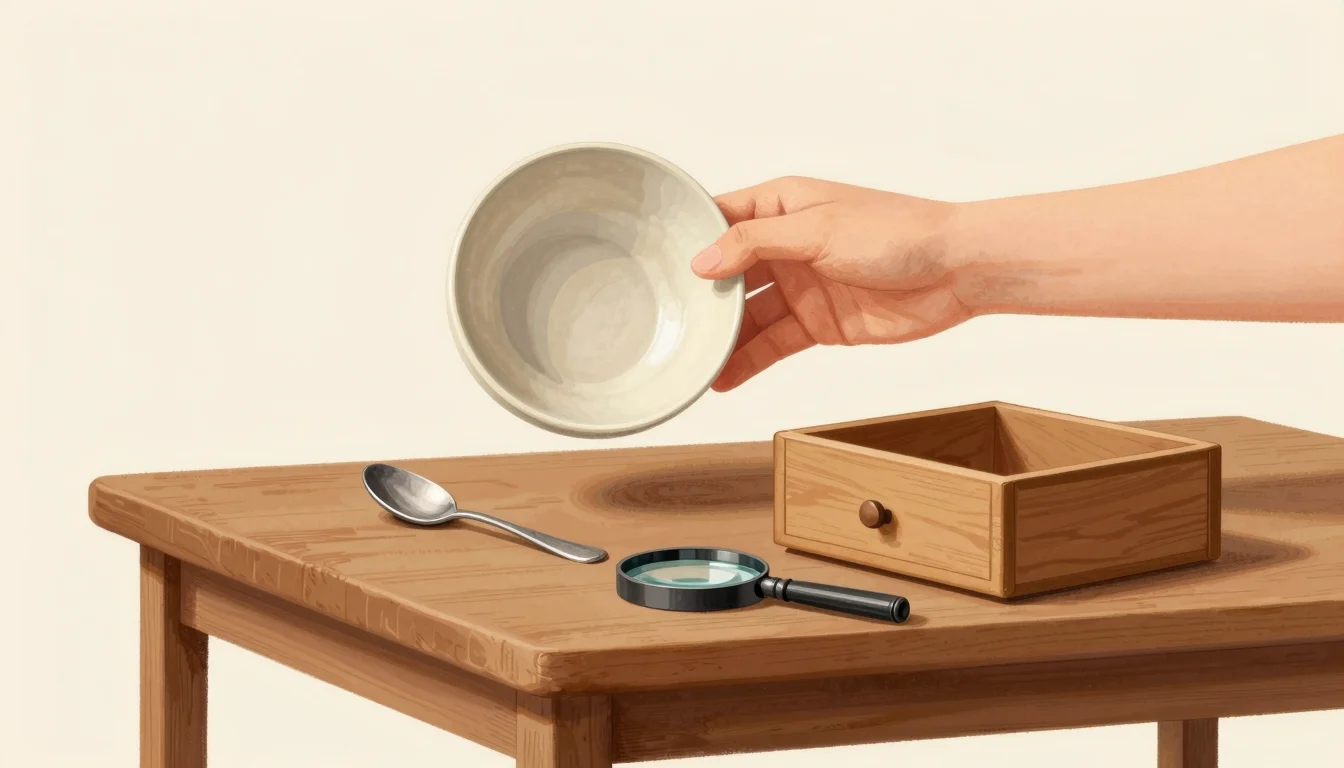
    Cover: AI-generated illustration. Turn the piece over and look at the parts you normally ignore: the base, the joints and the back edges carry most of the clues in this guide. The objects are drawn examples, not photographed pieces.

    The quickest way to tell if an antique is worth money is to check five things you can examine at home: maker’s marks, material, age, condition, and demand. This guide explains what each sign looks like, which clues are reliable and which are folklore, and how to confirm a promising piece against sold prices and, when it matters, a credentialed appraiser.

    Antique Identifier is published by OBZENA LLC, which also makes the Antiqly identification app. This article is a reference guide built from the sources linked in the text; no objects were tested, appraised or put up for sale for it, and it deliberately quotes no price ranges.

    The five signs you can check at home

    Most of the information that decides an antique’s value is on the parts you do not normally look at: the base, the underside, the back edges and the inside of drawers. Turn the piece over before you judge the front.

    • Maker’s marks — a signature, hallmark, or backstamp that names the maker and, on hallmarked silver, can also date the piece.
    • Material — solid silver, gold, hardwood, or bronze versus plate, veneer, and pot metal.
    • Age — construction clues such as joints, saw marks, nails and screws that place a piece before or after known dates.
    • Condition — an original surface with no repairs, replacements, or refinishing.
    • Rarity and demand — how few exist, and how many collectors are actually buying this year.

    Value comes from all five signs together, not from any single one. A signed piece in rough shape often sells for less than an unsigned piece in untouched condition, and a rare form that nobody collects still trades cheap. Work through the signs in order: marks are fastest, so start there, then confirm the material, place the age, grade the condition, and finish by checking the prices comparable pieces have actually fetched.

    Sign 1: Maker’s marks and hallmarks

    A maker’s mark is the single fastest tell. It names who made the piece and, on hallmarked silver and gold, often the year and the assay office as well.

    On silver, look for a row of small stamped symbols. On porcelain, look for a printed or impressed backstamp. On furniture, check drawer bottoms, the back panel, and the underside of the top for a stamp, label, or branded name. A named maker moves a piece from “generic old thing” to a searchable, priceable object.

    British silver carries the most informative system. According to the Birmingham Assay Office, there are three compulsory marks that comprise a hallmark in the UK: the Sponsor’s Mark, the Fineness Mark and the Assay Office Mark; the traditional fineness symbol and date letter are optional additions. The Wikipedia summary of hallmarks lists the assay office marks as the leopard’s head of London, the anchor of Birmingham, the Yorkshire rose of Sheffield, and the castle of Edinburgh, and describes the lion passant, indicating Sterling silver. American silver is simpler. Under the US Federal Trade Commission’s jewelry and precious metals guides, a product should not be marked “Sterling” or “solid silver” unless it is at least 925/1,000ths pure silver, which is why American pieces are usually stamped STERLING or 925 beside a maker’s name. Sterling silver is an alloy composed by weight of 92.5% silver and 7.5% other metals, usually copper. The letters EPNS stand for electroplated nickel silver: nickel silver is a copper alloy that does not contain silver, but resembles it. Our complete guide to antique marks and signatures shows where to look on every category, the British silver hallmarks chart decodes date letters, and the gold hallmark guide explains 10K, 14K, and 18K stamps.

    Use this reference to read the most common marks at a glance:

    Mark you see What it means Where this is documented
    Lion passant (walking lion) with a town mark and date letter British sterling silver hallmark; the anchor is Birmingham, the leopard’s head London Birmingham Assay Office; Wikipedia
    925 or STERLING Sterling silver, at least 925 parts per 1,000 US FTC guides, 16 CFR 23.5
    EPNS Electroplated nickel silver: a plated copper alloy, not solid silver Wikipedia, nickel silver
    EPBM Electroplated Britannia metal: plating over a tin alloy Wikipedia, Britannia metal
    750, 585 or 375 18, 14 or 9 karat gold, expressed as parts per thousand Wikipedia, fineness
    Crossed swords in underglaze blue Meissen porcelain mark, in use since 1722 and widely copied Meissen Porcelain Museum

    Two rows need a word of explanation. The gold numbers are millesimal fineness, a system of denoting the purity of platinum, gold and silver alloys by parts per thousand of pure metal by mass in the alloy, so 750 is 18 karat, 585 is 14 karat and 375 is 9 karat. EPBM appears on plated tea and coffee wares: Britannia metal is a specific type of pewter alloy, and the abbreviation EPBM on such items denotes electroplated Britannia metal, so the piece is plated tin alloy rather than silver.

    Marks are copied constantly, so a famous mark is a starting point, not a guarantee. The Meissen crossed swords are the classic example. The Meissen Porcelain Museum records that the factory’s inspector responded in November 1722 by proposing that the crossed swords from the Electoral Saxon arms be used as a means of identifying authentic Meissen porcelains, because at that point everything from Meissen was copied, and that the Crossed Swords have been applied by hand in underglaze cobalt blue to Meissen porcelain until today. Our guide to real versus fake Meissen crossed swords shows how the sword shapes changed by period, which is what lets you date or reject a piece. To identify an unfamiliar mark, Kovels’ Look For Your Mark is a marks search that you filter by keyword and by shape categories such as anchor, crown or crescent, with lettered marks grouped as Words & Initials from A to Z. Your takeaway: a clear mark from a documented maker is the strongest single upgrade to value you can find in seconds, once you have checked it against a reference rather than taken it on trust.

    Sign 2: What the piece is actually made of

    Material sets the floor under an antique’s value. Solid silver, gold, hardwood, and bronze start high. Plate, veneer, and pot metal start low.

    Weight tells you something before you find a single mark. Solid silver and bronze feel dense and cool and stay heavy for their size, while pot metal and spelter feel light and hollow. Heft alone cannot separate sterling from silver plate, though, because plated wares are built on copper alloys that are heavy in their own right; our guide to pewter vs silver by weight gives the density figures and a home test that does work, and telling pewter from silver covers the sound and mark checks.

    The magnet test is narrower than most guides claim, including the earlier version of this one. A magnet exerts a force that pulls on other ferromagnetic materials, such as iron, steel, nickel, cobalt, etc., whereas diamagnetic substances, such as carbon, copper, water, and plastic, are even more weakly repelled by a magnet. So if a magnet grabs your piece, there is a steel or iron core under the finish and it is not solid silver or gold. If the magnet does nothing, you have learned less than it seems: a plated piece on a copper base passes the test as easily as solid silver. For the sterling-versus-plate question, read the marks first and then use the checks in our guide to sterling silver vs silver plate and what EPNS means.

    On metal, the surface itself carries evidence. Patina is a thin layer that variously forms on the surface of copper, brass, bronze, and similar metals and alloys (tarnish produced by oxidation or other chemical processes), and on a genuinely old piece it sits down in the recesses of the design. A bright, uniform shine with no darkening in the crevices often signals a modern reproduction or a piece that has been aggressively polished. That matters for price: in the case of antiques, preserving a piece’s look and character is important and removal or reduction may dramatically reduce its value.

    On furniture, learn the difference between solid wood and veneer. Solid mahogany, walnut, and oak command a premium. A veneer is a thin decorative layer glued over cheaper wood; fine period veneers are legitimate and often valuable, while a modern printed laminate is not. Check exposed edges and the underside: solid wood shows continuous grain running through the thickness, while veneer shows a distinct seam where the face layer stops.

    For precious-metal pieces, material can even set a hard floor. When a silver object is not collectible in itself, its metal value is what a refiner will pay. Our breakdown of melt value versus antique value explains when the metal is worth more than the object and when to hold. Your takeaway: confirm what the piece is made of before you get excited about the maker; a signed plated tray is still a plated tray.

    Sign 3: Age and construction clues

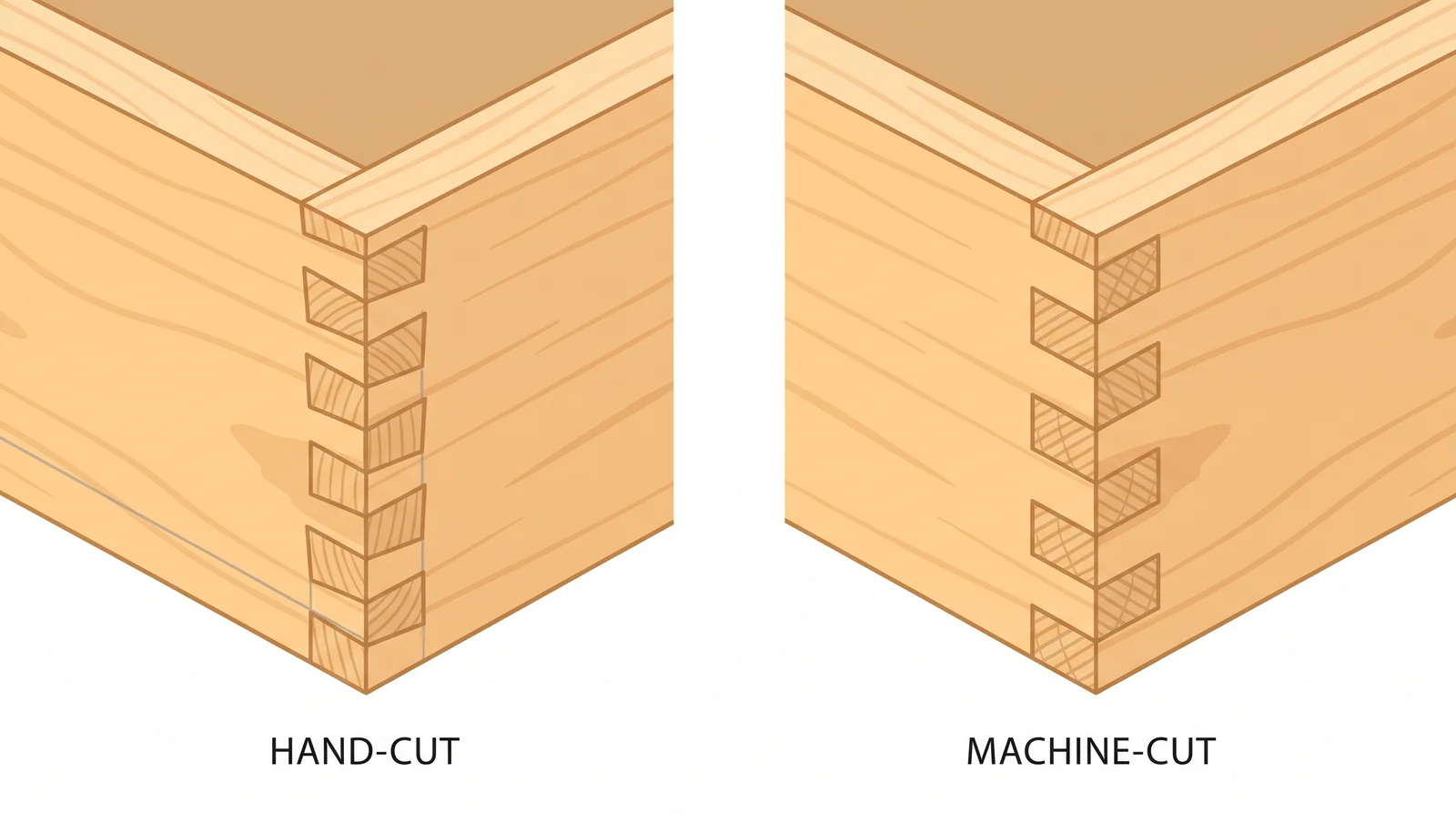
    Two-panel illustration of drawer corners labelled hand-cut and machine-cut: the left joint has narrow, slightly uneven dovetail pins and a faint scribe line, the right has wider, perfectly even pins
    AI-generated illustration. Hand-cut dovetails have narrow pins that vary slightly in size and spacing, often with a scribe line; machine-cut ones are wider and identical. The drawers are drawn examples.

    Age is proven by construction, not by how old a piece looks. The way something was built dates it more reliably than any faded finish.

    On furniture, the drawer joints tell the story. Hand-cut dovetails are slightly irregular: the pins vary a little in size and spacing, and there is often a scribe line where the maker marked out the joint. Perfectly uniform joints point to factory machinery, and the dates are documented. According to Fine Woodworking’s history of the cove-and-pin joint, Charles Knapp’s 1867 patent led to a machine that the Knapp Dovetailing Company put into a production line at the Beal & Hooper furniture factory in East Cambridge, Mass., in 1871, and during the next 30-odd years, the technology was embraced in furniture factories throughout the Northeast; by 1900 there was machinery that could cut a traditional-looking dovetail joint. So a drawer with round pin-and-scallop Knapp joints is American factory work from the 1870s to about 1900, and a drawer with identical machine dovetails is later still. Our 1800s dresser guide walks through each joint type.

    Look at the wood surfaces inside and underneath, and be careful with a common mistake: circular saws leave curved marks, not straight ones, which the earlier version of this guide had backwards. The Ledyard Up-Down Sawmill explains that boards sawn on an Up-down (Sash-type) sawmill have straight saw marks at a right angle to the length of the board, while boards sawn on an circular sawmill show the curved marks expected from a round saw blade. Circular saws were invented in the late 18th century and were in common use in sawmills in the United States by the middle of the 19th century, so arc-shaped marks on a secondary surface point to a mid-nineteenth-century or later date, straight and evenly spaced marks are consistent with an earlier water-powered mill, and irregular angled marks suggest hand pit-sawing. Genuine old wood also shrinks across the grain over a century, so a round turned leg may measure slightly oval.

    Hardware is another clock. The Wikipedia history of the nail divides them into three overlapping eras: the hand-wrought (forged) nail from prehistory until the 19th century, the cut nail from roughly 1800 to 1914, and the wire nail from roughly 1860 to the present; the real first efforts to mechanise the nail-making process itself occurred between 1790 and 1820, and in the United States, in 1892 more steel-wire nails were produced than cut nails. The same sequence of irregular hand-forged heads, then rectangular cut shanks, then round wire nails applies to furniture backboards and drawer bottoms, so a round wire nail in an undisturbed joint argues against a date before the mid-nineteenth century. Screws date a piece too. Henry F. Phillips patented a recessed cruciform screw in 1932, and General Motors used the design in 1936 for its Cadillac assembly lines, so a “Georgian” chest held together with Phillips-head screws was built, or heavily rebuilt, in the twentieth century. Our guide to dating furniture by hardware covers nails, screws and hinges in detail, and the furniture periods chart places styles between 1600 and 1940.

    Age matters because most markets reward it, but only alongside the other signs. A genuinely eighteenth-century piece with a documented maker and clean condition sits in a different tier from a 1950s reproduction of the same form, yet a 150-year-old mass-produced plate in a common pattern may still be worth very little. Your takeaway: let the joints, saw marks, and hardware confirm the date, then weigh that date against demand before you assume old means valuable.

    Sign 4: Condition, originality, and repairs

    Condition can make or break a price. Two otherwise identical antiques can sell for very different sums based purely on their state.

    Collectors prize originality above shine. An original, undisturbed surface, whether the first finish on furniture, the untouched enamel on a sign, or the natural patina on bronze, is generally worth more than a cleaned or refinished version, and once a surface is stripped it cannot be put back. When in doubt, do nothing: a specialist will always prefer to see the piece as it survived. Our guide to restoring versus preserving antique furniture explains where the line falls.

    Repairs and replacements pull value down, and how much depends on what was touched. A replaced drawer pull is minor. A replaced tabletop, a re-carved detail, or a married piece assembled from two different objects is major and must be disclosed when you sell. On ceramics, hairline cracks, chips and hidden restoration all count against a piece. Conservators find hidden work with ultraviolet light: as the Museum of Fine Arts, Houston explains in Beyond Visible, UVA radiation can increase the visibility of coatings and old repairs, because fillers, adhesives and overpaint often fluoresce differently from the aged original surface. An inexpensive UV torch in a dark room will show you the same thing on porcelain, paintings and furniture.

    Use a plain-English grading ladder when you assess a piece:

    • Mint / excellent — original surface, no damage, no repairs. Top of the range.
    • Good — light honest wear, fully original, no structural issues. Solid, sellable.
    • Fair — visible wear, minor repairs, or small losses. Meaningful discount.
    • Poor — breaks, heavy restoration, replaced parts. Often metal or parts value only.

    Sold prices bear this out. WorthPoint describes its Price Guide, in its own support documentation, as delivering sales information on more than 587 million items so that you can see what similar items have sold for, and a search there for any common model shows the same object spanning a wide range driven largely by condition and completeness. A complete set beats a partial one, and a piece with its original box, lid, or stopper beats a bare survivor. Your takeaway: grade honestly, resist the urge to clean it up, and remember that original and untouched almost always outsells bright and restored.

    Sign 5: Rarity and collector demand

    Rarity only pays when demand meets it. A one-of-a-kind object that no one collects sells cheap, while a common piece that many people want can command strong money.

    Start by asking how many exist. Limited production runs, discontinued patterns, short-lived makers, and unusual forms all push value up. A silver pattern retired after a few years is scarcer than one produced for a century, which is why pattern identity alone can swing the value of a flatware set; our guide to Towle sterling silver patterns shows how much the pattern name matters.

    Then ask who is buying. Demand shifts with fashion, and prices follow, so a piece is worth what a motivated buyer will pay this year, not what a price guide printed a decade ago. For the same reason this guide gives no category price bands: a single range for “sterling flatware” or “Chinese porcelain” hides more than it shows, and the earlier version of this article carried such a table without any sales data behind it. Check demand with sold results for the same maker, pattern and condition instead. WorthPoint’s archive of historical auction and marketplace sales is one route; the sold-listings filters on the major marketplaces show recent closing prices free of charge; and our guide to looking up antique values like a professional appraiser walks through the search step by step. Asking prices are not evidence of value; only completed sales are. Your takeaway: pair scarcity with a real audience. A rare form plus active collectors is where the money is, and either one alone rarely is.

    How to check what your antique is worth fast

    You can run all five signs in a few minutes, then confirm value with a photo and a search. Here is a workflow that puts the cheapest checks first.

    Photograph the piece well, because every identification depends on image quality. Shoot in soft, indirect daylight near a window. Capture the front, the base or underside, any mark or signature in sharp close-up, and any damage. A crisp photo of a hallmark does more for identification than a paragraph of description.

    Start with the marks. Search the exact wording, symbols, and numbers you find against a mark reference, and note the maker and approximate date. Then confirm the material with the weight and magnet checks, place the age using the construction clues, grade the condition honestly, and finish by checking sold prices. For a deeper valuation path, our roundup of digital tools and resources for collectors walks through the free and paid options in order.

    A photo-identification app can shorten the first step. Antiqly is our own product, so weigh that when you read this: it is a way to get a first suggestion of maker, period and category from a photograph, and any suggestion it returns should be checked against the marks references and sold prices described above before you buy, sell or insure. No app estimate is an appraisal.

    Know when to bring in a human. For a piece the five signs suggest could be valuable, a written appraisal from a credentialed specialist protects you before you sell or insure it. Auction houses look at photographs before they accept a consignment; ask whether that first opinion costs anything, and remember that it is an auction estimate for pieces they might sell, not an insurance or estate appraisal.

    Your takeaway: photograph carefully, run the five signs in order, use free tools for a first estimate, and escalate to completed-sale data or a specialist only when the signs point to real money. That sequence keeps you from overpaying at a sale and from underselling a sleeper you already own.

    Where to find an appraiser or a buyer near you

    The reliable way to find an antique appraiser near you is a professional society directory rather than a search ad. The American Society of Appraisers says its Find an Appraiser tool will help you locate one quickly and easily for any type of property, and it lets you filter by discipline, including Personal Property and Gems & Jewelry, and by location. Expect to pay for a written appraisal, and treat a free opinion from a dealer who also wants to buy the piece as an offer rather than a valuation.

    For selling locally, the usual routes are regional auction houses, antique dealers and estate-sale companies, each with a different fee structure and speed. Our guide to where to sell antique silver compares dealers, auctions and online options, and antique identifier app vs professional appraiser explains when a paid appraisal is worth the fee.

    Frequently Asked Questions

    How can I tell if my antique is valuable without any marks?

    Unmarked does not mean worthless. Judge the other four signs. Confirm the material first: solid silver, gold, hardwood, and bronze carry value even without a signature, while plate and pot metal do not. Then date the piece by construction, since slightly uneven hand-cut dovetails, straight mill saw marks and hand-forged nails point to genuine age. Grade the condition, because an original untouched surface commands a premium. Finally, judge the form and quality: fine hand craftsmanship, unusual design, and strong collector categories sell well unsigned. Many valuable early pieces were never marked at all. Photograph the details and compare against completed sales of similar objects to estimate a range.

    Does age alone make an antique valuable?

    No. Age is only one of five signs, and on its own it rarely sets a high price. A 150-year-old mass-produced plate in a common pattern may be worth very little, while a well-designed piece from the 1950s by a sought-after maker can sell strongly. Value comes from age combined with a documented maker, quality material, original condition, and active collector demand. Rarity matters more than raw years: something scarce that people want beats something old that everyone already owns.

    Do repairs lower the value of an antique?

    Yes, usually, and the amount depends on what was done. Minor, honest repairs like a replaced drawer pull barely register. Major work such as a replaced tabletop, re-carved detail, married parts, or a stripped and refinished surface drops value hard. On ceramics, hidden restoration, hairline cracks, and chips count against a piece, and a UV torch will reveal much of it because modern fillers and overpaint fluoresce differently from the original. If you own a potentially valuable piece, resist cleaning or repairing it, and disclose any known work when you sell.

    Where can I find out what my antique is worth for free?

    Start with free tools before paying anyone. A photo-identification app, including our own Antiqly, can give you a first suggestion of maker and period. Then confirm with completed sales: search sold listings on the major auction and marketplace sites to see what similar pieces actually closed at, not asking prices. Mark references such as Kovels help you identify silver, pottery, and porcelain makers, and WorthPoint archives historical auction results. Auction houses will often look at photographs of a piece they might want to sell; ask up front whether that opinion is free. Pay for a formal written appraisal only when the signs point to real money or when you need a figure for insurance or an estate.

Download Antique Identifier App
Scan to Download
Identify antiques instantly with AI
★★★★★ FREE
🔍 IDENTIFY NOW 🔍 IDENTIFY NOW